Global Paid Time Off Index 2026
Preview for press, not yet published. Embargoed until Tuesday 13 October 2026, 06:00 UTC.
How many paid days off the law makes an employer give, per country, ranked across 150 of them. One number per country: statutory paid annual leave plus the public holidays the law pays on top, and what that takes out of the working year you pay for.
Hire in Georgia and the law takes 42 of the 260 working days you pay for, 16.2% of the year, before you offer a single extra day. Hire in the United States and it takes 0, 0%, because federal law sets no paid annual leave at all.
The median ranked country takes 29 days, about 5.8 working weeks and 11.2% of the working year. These are statutory minimums, so they are the floor a package has to clear, not the package. Most employers offer more, and in several countries a collective agreement makes that the norm.

Robbin Schuchmann
Co-founder, Employ Borderless
“Most American employers I talk to assume they are somewhere in the middle on time off, and then they hire their first person in Europe and find the floor is 29 days rather than zero. The gap is not a perk question, it is a budgeting and a compliance question, and it is set by the country the contract is written in.”
A year of days off
Every dot is one day of the year, 365 of them. The coloured dots are the paid days off an employer must give: annual leave in teal, public holidays in amber. The grid says how many days, not which days, because public holidays fall on fixed dates and annual leave is taken when the employee chooses.
Key findings
24 days of statutory paid annual leave plus 18 public holidays, about 8.4 working weeks and 16.2% of the 260-day working year. That leaves 218 working days per employee before an employer adds a single day of its own.
Federal law sets no minimum paid annual leave, so the whole US figure of 0 days is public holidays and an employer hiring there writes the vacation policy itself. Every other ranked country puts a floor under it. An employer used to that discretion and hiring into the median ranked country picks up an obligation of 29 days, 11.2% of the working year, on day one. The US ranks 150th of 150.
Two hires doing the same job at either end of this ranking differ by 42 statutory paid days a year, set by nothing except which country the contract is written in. On a 60,000 salary, taken as an example, that difference is 9,692 of paid time off per employee per year.
United States put no minimum paid holiday in law, so there the employer's own policy is the whole answer and a competitive offer has to be built rather than topped up. A statutory zero is a value, not a gap, so it stays in the ranking rather than being quietly removed from it.
In 112 of 150 ranked countries the annual-leave entitlement is larger than the public-holiday count; in 34 the holidays dominate, and in 4 the two are equal. The distinction is operational: public holidays close the whole team on fixed dates, which you can schedule around, while annual leave is taken when the employee chooses and has to be covered.
Its 43 ranked countries average 31.6 statutory paid days off a year, against 24.9 days across 34 countries in Americas. Averages hide wide spreads, so the country figure is the one to budget from, not the regional one.
What the statutory floor costs you per hire
Pick two countries and a salary. The days figures are the two published totals; the share of the working year is those days over 260 working days; the salary cost is the salary you type times that share, per employee and across the team size you set. It is arithmetic on statutory minimums, nothing more, and most offers add days above the minimum.
The law in Georgia makes an employer give 42 more paid days off a year than the law in United States. On a 60,000 salary that is 9,692 of paid time off per employee, and 48,460 across 5 hires.
The 60,000 salary is an example, not a figure we hold for either country. Type your own to see the cost for a real role.
| Per employee, per year | Georgia | United States |
|---|---|---|
| Statutory paid days off | 42 | 0 |
| Share of the 260-day working year | 16.2% | 0% |
| Salary cost of those days (60,000 salary) | 9,692 | 0 |
| Same across 5 hires | 48,460 | 0 |
| Working days available per employee | 218 | 260 |
| Rank of 150 | 1 | 150 |
| Statutory paid days off | 24 + 18 | 0 + 11 |
Arithmetic on statutory minimums only. The salary cost is the salary above times the days off divided by 260 working days, so it is the share of a budgeted salary that buys paid time off rather than worked days, not a cost on top of salary. Most offers add days above the statutory minimum, and a collective agreement makes that the norm in several of these countries, so a real contract will sit above these figures rather than on them. Social contributions, leave accrual rules and payout on exit are not in this arithmetic.
How this differs from other paid-leave studies
Two studies already cover nearby ground and are worth reading alongside this one. Remote publishes a Global Life-Work Balance Index that blends around ten metrics across 60 countries into a single score. Resume.io has published a paid-vacation study covering roughly 185 countries. Both are useful and both answer a broader question than this index does.
This index is narrower on purpose, and the difference is worth stating plainly.
- Statutory entitlements only. Two inputs, both taken from law: paid annual leave and national public holidays. No happiness measures, no healthcare, no cost of living, nothing subjective.
- No weights. The two inputs are both counted in days off per year, so they add. A weighted blend would be an editorial judgment about which kind of day off matters more, and this index does not make one.
- Every value sourced and dated. Each figure carries its source and its as-of date in the table and in the dataset, so any number here can be traced back to where it came from.
- The dataset is downloadable. CSV and JSON under CC BY 4.0, with a permanent archived record and a changelog, so anyone can check the arithmetic or reproduce the ranking.
- Gaps are published, not filled. A country with only one of the two inputs is listed separately and left unranked rather than estimated into the table.
The honest cost of that narrowness: this index says nothing about how much time off people actually take, or about whether the statutory floor is the norm in a given labour market. It measures the floor, and only the floor.
By region
Mean total paid days off per ranked country, grouped by continent. Averages hide wide spreads, so the highest and lowest single value in each region is shown alongside.
| Region | Countries ranked | Average days | Highest | Lowest |
|---|---|---|---|---|
| Europe | 43 | 31.6 | 40 | 20 |
| Africa | 33 | 31.0 | 40 | 17 |
| Asia | 28 | 27.6 | 42 | 16 |
| Oceania | 12 | 26.3 | 37 | 19 |
| Americas | 34 | 24.9 | 38 | 0 |
Five bands, not one long list
A rank tells you the order. It does not tell you whether the gap between two countries changes a decision. These five bands cut the same total-days metric at fixed points, each one roughly a week of difference. Every ranked country sits in exactly one, and every count below is counted from the data.
Georgia, Iceland, Somalia
Cambodia, Zambia, Austria, Malta, Peru, Yemen, Azerbaijan, Bahrain, and 32 more
Armenia, Colombia, Czechia, Italy, Latvia, Moldova, Namibia, Serbia, and 35 more
Barbados, Eswatini, Gibraltar, Guyana, Malawi, South Africa, Timor-Leste, Argentina, and 39 more
Bermuda, Finland, Isle of Man, Netherlands, Canada, Costa Rica, Malaysia, Mexico, and 9 more
If you are the one being hired
The same two numbers read differently from the other chair. What the law obliges an employer to give is what you are entitled to take, so the country your contract is written in sets your floor. Pick the two countries and the difference is plain subtraction of the published totals, in days, in working weeks, and over a 40 year career.
Moving from United States to Georgia gives you 42 paid days a year.
That is 8.4 working weeks at 5 days a week. Over a 40 year career it adds up to 1,680 working days, about 6.5 working years at 260 days a year.
Statutory minimums only. Employers and collective agreements routinely offer more, and this arithmetic assumes a 5 day working week and 260 working days a year.
Full ranking
All 150 ranked countries, ordered by the total paid days off an employer must give. Annual leave and public holidays are the sourced statutory inputs; the share of the working year is that total over 260 working days; the percentile columns show where each component sits within this edition, and the composite is the percentile of the total. Tied totals share a rank and the next rank is skipped, so a rank of 30 means 29 countries give more days off. The list is complete, not truncated. Every row has a permalink: link to any country as #<iso2>, for example #de.
| Rank | Country | Total days | Share of working year | Annual leave | Public holidays | Composite | Leave pct | Holidays pct |
|---|---|---|---|---|---|---|---|---|
| 1 | Georgia | 42 | 16.2% | 24 | 18 | 100 | 90 | 97 |
| 2 | Icelandnote | 40 | 15.4% | 24 | 16 | 99 | 90 | 88 |
| 2 | Somalia | 40 | 15.4% | 30 | 10 | 99 | 100 | 11 |
| 4 | Cambodia | 39 | 15% | 18 | 21 | 97 | 45 | 99 |
| 4 | Zambia | 39 | 15% | 24 | 15 | 97 | 90 | 82 |
| 6 | Austria | 38 | 14.6% | 25 | 13 | 95 | 93 | 56 |
| 6 | Malta | 38 | 14.6% | 24 | 14 | 95 | 90 | 68 |
| 6 | Peru | 38 | 14.6% | 22 | 16 | 95 | 75 | 88 |
| 6 | Yemen | 38 | 14.6% | 22 | 16 | 95 | 75 | 88 |
| 10 | Azerbaijan | 37 | 14.2% | 15 | 22 | 91 | 28 | 100 |
| 10 | Bahrain | 37 | 14.2% | 22 | 15 | 91 | 75 | 82 |
| 10 | Luxembourg | 37 | 14.2% | 26 | 11 | 91 | 99 | 22 |
| 10 | Monaco | 37 | 14.2% | 25 | 12 | 91 | 93 | 39 |
| 10 | New Caledonianote | 37 | 14.2% | 25 | 12 | 91 | 93 | 39 |
| 10 | Romania | 37 | 14.2% | 20 | 17 | 91 | 48 | 95 |
| 16 | Albania | 36 | 13.8% | 22 | 14 | 85 | 75 | 68 |
| 16 | Algeria | 36 | 13.8% | 22 | 14 | 85 | 75 | 68 |
| 16 | Andorra | 36 | 13.8% | 22 | 14 | 85 | 75 | 68 |
| 16 | Egypt | 36 | 13.8% | 15 | 21 | 85 | 28 | 99 |
| 16 | Libya | 36 | 13.8% | 22 | 14 | 85 | 75 | 68 |
| 16 | Liechtenstein | 36 | 13.8% | 20 | 16 | 85 | 48 | 88 |
| 16 | Lithuania | 36 | 13.8% | 20 | 16 | 85 | 48 | 88 |
| 16 | Zimbabwe | 36 | 13.8% | 22 | 14 | 85 | 75 | 68 |
| 24 | Comoros | 35 | 13.5% | 22 | 13 | 79 | 75 | 56 |
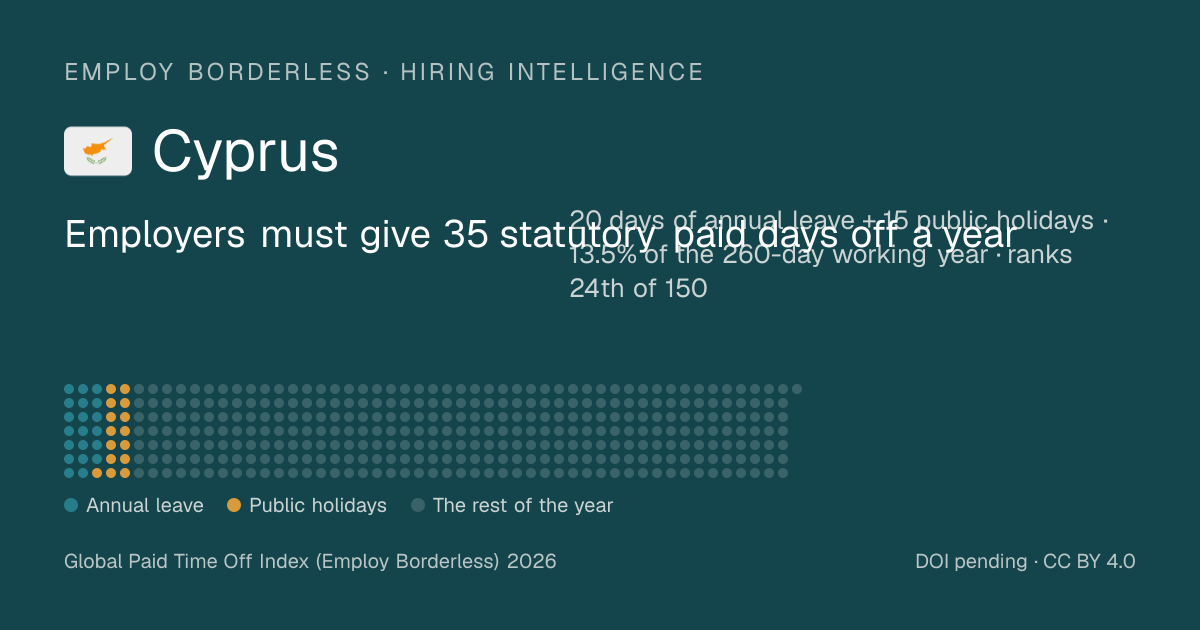
| 24 | Cyprusnote | 35 | 13.5% | 20 | 15 | 79 | 48 | 82 |
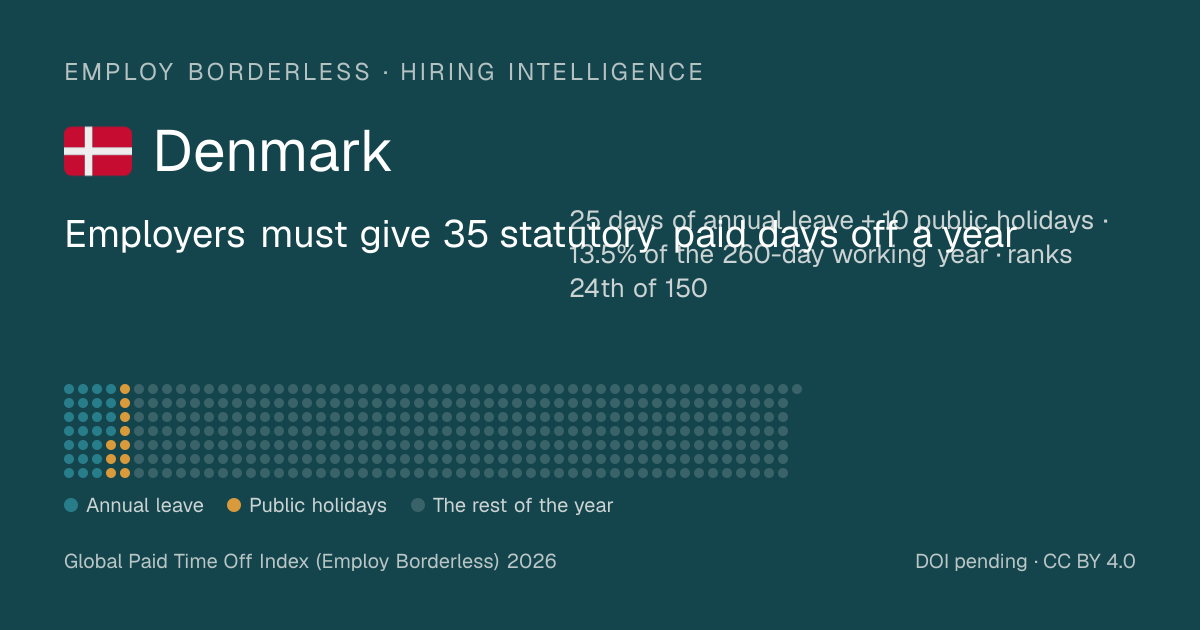
| 24 | Denmarknote | 35 | 13.5% | 25 | 10 | 79 | 93 | 11 |
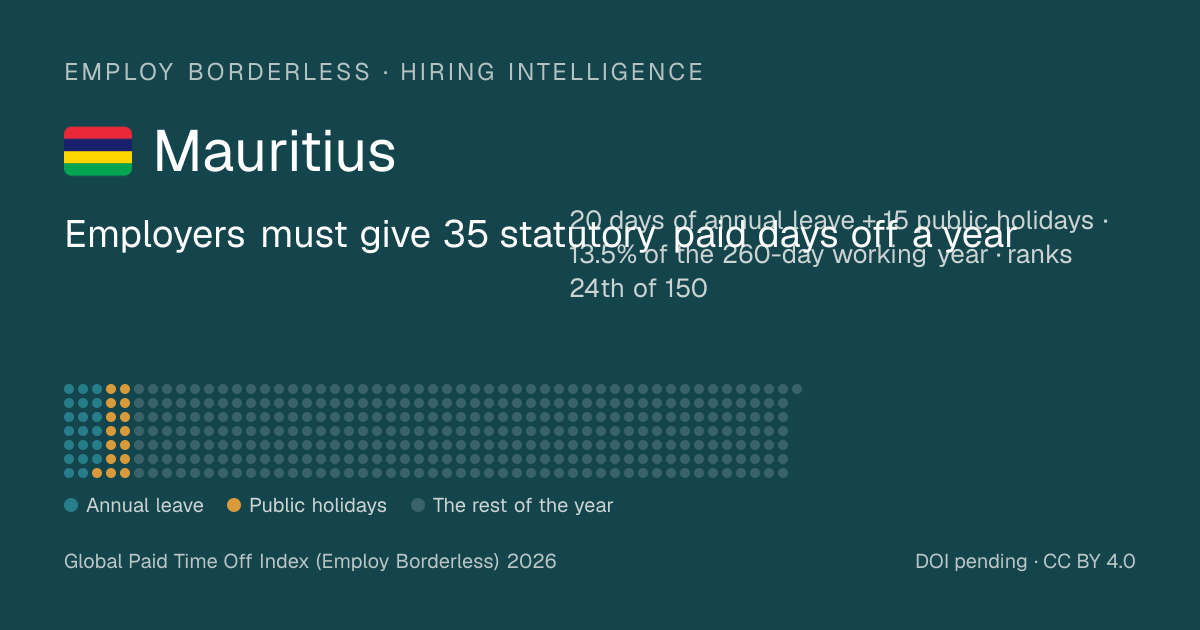
| 24 | Mauritius | 35 | 13.5% | 20 | 15 | 79 | 48 | 82 |
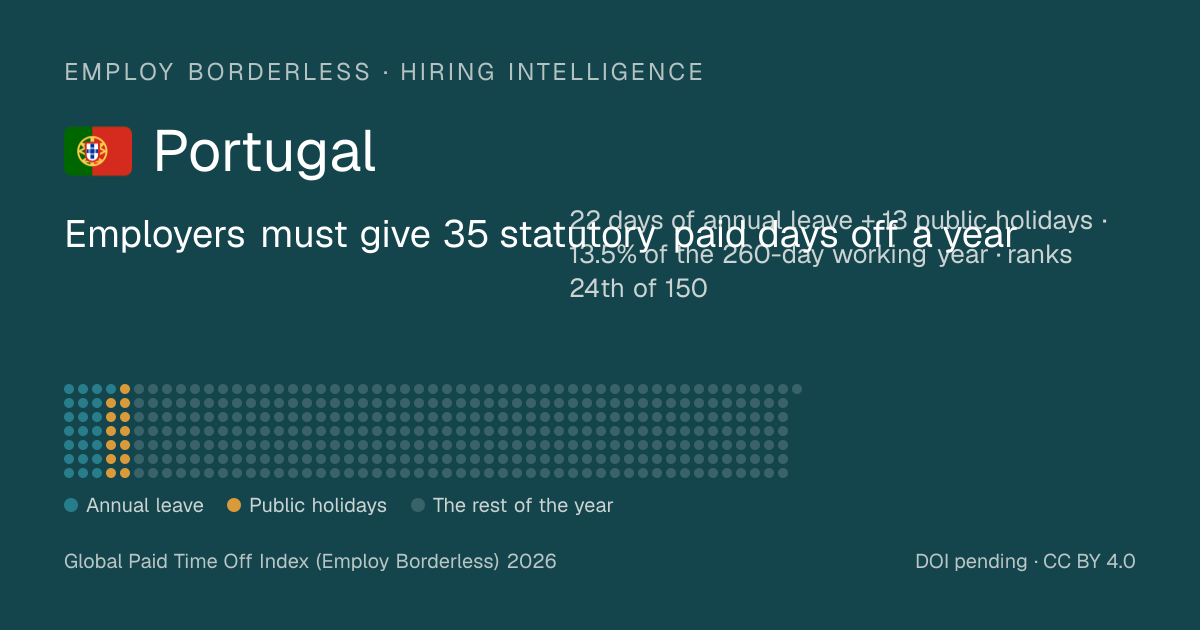
| 24 | Portugal | 35 | 13.5% | 22 | 13 | 79 | 75 | 56 |
| 24 | Seychelles | 35 | 13.5% | 21 | 14 | 79 | 71 | 68 |
| 24 | Slovenia | 35 | 13.5% | 20 | 15 | 79 | 48 | 82 |
| 24 | Tanzania | 35 | 13.5% | 20 | 15 | 79 | 48 | 82 |
| 24 | United Arab Emirates | 35 | 13.5% | 22 | 13 | 79 | 75 | 56 |
| 33 | Angola | 34 | 13.1% | 22 | 12 | 72 | 75 | 39 |
| 33 | Benin | 34 | 13.1% | 20 | 14 | 72 | 48 | 68 |
| 33 | Bulgaria | 34 | 13.1% | 20 | 14 | 72 | 48 | 68 |
| 33 | Croatia | 34 | 13.1% | 20 | 14 | 72 | 48 | 68 |
| 33 | Madagascar | 34 | 13.1% | 22 | 12 | 72 | 75 | 39 |
| 33 | Mali | 34 | 13.1% | 22 | 12 | 72 | 75 | 39 |
| 33 | Panama | 34 | 13.1% | 22 | 12 | 72 | 75 | 39 |
| 33 | Poland | 34 | 13.1% | 20 | 14 | 72 | 48 | 68 |
| 33 | Russia | 34 | 13.1% | 20 | 14 | 72 | 48 | 68 |
| 33 | Spainnote | 34 | 13.1% | 22 | 12 | 72 | 75 | 39 |
| 33 | Uganda | 34 | 13.1% | 21 | 13 | 72 | 71 | 56 |
| 44 | Armenia | 33 | 12.7% | 20 | 13 | 66 | 48 | 56 |
| 44 | Colombia | 33 | 12.7% | 15 | 18 | 66 | 28 | 97 |
| 44 | Czechia | 33 | 12.7% | 20 | 13 | 66 | 48 | 56 |
| 44 | Italy | 33 | 12.7% | 20 | 13 | 66 | 48 | 56 |
| 44 | Latvia | 33 | 12.7% | 20 | 13 | 66 | 48 | 56 |
| 44 | Moldova | 33 | 12.7% | 20 | 13 | 66 | 48 | 56 |
| 44 | Namibia | 33 | 12.7% | 20 | 13 | 66 | 48 | 56 |
| 44 | Serbia | 33 | 12.7% | 20 | 13 | 66 | 48 | 56 |
| 52 | Brazilnote | 32 | 12.3% | 22 | 10 | 61 | 75 | 11 |
| 52 | Christmas Island | 32 | 12.3% | 20 | 12 | 61 | 48 | 39 |
| 52 | Estonia | 32 | 12.3% | 20 | 12 | 61 | 48 | 39 |
| 52 | Kazakhstan | 32 | 12.3% | 18 | 14 | 61 | 45 | 68 |
| 52 | Kenya | 32 | 12.3% | 21 | 11 | 61 | 71 | 22 |
| 52 | Lebanon | 32 | 12.3% | 15 | 17 | 61 | 28 | 95 |
| 52 | Maldives | 32 | 12.3% | 22 | 10 | 61 | 75 | 11 |
| 52 | Turkmenistan | 32 | 12.3% | 22 | 10 | 61 | 75 | 11 |
| 60 | Republic of the Congo | 31.7 | 12.2% | 21.7 | 10 | 60 | 74 | 11 |
| 61 | Australianote | 31 | 11.9% | 20 | 11 | 54 | 48 | 22 |
| 61 | Cape Verde | 31 | 11.9% | 22 | 9 | 54 | 75 | 3 |
| 61 | Chile | 31 | 11.9% | 15 | 16 | 54 | 28 | 88 |
| 61 | Cuba | 31 | 11.9% | 22 | 9 | 54 | 75 | 3 |
| 61 | Hungary | 31 | 11.9% | 20 | 11 | 54 | 48 | 22 |
| 61 | Mongolia | 31 | 11.9% | 15 | 16 | 54 | 28 | 88 |
| 61 | Mozambique | 31 | 11.9% | 22 | 9 | 54 | 75 | 3 |
| 61 | New Zealand | 31 | 11.9% | 20 | 11 | 54 | 48 | 22 |
| 61 | Slovakia | 31 | 11.9% | 20 | 11 | 54 | 48 | 22 |
| 70 | Belgium | 30 | 11.5% | 20 | 10 | 52 | 48 | 11 |
| 70 | Ireland | 30 | 11.5% | 20 | 10 | 52 | 48 | 11 |
| 70 | Montenegro | 30 | 11.5% | 20 | 10 | 52 | 48 | 11 |
| 70 | Rwanda | 30 | 11.5% | 18 | 12 | 52 | 45 | 39 |
| 74 | Anguilla | 29 | 11.2% | 15 | 14 | 46 | 28 | 68 |
| 74 | Germany | 29 | 11.2% | 20 | 9 | 46 | 48 | 3 |
| 74 | Ghana | 29 | 11.2% | 15 | 14 | 46 | 28 | 68 |
| 74 | Greecenote | 29 | 11.2% | 20 | 9 | 46 | 48 | 3 |
| 74 | India | 29 | 11.2% | 12 | 17 | 46 | 18 | 95 |
| 74 | Indonesia | 29 | 11.2% | 12 | 17 | 46 | 18 | 95 |
| 74 | Switzerlandnote | 29 | 11.2% | 20 | 9 | 46 | 48 | 3 |
| 74 | Vanuatu | 29 | 11.2% | 15 | 14 | 46 | 28 | 68 |
| 74 | Venezuela | 29 | 11.2% | 15 | 14 | 46 | 28 | 68 |
| 83 | Belarus | 28 | 10.8% | 18 | 10 | 43 | 45 | 11 |
| 83 | Botswana | 28 | 10.8% | 15 | 13 | 43 | 28 | 56 |
| 83 | Ethiopia | 28 | 10.8% | 16 | 12 | 43 | 44 | 39 |
| 83 | United Kingdomnote | 28 | 10.8% | 28 | 8 | 43 | 99 | 1 |
| 87 | Barbadosnote | 27 | 10.4% | 15 | 12 | 38 | 28 | 39 |
| 87 | Eswatini | 27 | 10.4% | 14 | 13 | 38 | 26 | 56 |
| 87 | Gibraltar | 27 | 10.4% | 15 | 12 | 38 | 28 | 39 |
| 87 | Guyana | 27 | 10.4% | 12 | 15 | 38 | 18 | 82 |
| 87 | Malawi | 27 | 10.4% | 15 | 12 | 38 | 28 | 39 |
| 87 | South Africa | 27 | 10.4% | 15 | 12 | 38 | 28 | 39 |
| 87 | Timor-Leste | 27 | 10.4% | 12 | 15 | 38 | 18 | 82 |
| 94 | Argentina | 26 | 10% | 10 | 16 | 31 | 7 | 88 |
| 94 | Aruba | 26 | 10% | 15 | 11 | 31 | 28 | 22 |
| 94 | Bolivia | 26 | 10% | 15 | 11 | 31 | 28 | 22 |
| 94 | Dominican Republic | 26 | 10% | 14 | 12 | 31 | 26 | 39 |
| 94 | France | 26 | 10% | 25 | 11 | 31 | 93 | 22 |
| 94 | French Guiana | 26 | 10% | 25 | 12 | 31 | 93 | 39 |
| 94 | French Polynesia | 26 | 10% | 25 | 14 | 31 | 93 | 68 |
| 94 | Guatemala | 26 | 10% | 15 | 11 | 31 | 28 | 22 |
| 94 | Japannote | 26 | 10% | 10 | 16 | 31 | 7 | 88 |
| 94 | Martinique | 26 | 10% | 25 | 12 | 31 | 93 | 39 |
| 94 | Saint Kitts and Nevis | 26 | 10% | 14 | 12 | 31 | 26 | 39 |
| 105 | Cameroon | 25 | 9.6% | 15 | 10 | 28 | 28 | 11 |
| 105 | Paraguay | 25 | 9.6% | 12 | 13 | 28 | 18 | 56 |
| 105 | Qatar | 25 | 9.6% | 15 | 10 | 28 | 28 | 11 |
| 105 | Sweden | 25 | 9.6% | 25 | 13 | 28 | 93 | 56 |
| 105 | Uruguaynote | 25 | 9.6% | 20 | 5 | 28 | 48 | 0 |
| 110 | Belize | 24 | 9.2% | 10 | 14 | 23 | 7 | 68 |
| 110 | Grenada | 24 | 9.2% | 10 | 14 | 23 | 7 | 68 |
| 110 | Ivory Coast | 24 | 9.2% | 22 | 14 | 23 | 75 | 68 |
| 110 | Jersey | 24 | 9.2% | 15 | 9 | 23 | 28 | 3 |
| 110 | Saudi Arabia | 24 | 9.2% | 15 | 9 | 23 | 28 | 3 |
| 110 | Solomon Islands | 24 | 9.2% | 15 | 9 | 23 | 28 | 3 |
| 110 | Vietnam | 24 | 9.2% | 12 | 12 | 23 | 18 | 39 |
| 117 | Antigua and Barbuda | 23 | 8.8% | 12 | 11 | 20 | 18 | 22 |
| 117 | Lesotho | 23 | 8.8% | 12 | 11 | 20 | 18 | 22 |
| 117 | Mauritania | 23 | 8.8% | 15 | 8 | 20 | 28 | 1 |
| 117 | Norway | 23 | 8.8% | 21 | 12 | 20 | 71 | 39 |
| 117 | Tuvalu | 23 | 8.8% | 12 | 11 | 20 | 18 | 22 |
| 122 | Cayman Islands | 22 | 8.5% | 10 | 12 | 15 | 7 | 39 |
| 122 | Dominica | 22 | 8.5% | 10 | 12 | 15 | 7 | 39 |
| 122 | DR Congo | 22 | 8.5% | 12 | 10 | 15 | 18 | 11 |
| 122 | Ecuador | 22 | 8.5% | 11 | 11 | 15 | 17 | 22 |
| 122 | El Salvador | 22 | 8.5% | 11 | 11 | 15 | 17 | 22 |
| 122 | Hong Kong | 22 | 8.5% | 7 | 15 | 15 | 5 | 82 |
| 128 | Uzbekistan | 21.5 | 8.3% | 12.5 | 9 | 15 | 26 | 3 |
| 129 | Bahamas | 21 | 8.1% | 10 | 11 | 11 | 7 | 22 |
| 129 | Cook Islands | 21 | 8.1% | 10 | 11 | 11 | 7 | 22 |
| 129 | Fiji | 21 | 8.1% | 10 | 11 | 11 | 7 | 22 |
| 129 | Honduras | 21 | 8.1% | 10 | 11 | 11 | 7 | 22 |
| 129 | Samoa | 21 | 8.1% | 10 | 11 | 11 | 7 | 22 |
| 134 | Bermuda | 20 | 7.7% | 10 | 10 | 9 | 7 | 11 |
| 134 | Finland | 20 | 7.7% | 20 | 11 | 9 | 48 | 22 |
| 134 | Isle of Man | 20 | 7.7% | 20 | 10 | 9 | 48 | 11 |
| 134 | Netherlands | 20 | 7.7% | 20 | 11 | 9 | 48 | 22 |
| 138 | Canadanote | 19 | 7.3% | 10 | 9 | 4 | 7 | 3 |
| 138 | Costa Rica | 19 | 7.3% | 10 | 12 | 4 | 7 | 39 |
| 138 | Malaysia | 19 | 7.3% | 8 | 11 | 4 | 6 | 22 |
| 138 | Mexico | 19 | 7.3% | 12 | 7 | 4 | 18 | 1 |
| 138 | Papua New Guinea | 19 | 7.3% | 10 | 9 | 4 | 7 | 3 |
| 138 | Taiwan | 19 | 7.3% | 3 | 16 | 4 | 1 | 88 |
| 138 | Thailand | 19 | 7.3% | 6 | 13 | 4 | 3 | 56 |
| 145 | China | 18 | 6.9% | 5 | 13 | 3 | 1 | 56 |
| 145 | Singapore | 18 | 6.9% | 7 | 11 | 3 | 5 | 22 |
| 147 | Nigeria | 17 | 6.5% | 6 | 11 | 1 | 3 | 22 |
| 147 | Philippines | 17 | 6.5% | 5 | 12 | 1 | 1 | 39 |
| 149 | Macau | 16 | 6.2% | 6 | 10 | 1 | 3 | 11 |
| 150 | United States | 0 | 0% | 0 | 11 | 0 | 0 | 22 |
Each of these totals is correct under the index definition and still looks wrong at first reading, because the statute behind it counts days differently from the column it sits in. We state the convention rather than convert the value, so the published figure always matches the sourced one.
5 of these countries set public holidays regionally. Where public holidays are set regionally rather than nationally, the index counts the nationwide holidays plus the calendar of the most populous region, and names that region on the row.
- Iceland · 40 days
- Under review. The 40 days count Iceland’s 16 public holidays as paid days off on top of 24 days of annual leave. The Holiday Allowance Act keeps public holidays out of the leave count, and the Directorate of Labour describes them as days off with a premium when worked, but we have not found a statute that requires them to be paid. If they are not statutory paid days off, Iceland’s total is its 24 days of annual leave.
- New Caledonia · 37 days
- Under review. New Caledonia has its own labour code, separate from the French one, and we have not yet confirmed from it whether its public holidays are statutory paid days off.
- Cyprus · 35 days
- Under review. Cyprus’s Annual Paid Leave Law keeps public holidays out of the leave count, but we have not found a statute that requires private employers to pay for them. If they are not statutory paid days off, Cyprus’s total is its 20 days of annual leave.
- Denmark · 35 days
- Under review. The 35 days count Denmark’s 10 public holidays as paid days off. Danish holiday pay appears to come from collective agreements and contracts rather than statute, but we have not yet confirmed that from a government source. If they are not statutory paid days off, Denmark’s total is its 25 days of annual leave.
- Spain · 34 days
- Public holidays here are set regionally, so this figure is the Andalusia calendar for 2026, the region holding most of the workforce, counted alongside the nationwide days. Nationally the count runs 12 to 14 across the 17 autonomous communities. Annual leave is the national statutory minimum.
- Brazil · 32 days
- The statute sets 30 dias corridos, which are calendar days. Every figure in this column is counted in working days, so the fact store records the conversion (30 calendar days less the two weekend days in each completed week) and the index publishes 22. The Portuguese text of the article, the conversion arithmetic and the reduced tiers that apply after unexcused absences all travel with the row in the dataset.
- Australia · 31 days
- Public holidays here are set regionally, so this figure is the New South Wales calendar for 2026, the region holding most of the workforce, counted alongside the nationwide days. Nationally the count runs 9 to 13 across the eight states and territories. Annual leave is the national statutory minimum.
- Greece · 29 days
- Under review. The 29 days count Greece’s 9 public holidays as paid days off on top of 20 days of annual leave. Greek law makes some holidays, such as 25 March and 1 May, compulsory days off, but we have not yet confirmed from a government source which holidays an employer must pay for when they are not worked. If only some are statutory paid days off, Greece’s total is lower than shown.
- Switzerland · 29 days
- Counted for a monthly-salaried employee, the standard case in Switzerland, who keeps their salary on public holidays (SECO). Hourly-paid employees have a statutory right to pay only for 1 August; other holidays are paid for them only if a contract or collective agreement says so. Public holidays here are set regionally, so this figure is the Zurich calendar for 2026, the region holding most of the workforce, counted alongside the nationwide days. Nationally the count runs 7 to 13 across the 26 cantons. Annual leave is the national statutory minimum.
- United Kingdom · 28 days
- Public holidays here are set regionally, so this figure is the England and Wales calendar for 2026, the region holding most of the workforce, counted alongside the nationwide days. Nationally the count runs 8 in England and Wales, 10 in Scotland and 10 in Northern Ireland. Annual leave is the national statutory minimum.
- Barbados · 27 days
- Under review. Barbados’s Holidays with Pay Act extends annual leave when a public holiday falls inside it, but we have not found a statute that requires pay for an unworked public holiday. If they are not statutory paid days off, Barbados’s total is its 15 days of annual leave.
- Japan · 26 days
- Under review. The 26 days count Japan’s 16 national holidays as paid days off on top of 10 days of annual leave. The Labour Standards Act requires at least one day off a week (Article 35) and does not name the national holidays as required days off or require them to be paid. We have not found a government text that settles it either way, so this figure may change. If the holidays are not statutory paid days off, Japan’s total is its 10 days of annual leave.
- Uruguay · 25 days
- The 20 days shown are working days, not calendar days, and that is the statute’s own doing: Ley 12.590 art.1 sets 20 days and excludes feriados from the count, so no conversion applies. The public-holiday figure of 5 is the number of feriados the law requires to be paid; Uruguay observes more, but the rest are unpaid and so are not part of a paid-time-off total.
- Canada · 19 days
- Public holidays here are set regionally, so this figure is the Ontario calendar for 2026, the region holding most of the workforce, counted alongside the nationwide days. Annual leave is the national statutory minimum.
The line for your country
A ready-to-quote sentence for every one of the 150 ranked countries, plus its share card. Each line is generated from that country’s row, so it always agrees with the table above. The same sentence is in the CSV as the press_line column. Free to reuse with attribution.
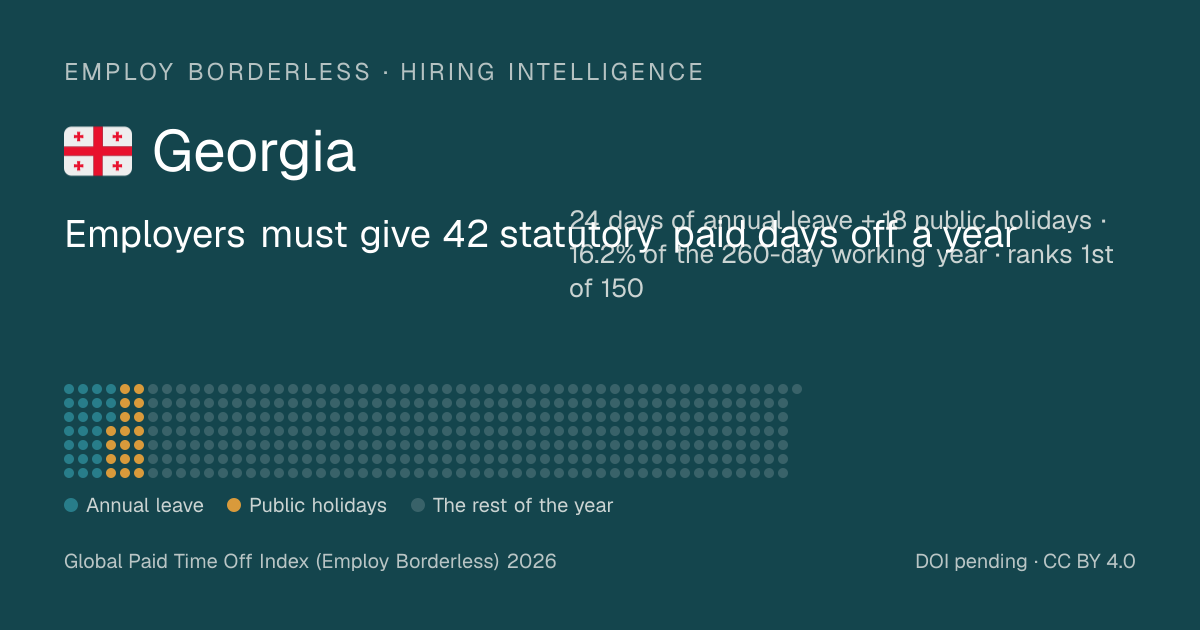
Georgia · rank 1 · 42 days
Employers in Georgia must give 42 statutory paid days off a year, 24 days of annual leave plus 18 public holidays, which is 16.2% of the 260-day working year and ranks the country 1st of 150 for statutory paid time off.
An employer hiring in Georgia must give 42 statutory paid days off a year, 24 days of annual leave plus 18 public holidays, about 8.4 working weeks and 16.2% of a 260-day working year, which leaves 218 working days per employee. It ranks 1st of 150 countries in the Global Paid Time Off Index 2026. That is 13 days above the median of the ranked set. These are statutory minimums, and most offers add days above the minimum.
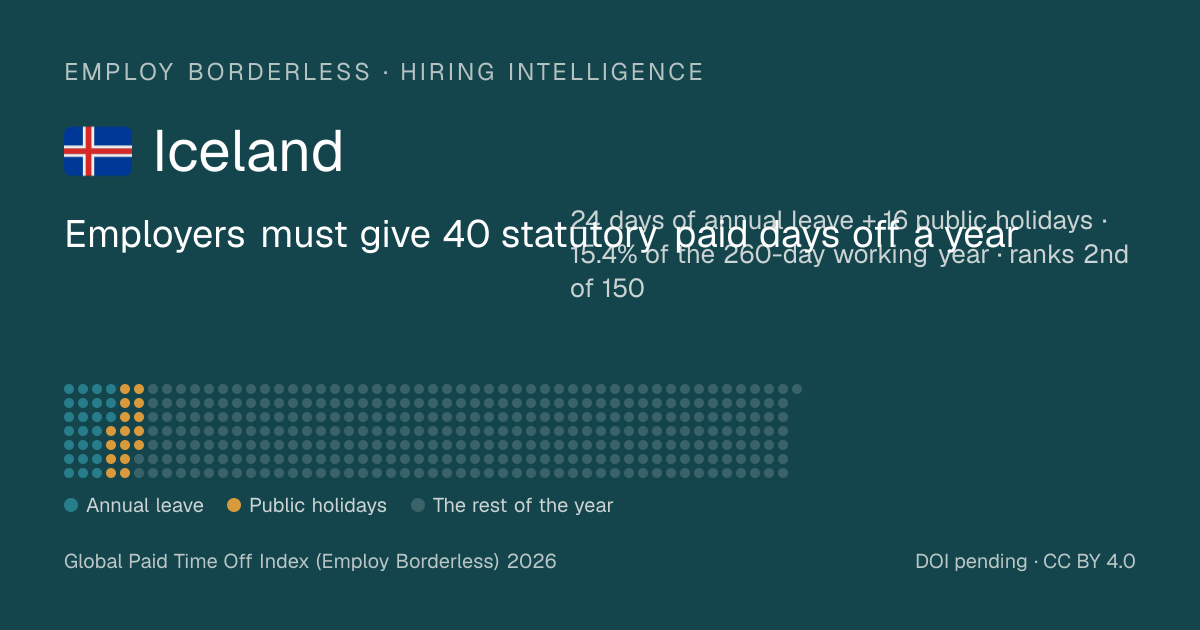
Iceland · rank 2 · 40 days
Employers in Iceland must give 40 statutory paid days off a year, 24 days of annual leave plus 16 public holidays, which is 15.4% of the 260-day working year and ranks the country 2nd of 150 for statutory paid time off.
An employer hiring in Iceland must give 40 statutory paid days off a year, 24 days of annual leave plus 16 public holidays, about 8 working weeks and 15.4% of a 260-day working year, which leaves 220 working days per employee. It ranks 2nd of 150 countries in the Global Paid Time Off Index 2026. That is 11 days above the median of the ranked set. These are statutory minimums, and most offers add days above the minimum.
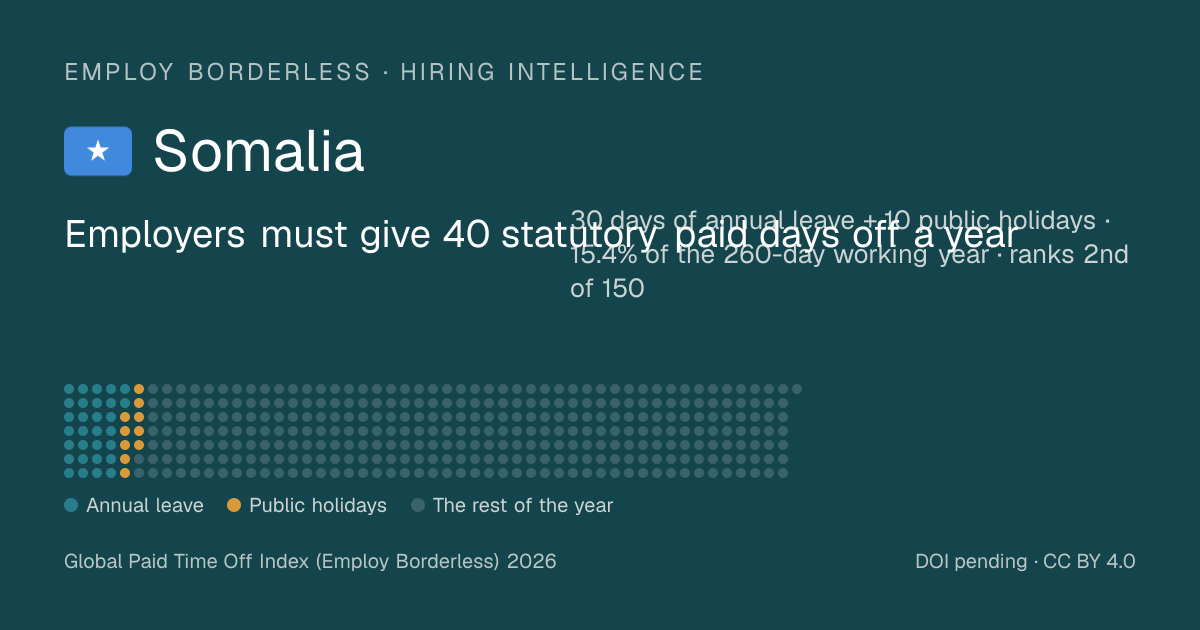
Somalia · rank 2 · 40 days
Employers in Somalia must give 40 statutory paid days off a year, 30 days of annual leave plus 10 public holidays, which is 15.4% of the 260-day working year and ranks the country 2nd of 150 for statutory paid time off.
An employer hiring in Somalia must give 40 statutory paid days off a year, 30 days of annual leave plus 10 public holidays, about 8 working weeks and 15.4% of a 260-day working year, which leaves 220 working days per employee. It ranks 2nd of 150 countries in the Global Paid Time Off Index 2026. That is 11 days above the median of the ranked set. These are statutory minimums, and most offers add days above the minimum.
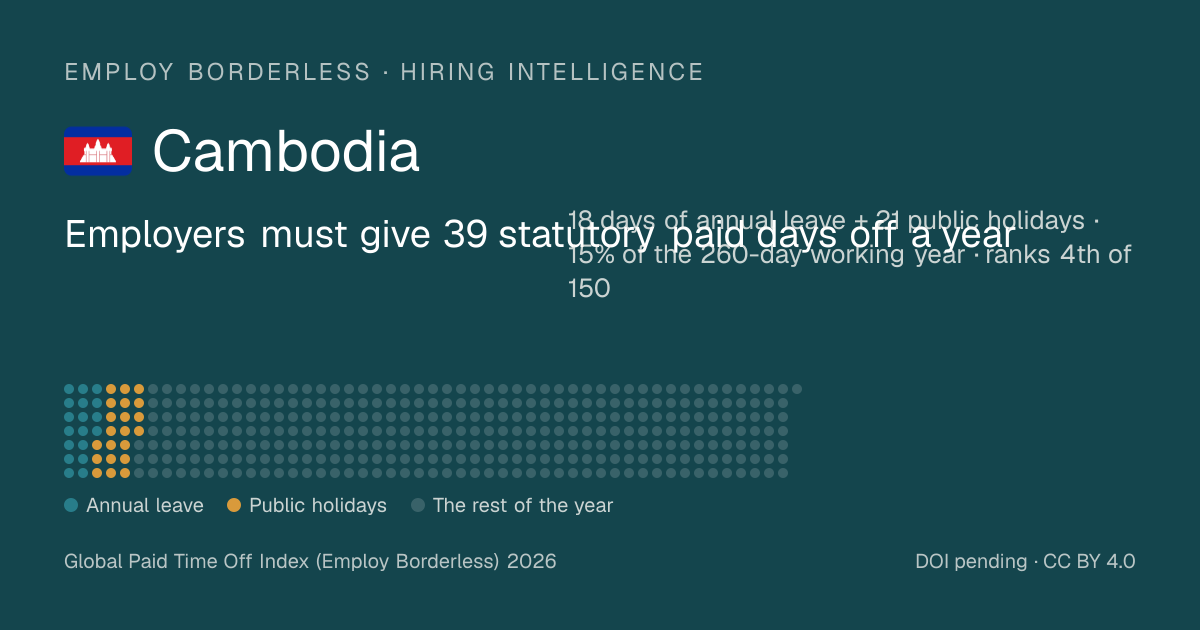
Cambodia · rank 4 · 39 days
Employers in Cambodia must give 39 statutory paid days off a year, 18 days of annual leave plus 21 public holidays, which is 15% of the 260-day working year and ranks the country 4th of 150 for statutory paid time off.
An employer hiring in Cambodia must give 39 statutory paid days off a year, 18 days of annual leave plus 21 public holidays, about 7.8 working weeks and 15% of a 260-day working year, which leaves 221 working days per employee. It ranks 4th of 150 countries in the Global Paid Time Off Index 2026. That is 10 days above the median of the ranked set. These are statutory minimums, and most offers add days above the minimum.
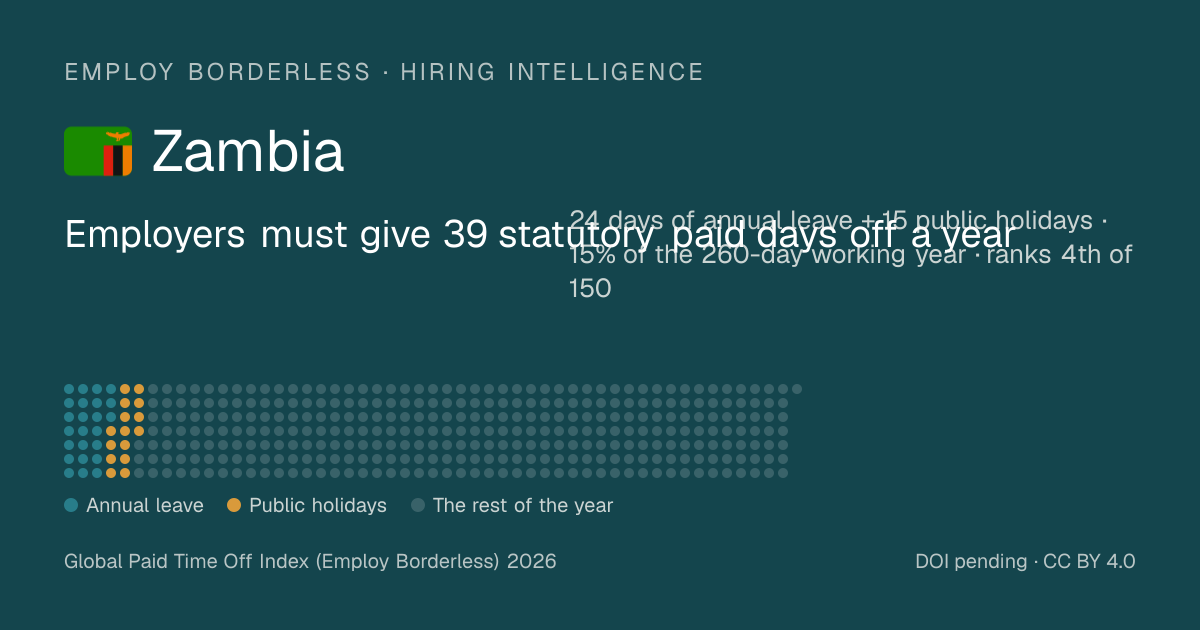
Zambia · rank 4 · 39 days
Employers in Zambia must give 39 statutory paid days off a year, 24 days of annual leave plus 15 public holidays, which is 15% of the 260-day working year and ranks the country 4th of 150 for statutory paid time off.
An employer hiring in Zambia must give 39 statutory paid days off a year, 24 days of annual leave plus 15 public holidays, about 7.8 working weeks and 15% of a 260-day working year, which leaves 221 working days per employee. It ranks 4th of 150 countries in the Global Paid Time Off Index 2026. That is 10 days above the median of the ranked set. These are statutory minimums, and most offers add days above the minimum.
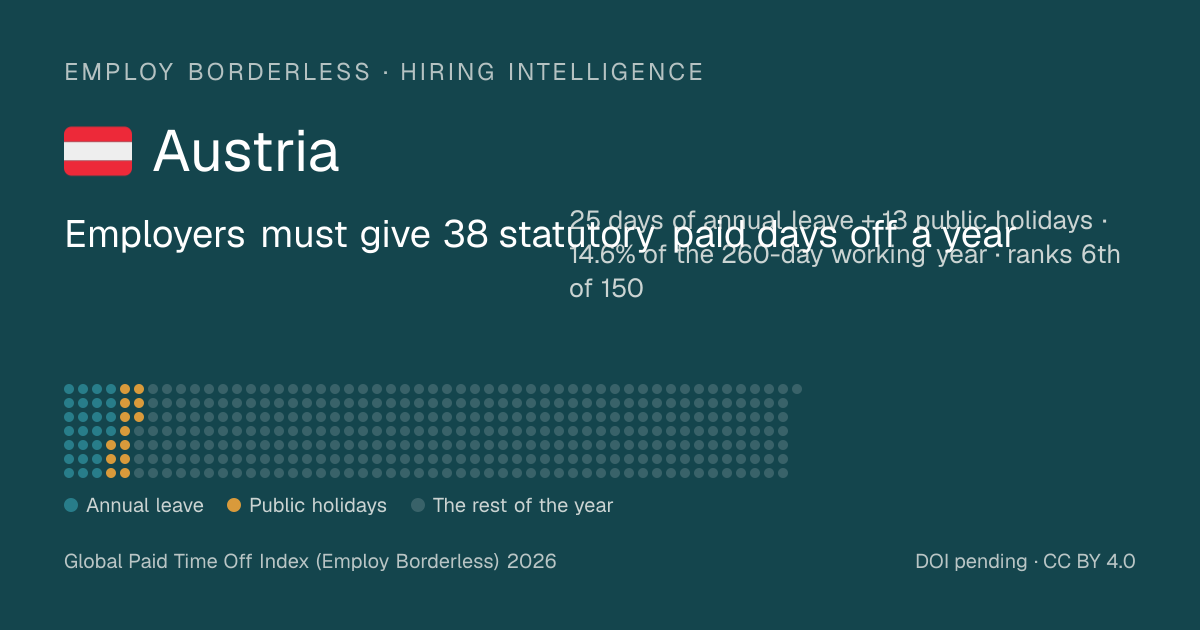
Austria · rank 6 · 38 days
Employers in Austria must give 38 statutory paid days off a year, 25 days of annual leave plus 13 public holidays, which is 14.6% of the 260-day working year and ranks the country 6th of 150 for statutory paid time off.
An employer hiring in Austria must give 38 statutory paid days off a year, 25 days of annual leave plus 13 public holidays, about 7.6 working weeks and 14.6% of a 260-day working year, which leaves 222 working days per employee. It ranks 6th of 150 countries in the Global Paid Time Off Index 2026. That is 9 days above the median of the ranked set. These are statutory minimums, and most offers add days above the minimum.
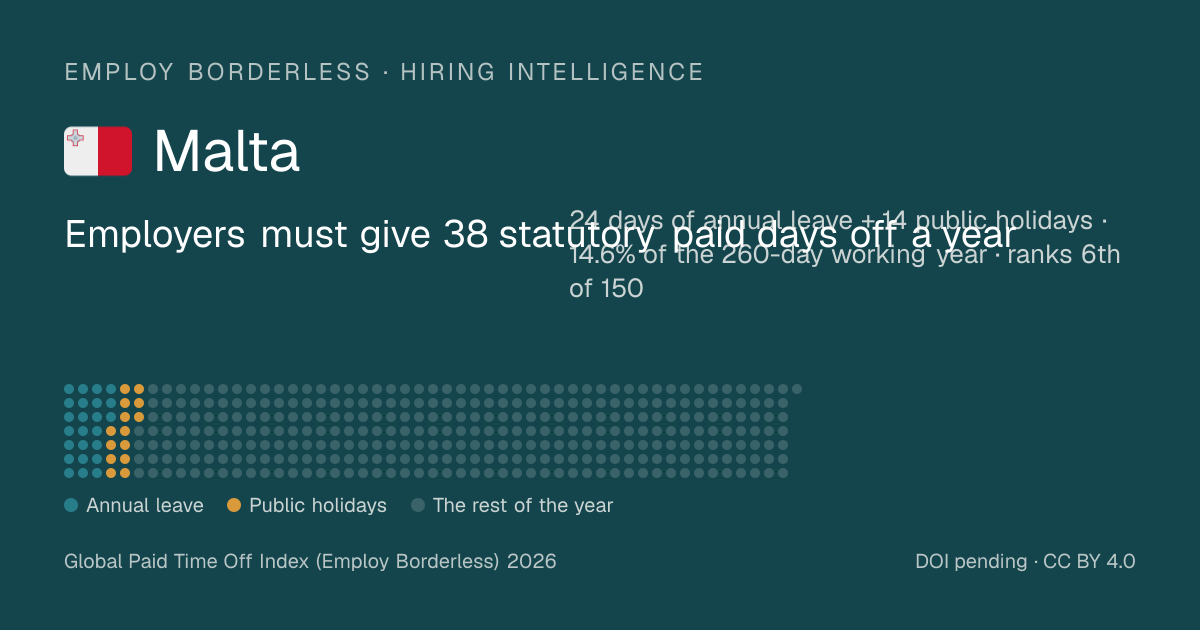
Malta · rank 6 · 38 days
Employers in Malta must give 38 statutory paid days off a year, 24 days of annual leave plus 14 public holidays, which is 14.6% of the 260-day working year and ranks the country 6th of 150 for statutory paid time off.
An employer hiring in Malta must give 38 statutory paid days off a year, 24 days of annual leave plus 14 public holidays, about 7.6 working weeks and 14.6% of a 260-day working year, which leaves 222 working days per employee. It ranks 6th of 150 countries in the Global Paid Time Off Index 2026. That is 9 days above the median of the ranked set. These are statutory minimums, and most offers add days above the minimum.
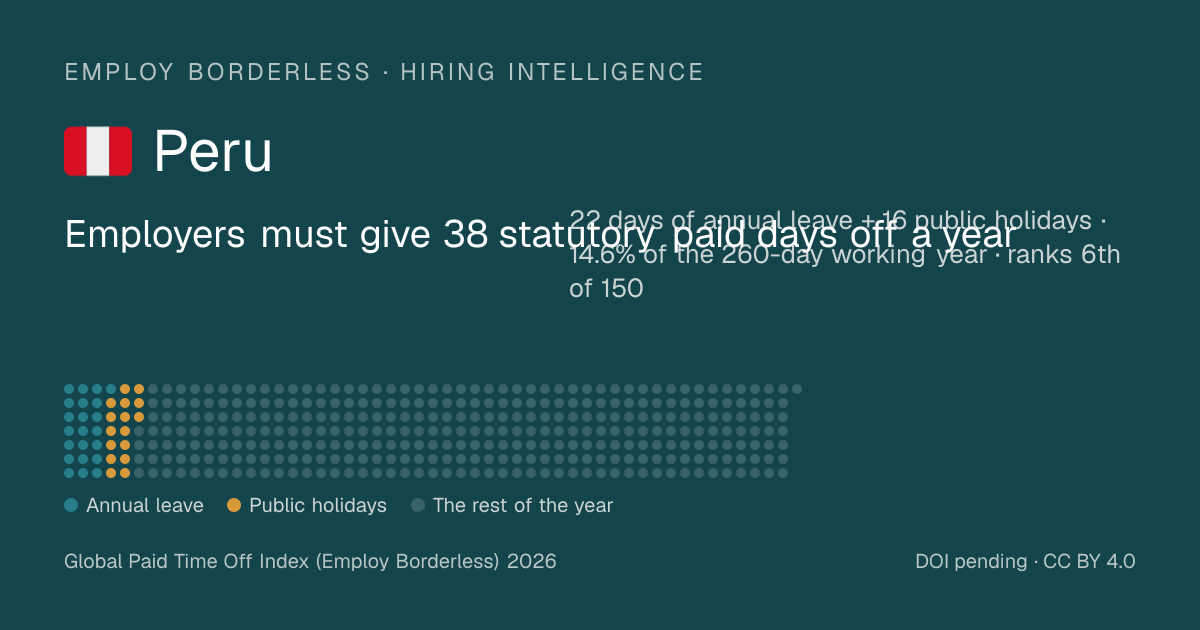
Peru · rank 6 · 38 days
Employers in Peru must give 38 statutory paid days off a year, 22 days of annual leave plus 16 public holidays, which is 14.6% of the 260-day working year and ranks the country 6th of 150 for statutory paid time off.
An employer hiring in Peru must give 38 statutory paid days off a year, 22 days of annual leave plus 16 public holidays, about 7.6 working weeks and 14.6% of a 260-day working year, which leaves 222 working days per employee. It ranks 6th of 150 countries in the Global Paid Time Off Index 2026. That is 9 days above the median of the ranked set. These are statutory minimums, and most offers add days above the minimum.
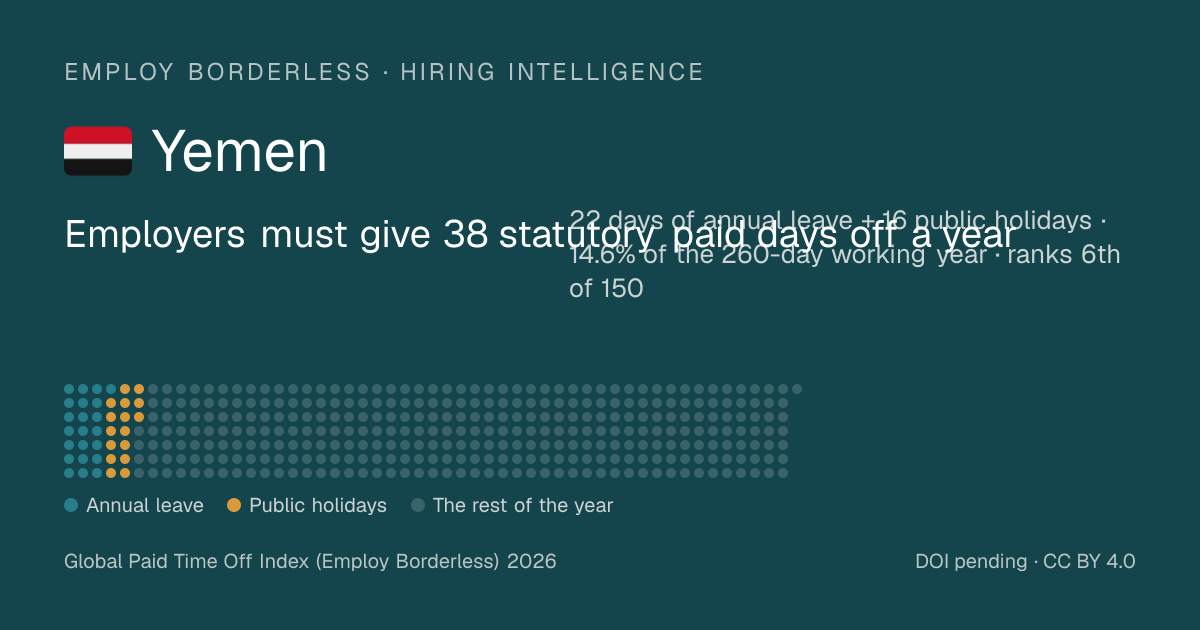
Yemen · rank 6 · 38 days
Employers in Yemen must give 38 statutory paid days off a year, 22 days of annual leave plus 16 public holidays, which is 14.6% of the 260-day working year and ranks the country 6th of 150 for statutory paid time off.
An employer hiring in Yemen must give 38 statutory paid days off a year, 22 days of annual leave plus 16 public holidays, about 7.6 working weeks and 14.6% of a 260-day working year, which leaves 222 working days per employee. It ranks 6th of 150 countries in the Global Paid Time Off Index 2026. That is 9 days above the median of the ranked set. These are statutory minimums, and most offers add days above the minimum.
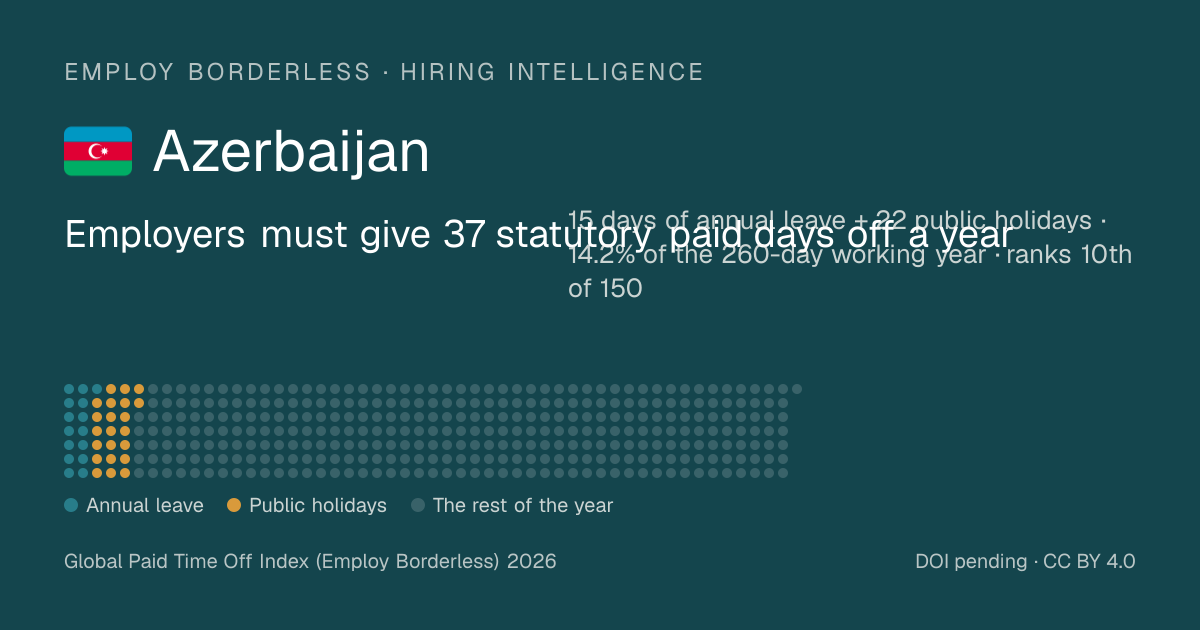
Azerbaijan · rank 10 · 37 days
Employers in Azerbaijan must give 37 statutory paid days off a year, 15 days of annual leave plus 22 public holidays, which is 14.2% of the 260-day working year and ranks the country 10th of 150 for statutory paid time off.
An employer hiring in Azerbaijan must give 37 statutory paid days off a year, 15 days of annual leave plus 22 public holidays, about 7.4 working weeks and 14.2% of a 260-day working year, which leaves 223 working days per employee. It ranks 10th of 150 countries in the Global Paid Time Off Index 2026. That is 8 days above the median of the ranked set. These are statutory minimums, and most offers add days above the minimum.
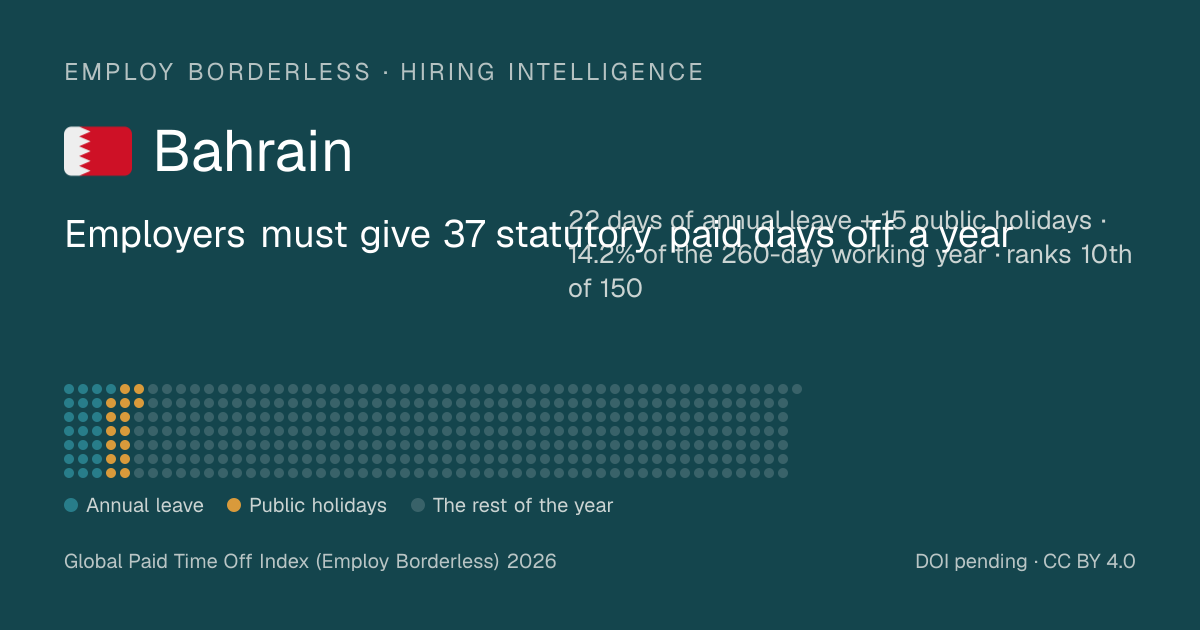
Bahrain · rank 10 · 37 days
Employers in Bahrain must give 37 statutory paid days off a year, 22 days of annual leave plus 15 public holidays, which is 14.2% of the 260-day working year and ranks the country 10th of 150 for statutory paid time off.
An employer hiring in Bahrain must give 37 statutory paid days off a year, 22 days of annual leave plus 15 public holidays, about 7.4 working weeks and 14.2% of a 260-day working year, which leaves 223 working days per employee. It ranks 10th of 150 countries in the Global Paid Time Off Index 2026. That is 8 days above the median of the ranked set. These are statutory minimums, and most offers add days above the minimum.
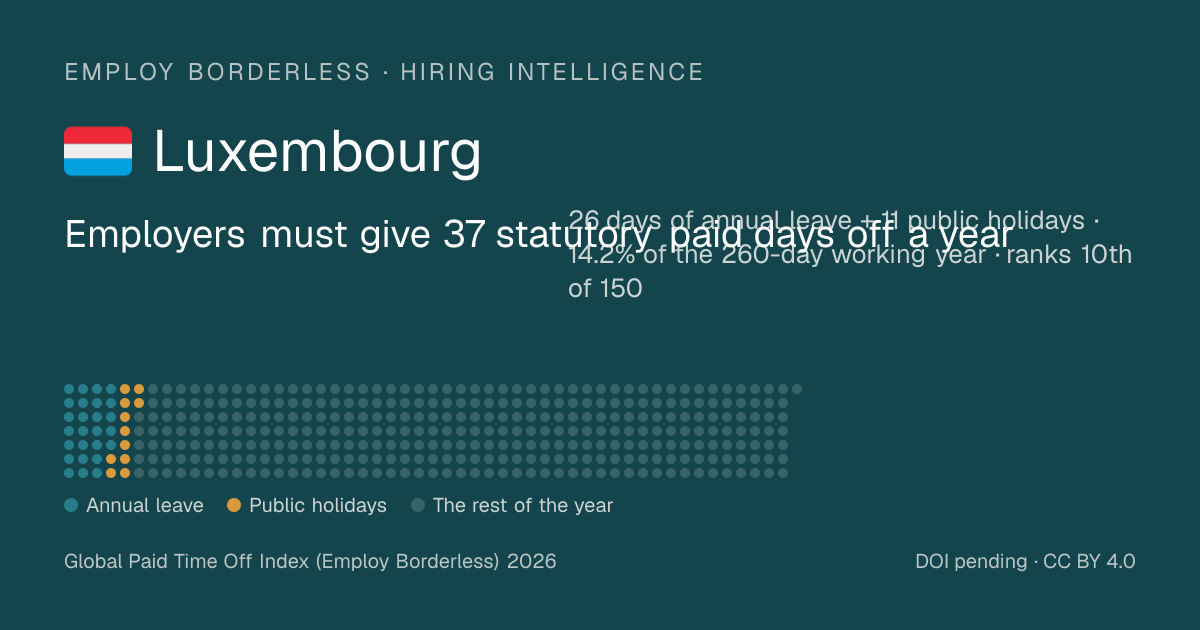
Luxembourg · rank 10 · 37 days
Employers in Luxembourg must give 37 statutory paid days off a year, 26 days of annual leave plus 11 public holidays, which is 14.2% of the 260-day working year and ranks the country 10th of 150 for statutory paid time off.
An employer hiring in Luxembourg must give 37 statutory paid days off a year, 26 days of annual leave plus 11 public holidays, about 7.4 working weeks and 14.2% of a 260-day working year, which leaves 223 working days per employee. It ranks 10th of 150 countries in the Global Paid Time Off Index 2026. That is 8 days above the median of the ranked set. These are statutory minimums, and most offers add days above the minimum.
Monaco · rank 10 · 37 days
Employers in Monaco must give 37 statutory paid days off a year, 25 days of annual leave plus 12 public holidays, which is 14.2% of the 260-day working year and ranks the country 10th of 150 for statutory paid time off.
An employer hiring in Monaco must give 37 statutory paid days off a year, 25 days of annual leave plus 12 public holidays, about 7.4 working weeks and 14.2% of a 260-day working year, which leaves 223 working days per employee. It ranks 10th of 150 countries in the Global Paid Time Off Index 2026. That is 8 days above the median of the ranked set. These are statutory minimums, and most offers add days above the minimum.
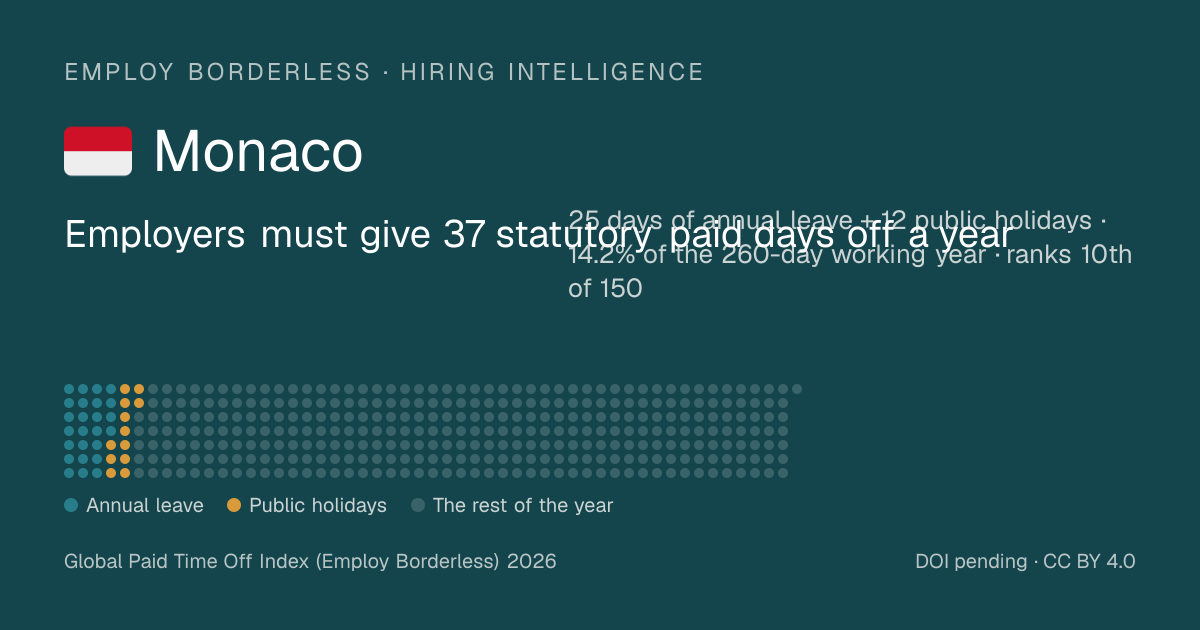
New Caledonia · rank 10 · 37 days
Employers in New Caledonia must give 37 statutory paid days off a year, 25 days of annual leave plus 12 public holidays, which is 14.2% of the 260-day working year and ranks the country 10th of 150 for statutory paid time off.
An employer hiring in New Caledonia must give 37 statutory paid days off a year, 25 days of annual leave plus 12 public holidays, about 7.4 working weeks and 14.2% of a 260-day working year, which leaves 223 working days per employee. It ranks 10th of 150 countries in the Global Paid Time Off Index 2026. That is 8 days above the median of the ranked set. These are statutory minimums, and most offers add days above the minimum.
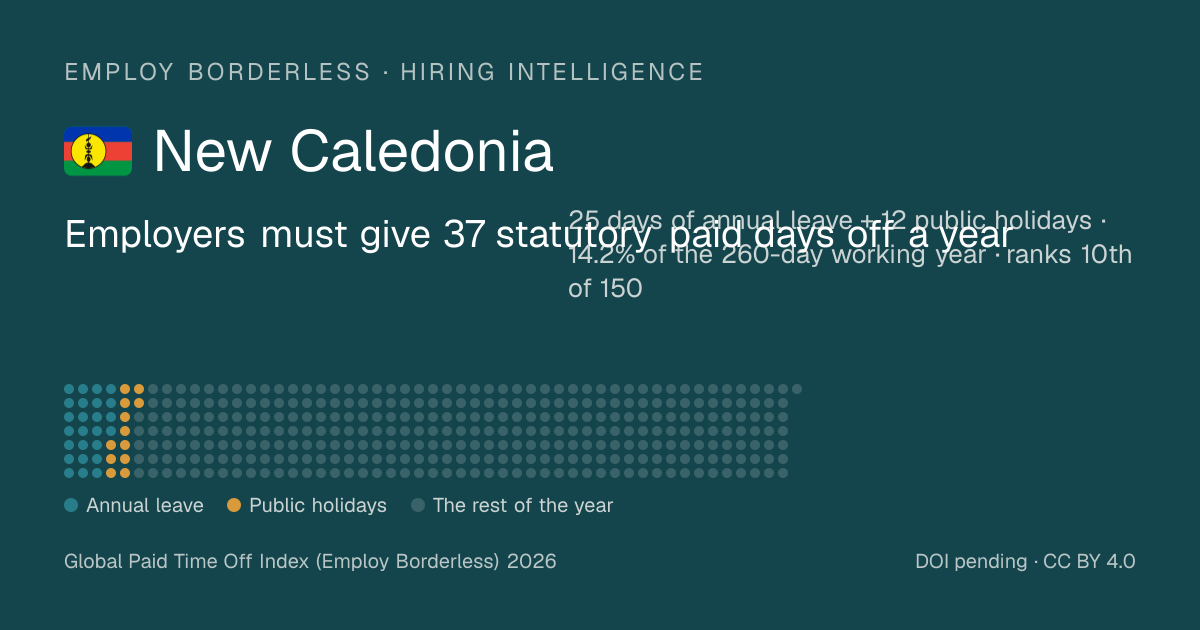
Romania · rank 10 · 37 days
Employers in Romania must give 37 statutory paid days off a year, 20 days of annual leave plus 17 public holidays, which is 14.2% of the 260-day working year and ranks the country 10th of 150 for statutory paid time off.
An employer hiring in Romania must give 37 statutory paid days off a year, 20 days of annual leave plus 17 public holidays, about 7.4 working weeks and 14.2% of a 260-day working year, which leaves 223 working days per employee. It ranks 10th of 150 countries in the Global Paid Time Off Index 2026. That is 8 days above the median of the ranked set. These are statutory minimums, and most offers add days above the minimum.
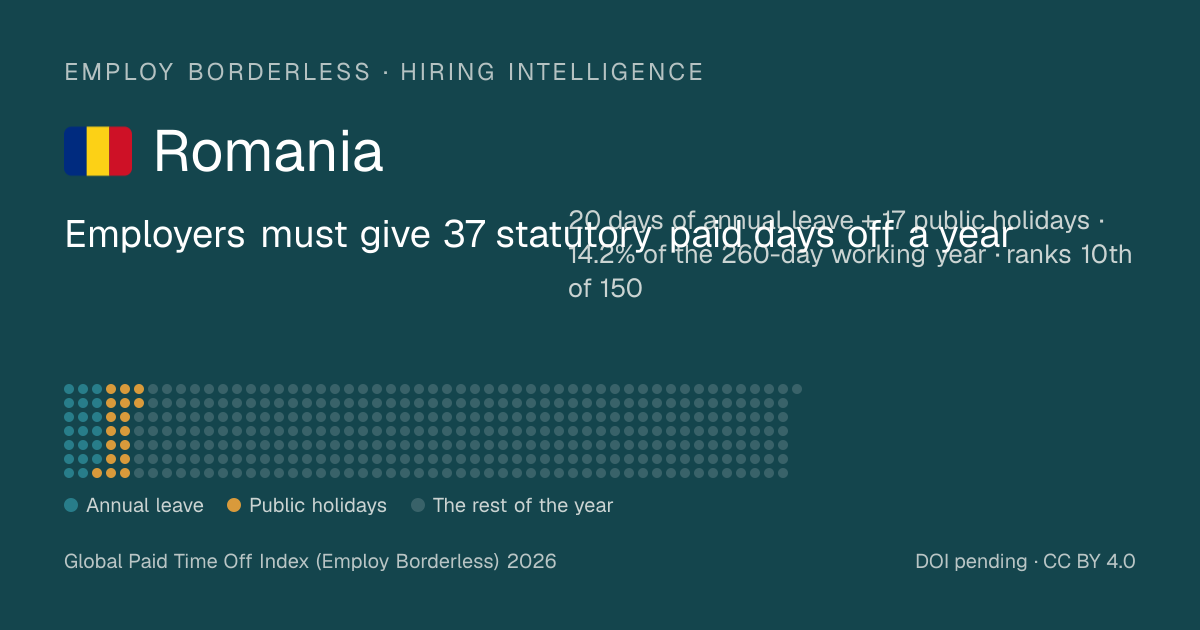
Albania · rank 16 · 36 days
Employers in Albania must give 36 statutory paid days off a year, 22 days of annual leave plus 14 public holidays, which is 13.8% of the 260-day working year and ranks the country 16th of 150 for statutory paid time off.
An employer hiring in Albania must give 36 statutory paid days off a year, 22 days of annual leave plus 14 public holidays, about 7.2 working weeks and 13.8% of a 260-day working year, which leaves 224 working days per employee. It ranks 16th of 150 countries in the Global Paid Time Off Index 2026. That is 7 days above the median of the ranked set. These are statutory minimums, and most offers add days above the minimum.
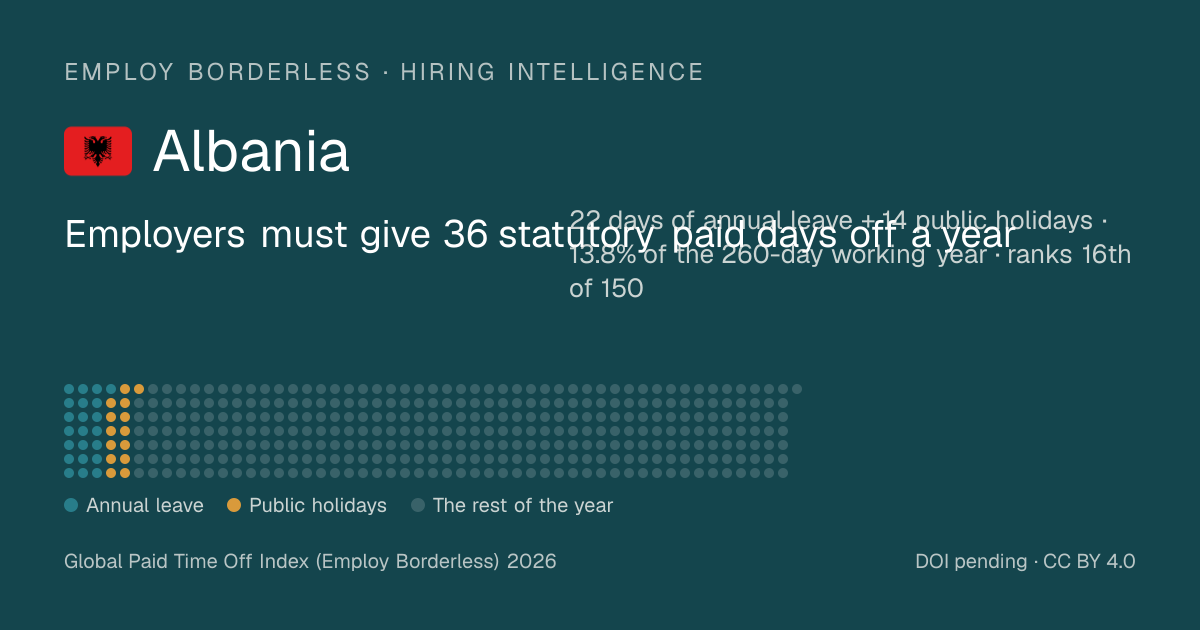
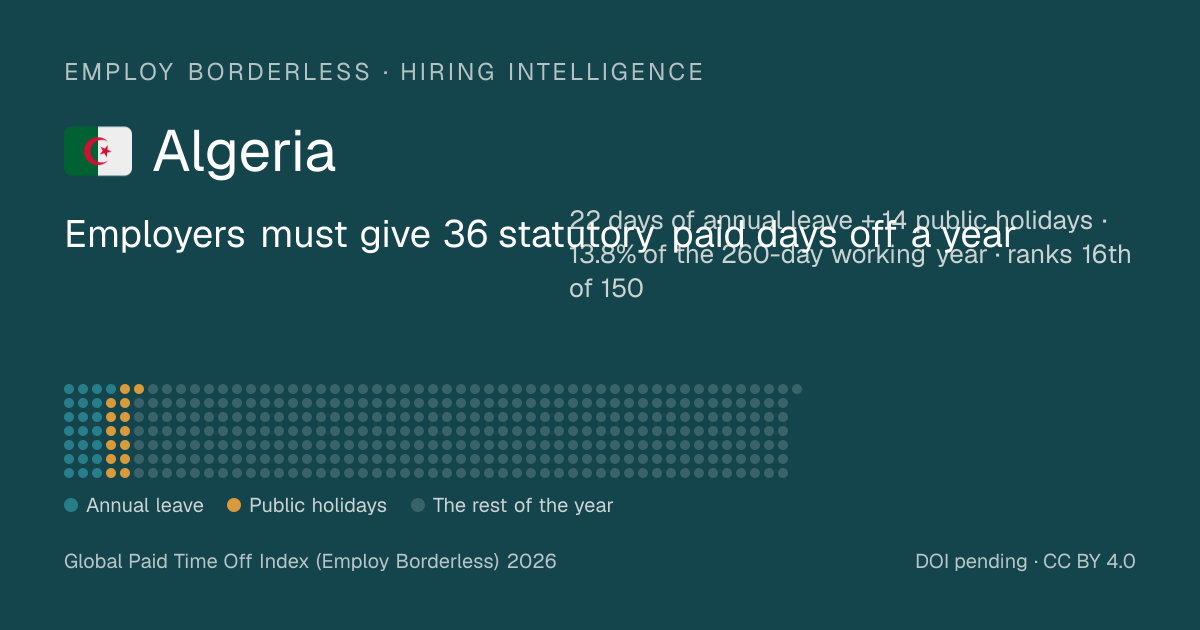
Algeria · rank 16 · 36 days
Employers in Algeria must give 36 statutory paid days off a year, 22 days of annual leave plus 14 public holidays, which is 13.8% of the 260-day working year and ranks the country 16th of 150 for statutory paid time off.
An employer hiring in Algeria must give 36 statutory paid days off a year, 22 days of annual leave plus 14 public holidays, about 7.2 working weeks and 13.8% of a 260-day working year, which leaves 224 working days per employee. It ranks 16th of 150 countries in the Global Paid Time Off Index 2026. That is 7 days above the median of the ranked set. These are statutory minimums, and most offers add days above the minimum.
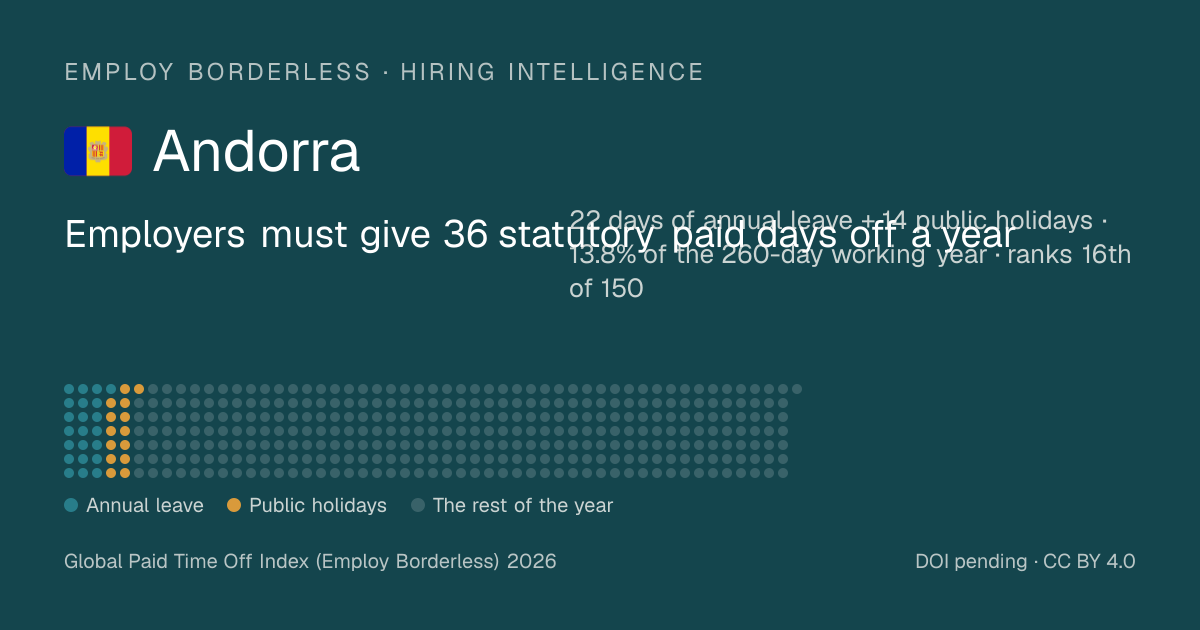
Andorra · rank 16 · 36 days
Employers in Andorra must give 36 statutory paid days off a year, 22 days of annual leave plus 14 public holidays, which is 13.8% of the 260-day working year and ranks the country 16th of 150 for statutory paid time off.
An employer hiring in Andorra must give 36 statutory paid days off a year, 22 days of annual leave plus 14 public holidays, about 7.2 working weeks and 13.8% of a 260-day working year, which leaves 224 working days per employee. It ranks 16th of 150 countries in the Global Paid Time Off Index 2026. That is 7 days above the median of the ranked set. These are statutory minimums, and most offers add days above the minimum.
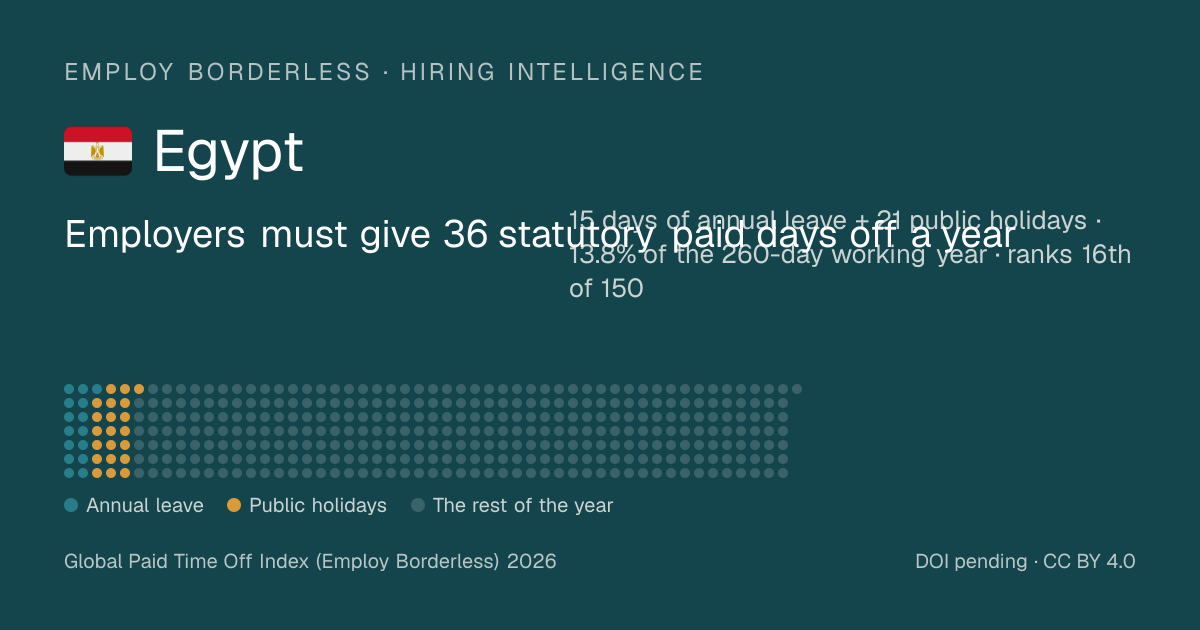
Egypt · rank 16 · 36 days
Employers in Egypt must give 36 statutory paid days off a year, 15 days of annual leave plus 21 public holidays, which is 13.8% of the 260-day working year and ranks the country 16th of 150 for statutory paid time off.
An employer hiring in Egypt must give 36 statutory paid days off a year, 15 days of annual leave plus 21 public holidays, about 7.2 working weeks and 13.8% of a 260-day working year, which leaves 224 working days per employee. It ranks 16th of 150 countries in the Global Paid Time Off Index 2026. That is 7 days above the median of the ranked set. These are statutory minimums, and most offers add days above the minimum.
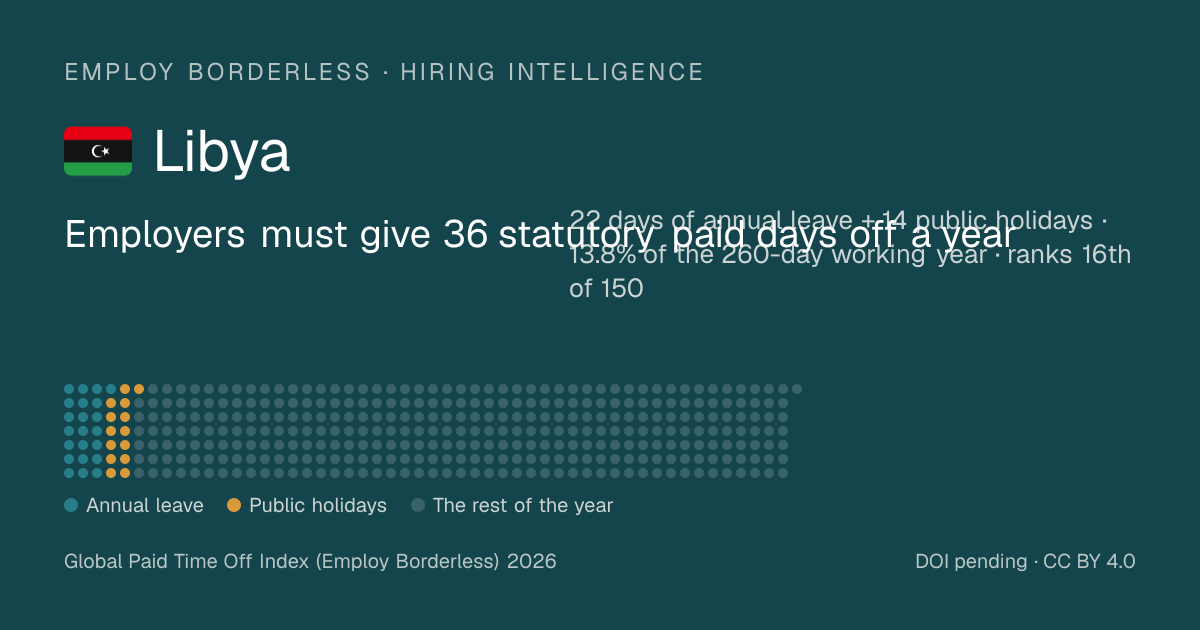
Libya · rank 16 · 36 days
Employers in Libya must give 36 statutory paid days off a year, 22 days of annual leave plus 14 public holidays, which is 13.8% of the 260-day working year and ranks the country 16th of 150 for statutory paid time off.
An employer hiring in Libya must give 36 statutory paid days off a year, 22 days of annual leave plus 14 public holidays, about 7.2 working weeks and 13.8% of a 260-day working year, which leaves 224 working days per employee. It ranks 16th of 150 countries in the Global Paid Time Off Index 2026. That is 7 days above the median of the ranked set. These are statutory minimums, and most offers add days above the minimum.
Liechtenstein · rank 16 · 36 days
Employers in Liechtenstein must give 36 statutory paid days off a year, 20 days of annual leave plus 16 public holidays, which is 13.8% of the 260-day working year and ranks the country 16th of 150 for statutory paid time off.
An employer hiring in Liechtenstein must give 36 statutory paid days off a year, 20 days of annual leave plus 16 public holidays, about 7.2 working weeks and 13.8% of a 260-day working year, which leaves 224 working days per employee. It ranks 16th of 150 countries in the Global Paid Time Off Index 2026. That is 7 days above the median of the ranked set. These are statutory minimums, and most offers add days above the minimum.
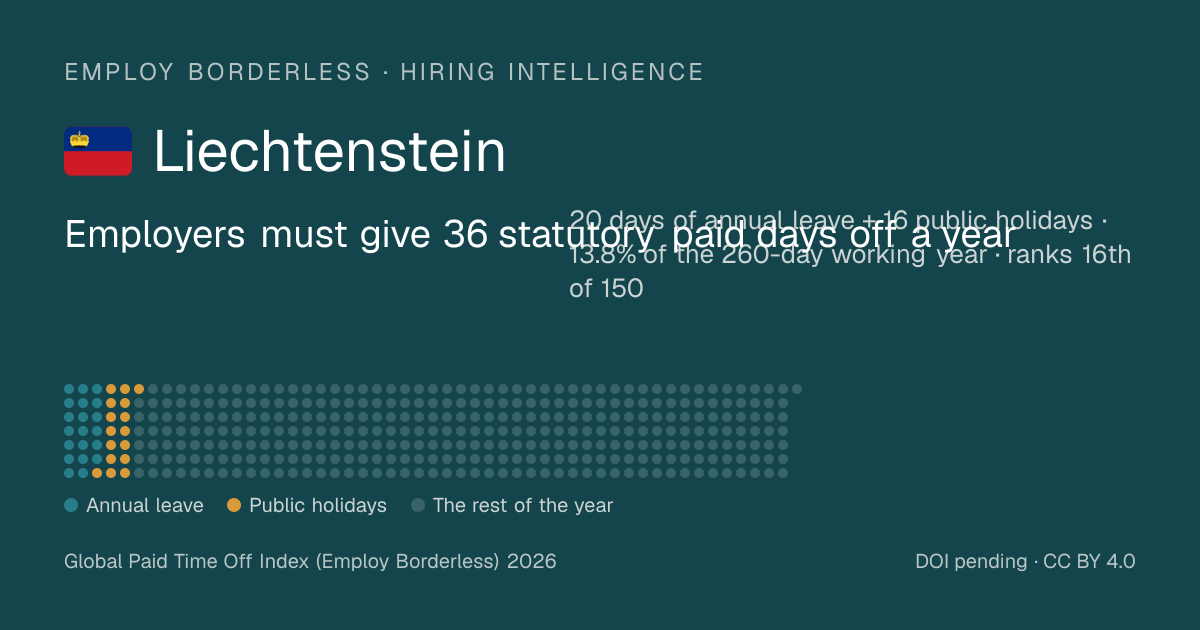
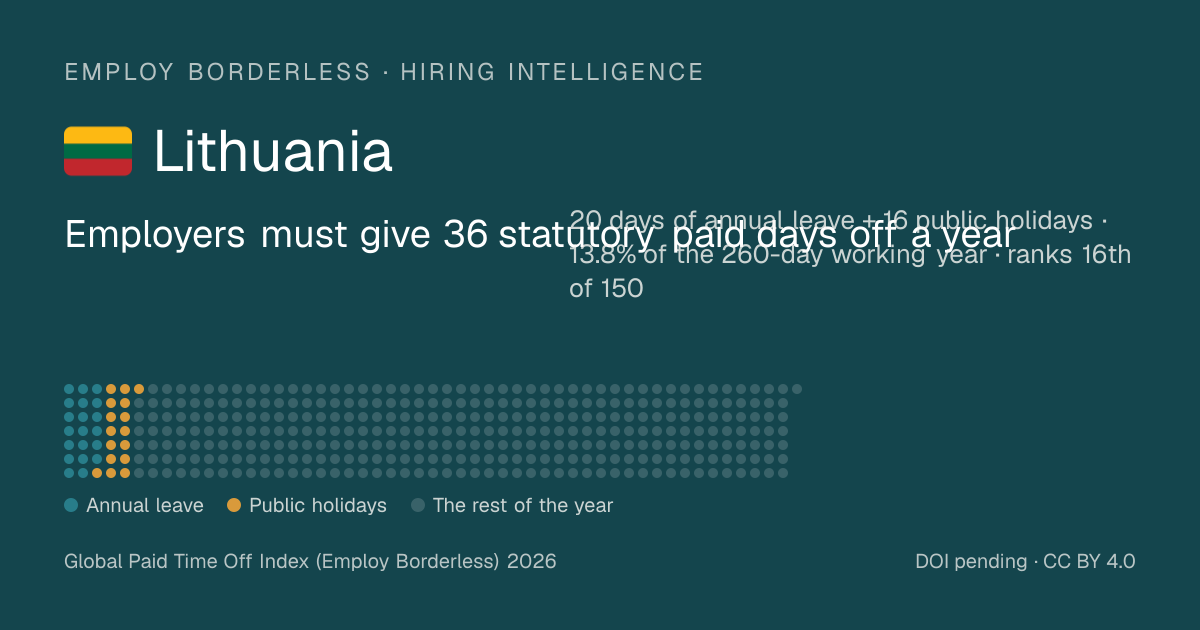
Lithuania · rank 16 · 36 days
Employers in Lithuania must give 36 statutory paid days off a year, 20 days of annual leave plus 16 public holidays, which is 13.8% of the 260-day working year and ranks the country 16th of 150 for statutory paid time off.
An employer hiring in Lithuania must give 36 statutory paid days off a year, 20 days of annual leave plus 16 public holidays, about 7.2 working weeks and 13.8% of a 260-day working year, which leaves 224 working days per employee. It ranks 16th of 150 countries in the Global Paid Time Off Index 2026. That is 7 days above the median of the ranked set. These are statutory minimums, and most offers add days above the minimum.
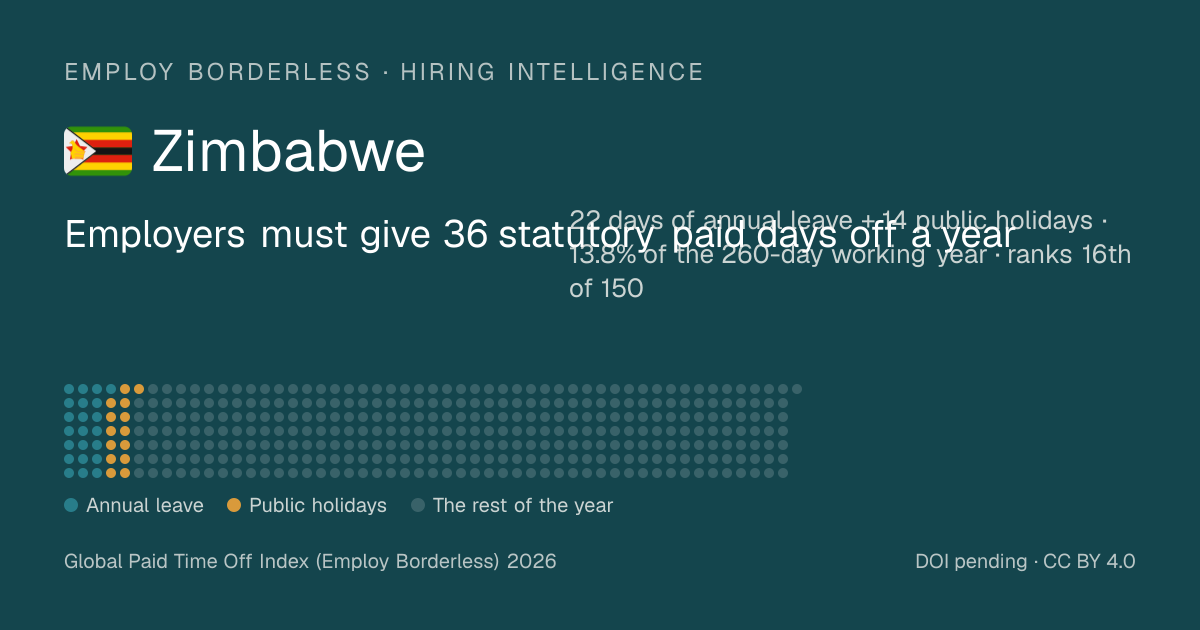
Zimbabwe · rank 16 · 36 days
Employers in Zimbabwe must give 36 statutory paid days off a year, 22 days of annual leave plus 14 public holidays, which is 13.8% of the 260-day working year and ranks the country 16th of 150 for statutory paid time off.
An employer hiring in Zimbabwe must give 36 statutory paid days off a year, 22 days of annual leave plus 14 public holidays, about 7.2 working weeks and 13.8% of a 260-day working year, which leaves 224 working days per employee. It ranks 16th of 150 countries in the Global Paid Time Off Index 2026. That is 7 days above the median of the ranked set. These are statutory minimums, and most offers add days above the minimum.
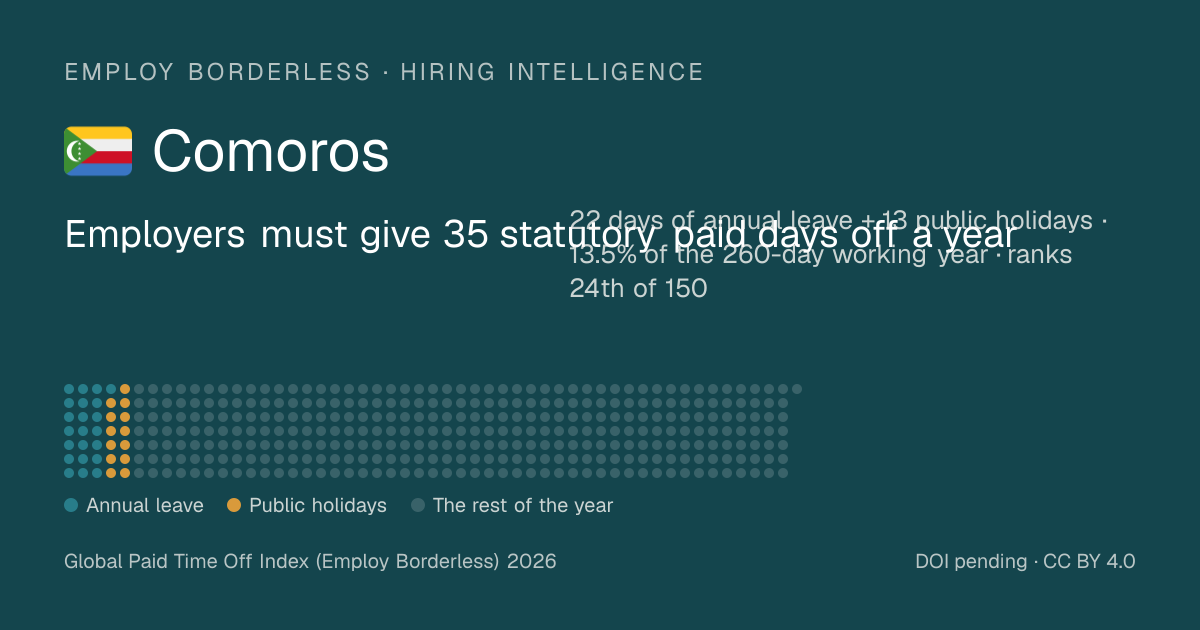
Comoros · rank 24 · 35 days
Employers in the Comoros must give 35 statutory paid days off a year, 22 days of annual leave plus 13 public holidays, which is 13.5% of the 260-day working year and ranks the country 24th of 150 for statutory paid time off.
An employer hiring in the Comoros must give 35 statutory paid days off a year, 22 days of annual leave plus 13 public holidays, about 7 working weeks and 13.5% of a 260-day working year, which leaves 225 working days per employee. It ranks 24th of 150 countries in the Global Paid Time Off Index 2026. That is 6 days above the median of the ranked set. These are statutory minimums, and most offers add days above the minimum.
Cyprus · rank 24 · 35 days
Employers in Cyprus must give 35 statutory paid days off a year, 20 days of annual leave plus 15 public holidays, which is 13.5% of the 260-day working year and ranks the country 24th of 150 for statutory paid time off.
An employer hiring in Cyprus must give 35 statutory paid days off a year, 20 days of annual leave plus 15 public holidays, about 7 working weeks and 13.5% of a 260-day working year, which leaves 225 working days per employee. It ranks 24th of 150 countries in the Global Paid Time Off Index 2026. That is 6 days above the median of the ranked set. These are statutory minimums, and most offers add days above the minimum.
Denmark · rank 24 · 35 days
Employers in Denmark must give 35 statutory paid days off a year, 25 days of annual leave plus 10 public holidays, which is 13.5% of the 260-day working year and ranks the country 24th of 150 for statutory paid time off.
An employer hiring in Denmark must give 35 statutory paid days off a year, 25 days of annual leave plus 10 public holidays, about 7 working weeks and 13.5% of a 260-day working year, which leaves 225 working days per employee. It ranks 24th of 150 countries in the Global Paid Time Off Index 2026. That is 6 days above the median of the ranked set. These are statutory minimums, and most offers add days above the minimum.
Mauritius · rank 24 · 35 days
Employers in Mauritius must give 35 statutory paid days off a year, 20 days of annual leave plus 15 public holidays, which is 13.5% of the 260-day working year and ranks the country 24th of 150 for statutory paid time off.
An employer hiring in Mauritius must give 35 statutory paid days off a year, 20 days of annual leave plus 15 public holidays, about 7 working weeks and 13.5% of a 260-day working year, which leaves 225 working days per employee. It ranks 24th of 150 countries in the Global Paid Time Off Index 2026. That is 6 days above the median of the ranked set. These are statutory minimums, and most offers add days above the minimum.
Portugal · rank 24 · 35 days
Employers in Portugal must give 35 statutory paid days off a year, 22 days of annual leave plus 13 public holidays, which is 13.5% of the 260-day working year and ranks the country 24th of 150 for statutory paid time off.
An employer hiring in Portugal must give 35 statutory paid days off a year, 22 days of annual leave plus 13 public holidays, about 7 working weeks and 13.5% of a 260-day working year, which leaves 225 working days per employee. It ranks 24th of 150 countries in the Global Paid Time Off Index 2026. That is 6 days above the median of the ranked set. These are statutory minimums, and most offers add days above the minimum.
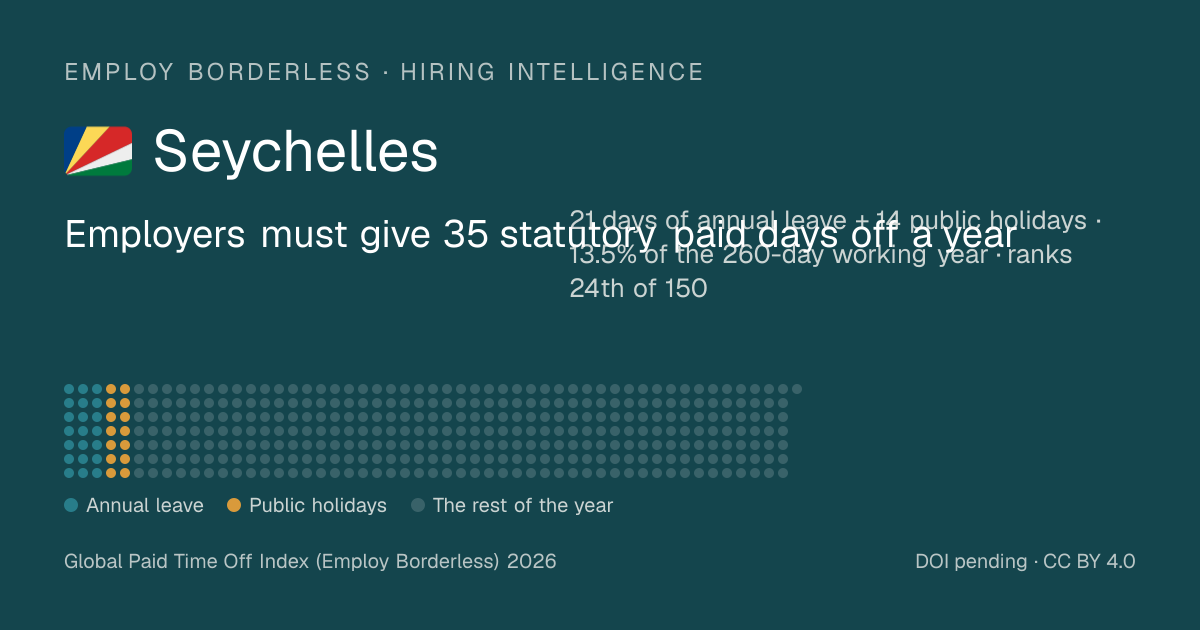
Seychelles · rank 24 · 35 days
Employers in the Seychelles must give 35 statutory paid days off a year, 21 days of annual leave plus 14 public holidays, which is 13.5% of the 260-day working year and ranks the country 24th of 150 for statutory paid time off.
An employer hiring in the Seychelles must give 35 statutory paid days off a year, 21 days of annual leave plus 14 public holidays, about 7 working weeks and 13.5% of a 260-day working year, which leaves 225 working days per employee. It ranks 24th of 150 countries in the Global Paid Time Off Index 2026. That is 6 days above the median of the ranked set. These are statutory minimums, and most offers add days above the minimum.
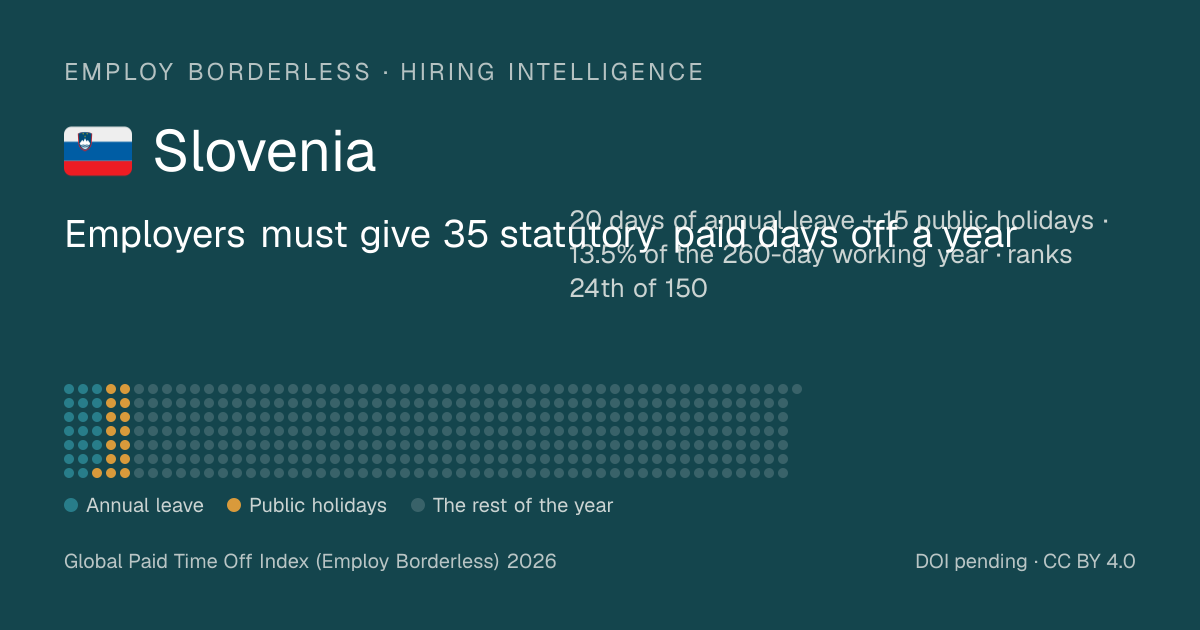
Slovenia · rank 24 · 35 days
Employers in Slovenia must give 35 statutory paid days off a year, 20 days of annual leave plus 15 public holidays, which is 13.5% of the 260-day working year and ranks the country 24th of 150 for statutory paid time off.
An employer hiring in Slovenia must give 35 statutory paid days off a year, 20 days of annual leave plus 15 public holidays, about 7 working weeks and 13.5% of a 260-day working year, which leaves 225 working days per employee. It ranks 24th of 150 countries in the Global Paid Time Off Index 2026. That is 6 days above the median of the ranked set. These are statutory minimums, and most offers add days above the minimum.
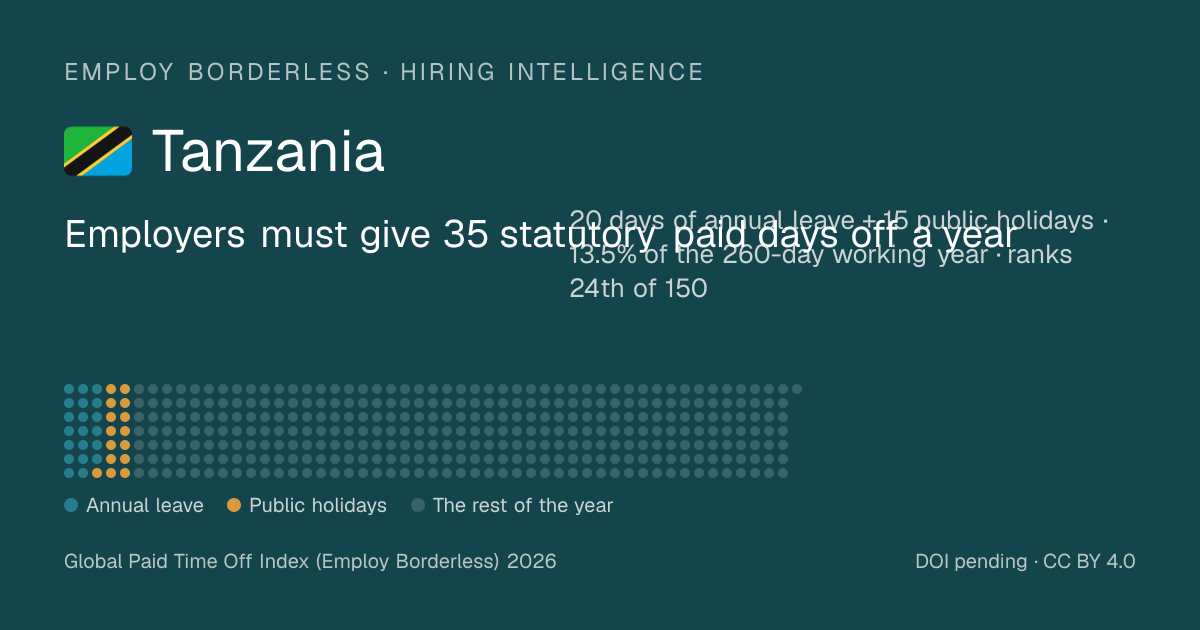
Tanzania · rank 24 · 35 days
Employers in Tanzania must give 35 statutory paid days off a year, 20 days of annual leave plus 15 public holidays, which is 13.5% of the 260-day working year and ranks the country 24th of 150 for statutory paid time off.
An employer hiring in Tanzania must give 35 statutory paid days off a year, 20 days of annual leave plus 15 public holidays, about 7 working weeks and 13.5% of a 260-day working year, which leaves 225 working days per employee. It ranks 24th of 150 countries in the Global Paid Time Off Index 2026. That is 6 days above the median of the ranked set. These are statutory minimums, and most offers add days above the minimum.
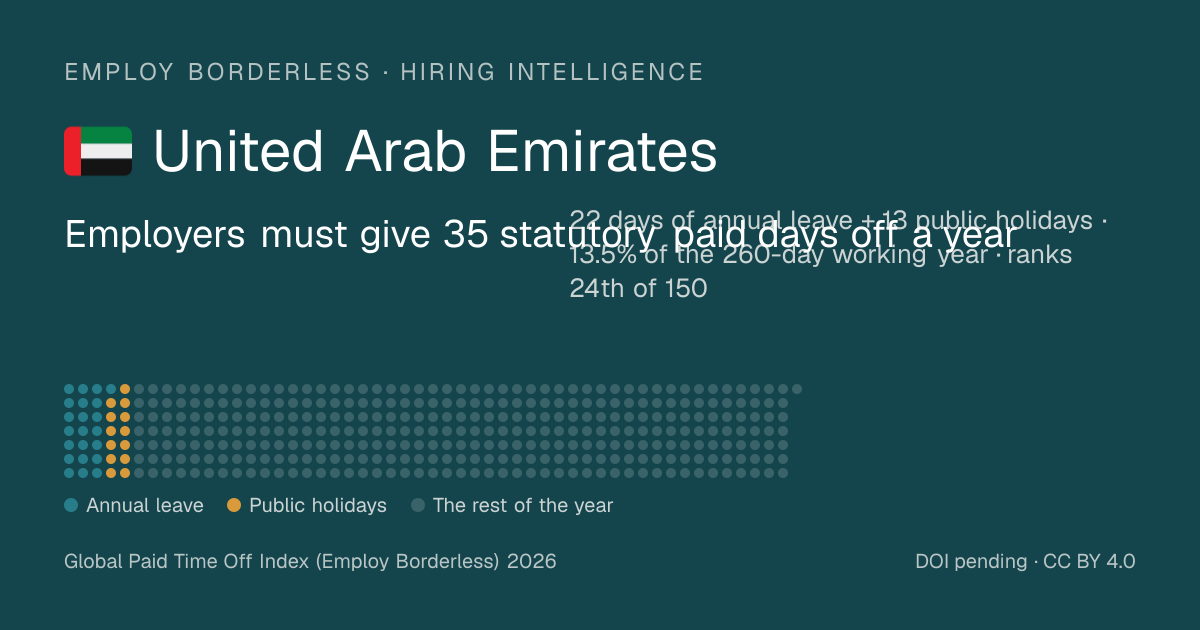
United Arab Emirates · rank 24 · 35 days
Employers in the United Arab Emirates must give 35 statutory paid days off a year, 22 days of annual leave plus 13 public holidays, which is 13.5% of the 260-day working year and ranks the country 24th of 150 for statutory paid time off.
An employer hiring in the United Arab Emirates must give 35 statutory paid days off a year, 22 days of annual leave plus 13 public holidays, about 7 working weeks and 13.5% of a 260-day working year, which leaves 225 working days per employee. It ranks 24th of 150 countries in the Global Paid Time Off Index 2026. That is 6 days above the median of the ranked set. These are statutory minimums, and most offers add days above the minimum.
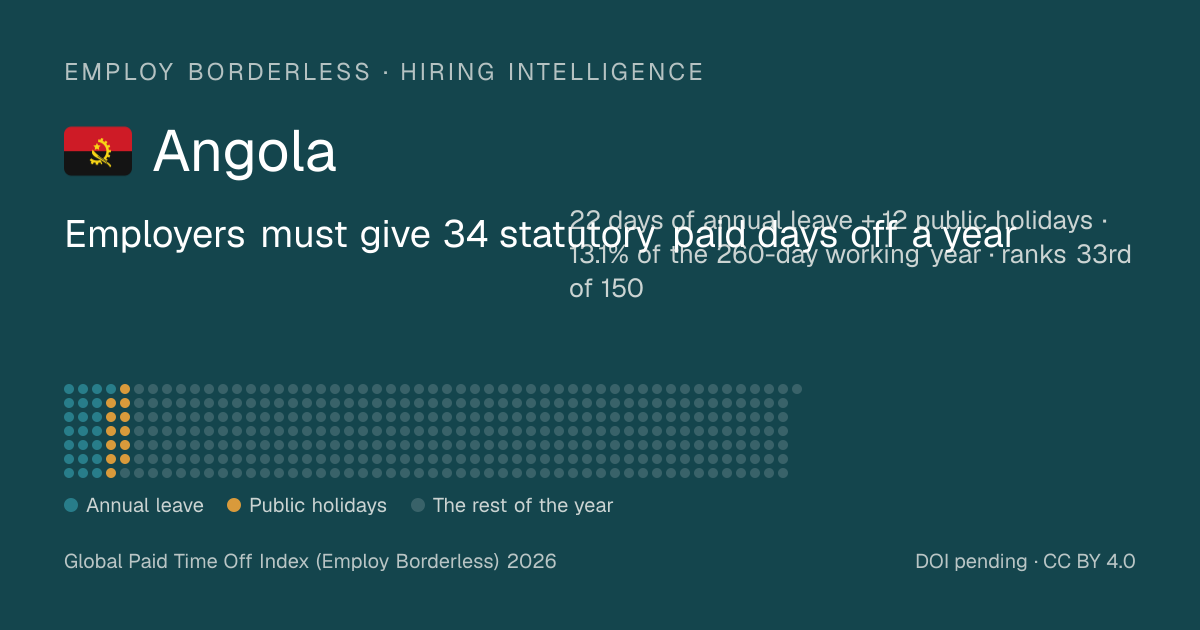
Angola · rank 33 · 34 days
Employers in Angola must give 34 statutory paid days off a year, 22 days of annual leave plus 12 public holidays, which is 13.1% of the 260-day working year and ranks the country 33rd of 150 for statutory paid time off.
An employer hiring in Angola must give 34 statutory paid days off a year, 22 days of annual leave plus 12 public holidays, about 6.8 working weeks and 13.1% of a 260-day working year, which leaves 226 working days per employee. It ranks 33rd of 150 countries in the Global Paid Time Off Index 2026. That is 5 days above the median of the ranked set. These are statutory minimums, and most offers add days above the minimum.
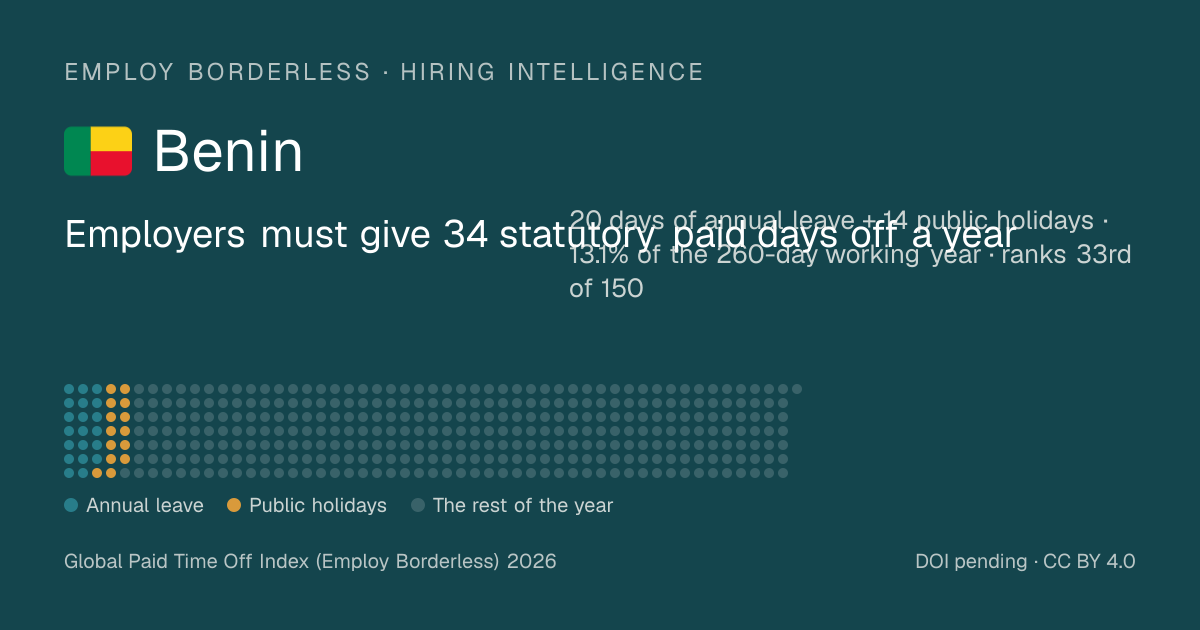
Benin · rank 33 · 34 days
Employers in Benin must give 34 statutory paid days off a year, 20 days of annual leave plus 14 public holidays, which is 13.1% of the 260-day working year and ranks the country 33rd of 150 for statutory paid time off.
An employer hiring in Benin must give 34 statutory paid days off a year, 20 days of annual leave plus 14 public holidays, about 6.8 working weeks and 13.1% of a 260-day working year, which leaves 226 working days per employee. It ranks 33rd of 150 countries in the Global Paid Time Off Index 2026. That is 5 days above the median of the ranked set. These are statutory minimums, and most offers add days above the minimum.
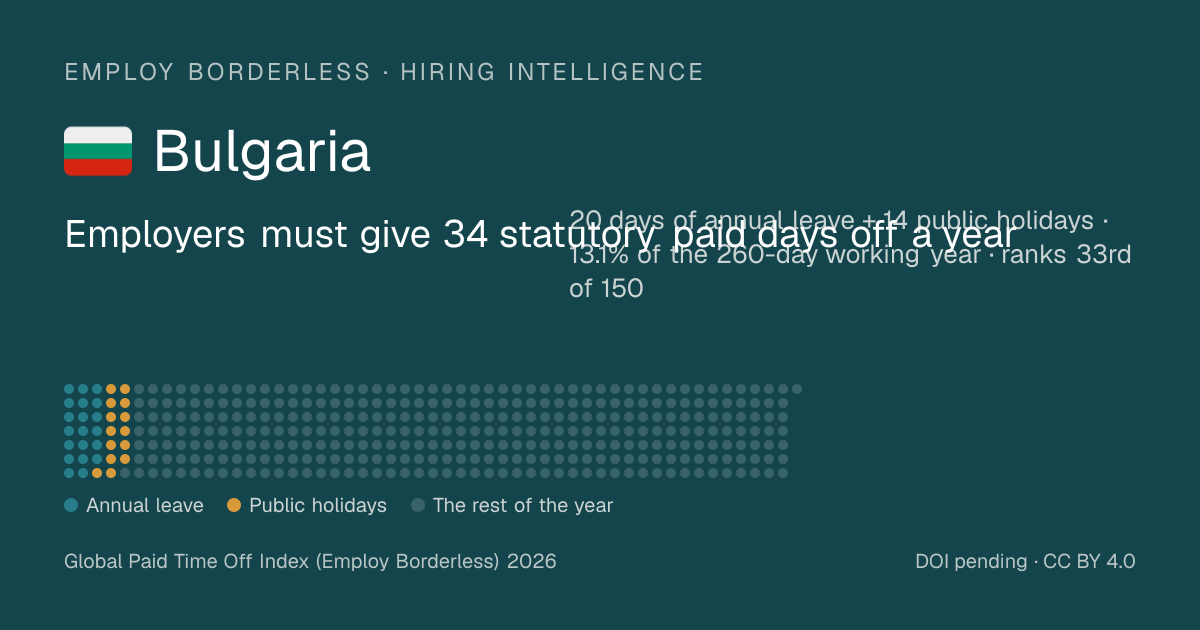
Bulgaria · rank 33 · 34 days
Employers in Bulgaria must give 34 statutory paid days off a year, 20 days of annual leave plus 14 public holidays, which is 13.1% of the 260-day working year and ranks the country 33rd of 150 for statutory paid time off.
An employer hiring in Bulgaria must give 34 statutory paid days off a year, 20 days of annual leave plus 14 public holidays, about 6.8 working weeks and 13.1% of a 260-day working year, which leaves 226 working days per employee. It ranks 33rd of 150 countries in the Global Paid Time Off Index 2026. That is 5 days above the median of the ranked set. These are statutory minimums, and most offers add days above the minimum.
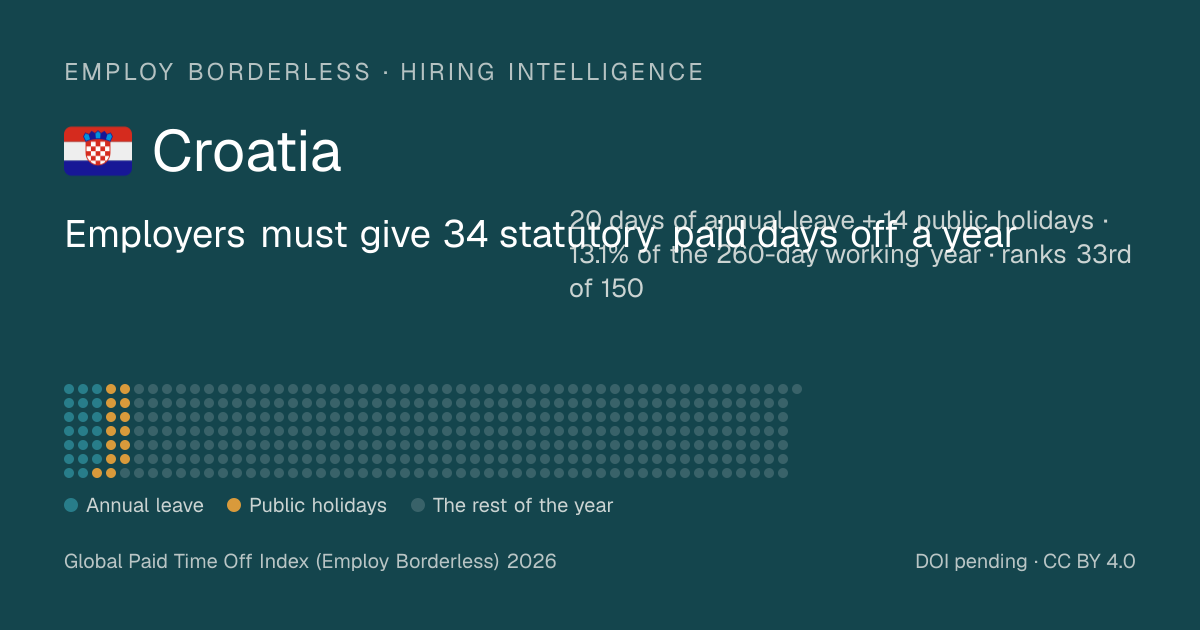
Croatia · rank 33 · 34 days
Employers in Croatia must give 34 statutory paid days off a year, 20 days of annual leave plus 14 public holidays, which is 13.1% of the 260-day working year and ranks the country 33rd of 150 for statutory paid time off.
An employer hiring in Croatia must give 34 statutory paid days off a year, 20 days of annual leave plus 14 public holidays, about 6.8 working weeks and 13.1% of a 260-day working year, which leaves 226 working days per employee. It ranks 33rd of 150 countries in the Global Paid Time Off Index 2026. That is 5 days above the median of the ranked set. These are statutory minimums, and most offers add days above the minimum.
Madagascar · rank 33 · 34 days
Employers in Madagascar must give 34 statutory paid days off a year, 22 days of annual leave plus 12 public holidays, which is 13.1% of the 260-day working year and ranks the country 33rd of 150 for statutory paid time off.
An employer hiring in Madagascar must give 34 statutory paid days off a year, 22 days of annual leave plus 12 public holidays, about 6.8 working weeks and 13.1% of a 260-day working year, which leaves 226 working days per employee. It ranks 33rd of 150 countries in the Global Paid Time Off Index 2026. That is 5 days above the median of the ranked set. These are statutory minimums, and most offers add days above the minimum.
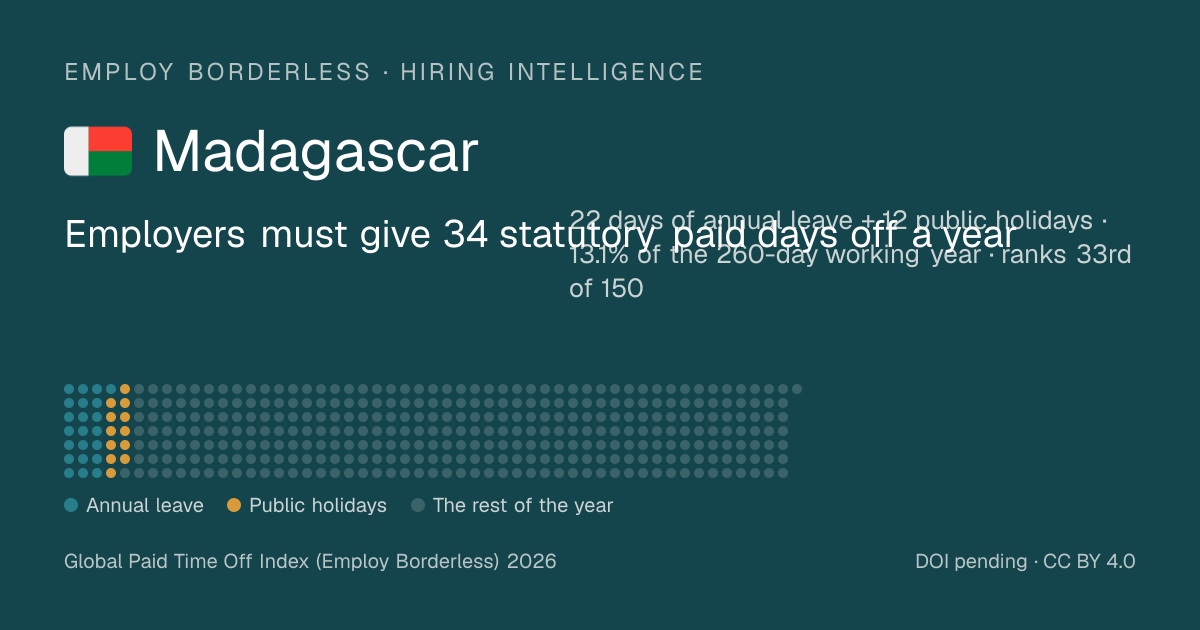
Mali · rank 33 · 34 days
Employers in Mali must give 34 statutory paid days off a year, 22 days of annual leave plus 12 public holidays, which is 13.1% of the 260-day working year and ranks the country 33rd of 150 for statutory paid time off.
An employer hiring in Mali must give 34 statutory paid days off a year, 22 days of annual leave plus 12 public holidays, about 6.8 working weeks and 13.1% of a 260-day working year, which leaves 226 working days per employee. It ranks 33rd of 150 countries in the Global Paid Time Off Index 2026. That is 5 days above the median of the ranked set. These are statutory minimums, and most offers add days above the minimum.
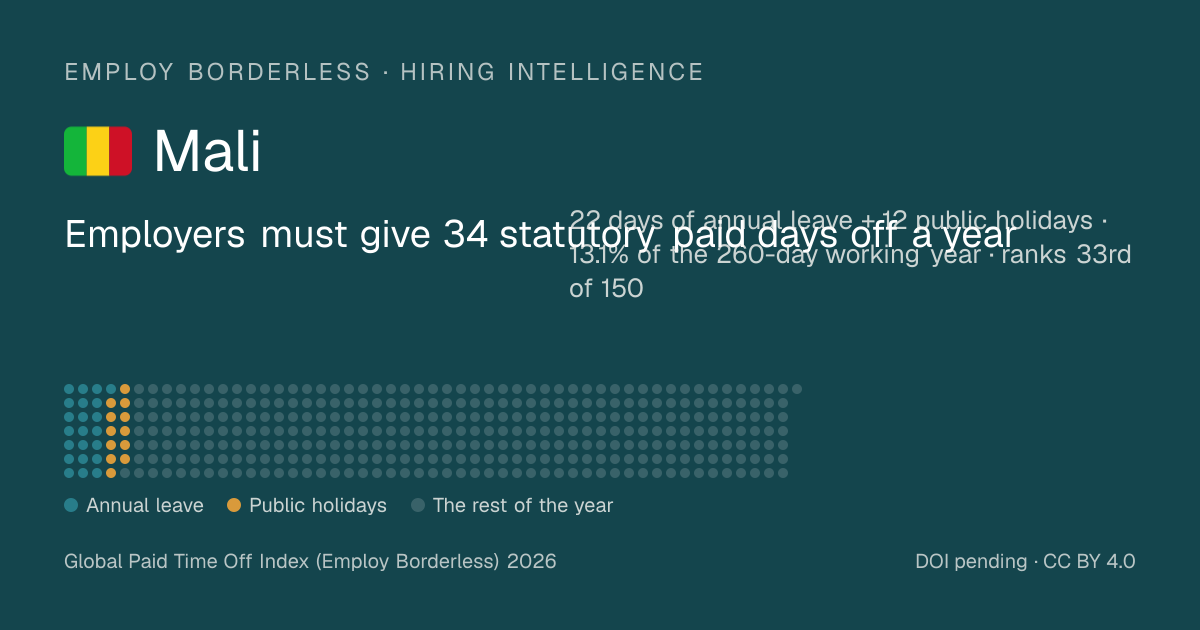
Panama · rank 33 · 34 days
Employers in Panama must give 34 statutory paid days off a year, 22 days of annual leave plus 12 public holidays, which is 13.1% of the 260-day working year and ranks the country 33rd of 150 for statutory paid time off.
An employer hiring in Panama must give 34 statutory paid days off a year, 22 days of annual leave plus 12 public holidays, about 6.8 working weeks and 13.1% of a 260-day working year, which leaves 226 working days per employee. It ranks 33rd of 150 countries in the Global Paid Time Off Index 2026. That is 5 days above the median of the ranked set. These are statutory minimums, and most offers add days above the minimum.
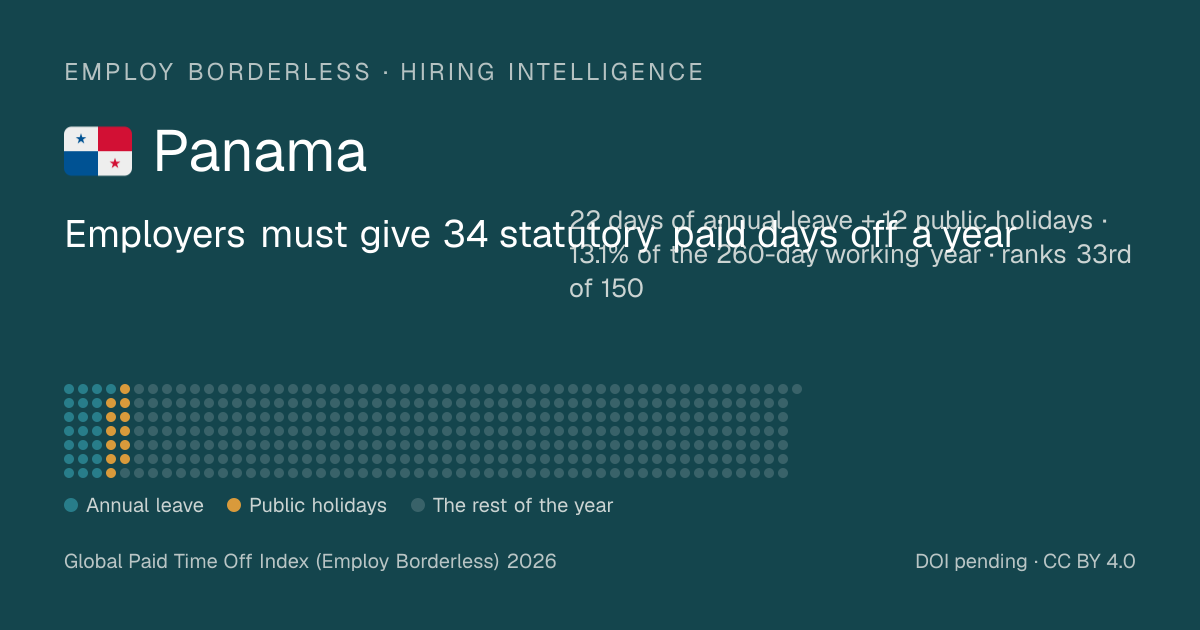
Poland · rank 33 · 34 days
Employers in Poland must give 34 statutory paid days off a year, 20 days of annual leave plus 14 public holidays, which is 13.1% of the 260-day working year and ranks the country 33rd of 150 for statutory paid time off.
An employer hiring in Poland must give 34 statutory paid days off a year, 20 days of annual leave plus 14 public holidays, about 6.8 working weeks and 13.1% of a 260-day working year, which leaves 226 working days per employee. It ranks 33rd of 150 countries in the Global Paid Time Off Index 2026. That is 5 days above the median of the ranked set. These are statutory minimums, and most offers add days above the minimum.
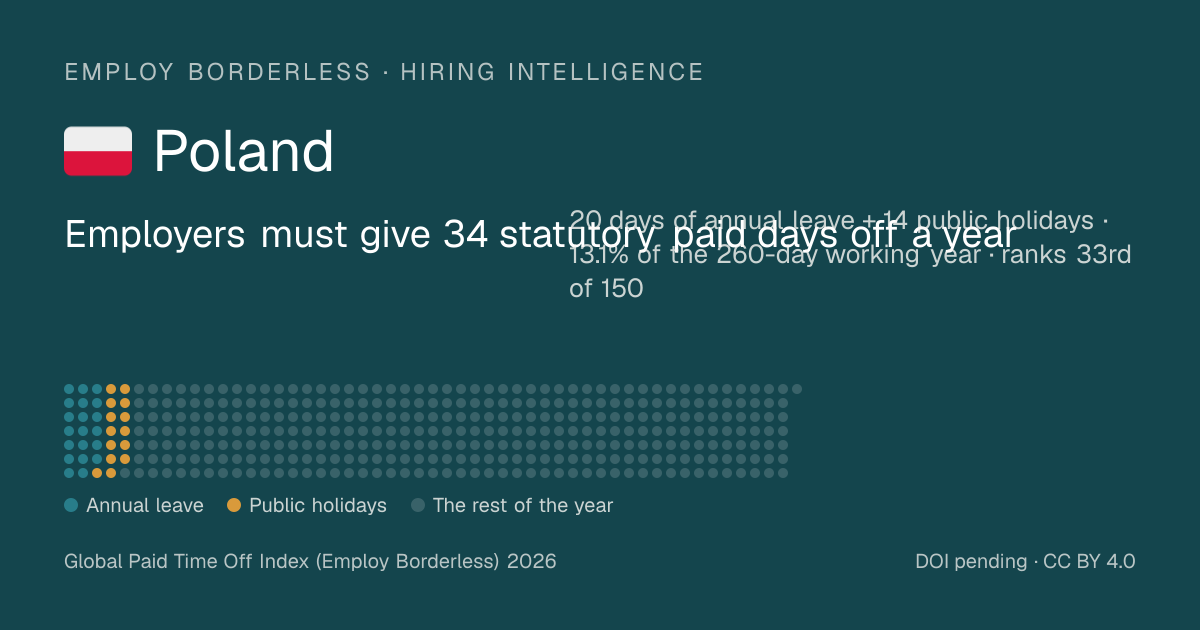
Russia · rank 33 · 34 days
Employers in Russia must give 34 statutory paid days off a year, 20 days of annual leave plus 14 public holidays, which is 13.1% of the 260-day working year and ranks the country 33rd of 150 for statutory paid time off.
An employer hiring in Russia must give 34 statutory paid days off a year, 20 days of annual leave plus 14 public holidays, about 6.8 working weeks and 13.1% of a 260-day working year, which leaves 226 working days per employee. It ranks 33rd of 150 countries in the Global Paid Time Off Index 2026. That is 5 days above the median of the ranked set. These are statutory minimums, and most offers add days above the minimum.
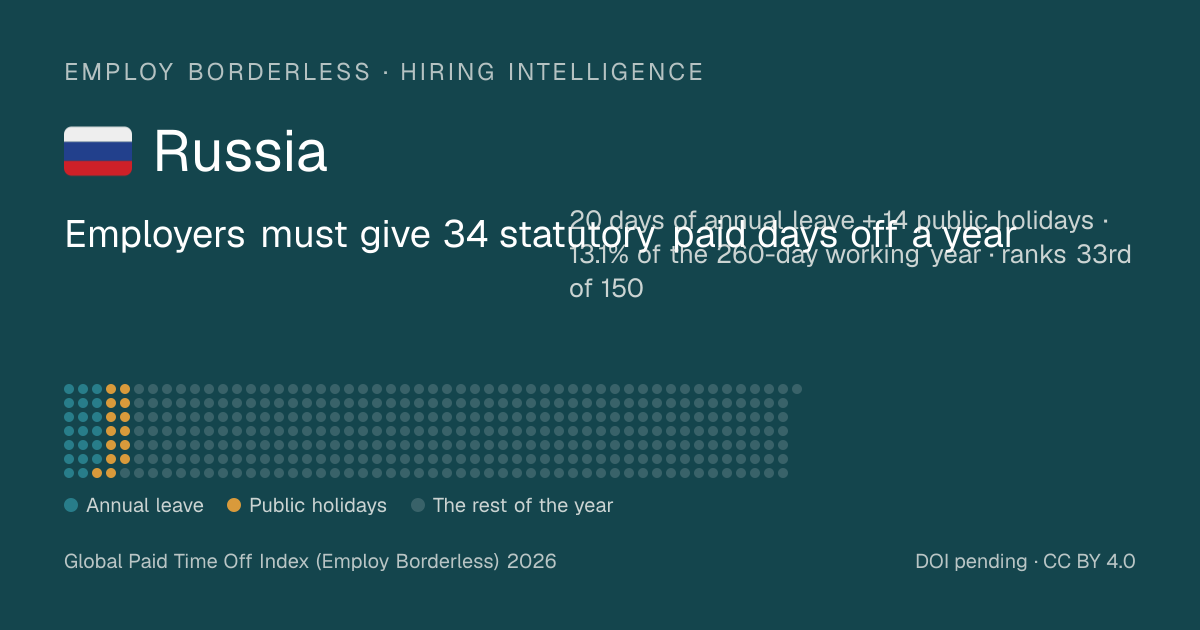
Spain · rank 33 · 34 days
Employers in Spain must give 34 statutory paid days off a year, 22 days of annual leave plus 12 public holidays, which is 13.1% of the 260-day working year and ranks the country 33rd of 150 for statutory paid time off.
An employer hiring in Spain must give 34 statutory paid days off a year, 22 days of annual leave plus 12 public holidays, about 6.8 working weeks and 13.1% of a 260-day working year, which leaves 226 working days per employee. It ranks 33rd of 150 countries in the Global Paid Time Off Index 2026. That is 5 days above the median of the ranked set. These are statutory minimums, and most offers add days above the minimum.
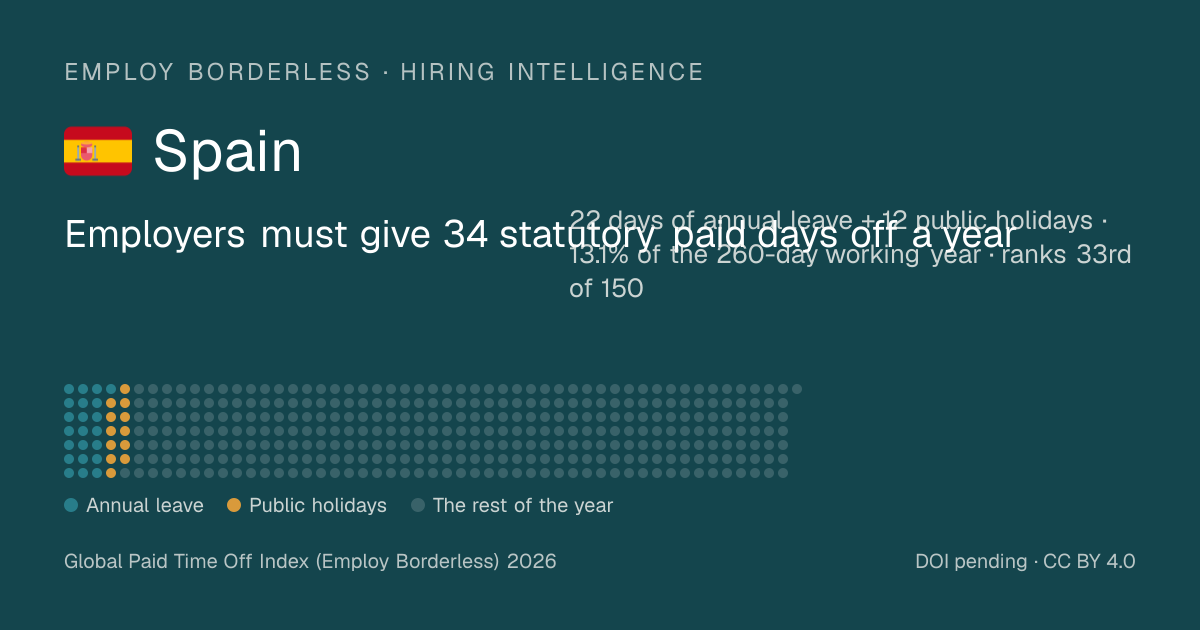
Uganda · rank 33 · 34 days
Employers in Uganda must give 34 statutory paid days off a year, 21 days of annual leave plus 13 public holidays, which is 13.1% of the 260-day working year and ranks the country 33rd of 150 for statutory paid time off.
An employer hiring in Uganda must give 34 statutory paid days off a year, 21 days of annual leave plus 13 public holidays, about 6.8 working weeks and 13.1% of a 260-day working year, which leaves 226 working days per employee. It ranks 33rd of 150 countries in the Global Paid Time Off Index 2026. That is 5 days above the median of the ranked set. These are statutory minimums, and most offers add days above the minimum.
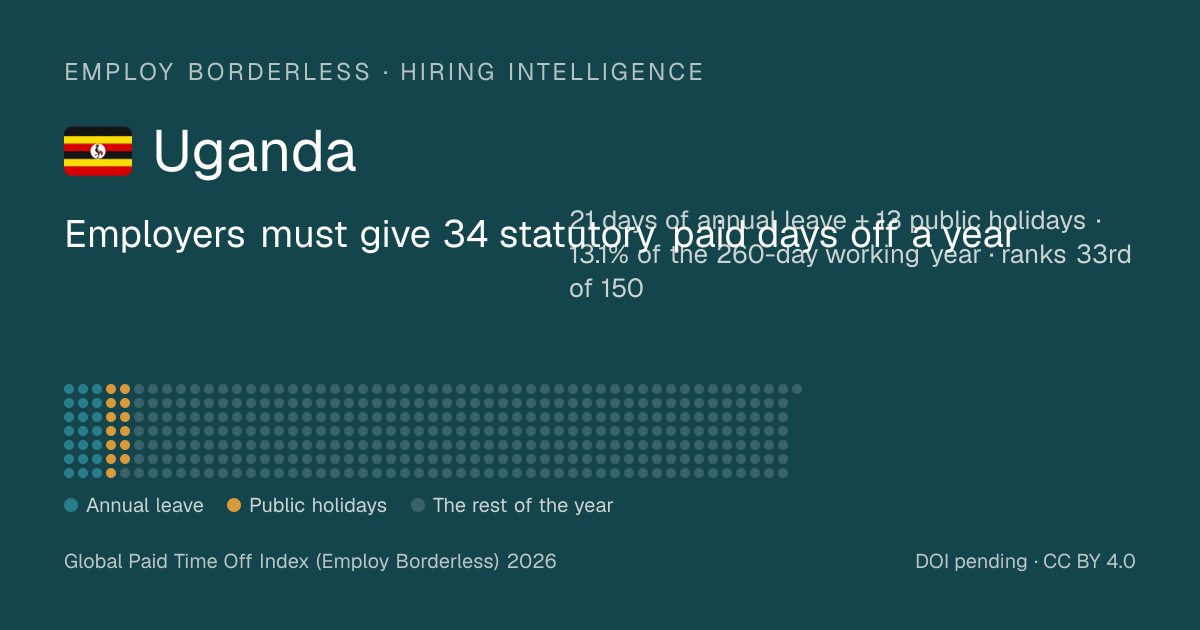
Armenia · rank 44 · 33 days
Employers in Armenia must give 33 statutory paid days off a year, 20 days of annual leave plus 13 public holidays, which is 12.7% of the 260-day working year and ranks the country 44th of 150 for statutory paid time off.
An employer hiring in Armenia must give 33 statutory paid days off a year, 20 days of annual leave plus 13 public holidays, about 6.6 working weeks and 12.7% of a 260-day working year, which leaves 227 working days per employee. It ranks 44th of 150 countries in the Global Paid Time Off Index 2026. That is 4 days above the median of the ranked set. These are statutory minimums, and most offers add days above the minimum.
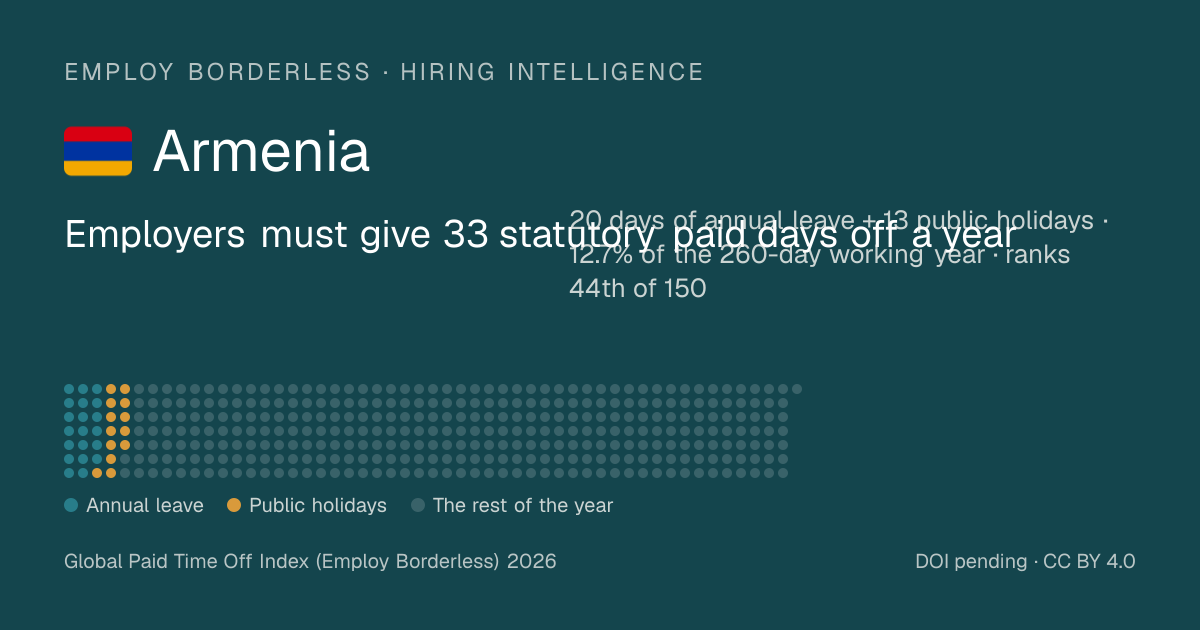
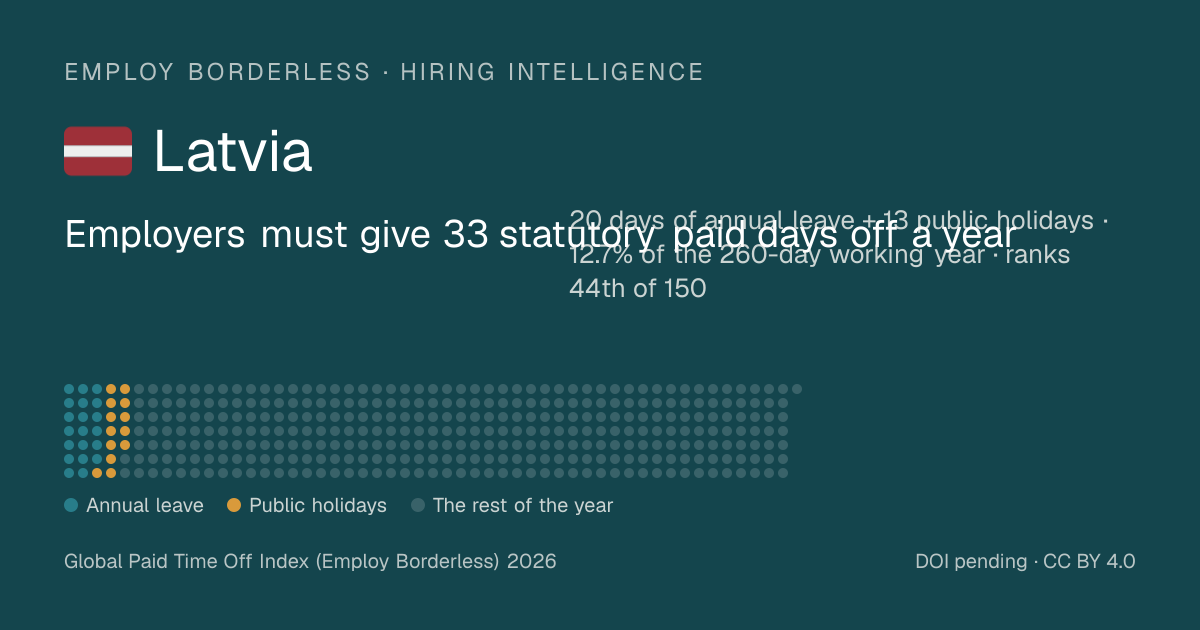
Colombia · rank 44 · 33 days
Employers in Colombia must give 33 statutory paid days off a year, 15 days of annual leave plus 18 public holidays, which is 12.7% of the 260-day working year and ranks the country 44th of 150 for statutory paid time off.
An employer hiring in Colombia must give 33 statutory paid days off a year, 15 days of annual leave plus 18 public holidays, about 6.6 working weeks and 12.7% of a 260-day working year, which leaves 227 working days per employee. It ranks 44th of 150 countries in the Global Paid Time Off Index 2026. That is 4 days above the median of the ranked set. These are statutory minimums, and most offers add days above the minimum.
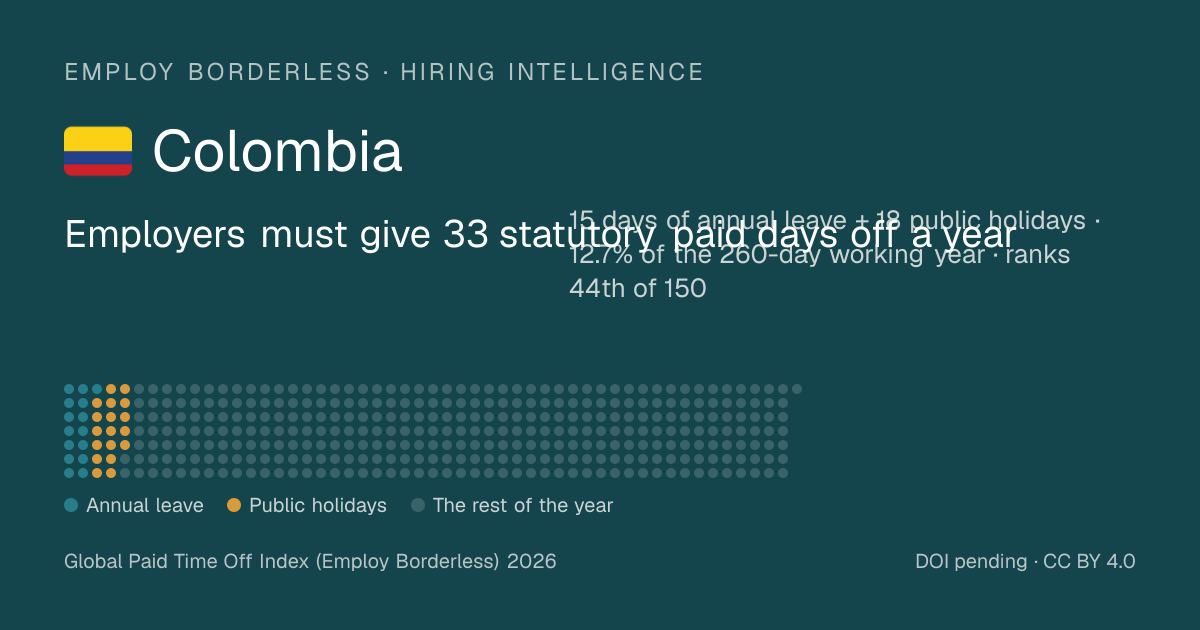
Czechia · rank 44 · 33 days
Employers in Czechia must give 33 statutory paid days off a year, 20 days of annual leave plus 13 public holidays, which is 12.7% of the 260-day working year and ranks the country 44th of 150 for statutory paid time off.
An employer hiring in Czechia must give 33 statutory paid days off a year, 20 days of annual leave plus 13 public holidays, about 6.6 working weeks and 12.7% of a 260-day working year, which leaves 227 working days per employee. It ranks 44th of 150 countries in the Global Paid Time Off Index 2026. That is 4 days above the median of the ranked set. These are statutory minimums, and most offers add days above the minimum.
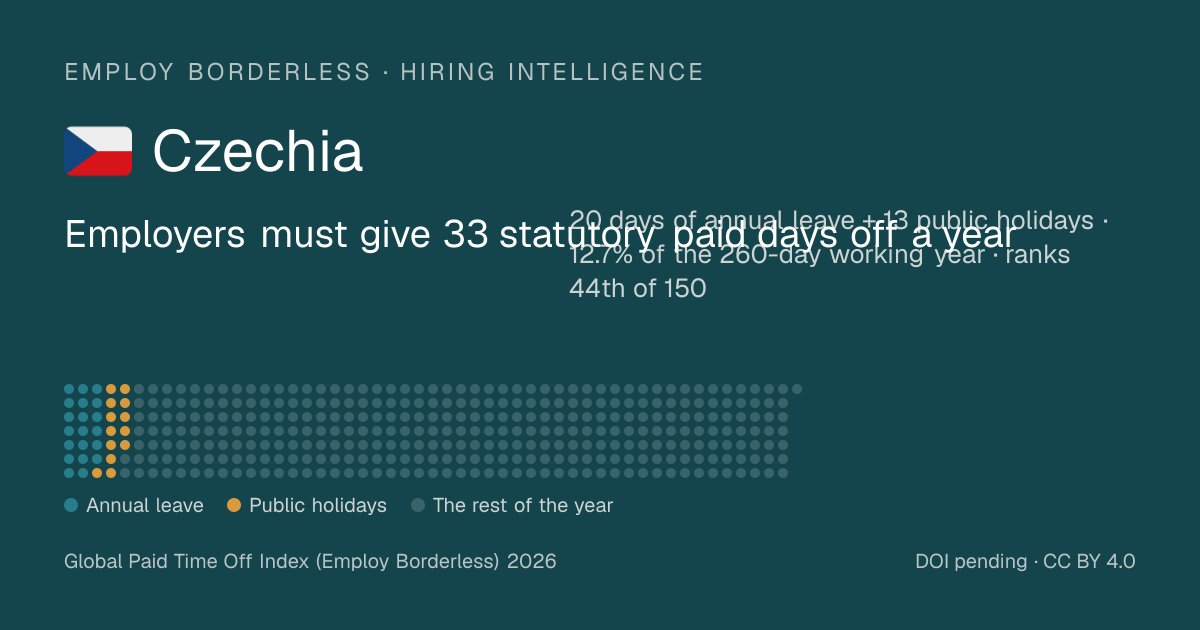
Italy · rank 44 · 33 days
Employers in Italy must give 33 statutory paid days off a year, 20 days of annual leave plus 13 public holidays, which is 12.7% of the 260-day working year and ranks the country 44th of 150 for statutory paid time off.
An employer hiring in Italy must give 33 statutory paid days off a year, 20 days of annual leave plus 13 public holidays, about 6.6 working weeks and 12.7% of a 260-day working year, which leaves 227 working days per employee. It ranks 44th of 150 countries in the Global Paid Time Off Index 2026. That is 4 days above the median of the ranked set. These are statutory minimums, and most offers add days above the minimum.
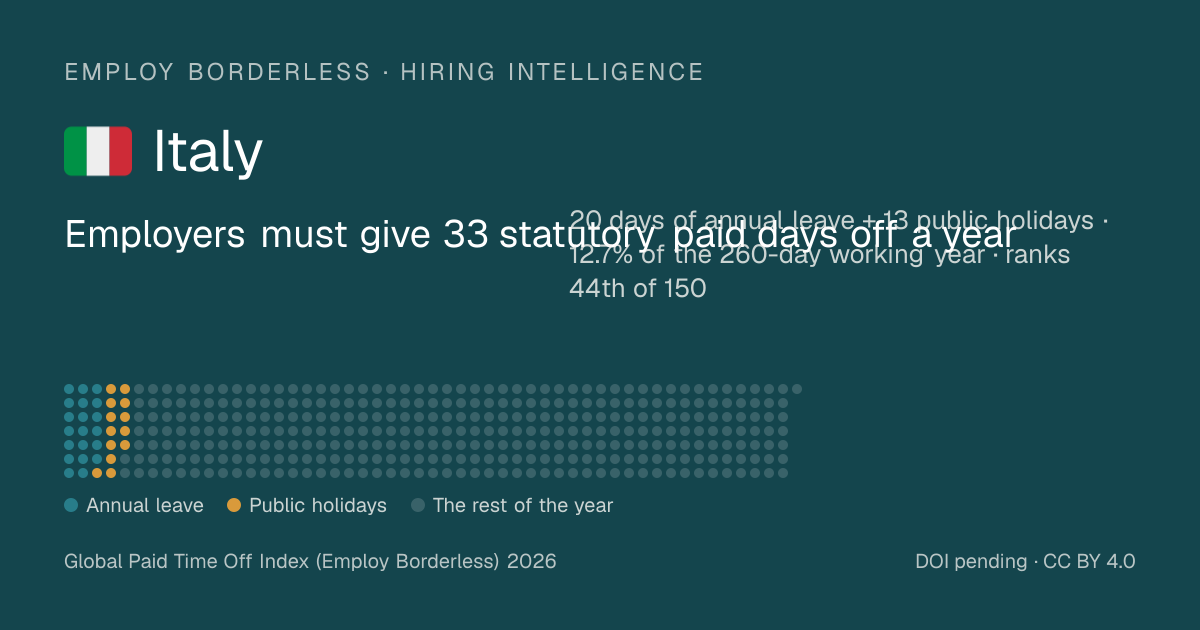
Latvia · rank 44 · 33 days
Employers in Latvia must give 33 statutory paid days off a year, 20 days of annual leave plus 13 public holidays, which is 12.7% of the 260-day working year and ranks the country 44th of 150 for statutory paid time off.
An employer hiring in Latvia must give 33 statutory paid days off a year, 20 days of annual leave plus 13 public holidays, about 6.6 working weeks and 12.7% of a 260-day working year, which leaves 227 working days per employee. It ranks 44th of 150 countries in the Global Paid Time Off Index 2026. That is 4 days above the median of the ranked set. These are statutory minimums, and most offers add days above the minimum.
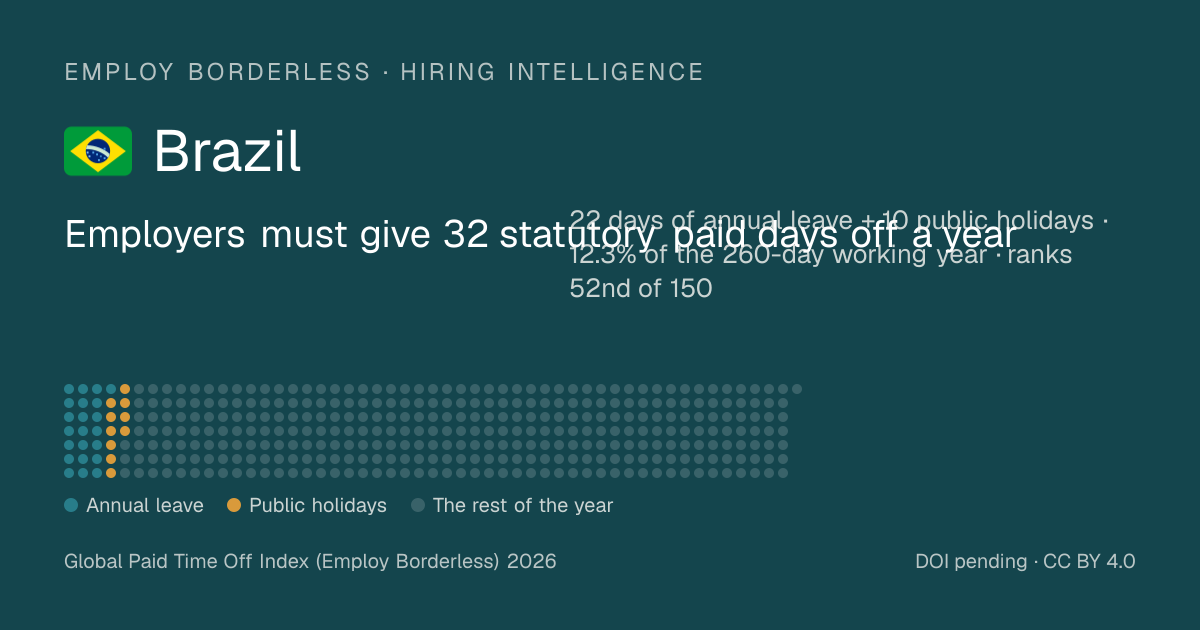
Moldova · rank 44 · 33 days
Employers in Moldova must give 33 statutory paid days off a year, 20 days of annual leave plus 13 public holidays, which is 12.7% of the 260-day working year and ranks the country 44th of 150 for statutory paid time off.
An employer hiring in Moldova must give 33 statutory paid days off a year, 20 days of annual leave plus 13 public holidays, about 6.6 working weeks and 12.7% of a 260-day working year, which leaves 227 working days per employee. It ranks 44th of 150 countries in the Global Paid Time Off Index 2026. That is 4 days above the median of the ranked set. These are statutory minimums, and most offers add days above the minimum.
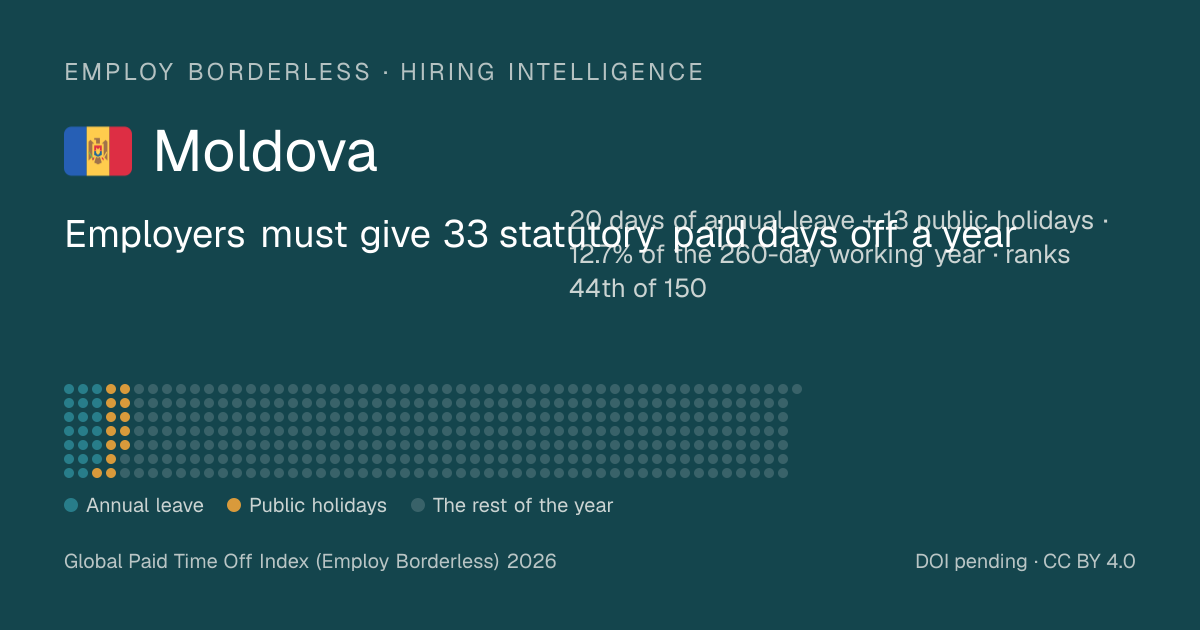
Namibia · rank 44 · 33 days
Employers in Namibia must give 33 statutory paid days off a year, 20 days of annual leave plus 13 public holidays, which is 12.7% of the 260-day working year and ranks the country 44th of 150 for statutory paid time off.
An employer hiring in Namibia must give 33 statutory paid days off a year, 20 days of annual leave plus 13 public holidays, about 6.6 working weeks and 12.7% of a 260-day working year, which leaves 227 working days per employee. It ranks 44th of 150 countries in the Global Paid Time Off Index 2026. That is 4 days above the median of the ranked set. These are statutory minimums, and most offers add days above the minimum.
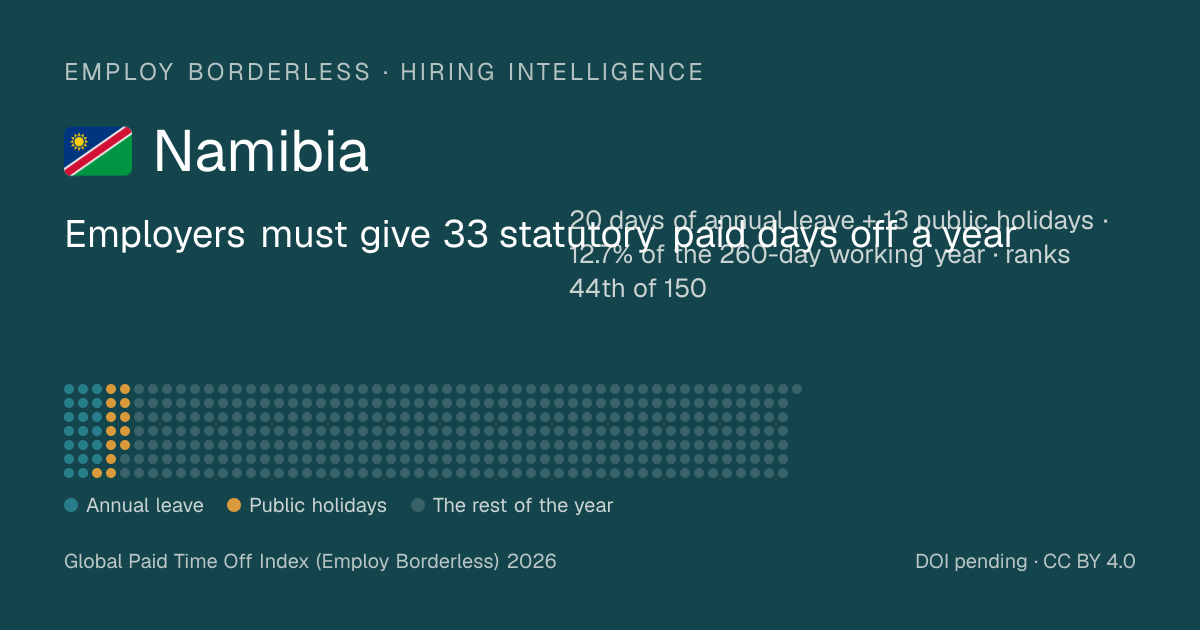
Serbia · rank 44 · 33 days
Employers in Serbia must give 33 statutory paid days off a year, 20 days of annual leave plus 13 public holidays, which is 12.7% of the 260-day working year and ranks the country 44th of 150 for statutory paid time off.
An employer hiring in Serbia must give 33 statutory paid days off a year, 20 days of annual leave plus 13 public holidays, about 6.6 working weeks and 12.7% of a 260-day working year, which leaves 227 working days per employee. It ranks 44th of 150 countries in the Global Paid Time Off Index 2026. That is 4 days above the median of the ranked set. These are statutory minimums, and most offers add days above the minimum.
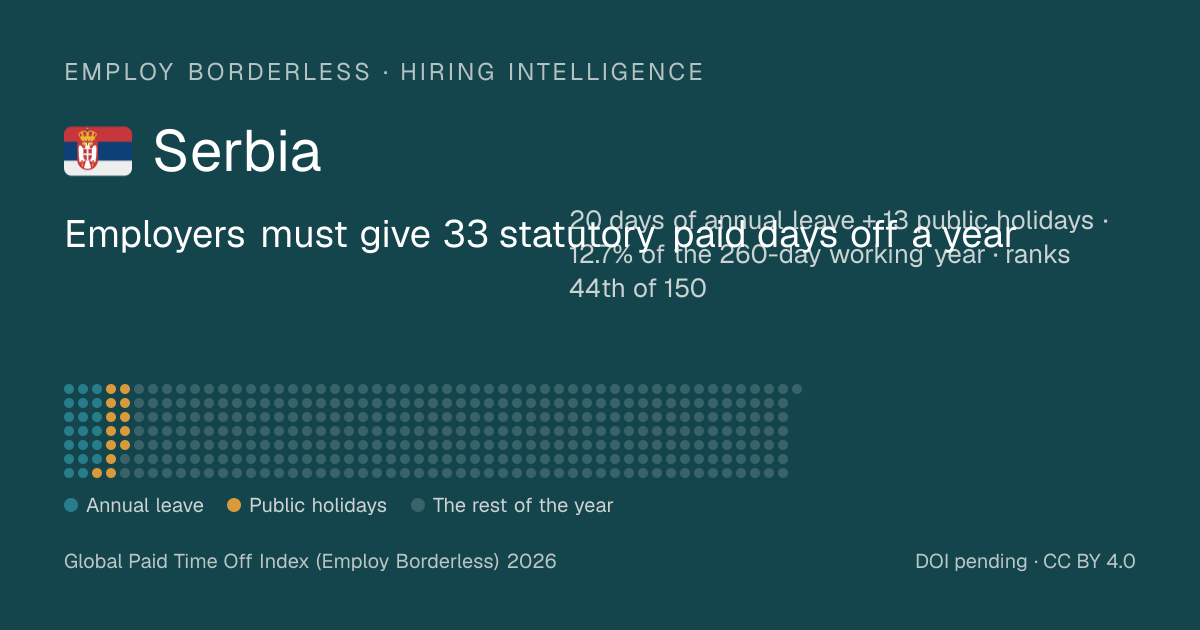
Brazil · rank 52 · 32 days
Employers in Brazil must give 32 statutory paid days off a year, 22 days of annual leave plus 10 public holidays, which is 12.3% of the 260-day working year and ranks the country 52nd of 150 for statutory paid time off.
An employer hiring in Brazil must give 32 statutory paid days off a year, 22 days of annual leave plus 10 public holidays, about 6.4 working weeks and 12.3% of a 260-day working year, which leaves 228 working days per employee. It ranks 52nd of 150 countries in the Global Paid Time Off Index 2026. That is 3 days above the median of the ranked set. These are statutory minimums, and most offers add days above the minimum.
Christmas Island · rank 52 · 32 days
Employers in Christmas Island must give 32 statutory paid days off a year, 20 days of annual leave plus 12 public holidays, which is 12.3% of the 260-day working year and ranks the country 52nd of 150 for statutory paid time off.
An employer hiring in Christmas Island must give 32 statutory paid days off a year, 20 days of annual leave plus 12 public holidays, about 6.4 working weeks and 12.3% of a 260-day working year, which leaves 228 working days per employee. It ranks 52nd of 150 countries in the Global Paid Time Off Index 2026. That is 3 days above the median of the ranked set. These are statutory minimums, and most offers add days above the minimum.
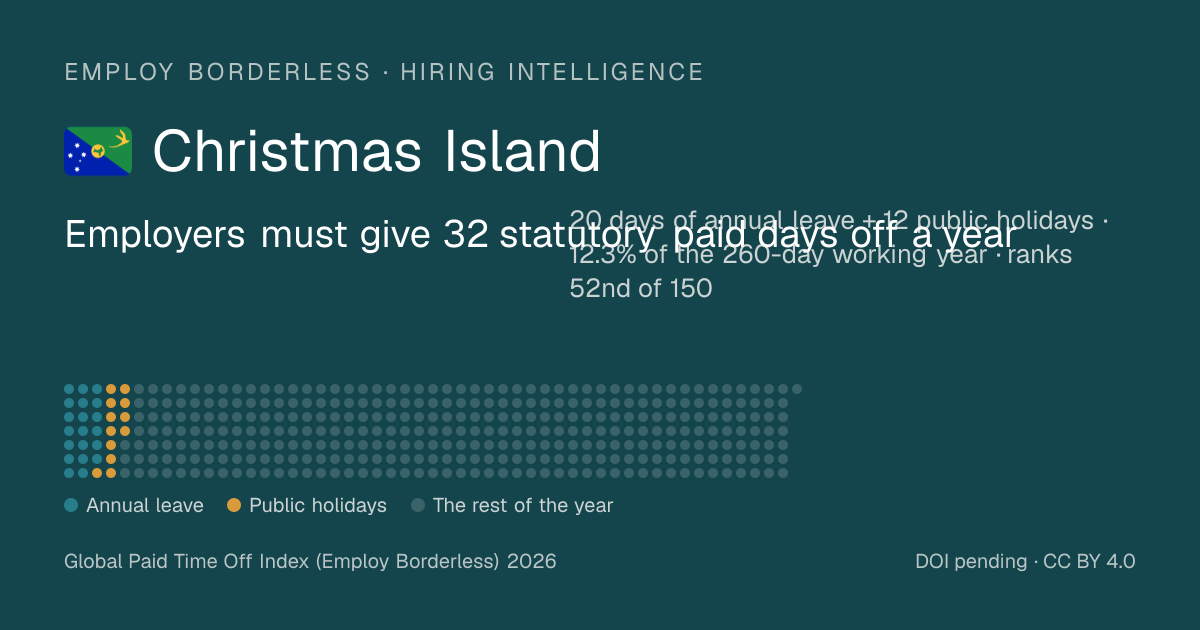
Estonia · rank 52 · 32 days
Employers in Estonia must give 32 statutory paid days off a year, 20 days of annual leave plus 12 public holidays, which is 12.3% of the 260-day working year and ranks the country 52nd of 150 for statutory paid time off.
An employer hiring in Estonia must give 32 statutory paid days off a year, 20 days of annual leave plus 12 public holidays, about 6.4 working weeks and 12.3% of a 260-day working year, which leaves 228 working days per employee. It ranks 52nd of 150 countries in the Global Paid Time Off Index 2026. That is 3 days above the median of the ranked set. These are statutory minimums, and most offers add days above the minimum.
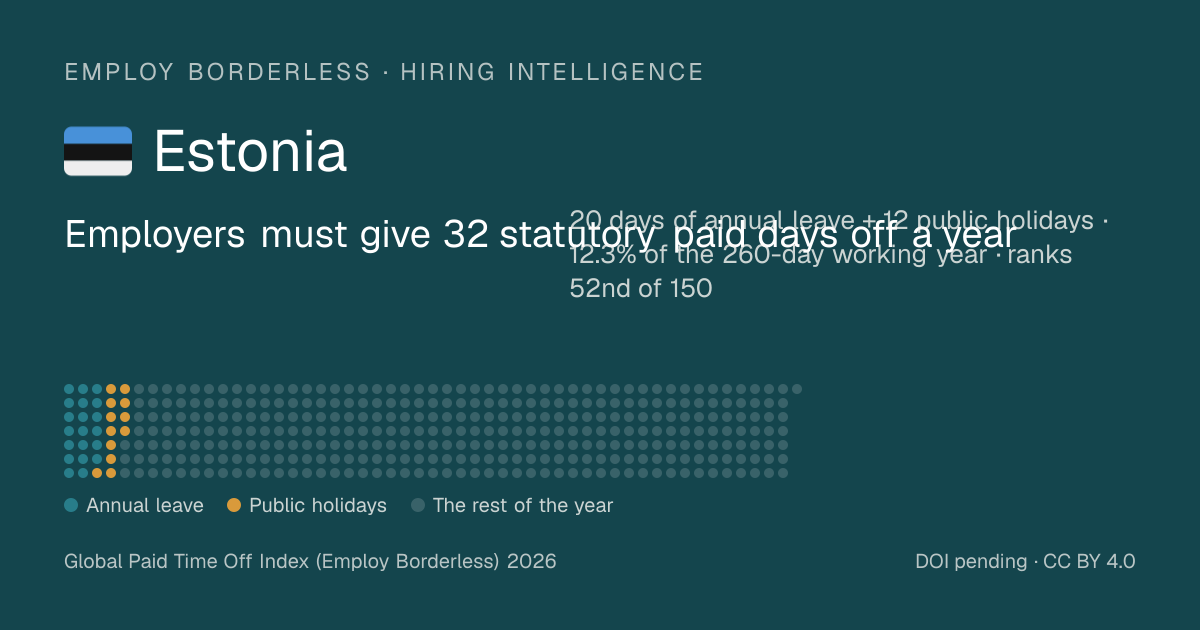
Kazakhstan · rank 52 · 32 days
Employers in Kazakhstan must give 32 statutory paid days off a year, 18 days of annual leave plus 14 public holidays, which is 12.3% of the 260-day working year and ranks the country 52nd of 150 for statutory paid time off.
An employer hiring in Kazakhstan must give 32 statutory paid days off a year, 18 days of annual leave plus 14 public holidays, about 6.4 working weeks and 12.3% of a 260-day working year, which leaves 228 working days per employee. It ranks 52nd of 150 countries in the Global Paid Time Off Index 2026. That is 3 days above the median of the ranked set. These are statutory minimums, and most offers add days above the minimum.
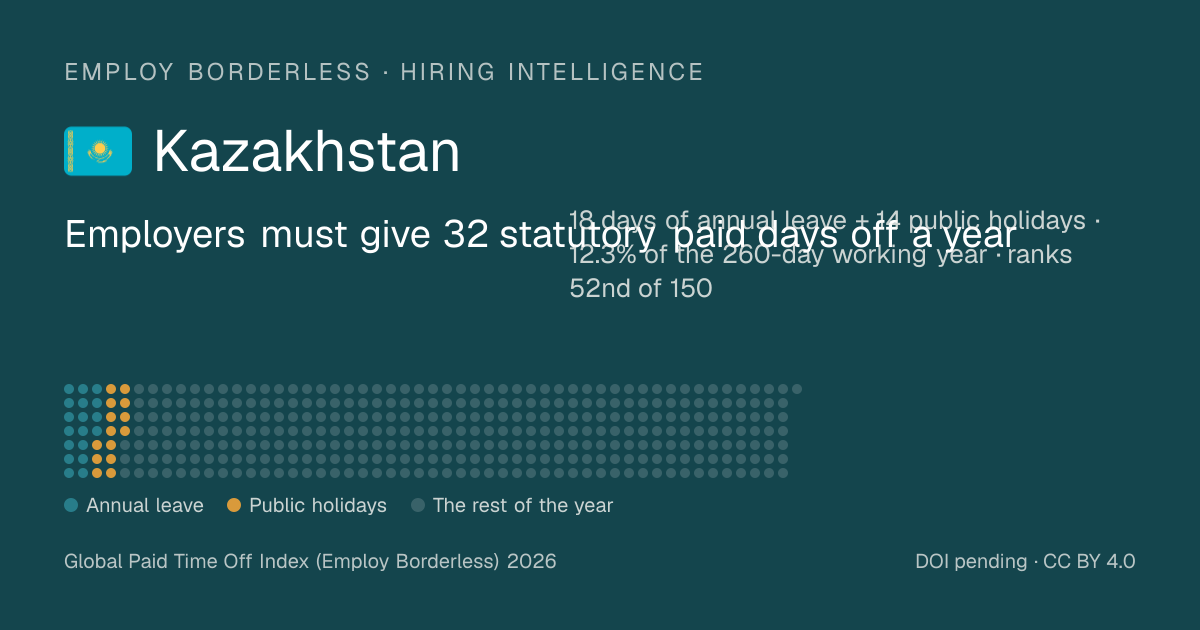
Kenya · rank 52 · 32 days
Employers in Kenya must give 32 statutory paid days off a year, 21 days of annual leave plus 11 public holidays, which is 12.3% of the 260-day working year and ranks the country 52nd of 150 for statutory paid time off.
An employer hiring in Kenya must give 32 statutory paid days off a year, 21 days of annual leave plus 11 public holidays, about 6.4 working weeks and 12.3% of a 260-day working year, which leaves 228 working days per employee. It ranks 52nd of 150 countries in the Global Paid Time Off Index 2026. That is 3 days above the median of the ranked set. These are statutory minimums, and most offers add days above the minimum.
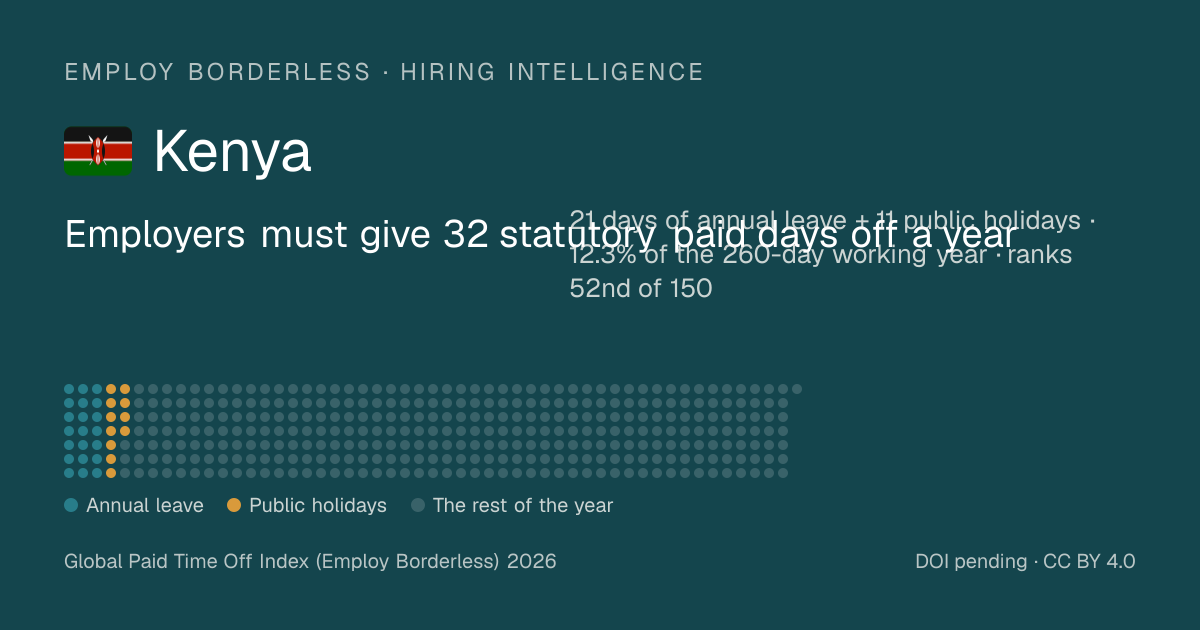
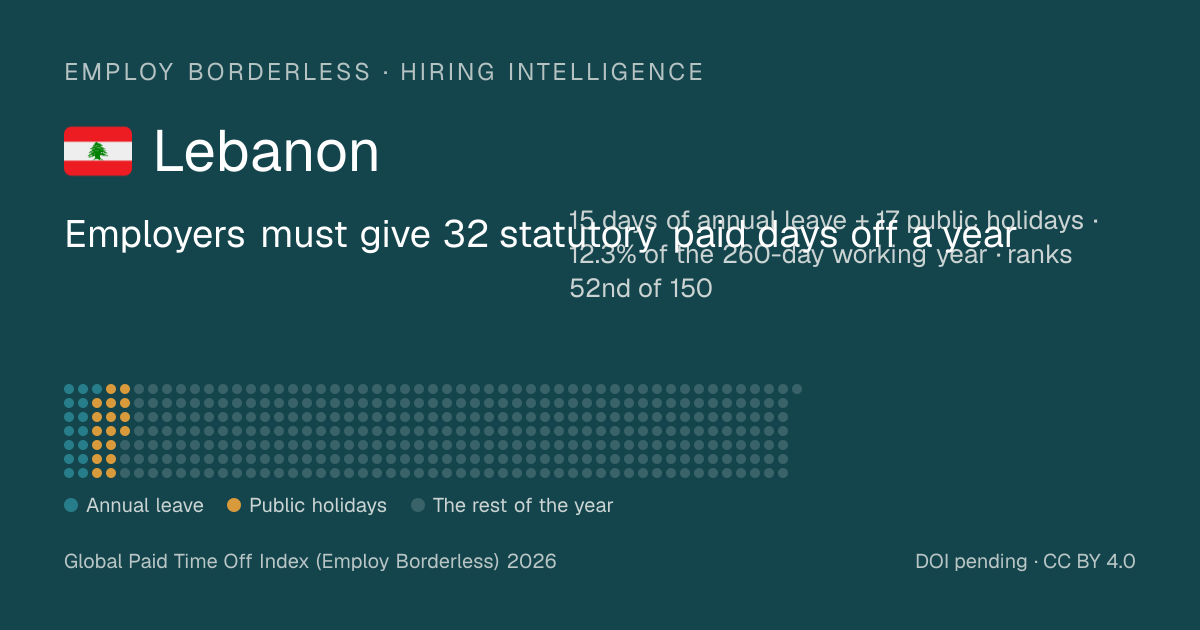
Lebanon · rank 52 · 32 days
Employers in Lebanon must give 32 statutory paid days off a year, 15 days of annual leave plus 17 public holidays, which is 12.3% of the 260-day working year and ranks the country 52nd of 150 for statutory paid time off.
An employer hiring in Lebanon must give 32 statutory paid days off a year, 15 days of annual leave plus 17 public holidays, about 6.4 working weeks and 12.3% of a 260-day working year, which leaves 228 working days per employee. It ranks 52nd of 150 countries in the Global Paid Time Off Index 2026. That is 3 days above the median of the ranked set. These are statutory minimums, and most offers add days above the minimum.
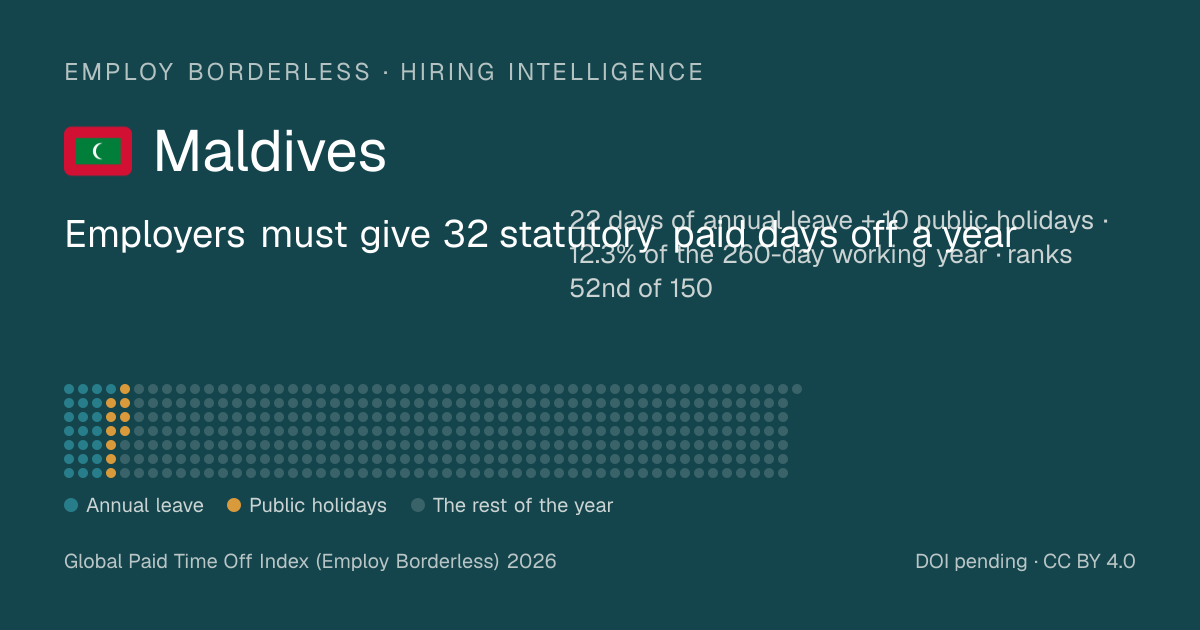
Maldives · rank 52 · 32 days
Employers in the Maldives must give 32 statutory paid days off a year, 22 days of annual leave plus 10 public holidays, which is 12.3% of the 260-day working year and ranks the country 52nd of 150 for statutory paid time off.
An employer hiring in the Maldives must give 32 statutory paid days off a year, 22 days of annual leave plus 10 public holidays, about 6.4 working weeks and 12.3% of a 260-day working year, which leaves 228 working days per employee. It ranks 52nd of 150 countries in the Global Paid Time Off Index 2026. That is 3 days above the median of the ranked set. These are statutory minimums, and most offers add days above the minimum.
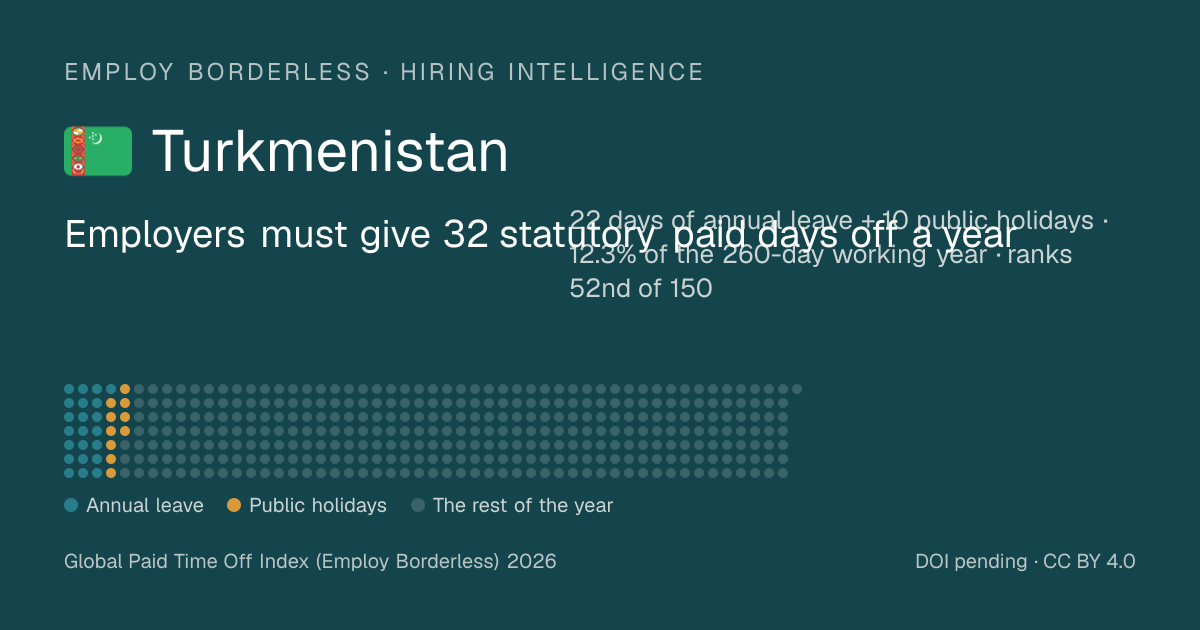
Turkmenistan · rank 52 · 32 days
Employers in Turkmenistan must give 32 statutory paid days off a year, 22 days of annual leave plus 10 public holidays, which is 12.3% of the 260-day working year and ranks the country 52nd of 150 for statutory paid time off.
An employer hiring in Turkmenistan must give 32 statutory paid days off a year, 22 days of annual leave plus 10 public holidays, about 6.4 working weeks and 12.3% of a 260-day working year, which leaves 228 working days per employee. It ranks 52nd of 150 countries in the Global Paid Time Off Index 2026. That is 3 days above the median of the ranked set. These are statutory minimums, and most offers add days above the minimum.
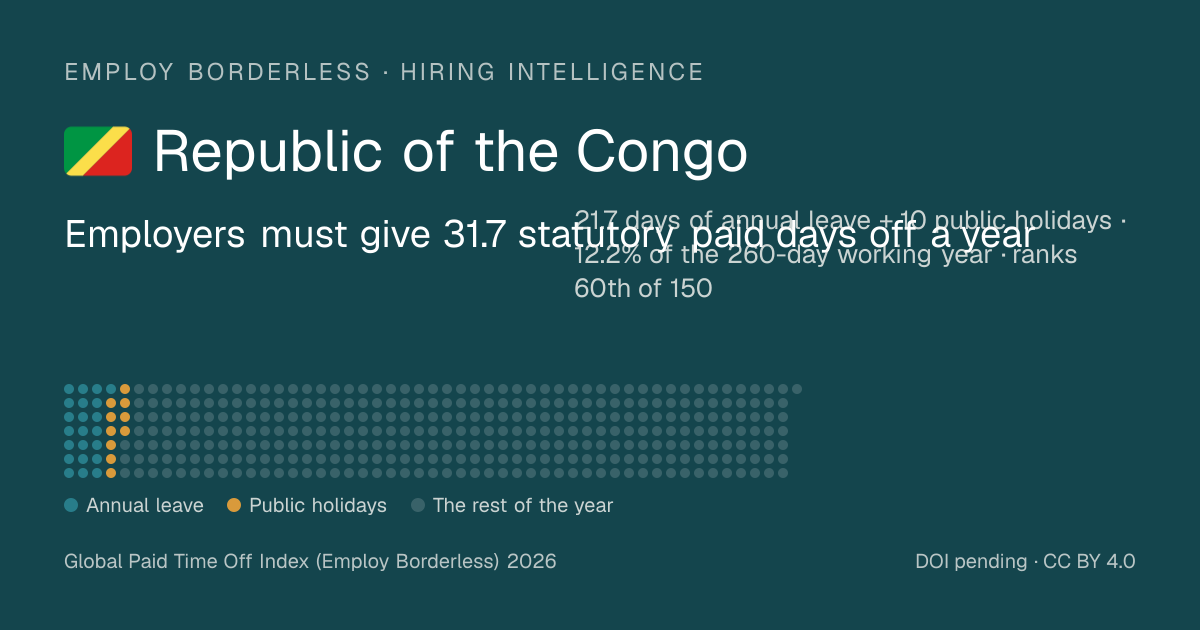
Republic of the Congo · rank 60 · 31.7 days
Employers in the Republic of the Congo must give 31.7 statutory paid days off a year, 21.7 days of annual leave plus 10 public holidays, which is 12.2% of the 260-day working year and ranks the country 60th of 150 for statutory paid time off.
An employer hiring in the Republic of the Congo must give 31.7 statutory paid days off a year, 21.7 days of annual leave plus 10 public holidays, about 6.3 working weeks and 12.2% of a 260-day working year, which leaves 228.3 working days per employee. It ranks 60th of 150 countries in the Global Paid Time Off Index 2026. That is 2.7 days above the median of the ranked set. These are statutory minimums, and most offers add days above the minimum.
Australia · rank 61 · 31 days
Employers in Australia must give 31 statutory paid days off a year, 20 days of annual leave plus 11 public holidays, which is 11.9% of the 260-day working year and ranks the country 61st of 150 for statutory paid time off.
An employer hiring in Australia must give 31 statutory paid days off a year, 20 days of annual leave plus 11 public holidays, about 6.2 working weeks and 11.9% of a 260-day working year, which leaves 229 working days per employee. It ranks 61st of 150 countries in the Global Paid Time Off Index 2026. That is 2 days above the median of the ranked set. These are statutory minimums, and most offers add days above the minimum.
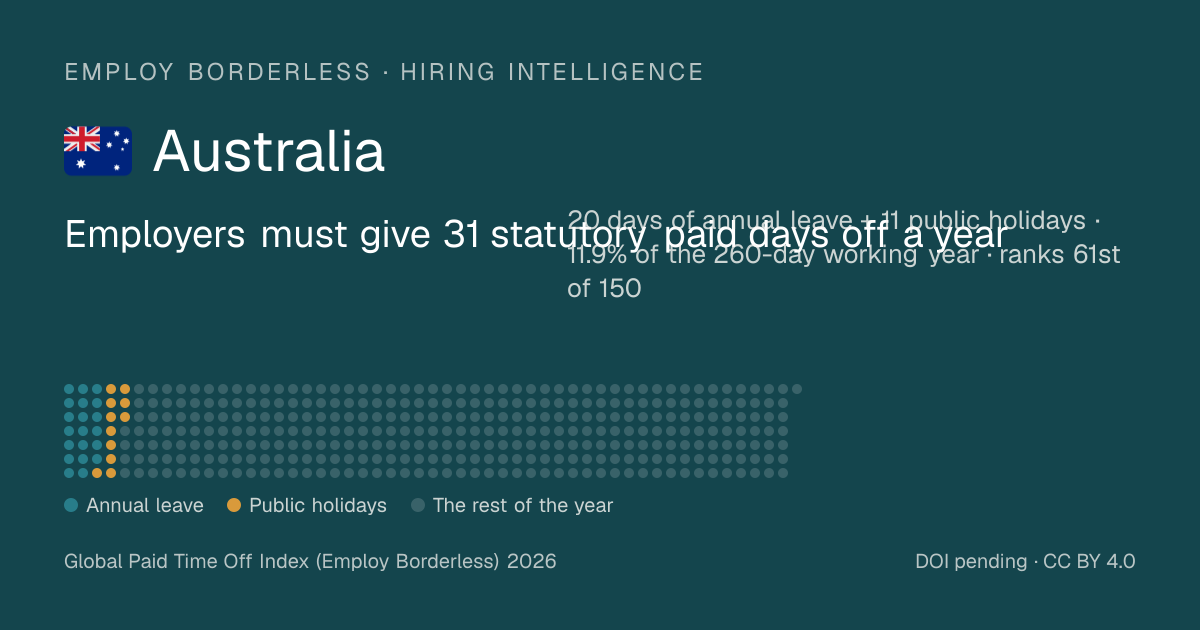
Cape Verde · rank 61 · 31 days
Employers in Cape Verde must give 31 statutory paid days off a year, 22 days of annual leave plus 9 public holidays, which is 11.9% of the 260-day working year and ranks the country 61st of 150 for statutory paid time off.
An employer hiring in Cape Verde must give 31 statutory paid days off a year, 22 days of annual leave plus 9 public holidays, about 6.2 working weeks and 11.9% of a 260-day working year, which leaves 229 working days per employee. It ranks 61st of 150 countries in the Global Paid Time Off Index 2026. That is 2 days above the median of the ranked set. These are statutory minimums, and most offers add days above the minimum.
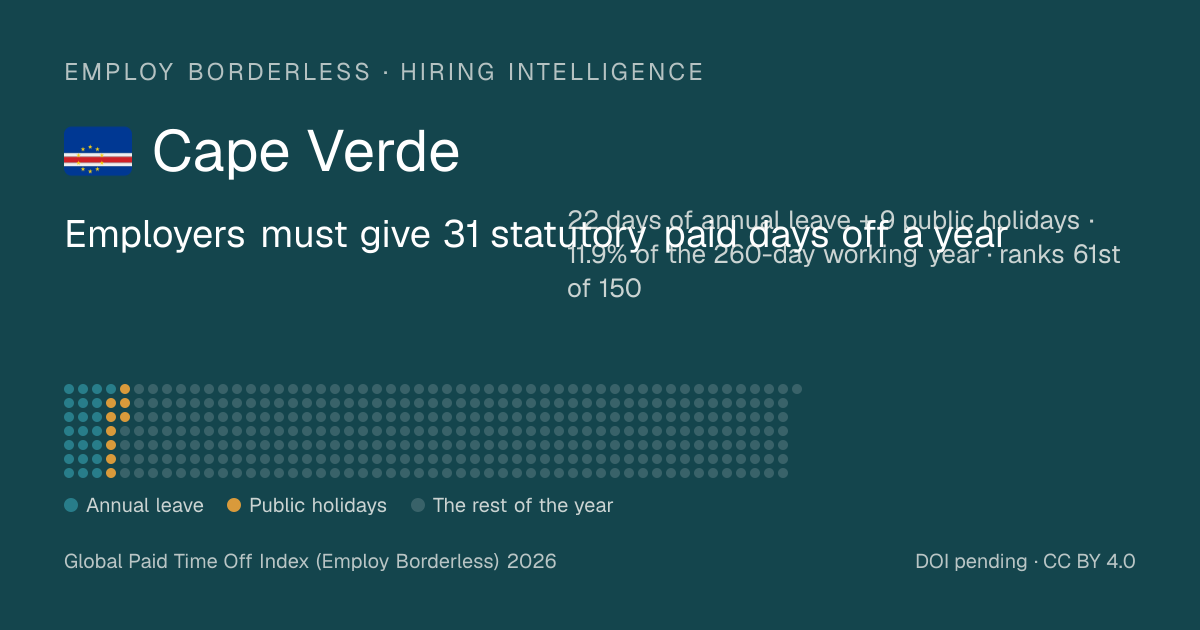
Chile · rank 61 · 31 days
Employers in Chile must give 31 statutory paid days off a year, 15 days of annual leave plus 16 public holidays, which is 11.9% of the 260-day working year and ranks the country 61st of 150 for statutory paid time off.
An employer hiring in Chile must give 31 statutory paid days off a year, 15 days of annual leave plus 16 public holidays, about 6.2 working weeks and 11.9% of a 260-day working year, which leaves 229 working days per employee. It ranks 61st of 150 countries in the Global Paid Time Off Index 2026. That is 2 days above the median of the ranked set. These are statutory minimums, and most offers add days above the minimum.
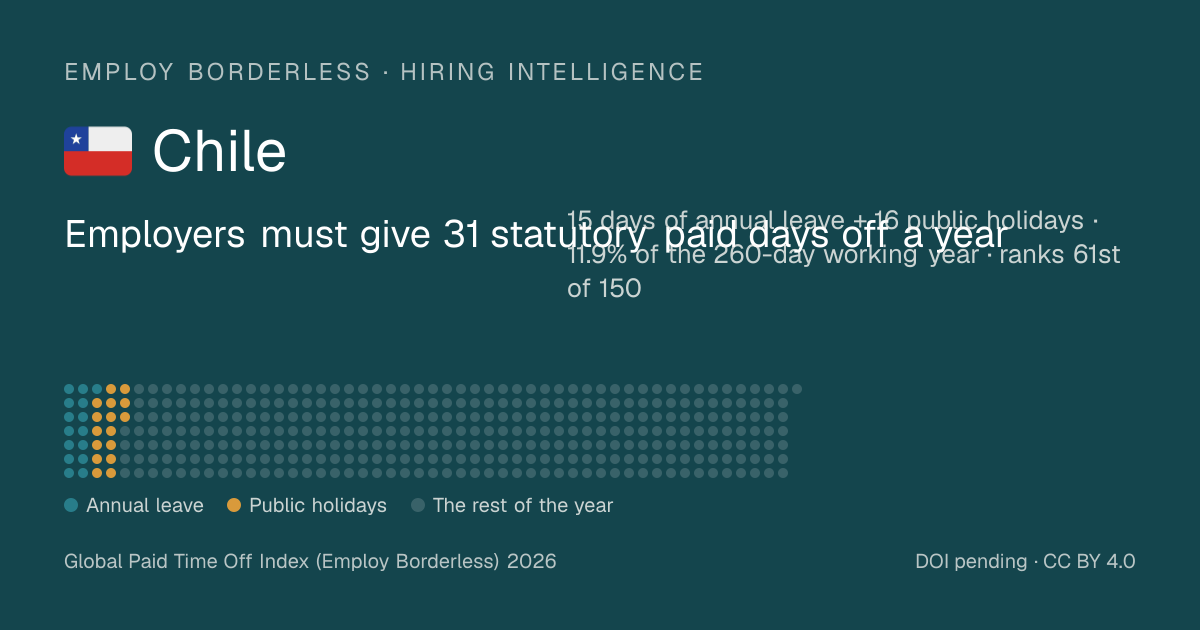
Cuba · rank 61 · 31 days
Employers in Cuba must give 31 statutory paid days off a year, 22 days of annual leave plus 9 public holidays, which is 11.9% of the 260-day working year and ranks the country 61st of 150 for statutory paid time off.
An employer hiring in Cuba must give 31 statutory paid days off a year, 22 days of annual leave plus 9 public holidays, about 6.2 working weeks and 11.9% of a 260-day working year, which leaves 229 working days per employee. It ranks 61st of 150 countries in the Global Paid Time Off Index 2026. That is 2 days above the median of the ranked set. These are statutory minimums, and most offers add days above the minimum.
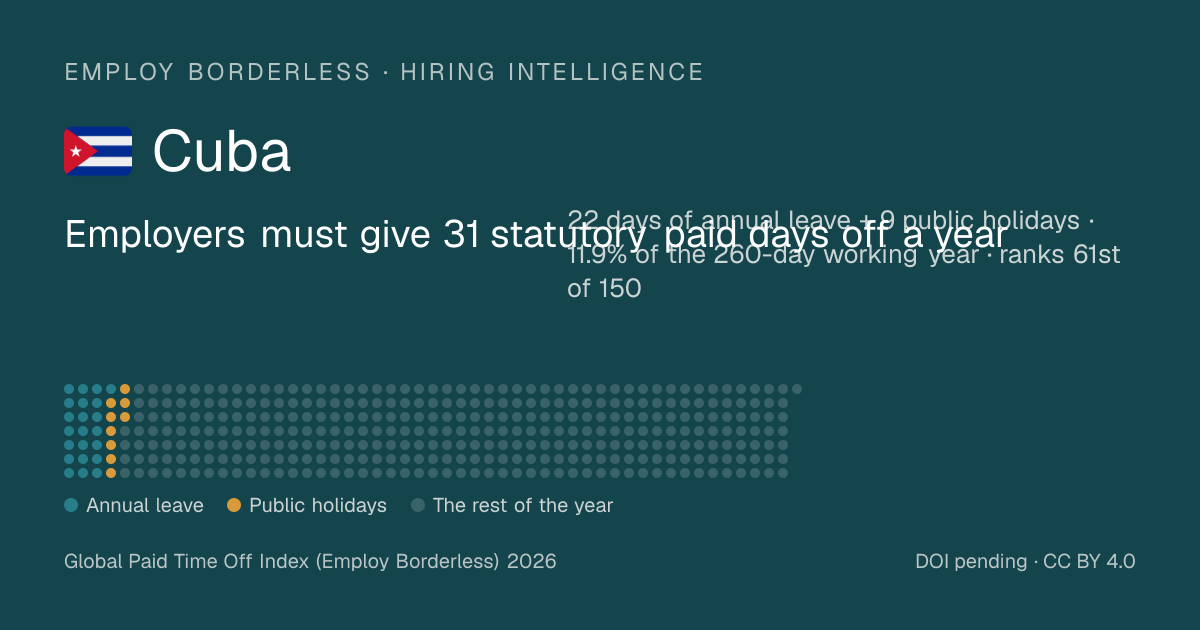
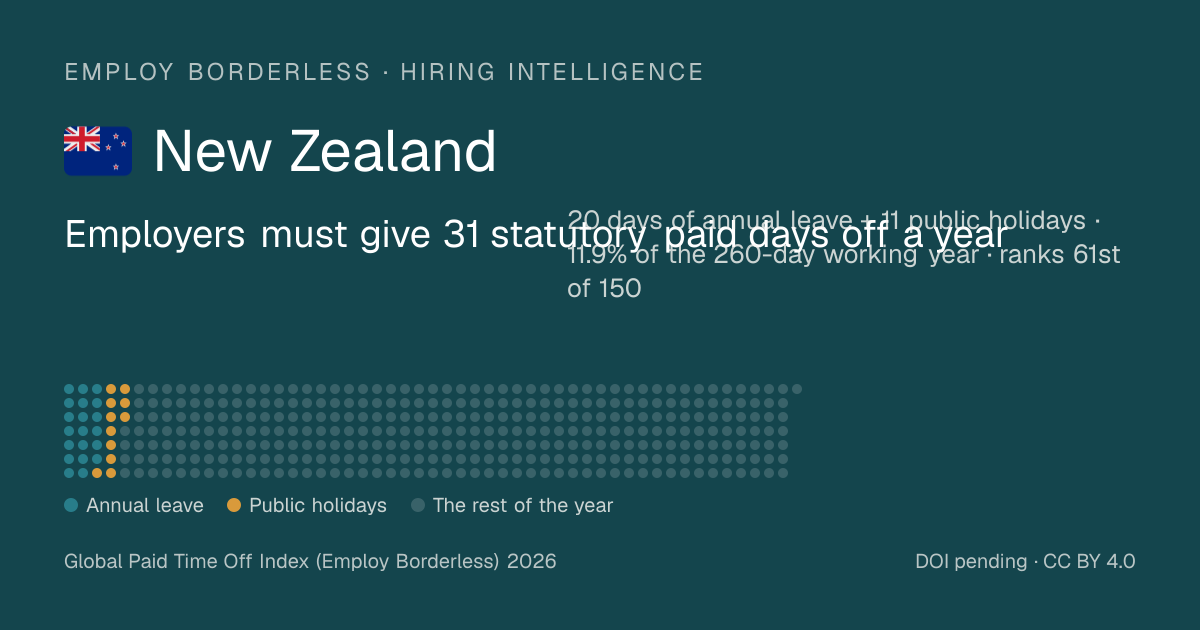
Hungary · rank 61 · 31 days
Employers in Hungary must give 31 statutory paid days off a year, 20 days of annual leave plus 11 public holidays, which is 11.9% of the 260-day working year and ranks the country 61st of 150 for statutory paid time off.
An employer hiring in Hungary must give 31 statutory paid days off a year, 20 days of annual leave plus 11 public holidays, about 6.2 working weeks and 11.9% of a 260-day working year, which leaves 229 working days per employee. It ranks 61st of 150 countries in the Global Paid Time Off Index 2026. That is 2 days above the median of the ranked set. These are statutory minimums, and most offers add days above the minimum.
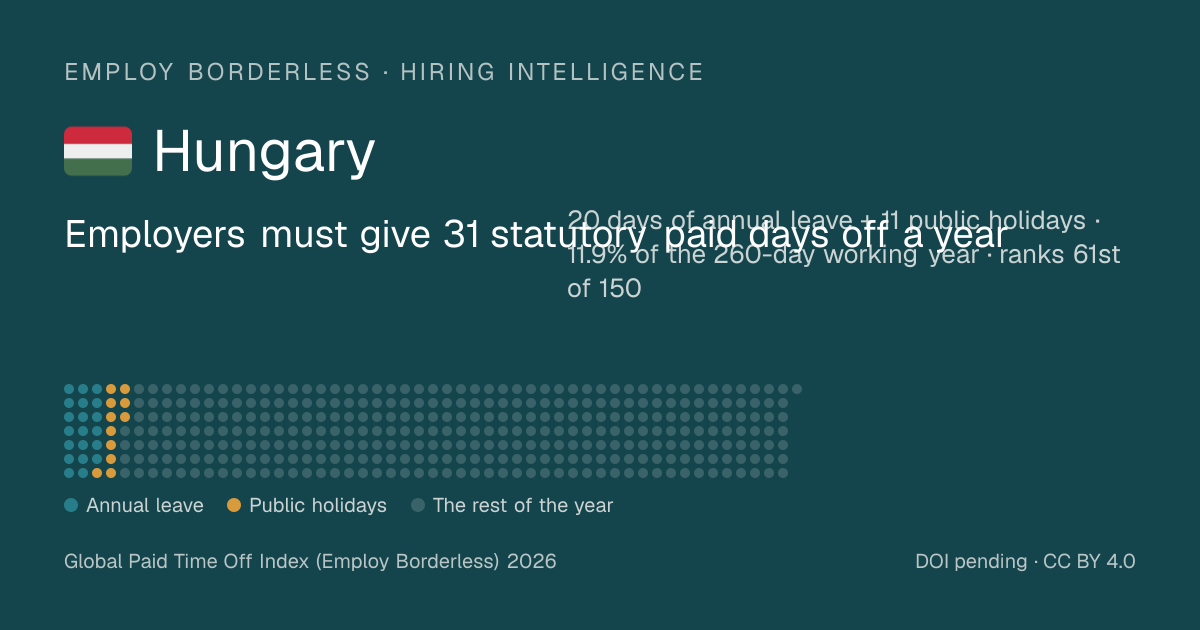
Mongolia · rank 61 · 31 days
Employers in Mongolia must give 31 statutory paid days off a year, 15 days of annual leave plus 16 public holidays, which is 11.9% of the 260-day working year and ranks the country 61st of 150 for statutory paid time off.
An employer hiring in Mongolia must give 31 statutory paid days off a year, 15 days of annual leave plus 16 public holidays, about 6.2 working weeks and 11.9% of a 260-day working year, which leaves 229 working days per employee. It ranks 61st of 150 countries in the Global Paid Time Off Index 2026. That is 2 days above the median of the ranked set. These are statutory minimums, and most offers add days above the minimum.
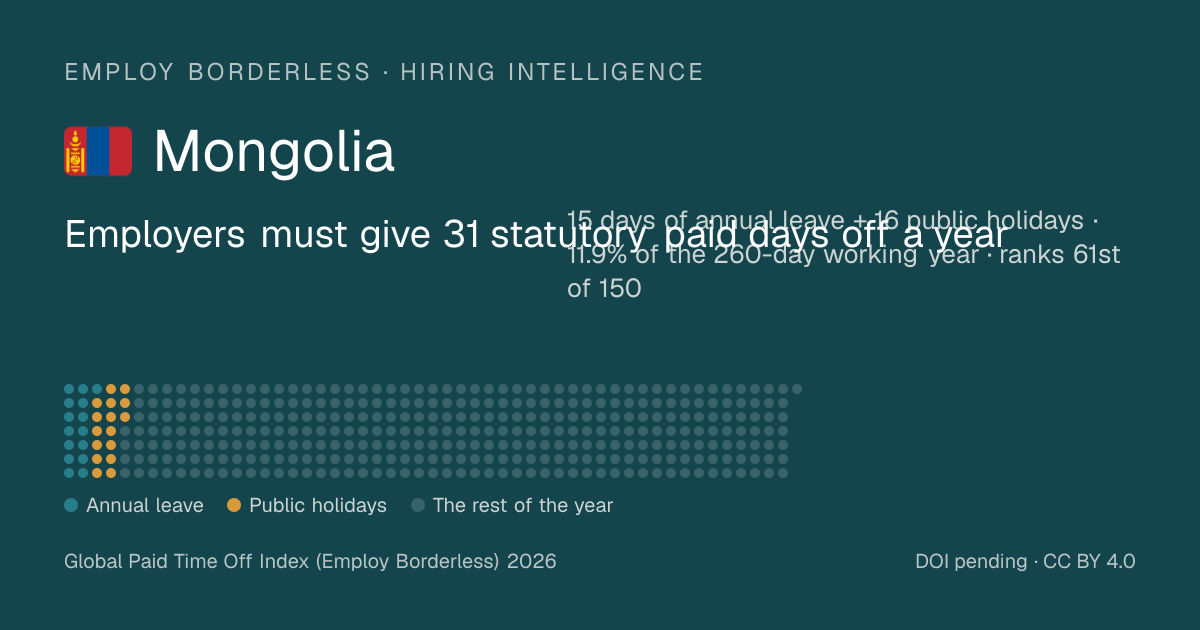
Mozambique · rank 61 · 31 days
Employers in Mozambique must give 31 statutory paid days off a year, 22 days of annual leave plus 9 public holidays, which is 11.9% of the 260-day working year and ranks the country 61st of 150 for statutory paid time off.
An employer hiring in Mozambique must give 31 statutory paid days off a year, 22 days of annual leave plus 9 public holidays, about 6.2 working weeks and 11.9% of a 260-day working year, which leaves 229 working days per employee. It ranks 61st of 150 countries in the Global Paid Time Off Index 2026. That is 2 days above the median of the ranked set. These are statutory minimums, and most offers add days above the minimum.
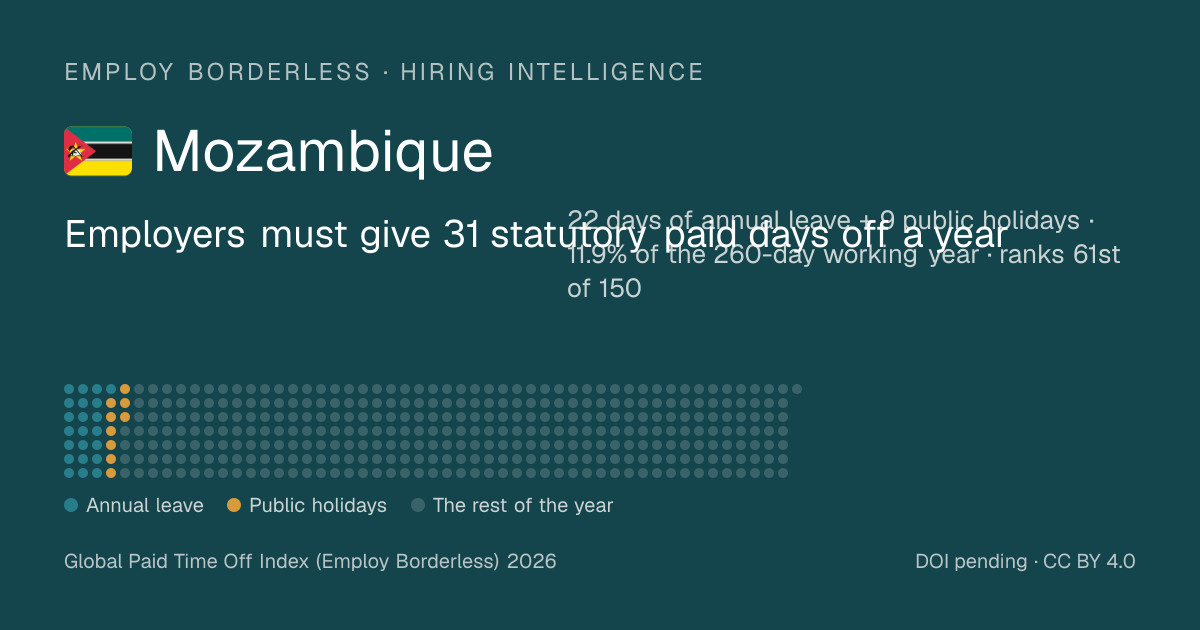
New Zealand · rank 61 · 31 days
Employers in New Zealand must give 31 statutory paid days off a year, 20 days of annual leave plus 11 public holidays, which is 11.9% of the 260-day working year and ranks the country 61st of 150 for statutory paid time off.
An employer hiring in New Zealand must give 31 statutory paid days off a year, 20 days of annual leave plus 11 public holidays, about 6.2 working weeks and 11.9% of a 260-day working year, which leaves 229 working days per employee. It ranks 61st of 150 countries in the Global Paid Time Off Index 2026. That is 2 days above the median of the ranked set. These are statutory minimums, and most offers add days above the minimum.
Slovakia · rank 61 · 31 days
Employers in Slovakia must give 31 statutory paid days off a year, 20 days of annual leave plus 11 public holidays, which is 11.9% of the 260-day working year and ranks the country 61st of 150 for statutory paid time off.
An employer hiring in Slovakia must give 31 statutory paid days off a year, 20 days of annual leave plus 11 public holidays, about 6.2 working weeks and 11.9% of a 260-day working year, which leaves 229 working days per employee. It ranks 61st of 150 countries in the Global Paid Time Off Index 2026. That is 2 days above the median of the ranked set. These are statutory minimums, and most offers add days above the minimum.
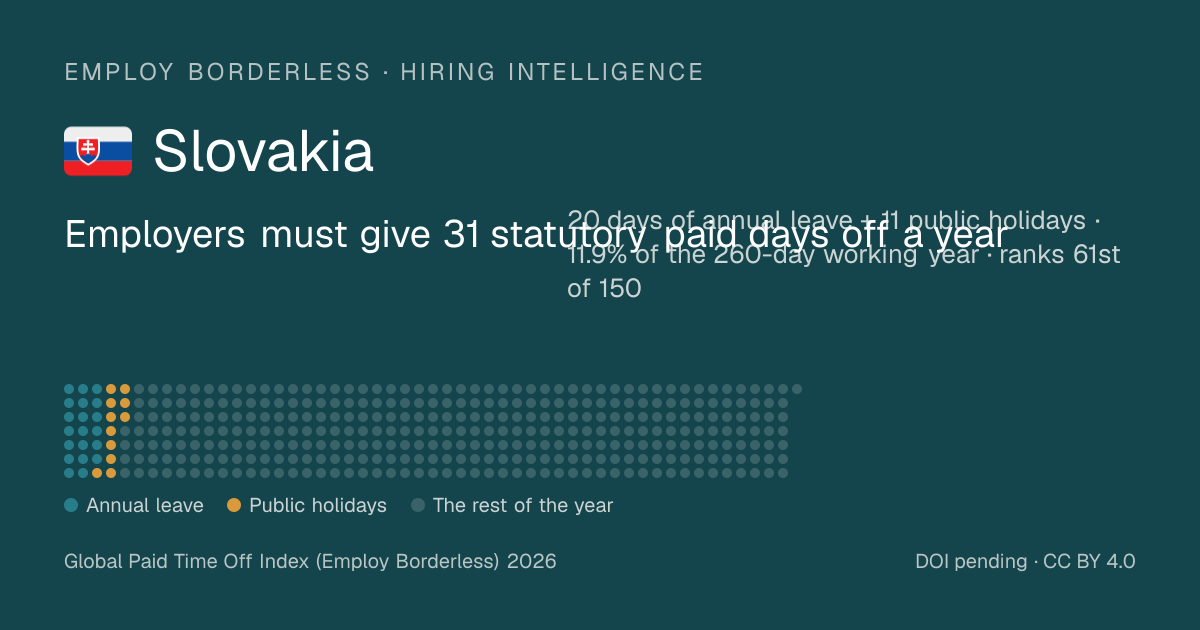
Belgium · rank 70 · 30 days
Employers in Belgium must give 30 statutory paid days off a year, 20 days of annual leave plus 10 public holidays, which is 11.5% of the 260-day working year and ranks the country 70th of 150 for statutory paid time off.
An employer hiring in Belgium must give 30 statutory paid days off a year, 20 days of annual leave plus 10 public holidays, about 6 working weeks and 11.5% of a 260-day working year, which leaves 230 working days per employee. It ranks 70th of 150 countries in the Global Paid Time Off Index 2026. That is 1 days above the median of the ranked set. These are statutory minimums, and most offers add days above the minimum.
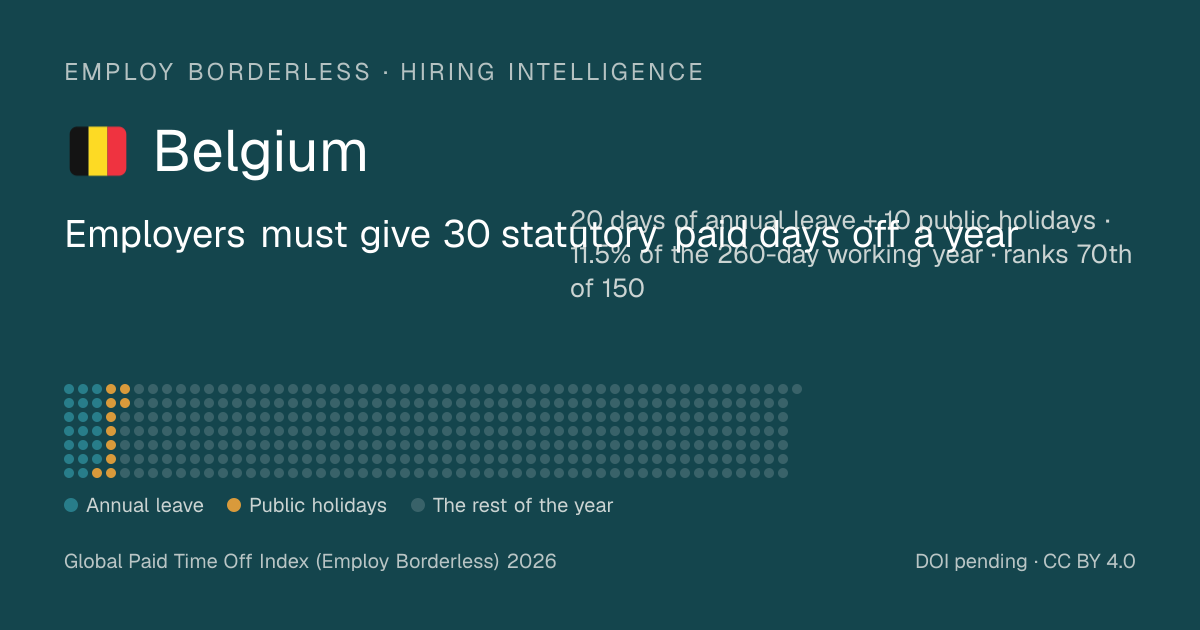
Ireland · rank 70 · 30 days
Employers in Ireland must give 30 statutory paid days off a year, 20 days of annual leave plus 10 public holidays, which is 11.5% of the 260-day working year and ranks the country 70th of 150 for statutory paid time off.
An employer hiring in Ireland must give 30 statutory paid days off a year, 20 days of annual leave plus 10 public holidays, about 6 working weeks and 11.5% of a 260-day working year, which leaves 230 working days per employee. It ranks 70th of 150 countries in the Global Paid Time Off Index 2026. That is 1 days above the median of the ranked set. These are statutory minimums, and most offers add days above the minimum.
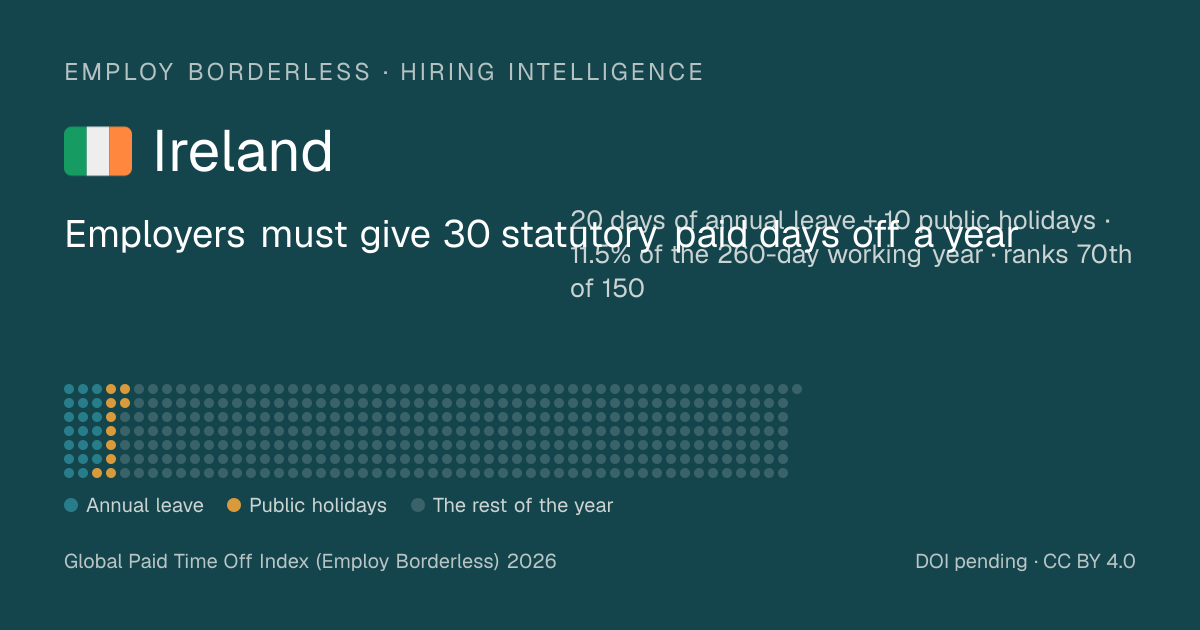
Montenegro · rank 70 · 30 days
Employers in Montenegro must give 30 statutory paid days off a year, 20 days of annual leave plus 10 public holidays, which is 11.5% of the 260-day working year and ranks the country 70th of 150 for statutory paid time off.
An employer hiring in Montenegro must give 30 statutory paid days off a year, 20 days of annual leave plus 10 public holidays, about 6 working weeks and 11.5% of a 260-day working year, which leaves 230 working days per employee. It ranks 70th of 150 countries in the Global Paid Time Off Index 2026. That is 1 days above the median of the ranked set. These are statutory minimums, and most offers add days above the minimum.
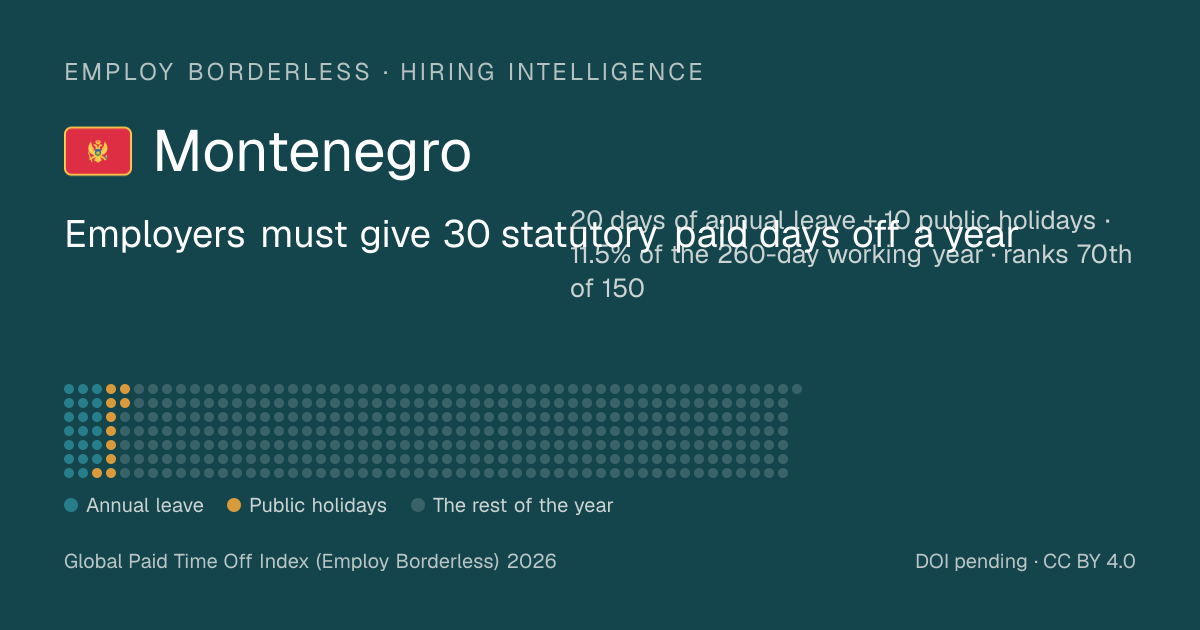
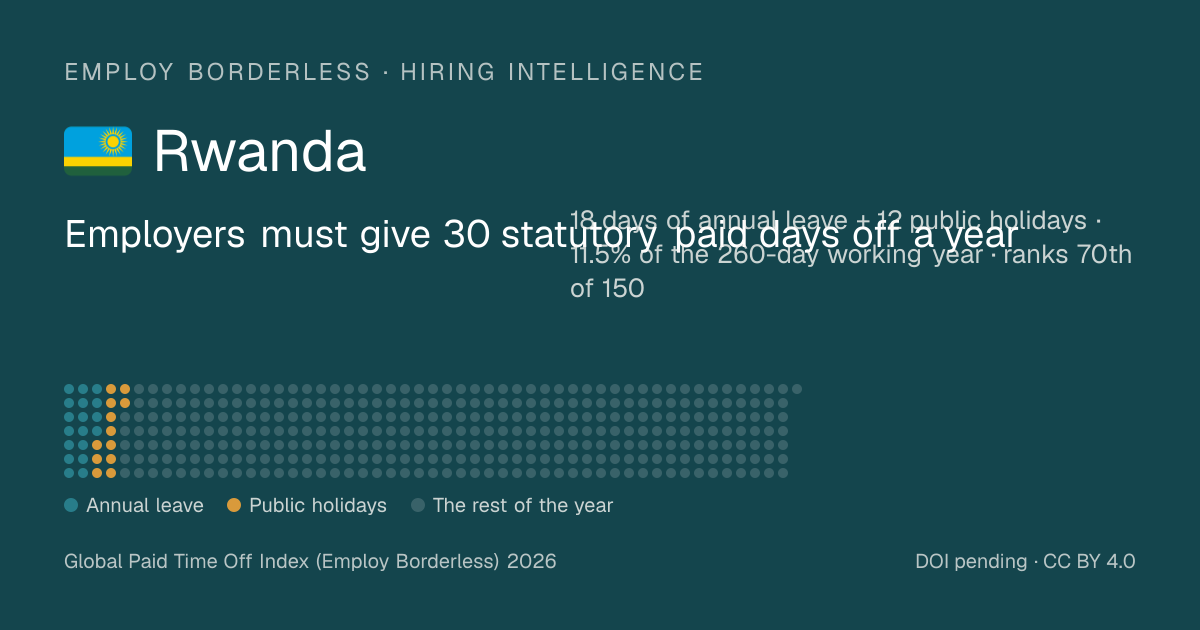
Rwanda · rank 70 · 30 days
Employers in Rwanda must give 30 statutory paid days off a year, 18 days of annual leave plus 12 public holidays, which is 11.5% of the 260-day working year and ranks the country 70th of 150 for statutory paid time off.
An employer hiring in Rwanda must give 30 statutory paid days off a year, 18 days of annual leave plus 12 public holidays, about 6 working weeks and 11.5% of a 260-day working year, which leaves 230 working days per employee. It ranks 70th of 150 countries in the Global Paid Time Off Index 2026. That is 1 days above the median of the ranked set. These are statutory minimums, and most offers add days above the minimum.
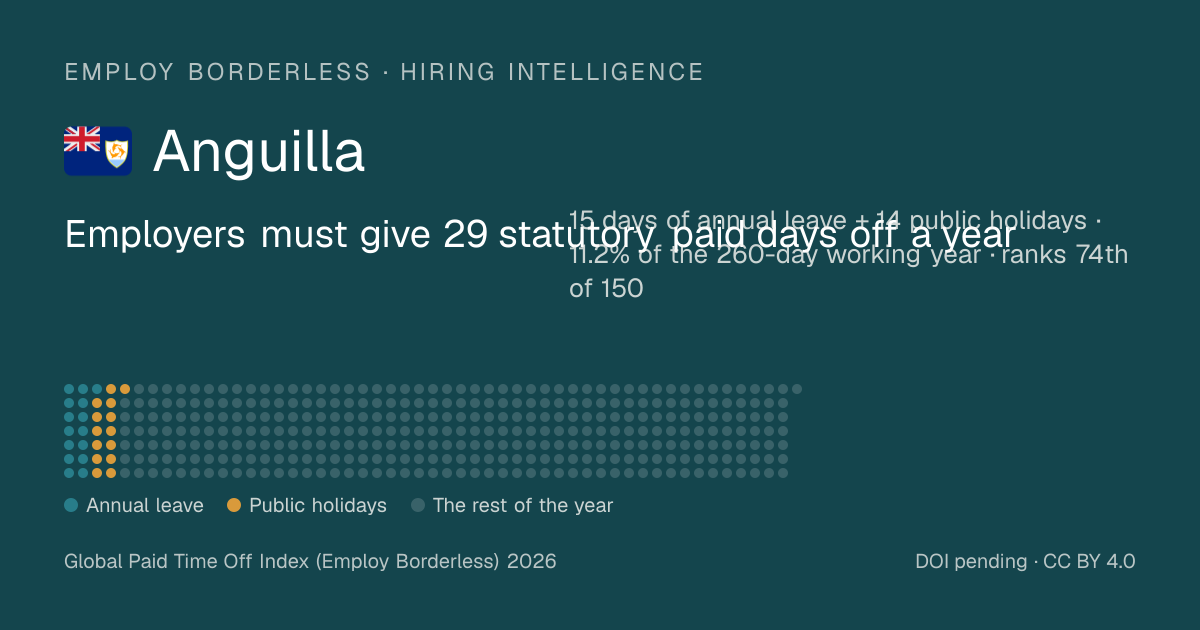
Anguilla · rank 74 · 29 days
Employers in Anguilla must give 29 statutory paid days off a year, 15 days of annual leave plus 14 public holidays, which is 11.2% of the 260-day working year and ranks the country 74th of 150 for statutory paid time off.
An employer hiring in Anguilla must give 29 statutory paid days off a year, 15 days of annual leave plus 14 public holidays, about 5.8 working weeks and 11.2% of a 260-day working year, which leaves 231 working days per employee. It ranks 74th of 150 countries in the Global Paid Time Off Index 2026. That sits exactly on the median of the ranked set. These are statutory minimums, and most offers add days above the minimum.
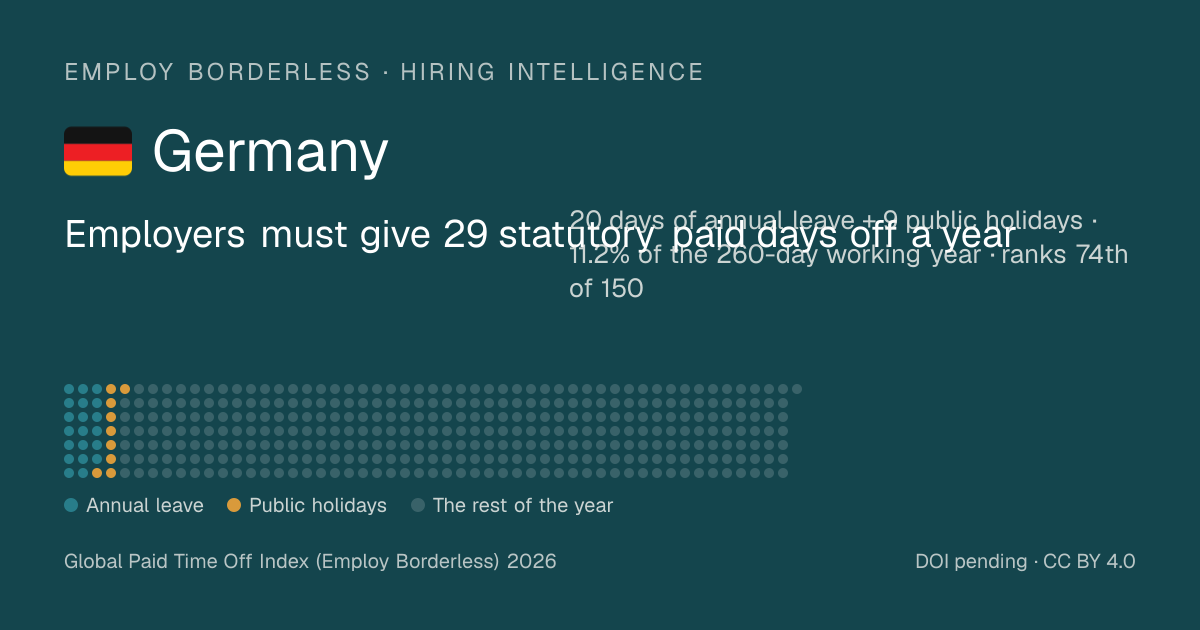
Germany · rank 74 · 29 days
Employers in Germany must give 29 statutory paid days off a year, 20 days of annual leave plus 9 public holidays, which is 11.2% of the 260-day working year and ranks the country 74th of 150 for statutory paid time off.
An employer hiring in Germany must give 29 statutory paid days off a year, 20 days of annual leave plus 9 public holidays, about 5.8 working weeks and 11.2% of a 260-day working year, which leaves 231 working days per employee. It ranks 74th of 150 countries in the Global Paid Time Off Index 2026. That sits exactly on the median of the ranked set. These are statutory minimums, and most offers add days above the minimum.
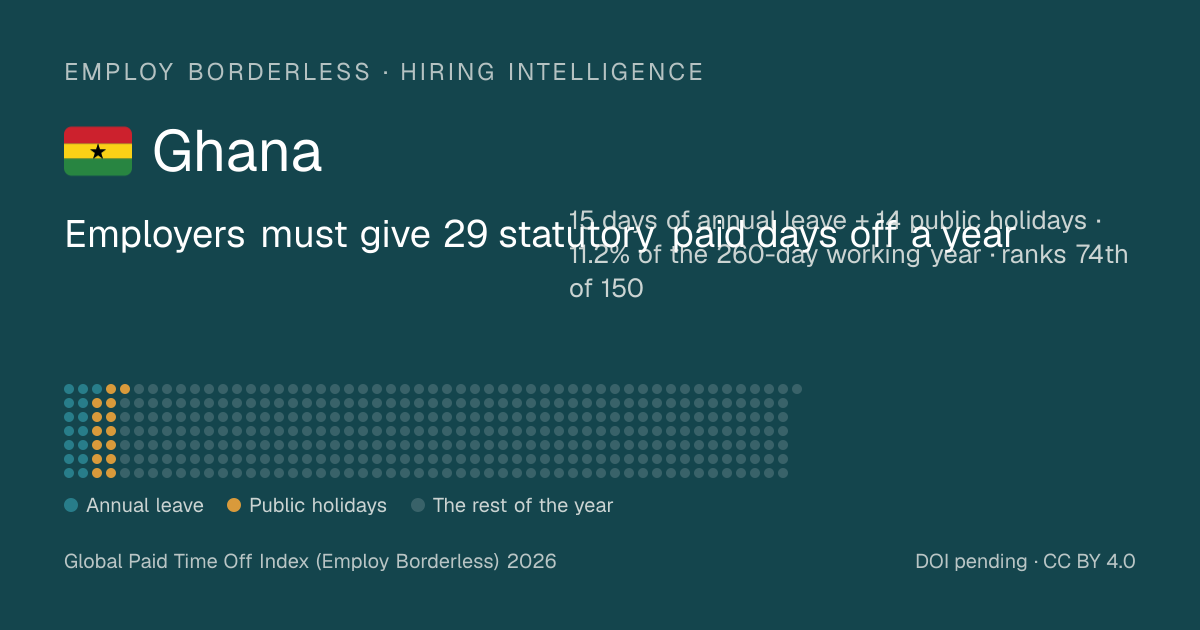
Ghana · rank 74 · 29 days
Employers in Ghana must give 29 statutory paid days off a year, 15 days of annual leave plus 14 public holidays, which is 11.2% of the 260-day working year and ranks the country 74th of 150 for statutory paid time off.
An employer hiring in Ghana must give 29 statutory paid days off a year, 15 days of annual leave plus 14 public holidays, about 5.8 working weeks and 11.2% of a 260-day working year, which leaves 231 working days per employee. It ranks 74th of 150 countries in the Global Paid Time Off Index 2026. That sits exactly on the median of the ranked set. These are statutory minimums, and most offers add days above the minimum.
Greece · rank 74 · 29 days
Employers in Greece must give 29 statutory paid days off a year, 20 days of annual leave plus 9 public holidays, which is 11.2% of the 260-day working year and ranks the country 74th of 150 for statutory paid time off.
An employer hiring in Greece must give 29 statutory paid days off a year, 20 days of annual leave plus 9 public holidays, about 5.8 working weeks and 11.2% of a 260-day working year, which leaves 231 working days per employee. It ranks 74th of 150 countries in the Global Paid Time Off Index 2026. That sits exactly on the median of the ranked set. These are statutory minimums, and most offers add days above the minimum.
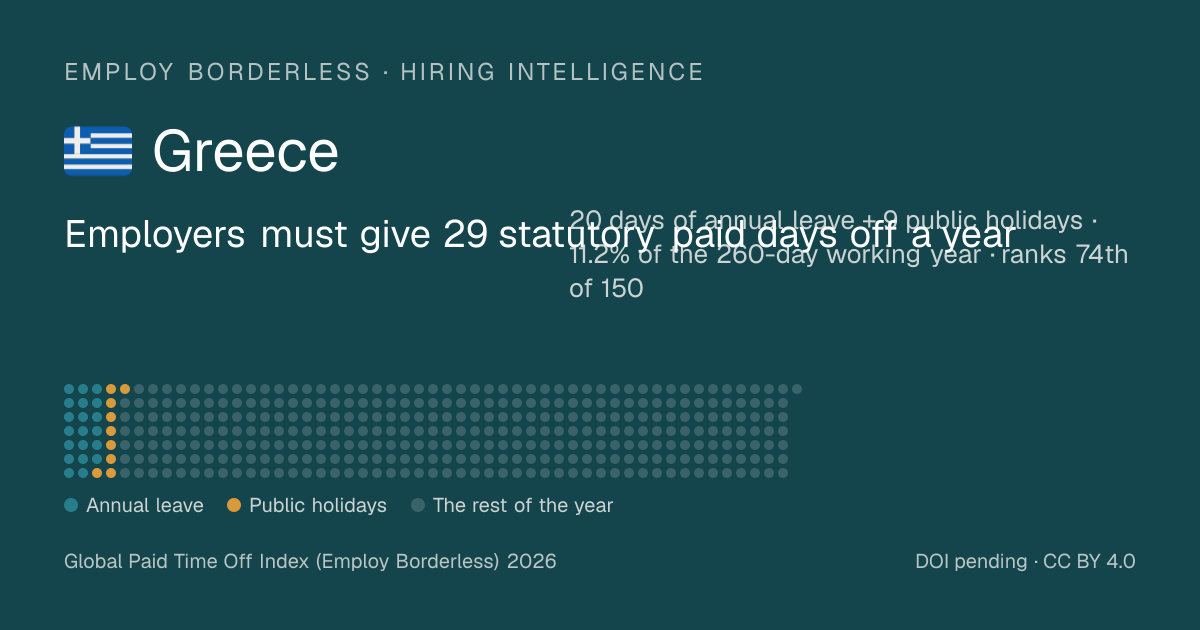
India · rank 74 · 29 days
Employers in India must give 29 statutory paid days off a year, 12 days of annual leave plus 17 public holidays, which is 11.2% of the 260-day working year and ranks the country 74th of 150 for statutory paid time off.
An employer hiring in India must give 29 statutory paid days off a year, 12 days of annual leave plus 17 public holidays, about 5.8 working weeks and 11.2% of a 260-day working year, which leaves 231 working days per employee. It ranks 74th of 150 countries in the Global Paid Time Off Index 2026. That sits exactly on the median of the ranked set. These are statutory minimums, and most offers add days above the minimum.
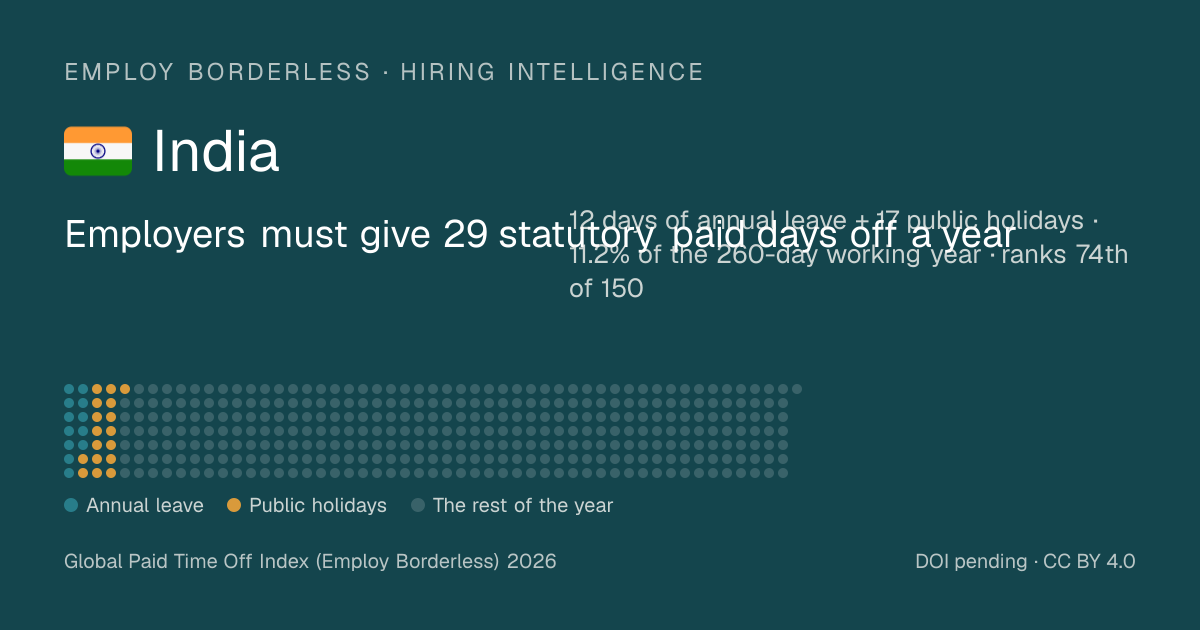
Indonesia · rank 74 · 29 days
Employers in Indonesia must give 29 statutory paid days off a year, 12 days of annual leave plus 17 public holidays, which is 11.2% of the 260-day working year and ranks the country 74th of 150 for statutory paid time off.
An employer hiring in Indonesia must give 29 statutory paid days off a year, 12 days of annual leave plus 17 public holidays, about 5.8 working weeks and 11.2% of a 260-day working year, which leaves 231 working days per employee. It ranks 74th of 150 countries in the Global Paid Time Off Index 2026. That sits exactly on the median of the ranked set. These are statutory minimums, and most offers add days above the minimum.
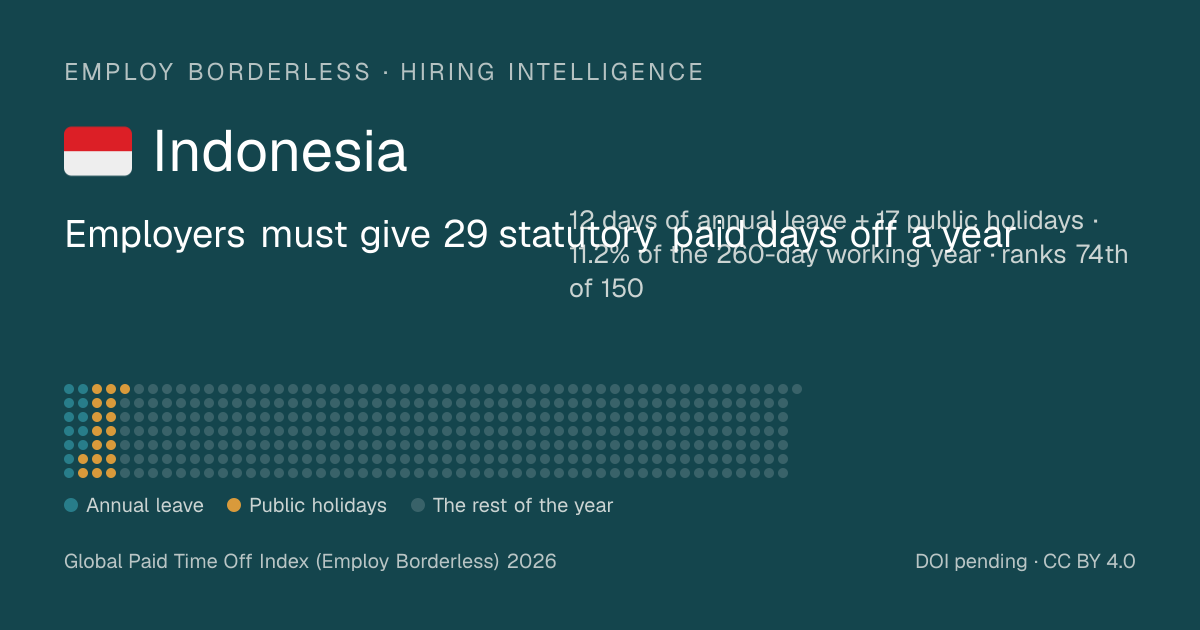
Switzerland · rank 74 · 29 days
Employers in Switzerland must give 29 statutory paid days off a year, 20 days of annual leave plus 9 public holidays, which is 11.2% of the 260-day working year and ranks the country 74th of 150 for statutory paid time off.
An employer hiring in Switzerland must give 29 statutory paid days off a year, 20 days of annual leave plus 9 public holidays, about 5.8 working weeks and 11.2% of a 260-day working year, which leaves 231 working days per employee. It ranks 74th of 150 countries in the Global Paid Time Off Index 2026. That sits exactly on the median of the ranked set. These are statutory minimums, and most offers add days above the minimum.
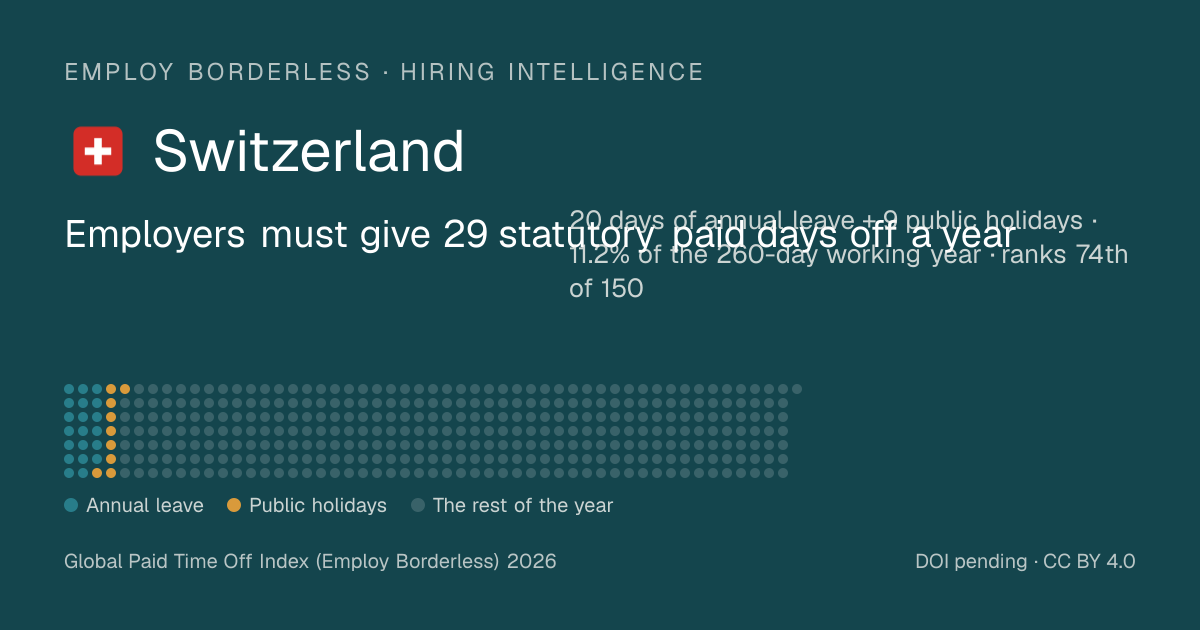
Vanuatu · rank 74 · 29 days
Employers in Vanuatu must give 29 statutory paid days off a year, 15 days of annual leave plus 14 public holidays, which is 11.2% of the 260-day working year and ranks the country 74th of 150 for statutory paid time off.
An employer hiring in Vanuatu must give 29 statutory paid days off a year, 15 days of annual leave plus 14 public holidays, about 5.8 working weeks and 11.2% of a 260-day working year, which leaves 231 working days per employee. It ranks 74th of 150 countries in the Global Paid Time Off Index 2026. That sits exactly on the median of the ranked set. These are statutory minimums, and most offers add days above the minimum.
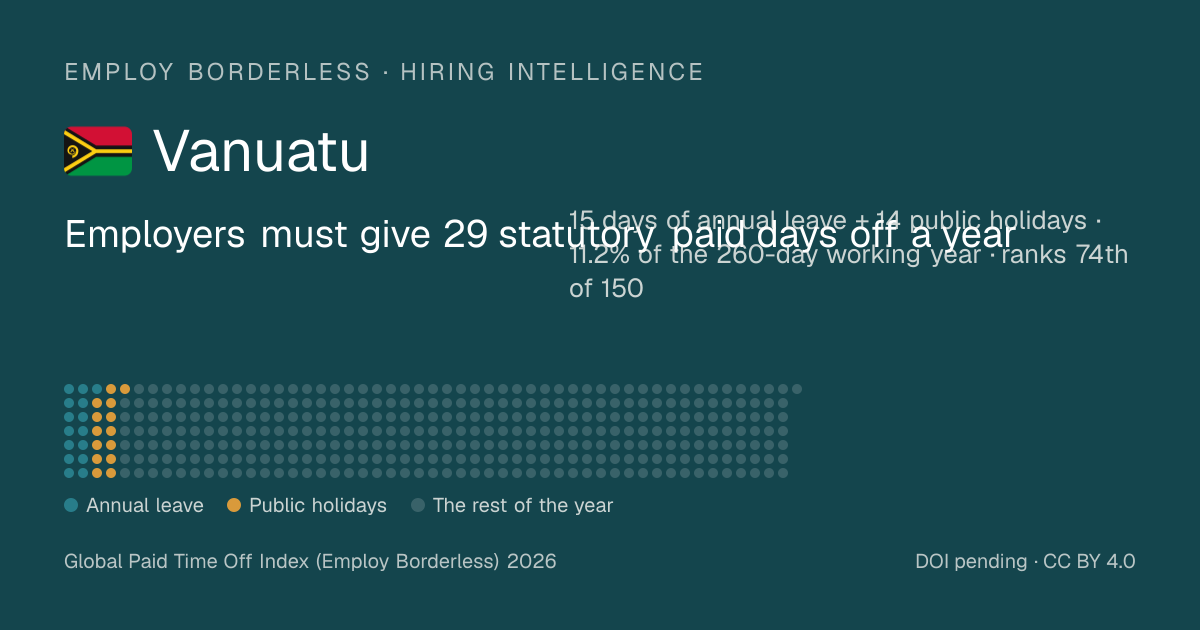
Venezuela · rank 74 · 29 days
Employers in Venezuela must give 29 statutory paid days off a year, 15 days of annual leave plus 14 public holidays, which is 11.2% of the 260-day working year and ranks the country 74th of 150 for statutory paid time off.
An employer hiring in Venezuela must give 29 statutory paid days off a year, 15 days of annual leave plus 14 public holidays, about 5.8 working weeks and 11.2% of a 260-day working year, which leaves 231 working days per employee. It ranks 74th of 150 countries in the Global Paid Time Off Index 2026. That sits exactly on the median of the ranked set. These are statutory minimums, and most offers add days above the minimum.
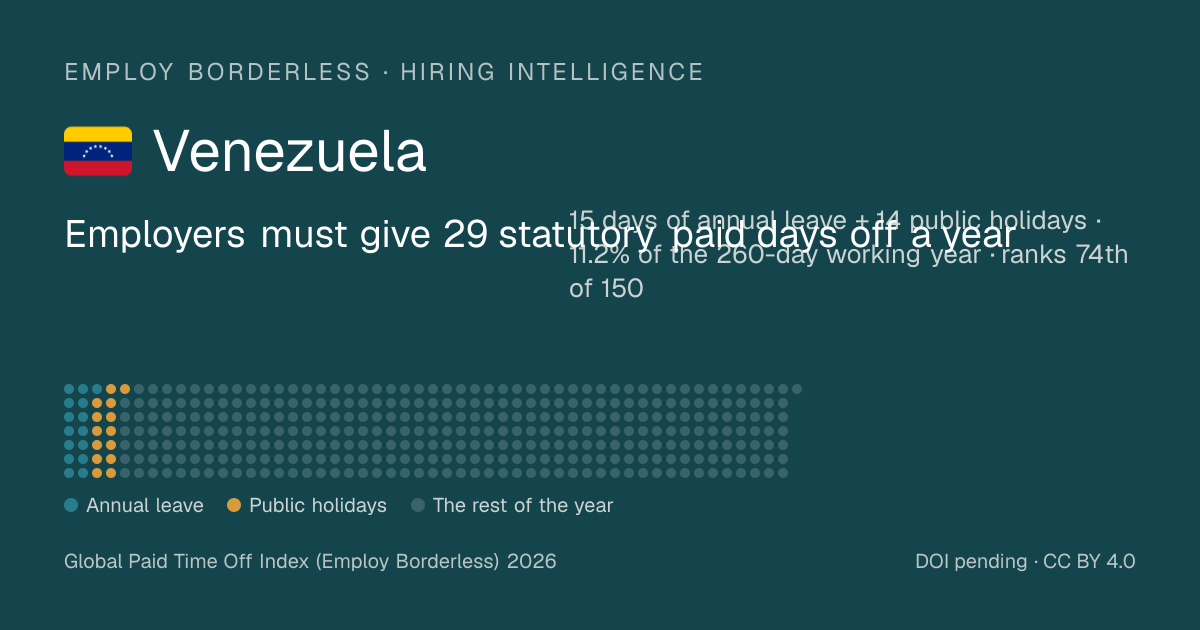
Belarus · rank 83 · 28 days
Employers in Belarus must give 28 statutory paid days off a year, 18 days of annual leave plus 10 public holidays, which is 10.8% of the 260-day working year and ranks the country 83rd of 150 for statutory paid time off.
An employer hiring in Belarus must give 28 statutory paid days off a year, 18 days of annual leave plus 10 public holidays, about 5.6 working weeks and 10.8% of a 260-day working year, which leaves 232 working days per employee. It ranks 83rd of 150 countries in the Global Paid Time Off Index 2026. That is 1 days below the median of the ranked set. These are statutory minimums, and most offers add days above the minimum.
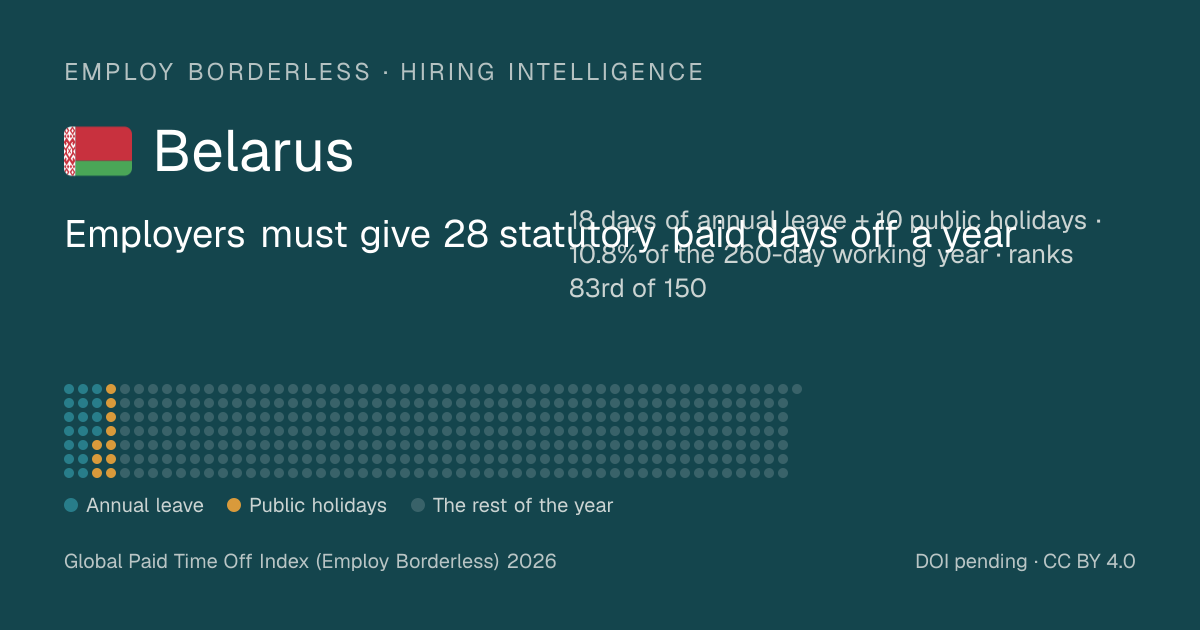
Botswana · rank 83 · 28 days
Employers in Botswana must give 28 statutory paid days off a year, 15 days of annual leave plus 13 public holidays, which is 10.8% of the 260-day working year and ranks the country 83rd of 150 for statutory paid time off.
An employer hiring in Botswana must give 28 statutory paid days off a year, 15 days of annual leave plus 13 public holidays, about 5.6 working weeks and 10.8% of a 260-day working year, which leaves 232 working days per employee. It ranks 83rd of 150 countries in the Global Paid Time Off Index 2026. That is 1 days below the median of the ranked set. These are statutory minimums, and most offers add days above the minimum.
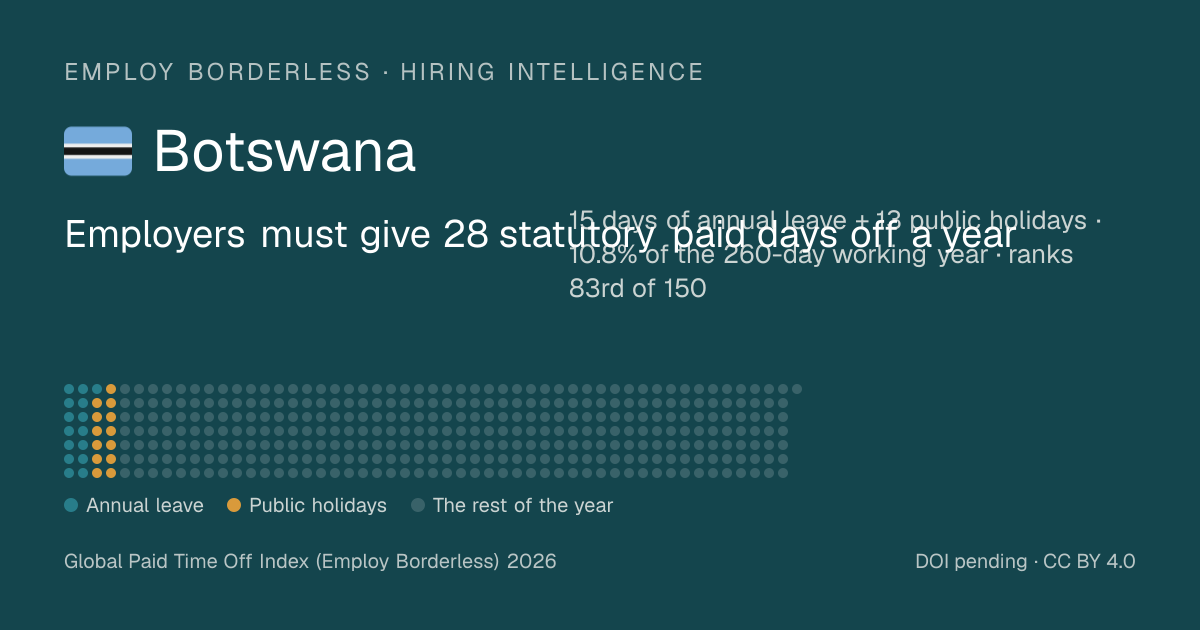
Ethiopia · rank 83 · 28 days
Employers in Ethiopia must give 28 statutory paid days off a year, 16 days of annual leave plus 12 public holidays, which is 10.8% of the 260-day working year and ranks the country 83rd of 150 for statutory paid time off.
An employer hiring in Ethiopia must give 28 statutory paid days off a year, 16 days of annual leave plus 12 public holidays, about 5.6 working weeks and 10.8% of a 260-day working year, which leaves 232 working days per employee. It ranks 83rd of 150 countries in the Global Paid Time Off Index 2026. That is 1 days below the median of the ranked set. These are statutory minimums, and most offers add days above the minimum.
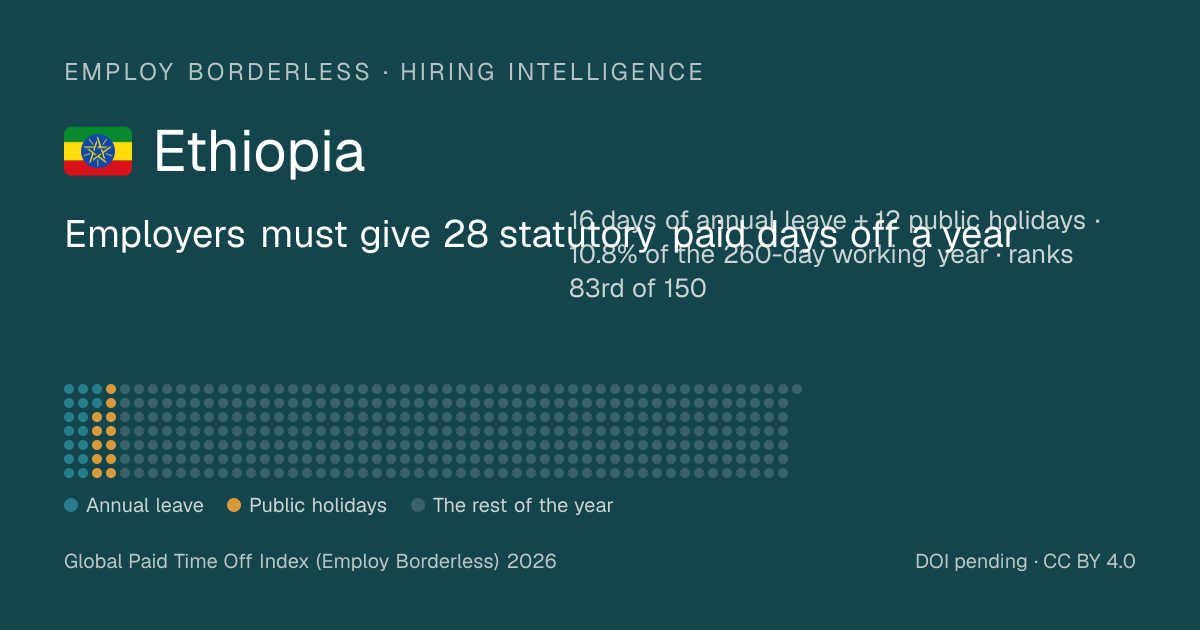
United Kingdom · rank 83 · 28 days
Employers in the United Kingdom must give 28 statutory paid days off a year, all of it annual leave, and the law lets them count the 8 public holidays within it. That is 10.8% of the 260-day working year and ranks the country 83rd of 150 for statutory paid time off.
An employer hiring in the United Kingdom must give 28 statutory paid days off a year, all of it annual leave, and can count the 8 public holidays within it, about 5.6 working weeks and 10.8% of a 260-day working year, which leaves 232 working days per employee. It ranks 83rd of 150 countries in the Global Paid Time Off Index 2026. That is 1 days below the median of the ranked set. These are statutory minimums, and most offers add days above the minimum.
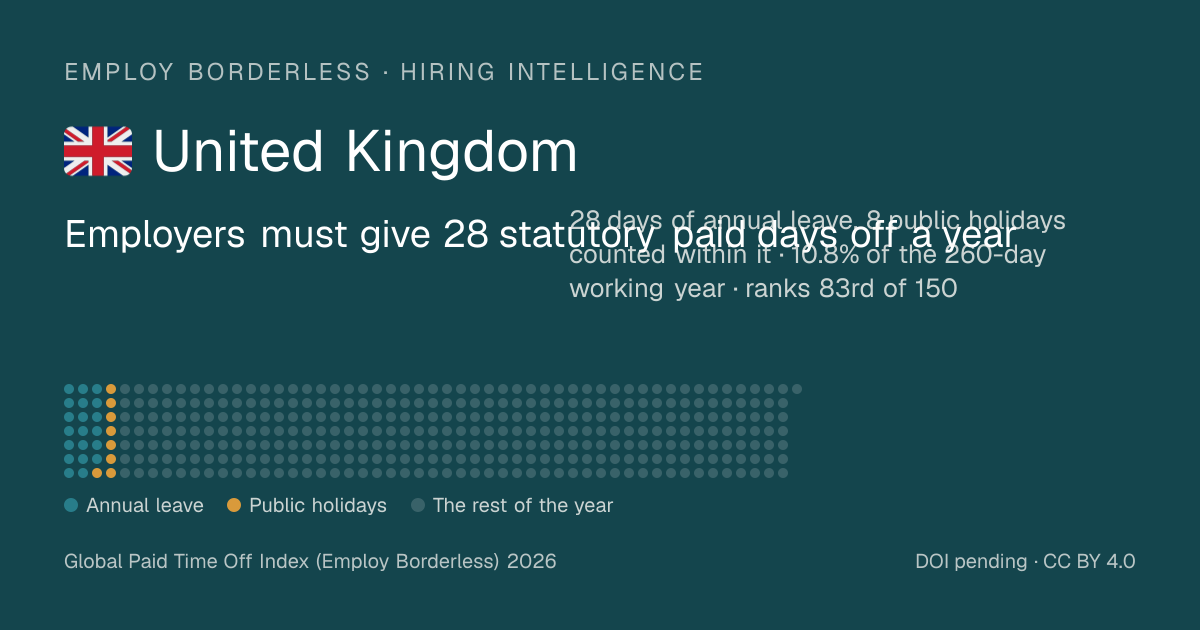
Barbados · rank 87 · 27 days
Employers in Barbados must give 27 statutory paid days off a year, 15 days of annual leave plus 12 public holidays, which is 10.4% of the 260-day working year and ranks the country 87th of 150 for statutory paid time off.
An employer hiring in Barbados must give 27 statutory paid days off a year, 15 days of annual leave plus 12 public holidays, about 5.4 working weeks and 10.4% of a 260-day working year, which leaves 233 working days per employee. It ranks 87th of 150 countries in the Global Paid Time Off Index 2026. That is 2 days below the median of the ranked set. These are statutory minimums, and most offers add days above the minimum.
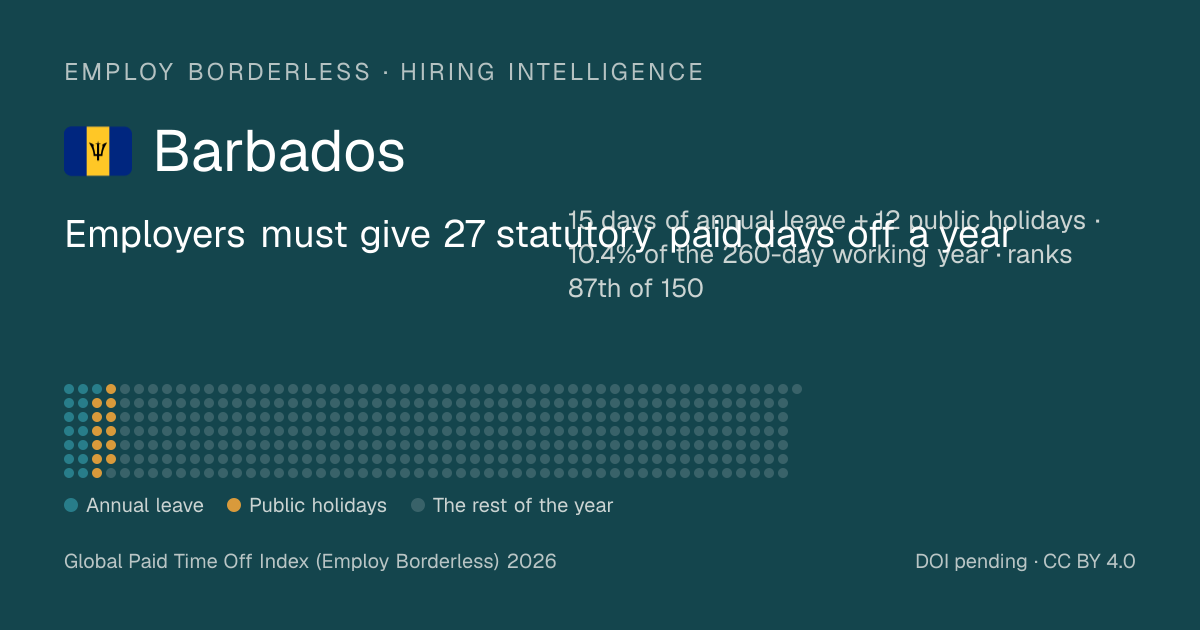
Eswatini · rank 87 · 27 days
Employers in Eswatini must give 27 statutory paid days off a year, 14 days of annual leave plus 13 public holidays, which is 10.4% of the 260-day working year and ranks the country 87th of 150 for statutory paid time off.
An employer hiring in Eswatini must give 27 statutory paid days off a year, 14 days of annual leave plus 13 public holidays, about 5.4 working weeks and 10.4% of a 260-day working year, which leaves 233 working days per employee. It ranks 87th of 150 countries in the Global Paid Time Off Index 2026. That is 2 days below the median of the ranked set. These are statutory minimums, and most offers add days above the minimum.
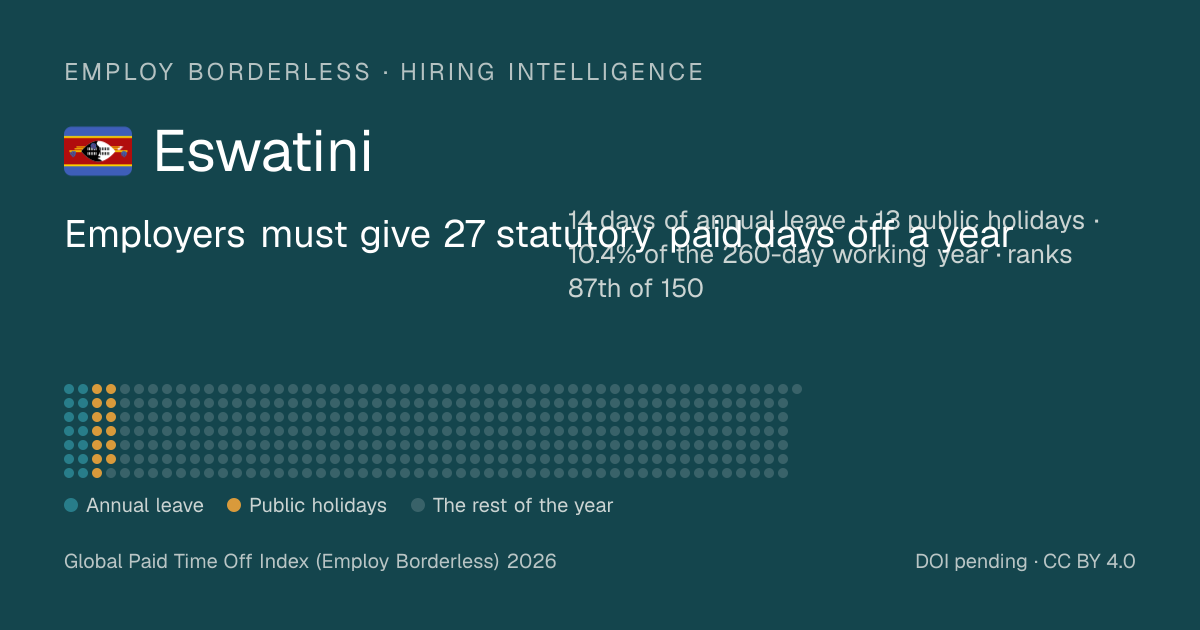
Gibraltar · rank 87 · 27 days
Employers in Gibraltar must give 27 statutory paid days off a year, 15 days of annual leave plus 12 public holidays, which is 10.4% of the 260-day working year and ranks the country 87th of 150 for statutory paid time off.
An employer hiring in Gibraltar must give 27 statutory paid days off a year, 15 days of annual leave plus 12 public holidays, about 5.4 working weeks and 10.4% of a 260-day working year, which leaves 233 working days per employee. It ranks 87th of 150 countries in the Global Paid Time Off Index 2026. That is 2 days below the median of the ranked set. These are statutory minimums, and most offers add days above the minimum.
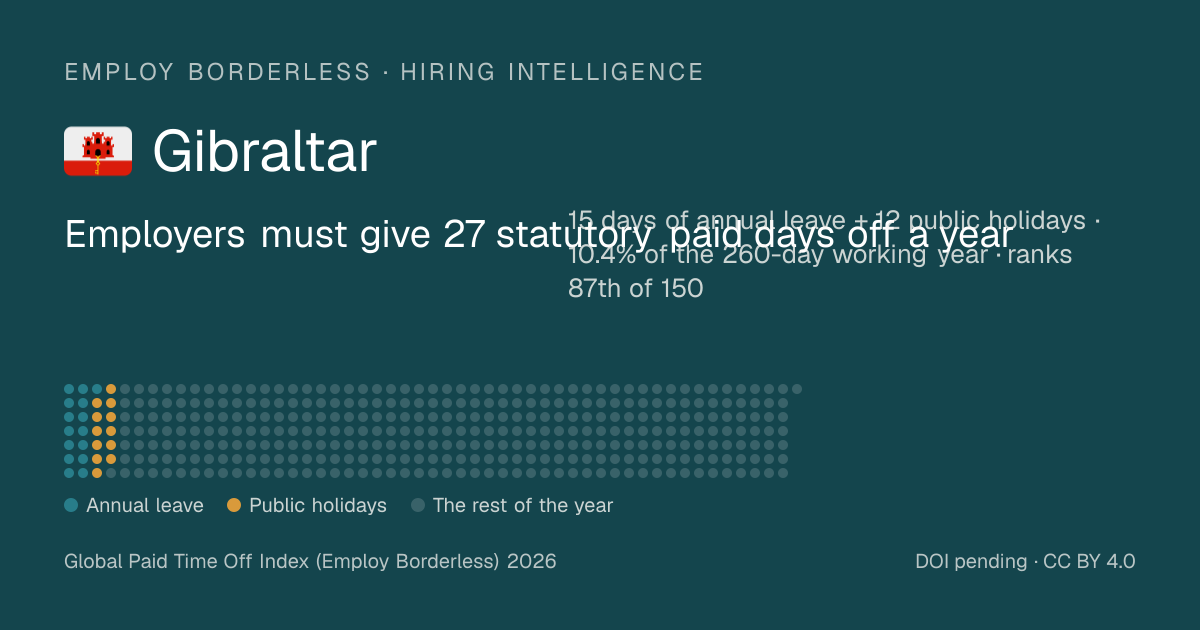
Guyana · rank 87 · 27 days
Employers in Guyana must give 27 statutory paid days off a year, 12 days of annual leave plus 15 public holidays, which is 10.4% of the 260-day working year and ranks the country 87th of 150 for statutory paid time off.
An employer hiring in Guyana must give 27 statutory paid days off a year, 12 days of annual leave plus 15 public holidays, about 5.4 working weeks and 10.4% of a 260-day working year, which leaves 233 working days per employee. It ranks 87th of 150 countries in the Global Paid Time Off Index 2026. That is 2 days below the median of the ranked set. These are statutory minimums, and most offers add days above the minimum.
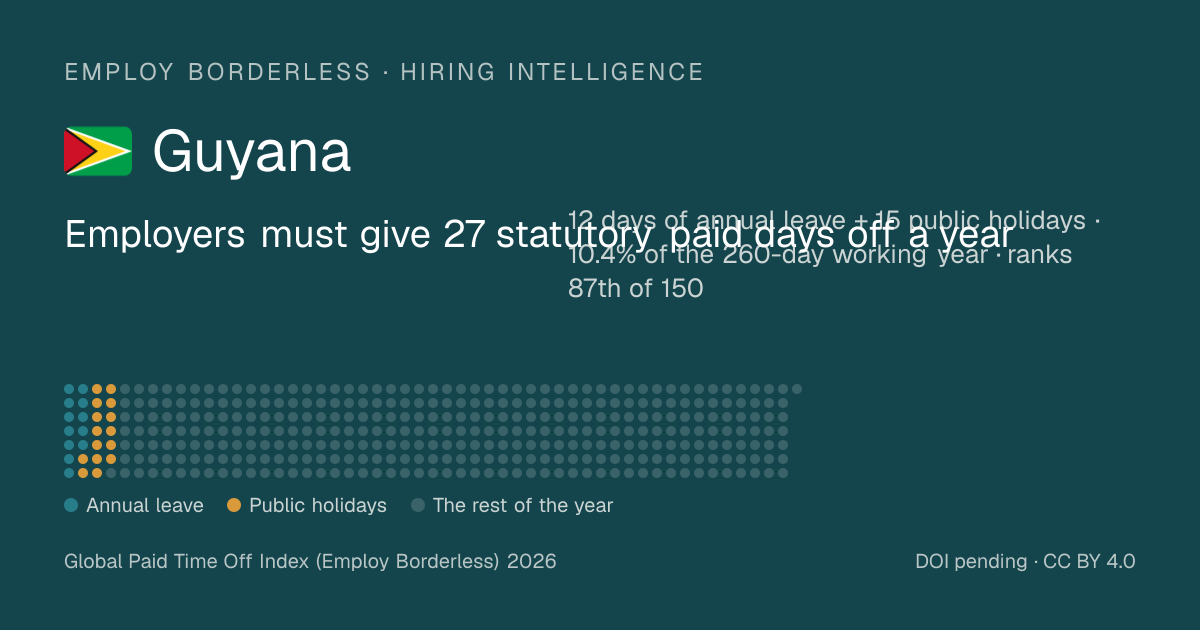
Malawi · rank 87 · 27 days
Employers in Malawi must give 27 statutory paid days off a year, 15 days of annual leave plus 12 public holidays, which is 10.4% of the 260-day working year and ranks the country 87th of 150 for statutory paid time off.
An employer hiring in Malawi must give 27 statutory paid days off a year, 15 days of annual leave plus 12 public holidays, about 5.4 working weeks and 10.4% of a 260-day working year, which leaves 233 working days per employee. It ranks 87th of 150 countries in the Global Paid Time Off Index 2026. That is 2 days below the median of the ranked set. These are statutory minimums, and most offers add days above the minimum.
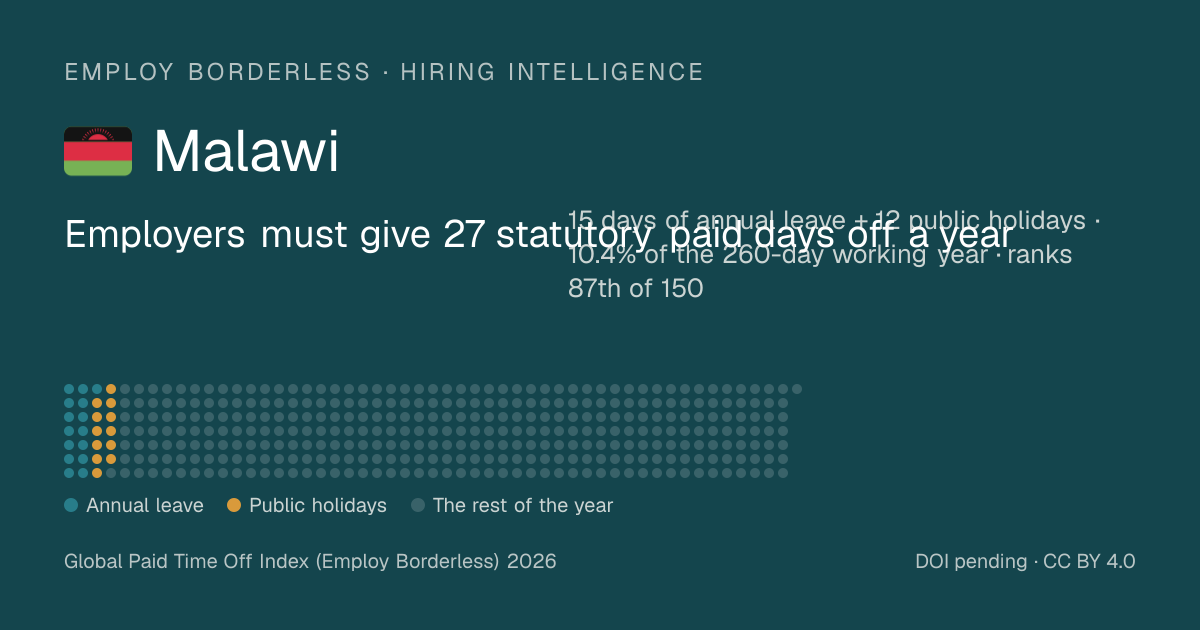
South Africa · rank 87 · 27 days
Employers in South Africa must give 27 statutory paid days off a year, 15 days of annual leave plus 12 public holidays, which is 10.4% of the 260-day working year and ranks the country 87th of 150 for statutory paid time off.
An employer hiring in South Africa must give 27 statutory paid days off a year, 15 days of annual leave plus 12 public holidays, about 5.4 working weeks and 10.4% of a 260-day working year, which leaves 233 working days per employee. It ranks 87th of 150 countries in the Global Paid Time Off Index 2026. That is 2 days below the median of the ranked set. These are statutory minimums, and most offers add days above the minimum.
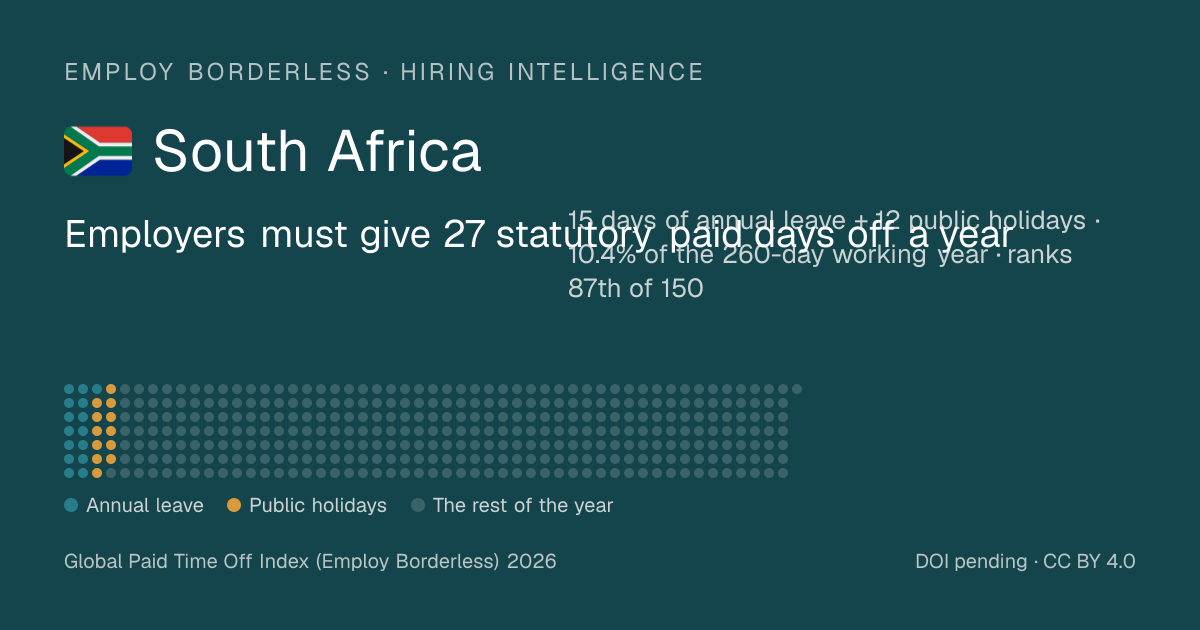
Timor-Leste · rank 87 · 27 days
Employers in Timor-Leste must give 27 statutory paid days off a year, 12 days of annual leave plus 15 public holidays, which is 10.4% of the 260-day working year and ranks the country 87th of 150 for statutory paid time off.
An employer hiring in Timor-Leste must give 27 statutory paid days off a year, 12 days of annual leave plus 15 public holidays, about 5.4 working weeks and 10.4% of a 260-day working year, which leaves 233 working days per employee. It ranks 87th of 150 countries in the Global Paid Time Off Index 2026. That is 2 days below the median of the ranked set. These are statutory minimums, and most offers add days above the minimum.
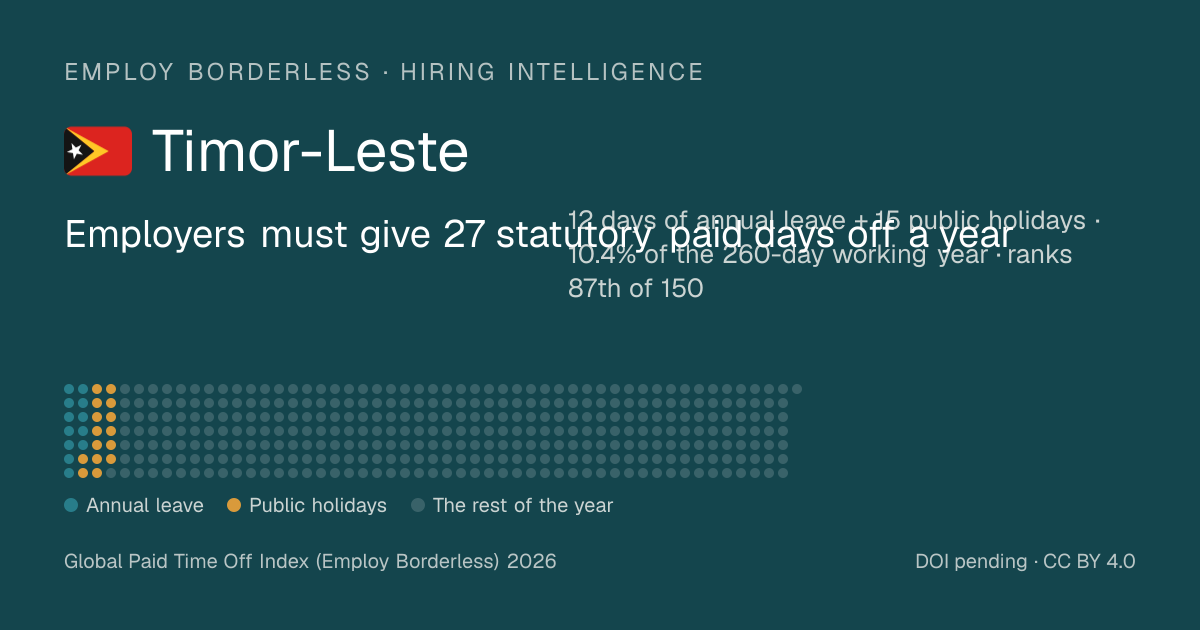
Argentina · rank 94 · 26 days
Employers in Argentina must give 26 statutory paid days off a year, 10 days of annual leave plus 16 public holidays, which is 10% of the 260-day working year and ranks the country 94th of 150 for statutory paid time off.
An employer hiring in Argentina must give 26 statutory paid days off a year, 10 days of annual leave plus 16 public holidays, about 5.2 working weeks and 10% of a 260-day working year, which leaves 234 working days per employee. It ranks 94th of 150 countries in the Global Paid Time Off Index 2026. That is 3 days below the median of the ranked set. These are statutory minimums, and most offers add days above the minimum.
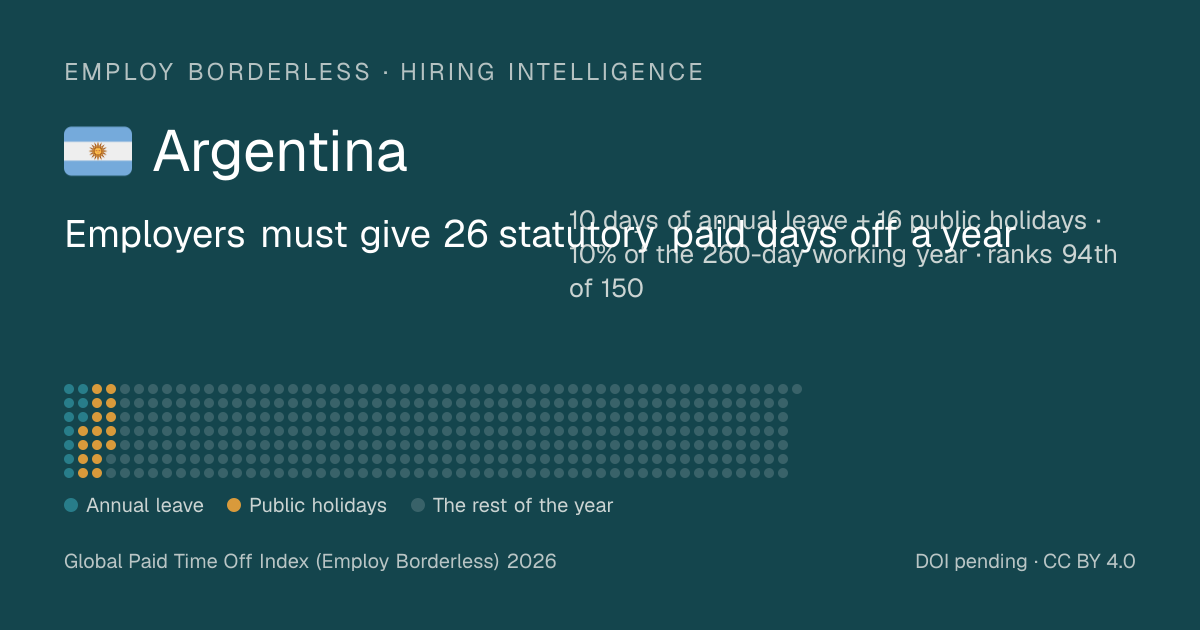
Aruba · rank 94 · 26 days
Employers in Aruba must give 26 statutory paid days off a year, 15 days of annual leave plus 11 public holidays, which is 10% of the 260-day working year and ranks the country 94th of 150 for statutory paid time off.
An employer hiring in Aruba must give 26 statutory paid days off a year, 15 days of annual leave plus 11 public holidays, about 5.2 working weeks and 10% of a 260-day working year, which leaves 234 working days per employee. It ranks 94th of 150 countries in the Global Paid Time Off Index 2026. That is 3 days below the median of the ranked set. These are statutory minimums, and most offers add days above the minimum.
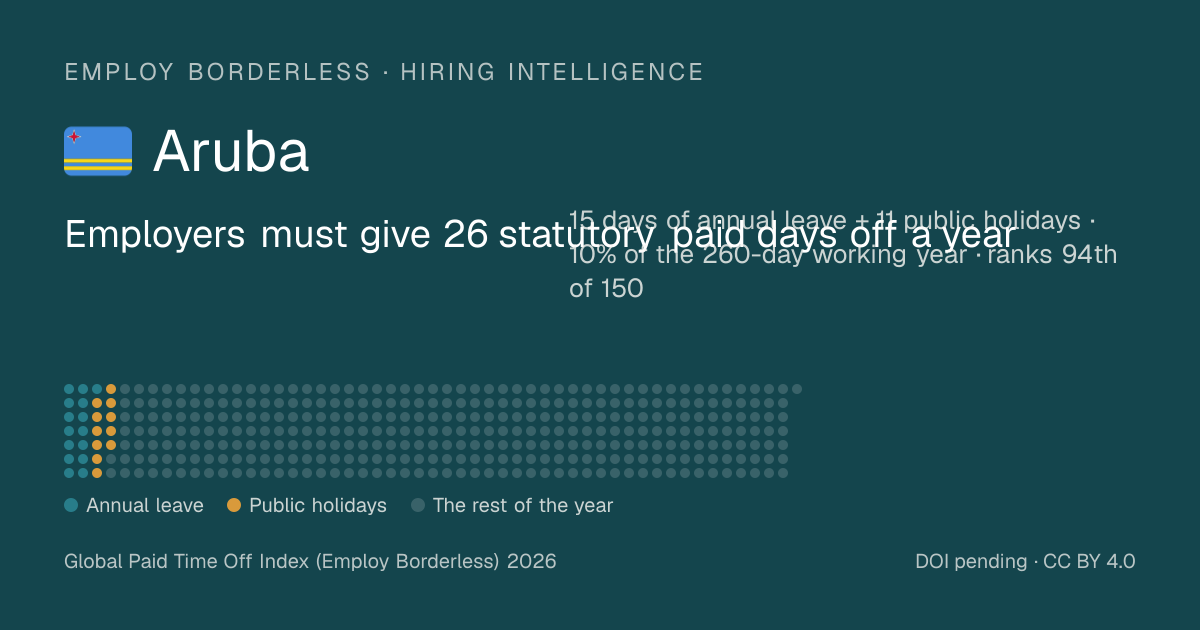
Bolivia · rank 94 · 26 days
Employers in Bolivia must give 26 statutory paid days off a year, 15 days of annual leave plus 11 public holidays, which is 10% of the 260-day working year and ranks the country 94th of 150 for statutory paid time off.
An employer hiring in Bolivia must give 26 statutory paid days off a year, 15 days of annual leave plus 11 public holidays, about 5.2 working weeks and 10% of a 260-day working year, which leaves 234 working days per employee. It ranks 94th of 150 countries in the Global Paid Time Off Index 2026. That is 3 days below the median of the ranked set. These are statutory minimums, and most offers add days above the minimum.
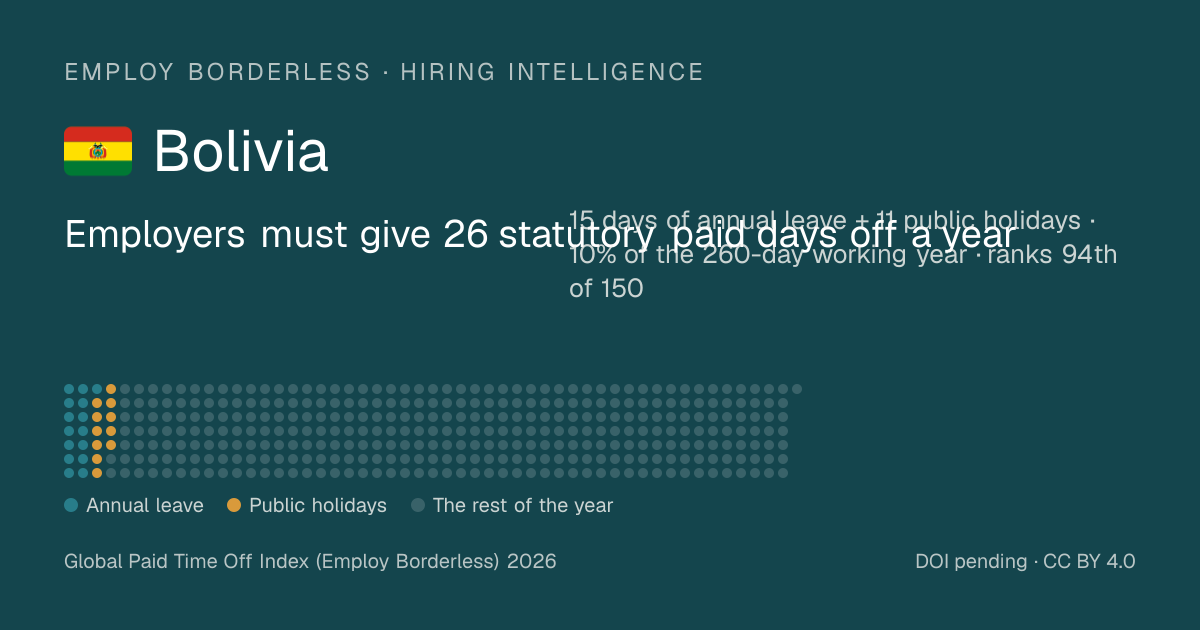
Dominican Republic · rank 94 · 26 days
Employers in the Dominican Republic must give 26 statutory paid days off a year, 14 days of annual leave plus 12 public holidays, which is 10% of the 260-day working year and ranks the country 94th of 150 for statutory paid time off.
An employer hiring in the Dominican Republic must give 26 statutory paid days off a year, 14 days of annual leave plus 12 public holidays, about 5.2 working weeks and 10% of a 260-day working year, which leaves 234 working days per employee. It ranks 94th of 150 countries in the Global Paid Time Off Index 2026. That is 3 days below the median of the ranked set. These are statutory minimums, and most offers add days above the minimum.
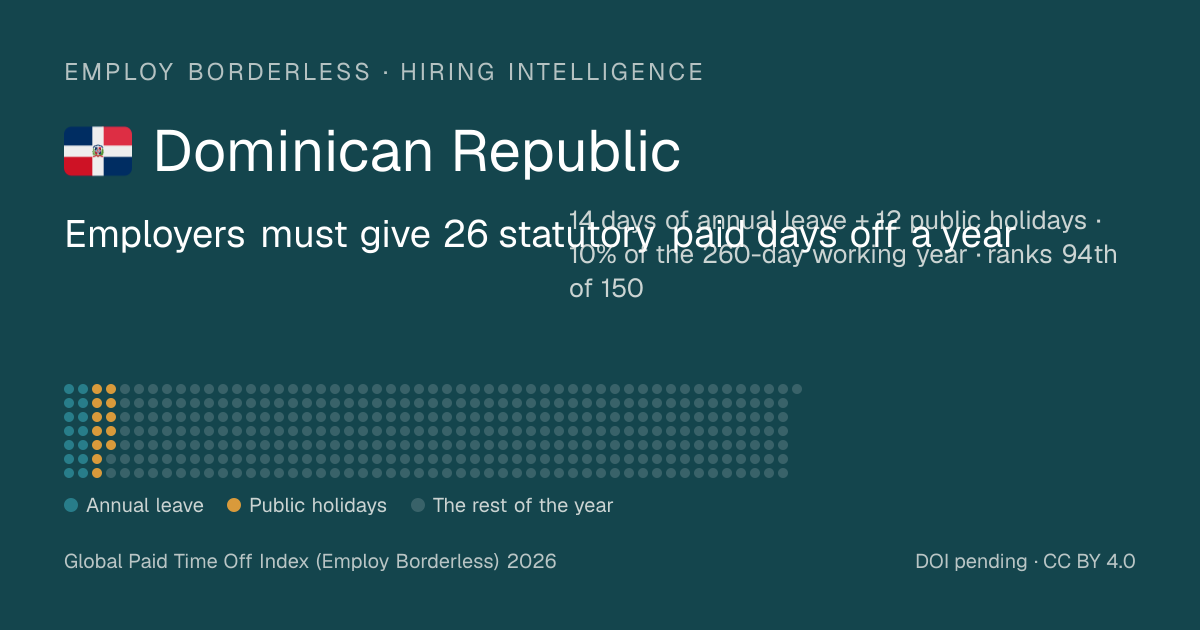
France · rank 94 · 26 days
Employers in France must give 26 statutory paid days off a year: 25 days of annual leave plus 1 public holiday the law requires as paid; the other 10 public holidays are not required as paid days off. That is 10% of the 260-day working year and ranks the country 94th of 150 for statutory paid time off.
An employer hiring in France must give 26 statutory paid days off a year, 25 days of annual leave plus 1 public holiday the law requires as paid, about 5.2 working weeks and 10% of a 260-day working year, which leaves 234 working days per employee. It ranks 94th of 150 countries in the Global Paid Time Off Index 2026. That is 3 days below the median of the ranked set. These are statutory minimums, and most offers add days above the minimum.
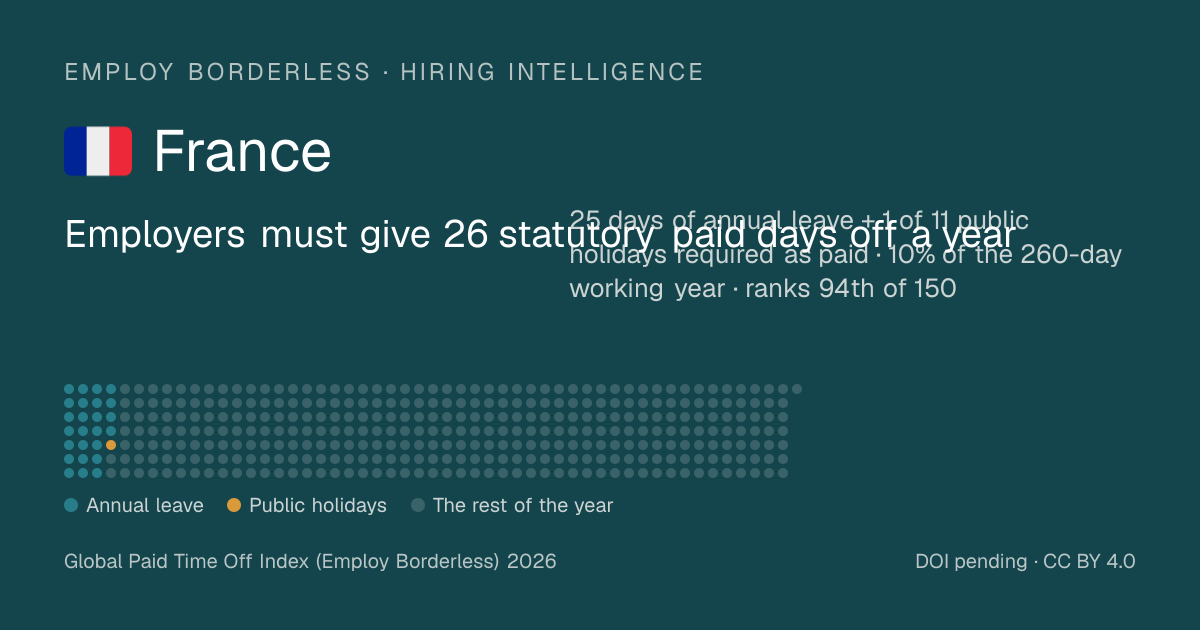
French Guiana · rank 94 · 26 days
Employers in French Guiana must give 26 statutory paid days off a year: 25 days of annual leave plus 1 public holiday the law requires as paid; the other 11 public holidays are not required as paid days off. That is 10% of the 260-day working year and ranks the country 94th of 150 for statutory paid time off.
An employer hiring in French Guiana must give 26 statutory paid days off a year, 25 days of annual leave plus 1 public holiday the law requires as paid, about 5.2 working weeks and 10% of a 260-day working year, which leaves 234 working days per employee. It ranks 94th of 150 countries in the Global Paid Time Off Index 2026. That is 3 days below the median of the ranked set. These are statutory minimums, and most offers add days above the minimum.
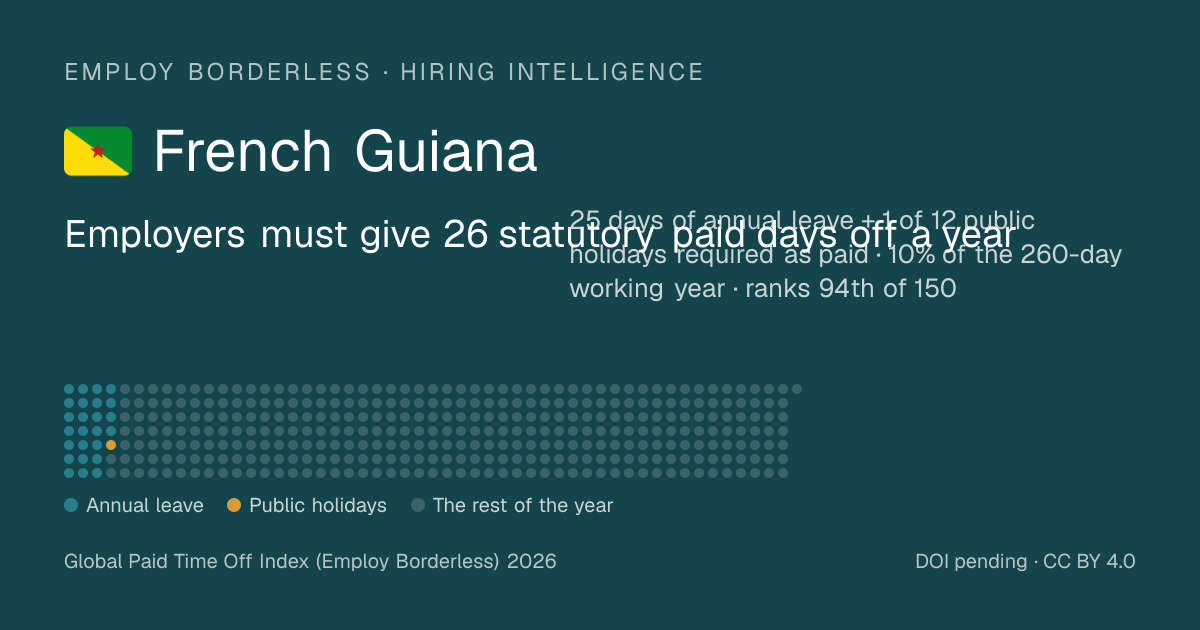
French Polynesia · rank 94 · 26 days
Employers in French Polynesia must give 26 statutory paid days off a year: 25 days of annual leave plus 1 public holiday the law requires as paid; the other 13 public holidays are not required as paid days off. That is 10% of the 260-day working year and ranks the country 94th of 150 for statutory paid time off.
An employer hiring in French Polynesia must give 26 statutory paid days off a year, 25 days of annual leave plus 1 public holiday the law requires as paid, about 5.2 working weeks and 10% of a 260-day working year, which leaves 234 working days per employee. It ranks 94th of 150 countries in the Global Paid Time Off Index 2026. That is 3 days below the median of the ranked set. These are statutory minimums, and most offers add days above the minimum.
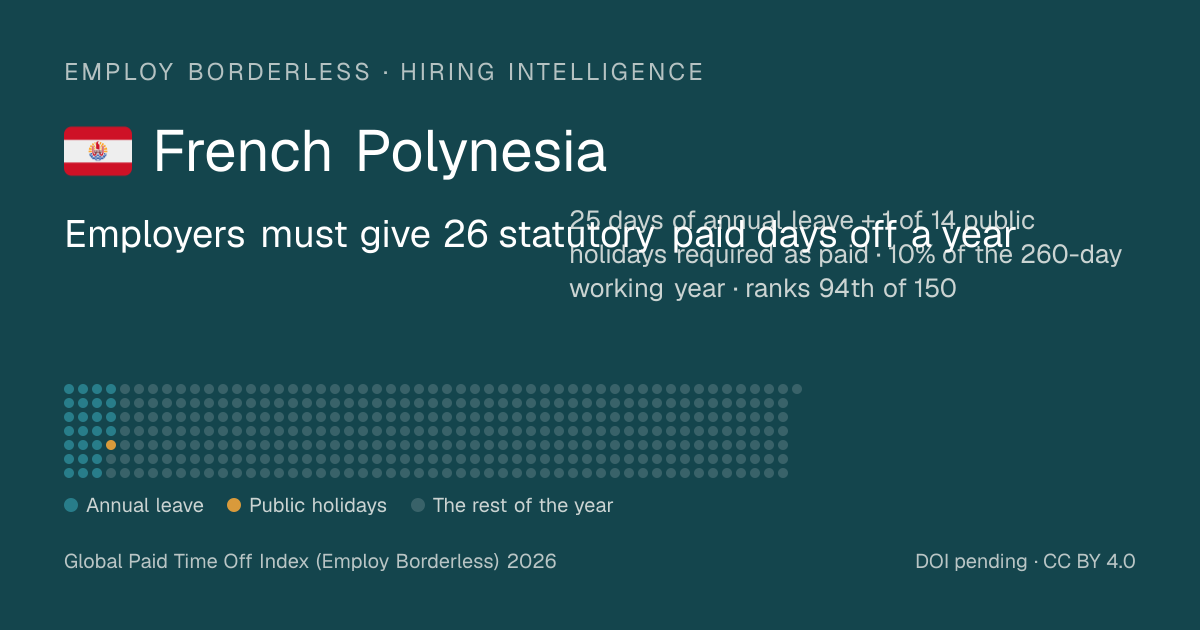
Guatemala · rank 94 · 26 days
Employers in Guatemala must give 26 statutory paid days off a year, 15 days of annual leave plus 11 public holidays, which is 10% of the 260-day working year and ranks the country 94th of 150 for statutory paid time off.
An employer hiring in Guatemala must give 26 statutory paid days off a year, 15 days of annual leave plus 11 public holidays, about 5.2 working weeks and 10% of a 260-day working year, which leaves 234 working days per employee. It ranks 94th of 150 countries in the Global Paid Time Off Index 2026. That is 3 days below the median of the ranked set. These are statutory minimums, and most offers add days above the minimum.
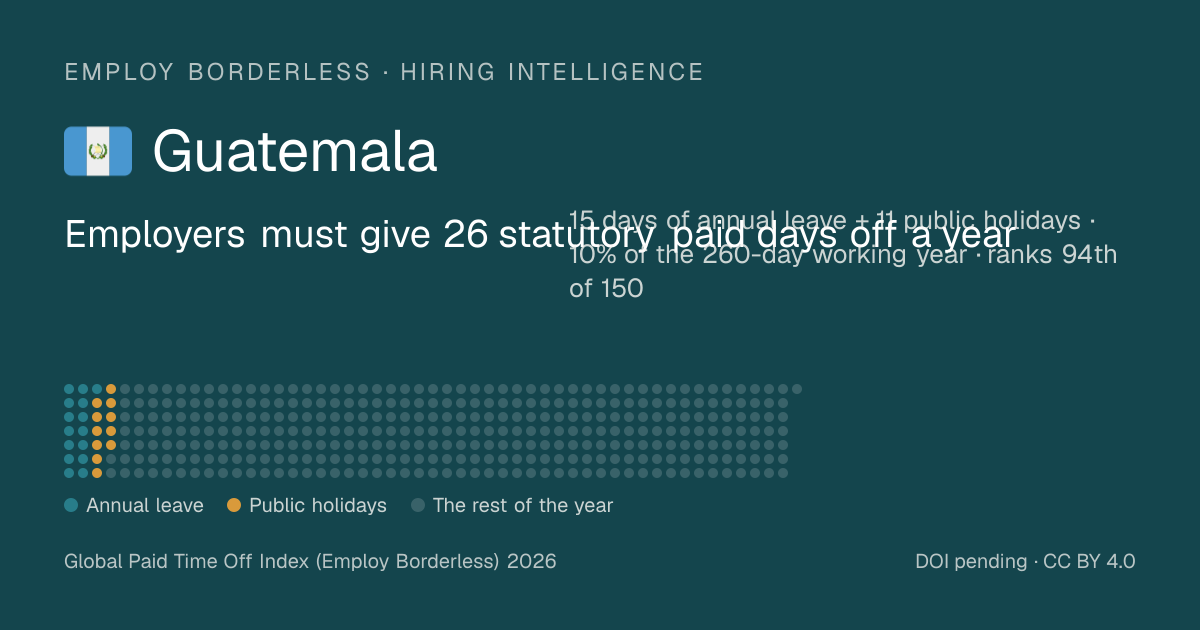
Japan · rank 94 · 26 days
Employers in Japan must give 26 statutory paid days off a year, 10 days of annual leave plus 16 public holidays, which is 10% of the 260-day working year and ranks the country 94th of 150 for statutory paid time off.
An employer hiring in Japan must give 26 statutory paid days off a year, 10 days of annual leave plus 16 public holidays, about 5.2 working weeks and 10% of a 260-day working year, which leaves 234 working days per employee. It ranks 94th of 150 countries in the Global Paid Time Off Index 2026. That is 3 days below the median of the ranked set. These are statutory minimums, and most offers add days above the minimum.
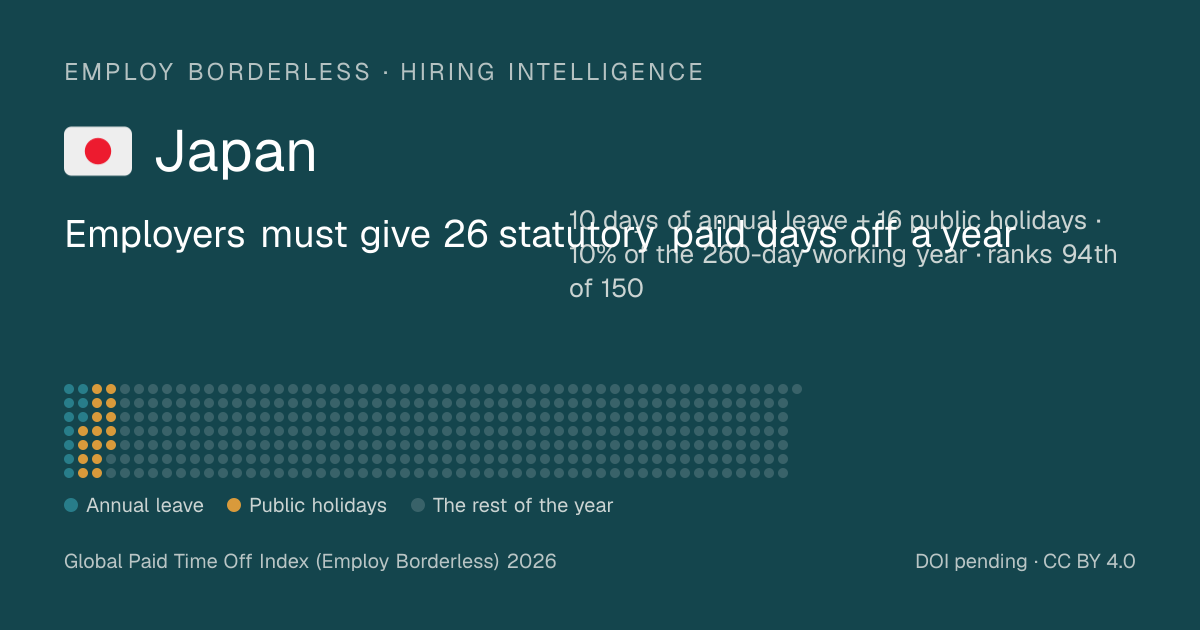
Martinique · rank 94 · 26 days
Employers in Martinique must give 26 statutory paid days off a year: 25 days of annual leave plus 1 public holiday the law requires as paid; the other 11 public holidays are not required as paid days off. That is 10% of the 260-day working year and ranks the country 94th of 150 for statutory paid time off.
An employer hiring in Martinique must give 26 statutory paid days off a year, 25 days of annual leave plus 1 public holiday the law requires as paid, about 5.2 working weeks and 10% of a 260-day working year, which leaves 234 working days per employee. It ranks 94th of 150 countries in the Global Paid Time Off Index 2026. That is 3 days below the median of the ranked set. These are statutory minimums, and most offers add days above the minimum.
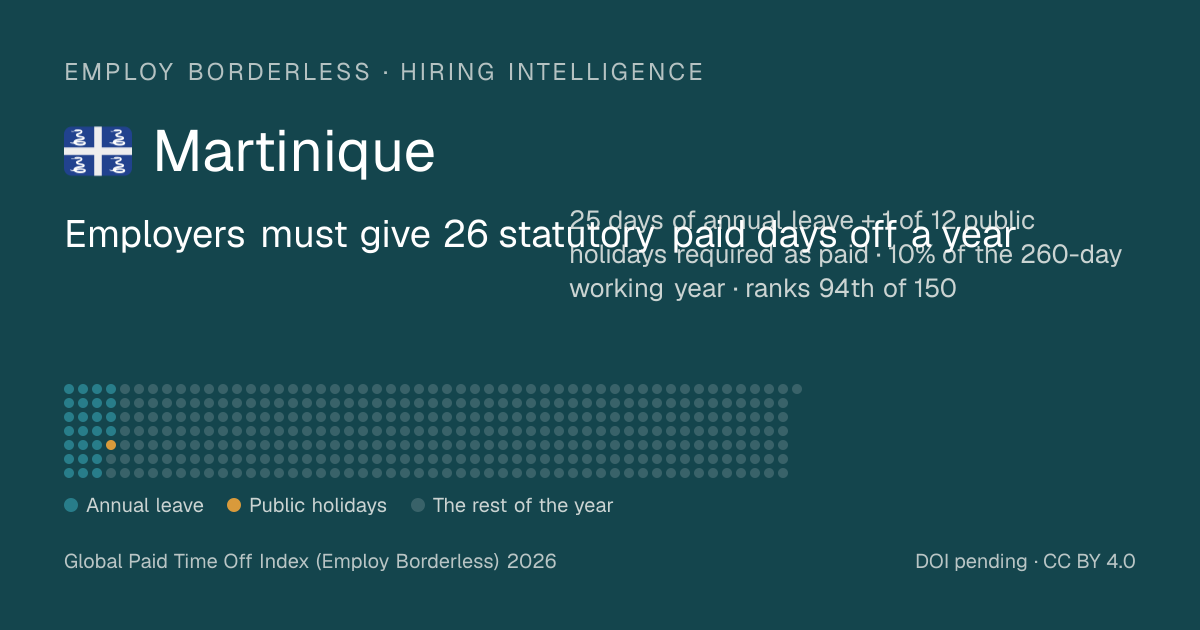
Saint Kitts and Nevis · rank 94 · 26 days
Employers in Saint Kitts and Nevis must give 26 statutory paid days off a year, 14 days of annual leave plus 12 public holidays, which is 10% of the 260-day working year and ranks the country 94th of 150 for statutory paid time off.
An employer hiring in Saint Kitts and Nevis must give 26 statutory paid days off a year, 14 days of annual leave plus 12 public holidays, about 5.2 working weeks and 10% of a 260-day working year, which leaves 234 working days per employee. It ranks 94th of 150 countries in the Global Paid Time Off Index 2026. That is 3 days below the median of the ranked set. These are statutory minimums, and most offers add days above the minimum.
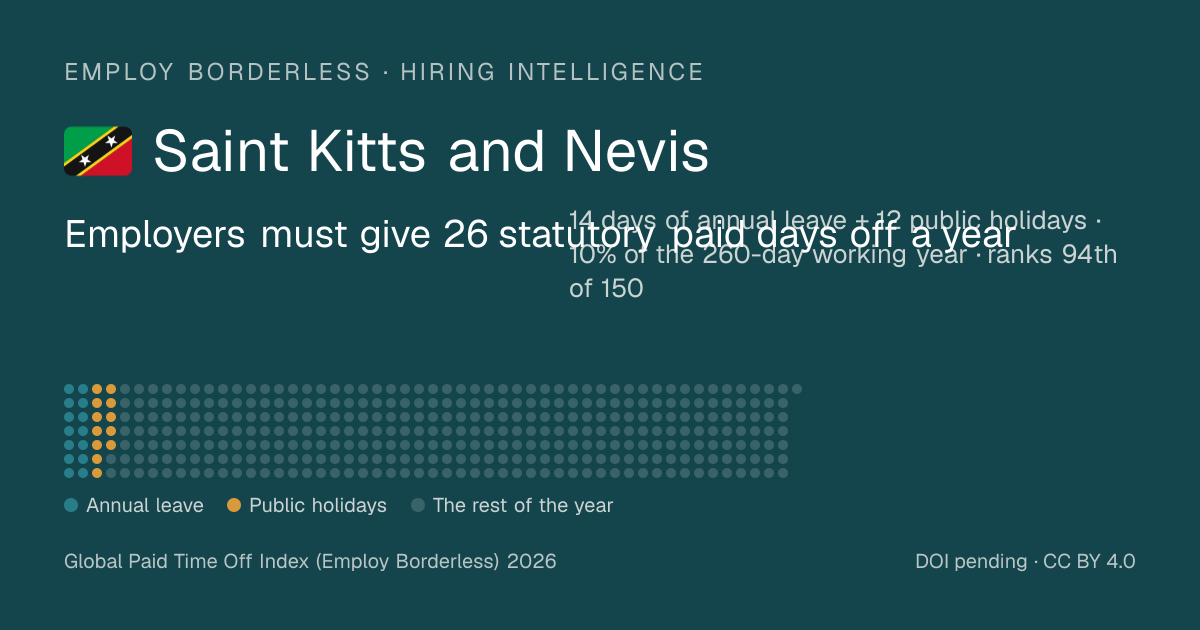
Cameroon · rank 105 · 25 days
Employers in Cameroon must give 25 statutory paid days off a year, 15 days of annual leave plus 10 public holidays, which is 9.6% of the 260-day working year and ranks the country 105th of 150 for statutory paid time off.
An employer hiring in Cameroon must give 25 statutory paid days off a year, 15 days of annual leave plus 10 public holidays, about 5 working weeks and 9.6% of a 260-day working year, which leaves 235 working days per employee. It ranks 105th of 150 countries in the Global Paid Time Off Index 2026. That is 4 days below the median of the ranked set. These are statutory minimums, and most offers add days above the minimum.
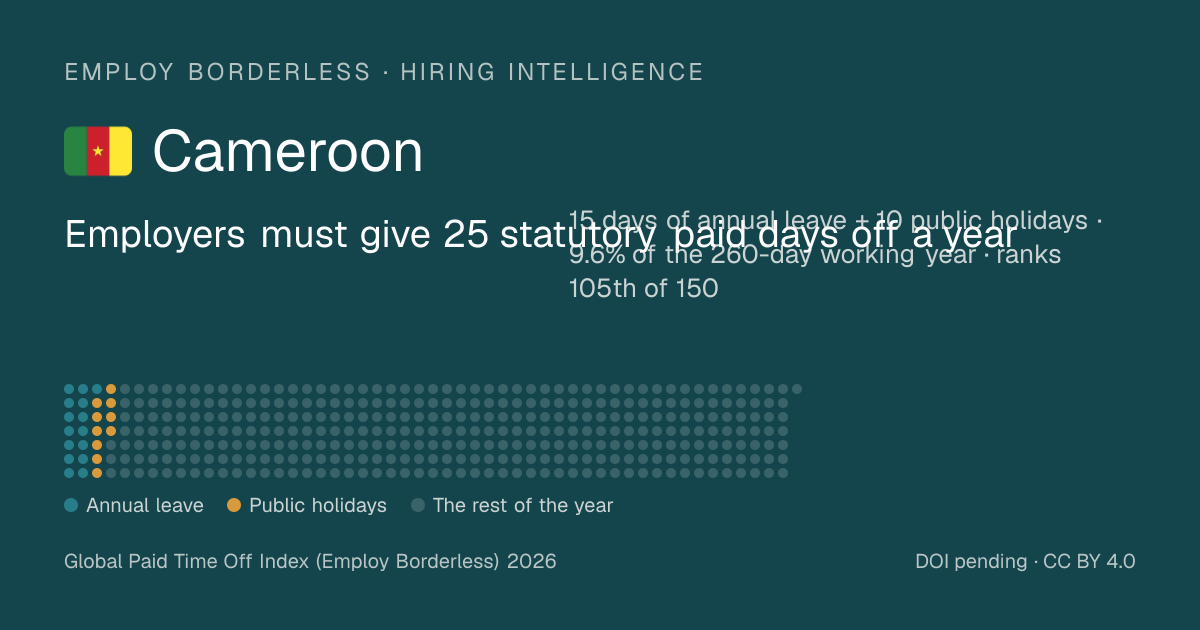
Paraguay · rank 105 · 25 days
Employers in Paraguay must give 25 statutory paid days off a year, 12 days of annual leave plus 13 public holidays, which is 9.6% of the 260-day working year and ranks the country 105th of 150 for statutory paid time off.
An employer hiring in Paraguay must give 25 statutory paid days off a year, 12 days of annual leave plus 13 public holidays, about 5 working weeks and 9.6% of a 260-day working year, which leaves 235 working days per employee. It ranks 105th of 150 countries in the Global Paid Time Off Index 2026. That is 4 days below the median of the ranked set. These are statutory minimums, and most offers add days above the minimum.
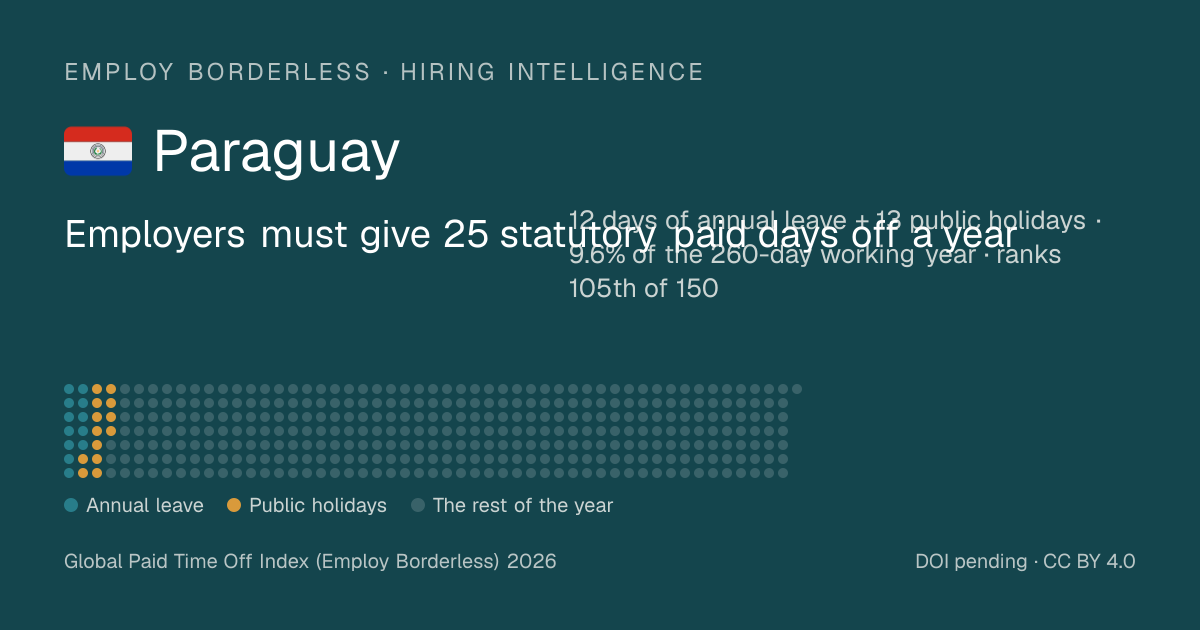
Qatar · rank 105 · 25 days
Employers in Qatar must give 25 statutory paid days off a year, 15 days of annual leave plus 10 public holidays, which is 9.6% of the 260-day working year and ranks the country 105th of 150 for statutory paid time off.
An employer hiring in Qatar must give 25 statutory paid days off a year, 15 days of annual leave plus 10 public holidays, about 5 working weeks and 9.6% of a 260-day working year, which leaves 235 working days per employee. It ranks 105th of 150 countries in the Global Paid Time Off Index 2026. That is 4 days below the median of the ranked set. These are statutory minimums, and most offers add days above the minimum.
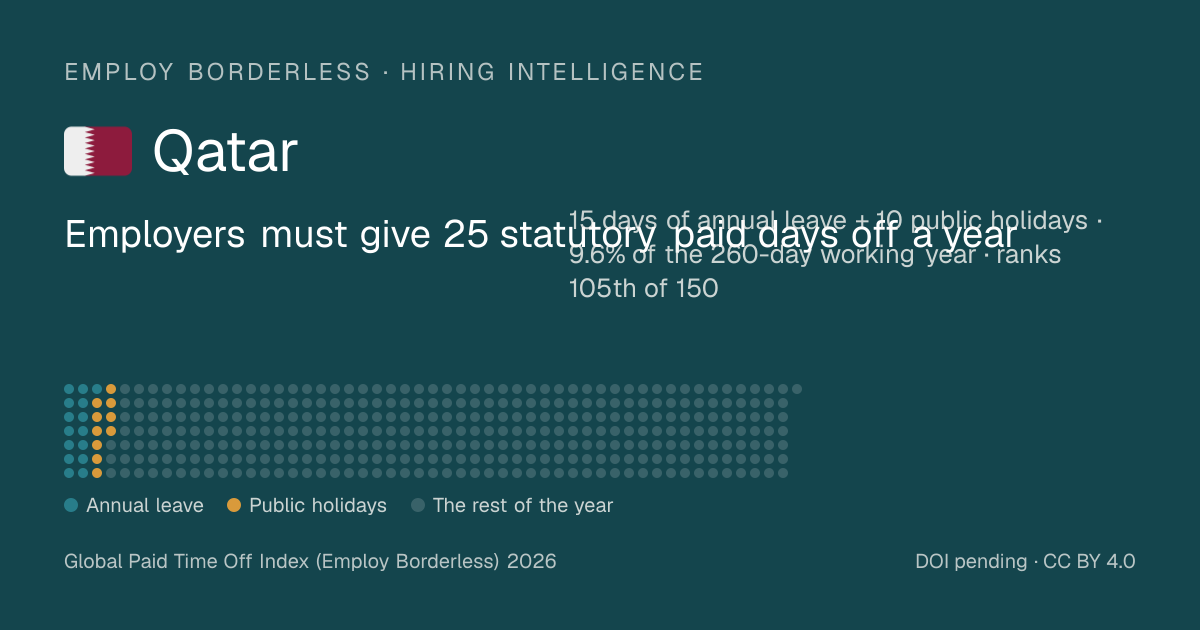
Sweden · rank 105 · 25 days
Employers in Sweden must give 25 statutory paid days off a year, all of it annual leave; the law does not require them to give the 13 public holidays as paid days off. That is 9.6% of the 260-day working year and ranks the country 105th of 150 for statutory paid time off.
An employer hiring in Sweden must give 25 statutory paid days off a year, all of it annual leave; the law does not require it to give the 13 public holidays as paid days off, about 5 working weeks and 9.6% of a 260-day working year, which leaves 235 working days per employee. It ranks 105th of 150 countries in the Global Paid Time Off Index 2026. That is 4 days below the median of the ranked set. These are statutory minimums, and most offers add days above the minimum.
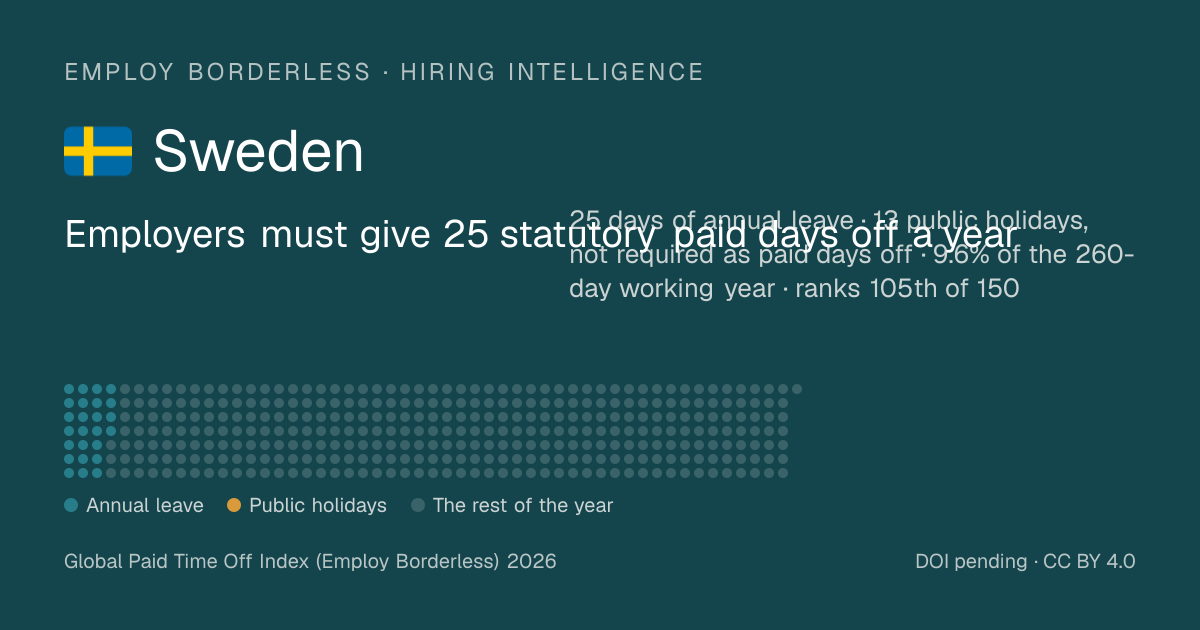
Uruguay · rank 105 · 25 days
Employers in Uruguay must give 25 statutory paid days off a year, 20 days of annual leave plus 5 public holidays, which is 9.6% of the 260-day working year and ranks the country 105th of 150 for statutory paid time off.
An employer hiring in Uruguay must give 25 statutory paid days off a year, 20 days of annual leave plus 5 public holidays, about 5 working weeks and 9.6% of a 260-day working year, which leaves 235 working days per employee. It ranks 105th of 150 countries in the Global Paid Time Off Index 2026. That is 4 days below the median of the ranked set. These are statutory minimums, and most offers add days above the minimum.
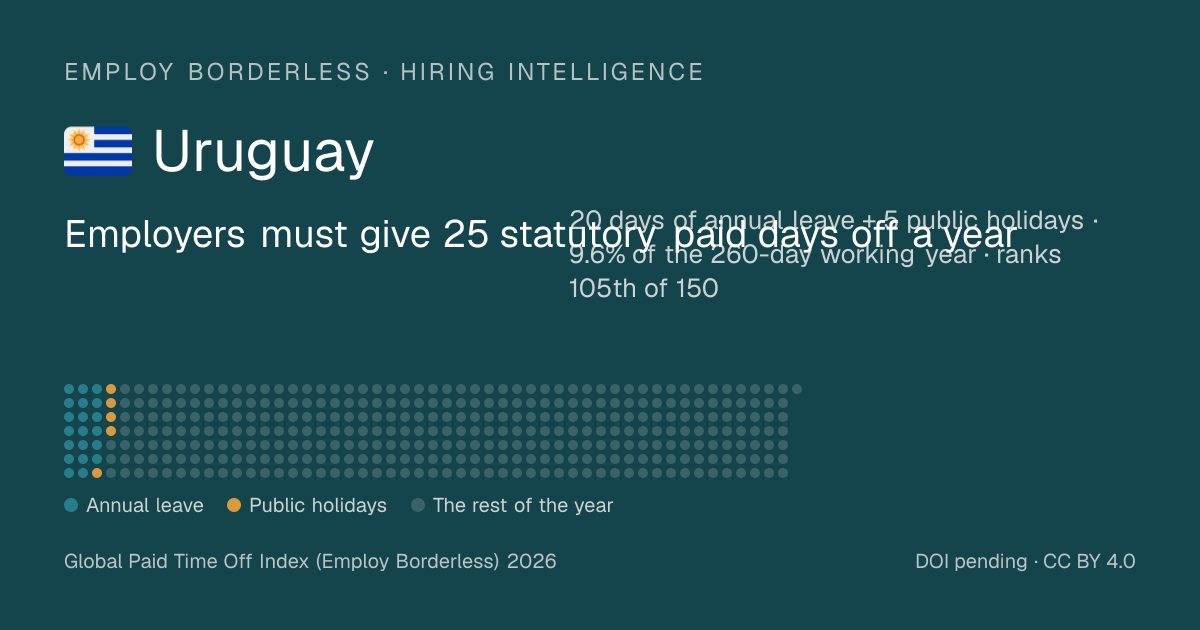
Belize · rank 110 · 24 days
Employers in Belize must give 24 statutory paid days off a year, 10 days of annual leave plus 14 public holidays, which is 9.2% of the 260-day working year and ranks the country 110th of 150 for statutory paid time off.
An employer hiring in Belize must give 24 statutory paid days off a year, 10 days of annual leave plus 14 public holidays, about 4.8 working weeks and 9.2% of a 260-day working year, which leaves 236 working days per employee. It ranks 110th of 150 countries in the Global Paid Time Off Index 2026. That is 5 days below the median of the ranked set. These are statutory minimums, and most offers add days above the minimum.
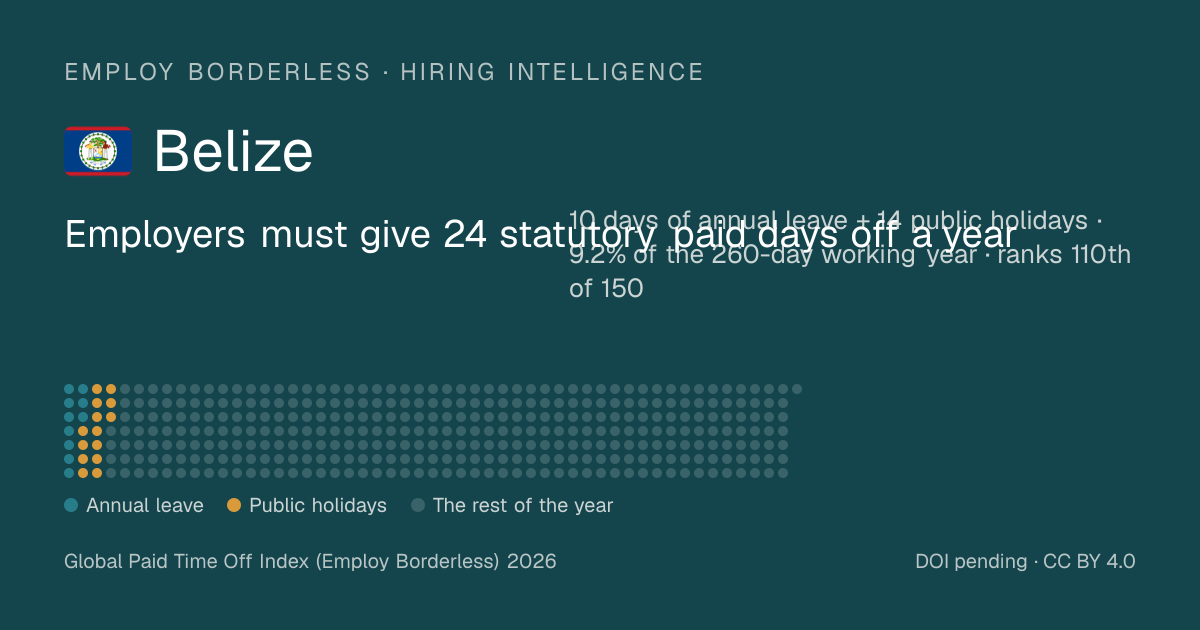
Grenada · rank 110 · 24 days
Employers in Grenada must give 24 statutory paid days off a year, 10 days of annual leave plus 14 public holidays, which is 9.2% of the 260-day working year and ranks the country 110th of 150 for statutory paid time off.
An employer hiring in Grenada must give 24 statutory paid days off a year, 10 days of annual leave plus 14 public holidays, about 4.8 working weeks and 9.2% of a 260-day working year, which leaves 236 working days per employee. It ranks 110th of 150 countries in the Global Paid Time Off Index 2026. That is 5 days below the median of the ranked set. These are statutory minimums, and most offers add days above the minimum.
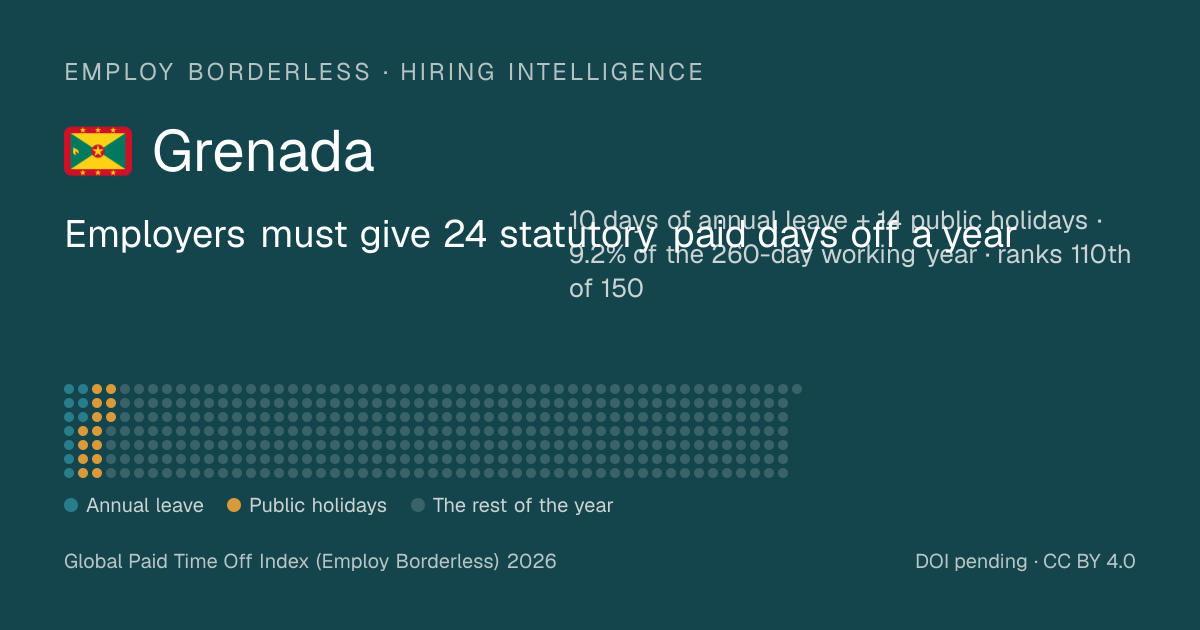
Ivory Coast · rank 110 · 24 days
Employers in Ivory Coast must give 24 statutory paid days off a year: 22 days of annual leave plus 2 public holidays the law requires as paid; the other 12 public holidays are not required as paid days off. That is 9.2% of the 260-day working year and ranks the country 110th of 150 for statutory paid time off.
An employer hiring in Ivory Coast must give 24 statutory paid days off a year, 22 days of annual leave plus 2 public holidays the law requires as paid, about 4.8 working weeks and 9.2% of a 260-day working year, which leaves 236 working days per employee. It ranks 110th of 150 countries in the Global Paid Time Off Index 2026. That is 5 days below the median of the ranked set. These are statutory minimums, and most offers add days above the minimum.
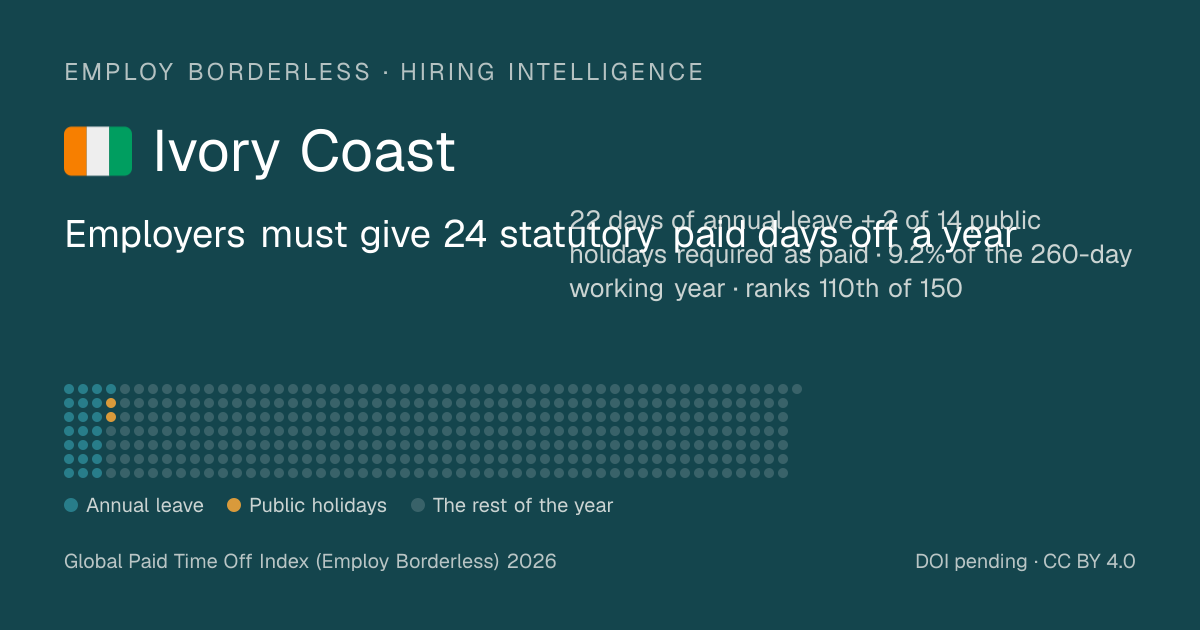
Jersey · rank 110 · 24 days
Employers in Jersey must give 24 statutory paid days off a year, 15 days of annual leave plus 9 public holidays, which is 9.2% of the 260-day working year and ranks the country 110th of 150 for statutory paid time off.
An employer hiring in Jersey must give 24 statutory paid days off a year, 15 days of annual leave plus 9 public holidays, about 4.8 working weeks and 9.2% of a 260-day working year, which leaves 236 working days per employee. It ranks 110th of 150 countries in the Global Paid Time Off Index 2026. That is 5 days below the median of the ranked set. These are statutory minimums, and most offers add days above the minimum.
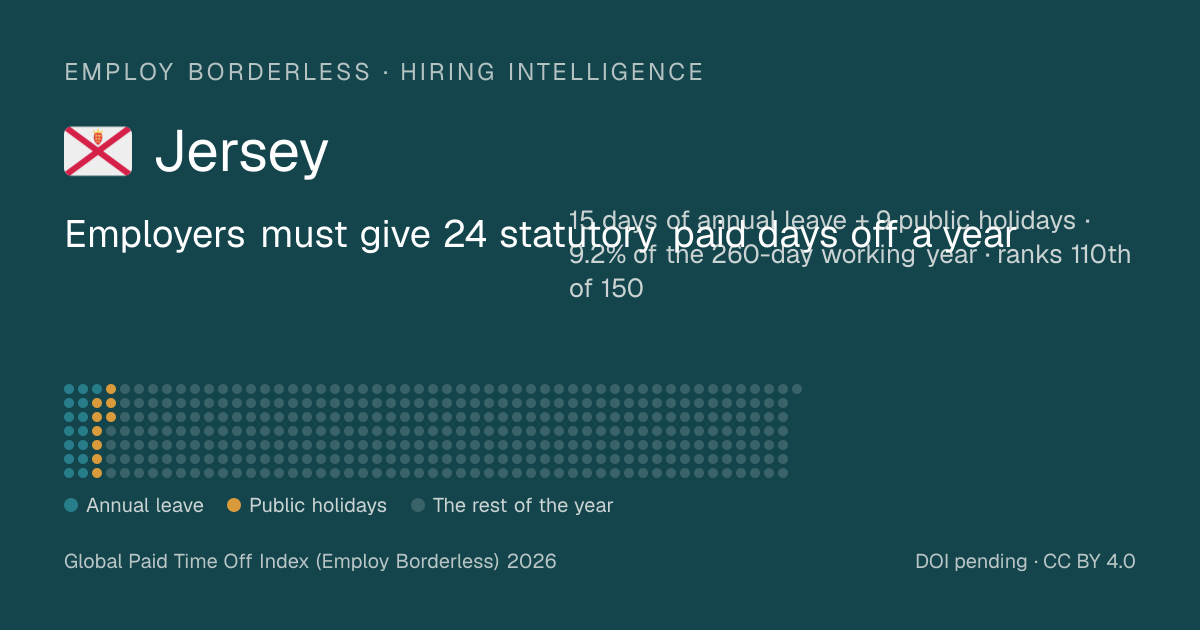
Saudi Arabia · rank 110 · 24 days
Employers in Saudi Arabia must give 24 statutory paid days off a year, 15 days of annual leave plus 9 public holidays, which is 9.2% of the 260-day working year and ranks the country 110th of 150 for statutory paid time off.
An employer hiring in Saudi Arabia must give 24 statutory paid days off a year, 15 days of annual leave plus 9 public holidays, about 4.8 working weeks and 9.2% of a 260-day working year, which leaves 236 working days per employee. It ranks 110th of 150 countries in the Global Paid Time Off Index 2026. That is 5 days below the median of the ranked set. These are statutory minimums, and most offers add days above the minimum.
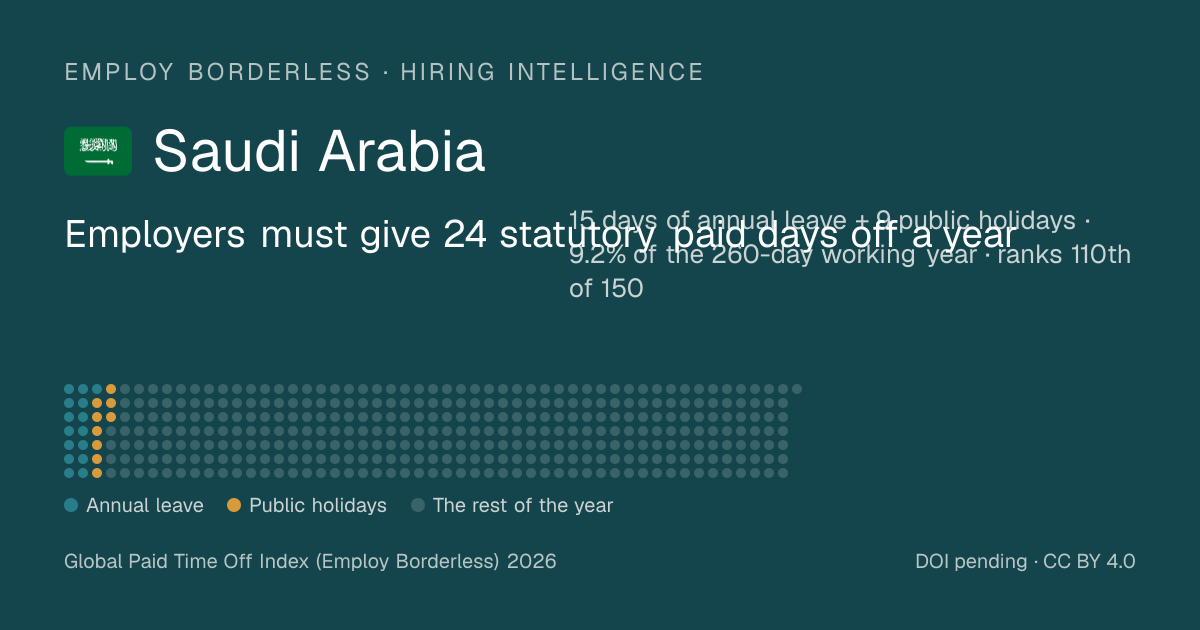
Solomon Islands · rank 110 · 24 days
Employers in the Solomon Islands must give 24 statutory paid days off a year, 15 days of annual leave plus 9 public holidays, which is 9.2% of the 260-day working year and ranks the country 110th of 150 for statutory paid time off.
An employer hiring in the Solomon Islands must give 24 statutory paid days off a year, 15 days of annual leave plus 9 public holidays, about 4.8 working weeks and 9.2% of a 260-day working year, which leaves 236 working days per employee. It ranks 110th of 150 countries in the Global Paid Time Off Index 2026. That is 5 days below the median of the ranked set. These are statutory minimums, and most offers add days above the minimum.
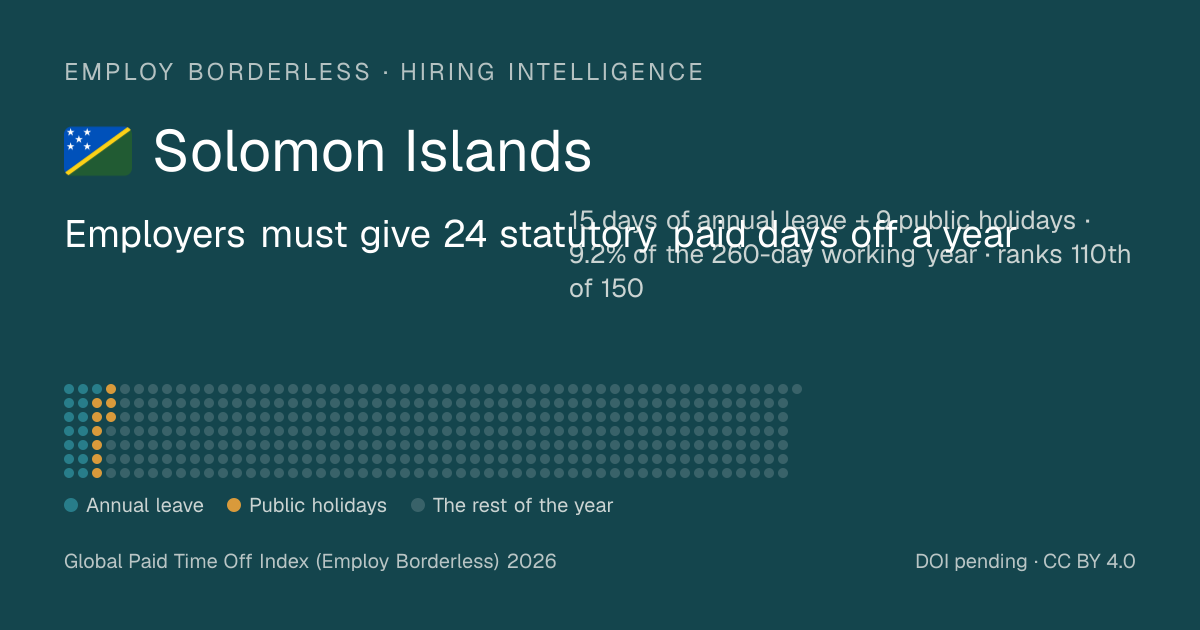
Vietnam · rank 110 · 24 days
Employers in Vietnam must give 24 statutory paid days off a year, 12 days of annual leave plus 12 public holidays, which is 9.2% of the 260-day working year and ranks the country 110th of 150 for statutory paid time off.
An employer hiring in Vietnam must give 24 statutory paid days off a year, 12 days of annual leave plus 12 public holidays, about 4.8 working weeks and 9.2% of a 260-day working year, which leaves 236 working days per employee. It ranks 110th of 150 countries in the Global Paid Time Off Index 2026. That is 5 days below the median of the ranked set. These are statutory minimums, and most offers add days above the minimum.
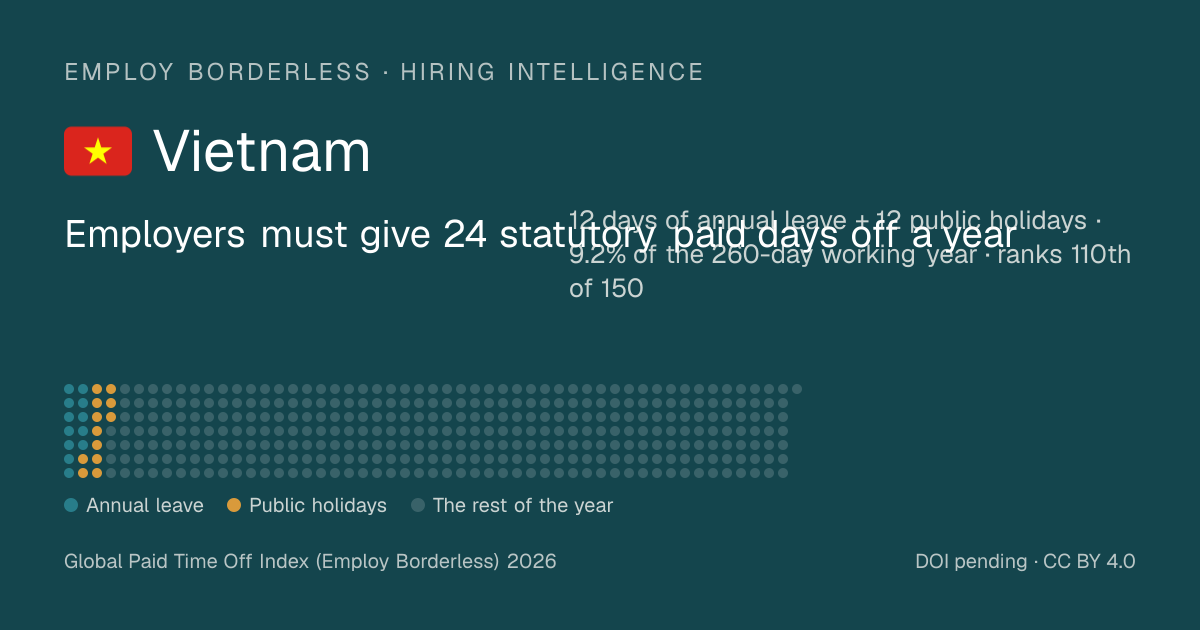
Antigua and Barbuda · rank 117 · 23 days
Employers in Antigua and Barbuda must give 23 statutory paid days off a year, 12 days of annual leave plus 11 public holidays, which is 8.8% of the 260-day working year and ranks the country 117th of 150 for statutory paid time off.
An employer hiring in Antigua and Barbuda must give 23 statutory paid days off a year, 12 days of annual leave plus 11 public holidays, about 4.6 working weeks and 8.8% of a 260-day working year, which leaves 237 working days per employee. It ranks 117th of 150 countries in the Global Paid Time Off Index 2026. That is 6 days below the median of the ranked set. These are statutory minimums, and most offers add days above the minimum.
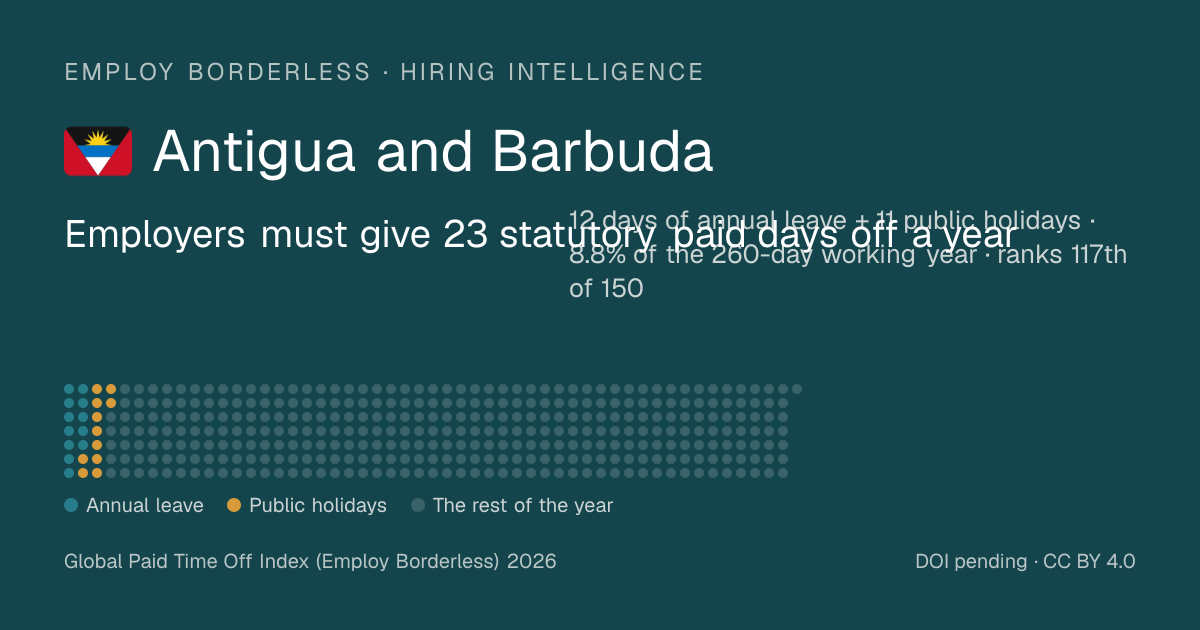
Lesotho · rank 117 · 23 days
Employers in Lesotho must give 23 statutory paid days off a year, 12 days of annual leave plus 11 public holidays, which is 8.8% of the 260-day working year and ranks the country 117th of 150 for statutory paid time off.
An employer hiring in Lesotho must give 23 statutory paid days off a year, 12 days of annual leave plus 11 public holidays, about 4.6 working weeks and 8.8% of a 260-day working year, which leaves 237 working days per employee. It ranks 117th of 150 countries in the Global Paid Time Off Index 2026. That is 6 days below the median of the ranked set. These are statutory minimums, and most offers add days above the minimum.
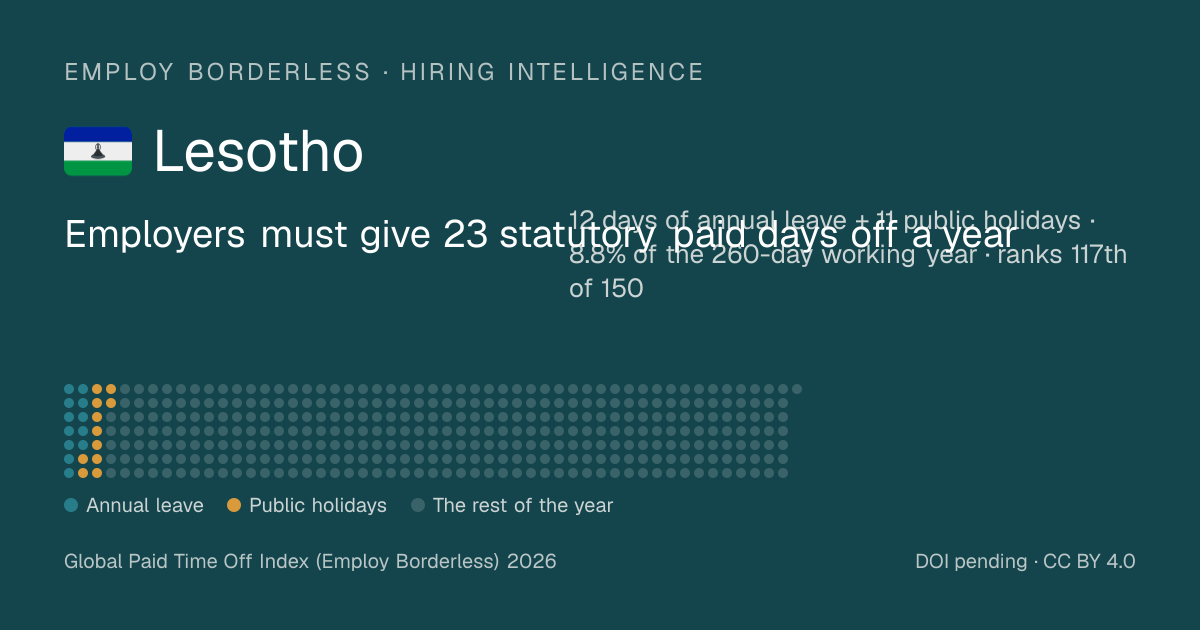
Mauritania · rank 117 · 23 days
Employers in Mauritania must give 23 statutory paid days off a year, 15 days of annual leave plus 8 public holidays, which is 8.8% of the 260-day working year and ranks the country 117th of 150 for statutory paid time off.
An employer hiring in Mauritania must give 23 statutory paid days off a year, 15 days of annual leave plus 8 public holidays, about 4.6 working weeks and 8.8% of a 260-day working year, which leaves 237 working days per employee. It ranks 117th of 150 countries in the Global Paid Time Off Index 2026. That is 6 days below the median of the ranked set. These are statutory minimums, and most offers add days above the minimum.
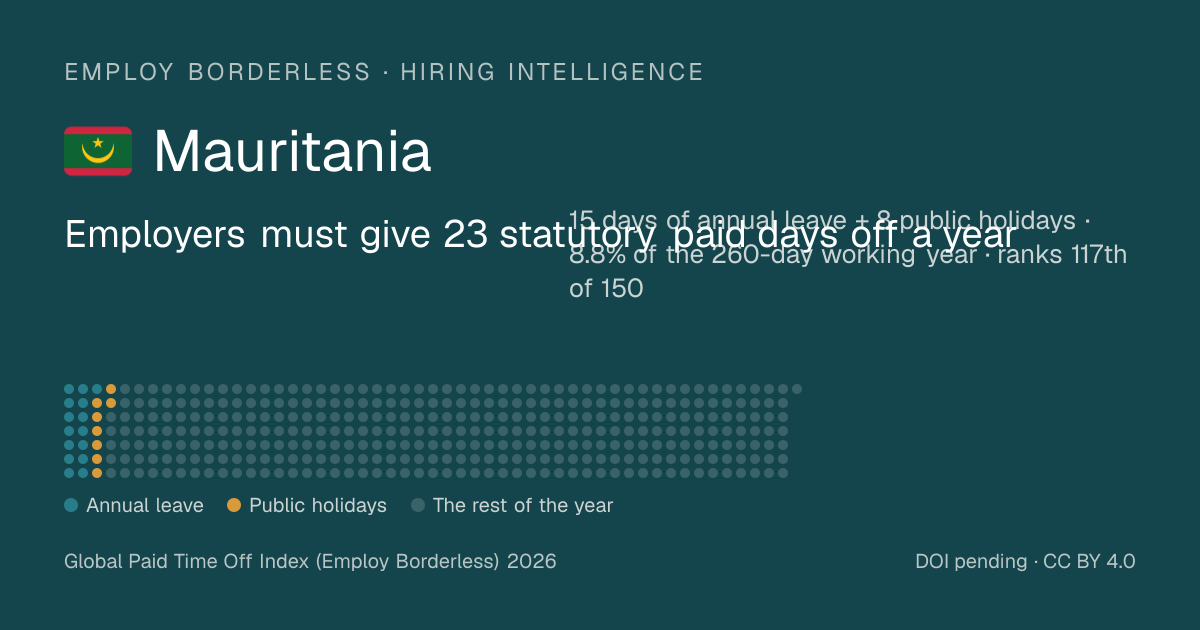
Norway · rank 117 · 23 days
Employers in Norway must give 23 statutory paid days off a year: 21 days of annual leave plus 2 public holidays the law requires as paid; the other 10 public holidays are not required as paid days off. That is 8.8% of the 260-day working year and ranks the country 117th of 150 for statutory paid time off.
An employer hiring in Norway must give 23 statutory paid days off a year, 21 days of annual leave plus 2 public holidays the law requires as paid, about 4.6 working weeks and 8.8% of a 260-day working year, which leaves 237 working days per employee. It ranks 117th of 150 countries in the Global Paid Time Off Index 2026. That is 6 days below the median of the ranked set. These are statutory minimums, and most offers add days above the minimum.
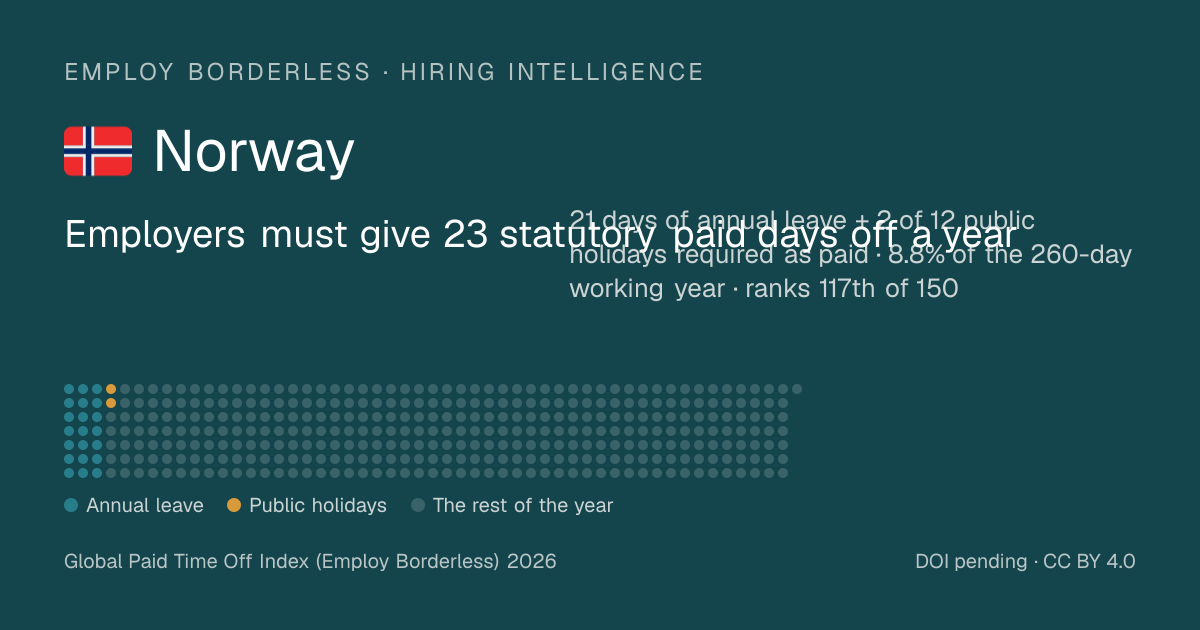
Tuvalu · rank 117 · 23 days
Employers in Tuvalu must give 23 statutory paid days off a year, 12 days of annual leave plus 11 public holidays, which is 8.8% of the 260-day working year and ranks the country 117th of 150 for statutory paid time off.
An employer hiring in Tuvalu must give 23 statutory paid days off a year, 12 days of annual leave plus 11 public holidays, about 4.6 working weeks and 8.8% of a 260-day working year, which leaves 237 working days per employee. It ranks 117th of 150 countries in the Global Paid Time Off Index 2026. That is 6 days below the median of the ranked set. These are statutory minimums, and most offers add days above the minimum.
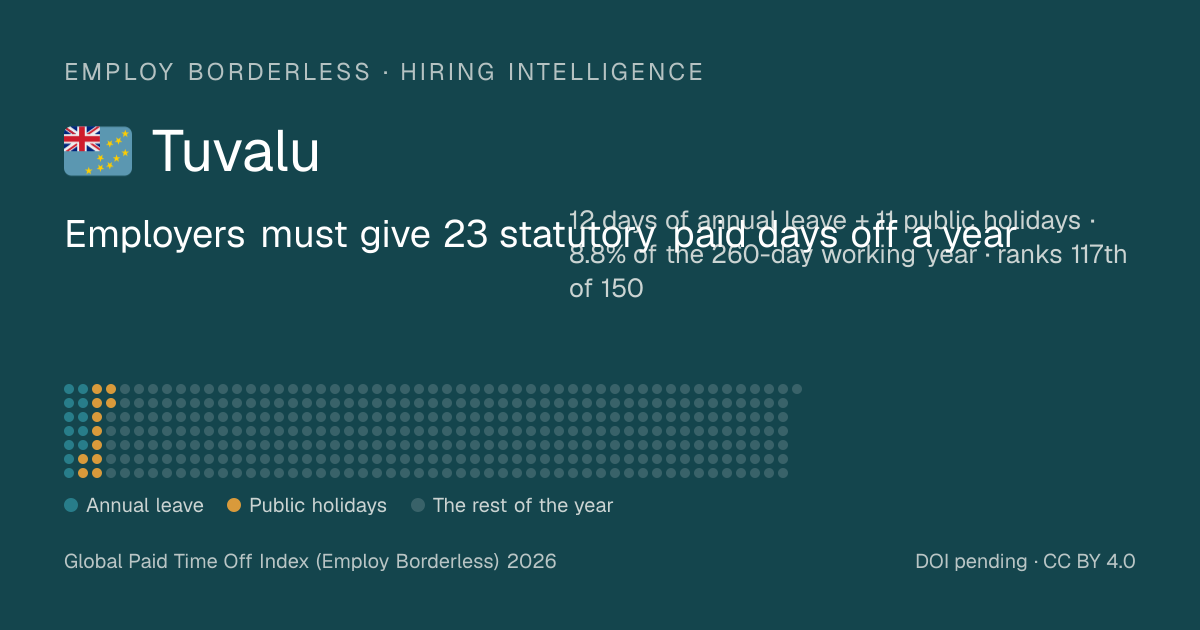
Cayman Islands · rank 122 · 22 days
Employers in the Cayman Islands must give 22 statutory paid days off a year, 10 days of annual leave plus 12 public holidays, which is 8.5% of the 260-day working year and ranks the country 122nd of 150 for statutory paid time off.
An employer hiring in the Cayman Islands must give 22 statutory paid days off a year, 10 days of annual leave plus 12 public holidays, about 4.4 working weeks and 8.5% of a 260-day working year, which leaves 238 working days per employee. It ranks 122nd of 150 countries in the Global Paid Time Off Index 2026. That is 7 days below the median of the ranked set. These are statutory minimums, and most offers add days above the minimum.
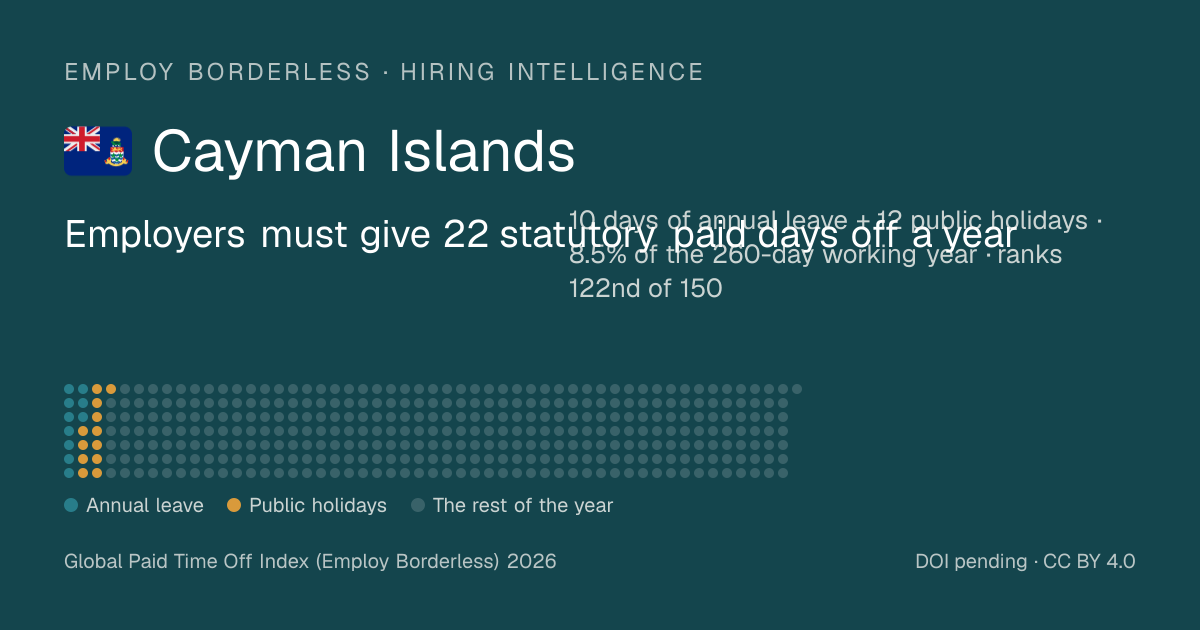
Dominica · rank 122 · 22 days
Employers in Dominica must give 22 statutory paid days off a year, 10 days of annual leave plus 12 public holidays, which is 8.5% of the 260-day working year and ranks the country 122nd of 150 for statutory paid time off.
An employer hiring in Dominica must give 22 statutory paid days off a year, 10 days of annual leave plus 12 public holidays, about 4.4 working weeks and 8.5% of a 260-day working year, which leaves 238 working days per employee. It ranks 122nd of 150 countries in the Global Paid Time Off Index 2026. That is 7 days below the median of the ranked set. These are statutory minimums, and most offers add days above the minimum.
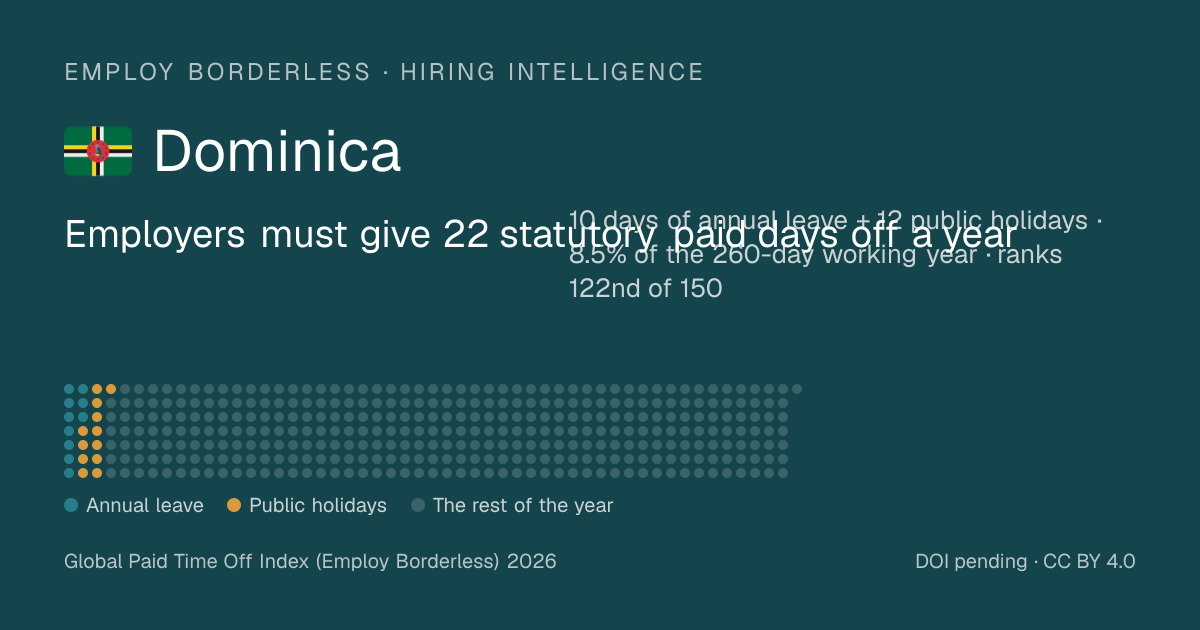
DR Congo · rank 122 · 22 days
Employers in DR Congo must give 22 statutory paid days off a year, 12 days of annual leave plus 10 public holidays, which is 8.5% of the 260-day working year and ranks the country 122nd of 150 for statutory paid time off.
An employer hiring in DR Congo must give 22 statutory paid days off a year, 12 days of annual leave plus 10 public holidays, about 4.4 working weeks and 8.5% of a 260-day working year, which leaves 238 working days per employee. It ranks 122nd of 150 countries in the Global Paid Time Off Index 2026. That is 7 days below the median of the ranked set. These are statutory minimums, and most offers add days above the minimum.
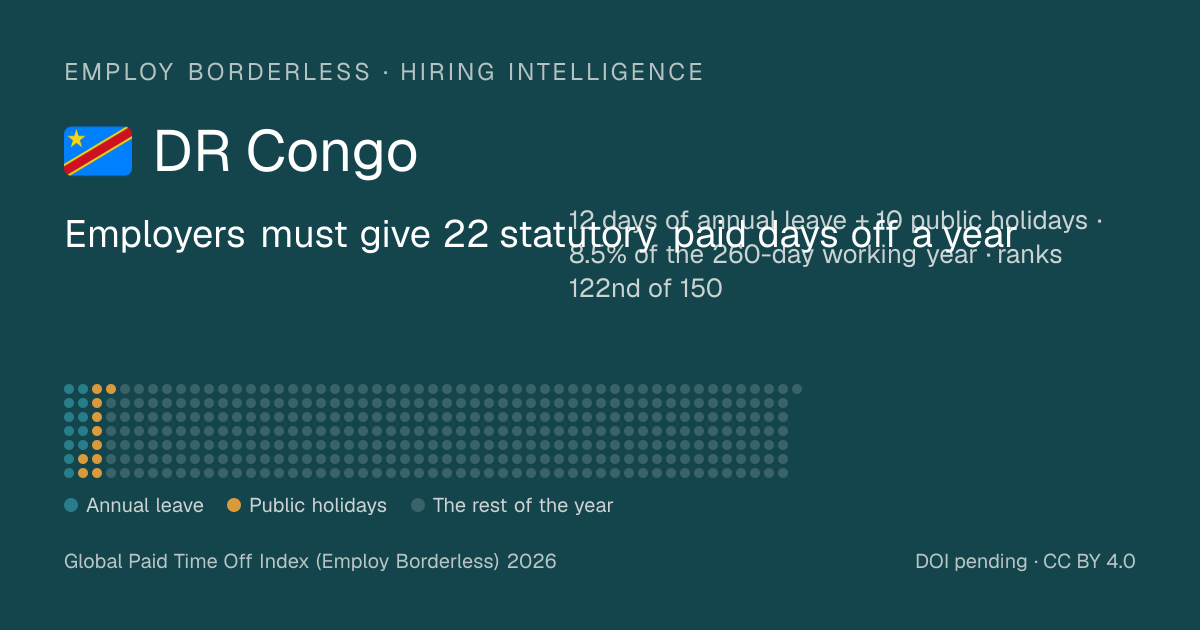
Ecuador · rank 122 · 22 days
Employers in Ecuador must give 22 statutory paid days off a year, 11 days of annual leave plus 11 public holidays, which is 8.5% of the 260-day working year and ranks the country 122nd of 150 for statutory paid time off.
An employer hiring in Ecuador must give 22 statutory paid days off a year, 11 days of annual leave plus 11 public holidays, about 4.4 working weeks and 8.5% of a 260-day working year, which leaves 238 working days per employee. It ranks 122nd of 150 countries in the Global Paid Time Off Index 2026. That is 7 days below the median of the ranked set. These are statutory minimums, and most offers add days above the minimum.
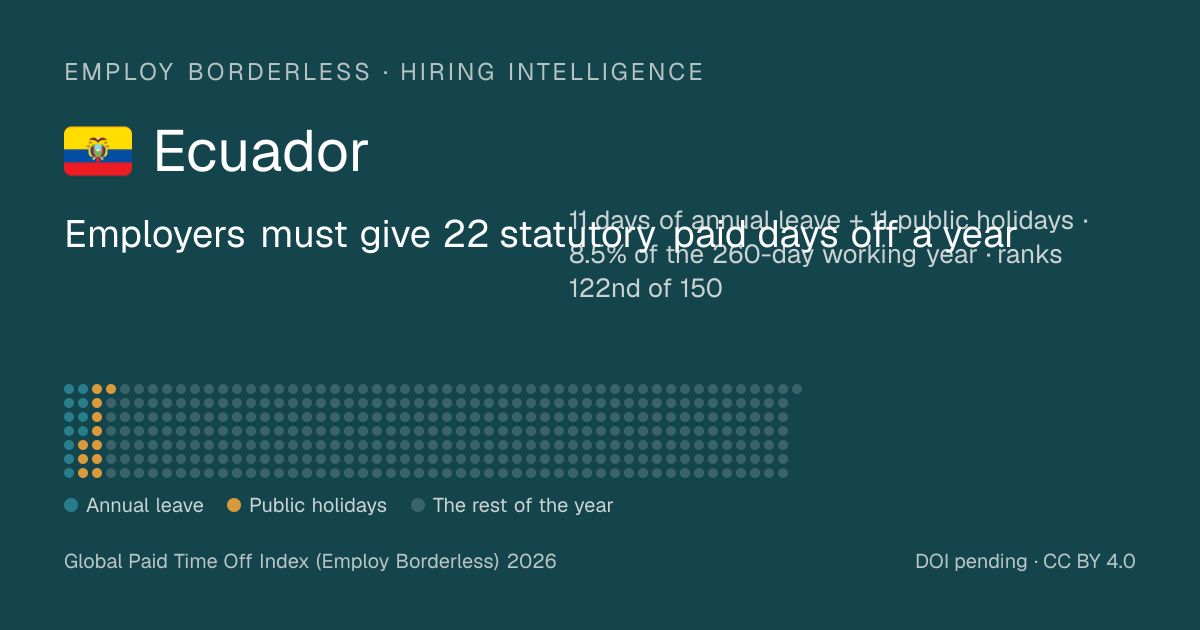
El Salvador · rank 122 · 22 days
Employers in El Salvador must give 22 statutory paid days off a year, 11 days of annual leave plus 11 public holidays, which is 8.5% of the 260-day working year and ranks the country 122nd of 150 for statutory paid time off.
An employer hiring in El Salvador must give 22 statutory paid days off a year, 11 days of annual leave plus 11 public holidays, about 4.4 working weeks and 8.5% of a 260-day working year, which leaves 238 working days per employee. It ranks 122nd of 150 countries in the Global Paid Time Off Index 2026. That is 7 days below the median of the ranked set. These are statutory minimums, and most offers add days above the minimum.
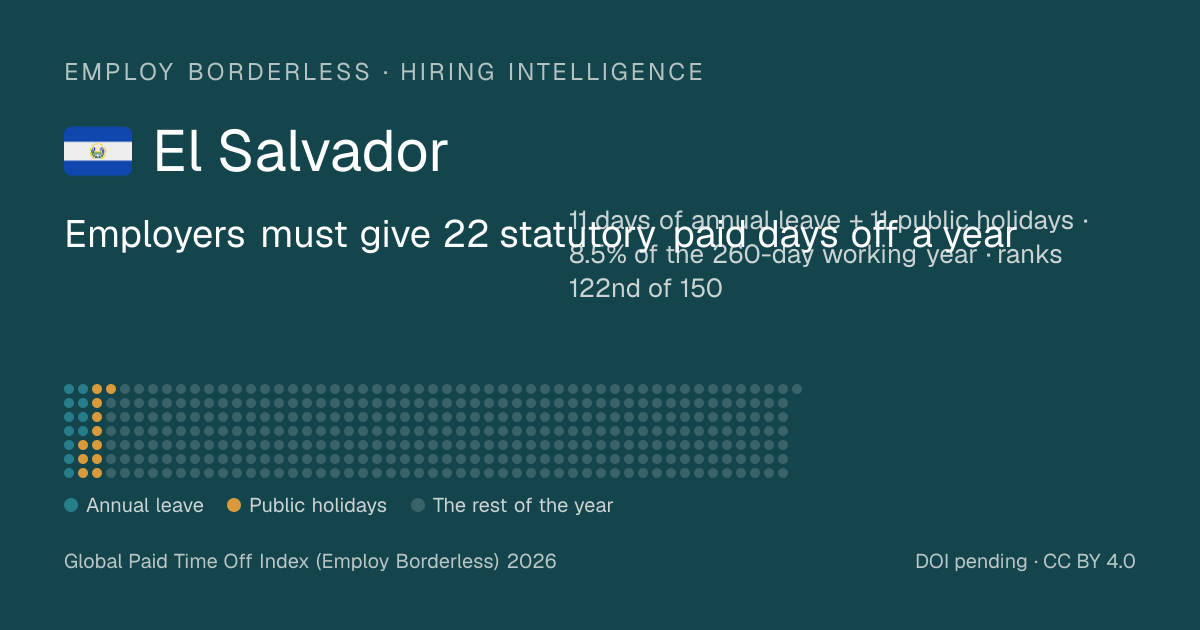
Hong Kong · rank 122 · 22 days
Employers in Hong Kong must give 22 statutory paid days off a year, 7 days of annual leave plus 15 public holidays, which is 8.5% of the 260-day working year and ranks the country 122nd of 150 for statutory paid time off.
An employer hiring in Hong Kong must give 22 statutory paid days off a year, 7 days of annual leave plus 15 public holidays, about 4.4 working weeks and 8.5% of a 260-day working year, which leaves 238 working days per employee. It ranks 122nd of 150 countries in the Global Paid Time Off Index 2026. That is 7 days below the median of the ranked set. These are statutory minimums, and most offers add days above the minimum.
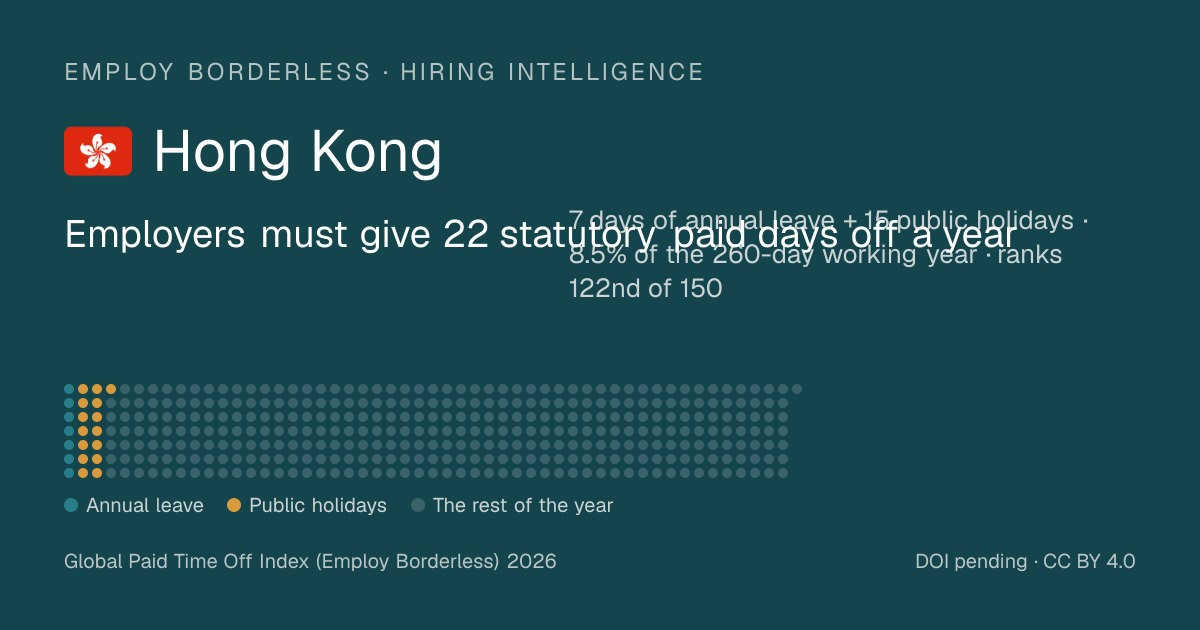
Uzbekistan · rank 128 · 21.5 days
Employers in Uzbekistan must give 21.5 statutory paid days off a year, 12.5 days of annual leave plus 9 public holidays, which is 8.3% of the 260-day working year and ranks the country 128th of 150 for statutory paid time off.
An employer hiring in Uzbekistan must give 21.5 statutory paid days off a year, 12.5 days of annual leave plus 9 public holidays, about 4.3 working weeks and 8.3% of a 260-day working year, which leaves 238.5 working days per employee. It ranks 128th of 150 countries in the Global Paid Time Off Index 2026. That is 7.5 days below the median of the ranked set. These are statutory minimums, and most offers add days above the minimum.
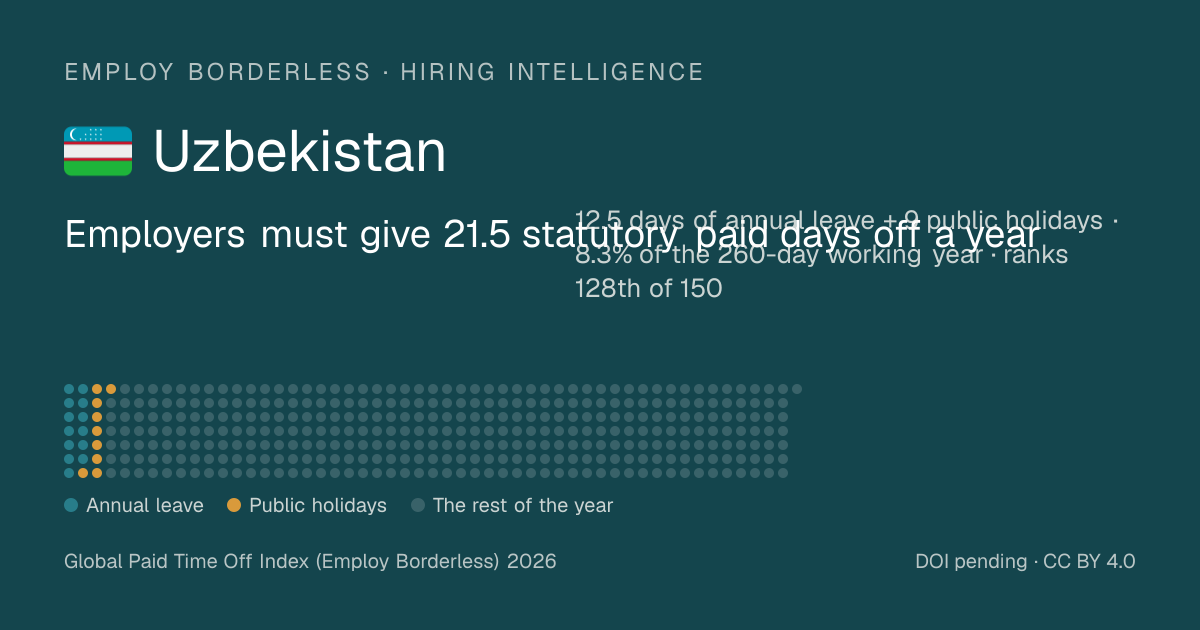
Bahamas · rank 129 · 21 days
Employers in the Bahamas must give 21 statutory paid days off a year, 10 days of annual leave plus 11 public holidays, which is 8.1% of the 260-day working year and ranks the country 129th of 150 for statutory paid time off.
An employer hiring in the Bahamas must give 21 statutory paid days off a year, 10 days of annual leave plus 11 public holidays, about 4.2 working weeks and 8.1% of a 260-day working year, which leaves 239 working days per employee. It ranks 129th of 150 countries in the Global Paid Time Off Index 2026. That is 8 days below the median of the ranked set. These are statutory minimums, and most offers add days above the minimum.
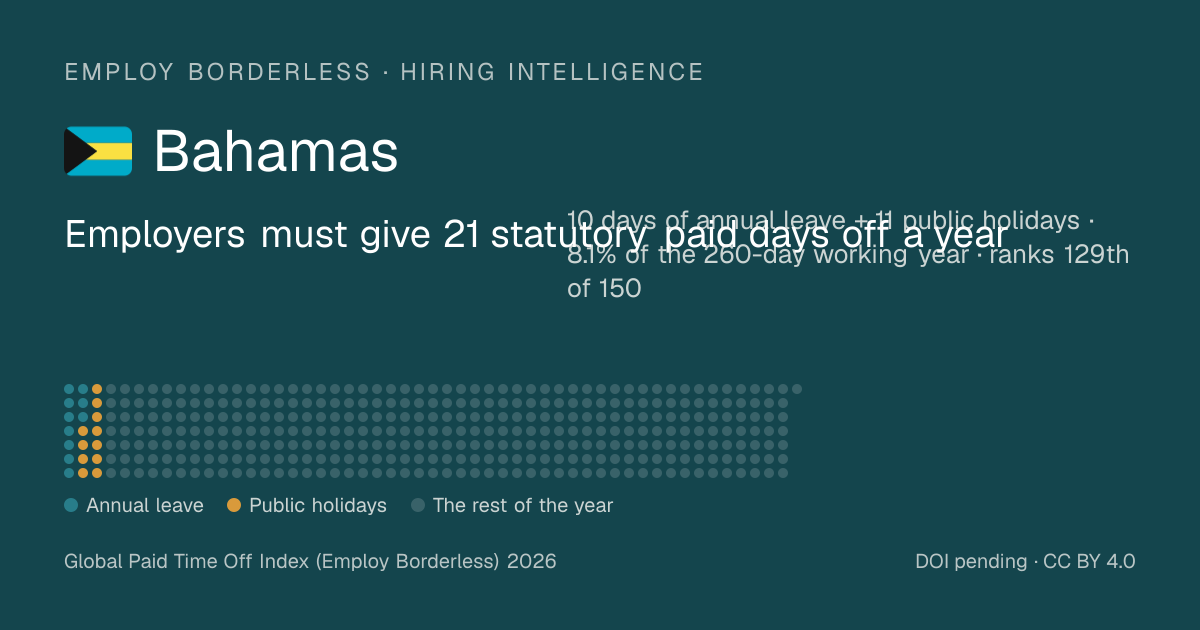
Cook Islands · rank 129 · 21 days
Employers in the Cook Islands must give 21 statutory paid days off a year, 10 days of annual leave plus 11 public holidays, which is 8.1% of the 260-day working year and ranks the country 129th of 150 for statutory paid time off.
An employer hiring in the Cook Islands must give 21 statutory paid days off a year, 10 days of annual leave plus 11 public holidays, about 4.2 working weeks and 8.1% of a 260-day working year, which leaves 239 working days per employee. It ranks 129th of 150 countries in the Global Paid Time Off Index 2026. That is 8 days below the median of the ranked set. These are statutory minimums, and most offers add days above the minimum.
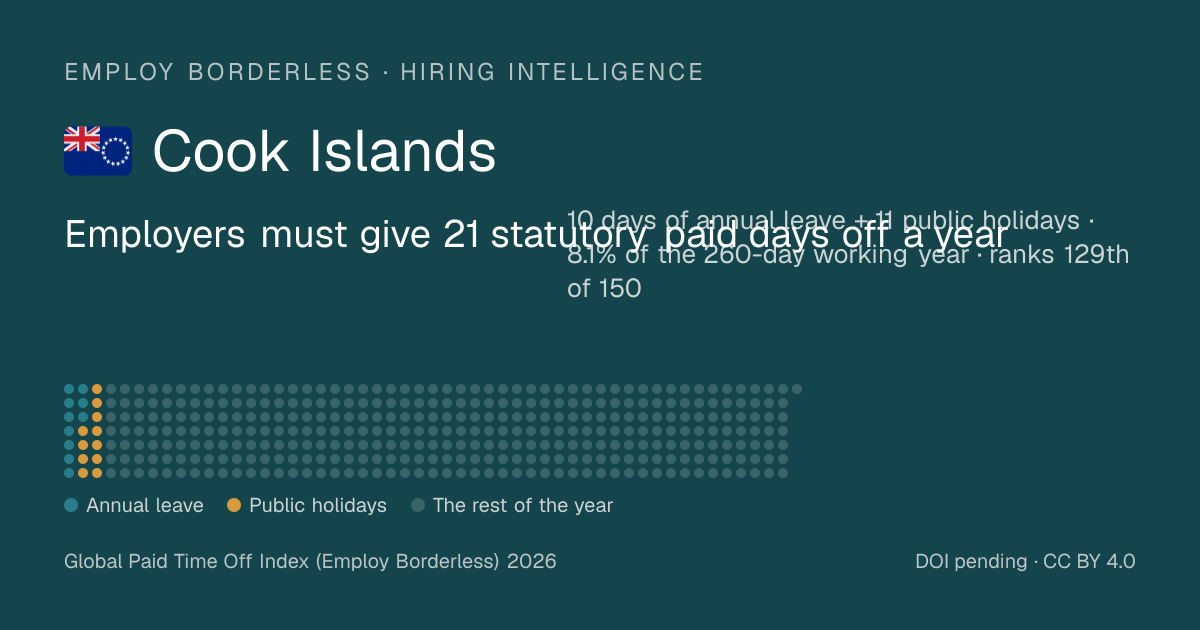
Fiji · rank 129 · 21 days
Employers in Fiji must give 21 statutory paid days off a year, 10 days of annual leave plus 11 public holidays, which is 8.1% of the 260-day working year and ranks the country 129th of 150 for statutory paid time off.
An employer hiring in Fiji must give 21 statutory paid days off a year, 10 days of annual leave plus 11 public holidays, about 4.2 working weeks and 8.1% of a 260-day working year, which leaves 239 working days per employee. It ranks 129th of 150 countries in the Global Paid Time Off Index 2026. That is 8 days below the median of the ranked set. These are statutory minimums, and most offers add days above the minimum.
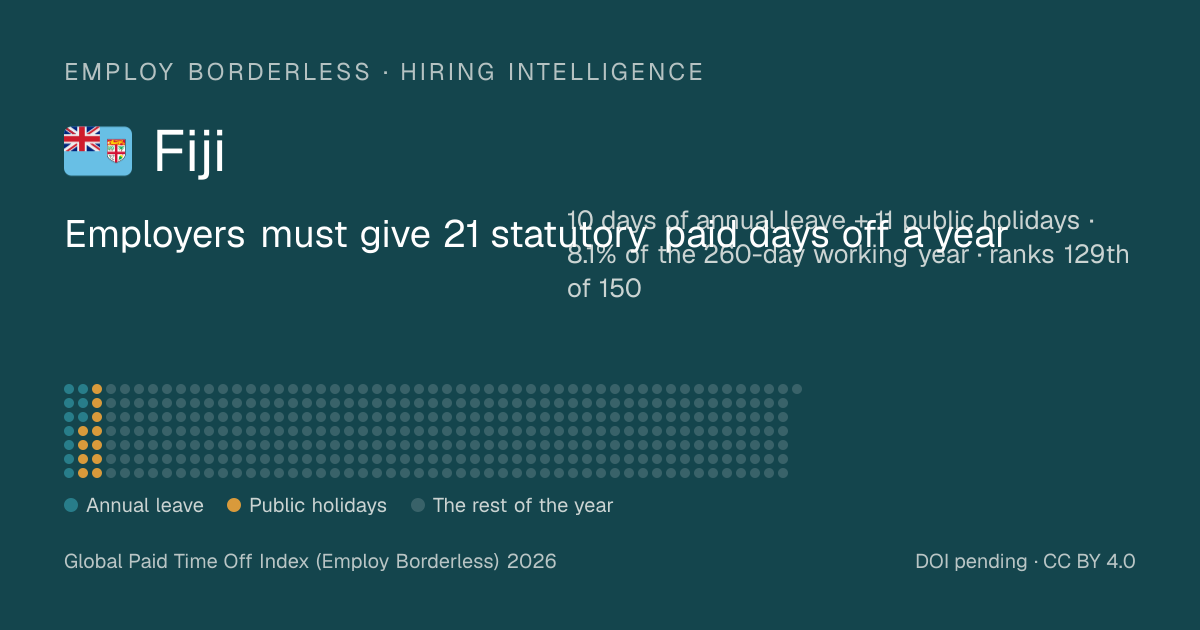
Honduras · rank 129 · 21 days
Employers in Honduras must give 21 statutory paid days off a year, 10 days of annual leave plus 11 public holidays, which is 8.1% of the 260-day working year and ranks the country 129th of 150 for statutory paid time off.
An employer hiring in Honduras must give 21 statutory paid days off a year, 10 days of annual leave plus 11 public holidays, about 4.2 working weeks and 8.1% of a 260-day working year, which leaves 239 working days per employee. It ranks 129th of 150 countries in the Global Paid Time Off Index 2026. That is 8 days below the median of the ranked set. These are statutory minimums, and most offers add days above the minimum.
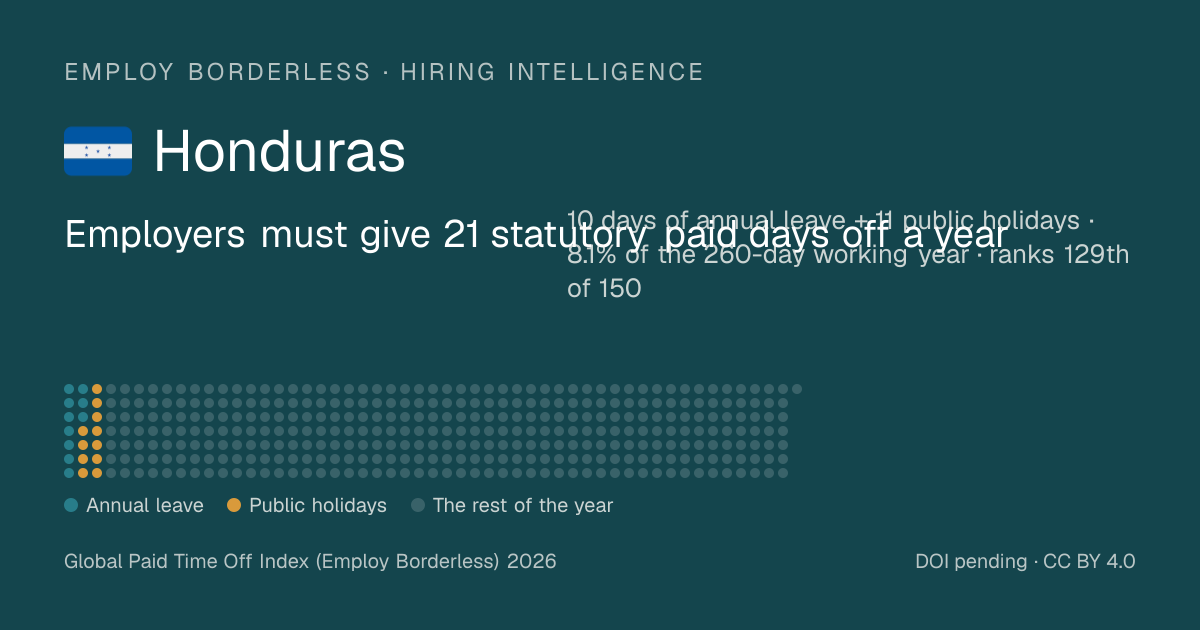
Samoa · rank 129 · 21 days
Employers in Samoa must give 21 statutory paid days off a year, 10 days of annual leave plus 11 public holidays, which is 8.1% of the 260-day working year and ranks the country 129th of 150 for statutory paid time off.
An employer hiring in Samoa must give 21 statutory paid days off a year, 10 days of annual leave plus 11 public holidays, about 4.2 working weeks and 8.1% of a 260-day working year, which leaves 239 working days per employee. It ranks 129th of 150 countries in the Global Paid Time Off Index 2026. That is 8 days below the median of the ranked set. These are statutory minimums, and most offers add days above the minimum.
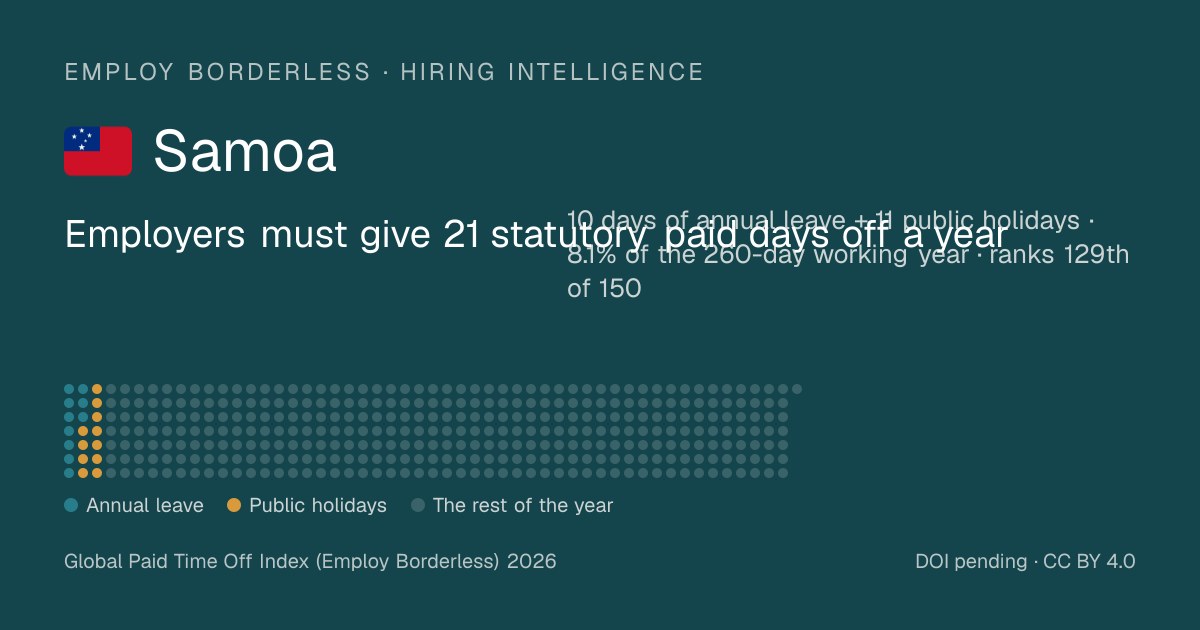
Bermuda · rank 134 · 20 days
Employers in Bermuda must give 20 statutory paid days off a year, 10 days of annual leave plus 10 public holidays, which is 7.7% of the 260-day working year and ranks the country 134th of 150 for statutory paid time off.
An employer hiring in Bermuda must give 20 statutory paid days off a year, 10 days of annual leave plus 10 public holidays, about 4 working weeks and 7.7% of a 260-day working year, which leaves 240 working days per employee. It ranks 134th of 150 countries in the Global Paid Time Off Index 2026. That is 9 days below the median of the ranked set. These are statutory minimums, and most offers add days above the minimum.
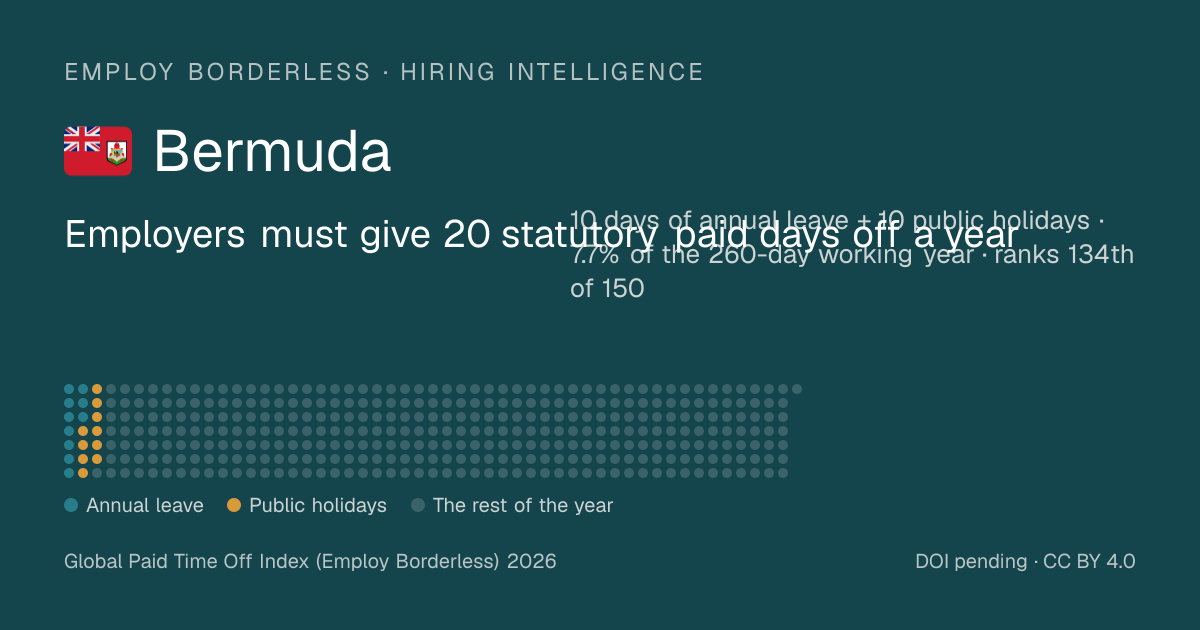
Finland · rank 134 · 20 days
Employers in Finland must give 20 statutory paid days off a year, all of it annual leave; the law does not require them to give the 11 public holidays as paid days off. That is 7.7% of the 260-day working year and ranks the country 134th of 150 for statutory paid time off.
An employer hiring in Finland must give 20 statutory paid days off a year, all of it annual leave; the law does not require it to give the 11 public holidays as paid days off, about 4 working weeks and 7.7% of a 260-day working year, which leaves 240 working days per employee. It ranks 134th of 150 countries in the Global Paid Time Off Index 2026. That is 9 days below the median of the ranked set. These are statutory minimums, and most offers add days above the minimum.
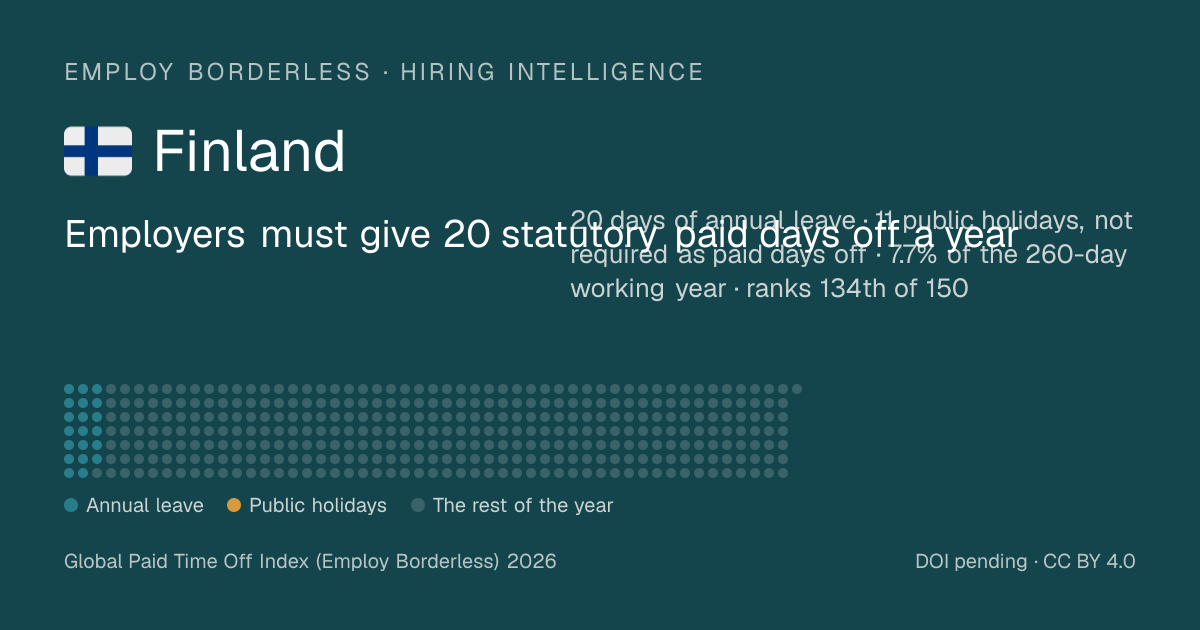
Isle of Man · rank 134 · 20 days
Employers in Isle of Man must give 20 statutory paid days off a year, all of it annual leave, and the law lets them count the 10 public holidays within it. That is 7.7% of the 260-day working year and ranks the country 134th of 150 for statutory paid time off.
An employer hiring in Isle of Man must give 20 statutory paid days off a year, all of it annual leave, and can count the 10 public holidays within it, about 4 working weeks and 7.7% of a 260-day working year, which leaves 240 working days per employee. It ranks 134th of 150 countries in the Global Paid Time Off Index 2026. That is 9 days below the median of the ranked set. These are statutory minimums, and most offers add days above the minimum.
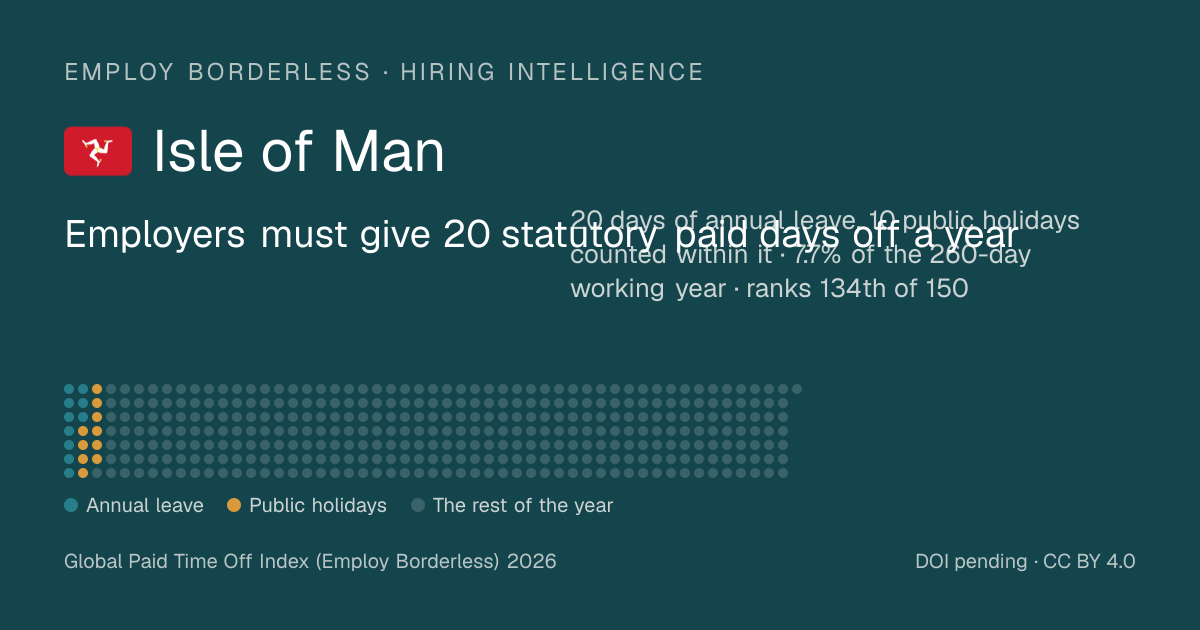
Netherlands · rank 134 · 20 days
Employers in the Netherlands must give 20 statutory paid days off a year, all of it annual leave; the law does not require them to give the 11 public holidays as paid days off. That is 7.7% of the 260-day working year and ranks the country 134th of 150 for statutory paid time off.
An employer hiring in the Netherlands must give 20 statutory paid days off a year, all of it annual leave; the law does not require it to give the 11 public holidays as paid days off, about 4 working weeks and 7.7% of a 260-day working year, which leaves 240 working days per employee. It ranks 134th of 150 countries in the Global Paid Time Off Index 2026. That is 9 days below the median of the ranked set. These are statutory minimums, and most offers add days above the minimum.
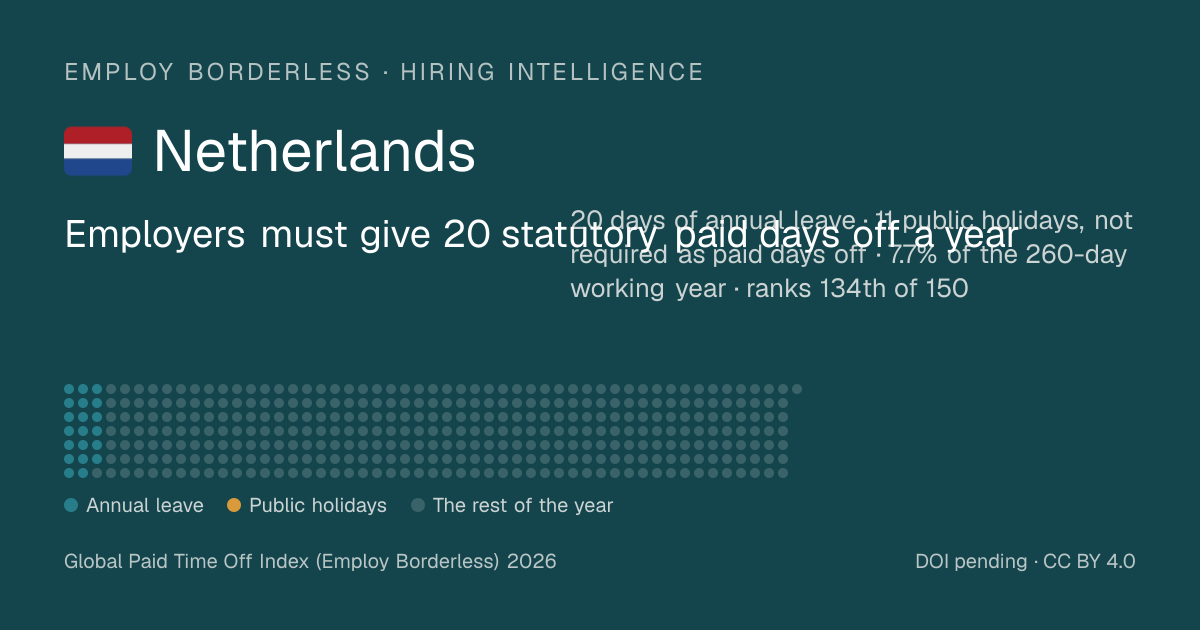
Canada · rank 138 · 19 days
Employers in Canada must give 19 statutory paid days off a year, 10 days of annual leave plus 9 public holidays, which is 7.3% of the 260-day working year and ranks the country 138th of 150 for statutory paid time off.
An employer hiring in Canada must give 19 statutory paid days off a year, 10 days of annual leave plus 9 public holidays, about 3.8 working weeks and 7.3% of a 260-day working year, which leaves 241 working days per employee. It ranks 138th of 150 countries in the Global Paid Time Off Index 2026. That is 10 days below the median of the ranked set. These are statutory minimums, and most offers add days above the minimum.
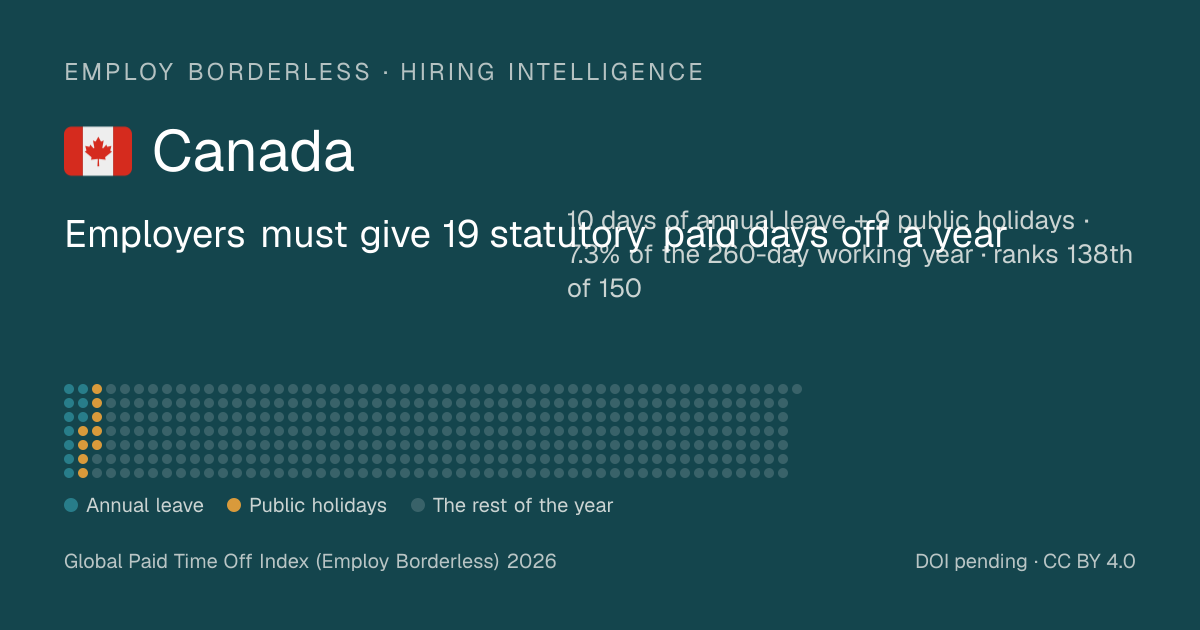
Costa Rica · rank 138 · 19 days
Employers in Costa Rica must give 19 statutory paid days off a year: 10 days of annual leave plus 9 public holidays the law requires as paid; the other 3 public holidays are not required as paid days off. That is 7.3% of the 260-day working year and ranks the country 138th of 150 for statutory paid time off.
An employer hiring in Costa Rica must give 19 statutory paid days off a year, 10 days of annual leave plus 9 public holidays the law requires as paid, about 3.8 working weeks and 7.3% of a 260-day working year, which leaves 241 working days per employee. It ranks 138th of 150 countries in the Global Paid Time Off Index 2026. That is 10 days below the median of the ranked set. These are statutory minimums, and most offers add days above the minimum.
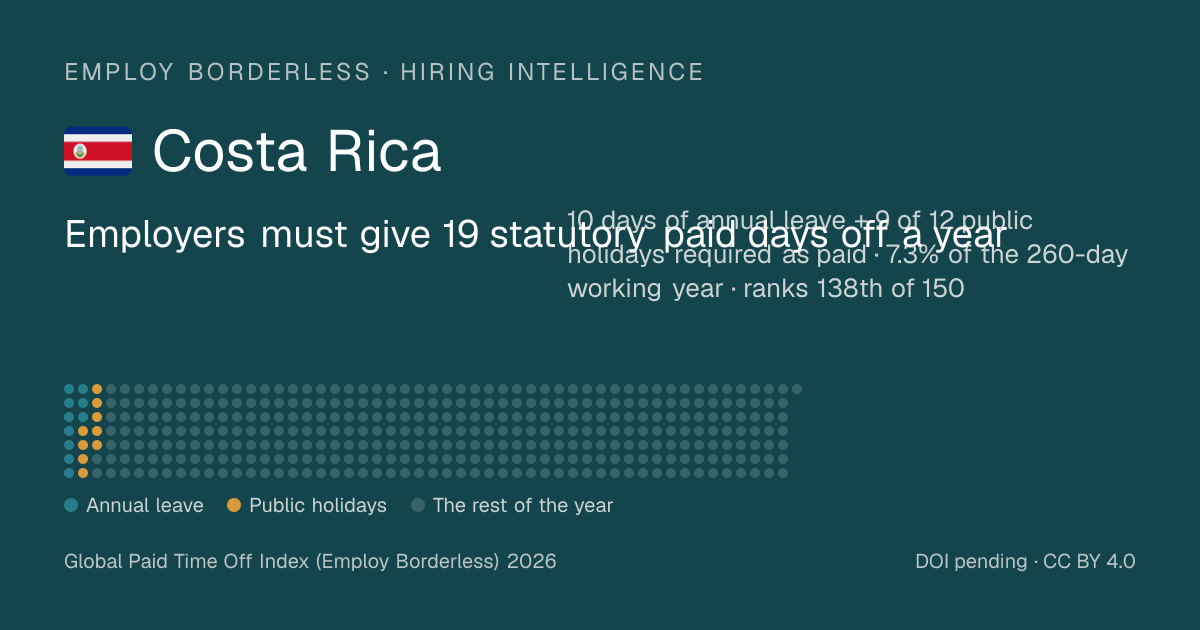
Malaysia · rank 138 · 19 days
Employers in Malaysia must give 19 statutory paid days off a year, 8 days of annual leave plus 11 public holidays, which is 7.3% of the 260-day working year and ranks the country 138th of 150 for statutory paid time off.
An employer hiring in Malaysia must give 19 statutory paid days off a year, 8 days of annual leave plus 11 public holidays, about 3.8 working weeks and 7.3% of a 260-day working year, which leaves 241 working days per employee. It ranks 138th of 150 countries in the Global Paid Time Off Index 2026. That is 10 days below the median of the ranked set. These are statutory minimums, and most offers add days above the minimum.
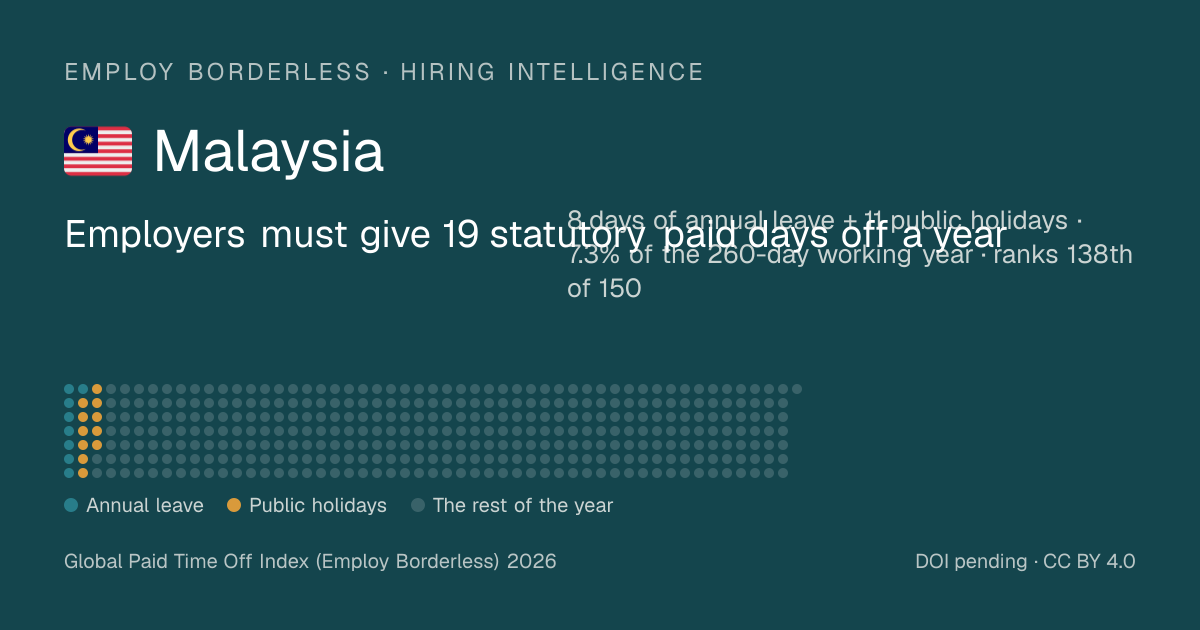
Mexico · rank 138 · 19 days
Employers in Mexico must give 19 statutory paid days off a year, 12 days of annual leave plus 7 public holidays, which is 7.3% of the 260-day working year and ranks the country 138th of 150 for statutory paid time off.
An employer hiring in Mexico must give 19 statutory paid days off a year, 12 days of annual leave plus 7 public holidays, about 3.8 working weeks and 7.3% of a 260-day working year, which leaves 241 working days per employee. It ranks 138th of 150 countries in the Global Paid Time Off Index 2026. That is 10 days below the median of the ranked set. These are statutory minimums, and most offers add days above the minimum.
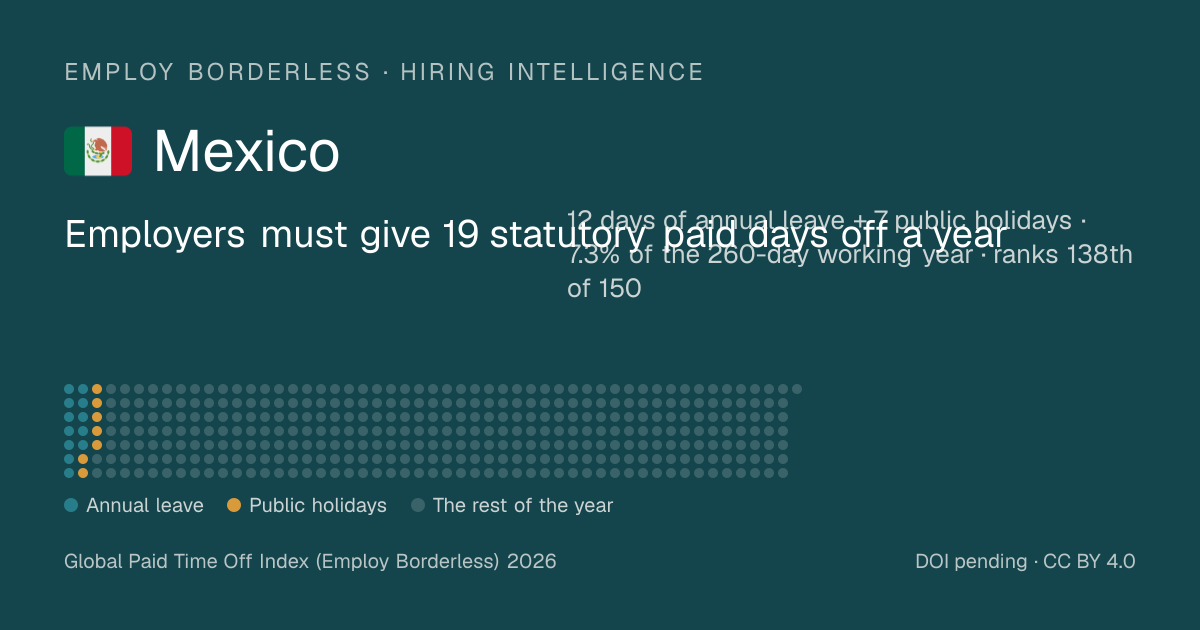
Papua New Guinea · rank 138 · 19 days
Employers in Papua New Guinea must give 19 statutory paid days off a year, 10 days of annual leave plus 9 public holidays, which is 7.3% of the 260-day working year and ranks the country 138th of 150 for statutory paid time off.
An employer hiring in Papua New Guinea must give 19 statutory paid days off a year, 10 days of annual leave plus 9 public holidays, about 3.8 working weeks and 7.3% of a 260-day working year, which leaves 241 working days per employee. It ranks 138th of 150 countries in the Global Paid Time Off Index 2026. That is 10 days below the median of the ranked set. These are statutory minimums, and most offers add days above the minimum.
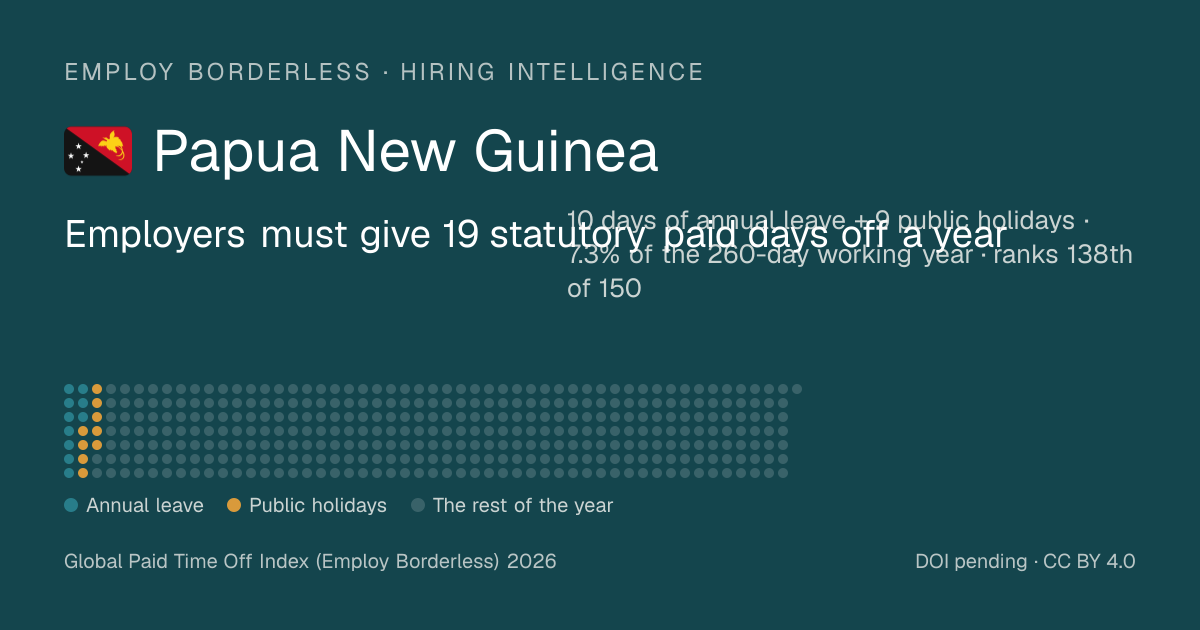
Taiwan · rank 138 · 19 days
Employers in Taiwan must give 19 statutory paid days off a year, 3 days of annual leave plus 16 public holidays, which is 7.3% of the 260-day working year and ranks the country 138th of 150 for statutory paid time off.
An employer hiring in Taiwan must give 19 statutory paid days off a year, 3 days of annual leave plus 16 public holidays, about 3.8 working weeks and 7.3% of a 260-day working year, which leaves 241 working days per employee. It ranks 138th of 150 countries in the Global Paid Time Off Index 2026. That is 10 days below the median of the ranked set. These are statutory minimums, and most offers add days above the minimum.
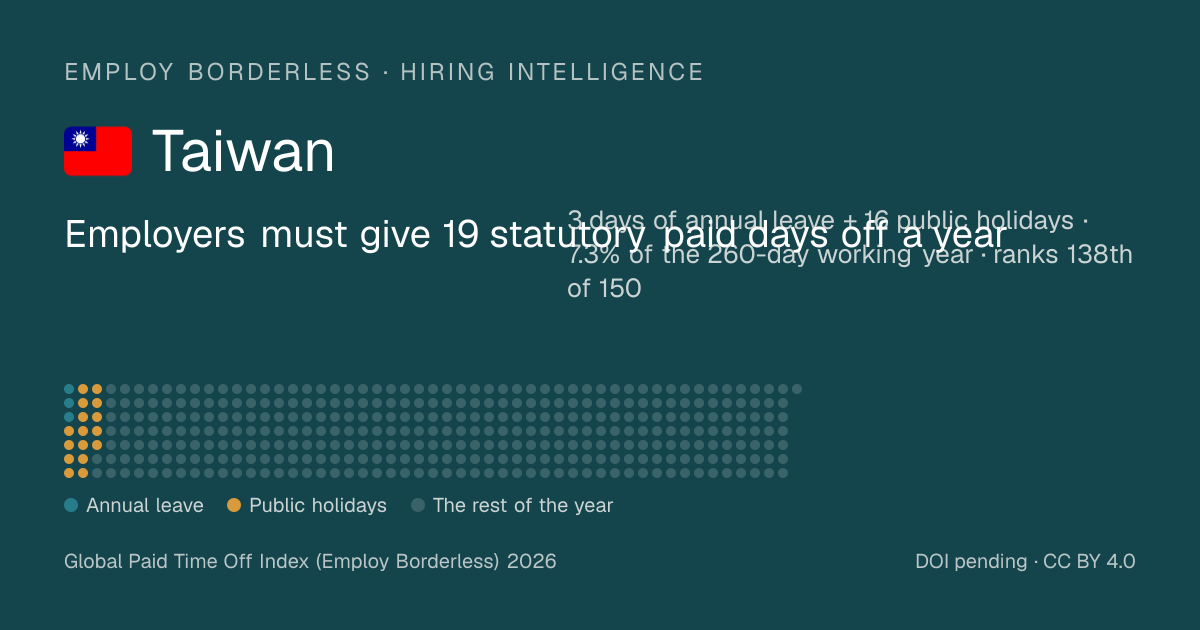
Thailand · rank 138 · 19 days
Employers in Thailand must give 19 statutory paid days off a year, 6 days of annual leave plus 13 public holidays, which is 7.3% of the 260-day working year and ranks the country 138th of 150 for statutory paid time off.
An employer hiring in Thailand must give 19 statutory paid days off a year, 6 days of annual leave plus 13 public holidays, about 3.8 working weeks and 7.3% of a 260-day working year, which leaves 241 working days per employee. It ranks 138th of 150 countries in the Global Paid Time Off Index 2026. That is 10 days below the median of the ranked set. These are statutory minimums, and most offers add days above the minimum.
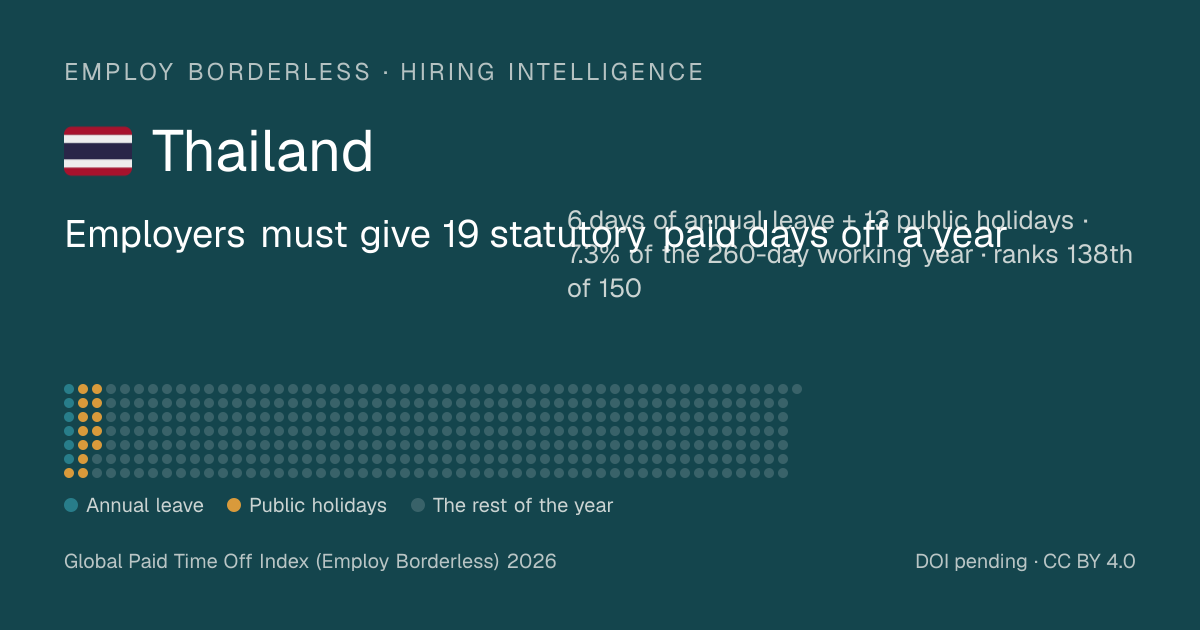
China · rank 145 · 18 days
Employers in China must give 18 statutory paid days off a year, 5 days of annual leave plus 13 public holidays, which is 6.9% of the 260-day working year and ranks the country 145th of 150 for statutory paid time off.
An employer hiring in China must give 18 statutory paid days off a year, 5 days of annual leave plus 13 public holidays, about 3.6 working weeks and 6.9% of a 260-day working year, which leaves 242 working days per employee. It ranks 145th of 150 countries in the Global Paid Time Off Index 2026. That is 11 days below the median of the ranked set. These are statutory minimums, and most offers add days above the minimum.
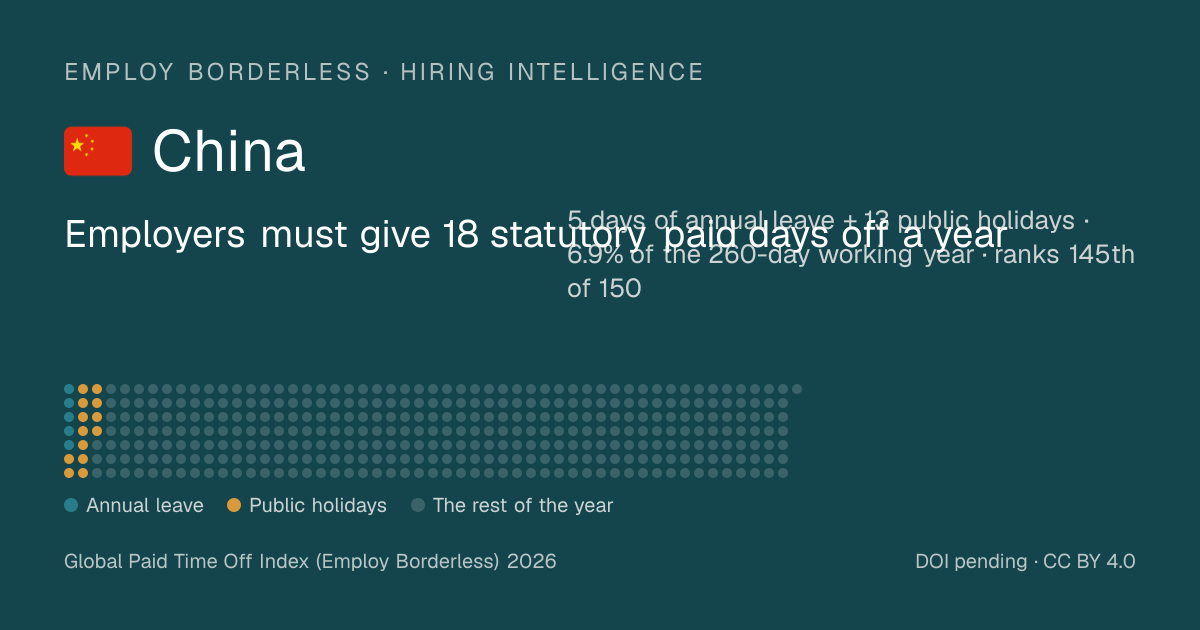
Singapore · rank 145 · 18 days
Employers in Singapore must give 18 statutory paid days off a year, 7 days of annual leave plus 11 public holidays, which is 6.9% of the 260-day working year and ranks the country 145th of 150 for statutory paid time off.
An employer hiring in Singapore must give 18 statutory paid days off a year, 7 days of annual leave plus 11 public holidays, about 3.6 working weeks and 6.9% of a 260-day working year, which leaves 242 working days per employee. It ranks 145th of 150 countries in the Global Paid Time Off Index 2026. That is 11 days below the median of the ranked set. These are statutory minimums, and most offers add days above the minimum.
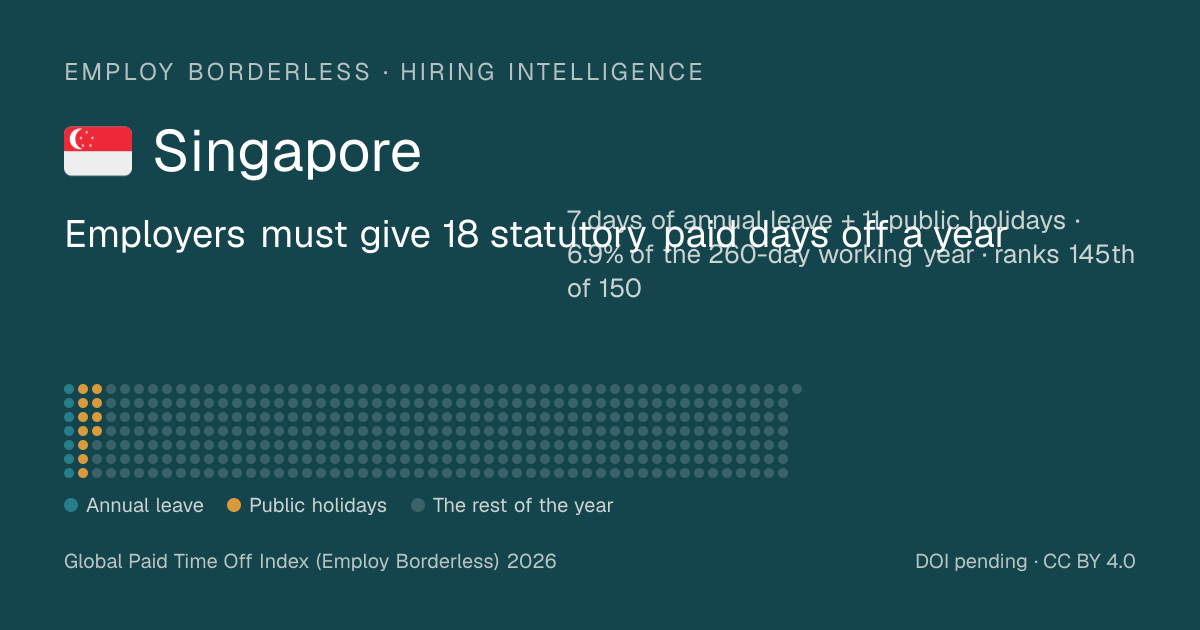
Nigeria · rank 147 · 17 days
Employers in Nigeria must give 17 statutory paid days off a year, 6 days of annual leave plus 11 public holidays, which is 6.5% of the 260-day working year and ranks the country 147th of 150 for statutory paid time off.
An employer hiring in Nigeria must give 17 statutory paid days off a year, 6 days of annual leave plus 11 public holidays, about 3.4 working weeks and 6.5% of a 260-day working year, which leaves 243 working days per employee. It ranks 147th of 150 countries in the Global Paid Time Off Index 2026. That is 12 days below the median of the ranked set. These are statutory minimums, and most offers add days above the minimum.
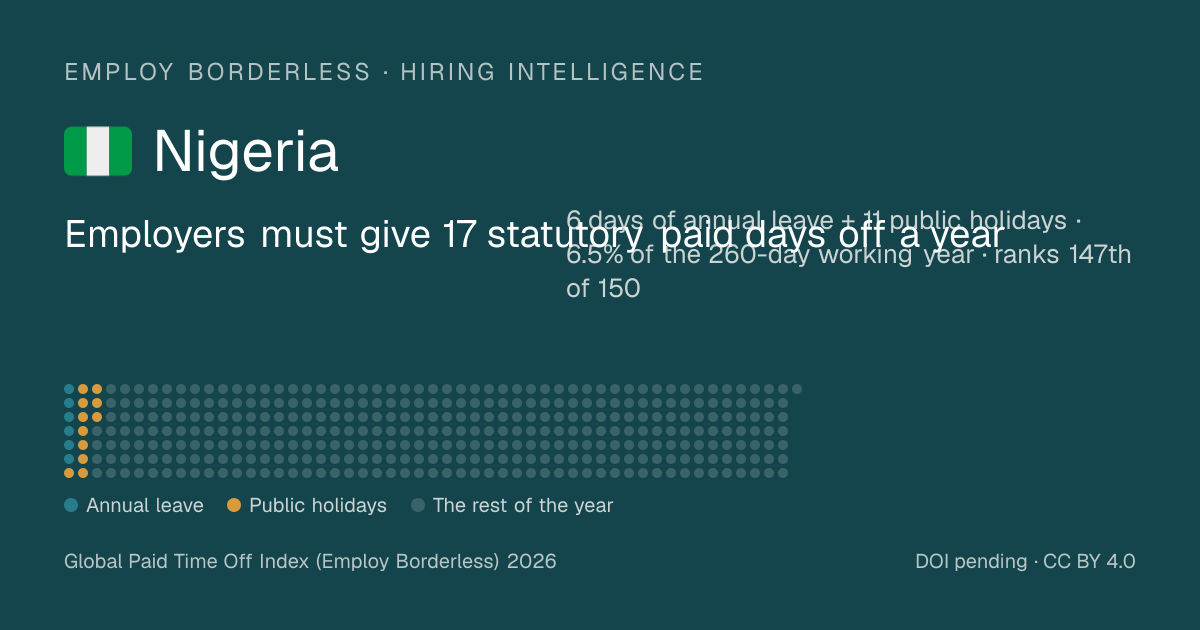
Philippines · rank 147 · 17 days
Employers in the Philippines must give 17 statutory paid days off a year, 5 days of annual leave plus 12 public holidays, which is 6.5% of the 260-day working year and ranks the country 147th of 150 for statutory paid time off.
An employer hiring in the Philippines must give 17 statutory paid days off a year, 5 days of annual leave plus 12 public holidays, about 3.4 working weeks and 6.5% of a 260-day working year, which leaves 243 working days per employee. It ranks 147th of 150 countries in the Global Paid Time Off Index 2026. That is 12 days below the median of the ranked set. These are statutory minimums, and most offers add days above the minimum.
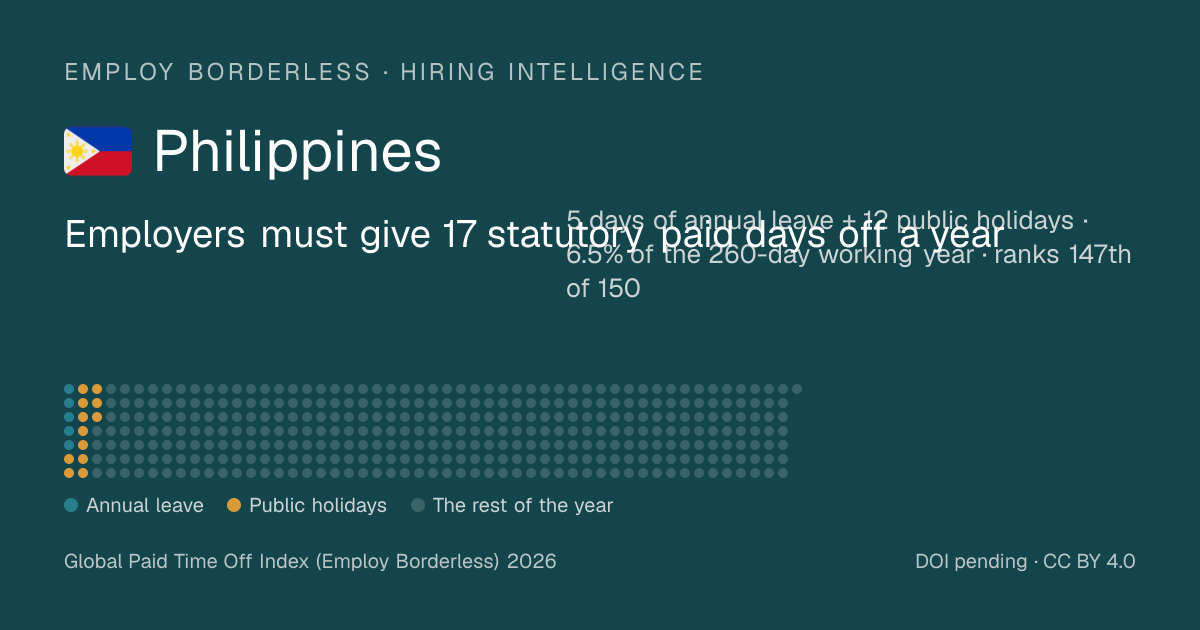
Macau · rank 149 · 16 days
Employers in Macau must give 16 statutory paid days off a year, 6 days of annual leave plus 10 public holidays, which is 6.2% of the 260-day working year and ranks the country 149th of 150 for statutory paid time off.
An employer hiring in Macau must give 16 statutory paid days off a year, 6 days of annual leave plus 10 public holidays, about 3.2 working weeks and 6.2% of a 260-day working year, which leaves 244 working days per employee. It ranks 149th of 150 countries in the Global Paid Time Off Index 2026. That is 13 days below the median of the ranked set. These are statutory minimums, and most offers add days above the minimum.
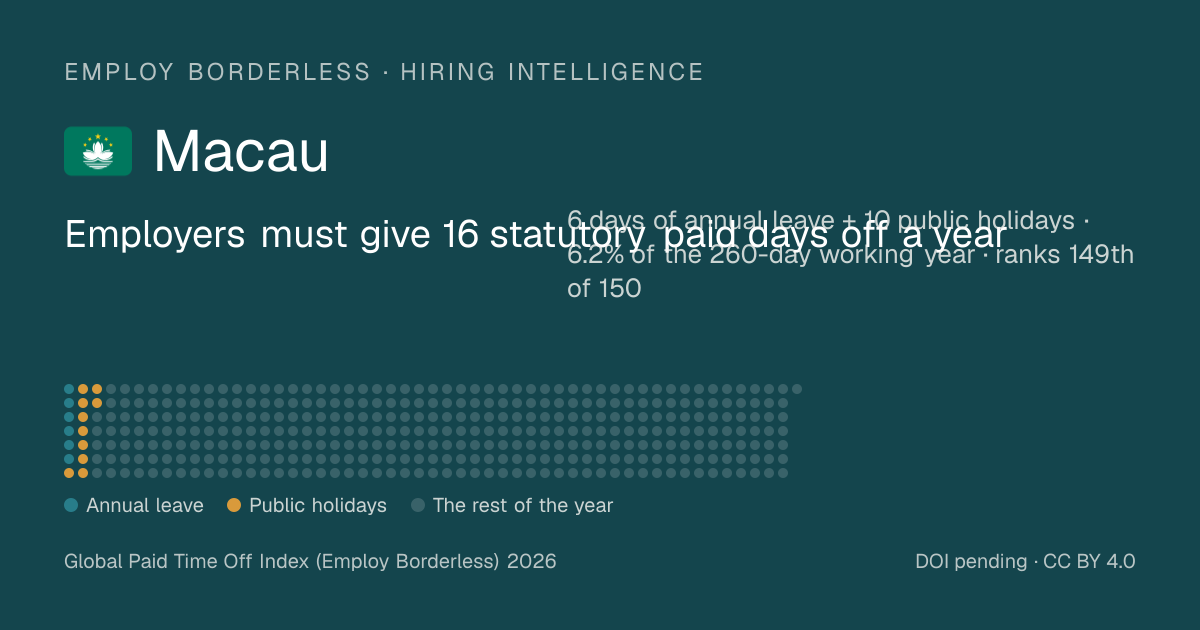
United States · rank 150 · 0 days
The United States sets no statutory minimum paid annual leave and does not require employers to give its 11 public holidays as paid days off, so all paid time off there is the employer's own policy. That gives it 0 statutory paid days off a year and ranks the country 150th of 150 for statutory paid time off.
The United States sets no statutory minimum paid annual leave and does not require employers to give its 11 public holidays as paid days off, so an employer hiring there decides all paid time off itself. That is 0 statutory paid days off, about 0 working weeks and 0% of a 260-day working year, which leaves 260 working days per employee. It ranks 150th of 150 countries in the Global Paid Time Off Index 2026. That is 29 days below the median of the ranked set. These are statutory minimums, and most offers add days above the minimum.
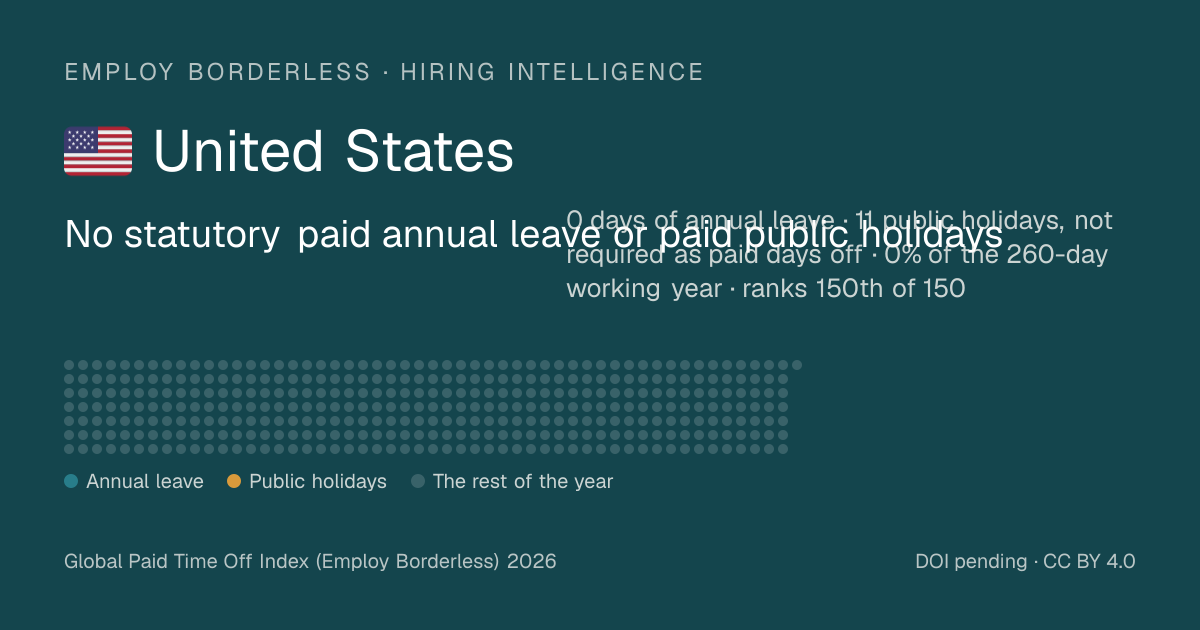
Public holidays only, not ranked
61 countries hold a sourced public-holiday count but no approved value for statutory paid annual leave. They are shown here with the one figure we have, and they are not ranked against the 150 countries above: a holiday count on its own is not comparable with a total that includes annual leave, and filling the missing half with an estimate would be inventing the answer. Åland Islands, Bangladesh, British Virgin Islands are in this table for that reason.
| Country | Region | Public holidays |
|---|---|---|
| Myanmar | Asia | 25 |
| Palestine | Asia | 19 |
| San Marino | Europe | 18 |
| Suriname | Americas | 18 |
| Faroe Islands | Europe | 17 |
| Kiribati | Oceania | 17 |
| United States Virgin Islands | Americas | 17 |
| Åland Islands | Europe | 16 |
| Iraq | Asia | 16 |
| South Korea | Asia | 16 |
| Morocco | Africa | 15 |
| Northern Mariana Islands | Oceania | 15 |
| Vatican City | Europe | 15 |
| British Virgin Islands | Americas | 14 |
| Curaçao | Americas | 14 |
| Sint Maarten | Americas | 14 |
| Trinidad and Tobago | Americas | 14 |
| Wallis and Futuna | Oceania | 14 |
| Nauru | Oceania | 13 |
| Saint Lucia | Americas | 13 |
| Saint Vincent and the Grenadines | Americas | 13 |
| Burundi | Africa | 12 |
| Central African Republic | Africa | 12 |
| Greenland | Americas | 12 |
| Guadeloupe | Americas | 12 |
| Nicaragua | Americas | 12 |
| North Macedonia | Europe | 12 |
| Réunion | Africa | 12 |
| Saint Barthélemy | Americas | 12 |
| Svalbard and Jan Mayen | Europe | 12 |
| Burkina Faso | Africa | 11 |
| Guinea-Bissau | Africa | 11 |
| Montserrat | Americas | 11 |
| Norfolk Island | Oceania | 11 |
| Palau | Oceania | 11 |
| Saint Martin | Americas | 11 |
| Saint Pierre and Miquelon | Americas | 11 |
| Togo | Africa | 11 |
| Tokelau | Oceania | 11 |
| Ukraine | Europe | 11 |
| Caribbean Netherlands | Americas | 10 |
| Eritrea | Africa | 10 |
| Jamaica | Americas | 10 |
| Marshall Islands | Oceania | 10 |
| Falkland Islands | Americas | 9 |
| Gambia | Africa | 9 |
| Guernsey | Europe | 9 |
| Niue | Oceania | 9 |
| Saint Helena, Ascension and Tristan da Cunha | Africa | 9 |
| Senegal | Africa | 9 |
| Sierra Leone | Africa | 9 |
| South Georgia | Antarctic | 9 |
| Syria | Asia | 9 |
| Tonga | Oceania | 9 |
| Cocos (Keeling) Islands | Oceania | 8 |
| Pitcairn Islands | Oceania | 8 |
| São Tomé and Príncipe | Africa | 8 |
| Tunisia | Africa | 8 |
| Bangladesh | Asia | 7 |
| Micronesia | Oceania | 5 |
| Sudan | Africa | 4 |
Not ranked
39 countries and territories are outside the ranking. Most carry no sourced value for either input, and we list them by name rather than fill the gaps with estimates. 13 hold both figures, but one of them has no government or official source yet, so we show it without a rank until it does.
| Country | Why it is not ranked |
|---|---|
| Afghanistan | Statutory annual leave, Public holidays |
| American Samoa | Statutory annual leave, Public holidays |
| Antarctica | Statutory annual leave, Public holidays |
| Bhutan | Public holidays |
| Bosnia and Herzegovina | no government or official source for one of its figures yet; not ranked |
| Bouvet Island | Statutory annual leave, Public holidays |
| British Indian Ocean Territory | Statutory annual leave, Public holidays |
| Brunei | Statutory annual leave, Public holidays |
| Chad | no government or official source for one of its figures yet; not ranked |
| Djibouti | no government or official source for one of its figures yet; not ranked |
| Equatorial Guinea | no government or official source for one of its figures yet; not ranked |
| French Southern and Antarctic Lands | Statutory annual leave, Public holidays |
| Gabon | no government or official source for one of its figures yet; not ranked |
| Guam | Statutory annual leave, Public holidays |
| Guinea | no government or official source for one of its figures yet; not ranked |
| Haiti | no government or official source for one of its figures yet; not ranked |
| Heard Island and McDonald Islands | Statutory annual leave, Public holidays |
| Iran | Public holidays |
| Israel | Statutory annual leave, Public holidays |
| Jordan | Public holidays |
| Kosovo | Public holidays |
| Kuwait | Public holidays |
| Kyrgyzstan | Public holidays |
| Laos | Public holidays |
| Liberia | no government or official source for one of its figures yet; not ranked |
| Mayotte | Statutory annual leave, Public holidays |
| Nepal | Statutory annual leave, Public holidays |
| Niger | no government or official source for one of its figures yet; not ranked |
| North Korea | Statutory annual leave, Public holidays |
| Oman | Public holidays |
| Pakistan | Public holidays |
| Puerto Rico | no government or official source for one of its figures yet; not ranked |
| South Sudan | no government or official source for one of its figures yet; not ranked |
| Sri Lanka | Public holidays |
| Tajikistan | Statutory annual leave, Public holidays |
| Turkey | no government or official source for one of its figures yet; not ranked |
| Turks and Caicos Islands | no government or official source for one of its figures yet; not ranked |
| United States Minor Outlying Islands | Statutory annual leave, Public holidays |
| Western Sahara | Statutory annual leave, Public holidays |
Use the dataset
The full ranking, both statutory inputs, the ready-to-quote line for every country, and the source and as-of date behind every value are open data under CC BY 4.0. Reuse it freely with attribution.
Schuchmann, R. (2026). Global Paid Time Off Index (Employ Borderless) [Data set]. Employ Borderless. https://employborderless.com/hiring-intelligence/paid-time-off-index/
DOI pending. The Zenodo record for this edition is being minted; until it resolves, cite the canonical URL above. The dataset name will not change.
For journalists and researchers
Everything on this page may be quoted and republished with attribution (CC BY 4.0). Questions about the data, custom cuts, or comment from the author, email robbin@employborderless.com. We answer fast on deadline.
- Full dataset (CSV) · ranking, both inputs, the local line, per-value provenance
- Full dataset (JSON) · includes the holidays-only and excluded lists
- Ranking snapshot (PNG) · 1200x630, ready for a social card
- Full methodology · metric, inputs, sources, limitations
- Embeddable widget · free to iframe on any site, attribution built in
- A prepared line for every ranked country · with its own share card
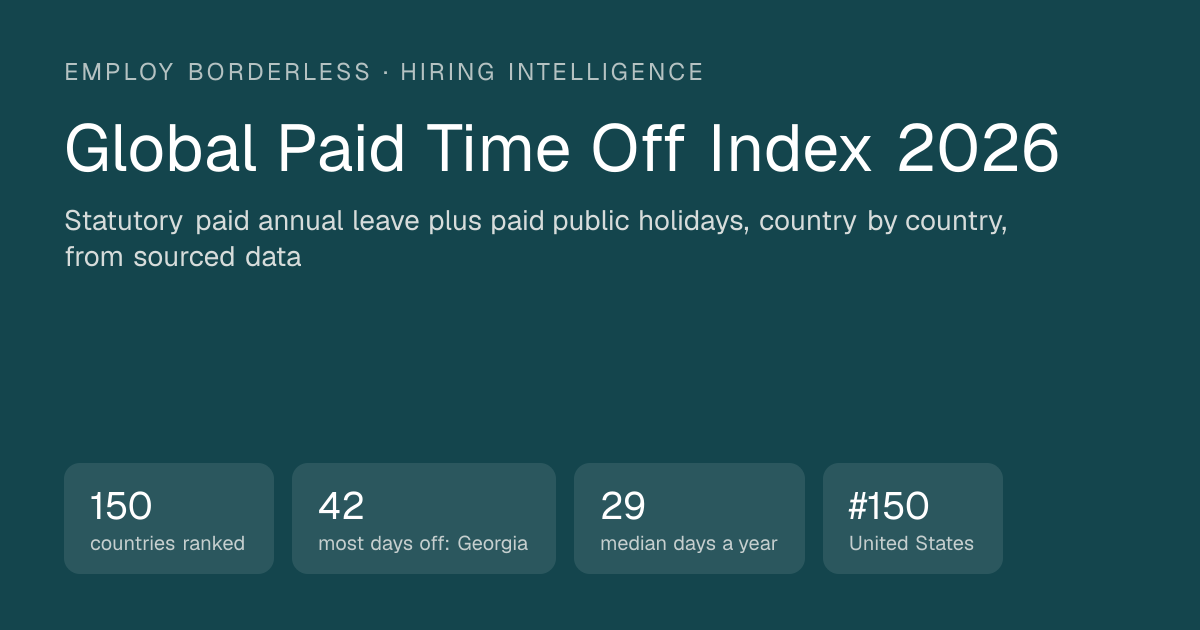
A live, self-updating snapshot of the ranking. Paste the snippet into any article or CMS. It refreshes when the data does, and the attribution link back to this study is part of the widget.
<iframe src="https://employborderless.com/hiring-intelligence/paid-time-off-index/embed/" width="100%" height="560" style="border:1px solid #e2ddd6;border-radius:12px" title="Global Paid Time Off Index (Employ Borderless) 2026" loading="lazy"></iframe>
US employers owe no statutory paid annual leave at all, so paid vacation is entirely company policy, new index of 150 countries finds
The Global Paid Time Off Index 2026 ranks 150 countries on the paid time off their law makes an employer give: statutory paid annual leave plus the public holidays the law pays on top. The United States is the only ranked country with no federal minimum paid annual leave, and federal law does not require a private employer to pay for its 11 public holidays, so it has 0 statutory paid days off and ranks 150th. A US employer sets the vacation policy itself; an employer hiring into the median ranked country inherits an obligation of 29 days, 11.2% of the working year. These are statutory minimums, and most offers add days above the minimum.
Share card (PNG)Europe averages 31.6 statutory paid days off a year against 24.9 in Americas, new index of 150 countries finds
Across the 150 countries ranked in the Global Paid Time Off Index 2026, mean statutory paid time off by region runs: Europe 31.6, Africa 31.0, Asia 27.6, Oceania 26.3, Americas 24.9. Europe's 43 ranked countries average 31.6 days a year, 6.7 more than the 34 ranked countries in Americas. Every figure is a statutory minimum, counted as annual leave plus the public holidays the law pays on top.
Employers in Georgia must give 42 statutory paid days off a year, 16.2% of the working year, new index of 150 countries finds
An employer hiring in Georgia must give 42 statutory paid days off a year, 24 days of annual leave plus 18 public holidays, about 8.4 working weeks and 16.2% of a 260-day working year, which leaves 218 working days per employee. It ranks 1st of 150 countries in the Global Paid Time Off Index 2026. That is 13 days above the median of the ranked set. These are statutory minimums, and most offers add days above the minimum.
Share card (PNG)Employers in Iceland must give 40 statutory paid days off a year, 15.4% of the working year, new index of 150 countries finds
An employer hiring in Iceland must give 40 statutory paid days off a year, 24 days of annual leave plus 16 public holidays, about 8 working weeks and 15.4% of a 260-day working year, which leaves 220 working days per employee. It ranks 2nd of 150 countries in the Global Paid Time Off Index 2026. That is 11 days above the median of the ranked set. These are statutory minimums, and most offers add days above the minimum.
Share card (PNG)Employers in Somalia must give 40 statutory paid days off a year, 15.4% of the working year, new index of 150 countries finds
An employer hiring in Somalia must give 40 statutory paid days off a year, 30 days of annual leave plus 10 public holidays, about 8 working weeks and 15.4% of a 260-day working year, which leaves 220 working days per employee. It ranks 2nd of 150 countries in the Global Paid Time Off Index 2026. That is 11 days above the median of the ranked set. These are statutory minimums, and most offers add days above the minimum.
Share card (PNG)Employers in Cambodia must give 39 statutory paid days off a year, 15% of the working year, new index of 150 countries finds
An employer hiring in Cambodia must give 39 statutory paid days off a year, 18 days of annual leave plus 21 public holidays, about 7.8 working weeks and 15% of a 260-day working year, which leaves 221 working days per employee. It ranks 4th of 150 countries in the Global Paid Time Off Index 2026. That is 10 days above the median of the ranked set. These are statutory minimums, and most offers add days above the minimum.
Share card (PNG)Employers in Zambia must give 39 statutory paid days off a year, 15% of the working year, new index of 150 countries finds
An employer hiring in Zambia must give 39 statutory paid days off a year, 24 days of annual leave plus 15 public holidays, about 7.8 working weeks and 15% of a 260-day working year, which leaves 221 working days per employee. It ranks 4th of 150 countries in the Global Paid Time Off Index 2026. That is 10 days above the median of the ranked set. These are statutory minimums, and most offers add days above the minimum.
Share card (PNG)Employers in Austria must give 38 statutory paid days off a year, 14.6% of the working year, new index of 150 countries finds
An employer hiring in Austria must give 38 statutory paid days off a year, 25 days of annual leave plus 13 public holidays, about 7.6 working weeks and 14.6% of a 260-day working year, which leaves 222 working days per employee. It ranks 6th of 150 countries in the Global Paid Time Off Index 2026. That is 9 days above the median of the ranked set. These are statutory minimums, and most offers add days above the minimum.
Share card (PNG)Employers in Malta must give 38 statutory paid days off a year, 14.6% of the working year, new index of 150 countries finds
An employer hiring in Malta must give 38 statutory paid days off a year, 24 days of annual leave plus 14 public holidays, about 7.6 working weeks and 14.6% of a 260-day working year, which leaves 222 working days per employee. It ranks 6th of 150 countries in the Global Paid Time Off Index 2026. That is 9 days above the median of the ranked set. These are statutory minimums, and most offers add days above the minimum.
Share card (PNG)Employers in Peru must give 38 statutory paid days off a year, 14.6% of the working year, new index of 150 countries finds
An employer hiring in Peru must give 38 statutory paid days off a year, 22 days of annual leave plus 16 public holidays, about 7.6 working weeks and 14.6% of a 260-day working year, which leaves 222 working days per employee. It ranks 6th of 150 countries in the Global Paid Time Off Index 2026. That is 9 days above the median of the ranked set. These are statutory minimums, and most offers add days above the minimum.
Share card (PNG)Employers in Yemen must give 38 statutory paid days off a year, 14.6% of the working year, new index of 150 countries finds
An employer hiring in Yemen must give 38 statutory paid days off a year, 22 days of annual leave plus 16 public holidays, about 7.6 working weeks and 14.6% of a 260-day working year, which leaves 222 working days per employee. It ranks 6th of 150 countries in the Global Paid Time Off Index 2026. That is 9 days above the median of the ranked set. These are statutory minimums, and most offers add days above the minimum.
Share card (PNG)Employers in Azerbaijan must give 37 statutory paid days off a year, 14.2% of the working year, new index of 150 countries finds
An employer hiring in Azerbaijan must give 37 statutory paid days off a year, 15 days of annual leave plus 22 public holidays, about 7.4 working weeks and 14.2% of a 260-day working year, which leaves 223 working days per employee. It ranks 10th of 150 countries in the Global Paid Time Off Index 2026. That is 8 days above the median of the ranked set. These are statutory minimums, and most offers add days above the minimum.
Share card (PNG)Employers in Bahrain must give 37 statutory paid days off a year, 14.2% of the working year, new index of 150 countries finds
An employer hiring in Bahrain must give 37 statutory paid days off a year, 22 days of annual leave plus 15 public holidays, about 7.4 working weeks and 14.2% of a 260-day working year, which leaves 223 working days per employee. It ranks 10th of 150 countries in the Global Paid Time Off Index 2026. That is 8 days above the median of the ranked set. These are statutory minimums, and most offers add days above the minimum.
Share card (PNG)Employers in Luxembourg must give 37 statutory paid days off a year, 14.2% of the working year, new index of 150 countries finds
An employer hiring in Luxembourg must give 37 statutory paid days off a year, 26 days of annual leave plus 11 public holidays, about 7.4 working weeks and 14.2% of a 260-day working year, which leaves 223 working days per employee. It ranks 10th of 150 countries in the Global Paid Time Off Index 2026. That is 8 days above the median of the ranked set. These are statutory minimums, and most offers add days above the minimum.
Share card (PNG)Employers in Monaco must give 37 statutory paid days off a year, 14.2% of the working year, new index of 150 countries finds
An employer hiring in Monaco must give 37 statutory paid days off a year, 25 days of annual leave plus 12 public holidays, about 7.4 working weeks and 14.2% of a 260-day working year, which leaves 223 working days per employee. It ranks 10th of 150 countries in the Global Paid Time Off Index 2026. That is 8 days above the median of the ranked set. These are statutory minimums, and most offers add days above the minimum.
Share card (PNG)Employers in New Caledonia must give 37 statutory paid days off a year, 14.2% of the working year, new index of 150 countries finds
An employer hiring in New Caledonia must give 37 statutory paid days off a year, 25 days of annual leave plus 12 public holidays, about 7.4 working weeks and 14.2% of a 260-day working year, which leaves 223 working days per employee. It ranks 10th of 150 countries in the Global Paid Time Off Index 2026. That is 8 days above the median of the ranked set. These are statutory minimums, and most offers add days above the minimum.
Share card (PNG)Employers in Romania must give 37 statutory paid days off a year, 14.2% of the working year, new index of 150 countries finds
An employer hiring in Romania must give 37 statutory paid days off a year, 20 days of annual leave plus 17 public holidays, about 7.4 working weeks and 14.2% of a 260-day working year, which leaves 223 working days per employee. It ranks 10th of 150 countries in the Global Paid Time Off Index 2026. That is 8 days above the median of the ranked set. These are statutory minimums, and most offers add days above the minimum.
Share card (PNG)Employers in Albania must give 36 statutory paid days off a year, 13.8% of the working year, new index of 150 countries finds
An employer hiring in Albania must give 36 statutory paid days off a year, 22 days of annual leave plus 14 public holidays, about 7.2 working weeks and 13.8% of a 260-day working year, which leaves 224 working days per employee. It ranks 16th of 150 countries in the Global Paid Time Off Index 2026. That is 7 days above the median of the ranked set. These are statutory minimums, and most offers add days above the minimum.
Share card (PNG)Employers in Algeria must give 36 statutory paid days off a year, 13.8% of the working year, new index of 150 countries finds
An employer hiring in Algeria must give 36 statutory paid days off a year, 22 days of annual leave plus 14 public holidays, about 7.2 working weeks and 13.8% of a 260-day working year, which leaves 224 working days per employee. It ranks 16th of 150 countries in the Global Paid Time Off Index 2026. That is 7 days above the median of the ranked set. These are statutory minimums, and most offers add days above the minimum.
Share card (PNG)Employers in Andorra must give 36 statutory paid days off a year, 13.8% of the working year, new index of 150 countries finds
An employer hiring in Andorra must give 36 statutory paid days off a year, 22 days of annual leave plus 14 public holidays, about 7.2 working weeks and 13.8% of a 260-day working year, which leaves 224 working days per employee. It ranks 16th of 150 countries in the Global Paid Time Off Index 2026. That is 7 days above the median of the ranked set. These are statutory minimums, and most offers add days above the minimum.
Share card (PNG)Employers in Egypt must give 36 statutory paid days off a year, 13.8% of the working year, new index of 150 countries finds
An employer hiring in Egypt must give 36 statutory paid days off a year, 15 days of annual leave plus 21 public holidays, about 7.2 working weeks and 13.8% of a 260-day working year, which leaves 224 working days per employee. It ranks 16th of 150 countries in the Global Paid Time Off Index 2026. That is 7 days above the median of the ranked set. These are statutory minimums, and most offers add days above the minimum.
Share card (PNG)Employers in Libya must give 36 statutory paid days off a year, 13.8% of the working year, new index of 150 countries finds
An employer hiring in Libya must give 36 statutory paid days off a year, 22 days of annual leave plus 14 public holidays, about 7.2 working weeks and 13.8% of a 260-day working year, which leaves 224 working days per employee. It ranks 16th of 150 countries in the Global Paid Time Off Index 2026. That is 7 days above the median of the ranked set. These are statutory minimums, and most offers add days above the minimum.
Share card (PNG)Employers in United States owe no statutory paid annual leave, and the country ranks 150th of 150 for statutory paid time off, new index finds
The United States sets no statutory minimum paid annual leave and does not require employers to give its 11 public holidays as paid days off, so an employer hiring there decides all paid time off itself. That is 0 statutory paid days off, about 0 working weeks and 0% of a 260-day working year, which leaves 260 working days per employee. It ranks 150th of 150 countries in the Global Paid Time Off Index 2026. That is 29 days below the median of the ranked set. These are statutory minimums, and most offers add days above the minimum.
Share card (PNG)Employers in United Kingdom must give 28 statutory paid days off a year, 10.8% of the working year, new index of 150 countries finds
An employer hiring in the United Kingdom must give 28 statutory paid days off a year, all of it annual leave, and can count the 8 public holidays within it, about 5.6 working weeks and 10.8% of a 260-day working year, which leaves 232 working days per employee. It ranks 83rd of 150 countries in the Global Paid Time Off Index 2026. That is 1 days below the median of the ranked set. These are statutory minimums, and most offers add days above the minimum.
Share card (PNG)Employers in Canada must give 19 statutory paid days off a year, 7.3% of the working year, new index of 150 countries finds
An employer hiring in Canada must give 19 statutory paid days off a year, 10 days of annual leave plus 9 public holidays, about 3.8 working weeks and 7.3% of a 260-day working year, which leaves 241 working days per employee. It ranks 138th of 150 countries in the Global Paid Time Off Index 2026. That is 10 days below the median of the ranked set. These are statutory minimums, and most offers add days above the minimum.
Share card (PNG)Employers in France must give 26 statutory paid days off a year, 10% of the working year, new index of 150 countries finds
An employer hiring in France must give 26 statutory paid days off a year, 25 days of annual leave plus 1 public holiday the law requires as paid, about 5.2 working weeks and 10% of a 260-day working year, which leaves 234 working days per employee. It ranks 94th of 150 countries in the Global Paid Time Off Index 2026. That is 3 days below the median of the ranked set. These are statutory minimums, and most offers add days above the minimum.
Share card (PNG)Employers in Germany must give 29 statutory paid days off a year, 11.2% of the working year, new index of 150 countries finds
An employer hiring in Germany must give 29 statutory paid days off a year, 20 days of annual leave plus 9 public holidays, about 5.8 working weeks and 11.2% of a 260-day working year, which leaves 231 working days per employee. It ranks 74th of 150 countries in the Global Paid Time Off Index 2026. That sits exactly on the median of the ranked set. These are statutory minimums, and most offers add days above the minimum.
Share card (PNG)Employers in Italy must give 33 statutory paid days off a year, 12.7% of the working year, new index of 150 countries finds
An employer hiring in Italy must give 33 statutory paid days off a year, 20 days of annual leave plus 13 public holidays, about 6.6 working weeks and 12.7% of a 260-day working year, which leaves 227 working days per employee. It ranks 44th of 150 countries in the Global Paid Time Off Index 2026. That is 4 days above the median of the ranked set. These are statutory minimums, and most offers add days above the minimum.
Share card (PNG)Employers in Japan must give 26 statutory paid days off a year, 10% of the working year, new index of 150 countries finds
An employer hiring in Japan must give 26 statutory paid days off a year, 10 days of annual leave plus 16 public holidays, about 5.2 working weeks and 10% of a 260-day working year, which leaves 234 working days per employee. It ranks 94th of 150 countries in the Global Paid Time Off Index 2026. That is 3 days below the median of the ranked set. These are statutory minimums, and most offers add days above the minimum.
Share card (PNG)How we score it
A country is ranked only when it has a sourced, dated value for both statutory paid annual leave and national public holidays. The two are already counted in the same unit, days off per year, so they are added rather than weighted. The composite is the percentile of that total within the ranked set. No estimates, no invented weights, no AI-filled gaps.
Read the full methodologyWhere this fits: this index answers what paid time off an employer has to give while the employee stays. For what the same employee costs an employer over that time, see our Global Employer Burden Index. For what it costs to end the relationship, see our Termination Cost Index. All of them are built from the same sourced statutory dataset, and all of them apply whether you employ directly or through an employer of record. Leave entitlements are covered in our guides to EOR benefits and EOR employment contracts, and accrued leave is paid out through payroll.
Entity Home: Global Paid Time Off Index (Employ Borderless) 2026 ▼
An independent ranking of countries by the paid time off the law guarantees, combining statutory paid annual leave with national public holidays, in days off per year. | ||||||||||||||||||||||
| ||||||||||||||||||||||
| ||||||||||||||||||||||
| Entity Home canonical URL | Canonical URL | |||||||||||||||||||||
| Related datasets | Global Employer Burden Index, Termination Cost Index | |||||||||||||||||||||
Hiring in one of these countries?
The statutory floor is only part of the picture, and the provider you hire through decides how leave is tracked, accrued, and paid out. Get an independent recommendation for where you’re hiring.
Get a recommendation