Top 8 PEO Services for 2026: Comprehensive Guide

Reviewed by Robbin Schuchmann

Top 8 providers Shortlist

This is my shortlist of the 8 best providers. For detailed reviews, please read below.

# Provider Rating PEO Pricing Actions
1
Deel 20% Off
4.9
Contact
2
Multiplier 15% Off
4.7
Contact
3
Oyster HR
4.4
Contact
4
Rippling 2 months free
4.8
Contact
5
ADP
4.1
Contact
6
Atlas HXM
4.5
Contact
7
Papaya Global
4.5
Contact
8
Justworks
4.6
Contact
1
Deel 20% Off
Contact 4.9
2
Multiplier 15% Off
Contact 4.7
3
Oyster HR
Contact 4.4
4
Rippling 2 months free
Contact 4.8
5
ADP
Contact 4.1
6
Atlas HXM
Contact 4.5
7
Papaya Global
Contact 4.5
8
Justworks
Contact 4.6

Selecting the ideal Professional Employer Organization (PEO) is a nuanced decision that hinges on multiple factors: your company’s size, growth trajectory, budget constraints, and specific HR management needs.

While no universal PEO solution fits every business perfectly, that’s not a problem—the market is rich with excellent options tailored to diverse business requirements.

Many top-tier PEO services offer comprehensive features at competitive rates, making them accessible even to smaller businesses looking to streamline their HR operations.

Pro tip: Most PEO providers offer free consultations or trial periods, allowing you to test their platforms and services before making a long-term commitment.

As a long-time HR consultant who has worked with businesses ranging from startups to Fortune 500 companies, I’ve witnessed firsthand the transformative impact of partnering with the right PEO.

I thoroughly researched and evaluated over 25 PEO providers for this article, rigorously testing the top contenders. Drawing from this analysis and my hands-on experience, I’ve curated a list of the eight best PEO companies available for various business needs and budgets.

These selections represent the cream of the crop in the PEO industry, offering a balanced mix of service breadth, compliance expertise, user-friendly technology, and value for money.

Whether you’re a small business looking to outsource your HR functions for the first time or a rapidly growing enterprise seeking a more robust HR solution, this list will guide you to the PEO partner best suited to support your business journey.

Reviews of the best PEO services

I've analyzed the top PEO services in detail to help you make the right choice for your business. Below, you'll find detailed reviews of each service, including their key features, pricing, and what makes them stand out. Whether you're a startup looking for basic coverage or an enterprise needing advanced tools, these reviews will guide you to the perfect match.

#1

Deel

20% Off

Mid-sized and growing companies, especially in tech and regulated industries

4.9 (24,469 reviews)

What is Deel?

Deel website screenshot

Deel is an Employer of Record (EOR) and a global payroll platform. Companies use it to hire, pay, and manage international contractors and full-time employees without setting up local entities.

Alex Bouaziz, Shuo Wang, and Ofer Simon founded the company in 2019. Deel is headquartered in San Francisco and has raised more than $980 million in seven funding rounds.

The platform is now valued at $17.3 billion.

How Deel works

Deel supports hiring and payroll across more than 150 countries.

Companies typically use the platform for the following services:

  • Employer of Record (EOR): Deel becomes the legal employer in the target country while the client manages the day-to-day work
  • Contractor management: Allow clients to hire, manage, and pay independent contractors in multiple countries through a single platform.
  • Contractor of Record (COR): Deel takes on the liability, manages all HR/admin, and handles the risk for you.
  • Global payroll: Clients submit payroll data and approve it in one dashboard, and Deel handles taxes, deductions, and currency conversions automatically.

Note: The main difference between contractor management and Contractor of Record services is who bears the legal risk and responsibility: you (with a standard Deel contractor service) or Deel (with COR).

What stood out in my tests

In my tests of the platform, the onboarding stood out for its simplicity and speed.

In most cases, contracts are generated automatically based on the country, reviewed right on the platform, and approved in a few steps.

What it means for clients: Deel clients can hire in established markets within days. They’re also likely to find better contract standardization, clear compliance guidance, and faster onboarding compared to smaller regional providers.

Key features of Deel

  • International payroll: Deel processes payroll in 120+ currencies across 150+ countries with withdrawal options including bank transfers, Revolut, Wise, PayPal, and crypto. The payment dashboard shows exactly what each person receives after local tax deductions.
  • Employer of Record services: Allow clients to hire full-time employees without establishing their own legal presence. Deel handles employment contracts, onboarding, tax registration, and mandatory benefits in each country.
  • Contractor of Record services: Deel legally employs contractors on your behalf and assumes liability for any misclassification claims.
  • Contractor management: The platform generates localized contractor agreements and handles payments in 150+ countries. Tax forms such as 1099s are generated automatically.
  • Compliance automation: Deel tracks regulatory changes across all countries and automatically updates the contract templates.
  • Benefits administration: The platform offers health insurance, retirement plans, and stipends tailored to each country. The client can customize packages through the dashboard while Deel ensures mandatory benefits are always included.

Pros

  • Owned legal entities

    This gives Deel more direct control compared to providers that use third-party suppliers.

  • Multi-currency payroll services

    Processes payments in over 120 local currencies (often with better exchange rates than bank transfers).

  • Automated compliance tracking

    Generates country-specific contracts and tax forms automatically.

  • Contractor of Record service

    Deel assumes the misclassification liability by hiring contractors on your behalf through their entities.

  • Localized benefits packages

    Health insurance, equipment stipends, and perks are tailored to each market. This helps Deel clients attract (and keep) better talent.

  • 24/7 support across multiple channels

    They offer round-the-clock support beyond workdays.

  • Unified platform

    Manages both contractors and full-time employees in one system.

Cons

  • Premium pricing

    With EOR at $499 per month and contractor management at $49, their rates are higher compared to some budget providers.

  • Support delays during peak periods

    Response times might exceed those advertised during busy payroll periods.

  • Limited reporting

    Analytics covers the essentials but lacks deep customization options.

Platform reviews

Platform Rating Reviews
G2 4.9 12,332 reviews
Capterra 4.8 3,889 reviews
Trustpilot 4.7 8,248 reviews

Customer support

Support Feature Details
Support Channels Email, Phone, Live Chat
Support Availability 24/7

Best for

Mid-sized and growing companies, especially in tech and regulated industries

#2

Multiplier

15% Off

Companies looking for same-day global hiring & payments

4.8 (4,421 reviews)

What is Multiplier?

Multiplier website screenshot

Multiplier is an Employer of Record (EOR) and a global employment platform. Companies use it to hire and manage international team members without establishing local entities.

Sagar Khatri, Amritpal Singh, and Vamsi Krishna founded the company in 2020. It’s headquartered in New York, United States, and has secured over $77 million in funding since launch.

How Multiplier works

Multiplier manages employment operations across 150+ countries.

The core services they offer are:

  • Compliance management: Multiplier manages local employment laws and requirements.
  • Payroll processing: International payments run through the system.
  • Benefits administration: Companies can provide employee benefits without setting up local programs.
  • Contractor management: Businesses can manage both full employees and contractors in one place.

As I tested the Multiplier platform, I found its fast onboarding particularly impressive.

Most companies can start hiring internationally within days instead of waiting months for entity setup.

Regional strength in Asia-Pacific

Multiplier is a great fit for small to medium-sized businesses and startups entering global markets.

The platform shows particular strength in the Asia-Pacific region.

Benefit for clients: Companies hiring in Singapore, Australia, or Japan get better localized support than they’d find with most global providers.

Helpful reads: Best Employer of Record (EOR) for startups

Key features of Multiplier

  • Hiring without local entities: Multiplier runs employment operations in 150+ countries. Companies skip the entity setup entirely, and this saves 3-6 months compared to traditional international hires.
  • Multi-currency payroll: The platform pays employees in 120+ currencies. Tax calculations and deductions run automatically from one dashboard.
  • Contract compliance: Multiplier creates contracts in multiple languages. All contracts follow local regulations. This reduces legal risks in markets like Europe and Asia.
  • Country-specific benefits: Companies provide insurance and benefits packages for each country. Coverage runs lighter than some premium alternatives.
  • Contractor payments: Their clients pay international contractors through the platform, for $40 monthly per contractor. The service covers misclassification protection and supports multiple currencies.
  • Time-off tracking and management: The system tracks leave entitlements and public holidays by country. Employees submit requests through a simple interface.
  • Expense management tools: Multiplier manages expense submissions, approvals, and reimbursements across multiple currencies. Manual reconciliation work goes away for most parts (which is a big plus in my book).

Pros

  • Lower EOR rates

    EOR services cost $400 monthly with Multiplier. Premium providers charge $599 or more.

  • Asia-Pacific expertise

    Multiplier shows particular strength in Singapore, Australia, and Japan. Companies hiring in these markets get better regional support.

  • Fast onboarding

    Their clients can onboard international employees within 24 hours. Entity setup through standard methods takes months.

  • Multi-currency payroll

    Payments get processed in over 120 currencies. Tax calculations and deductions run automatically across 150+ countries.

  • Strong compliance handling

    The platform handles local labor laws and creates compliant contracts. Their clients face fewer legal risks.

  • No setup fees

    Multiplier doesn't charge additional costs for onboarding, offboarding, or setup. Many competitors add these fees.

Cons

  • Unintuitive platform layout

    The system may not be intuitive for everyone, so some users report initial difficulties with the interface.

  • Slower email support

    Email support can be significantly slower than chat support, so time-sensitive issues might take longer to resolve.

  • Limited customization

    The platform offers fewer personalization features than competitors. Businesses with specific needs face restrictions.

Platform reviews

Platform Rating Reviews
G2 4.7 1,924 reviews
Capterra 4.6 42 reviews
Trustpilot 4.9 2,455 reviews

Customer support

Support Feature Details
Support Channels Email, Phone, Live Chat
Support Availability Business Hours

Best for

Companies looking for same-day global hiring & payments

#3

Oyster HR

Companies scaling globally with a focus on compliance and worker experience

4.6 (1,663 reviews)

What is Oyster HR?

Oyster HR website screenshot

Oyster HR is an Employer of Record (EOR) and a global employment platform that allows companies to hire and manage international workers in more than 180 countries without setting up local legal entities. Founded in 2020, the company focuses on supporting distributed teams.

Oyster’s services include international employment contracts, payroll processing, benefits administration, and ongoing local compliance in each country where it operates.

Focus on employee experience

Oyster places more emphasis on the employee experience than traditional EOR providers.

Alongside core employment services, the platform includes Oyster Academy for professional development, as well as tools designed to support onboarding and cross-cultural collaboration.

What it means for clients: Oyster acts as more than a compliance partner. The platform is designed to help companies build and maintain engaged global teams, not just employ them on paper.

Typical customers

Oyster primarily serves mid-market and enterprise companies with 50 or more employees, but I’ve also seen a few startups in their customer base.

The limiting factor here is the higher rate for Employer of Record (EOR) services.

The platform attracts companies that value consistency, employee satisfaction, and long-term retention, even when that means paying more than low-cost EOR alternatives.

Key features of Oyster HR

  • Global hiring: Oyster creates employment contracts that match local labor laws. They also handle job postings, offers, and onboarding.
  • Payroll in 120+ currencies: The platform calculates pay, taxes, and deductions, and pays employees in their local currency on schedule.
  • Compliance tracking: Oyster monitors labor laws and tax rules in each country where you hire. Clients receive alerts when local laws change.
  • Benefits packages: They offer health insurance, retirement plans, and other benefits tailored to local requirements. Most markets include multiple-tier options.
  • Contractor and employee management: Both worker types are handled on the same platform. Clients can convert contractors to employees if/when they need to.
  • Visa support: Includes help with work permits and immigration paperwork in more than 60 countries.
  • Oyster Academy: Training courses for skill development. This is the main separator between Oyster and other providers.

Pros

  • Employee development

    Oyster Academy includes training and professional development tools. This sets Oyster apart from EOR providers that focus only on compliance and payroll.

  • Designed for remote teams

    The platform is well-suited to distributed teams, particularly in collaboration across regions.

  • Strong global coverage

    Hiring is supported in more than 180 countries, with benefits aligned to local expectations. This allows Oyster clients to attract better talent.

  • Simple compliance tracking

    Labor law updates appear directly on the platform in real time. This reduces the need to monitor changes separately as the client company grows.

  • Built-in cost calculator

    Shows expected employment costs across different countries upfront.

  • Ethical employment standards

    Oyster’s focus on fair pay and responsible hiring supports companies planning for sustainable, long-term growth.

Cons

  • Premium rates

    EOR services cost $699 per employee per month. Some budget providers charge less for similar coverage (for example, RemoFirst at $199 per month).

  • Add-on costs

    Salary bands, visa sponsorship, and premium benefits cost extra.

  • Limited self-service

    Some routine workflows are less automated compared to platforms like Deel. In some cases, more human intervention can mean delayed hires.

Platform reviews

Platform Rating Reviews
G2 4.4 1,314 reviews
Capterra 4.6 91 reviews
Trustpilot 4.2 258 reviews

Customer support

Support Feature Details
Support Channels Email, Live Chat
Support Availability Business Hours

Best for

Companies scaling globally with a focus on compliance and worker experience

#4

Rippling

2 months free

Tech-forward companies with 50-1000 employees needing integrated HR and IT management

4.8 (18,552 reviews)

What is Rippling?

Rippling website screenshot

Rippling is an all-in-one workforce management platform that connects HR, IT, and finance functions through a unified employee database. Companies use it to manage payroll, benefits, devices, and software from one system.

Parker Conrad (former Zenefits CEO) and Prasanna Sankar founded the company in 2016. Rippling now supports businesses operating in more than 50 countries.

How Rippling works

The platform automates workflows across business systems that normally operate separately.

When I tested Rippling, the onboarding caught my attention because it was so efficient. For example, adding someone to payroll triggered their laptop order, email setup, and software provisioning right away.

There are no (or fewer) manual steps since one employee database feeds all systems at once.

What it means for clients: It means automating tasks that normally require switching between multiple tools.

Who uses Rippling

Rippling works best for medium-sized technology and growing businesses with members across the world.

These companies need advanced systems but lack enterprise-level IT departments. The Rippling platform provides just that: enterprise-grade tools without massive IT investments.

What it means for clients: Companies automate work that normally requires multiple tools and manual coordination.

Key features of Rippling

  • Full EOR service: Rippling's EOR service allows companies to hire in 50+ countries without legal entities. The platform manages all contracts, tax registrations, and compliance. International and domestic employees are managed in the same system.
  • Central employee database: Built around a central database that serves as a single source of truth, automatically updating all connected systems when information changes anywhere, significantly reducing administrative errors.
  • IT automation: Handles device procurement, configuration, and security for distributed teams. Automatically orders equipment based on role templates, pre-installs software, and enforces security policies before devices reach employees.
  • Payroll across worker types: Rippling processes payments for domestic and international employees, contractors, and part-time workers through one interface. The system calculates taxes and deductions based on location, and reports segment costs by department or project.
  • Role-based permission controls: Implements sophisticated permission settings beyond basic admin/user distinctions, allowing custom access profiles based on department, seniority, or location, with centralized permission management across all integrated applications. RetryClaude can make mistakes. Please double-check responses.

Pros

  • System integration

    Rippling connects HR, IT, and finance in one platform. This removes the disconnected data that comes from using separate tools.

  • Strong automation

    Rippling reduces manual workload by automating HR processes from hiring to offboarding across all connected systems and countries.

  • Device management

    Rippling handles laptop ordering, software installation, and security for remote teams. Most EOR providers don't offer this.

  • App integrations

    Rippling connects with 500+ business applications. This creates a more unified workspace than most competitors.

  • Custom workflows

    Companies can build approval chains that match their structure.

Cons

  • Unclear pricing

    Rippling's modular pricing makes total costs hard to predict without direct quotes. Each service component adds to the base fee.

  • Lengthy setup and steep learning curve

    Setup takes longer compared to similar tools because of the many functions. HR teams coming from simpler tools face a bigger adjustment.

  • Inconsistent support

    Response times change based on issue type and plan level. Some users wait several days for a resolution.

Platform reviews

Platform Rating Reviews
G2 4.8 12,396 reviews
Capterra 4.9 4,407 reviews
Trustpilot 4.6 1,749 reviews

Customer support

Support Feature Details
Support Channels Email, Phone, Live Chat
Support Availability Business Hours

Best for

Tech-forward companies with 50-1000 employees needing integrated HR and IT management

#5

ADP

Medium to large businesses needing comprehensive payroll, benefits, and HR management with dedicated support

3.7 (12,799 reviews)

What is ADP?

ADP website screenshot

ADP (Automatic Data Processing) is a comprehensive human capital management (HCM) company that provides payroll, HR, benefits, and workforce management solutions to businesses worldwide. Founded in 1949 and headquartered in Roseland, New Jersey, ADP has grown to become the largest payroll processing company in the United States, serving over 810,000 clients across more than 140 countries.

When a company uses ADP, they gain access to a full suite of HR and payroll services delivered through cloud-based platforms. ADP handles everything from basic payroll calculations and tax filings to complex HR management, benefits administration, and workforce analytics, while businesses maintain control over their day-to-day employee management.

The platform serves multiple business needs:

  • Payroll processing with automated tax calculations and compliance
  • HR management including onboarding, performance tracking, and employee records
  • Benefits administration with insurance plan management and enrollment
  • Time and attendance tracking with mobile clock-in capabilities
  • Compliance management with automatic regulatory updates

What makes ADP distinctive is their service-first approach, providing dedicated account representatives and industry specialists to guide businesses through complex HR challenges. Their solutions are highly customizable, allowing organizations to select specific modules and features that match their operational requirements and budget constraints.

ADP operates through several key platforms including RUN (for small businesses), Workforce Now (for mid-market), and Vantage HCM (for enterprise), enabling companies to start with basic payroll and expand into comprehensive HR management as they grow. This scalability has made ADP a long-term partner for many organizations throughout their business lifecycle.

Key features of ADP

  • Payroll processing: Automates payroll with compliance support across various jurisdictions.
  • Time and attendance tracking: Provides tools to manage employee time, scheduling, and attendance.
  • Employee self-service: Offers a portal where employees can access pay stubs, tax documents, and other essential information.
  • HR management: Includes onboarding, employee management, and benefits administration to support HR tasks.
  • Talent management: Tools to support recruitment, performance tracking, and development initiatives.
  • Compliance management: Helps ensure payroll and HR practices comply with relevant labor laws and regulations.
  • Analytics and reporting: Provides detailed reports and insights into workforce metrics and trends.
  • Mobile app: Allows users to access payroll, time tracking, and other features on the go.

Pros

  • Payroll processing

    ADP handles complex payroll scenarios across all 50 states with automated tax calculations, filings, and compliance management for businesses of any size.

  • Scalable

    Suitable for businesses of all sizes, from small businesses to large enterprises.

  • Compliance support

    Reduces legal risks with built-in compliance updates.

  • Mobile-friendly

    User-friendly app supports employee access on the go.

  • Robust reporting

    Detailed analytics provide valuable workforce insights.

Cons

  • Costly for small businesses

    Pricing can be high for small businesses or startups.

  • Complex setup process

    Initial implementation may require time and technical support.

  • Customer service variability

    Some users report inconsistent customer support quality.

Platform reviews

Platform Rating Reviews
G2 4.1 3,471 reviews
Capterra 4.4 6,767 reviews
Trustpilot 1.2 2,561 reviews

Customer support

Support Feature Details
Support Channels Email, Phone, Live Chat
Support Availability 24/7

Best for

Medium to large businesses needing comprehensive payroll, benefits, and HR management with dedicated support

#6

Atlas HXM

Enterprises seeking advanced HR analytics & talent management

4.8 (40 reviews)

What is Atlas HXM?

Atlas HXM website screenshot

Atlas HXM is a sophisticated Human Experience Management platform designed to simplify global workforce management. It stands out for its comprehensive approach to international employment, offering a suite of tools that cover the entire employee lifecycle.

Atlas HXM’s core strengths lie in its direct employer-of-record model, comprehensive compliance management, and advanced HR analytics capabilities. The platform is well-suited for medium to large enterprises with complex global workforce needs.

Key features of Atlas HXM

  • Global coverage: Operates in over 160 countries with direct entities, ensuring strong local presence and compliance.
  • HXM platform: Covers the entire employee lifecycle from recruitment to retirement, offering a unified solution for workforce management.
  • Direct Employer of Record (EOR) model: Ensures strong compliance and faster issue resolution through owned entities in each country.
  • Global payroll: Processes payroll directly without relying on third parties, enhancing control and reliability.
  • Compliance management: Provides real-time updates on local labor laws and regulations, minimizing legal risks.
  • Benefits administration: Offers locally aligned benefits packages with multiple tiers, tailored to each country's norms.
  • Advanced HR analytics: Enables data-driven decision-making for workforce planning and strategic insights.
  • Talent management: Includes performance evaluation and employee development tools to foster growth and retention.
  • Global HR advisory: Offers expert support for navigating complex international employment issues.
  • Visa and immigration support: Assists with work visa and immigration processes for international hires.

Pros

  • Advanced solution

    Offers a full-fledged Human Experience Management platform covering all aspects of workforce management.

  • Strong Compliance assurance

    Direct EOR model provides high-level compliance across countries through owned entities.

  • Advanced analytics

    Provides deep insights into workforce data for strategic planning and decision-making.

  • Customization options

    Extensive customization capabilities for complex enterprise needs.

  • Global expertise

    Access to local HR experts with extensive experience in each operational country.

  • Technology integration

    Proprietary Atlas HXM platform for centralized management of global workforce.

Cons

  • Premium pricing

    Potentially higher costs, with EOR pricing starting at $599 per employee per month.

  • Complexity

    May have a steeper learning curve for new users due to its advanced feature set.

  • Overkill for small businesses

    May be too sophisticated for companies with simple global employment needs.

  • No standalone payroll service

    Doesn't offer a separate payroll outsourcing option for companies with existing entities.

Platform reviews

Platform Rating Reviews
G2 4.5 35 reviews
Capterra 5.0 5 reviews

Customer support

Support Feature Details
Support Channels Email, Phone, Live Chat
Support Availability 24/7

Best for

Enterprises seeking advanced HR analytics & talent management

#7

Papaya Global

Organizations requiring enterprise-grade payroll solutions

4.2 (107 reviews)

What is Papaya Global?

Papaya Global website screenshot

Papaya Global is a global workforce platform that helps companies manage payroll, payments, and employment across multiple countries.

Founded in 2016 by Eynat Guez, Ruben Drong, and Ofer Herman, Papaya Global later raised roughly $440 million, including a $250 million Series D in 2021.

On the product side, Papaya covers:

  • Global payroll: Runs payroll and workforce payments in more than 160 countries
  • Employer of Record: Allows companies to hire employees in countries where they don’t have a legal entity
  • Contractor management: Supports compliant onboarding and payments for international contractors
  • Compliance support: Handles local tax rules, labor laws, and reporting requirements
  • Benefits administration: Offers benefits for employees (including health coverage) that are aligned with each country
  • Integrations: Connects with tools like Workday, NetSuite, and other HRIS and ERP systems

Note: HRIS (Human Resources Information System) manages employee data, payroll, benefits, and HR functions. ERP (Enterprise Resource Planning) integrates core business processes, including finance, accounting, supply chain, and human resources, into one platform.

Key features of Papaya Global

  • Payroll as the core system: The platform centers on payroll calculations, deductions, and filings. HR tools complement it, not the other way around.
  • Integrated payroll and payments: Clients approve payroll and release salary, tax, and third-party payments in the same system.
  • Country-level payroll logic: The system applies local tax rules, contributions, and statutory requirements directly inside payroll workflows.
  • EOR and direct payroll in one system: Companies manage EOR employees, local payroll, and contractors without switching platforms.
  • Payroll-centric reporting: Reports focus on payroll activity, costs, and changes across countries, not people analytics.
  • Contract handling for EOR: The platform generates and maintains country-specific employment contracts as part of EOR workflows.

Pros

  • Core payroll focus

    The platform was built around the payroll engine, not as an HR tool with payroll as a secondary add-on. The result: fewer calculation errors and more reliable tax compliance.

  • Payments built in

    Payroll approval and payment execution happen in the same system. That means less back-and-forth between payroll software and banking tools for reconciliations.

  • Over 160 countries covered

    Broad enough to consolidate payroll across all major markets in a single system.

  • Detailed logs

    Changes, approvals, and payments are tracked across the full payroll process.

  • Multiple worker models

    EOR employees, locally employed staff, and contractors are managed in the same system.

Cons

  • Setup takes time

    Multi-country rollouts require planning, testing cycles, and clear payroll ownership on the client side.

  • Not HR-led

    The platform is oriented toward payroll and finance users rather than employee-facing HR workflows.

  • Partner-based EOR

    Employer of Record services rely on local partners in most countries. That can affect consistency by region.

  • Quote-based pricing

    Pricing is custom and modular, so clients don't know the full cost before speaking with Papaya's sales team.

Platform reviews

Platform Rating Reviews
G2 4.5 38 reviews
Capterra 4.4 35 reviews
Trustpilot 2.9 34 reviews

Customer support

Support Feature Details
Support Channels Email, Live Chat
Support Availability 24/7

Best for

Organizations requiring enterprise-grade payroll solutions

#8

Justworks

Small and medium-sized businesses (primarily 5–99 employees)

4.2 (1,760 reviews)

What is Justworks?

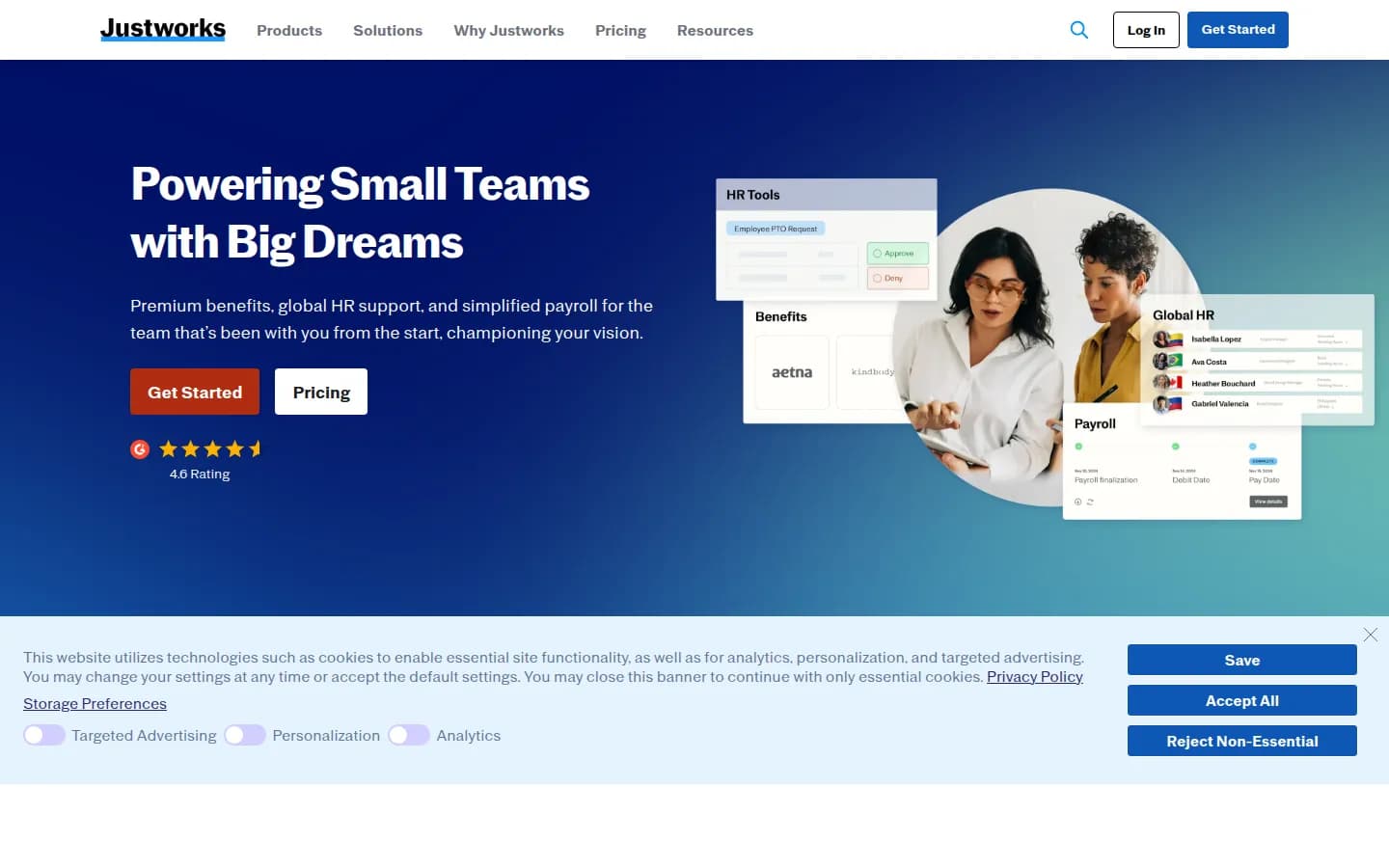
Justworks is a Professional Employer Organization (PEO). It runs HR, payroll, benefits, and compliance for small and mid-sized companies. The idea for the company was born in 2012 when founder Isaac Oates struggled with benefits and state rules at his earlier startup. He built Justworks to fix the problems he faced in that process.

How it works

The platform covers the full employment cycle. It supports onboarding, payroll, benefits, and compliance in one dashboard.

As a PEO, they use a co-employment model. This setup gives small businesses access to stronger benefits and compliance support that most basic payroll tools don’t offer.

Scale and tax coverage

Justworks processed more than $25.6 billion in payroll and $6 billion in federal taxes in 2023. They also support about 2,000 tax localities. This scale supports companies that employ or contract people in different countries.

Who it fits

Justworks fits small and mid-sized companies with five to 99 employees who want less admin work and stronger benefits. The simple setup and clean interface make it a common choice for tech firms and other SMBs that want HR tasks organized in one place.
Key features of Justworks

  • Payroll management and tax filing: Justworks runs payroll across states and handles direct deposits, tax calculations, and year-end forms in one place.They calculate and send federal, state, and local taxes through the platform, which cuts typical multi-state admin work. You can set payment schedules, adjust pay rates with job codes, and use the system to create W-2 and 1099 forms at the end of the year.
  • HR administration and compliance support: The platform handles core HR work with digital onboarding, organized document storage, and PTO tracking. It keeps up with federal, state, and local rules and offers steady guidance as requirements change. It also includes workers’ compensation and EPLI coverage, which protects companies from common employment issues without adding extra vendors.
  • Benefits administration with enterprise access: Through its PEO model, Justworks gives smaller companies access to health insurance plans that are usually available only to larger employers. The Plus plan includes medical, dental, and vision coverage along with HSA and FSA accounts and a set of wellness perks. This level of access helps smaller teams offer benefits that stay competitive next to bigger companies.
  • All-in-one employee management platform: Justworks centralizes workforce management through a clean, intuitive interface accessible to both employers and employees. The dashboard provides quick access to essential functions including team oversight, payroll processing, and benefits administration. For employees, the platform offers self-service access to pay information, benefits selections, and time-off requests, creating a streamlined experience for the entire organization.
  • Modern, user-friendly interface: The platform uses a clear layout that makes HR tasks easier to manage without overloading new administrators. Navigation follows straightforward workflows, and employees can quickly get to their personal details, benefits, and onboarding steps. This setup helps teams pick up the system faster and spend less time hunting for basic information.
  • Multi-state employer support: The platform handles state tax rules, unemployment insurance, and other requirements for teams working in different locations. It applies the right regulations based on where people live and work, which takes pressure off your admin load as you hire across more states.
  • 24/7 customer support: The platform offers 24/7 support through email and chat, and you can book video calls when a situation needs more attention. It also includes a detailed knowledge base with country-specific guides for common employment questions. This mix of live help and clear resources makes it easier to solve issues whenever they come up.

Pros

  • Easy to use platform with a clean layout

    Justworks platform has a simple, modern interface. It makes HR tasks easier for employers and employees. The shorter learning curve reduces admin work.

  • Strong multi-state compliance support

    They keep up with state rules and tax requirements. This helps companies with people in more than one location.

  • Access to enterprise-level benefits

    Small businesses can tap into health insurance options and other benefits usually reserved for larger organizations. This helps them attract and keep people.

  • Transparent flat-rate pricing

    The pricing is clear with no hidden fees or setup costs. This makes it easier to plan budgets.

  • Around-the-clock support

    Justworks provides 24/7 assistance through multiple channels, so help is available always.

  • All-in-one HR setup

    The platform removes the need for multiple systems and keeps workflows clear from onboarding through offboarding. In other words, it reduces the administrative burden.

Cons

  • Premium pricing compared to basic payroll providers

    At $59 to $599 per employee each month, Justworks costs more than simpler payroll tools. The rates can feel high for small companies.

  • Limited customization

    The standardized approach works well for typical scenarios but gives less room to adjust things for businesses with specialized employment arrangements (e.g. custom overtime rules).

  • Mobile app features not as strong as desktop

    The mobile experience covers the basic self-service features for employees, but it doesn’t include all admin tools you get on desktop.

  • Lower international scope

    The platform focuses on US-based employees and offers limited international support compared to large global Employer of Record (EOR) providers.

Platform reviews

Platform Rating Reviews
G2 4.6 1,007 reviews
Capterra 4.6 735 reviews
Trustpilot 2.6 18 reviews

Customer support

Support Feature Details
Support Channels Email, Phone, Live Chat
Support Availability 24/7

Best for

Small and medium-sized businesses (primarily 5–99 employees)

Complete provider comparison

Key metrics Deel Multiplier Oyster HR Rippling ADP Atlas HXM Papaya Global Justworks
PEO Pricing
Contact sales Contact sales Contact sales Contact sales Contact sales Contact sales Contact sales Contact sales
Contractor pricing
$49 /month
$40 /month
$29 /month
$35 /month
Contact sales Contact sales
$30 /month
$39 /month
Payroll pricing
$29 /month
$29 /month
$35 /month
$8 /month
G2 rating
4.9 ★★★★★
4.7 ★★★★★
4.4 ★★★★★
4.8 ★★★★★
4.1 ★★★★★
4.5 ★★★★★
4.5 ★★★★★
4.6 ★★★★★
Country coverage
150+ countries
150+ countries
180+ countries
185+ countries
140++ countries
160+ countries
160+ countries
100+ countries
Support channels
Email, Phone, Live Chat Email, Phone, Live Chat Email, Live Chat Email, Phone, Live Chat Email, Phone, Live Chat Email, Phone, Live Chat Email, Live Chat Email, Phone, Live Chat
Support availability
24/7 Business Hours Business Hours Business Hours 24/7 24/7 24/7 24/7
Annual discount
✓ Available ✓ Available ✓ Available ✓ Available ✓ Available ✓ Available ✓ Available ✓ Available
Visit website
Visit website Visit website Visit website Visit website Visit website Visit website Visit website Visit website

A deeper dive into understanding PEOs

A Professional Employer Organization (PEO) offers comprehensive HR solutions through a unique co-employment model. This arrangement allows businesses to outsource a wide array of human resource functions, including but not limited to payroll processing, benefits administration, compliance management, and risk mitigation. By entering into this partnership, companies effectively share employer responsibilities with the PEO, creating a symbiotic relationship that can significantly benefit both parties.

The co-employment model is at the heart of what makes PEOs unique. Under this arrangement, the PEO becomes the employer of record for tax purposes and takes on many administrative and legal responsibilities associated with employment. This allows the client company to focus on managing their employees’ day-to-day work and core business operations while the PEO handles the complexities of HR administration.

PEOs have become increasingly popular, especially among small and medium-sized businesses, as they provide access to expertise and resources that might otherwise be out of reach. This level of support can be particularly valuable in navigating the complex landscape of employment laws, tax regulations, and benefits administration, which can be overwhelming for businesses without dedicated HR departments or expertise.

The multifaceted benefits of using a PEO

Partnering with a PEO can offer numerous advantages beyond simple administrative relief. Let’s explore these benefits in more detail:

Cost savings: One of the most significant advantages of working with a PEO is the potential for substantial cost savings. PEOs can often negotiate better rates for benefits and insurance due to their large employee pools, effectively allowing small businesses to access the buying power of much larger corporations. This can result in significant savings on health insurance, workers’ compensation, and other employee benefits. Additionally, by outsourcing HR tasks, companies can reduce or eliminate the need for in-house HR staff, reducing overhead costs.

Compliance assistance: Staying compliant with the ever-changing employment laws and regulations landscape can be a full-time job. PEOs specialize in this area, keeping abreast of federal, state, and local regulations to ensure their clients remain compliant. This expertise can be invaluable in avoiding costly fines and legal issues related to non-compliance. PEOs often provide regular updates and training on new regulations, helping businesses stay ahead of the curve.

Improved benefits: Through a PEO, small and medium-sized businesses can offer employees benefits packages that rival much larger companies. This can include comprehensive health insurance, retirement plans, life insurance, and even perks like employee assistance programs or professional development opportunities. Access to better benefits can significantly improve employee satisfaction, leading to better retention rates and making attracting top talent in competitive job markets easier.

Time savings: PEOs free up business owners and managers to focus on core business activities by taking on time-consuming HR tasks. This can include everything from strategic planning and product development to sales and customer service. The time saved on administrative tasks can be reinvested into growing the business, improving products or services, or developing new market opportunities.

Risk management: PEOs are crucial in helping businesses manage and mitigate employment-related risks. This includes handling workers’ compensation claims, unemployment insurance, and even assisting with workplace safety programs. Many PEOs also offer guidance on best practices for hiring, firing, and managing employees to reduce the risk of employment-related lawsuits.

Scalability: As businesses grow or face seasonal fluctuations, their HR needs can change rapidly. PEO services can easily scale up or down to meet these changing needs, providing flexibility that can be difficult to achieve with an in-house HR department. This scalability allows businesses to adapt quickly to market conditions without hiring or laying off HR staff.

Choosing the right PEO: A strategic approach

Selecting the right PEO for your business is a critical decision impacting your operations, employee satisfaction, and bottom line. To make an informed choice, consider the following factors in detail:

  1. Comprehensive assessment of your business needs: Begin by thoroughly analyzing your current HR challenges and future goals. Consider aspects such as your growth projections, plans for geographic expansion, and any industry-specific requirements. This assessment will help you identify the key services and capabilities you need from a PEO partner.
  2. Service offerings and specializations: Evaluate the range of services each PEO offers and how well they align with your identified needs. Some PEOs excel in specific areas like global expansion, while others might offer more comprehensive domestic services. Ensure the PEO can provide all the critical services you require, from payroll and benefits administration to compliance management and risk mitigation.
  3. Industry expertise: Look for a PEO with significant experience in your specific industry. Different sectors have unique HR challenges and regulatory requirements. A PEO with industry-specific knowledge can provide more tailored advice and solutions, ensuring better compliance and risk management.
  4. Geographic coverage: If you have employees in multiple states or countries or are planning to expand, choose a PEO with appropriate geographic coverage. Ensure they have expertise in managing HR functions across all relevant jurisdictions, including knowledge of local labor laws and tax regulations.
  5. Technology platform and user experience: In today’s digital age, the quality of a PEO’s technology platform can significantly impact your experience. Evaluate the user-friendliness and capabilities of the PEO’s software. Look for features like employee self-service portals, mobile accessibility, and robust reporting tools. Also, consider the platform’s ability to integrate with your existing systems.
  6. Pricing structure and transparency: Understand the pricing model of each PEO you’re considering. Some offer a straightforward per-employee fee, while others might charge a percentage of payroll. Look for transparency in pricing and be wary of hidden fees. While cost is important, remember that the cheapest option isn’t always the best value in the long run.
  7. Customer support and service model: Consider the level and availability of customer service. Some PEOs offer dedicated account managers, while others provide more generalized support. Think about your preferred communication methods and support hours. If you’re managing a global workforce, 24/7 support might be crucial.
  8. Compliance expertise and risk management: Ensure the PEO stays up-to-date with relevant laws and regulations. Look for providers that offer proactive compliance updates and have a strong track record in risk management. This is particularly important if you operate in highly regulated industries or across multiple jurisdictions.
  9. Scalability and flexibility: Choose a PEO that can grow with your business. Consider whether their services and pricing structure can easily adapt as your company expands or your needs change. Flexibility in contract terms can also be beneficial, allowing you to adjust services as needed.
  10. Financial stability and accreditation: Research the PEO’s financial stability and look for industry accreditations. A financially sound PEO with recognitions like the IRS’s Certified Professional Employer Organization (CPEO) designation or accreditation from the Employer Services Assurance Corporation (ESAC) can provide additional peace of mind.
  11. References and reputation: Don’t hesitate to ask for references from current clients, particularly those in similar industries or of similar size. Look for online reviews and testimonials, but be sure to consider the source and context of these reviews. Industry awards and recognitions can also indicate a PEO’s quality and reputation.
  12. Data security and privacy measures: Given the sensitive nature of employee data, it’s crucial to understand the PEO’s data security protocols and privacy measures. Ensure they comply with relevant data protection regulations and have robust systems to protect your company’s and employees’ information.
  13. Employee benefits offerings: If improving your benefits package is a priority, closely examine the types and quality of benefits each PEO offers. Consider factors like the variety of health insurance options, retirement plans, and additional perks like professional development opportunities or wellness programs.
  14. Onboarding and implementation process: Understanding how the PEO handles the onboarding process can give you insight into their operational efficiency. Ask about timelines, required resources, and the level of support provided during the transition period.

By carefully considering these factors and how they align with your business needs, you can make a more informed decision when choosing a PEO partner. Remember that the right PEO can be a valuable asset in managing your workforce effectively, allowing you to focus on growing your business.

Emerging trends shaping the future of PEO services

As we move further into 2026, several key trends are shaping the PEO industry, influencing the services offered and how they are delivered:

  1. Increased focus on global workforce management: With the rise of remote work and increasing globalization, PEOs are expanding their international capabilities. This includes more comprehensive support for hiring and managing employees across borders, navigating international tax laws, and providing globally competitive benefits packages.
  2. Enhanced technology integration: PEOs invest heavily in more sophisticated platforms that integrate various HR functions and provide advanced analytics. This includes AI-driven insights, predictive analytics for workforce planning, and more seamless integration with other business software systems.
  3. Emphasis on employee experience: There’s a growing focus on improving the overall employee experience, from onboarding to ongoing engagement. PEOs offer more tools and services to enhance employee satisfaction, including personalized benefits portals, mental health support, and career development resources.
  4. Greater flexibility in service offerings: Recognizing that one size doesn’t fit all, PEOs provide more customizable service packages. This allows businesses to select only the needed services, creating more cost-effective solutions for companies of all sizes.
  5. Heightened focus on compliance and risk management: With constantly evolving regulations, especially in areas like data privacy and employment law, PEOs are strengthening their compliance and risk management offerings. This includes more proactive updates on regulatory changes and enhanced support for managing complex compliance issues.
  6. Expansion of benefits offerings: PEOs are broadening their benefits packages to include more comprehensive health, wellness, and financial planning options. This includes telemedicine, mental health support, financial counseling, and personalized wellness programs.
  7. Increased support for remote and hybrid work models: As remote and hybrid work becomes more common, PEOs are developing more tools and services to help businesses manage distributed workforces. These include enhanced time-tracking tools, virtual team-building resources, and guidance on managing remote employees effectively.
  8. Focus on diversity, equity, and inclusion (DEI): PEOs increasingly offer services and resources to help businesses implement and maintain effective DEI initiatives. This includes training programs, policy development support, and analytics tools to track DEI progress.
  9. Integration of larning and development Platforms: Many PEOs are incorporating robust learning management systems into their offerings, providing employees with access to a wide range of professional development and skills training resources.
  10. Enhanced cybersecurity measures: With data protection becoming increasingly important, PEOs are bolstering their cybersecurity measures and offering more support to clients in safeguarding sensitive employee information.

These trends reflect the evolving needs of businesses in an increasingly complex and global workplace environment. As PEOs continue to adapt and innovate, they are likely to play an even more critical role in helping businesses manage their workforce effectively and compliantly.

Closing thoughts on choosing the best PEO

Partnering with a PEO can provide valuable support and expertise as businesses navigate an increasingly complex HR landscape in 2026 and beyond. The best PEO for your company will depend on your specific needs, size, industry, and growth plans. By carefully evaluating the options and considering the factors discussed in this comprehensive guide, you can find a PEO partner to help streamline your HR operations, ensure compliance, and support your business growth.

Remember that the PEO industry is continually evolving, with providers expanding their services and embracing new technologies to meet the changing needs of businesses. Stay informed about these developments and be prepared to reassess your PEO partnership periodically to ensure it continues to meet your evolving needs.

Ultimately, the right PEO can be a powerful ally in managing your workforce effectively, allowing you to focus on your core business activities and strategic goals. With the insights in this guide, you’re well-equipped to make an informed decision and choose a PEO that will be a valuable partner in your business’s success.

Frequently asked questions