Best Global Payroll Software
Managing payroll shouldn’t take up hours of your week.
Independently researched by Employ Borderless.

One Global Payroll
#1
Multi-country payroll
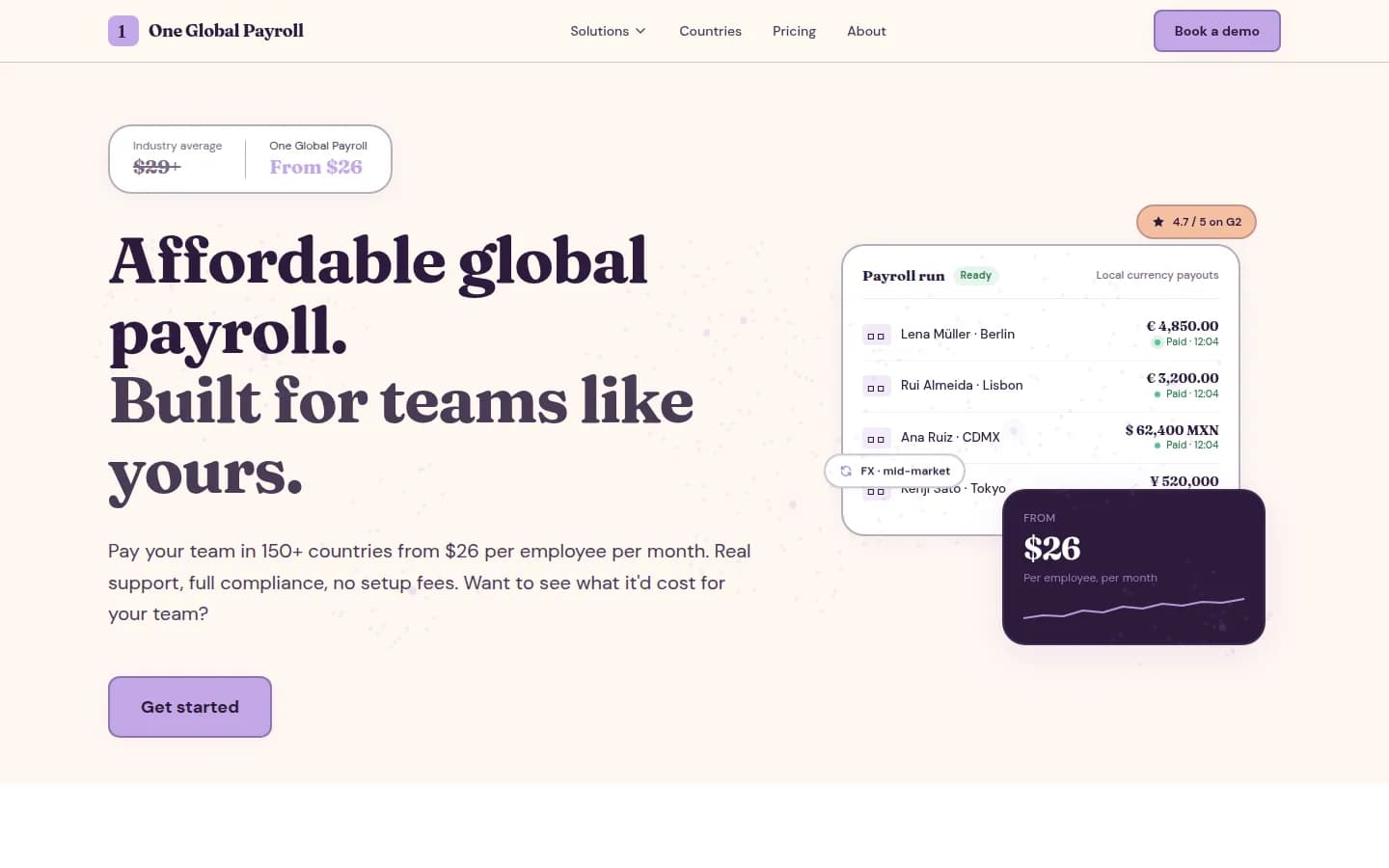
Automated local tax compliance across multiple countries, from $26 per employee per month, with no setup fees or per-country surcharges.
- Payroll from
- $26 per employee per month
- Countries
- 163
Also worth a look

Remote
Own entities, one platform
Own-entity model with strong IP protection, from $699 per employee per month.

Multiplier
Fast hiring and payroll
Fast (often same-day) global hiring, from $459 per employee per month.
How we make money: Employ Borderless earns commissions and pre-negotiated discounts when you choose a provider through us. You pay nothing for our recommendation. Our methodology is independent of partner economics. If a provider is wrong for you, we say so.
The best payroll services in 2026 are One Global Payroll (starting at $26/mo), Remote (starting at $29/mo), and Multiplier (starting at $20/mo), scored on The Employ Borderless Standard, our 10-pillar framework, across 7 providers.
Managing payroll shouldn’t take up hours of your week. Yet between calculating taxes across different jurisdictions, staying compliant with constantly changing regulations, and making sure everyone gets paid correctly and on time, most growing companies find themselves drowning in spreadsheets and paperwork. Miss a tax deadline or miscalculate withholdings, and you’re looking at penalties that quickly add up.
That’s where professional payroll services come in, to handle the complexity while you focus on building your business.
Based on my analysis of payroll providers across different company sizes and needs, Bamboo HR consistently ranks as the top choice for most small to medium businesses, particularly those looking for an intuitive platform that doesn’t require a degree in accounting to operate. However, depending on your specific situation, international team members, complex benefits administration, or enterprise-level requirements, other providers like Rippling or ADP might be better fits.
I’ve spent the last four years analyzing payroll and HR solutions, working directly with companies who’ve switched providers after expensive mistakes and those who got it right the first time. In this guide, I’ll explain why Bamboo HR leads our rankings for most businesses, while also helping you understand which alternative might actually work better for your specific needs.
Which providers made our shortlist?
Here's how all 7 providers on our shortlist compare. They're ranked by overall fit for this guide, not by score alone, so the highest-scored provider isn't always first. The Employ Borderless Standard score for each provider is in its review.
Scored on The Employ Borderless Standard →


| # | Provider | Best for | |||
|---|---|---|---|---|---|
| 1 | | Companies running payroll across multiple countries who want reliable compliance without overpaying | From $26/mo | 163+ | Visit |
| 2 | | teams that want the provider to employ staff through its own local entity | From $29/mo | 186+ | Visit |
| 3 | | teams where the monthly fee per employee decides it | From $20/mo | 171+ | Visit |
| 4 | | Growing companies scaling internationally with a mix of contractors and full-time employees | From $29/mo | 153+ | Visit |
| 5 |  | US-based businesses managing domestic payroll with occasional international payments | - | 11+ | Visit |
| 6 |  | Companies with 50–1,000 employees that use multiple tools to manage HR, IT, and finance | - | 83+ | Visit |
| 7 |  | Companies that want a user-friendly platform with built-in payroll and EOR flexibility | - | 132+ | Visit |
Why you can trust our reviews
We combine structured research with real-world global hiring experience. Our methodology is built by operators who've spent years working with EOR, PEO, and payroll providers across multiple markets.
- 10+ years in global hiring - hands-on experience selecting and working with EOR providers
- 5-layer research methodology - demos where providers grant access, review platforms (G2, Trustpilot, Capterra), communities, and provider validation
- The Employ Borderless Standard - our 10-pillar rating framework, scored out of 5 in half steps across features, country coverage, pricing, UX, support, integrations, mobile, analytics, security, and compliance
- Weighted review analysis- platforms with more reviews have higher impact (e.g. 2000 > 30)
- Independent - rankings are not influenced by affiliate partnerships
Built by practitioners, not publishers - so you can rely on it for real hiring decisions.

Ranked by fit for this use case: hands-on testing, customer feedback from teams hiring through these providers, and pricing. Where a lower-scored provider sits higher, it is because customer feedback favours it.
One Global Payroll
Automated local tax compliance across multiple countries, from $26 per employee per month, with no setup fees or per-country surcharges.
- Pricing
- Country coverage
- Compliance
- Integrations
Third-party ratings
 5.0(1)
Pricing and coverage
| Global payroll | From $26/mo |
| Country coverage | 163+ countries |
Pricing sourced from One Global Payroll's pricing page · verified Sep 2026
Key features
Pros and cons
Pros
- Competitive pricing
- 163-country coverage
- Dedicated payroll specialist
- 24/7 support
- Fast setup
- No hidden fees
Cons
- Payroll only
- Limited third-party reviews
- No built-in HR tools
One Global Payroll is a global payroll platform that processes employee payments across 163 countries. Companies use it to run payroll, handle local tax compliance, and manage statutory filings from a single dashboard.
The platform focuses specifically on payroll processing rather than trying to be an all-in-one HR solution. That narrow focus means the payroll features run deeper than what you find in platforms that spread across EOR, contractor management, and HR.
How One Global Payroll works
The platform manages payroll operations across 163 countries.Core services include:
- Multi-country payroll processing: Run payroll for employees in multiple countries from one dashboard, with automated local tax calculations.
- Tax filing and compliance: The platform handles statutory filings, social contributions, and year-end reporting in each country.
- Employee self-service: Employees access payslips, tax documents, and leave requests through their own portal.
- Payroll reporting: Real-time visibility into payroll costs by country, department, or employee.
Most companies start processing payroll within a few days of signing up. The platform handles local tax registration and compliance configuration for each country.
Payroll-first approach
One Global Payroll is built for companies that already have legal entities in their hiring countries but need a reliable payroll processor.The platform stands out for its pricing transparency and compliance depth.
Benefit for clients: Companies paying $26/employee/month get the same compliance coverage that premium providers charge $40-50 for.
Remote
Own-entity model with strong IP protection, from $699 per employee per month.
Why it ranks here: Best for owned entities: employs staff through its own local entities across 186 payroll countries.
- Pricing
- Country coverage
- Compliance
- Integrations
Third-party ratings
 4.5(5,008)
 4.6(3,439)4.3(101)
 3.4(592)
Pricing and coverage
| Employer of record | From $699/mo |
| Global payroll | From $29/mo |
| Contractor management | From $29/mo |
| Country coverage | 186+ countries |
Pricing sourced from Remote's pricing page · verified Sep 2026
Key features
Pros and cons
Pros
- Own-entity model
- Superior IP protection
- Transparent flat-rate pricing
- Extensive human resources (HR) coverage
- Custom benefits packages
- Recently launched global payroll solution
Cons
- Costs more than budget options
- Limited customization options
- Basic reporting capabilities
Remote is an Employer of Record (EOR) service that helps companies hire international employees without creating local entities.
It was founded in 2019 by Job van der Voort and Marcelo Lebre, both former GitLab executives. The company has raised more than $500 million and expanded quickly. They now support hiring in 186+ countries.
The platform manages the full employment cycle through a centralized dashboard (compliant contracts, onboarding, payroll, benefits, taxes, and termination).
A key standout: owned entities
Remote stands out in the industry because they own and directly operate legal entities in each country instead of relying on third-party partners, which is not the case with all providers.This wholly owned structure gives the company full control over employment tasks and compliance.
What this means for you: Remote is a good fit for businesses that prioritize compliance and risk management when expanding into new markets because the platform keeps employment responsibilities in-house.

Multiplier
Fast (often same-day) global hiring, from $459 per employee per month.
Why it ranks here: Best value: payroll from $20 per employee per month, 171 payroll countries.
- Pricing
- Country coverage
- Compliance
- Integrations
Third-party ratings
4.7(1,482)4.9(2,870)4.4(44)4.2(352)Pricing and coverage
| Employer of record | From $459/mo |
| Contractor management | From $40/mo |
| Global payroll | From $20/mo |
| Country coverage | 171+ countries |
Pricing sourced from Multiplier's pricing page · verified Sep 2026
Key features
Pros and cons
Pros
- Lower EOR rates
- Fast onboarding
- Multi-currency payroll
- Strong compliance handling
- No setup fees
Cons
- Unintuitive platform layout
- Slower email support
- Limited customization
Multiplier is an Employer of Record (EOR) and a global employment platform. Companies use it to hire and manage international team members without establishing local entities.
Sagar Khatri, Amritpal Singh, and Vamsi Krishna founded the company in 2020. It's headquartered in New York, United States, and has secured over $77 million in funding since launch.
How Multiplier works
Multiplier manages employment operations across 171+ countries.The core services they offer are:
- Compliance management: Multiplier manages local employment laws and requirements.
- Payroll processing: International payments run through the system.
- Benefits administration: Companies can provide employee benefits without setting up local programs.
- Contractor management: Businesses can manage both full employees and contractors in one place.
Most companies can start hiring internationally within days instead of waiting months for entity setup.
Who Multiplier is for
Multiplier is a great fit for small to medium-sized businesses and startups entering global markets.Benefit for clients: You can hire in 171+ countries through one platform without setting up local entities.
Helpful reads: Best Employer of Record (EOR) for startups
Not sure which provider is right for you?
Tell me about your team and I'll give you a free, independent recommendation.

Deel
Contractor of Record (COR), where Deel handles contractor classification, not just payments, from $599 per employee per month.
- Pricing
- Country coverage
- Compliance
- Integrations
Third-party ratings
4.7(6,983)4.6(9,315)4.9(4,311)4.4(1,903)Pricing and coverage
| Employer of record | From $599/mo |
| Contractor management | From $49/mo |
| Global payroll | From $29/mo |
| Country coverage | 153+ countries |
Pricing sourced from Deel's pricing page · verified Sep 2026
Key features
Pros and cons
Pros
- Owned legal entities
- Multi-currency payroll services
- Automated compliance tracking
- Contractor of Record service
- Localized benefits packages
- 24/7 support across multiple channels
- Unified platform
Cons
- Premium pricing
- Support delays during peak periods
- Limited reporting
Deel is an Employer of Record (EOR) and a global payroll platform. Companies use it to hire, pay, and manage international contractors and full-time employees without setting up local entities.
Alex Bouaziz, Shuo Wang, and Ofer Simon founded the company in 2019. Deel is headquartered in San Francisco and has raised more than $980 million in seven funding rounds.
The platform is now valued at $17.3 billion.
How Deel works
Deel supports hiring and payroll across 153+ countries.Companies typically use the platform for the following services:
- Employer of Record (EOR): Deel becomes the legal employer in the target country while you manage the day-to-day work
- Contractor management: Allow clients to hire, manage, and pay independent contractors in multiple countries through a single platform.
- Contractor of Record (COR): Deel takes on the liability, manages all HR/admin, and handles the risk for you.
- Global payroll: Clients submit payroll data and approve it in one dashboard, and Deel handles taxes, deductions, and currency conversions automatically.
What stood out in my tests
In my tests of the platform, the onboarding stood out for its simplicity and speed.In most cases, contracts are generated automatically based on the country, reviewed right on the platform, and approved in a few steps.
What this means for you: you can hire in established markets within days. They’re also likely to find better contract standardization, clear compliance guidance, and faster onboarding compared to smaller regional providers.


Gusto
Runs US payroll in under 10 minutes, with automated tax calculations and filings built in.
- Pricing
- Country coverage
- Compliance
- Integrations
Third-party ratings
4.6(12,991)1.9(2,517)3.1(1,092)Pricing and coverage
| Contractor management | From $35/mo |
| Country coverage | 11+ countries |
Pricing sourced from Gusto's pricing page · verified Sep 2026
Key features
Pros and cons
Pros
- Fast US payroll processing
- Clean interface
- Contractor payments in 120+ countries
- Strong accounting integrations
- Unlimited payroll runs
- Built-in time tracking
Cons
- Limited EOR coverage
- Inconsistent customer support
- Limited mobile admin functions
- Recent price increases
Gusto's EOR, also known as Gusto Global, is an extension of Gusto's popular payroll and HR platform designed to support businesses in hiring and managing international employees. Known to be powered by Remote, it allows companies to expand their workforce globally without establishing local legal entities in foreign countries.
Gusto EOR's core strengths lie in its user-friendly design, comprehensive payroll features, and integrated benefits administration. The platform is particularly well-suited for small to medium-sized businesses looking to hire in its supported countries or those managing international contractors across multiple countries.


Rippling
Rippling connects HR, payroll, IT and finance in one platform, so your data never lives in disconnected tools.
- Pricing
- Country coverage
- Compliance
- Integrations
Third-party ratings
4.8(13,424)4.5(2,466)4.9(4,867)3.7(1,103)Pricing and coverage
| Country coverage | 83+ countries |
Key features
Pros and cons
Pros
- System integration
- Strong automation
- Device management
- App integrations
- Custom workflows
Cons
- Unclear pricing
- Lengthy setup and steep learning curve
- Inconsistent support
Rippling is an all-in-one workforce management platform that connects HR, IT, and finance functions through a unified employee database. Companies use it to manage payroll, benefits, devices, and software from one system.
Parker Conrad (former Zenefits CEO) and Prasanna Sankar founded the company in 2016. Rippling now supports businesses operating in 83 countries.
How Rippling works
The platform automates workflows across business systems that normally operate separately.
Rippling’s onboarding stood out in my research because users consistently describe it as efficient. For example, adding someone to payroll triggered their laptop order, email setup, and software provisioning right away.
There are no (or fewer) manual steps since one employee database feeds all systems at once.
What this means for you: It means automating tasks that normally require switching between multiple tools.
Who uses Rippling
Rippling works best for medium-sized technology and growing businesses with members across the world.
These companies need advanced systems but lack enterprise-level IT departments. The Rippling platform provides just that: enterprise-grade tools without massive IT investments.
What this means for you: Companies automate work that normally requires multiple tools and manual coordination.


Oyster
Oyster guides you through onboarding, then lets employees self-serve on pay, benefits, and compliance, in 116 countries from $699 per employee per month.
- Pricing
- Country coverage
- Compliance
- Integrations
Third-party ratings
4.4(1,592)3.8(271)4.6(91)4.0(242)Pricing and coverage
| Employer of record | From $699/mo |
| Contractor management | From $29/mo |
| Country coverage | 132+ countries |
Pricing sourced from Oyster's pricing page · verified Sep 2026
Key features
Pros and cons
Pros
- Employee development
- Designed for remote teams
- Strong global coverage
- Simple compliance tracking
- Built-in cost calculator
- Ethical employment standards
Cons
- Premium rates
- Add-on costs
- Limited self-service
Oyster HR is an Employer of Record (EOR) and a global employment platform that allows companies to hire and manage international workers in 132+ countries without setting up local legal entities. Founded in 2020, the company focuses on supporting distributed teams.
Oyster’s services include international employment contracts, payroll processing, benefits administration, and ongoing local compliance in each country where it operates.
Focus on employee experience
Oyster places more emphasis on the employee experience than traditional EOR providers.Alongside core employment services, the platform includes Oyster Academy for professional development, as well as tools designed to support onboarding and cross-cultural collaboration.
What this means for you: Oyster acts as more than a compliance partner. The platform is designed to help companies build and maintain engaged global teams, not just employ them on paper.
Typical customers
Oyster primarily serves mid-market and enterprise companies with 50 or more employees, but I've also seen a few startups in their customer base.The limiting factor here is the higher rate for Employer of Record (EOR) services.
The platform attracts companies that value consistency, employee satisfaction, and long-term retention, even when that means paying more than low-cost EOR alternatives.

How do these providers compare?
| # | Provider | Best for | Payroll from | Countries | Entity | Support hours |
|---|---|---|---|---|---|---|
| 1 | | — | $26 | 163 | Not verified | n/a |
| 2 | | teams that want the provider to employ staff through its | $29 | 186 | Not verified | 24/7 |
| 3 | | teams where the monthly fee per employee decides it | $20lowest | 171 | Not verified | 24/5 |
| 4 | | — | $29 | 153 | Not verified | 24/7 |
| 5 | | — | n/a | 11 | Not verified | Business Hours |
| 6 | | — | n/a | 83 | Not verified | Business Hours |
| 7 | | Companies that want a user-friendly platform with built-in | n/a | 132 | Not verified | Business Hours |
Ranked by overall fit; the Employ Borderless Standard score for each provider is in its review.
How do we evaluate Payroll providers?
We ranked each provider on the things that decide whether global payroll actually saves you time: the real cost structure across own-entity and employer-of-record models including currency margins and per-country setup fees, how well the platform calculates local statutory contributions and 13th or 14th month salaries and files on time, whether it runs on owned infrastructure or partner networks, how it handles currencies and same-cycle payment timing, and its data-protection posture including GDPR and SOC 2 Type II.
What to know about choosing global payroll software
Paying people in one country is a solved problem. Paying people in ten countries, in ten currencies, under ten sets of labor and tax rules, is where payroll starts consuming real time. The right global payroll platform removes most of that work. The wrong one just moves the spreadsheets somewhere else.
Cost structure realities
Global payroll is usually priced per employee per month, and the rate depends on the employment model. Running payroll for staff on your own entities typically costs from $20 to $50 per employee monthly. If the provider also acts as employer of record in countries where you have no entity, expect from $199 to $699 per employee monthly. Watch the extras: currency conversion margins, off-cycle run fees, and per-country setup charges often add more than the headline rate. Ask for a full quote covering every country you operate in before comparing providers.
Local compliance is the whole job
Every country has its own statutory contributions, filing calendars, and payslip requirements. Some add 13th-month or 14th-month salaries, mandatory bonuses, or severance accruals that US-style payroll never deals with. A good platform calculates these automatically and files with local authorities on time. Ask who is actually responsible when a filing is late: the answer tells you whether you are buying software or accountability.
Owned infrastructure versus partner networks
Some providers run payroll through their own local entities and teams. Others route it through in-country partners. Partner networks reach more countries, but every handoff adds delay and a second support queue. If most of your headcount sits in a few key markets, a provider with its own operations there will usually resolve issues faster.
Currencies and payment timing
Check which currencies the platform pays in, how it sets exchange rates, and whether employees receive net pay on the same date everywhere. Late or short salary payments are the fastest way to lose a remote team's trust. Same-cycle payments across time zones, visible FX margins, and local bank rails in each country are the features that matter.
Data protection across borders
Payroll data crosses borders with your team. GDPR applies to anyone you employ in Europe, and several countries add local data-residency rules on top. Look for SOC 2 Type II certification, clear data-processing agreements, and a straight answer on where employee data is stored.
How to choose the best global payroll platform for your business
Here is how to evaluate the options without sitting through ten identical demos.
Essential capabilities to verify
- Automated gross-to-net calculations in every country you hire in
- Statutory filings and contributions handled by the provider, not just calculated
- Multi-currency payments with transparent exchange rates
- Localized payslips and year-end documents in the local language
- Employee self-service for payslips and tax forms
- Contractor payments alongside employee payroll
- A single consolidated report across all countries for your finance team
Features that separate the leaders
- Employer of record coverage for countries where you have no entity
- Employer cost estimates before you make an offer
- Benefits administration adapted to each market
- Native accounting integrations (QuickBooks, Xero, NetSuite) and an open API
- Support coverage across your team's time zones
Red flags to avoid
- Pricing that only appears after a sales call
- No clarity on which countries run on partners versus own entities
- FX margins the provider will not put in writing
- No liability for late or incorrect statutory filings
- Long-term contracts with steep exit fees
Questions to ask during demos
- "Which of our countries do you serve with your own entities?"
- "Who pays the penalty if a local filing is late?"
- "What exchange rate do employees actually get, and what is your margin?"
- "How fast can you run an off-cycle payment in [country]?"
- "What does onboarding look like for our existing payroll data?"
Making your final decision
Weight the countries where most of your payroll cost sits. A platform that is excellent in your two biggest markets and adequate elsewhere beats one that is mediocre everywhere. And check the migration path: switching global payroll mid-year across multiple countries is far more painful than a domestic switch, so pick a provider you can grow with.
Common global payroll mistakes and what to look for
Treating contractors as a permanent workaround
Many companies pay international team members as contractors to avoid payroll complexity. Do this long enough with full-time work and you build up misclassification risk: back taxes, penalties, and forced conversions. Look for a provider that offers both contractor payments and employee payroll, with a clean conversion path between them.
Ignoring statutory extras
Budgeting salaries without employer contributions, 13th-month pay, or mandatory benefits understates real costs by 20% to 40% in many countries. Look for platforms that show total employer cost per country before you hire, not after the first payroll run.
Underestimating FX costs
A 2% hidden currency margin on a $50,000 salary is $1,000 a year, per employee. Look for providers that disclose their FX rates and margins in writing, or let you fund payroll in local currency.
Assuming support follows the sun
When payroll breaks in Singapore, a support team that opens at 9am Eastern is twelve hours too late. Look for support coverage matched to where your people are, and a named contact for payroll-critical issues.
Scattering payroll data across providers
Running separate local providers in each country means no single source of truth, manual consolidation, and month-end surprises. Look for one platform with consolidated reporting across every country, or at minimum clean exports your finance team can actually use.
Keep exploring
Best-of guides by use case
Best EOR by country
Frequently asked questions
How much does global payroll cost?
What is global payroll software?
What should I look for in a global payroll platform?
Does global payroll include employer of record?
Not sure which payroll provider is right for you?
Employ Borderless is an independent advisory platform for global hiring solutions, not a provider. Tell us about your team and we'll recommend the best fit for your situation, free and independent.
Get free recommendations