Best PEOs for Startups in 2026
The first payroll mistake at a startup costs more than money.
Independently researched by Employ Borderless.

Deel
#1
EOR, contractors and payroll in one
Contractor of Record (COR), where Deel handles contractor classification, not just payments, from $599 per employee per month.
- Countries
- 153
Also worth a look

Multiplier
Fast hiring and payroll
Fast (often same-day) global hiring, from $459 per employee per month.

Rippling
HR, IT and payroll in one
Rippling connects HR, payroll, IT and finance in one platform, so your data never lives in disconnected tools.
How we make money: Employ Borderless earns commissions and pre-negotiated discounts when you choose a provider through us. You pay nothing for our recommendation. Our methodology is independent of partner economics. If a provider is wrong for you, we say so.
The best PEOs for startups in 2026 are Deel, Multiplier, and Rippling, scored on The Employ Borderless Standard, our 10-pillar framework, across 7 providers.
The first payroll mistake at a startup costs more than money.
It costs trust, and early hires remember it.
Based on our 2026 analysis, Deel, Multiplier, and Rippling are the best PEO providers for startups.
This guide reviews eight, covering pricing, contract flexibility, and which stage each one fits best, so you pick the right one before you need it.
Which providers made our shortlist?
Here's how all 7 providers on our shortlist compare. They're ranked by overall fit for this guide, not by score alone, so the highest-scored provider isn't always first. The Employ Borderless Standard score for each provider is in its review.
Scored on The Employ Borderless Standard →| # | Provider | Best for | |||
|---|---|---|---|---|---|
| 1 |  | Growing companies hiring internationally with a mix of contractors and full-time employees | - | 153+ | Visit |
| 2 |  | teams where the monthly fee per employee decides it | - | 171+ | Visit |
| 3 |  | Companies with 50–1,000 employees that use multiple tools to manage HR, IT, and finance | - | 83+ | Visit |
| 4 |  | Mid-size to large companies with complex, multi-country payrolls | - | 163+ | Visit |
| 5 |  | Growing companies looking for strong global compliance support and fast onboarding in all major markets | - | 132+ | Visit |
| 6 |  | Mid-market and enterprise teams that want to employ through the provider’s own entities and get strong analytics | - | 147+ | Visit |
| 7 |  | US-based small to mid-sized companies that want HR, payroll, and compliance handled in one place | - | 41+ | Visit |
Why you can trust our reviews
We combine structured research with real-world global hiring experience. Our methodology is built by operators who've spent years working with EOR, PEO, and payroll providers across multiple markets.
- 10+ years in global hiring - hands-on experience selecting and working with EOR providers
- 5-layer research methodology - demos where providers grant access, review platforms (G2, Trustpilot, Capterra), communities, and provider validation
- The Employ Borderless Standard - our 10-pillar rating framework, scored out of 5 in half steps across features, country coverage, pricing, UX, support, integrations, mobile, analytics, security, and compliance
- Weighted review analysis - platforms with more reviews have higher impact (e.g. 2000 > 30)
- Independent - rankings are not influenced by affiliate partnerships
Built by practitioners, not publishers - so you can rely on it for real hiring decisions.

Ranked by fit for this use case: hands-on testing, customer feedback from teams hiring through these providers, and pricing. Where a lower-scored provider sits higher, it is because customer feedback favours it.
Deel
Contractor of Record (COR), where Deel handles contractor classification, not just payments, from $599 per employee per month.
- Pricing
- Country coverage
- Compliance
- Integrations
Third-party ratings
 4.7(7,039)
 4.6(9,601)
 4.9(4,314)
 4.4(1,903)
Pricing and coverage
| Employer of record | From $599/mo |
| Contractors | From $49/mo |
| Global payroll | From $29/mo |
| Country coverage | 153+ countries |
Pricing sourced from Deel's pricing page · verified Oct 2026
Key features
Pros and cons
Pros
- Owned legal entities
- Multi-currency payroll services
- Automated compliance tracking
- Contractor of Record service
- Localized benefits packages
- 24/7 support across multiple channels
- Unified platform
Cons
- Premium pricing
- Support delays during peak periods
- Limited reporting
Deel is an Employer of Record (EOR) and a global payroll platform. Companies use it to hire, pay, and manage international contractors and full-time employees without setting up local entities.
Alex Bouaziz, Shuo Wang, and Ofer Simon founded the company in 2019. Deel is headquartered in San Francisco and has raised more than $980 million in seven funding rounds.
The platform is now valued at $17.3 billion.
How Deel works
Deel supports hiring and payroll across 150+ countries.Companies typically use the platform for the following services:
- Employer of Record (EOR): Deel becomes the legal employer in the target country while you manage the day-to-day work
- Contractor management: Allow clients to hire, manage, and pay independent contractors in multiple countries through a single platform.
- Contractor of Record (COR): Deel takes on the liability, manages all HR/admin, and handles the risk for you.
- Global payroll: Clients submit payroll data and approve it in one dashboard, and Deel handles taxes, deductions, and currency conversions automatically.
Onboarding
In most cases, contracts are generated automatically based on the country, reviewed right on the platform, and approved in a few steps.What this means for you: you can hire in established markets within days. They’re also likely to find better contract standardization, clear compliance guidance, and faster onboarding compared to smaller regional providers.

Multiplier
Fast (often same-day) global hiring, from $459 per employee per month.
Why it ranks here: Best value: from $459 per employee per month, 150+ countries.
- Pricing
- Country coverage
- Compliance
- Integrations
Third-party ratings
4.7(1,490)4.8(2,871)4.4(44)4.2(352)Pricing and coverage
| Employer of record | From $459/mo |
| Contractors | From $40/mo |
| Global payroll | From $20/mo |
| Country coverage | 171+ countries |
Pricing sourced from Multiplier's pricing page · verified Oct 2026
Key features
Pros and cons
Pros
- Lower EOR rates
- Fast onboarding
- Multi-currency payroll
- Strong compliance handling
Cons
- Unintuitive platform layout
- Slower email support
- Limited customization
Multiplier is an Employer of Record (EOR) and a global employment platform. Companies use it to hire and manage international team members without establishing local entities.
Sagar Khatri, Amritpal Singh, and Vamsi Krishna founded the company in 2020. It's headquartered in New York, United States, and has secured over $77 million in funding since launch.
How Multiplier works
Multiplier manages employment operations across 150+ countries.The core services they offer are:
- Compliance management: Multiplier manages local employment laws and requirements.
- Payroll processing: International payments run through the system.
- Benefits administration: Companies can provide employee benefits without setting up local programs.
- Contractor management: Businesses can manage both full employees and contractors in one place.
Who Multiplier is for
Multiplier is a great fit for small to medium-sized businesses and startups entering global markets.Benefit for clients: You can hire in 150+ countries through one platform without setting up local entities.
Helpful reads: Best Employer of Record (EOR) for startups
Rippling
Rippling connects HR, payroll, IT and finance in one platform, so your data never lives in disconnected tools.
- Pricing
- Country coverage
- Compliance
- Integrations
Third-party ratings
4.8(13,489)4.5(2,484)4.9(4,883)3.7(1,103)Pricing and coverage
| Country coverage | 83+ countries |
Key features
Pros and cons
Pros
- System integration
- Strong automation
- Device management
- App integrations
- Custom workflows
Cons
- Unclear pricing
- Lengthy setup and steep learning curve
- Inconsistent support
Rippling is a workforce management platform that runs HR, IT and finance off one employee record. Companies use it to manage payroll, benefits, devices and software access from a single system, and it acts as employer of record in 80 countries.
It was founded in 2016, is headquartered in San Francisco, and Parker Conrad is its CEO.
How Rippling works
The point of the shared employee record is that systems which normally run separately move together. Adding someone to payroll is also what provisions their laptop, their email and their software access, because all of it reads the same record rather than being keyed in three times.
What this means for you: the work you stop doing is the re-keying between tools. That is worth most to a company that currently runs HR, payroll and IT provisioning as three separate jobs, and worth least to one that has already solved it.
Who Rippling suits
The fit is a growing company with people in several countries that wants enterprise-grade HR and IT tooling without an enterprise IT department to run it. The breadth is the product.
What this means for you: that breadth is also the learning curve reviewers describe. Budget setup time, and be honest about whether you will use enough of the platform to justify configuring it.

Not sure which provider is right for you?
Tell me about your team and I'll give you a free, independent recommendation.

Papaya Global
Payroll and payments are unified on Papaya’s licensed platform, built on J.P. Morgan infrastructure, from $499 per employee per month.
- Pricing
- Country coverage
- Compliance
- Integrations
Third-party ratings
4.5(55)4.2(58)4.5(43)2.7(356)Pricing and coverage
| Employer of record | From $499/mo |
| Contractors | From $199/mo |
| Country coverage | 163+ countries |
Pricing sourced from Papaya Global's pricing page · verified Oct 2026
Key features
Pros and cons
Pros
- Core payroll focus
- Payments built in
- 163+ countries covered
- Detailed logs
- Multiple worker models
Cons
- Setup takes time
- Not HR-led
- Mixed employment model
- Quote-based pricing
Papaya Global is a global workforce platform that helps companies manage payroll, payments, and employment across multiple countries.
Founded in 2016 by Eynat Guez, Ruben Drong, and Ofer Herman, Papaya Global later raised roughly $440 million, including a $250 million Series D in 2021.
On the product side, Papaya covers:
- Global payroll: Runs payroll and workforce payments in 163+ countries
- Employer of Record: Allows companies to hire employees in countries where they don’t have a legal entity
- Contractor management: Supports compliant onboarding and payments for international contractors
- Compliance support: Handles local tax rules, labor laws, and reporting requirements
- Benefits administration: Offers benefits for employees (including health coverage) that are matched to each country
- Integrations: Connects with tools like Workday, NetSuite, and other HRIS and ERP systems
Note: HRIS (Human Resources Information System) manages employee data, payroll, benefits, and HR functions. ERP (Enterprise Resource Planning) integrates core business processes, including finance, accounting, supply chain, and human resources, into one platform.


Oyster
Oyster guides you through onboarding, then lets employees self-serve on pay, benefits, and compliance, in 116 countries from $699 per employee per month.
- Pricing
- Country coverage
- Compliance
- Integrations
Third-party ratings
4.4(1,610)3.8(271)4.6(91)4.0(242)Pricing and coverage
| Employer of record | From $699/mo |
| Contractors | From $29/mo |
| Country coverage | 132+ countries |
Pricing sourced from Oyster's pricing page · verified Oct 2026
Key features
Pros and cons
Pros
- Employee development
- Designed for remote teams
- Strong global coverage
- Simple compliance tracking
- Built-in cost calculator
- Ethical employment standards
Cons
- Premium rates
- Add-on costs
- Limited self-service
Oyster HR is an Employer of Record (EOR) and a global employment platform that allows companies to hire and manage international workers in 132+ countries without setting up local legal entities. Founded in 2020, the company focuses on supporting distributed teams.
Oyster’s services include international employment contracts, payroll processing, benefits administration, and ongoing local compliance in each country where it operates.
Focus on employee experience
Oyster places more emphasis on the employee experience than traditional EOR providers.Alongside core employment services, the platform includes Oyster Academy for professional development, as well as tools designed to support onboarding and cross-cultural collaboration.
What this means for you: Oyster acts as more than a compliance partner. The platform is designed to help companies build and maintain engaged global teams, not just employ them on paper.
Typical customers
Oyster primarily serves mid-market and enterprise companies with 50 or more employees, but I've also seen a few startups in their customer base.The limiting factor here is the higher rate for Employer of Record (EOR) services.
The platform attracts companies that value consistency, employee satisfaction, and long-term retention, even when that means paying more than low-cost EOR alternatives.


Atlas HXM
Fully owned legal entities, from $599 per employee per month.
- Pricing
- Country coverage
- Compliance
- Integrations
Third-party ratings
4.2(94)2.9(2)5.0(5)2.9(170)Pricing and coverage
| Employer of record | From $599/mo |
| Country coverage | 147+ countries |
Pricing sourced from Atlas HXM's pricing page · verified Oct 2026
Key features
Pros and cons
Pros
- Direct entity ownership
- Support model built for global time zones
- Strong analytics angle
- Analytics and planning tools
- Structured onboarding
Cons
- Premium cost
- Setup feels heavier than simpler EOR tools
- Integrations are harder to validate upfront
- Smaller number of reviews than most competitors
Atlas HXM is an Employer of Record provider built around a direct employment model. The platform positions itself as the legal employer through owned entities across the coverage network, rather than operating through partners.
Companies use Atlas to hire and pay international employees, manage locally compliant benefits, and maintain ongoing compliance support through a single system.
Atlas was founded by Rick Hammell in 2015 as Elements Global Services and rebranded to Atlas HXM in 2022.
How Atlas works
Atlas acts as the legal employer for your international hires. It handles contracts, payroll, statutory filings, and the compliance processes tied to employment in each country.The direct entity model typically matters most in complex scenarios, such as terminations, policy changes, audits, and edge-case benefits requirements.
With fewer third parties involved, escalation paths are more direct.
Who uses Atlas
Atlas is most commonly used by multi-country programs of companies that need consistency across regions, clear reporting, and predictable compliance oversight.

Justworks
A simple, modern platform that handles multi-state compliance and gives employees access to strong benefits plans.
- Pricing
- Country coverage
- Compliance
- Integrations
Third-party ratings
4.6(1,127)2.1(37)4.6(741)3.2(533)Pricing and coverage
| Contractors | From $39/mo |
| Global payroll | From $8/mo |
| Country coverage | 41+ countries |
Pricing sourced from Justworks's pricing page · verified Oct 2026
Key features
Pros and cons
Pros
- Easy to use platform with a clean layout
- Strong multi-state compliance support
- Access to enterprise-level benefits
- Transparent per-employee pricing
- Around-the-clock support
- All-in-one HR setup
Cons
- Premium pricing compared to basic payroll providers
- Limited customization
- Mobile app features not as strong as desktop
- Lower international scope
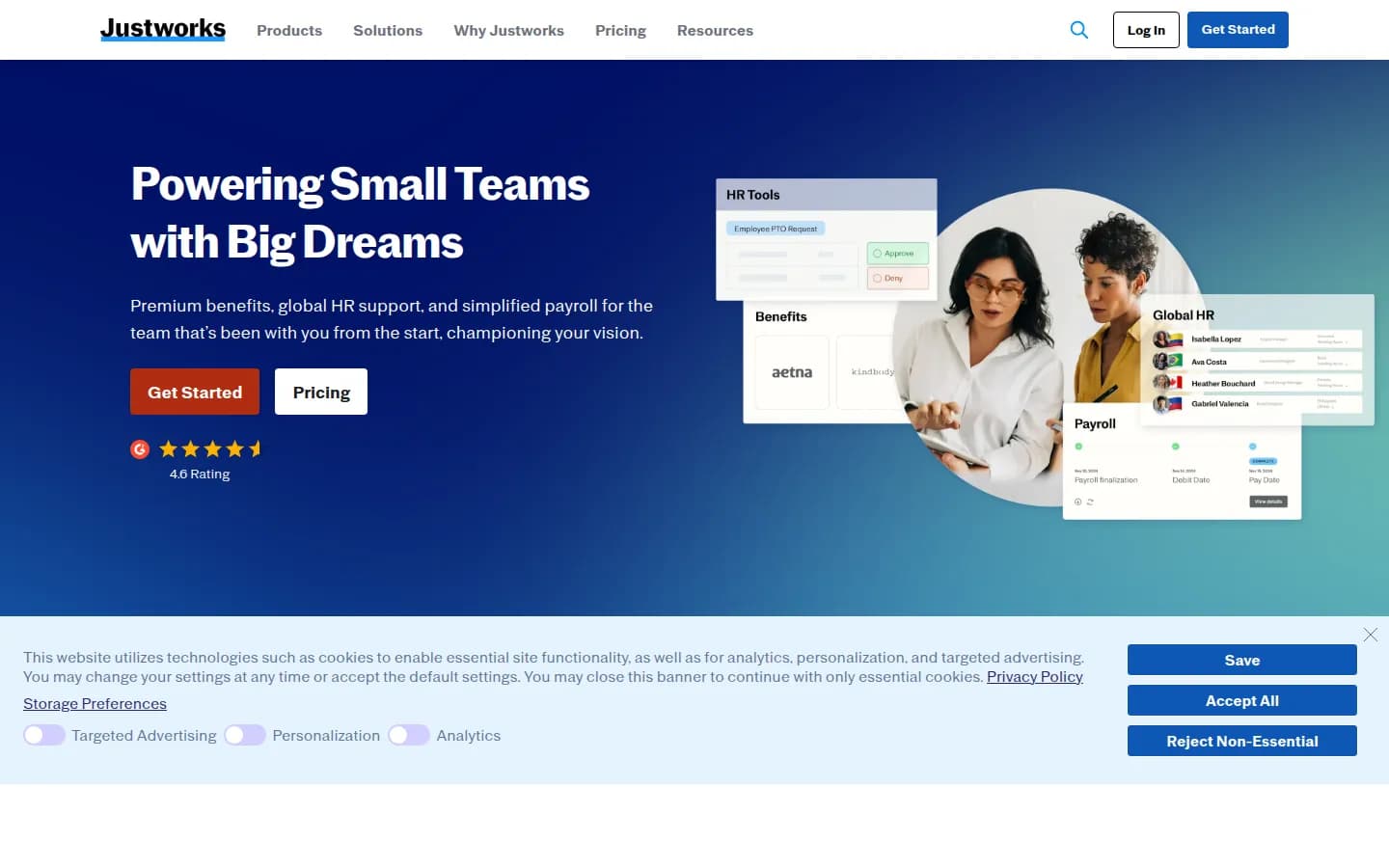
Justworks is a Professional Employer Organization (PEO). It runs HR, payroll, benefits, and compliance for small and mid-sized companies. The idea for the company was born in 2012 when founder Isaac Oates struggled with benefits and state rules at his earlier startup. He built Justworks to fix the problems he faced in that process.
How it works
The platform covers the full employment cycle. It supports onboarding, payroll, benefits, and compliance in one dashboard.
As a PEO, they use a co-employment model. This setup gives small businesses access to stronger benefits and compliance support that most basic payroll tools don't offer.
Scale and tax coverage
Justworks processed more than $25.6 billion in payroll and $6 billion in federal taxes in 2023. They also support about 2,000 tax localities. This scale supports companies that employ or contract people in different countries.
Who it fits
Justworks fits small and mid-sized companies with five to 99 employees who want less admin work and stronger benefits. The simple setup and clean interface make it a common choice for tech firms and other SMBs that want HR tasks organized in one place.
How do these providers compare?
| # | Provider | Best for | PEO from | Countries | Support hours |
|---|---|---|---|---|---|
| 1 | | — | n/a | 153 | 24/7 |
| 2 | | teams where the monthly fee per employee decides it | n/a | 171 | 24/7 |
| 3 | | — | n/a | 83 | Business Hours |
| 4 | | — | n/a | 163 | 24/7 |
| 5 | | — | n/a | 132 | Business Hours |
| 6 | | — | n/a | 147 | 24/7 |
| 7 | | — | n/a | 41 | 24/7 |
Ranked by overall fit; the Employ Borderless Standard score for each provider is in its review.
How do we evaluate PEO providers?
We ranked each provider on what a startup needs from a PEO, and which stage each one fits: how fast they onboard and scale through hypergrowth, whether pooled benefits reach enterprise quality on a startup budget, how well they work through compliance including global hiring, whether they support equity compensation cleanly, and how flexible their pricing and contracts are. The aim was to help you pick the right partner before you need it, not after the first payroll mistake.
Benefits of using PEOs for a startup
Partnering with a Professional Employer Organization (PEO) shapes how a small business runs, and the effect on growth is large either way. From cost-effective access to premium benefits to reducing administrative burdens, PEOs provide small businesses with the tools and expertise typically reserved for larger corporations. Let’s explore the key benefits of using a PEO:
- Rapid growing features: Startups often experience periods of hypergrowth. A good PEO can quickly onboard new employees, manage payroll for a rapidly expanding team, and scale benefits administration without missing a beat. This agility is important for startups that need to capitalize on market opportunities swiftly.
- Global talent acquisition: In today’s remote-first world, startups aren’t limited by geography regarding hiring. Many PEOs offer international hiring features, allowing you to build a diverse, global team without the complexities of setting up foreign entities or working through international labor laws.
- Competitive benefits on a startup budget: Attracting top talent is important for startups, but offering competitive benefits can be costly. PEOs pool employees from multiple companies, allowing them to negotiate enterprise-level benefits packages that startups couldn’t access. This levels the playing field when competing for talent against larger, established companies.
- Compliance navigation: Startups often operate in regulatory grey areas or disrupt highly regulated industries. A knowledgeable PEO can help work through complex compliance landscapes, reducing legal risks and allowing founders to innovate confidently.
- Focus on core business: Every hour spent on HR administration is not spent on product development, customer acquisition, or fundraising. By outsourcing HR tasks to a PEO, startup teams can maintain a laser focus on activities that drive growth and innovation.
- Able to grow HR technology: Many PEOs offer sophisticated HR platforms that grow with your startup. These systems can provide valuable data and insights about your workforce, helping inform strategic decisions as you scale.
- Equity compensation support: Equity is important for startup recruitment and retention. Some PEOs offer specialized support for managing equity compensation plans, a complex area many startups struggle with.
- Funding readiness: When raising capital, having a professional HR setup can instill confidence in potential investors. A PEO partnership demonstrates that your startup takes compliance and employee management seriously.
- Crisis management: Startups often face unexpected challenges. Whether working through a global pandemic or managing a sudden pivot, PEOs can provide important support and expertise in times of crisis.
- Culture preservation: As startups grow, maintaining company culture can be challenging. The right PEO can help set up programs and policies that reinforce your startup’s unique culture and values, even as you scale rapidly.
Keep these benefits in mind when choosing a provider to best suit your startup’s specific needs and ambitious goals.
How to choose the right PEO for your startup?
Choosing a PEO for a startup reaches into how fast you can grow and how much admin you carry while doing it. To help you work through this choice, we’ve broken down the key considerations into ten essential categories:
1. Room to grow and flexibility
- Growth stage alignment: Make sure the PEO’s services match your current stage (seed, Series A, B, etc.) and can scale with you.
- Service adaptability: Look for the ability to easily add or remove services as your needs change.
- Rapid onboarding: Assess how quickly the PEO can onboard new employees during periods of rapid growth.
2. Global features
- International reach: If you’re planning global expansion, check the PEO’s expertise in your target markets.
- Compliance expertise: Evaluate their knowledge of international labor laws and regulations.
- Multi-currency support: Make sure they can handle payroll and benefits in multiple currencies.
3. Technology and integration
- User-friendly interface: The platform should be intuitive, considering that in a startup, everyone might interact with the HR system.
- Integration features: Check if the PEO’s platform integrates with tools commonly used by startups (e.g., Slack, Asana, GitHub).
- Mobile accessibility: Look for mobile apps or responsive design for on-the-go access.
4. Startup-specific features
- Equity management: Does the PEO offer support for managing stock options and equity compensation?
- Flexible work arrangements: Make sure they can handle remote or hybrid work models common in startups.
- Competitive benefits: Look for benefits packages that are particularly attractive to startup employees.
5. Financial considerations
- Transparent pricing: The cost structure should be clear and predictable.
- Flexible billing: Look for options that accommodate variable cash flow (e.g., monthly vs. annual billing).
- Cost vs value: Consider the long-term value in terms of time saved and risks mitigated, not just the upfront cost.
6. Compliance and risk management
- Industry-specific knowledge: For tech startups, make sure the PEO understands the unique compliance needs of your sector.
- Risk mitigation: Assess their ability to help work through complex regulatory environments.
- Data security: Verify their data protection measures and compliance with relevant standards (e.g., GDPR, SOC 2).
7. Support and expertise
- Customer service availability: Check if support is available during the non-standard hours startups often keep.
- Dedicated support: Look for providers offering dedicated account managers who understand your specific needs.
- HR expertise: Evaluate the depth of their HR knowledge and ability to provide strategic guidance.
8. Reporting and analytics
- Data accessibility: Make sure you can easily access and export data for investor reports or board meetings.
- Insightful analytics: Look for PEOs that provide usable insights to inform your hiring and retention strategies.
- Customizable reporting: Check if you can tailor reports to your specific startup metrics and KPIs.
9. Cultural fit and employer branding
- Startup culture understanding: The PEO should match and support your startup’s unique culture and values.
- Employer brand support: Assess their ability to help you build and maintain a strong employer brand to attract top talent.
- Recruitment assistance: Look for tools and support in showing your startup’s unique culture and benefits to potential hires.
10. Future-proofing
- Funding and exit xupport: Can the PEO assist with due diligence during funding rounds or support you through acquisitions or IPOs?
- Room to grow: Choose a PEO that can grow with you from your current stage through to potential major milestones.
- Innovation: Look for providers that continuously update their offerings to stay ahead of HR trends and technologies.
By carefully considering these factors, you can select a PEO that not only meets your current needs but also matches your startup’s long-term vision and growth trajectory. Remember, the right PEO should be a strategic partner in your startup’s process, providing the support and expertise you need to focus on innovation and growing your business.
When is the best time to use a PEO as a startup?
Startups often face numerous challenges when it comes to managing human resources and administrative tasks. A Professional Employer Organization (PEO) can be a valuable partner in handling these responsibilities, but timing is important. The best time for a startup to consider using a PEO is typically when:
- Rapid growth is anticipated: If your startup is poised for quick expansion, a PEO can help manage the complexities of hiring and onboarding new employees efficiently.
- HR tasks are overwhelming: When founders and core team members find themselves spending too much time on administrative duties instead of focusing on business growth, it’s time to consider a PEO.
- Compliance becomes complex: As your workforce grows and you expand into new states or countries, working through various employment laws and regulations can become daunting. A PEO takes on compliance across multiple jurisdictions.
- Benefits packages need improvement: PEOs can often provide access to better, more cost-effective benefits packages than a small startup could negotiate on its own, helping to attract and retain top talent.
- Risk management becomes a concern: With growth comes increased liability. A PEO can help manage workers’ compensation, unemployment claims, and other employment-related risks.
- Funding rounds are successful: After securing significant funding, startups often need to scale quickly. A PEO can provide the setup to support rapid hiring and expansion.
- Expertise is needed: When your startup requires HR expertise but can’t justify hiring a full-time HR professional, a PEO can fill this knowledge gap.
The ideal time to engage a PEO is often when a startup has between 10 to 50 employees. At this stage, the business is typically complex enough to benefit from professional HR support but not large enough to warrant a full in-house HR department. However, each startup’s needs are unique, and some may find value in PEO services earlier or later in their growth trajectory.
How can a PEO accelerate startup growth?
A Professional Employer Organization (PEO) can be a powerful catalyst for startup growth, providing several key advantages that allow founders and their teams to focus on core business objectives. Here’s how a PEO can accelerate startup growth:
- Simple HR processes: By handling payroll, benefits administration, and compliance, a PEO frees up valuable time and resources that can be redirected towards product development, marketing, and sales efforts.
- Cost savings: PEOs can often negotiate better rates for benefits and insurance due to their large client base. These savings can be reinvested into growth initiatives.
- Improved talent acquisition: With access to strong benefits packages typically reserved for larger companies, startups can attract higher-quality candidates and compete for top talent.
- Reduced legal risks: PEOs take on compliance with labour laws and regulations, reducing the risk of costly legal issues that could derail growth.
- Room to grow: As the startup expands, a PEO can quickly adapt to support new hires, whether in existing locations or new markets, without the need to build out internal HR setup.
- Access to HR expertise: PEOs provide startups with seasoned HR professionals who can offer strategic guidance on workforce management, helping to build a strong organizational foundation for growth.
- Employee retention: By offering competitive benefits and so smooth HR operations, PEOs can help improve employee satisfaction and retention, reducing turnover costs and maintaining productivity.
- Focus on core competencies: With HR tasks handled externally, startup leaders can concentrate on innovation, product improvement, and market expansion – activities that directly drive growth.
- Data-driven insights: Many PEOs offer analytics and reporting tools that can provide useful detail on workforce trends, helping startups make informed decisions about hiring, compensation, and resource allocation.
Keep exploring
Best-of guides by use case
Frequently asked questions
Which PEO is best for startups?
Why do startups use a PEO?
How much does a PEO cost for a startup?
How do I choose the right PEO for a startup?
Not sure which PEO service is right for you?
Employ Borderless is an independent advisory platform for global hiring solutions, not a provider. Tell us about your team and we'll recommend the best fit for your situation, free and independent.
Get free recommendations