15 global payroll best practices businesses should know in 2026

Robbin Schuchmann
Co-founder, Employ Borderless
Global payroll is the unified process of managing employee compensation, taxes, deductions, and benefits across multiple countries from a single platform. It works by gathering employee information, such as salaries, hours, and benefits, from different countries, applying local labor laws, tax rules, and statutory deductions, and then processing salaries in the required currency.
The top-rated practices for global payroll are to comply with all local payroll laws and regulations, standardize payroll procedures across all regions, use payroll technology and automation, set up an international payments system, prioritize the security and confidentiality of payroll data, improve the overall employee payroll experience, and establish a centralized payroll governance model.
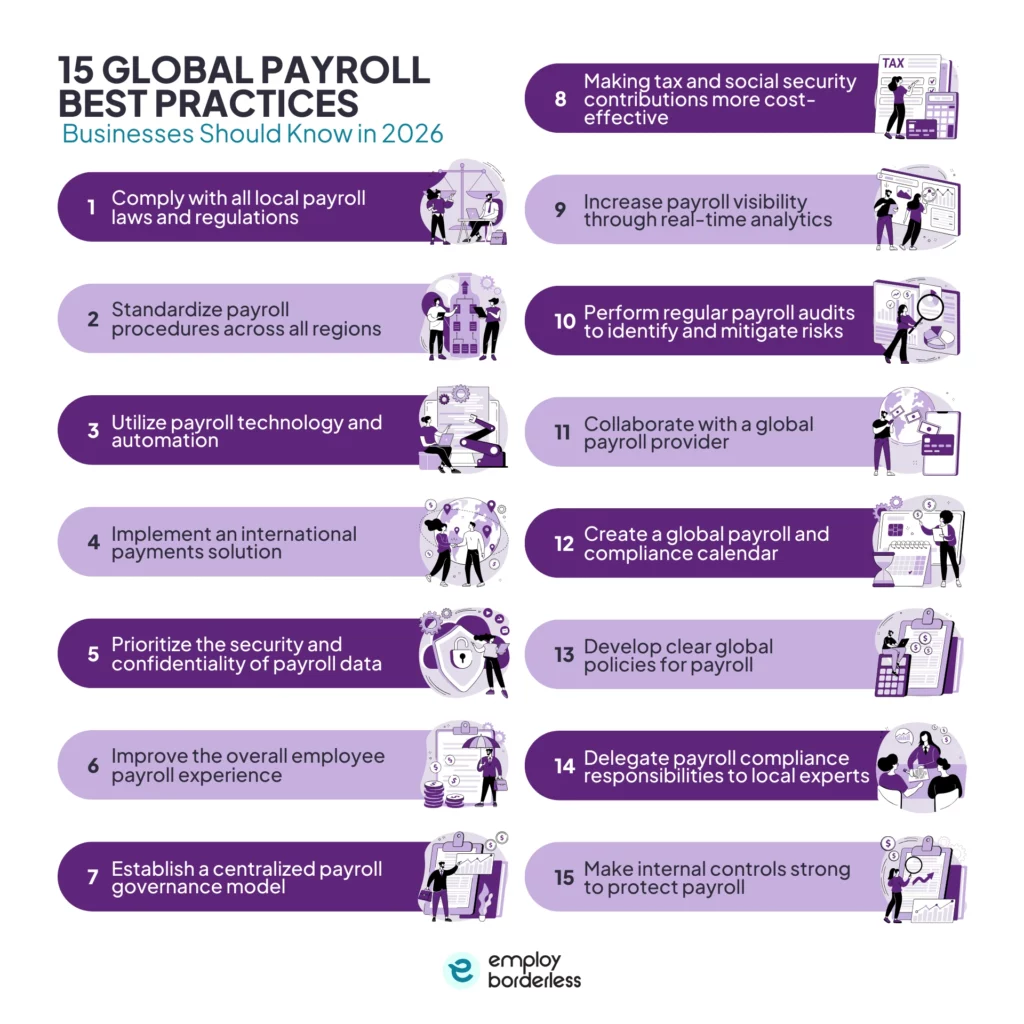
The 15 global payroll best practices that businesses should know are listed below.
- Comply with all local payroll laws and regulations: Organizations must comply with local payroll laws, which differ by country or region and include labor laws, tax rules, and social security requirements.
- Standardize payroll procedures across all regions: Standardizing payroll processes across regions involves country-specific pay cycles, tax structures, and regulations. This standardization helps avoid errors, delays, and compliance risks.
- Use payroll technology and automation: Using payroll technology and automation improves accuracy, reduces manual errors, offers compliance with changing regulations, and helps payroll teams focus on strategic tasks in global payroll operations.
- Set up an international payments system: Setting up a global payments system offers reliable cross-border salary disbursements, reduces transaction delays and fees, and handles currency and regulatory differences.
- Prioritize the security and confidentiality of payroll data: Prioritizing the security and confidentiality of payroll data means protecting sensitive employee information with strong access controls, encryption, audits, and compliance with privacy laws to reduce the risk of breaches.
- Improve the overall employee payroll experience: Improving the overall employee payroll experience means making payroll timely, accurate, transparent, and accessible, such as through self-service portals and clear communication.
- Establish a centralized payroll governance model: Establishing a centralized payroll governance model standardizes policies, processes, and controls across all countries, which reduces risk and administrative complexity in global payroll operations.
- Making tax and social security contributions more cost-effective: Plan compliance strategies by using centralized payroll systems, understanding local tax policies, and improving contribution processes to reduce liabilities and administrative costs while staying legally compliant.
- Increase payroll visibility through real-time analytics: Increasing payroll visibility through real-time analytics provides updated insights into payroll costs, errors, and compliance trends. These insights support active decision-making, quick issue resolution, and more accurate global payroll management.
- Perform regular payroll audits to identify and mitigate risks: Performing regular payroll audits to identify and mitigate risks keeps you legally compliant, prevents fraud, and improves global payroll accuracy.
- Collaborate with a global payroll provider: Collaborating with a global payroll provider reduces administrative burden and gives access to expertise and advanced systems, which allow internal teams to focus on strategic growth.
- Create a global payroll and compliance calendar: Creating a global payroll and compliance calendar helps organizations track all important payroll dates, reporting deadlines, tax filings, and statutory obligations across countries.
- Develop clear global policies for payroll: Developing standardized global payroll policies includes creating guidelines for expense reimbursement, benefits management, compensation strategies, payroll audits, reporting, and error resolution.
- Make internal controls strong to protect payroll: Strong internal controls in global payroll help reduce errors, detect fraud, support compliance with laws and standards, and protect sensitive data by applying measures like division of duties, approval workflows, audits, and monitoring.
Comply with all local payroll laws and regulations
Complying with all local payroll laws and regulations means organizations must follow country-specific labor laws, tax rules, social security requirements, and statutory payroll reporting obligations. These compliance requirements differ not only between countries but even within the same region, which makes uniformity challenging. Failure to comply results in penalties, audits, legal action, and long-term reputational damage.
Businesses must monitor regulatory updates through official government sources and trusted industry channels, which involve dedicated compliance officers, consultants, or legal experts. Collaboration with in-country tax consultants, legal advisors, and accountants is important because manual payroll processes make it difficult to stay updated with ongoing legal changes. Their tax compliance expertise offers accurate payroll calculations and timely remittances, which help organizations maintain compliant contracts and reduce payroll risks.
Standardize payroll processes across all regions
Standardize payroll processes across all regions because non-standardization results in incorrect calculations, payroll errors, delayed payments, and higher compliance risks. Global payroll standardization is challenging due to country-specific differences in pay cycles, tax structures, statutory benefits, and social security regulations, so a unified yet flexible approach is important.
A central payroll team helps monitor global operations to provide data accuracy and maintain controls while still allowing local teams the flexibility required to meet regional standards. Using a global payroll management system helps consolidate multi-country payroll data into a single platform, which improves accessibility and reduces manual involvement. Using similar payroll reporting formats across subsidiaries also improves transparency, audit readiness, and decision-making. Standardized systems need to allow country-specific payroll rules to stay fully compliant with local labor laws.
Use payroll technology and automation
Use payroll technology and automation, as manual payroll processing increases the risk of errors, delays, and compliance challenges across regions. Global payroll automation improves accuracy, performance, and reliability by standardizing calculations and providing timely salary payments. Automated systems apply country-specific tax regulations, support multi-currency payroll, and provide timely processing, which reduces the risk of legal penalties.
Investing in cloud-based payroll software means accessing real-time updates, remote management, and advanced security features such as two-factor authentication. Smooth integration with HR, finance, accounting, and compliance tools allows organizations to automate taxes, overtime, and bonuses while growing payroll operations as they expand into new markets.
Set up an international payments system
Set up an international payments system because managing multiple currencies, fluctuating exchange rates, and country-specific banking regulations adds complexity to cross-border payroll. Inaccurate currency handling causes payment delays, compliance risks, and financial losses, so using a multi-currency payroll platform simplifies global payroll operations. Effective global payroll software supports a wide range of currencies and provides automatically updated exchange rates from reliable sources, with customizable update frequencies such as hourly or daily.
Secure and timely international payment methods are equally important, such as direct bank transfers, digital wallets, payroll cards for regions with limited banking access, and global payroll providers. Multi-currency virtual wallets also improve flexibility by allowing employers to fund accounts through bank transfers, cards, Payoneer, and similar options. These options allow employees to withdraw, deposit, and transfer funds smoothly across local bank accounts, cards, and digital wallets.
Prioritize the security and confidentiality of payroll data
Prioritize the security and confidentiality of payroll data, as it keeps you compliant with regulations and builds trust among employees. Organizations have to comply with data privacy regulations such as GDPR (General Data Protection Regulation), CCPA (California Consumer Privacy Act), and other local data protection laws to secure sensitive payroll information.
Using data encryption, like SSL and HTTPS (Hypertext Transfer Protocol Secure) communications, strong authentication, and mandatory 2FA (Two-Factor Authentication) helps prevent unauthorized access and protect payroll transactions. Restricting payroll data access to authorized personnel only reduces the risk of internal fraud and data misuse. Verifying user identities through KYC (Know Your Customer) and AML (Anti-Money Laundering) compliance helps meet international financial regulations. Regular security audits also improve global payroll systems by identifying risks and correcting system errors early.
Improve the overall employee payroll experience
Improving the overall employee payroll experience with a smooth and reliable global payroll process builds employee trust, confidence, and job satisfaction. Payroll errors, delayed payments, and unclear salary information increase administrative burden and impact employee morale, which makes accuracy and timeliness important. Clear payroll communication that explains salary distributions, tax deductions, and benefits helps employees understand their compensation, while providing payroll information in local languages improves transparency across global teams.
Employee self-service portals add value by giving easy access to payslips, tax documents, and payroll queries, which include detailed salary statements that outline earnings, deductions, and taxes. Automated payments help prevent delays, a dedicated payroll support team offers quick issue resolution, and well-organized payroll records simplify payment tracking while maintaining audit readiness.
Establish a centralized payroll governance model
A centralized payroll governance model makes sure global payroll operations follow standard rules and compliance regulations across all countries. Managing global payroll without central governance leads to data inaccuracies, calculation errors, and compliance gaps. Centralization simplifies payroll processes, controls, policies, and reporting, which creates transparency across regions while improving accuracy.
This model gives regional payroll managers specific responsibilities while keeping strategic management and decision-making at the central level. Using unified payroll reporting templates across all subsidiaries improves insights and audit readiness. Effective governance requires collaboration between payroll, HR, finance, and legal teams to maintain operational and regulatory uniformity. A centralized payroll governance model works best when paired with a global payroll provider, where governance defines the rules and the provider executes them accurately in complex or unfamiliar markets.
Increase payroll visibility through real-time analytics
Limited integration between payroll and financial systems restricts visibility into payroll data across branches, which makes it difficult to track trends and compliance risks. Using a payroll platform with real-time analytics on salaries, tax payments, and benefit costs allows organizations to monitor KPIs (Key Performance Indicators) such as payroll processing time, error rates, and compliance trends. Analyzing this data helps predict labor costs, improve budget allocation, identify patterns in payroll errors and compliance risks before they increase, and automate payroll cost reporting for finance teams.
Perform regular payroll audits to identify and mitigate risks
Performing regular payroll audits is important to maintain a smooth and compliant global payroll process. Payroll errors, which include miscalculations, incorrect tax withholdings, and late payments, lead to financial losses, regulatory fines, and employee dissatisfaction. Conducting internal audits helps review payroll accuracy, compliance, and reporting standards, while engaging external auditors provides further verification.
Regular audits also help with correct employee classifications, accurate tax and social security contributions, and identifying duplicate or unauthorized payroll transactions. Use payroll software that automates audit reports, finds differences in salaries, taxes, and benefits, and sets up automated alerts for compliance violations. This automation allows organizations to catch and address risks before they become serious.
Collaborate with a global payroll provider
Collaborating with a global payroll provider simplifies operations by reducing the need to manage multiple local vendors and separate payroll processes. A reputable provider offers a single platform to handle payroll across all countries, which supports unified reporting and dashboards for better insights. Standardized processes offer consistency across regions, while choosing providers with proven multi-country experience reduces compliance risks.
Many global providers also offer EOR (Employer of Record) services, which allow businesses to onboard employees legally without establishing local entities. It is important to verify that the provider's system integrates smoothly with HR and finance software and follows strict data security and compliance standards. Make sure the system also regularly monitors global payroll performance to maintain accuracy and reliability across your global workforce.
Create a global payroll and compliance calendar
Creating a global payroll and compliance calendar is necessary to maintain accuracy and compliance across multiple regions. This centralized calendar helps businesses track all important payroll deadlines, which involve processing dates, employee payouts, reporting obligations, and statutory tax remittances. It also shows cut-off dates for payroll changes, start and end dates of pay periods, and visibility across all countries where payroll is processed, which reduces errors and supports timely, compliant operations.
Develop clear global policies for payroll
Develop clear global payroll policies to maintain uniformity and accuracy across multiple countries. Standardizing payroll involves creating policies that handle all processes, from expense reimbursement and global benefits management to compensation strategies, payroll audits, reporting, and error resolution. Clearly defining the roles and responsibilities of every payroll team member for accountability and smooth execution of payroll operations across borders lowers errors and keeps you compliant and transparent.
Delegate payroll compliance responsibilities to local experts
Organizations have to follow complex compensation laws and payroll regulations in every country to maintain global payroll compliance. Central payroll teams mostly lack the thorough, local expertise required to stay fully compliant. Companies mitigate compliance risks and provide timely payroll across multiple regions by delegating payroll responsibilities to ICPs (In-country Partners) with specialized knowledge and experience. Partnering with ICPs provides a reliable way to prevent costly compliance issues and maintain continuity in global payroll operations.
Make internal controls strong to protect payroll
Clear division of duties, where different people handle payroll tasks such as data entry, approval, and payment, creates a strong system of internal controls. Such a system makes sure no fraudulent activity or mistakes remain undetected. Regular reconciliation, change reports, and internal audits help identify issues early, confirm compliance with laws and policies, and support accurate, transparent payroll operations across the organization.
What is global payroll?
Global payroll is the management and processing of compensation for employees working in different countries through a unified system. It includes calculating workers' pay and deductions, withholding taxes, and managing currency conversions across multiple jurisdictions, while maintaining compliance with local laws and taxation systems.
How does global payroll work?
Global payroll works by gathering payroll information from different locations and combining it into a single central system that manages the particular needs of each location. This system allows businesses to accurately pay their global workforce in local currencies while complying with all relevant legal and financial regulations.
Why should businesses use a full approach to global payroll?
Businesses should use a full approach to global payroll, as managing an international workforce requires standardized, accurate, and compliant payroll operations across multiple jurisdictions. Putting global payroll best practices in place improves workforce management by simplifying processes and reducing operational risks as companies expand internationally. A structured approach offers payroll accuracy and compliance with local labor laws, tax regulations, and statutory requirements, which is important for international growth.
Drawing on regional expertise and established networks helps organizations manage payroll across countries while staying compliant with complex regulatory systems. Supporting multi-currency payments, localized benefits, and adaptable payroll processes simplifies administration and improves the employee experience. Businesses also focus more on core operations and strategic goals when partnering with a trusted global EOR provider. Such a provider helps with compliant and cost-effective payroll management across borders.
How is global regulatory reporting an important global payroll best practice?
Global regulatory reporting is an important global payroll best practice because it ensures compliance with complex international tax laws while preventing costly penalties and legal issues. Accurate global regulatory reporting provides insights into payroll costs, helps with budget management and financial decisions, and also promotes transparency across multinational operations.
How can global payroll systems help companies expand internationally?
Global payroll systems help companies expand internationally by simplifying multi-currency payments, automating tax and labor law compliance, and reducing administrative burden. These systems allow quick market entry, better workforce management, and reduced compliance risks while supporting international expansion at scale.
What are common employee management challenges in global payroll operations?
Common employee management challenges in global payroll operations include managing complex tax or statutory requirements, providing data security, and maintaining a consistent employee experience across borders. Employee management challenges also involve language barriers and time zone differences.
How can companies plan for flexibility in their global payroll operations?
Companies can plan for flexibility in their global payroll operations by using cloud-based, centralized payroll platforms that support multiple countries and currencies. These platforms also allow payroll processes to grow without manual rework.
What are the benefits of outsourcing the global payroll process?
The benefits of outsourcing the global payroll process include faster global expansion, cost savings, no permanent establishments, and improved employee satisfaction. Payroll outsourcing benefits also include saving time and resources and maintaining complex cross-border compliance.

Co-founder, Employ Borderless
Robbin Schuchmann is the co-founder of Employ Borderless, an independent advisory platform for global employment. With years of experience analyzing EOR, PEO, and global payroll providers, he helps companies make informed decisions about international hiring.
Learning path · 10 articles
Payroll fundamentals
Master the fundamentals with our step-by-step guide.
Start the pathReady to hire globally?
Get a free, personalized recommendation for the best EOR provider based on your needs.
Get free recommendations