Payroll outsourcing benefits and how to choose the right provider

Robbin Schuchmann
Co-founder, Employ Borderless
Payroll outsourcing means handing salary calculations, tax withholdings, deductions, and compliance reporting to an external specialist who uses secure systems to pay employees accurately and on time. The main advantages of outsourcing payroll are time and cost savings, fewer errors, stronger data security, accurate tax compliance, and access to advanced technology, all of which free internal teams to focus on strategic work instead of manual processing.
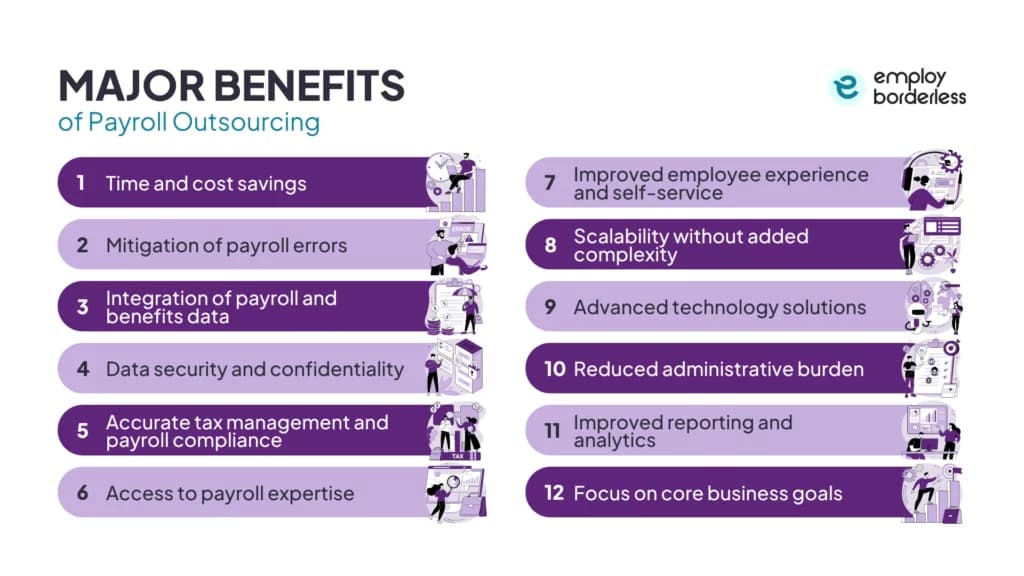
Beyond the core advantages, businesses that outsource payroll also gain improved reporting and analytics, integrated payroll and benefits data, easier scalability across regions, and employee self-service portals that build trust and transparency.
12 benefits of payroll outsourcing
| Benefit | What it means |
|---|---|
| Time and cost savings | Reduces spending on in-house payroll staff, training, and software while freeing up HR hours. |
| Mitigation of payroll errors | Trained specialists and dedicated software cut mistakes in wages, tax withholdings, and overtime. |
| Integration of payroll and benefits data | Syncs payroll with HR, attendance, and benefits systems so changes update automatically. |
| Data security and confidentiality | Providers use encryption, access controls, audits, and multi-factor authentication to protect employee data. |
| Accurate tax management and compliance | Experts track changing tax and labor laws across jurisdictions and file correctly. |
| Access to payroll expertise | Businesses get specialist knowledge on multi-state or multi-country payroll without hiring or training staff. |
| Improved employee experience and self-service | Self-service portals let staff view pay, tax forms, and benefits anytime, building trust. |
| Scalability without added complexity | Providers adjust services as headcount, locations, or payroll frequency change. |
| Advanced technology solutions | Cloud systems and AI automate wage calculations and flag inconsistencies in real time. |
| Reduced administrative burden | Outsourcing removes manual payroll runs and tax filing work from HR and finance teams. |
| Improved reporting and analytics | Cloud dashboards give real-time insight into labor costs, overtime trends, and compliance risk. |
| Focus on core business goals | Frees internal resources for hiring, product development, and growth instead of routine payroll tasks. |
Time, cost, and administrative savings
Managing payroll in-house is complex for HR teams, and hiring or retaining payroll personnel adds ongoing costs for salaries, training, professional memberships, and software upgrades. Outsourcing removes those costs and hands calculations, filings, and processing to experienced specialists who deliver results on time.
Outsourcing also cuts the administrative load: payroll runs, record-keeping, and compliance reporting move to the provider, so HR and finance can focus on hiring, training, and planning. A small company that previously spent hours each month on payroll data entry and chasing tax filings freed that time for employee retention programs after switching providers, while the provider handled software updates, audits, and deadlines.
This shift toward strategic priorities also supports growth. Instead of spending hours on deductions and compliance issues, internal teams can concentrate on customer service, product development, and expanding into new markets, with specialists managing payroll risk in the background.
Accuracy, compliance, and security
Payroll involves gross wages, tax withholdings, benefits deductions, overtime, and statutory contributions, where even small miscalculations can trigger non-compliance, employee distrust, or fines. Businesses in industries like construction have paid thousands in back wages and fines due to small payroll errors. Outsourcing firms use trained professionals and dedicated software to reduce this risk and keep payments accurate and on schedule.
Tax rules such as minimum wage, overtime, income tax brackets, and social security contributions vary by country and even by city. Employer social security contributions carry a median of 12.6% across the 196 countries in our dataset, per our Global Employer Burden Index dataset (196 countries), while New Caledonia's 36.49% is the highest we track, per the same dataset. Employee contributions run lower, at a median of 7% across 191 countries, per the same dataset, with Romania's 35% the highest recorded, per the same dataset. Providers monitor these changes at local, state, and national levels so deductions use current rates and employee-specific factors like marital status or residency. They also maintain clear payroll histories, tax filings, and compliance documentation.
On the security side, outsourced providers apply encryption, strict access control, insider threat prevention, and regular security audits, vulnerability scans, and penetration tests. They follow data protection standards such as GDPR and ISO 27001 or local privacy laws, enforce multi-factor authentication so a stolen password alone cannot grant access, and maintain backups and recovery plans in case of a cyber incident.
Technology, integration, and reporting
Integrating payroll with time and attendance systems, benefits platforms, and other HR applications sends all data into one system, cutting duplication and manual entry. Changes such as tax status, benefits eligibility, or leave approvals flow automatically into payroll: an approved leave request, for example, is deducted from pay without manual cross-checking.
Providers give small and medium-sized businesses access to cloud-based systems and AI tools that would otherwise be unaffordable. Automation calculates wages, deductions, and overtime, and can flag when someone logs too many hours, catch missing deductions, or alert HR when tax tables change, reducing manual checking and keeping pay accurate. Cloud access also lets businesses manage payroll from anywhere and scale as headcount grows.
This same data feeds real-time dashboards covering labor costs, tax obligations, overtime trends, and financial forecasts, helping leaders anticipate cost increases or budget shifts. Payroll data can combine with business intelligence tools so HR, finance, and management plan strategically, while analytics track payroll against changing tax rules and flag risks before they become costly mistakes.
Employee experience and scalability
Payroll providers employ specialists who handle multi-state or multi-country taxation, correct employee classification (full-time, contractor, exempt, non-exempt), and benefits integration across legal jurisdictions, giving businesses that expertise without hiring or training extra staff. These professionals keep their knowledge current through ongoing courses and industry updates.
Self-service portals let employees check earnings, tax forms, and benefits at any time; if a worker notices a discrepancy, they can check their history immediately instead of waiting on HR. Companies that automate payroll or use self-service portals report lower turnover and higher employee satisfaction as a result of this reliability and transparency.
As a business hires more staff, enters new markets, or faces seasonal workforce swings, outsourced providers scale services up or down without requiring extra in-house payroll staff or software upgrades, avoiding large upfront costs and disruption during growth phases.
Drawbacks of payroll outsourcing
The drawbacks of payroll outsourcing include risk of payroll errors and processing delays, limited visibility and reduced control, transition difficulties, dependence on provider reliability, limited use of available services, and data security and privacy concerns.
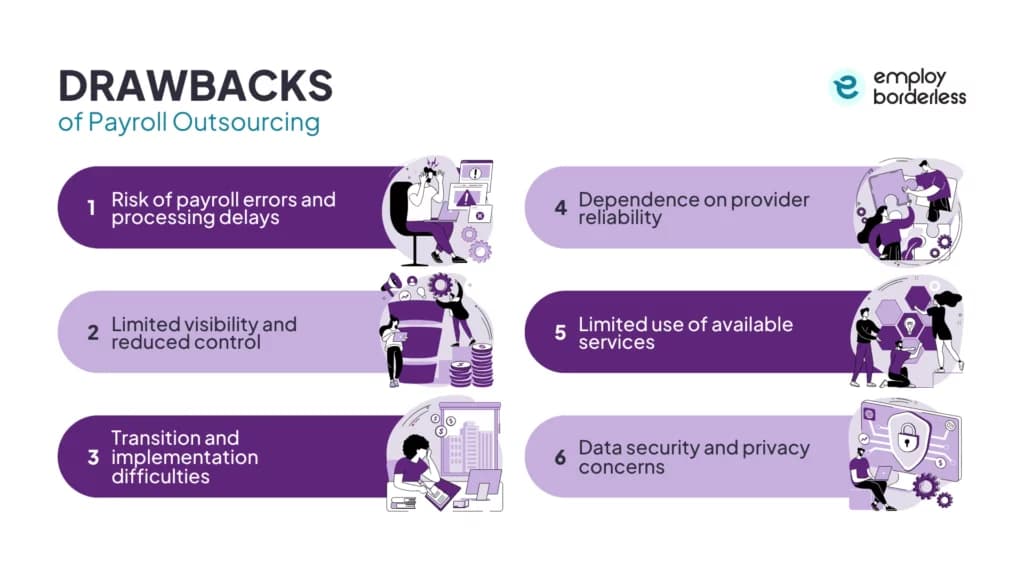
- Risk of payroll errors and processing delays: Outsourcing does not fully remove the risk of incorrect calculations or missed deadlines, and technical or staffing issues at the provider can delay processing.
- Limited visibility and reduced control: Handing payroll to an external party reduces day-to-day visibility, making quick adjustments or employee query resolution harder.
- Transition and implementation difficulties: Moving payroll to a provider requires system integration, data migration, and process changes that can disrupt employees and HR teams during the switch.
- Dependence on provider reliability: Payroll accuracy and timeliness become tied to the provider's efficiency, so poor service quality or weak communication has a direct impact.
- Limited use of available services: Some businesses underuse a provider's advanced tools or additional HR services due to lack of awareness or budget.
- Data security and privacy concerns: Payroll includes salaries, bank details, and personal data, so weak provider security increases the risk of breaches or unauthorized access.
How to choose a provider for outsourcing payroll
Choosing the right provider for outsourcing payroll comes down to five factors: business needs, budget, industry experience, compliance expertise, and technology integration.
| Factor | What to check |
|---|---|
| Business needs | Match the provider to employee size, payment frequency, and specific compliance requirements. |
| Budget | Look for transparent pricing with no hidden charges that fits your financial capacity. |
| Experience | Choose a provider with a track record in your industry and complex payroll processes. |
| Compliance and expertise | Confirm expert knowledge of tax laws, labor regulations, and statutory requirements to limit penalty risk. |
| Technology integration | Confirm the platform connects with existing HR, accounting, and attendance tools. |
What does it cost to outsource payroll?
Outsourcing payroll typically costs a PEPM (Per Employee Per Month) fee of $5 to $10, with setup, implementation, and add-on fees charged separately. Final cost depends on organization size, and some providers offer a fixed monthly rate instead of a per-employee fee.
What services are usually included in payroll outsourcing?
Payroll outsourcing usually includes calculating wages and overtime, processing direct deposits or checks, and managing all tax filings and payments. Providers also issue year-end tax forms and give employees online access to pay documents.
What are the main components of payroll?
The main components of payroll are employee information, basic salary, net salary, deductions, payroll calculation, and allowances. Payroll components also include employee benefits, payment distribution, and deductions and withholdings.
What are the risks of not properly managing payroll?
Poorly managed payroll carries risks including costly penalties, reputational damage, underpayments, poor security and backups, commission or bonus fraud, compliance errors, and payroll diversion.
In-house payroll vs outsourcing payroll
| Aspect | In-house payroll system | Outsourced payroll |
|---|---|---|
| Control | Direct control over the process and staff communication | Less direct control over day-to-day processing |
| Flexibility | Adjust processes internally as needed | Depends on provider's service structure |
| Cost | Carries the direct expense of internal staff salaries | Avoids direct in-house staffing costs |
The core difference between an in-house payroll system and outsourcing is that in-house payroll gives a business direct control, staff communication, and flexibility, while outsourcing trades some of that control for lower staffing costs and specialist expertise.

Co-founder, Employ Borderless
Robbin Schuchmann is the co-founder of Employ Borderless, an independent advisory platform for global employment. With years of experience analyzing EOR, PEO, and global payroll providers, he helps companies make informed decisions about international hiring.
Learning path · 10 articles
Payroll fundamentals
Master the fundamentals with our step-by-step guide.
Start the pathReady to hire globally?
Get a free, personalized recommendation for the best EOR provider based on your needs.
Get free recommendations