Global payroll: definition, how it works, components, benefits, challenges, and how to choose

Robbin Schuchmann
Co-founder, Employ Borderless
Global payroll is the system a company uses to pay employees who work in different countries in a consistent, compliant way. It means collecting workforce data from every location, applying each country's tax and labor rules, converting currencies where needed, and paying every employee correctly and on time. The core components are payroll processing, benefits administration, payment distribution, multi-country reporting, and tax compliance.
What is global payroll? Definition and meaning
Global payroll is the process of managing and processing pay for employees working in multiple countries while following each location's tax laws, labor regulations, and reporting requirements. Companies run global payroll through a specialized system or a service provider to keep calculations accurate, simplify operations, and lower the risk of non-compliance.
A global employee, in this context, is a worker employed by a company outside the country where that company is headquartered. Their pay, benefits, and tax withholding are handled through global payroll rather than a single domestic payroll run.
How does global payroll work? The process step by step
Global payroll works like local payroll: the goal is still to pay people accurately and on time. The difference is scope, since global payroll covers employees across several countries, each with its own tax rules, labor laws, and payment requirements.
- Collect employee data from every country: hours worked, benefits, deductions.
- Apply local tax and labor rules for each location before calculating wages.
- Review and approve payroll runs before funds move.
- Process payments in the relevant local currencies through banking or international payment networks.
- Generate reports for compliance and to give management a consolidated view of global labor costs.
Components of global payroll
The five components of global payroll are payroll processing, benefits administration, payment distribution, multi-country reporting, and tax compliance.
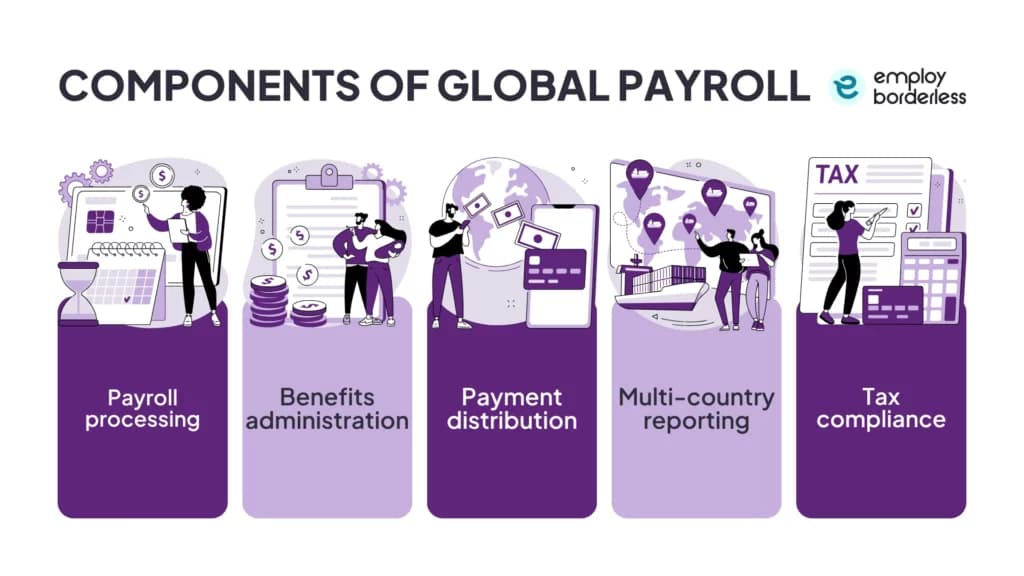
| Component | Function |
|---|---|
| Payroll processing | Calculates employee earnings, deductions, and net pay by gathering data from each country and applying local wage rules. |
| Benefits administration | Manages health insurance, retirement plans, and allowances, customized to local laws and customs while tracking cost. |
| Payment distribution | Delivers pay in the correct amount, on time, in the right currency, managing exchange rates and international banking systems. |
| Multi-country reporting | Consolidates payroll data from every region into one view to track labor costs, compliance status, and workforce trends. |
| Tax compliance | Applies correct tax rates and files with local authorities in each jurisdiction to avoid fines or legal risk. |
Types of global payroll
The four types of global payroll are in-house payroll, outsourced payroll, managed payroll services, and international payroll services.
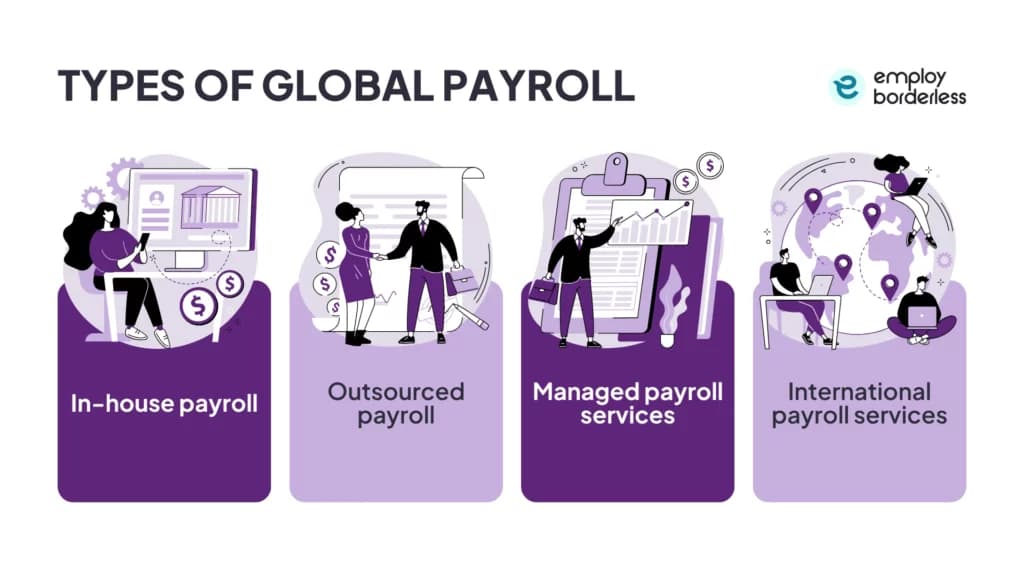
| Type | How it works | Trade-off |
|---|---|---|
| In-house payroll | Company manages and processes payroll internally with its own staff and systems. | Full control, but requires strong technology, compliance knowledge, and dedicated staff. |
| Outsourced payroll | An external provider handles calculations, compliance, and payments. | Reduces workload, but creates dependency on the provider's systems and processes. |
| Managed payroll services | Combines in-house strategy and decision-making with external support for daily payroll tasks. | Balances control and support. |
| International payroll services | Specialized solutions for companies with employees across multiple countries. | Manages local tax compliance, multiple currencies, and integrated reporting. |
Ways to handle global payroll
Companies handle global payroll by setting up a local entity, hiring global contractors, using an EOR (Employer of Record), or using a PEO (Professional Employer Organization).
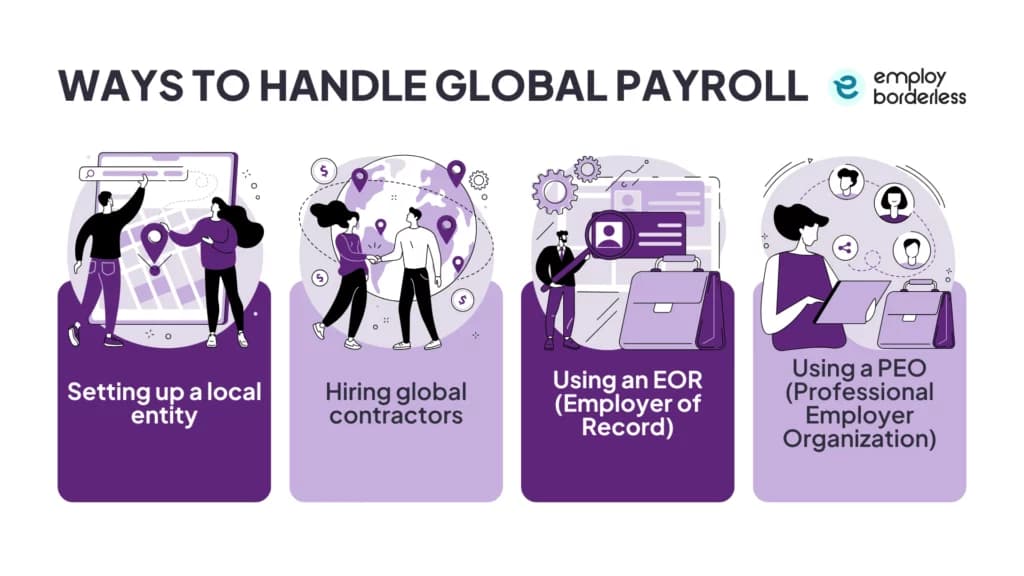
| Method | Description |
|---|---|
| Local entity | Registering a business branch in a foreign country to directly hire employees and manage payroll. Gives full control but demands time, money, and knowledge of local laws. |
| Global contractors | Engaging independent workers abroad instead of full-time employees. Avoids setting up an entity and adds flexibility, but carries misclassification risk under local labor laws. |
| EOR (Employer of Record) | Legally employs workers on a company's behalf in another country, managing payroll, taxes, benefits, and compliance while the company directs daily work. |
| PEO (Professional Employer Organization) | Acts as legal employer through co-employment, sharing payroll processing, tax filing, and benefits administration responsibilities while ensuring compliance with local regulations. |
Benefits of global payroll
The benefits of global payroll are compliance with international laws, access to in-house payroll knowledge, on-time payments, operational accuracy, time and cost savings, and increased productivity.
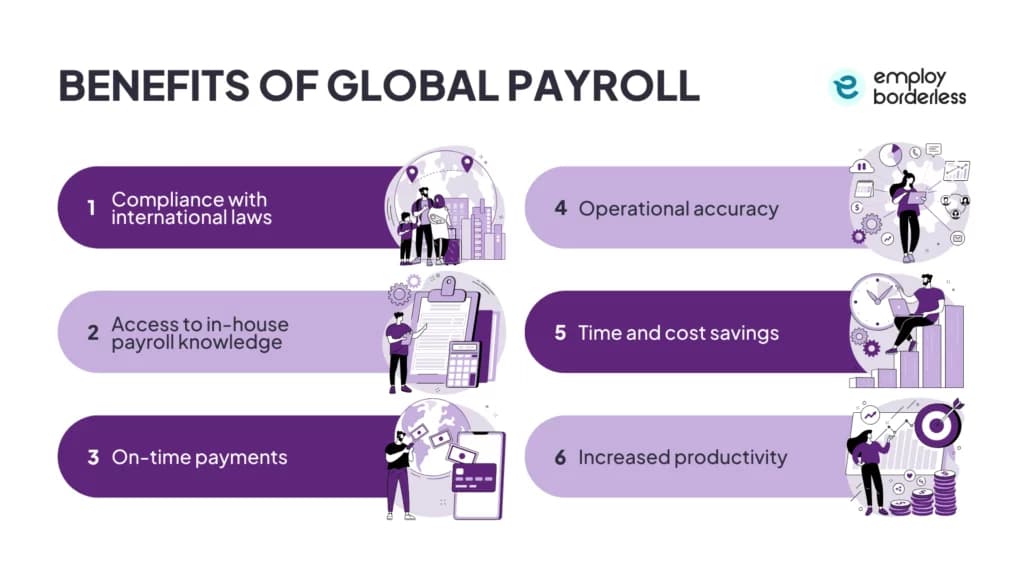
| Benefit | What it means |
|---|---|
| Compliance with international laws | Providers follow the tax, labor, and employment rules of each country where employees work, reducing the risk of penalties. |
| Access to in-house payroll knowledge | Specialists understand country-specific wage structures and tax practices, cutting down on errors. |
| On-time payments | Employees receive salaries accurately and without delay, regardless of location or currency. |
| Operational accuracy | Automated calculations, deductions, and reporting stay consistent, keeping records audit-ready. |
| Time and cost savings | Reduces manual data collection, tax filing, and payment work, lowering administrative overhead. |
| Increased productivity | Frees HR and finance teams to focus on employee development, planning, and performance rather than payroll upkeep. |
Challenges of global payroll
The main challenges of global payroll are international payments and currency conversions, tax regulations, complex employment laws, employee classification, data management and security, and system integration.
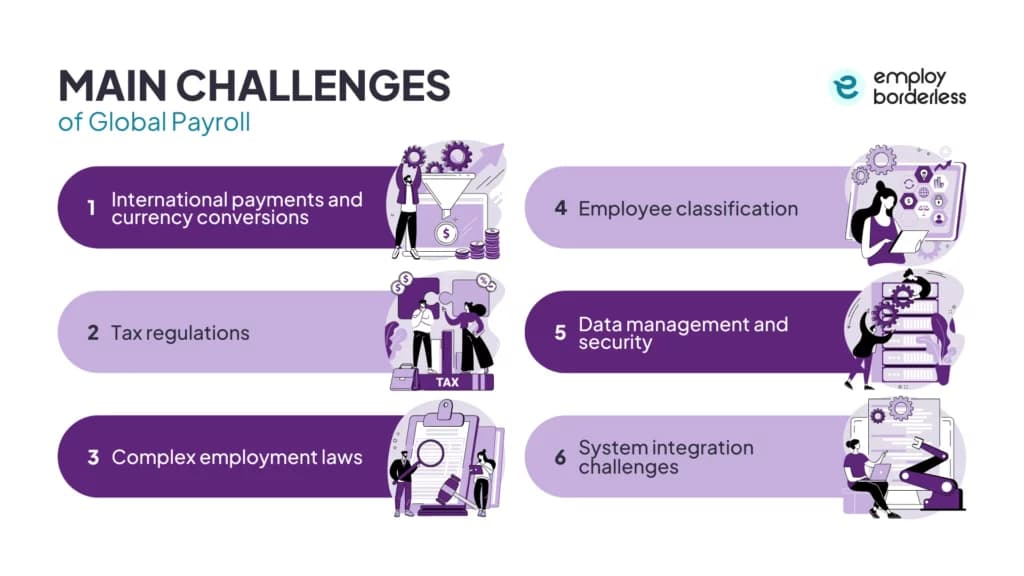
| Challenge | What it involves |
|---|---|
| International payments and currency conversions (foreign exchange) | Paying employees across multiple currencies and banking systems while managing exchange rate fluctuations and cross-border transaction fees, which can delay payments and affect trust. |
| Tax regulations | Each country has unique tax rules, reporting requirements, and filing deadlines; failure to comply results in fines or penalties. |
| Complex employment laws | Working hours, overtime, severance pay, and mandatory benefits differ by country; ignoring them causes legal disputes and reputational damage. |
| Employee classification | Determining whether a worker is an employee, contractor, or freelancer; misclassification causes compliance issues and unpaid taxes. |
| Data management and security | Protecting sensitive payroll data across borders requires cybersecurity measures and compliance with laws such as GDPR (General Data Protection Regulation). |
| System integration | Payroll systems that don't connect with HR, accounting, or benefits platforms create duplicate work, inaccurate records, and reporting delays. |
When should companies outsource global payroll operations?
Companies should consider outsourcing global payroll when expanding internationally, reducing complexity, maintaining multi-country compliance, saving time, and improving data security.
Expanding abroad requires expert knowledge of local tax laws, labor rules, and currencies that in-house teams may not have. Payroll also gets complicated with multiple systems, larger workforces, or mixed employment types, and providers use standardized tools to simplify that operational load.
Outsourced experts track changing tax rates, labor laws, and reporting deadlines to help companies stay compliant and avoid penalties. Delegating payroll also frees HR and finance teams to focus on growth initiatives and core business goals instead of administrative tasks.
Data security is another driver: payroll providers invest in cybersecurity systems, SSL encryption, and regular audits, which lowers the risk of fraud or breaches compared with managing sensitive payroll data internally.
How to choose the right global payroll provider
Evaluate a payroll provider on compliance expertise, technology and integration, data security, scalability, flexibility, customer support, and service quality.
| Criterion | What to look for |
|---|---|
| Compliance expertise | Knowledge of international tax laws, labor rules, and reporting requirements across every jurisdiction you operate in. |
| Technology and integration | Cloud-based platforms, payroll automation, and smooth integration with existing HR and finance systems. |
| Data security | SSL encryption, multi-factor authentication, and regular security audits to protect employee and company information. |
| Scalability and flexibility | Ability to support business growth, new-country expansion, or larger workforces without added complexity. |
| Customer support and service quality | Responsive, multilingual support that resolves issues quickly and keeps employee pay accurate worldwide. |
Frequently asked questions
What are the types of global payroll providers?
The types of global payroll providers are in-house payroll, outsourced payroll, managed payroll services, and international payroll services.
What are the responsibilities of global payroll providers?
Global payroll providers manage employee payments across multiple countries while ensuring compliance with local tax laws, labor regulations, and reporting requirements. They also handle payroll calculations, deductions, benefits, and multi-currency transactions with accuracy.
How do you track global payroll costs?
Track global payroll costs using payroll software or a global payroll provider that combines data from all countries into one system, letting you monitor salaries, taxes, benefits, and compliance expenses in real time.
What is the difference between global payroll and local payroll?
Global payroll manages employee payments across multiple countries, handling different tax laws, currencies, and compliance rules. Local payroll only covers one country's regulations and payments.
How did payroll evolve to automation?
Payroll evolved from manual, paper-based calculations to digital spreadsheets and then to specialized payroll software. See the full payroll history; automation now handles calculations, tax deductions, and compliance checks with minimal human input.
Which services are included in payroll outsourcing?
Payroll outsourcing includes payroll processing, tax calculations, and compliance management for accurate, timely employee payments. Providers also handle benefits administration, direct deposits, and multi-currency transactions for global businesses.
How long does it take to set up global payroll?
Setting up global payroll takes 10 days to 3 months per entity, depending on the company's size, the number of countries involved, and the complexity of the system chosen.
What are the alternative solutions to global payroll?
Alternatives include setting up local entities in each country for direct control, though this adds cost and complexity, or hiring global contractors for flexible workforce needs without setting up entities.

Co-founder, Employ Borderless
Robbin Schuchmann is the co-founder of Employ Borderless, an independent advisory platform for global employment. With years of experience analyzing EOR, PEO, and global payroll providers, he helps companies make informed decisions about international hiring.
Ready to hire globally?
Get a free, personalized recommendation for the best EOR provider based on your needs.
Get free recommendations