EOR for technology: services, benefits, challenges, considerations, and how to choose

Robbin Schuchmann
Co-founder, Employ Borderless
An EOR (Employer of Record) is a global employment approach that allows companies to hire, manage, and compensate employees in different regions without establishing a legal entity. It provides a centralized way for companies to handle payroll, benefits, compliance, and tax regulations.
The services that an EOR provides for technology companies include payroll management, employee benefits administration, legal and compliance support, and onboarding and offboarding.
The benefits of using an EOR for technology companies include simplified global hiring and onboarding, accurate payroll management, cost-effective market expansion, organized HR operations, and lower risk of employee misclassification.
The challenges of using EOR for technology companies are limited control over HR functions, complex communication processes, risk of dependency on the EOR, difficulties in terminating the EOR contract, and high upfront costs and service fees.
The factors to consider when choosing the right EOR for your technology company include assessing your needs, checking expertise in local laws, evaluating the ability to manage multi-country operations, comparing pricing, and reviewing data security.
What is an EOR?
An EOR (Employer of Record) is a third-party organization that legally employs workers on behalf of a company in another location or country. It handles payroll, taxes, benefits, and compliance with local labor laws, while the company maintains control over routine employee work and management.
What services does an EOR provide for technology companies?
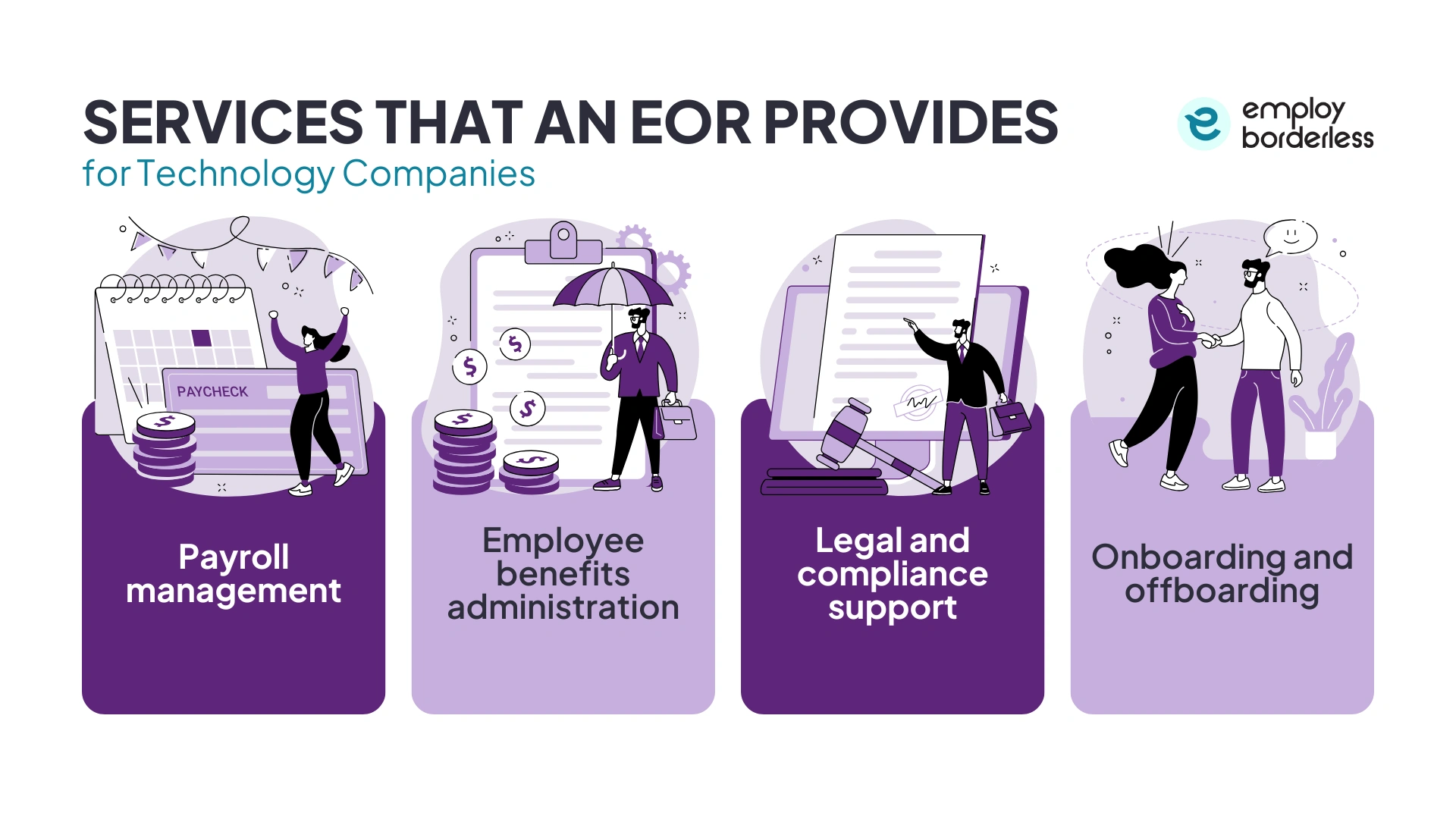
The services that an EOR provides for technology companies include payroll management, employee benefits administration, legal and compliance support, and onboarding and offboarding.
Payroll management
An EOR handles the client company's payroll accurately and provides timely payments. It manages employee salaries, bonuses, deductions, and tax withholdings while staying compliant with local labor and tax regulations. This reduces payroll errors and allows technology companies to focus on core operations rather than administrative tasks.
Employee benefits administration
An EOR manages employee benefits administration for technology companies by offering competitive health insurance and retirement plans without requiring a legal entity. It makes sure that all benefits comply with local regulations and market standards. This approach increases employee satisfaction and helps attract and retain top technical talent.
Legal and compliance support
Legal and compliance support from an EOR keeps all employment contracts, payroll taxes, and data protection policies in line with regional labor laws such as the FLSA (Fair Labor Standards Act). This employment partner reduces the risk of non-compliance and legal penalties. Technology firms expanding globally get operational security across diverse legal environments.
Onboarding and offboarding
EORs offer onboarding and offboarding services that simplify employee transitions within the company. The EOR manages documentation, background checks, contract management, and exit procedures while complying with local laws, which include minimum wage, overtime, and recordkeeping. This support helps technology firms maintain consistency, protect company data, and provide a positive employee experience across all locations.
Why do technology companies need an EOR?
Technology companies need an EOR for global talent acquisition, compliance with international labor laws, faster market entry and growth, and reduced administrative and HR burdens.
Technology firms often need to hire top talent from around the world to stay competitive. An EOR allows them to employ skilled professionals across borders without setting up foreign entities.
Managing the unique employment, tax, and data protection laws of each country is a real challenge for tech companies. An EOR keeps companies compliant with regulations such as GDPR (General Data Protection Regulation) or local labor laws to reduce legal and financial risks.
Technology businesses that want to expand into new markets need months to set up legal entities. An EOR addresses this problem by using an existing organization procedure for immediate hiring and business operations.
An EOR manages contracts, compliance, taxes, and employee records on the company's behalf, which allows technology firms to focus on advancement and product development rather than HR and legal complexities.
What are the benefits of using EOR for technology companies?
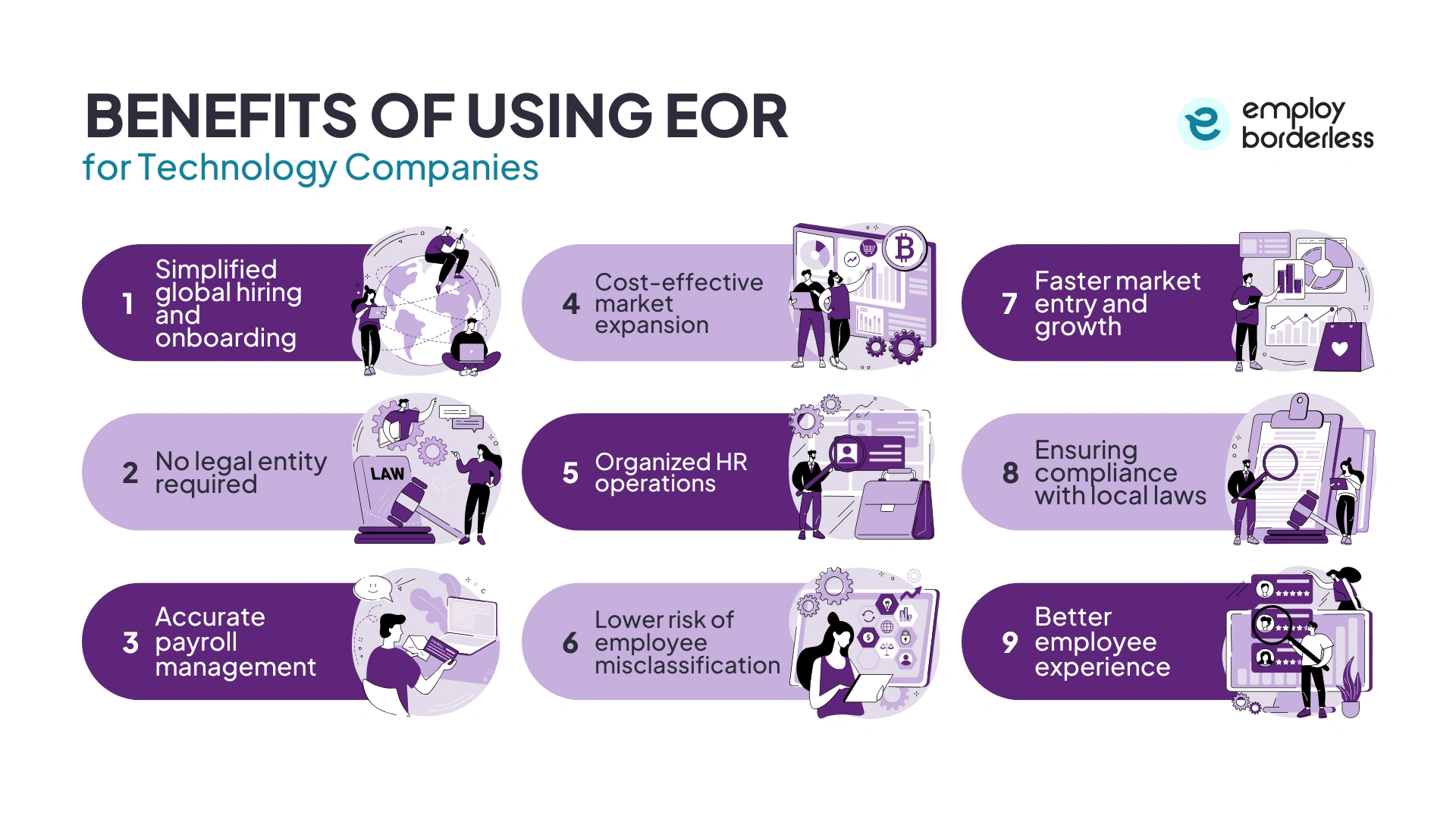
The benefits of using an EOR for technology companies include simplified global hiring and onboarding, no legal entity requirement, accurate payroll management, cost-effective market expansion, and organized HR operations.
Simplified global hiring and onboarding
EORs simplify the process of global hiring and onboarding by managing employment contracts, work permits, and documentation. This reduces the complexity of recruiting across borders while keeping companies compliant with local hiring regulations. An EOR provides a smooth onboarding experience that helps new employees quickly integrate and start performing company operations.
No legal entity required
Technology companies expand internationally without spending time or money to establish local subsidiaries when they partner with an EOR. The EOR acts as the legal employer on the company's behalf and allows companies to hire new employees in foreign markets immediately. Technology firms focus on business growth and development rather than time-consuming registration processes, with an EOR handling legal and administrative tasks.
Accurate payroll management
EORs process payroll, manage tax withholdings, and administer benefits across multiple regions, which helps technology companies pay employees accurately and on time. Fewer payroll errors occur thanks to automated systems and compliance checks, which results in improved transparency and employee trust.
Cost-effective market expansion
An EOR helps expand into new markets by reducing the expenses of setting up a legal entity, hiring local legal experts, and managing separate HR systems. This cost efficiency allows technology companies to test new markets or establish remote teams without major upfront investments. Businesses allocate saved resources to product development or market growth strategies.
Organized HR operations
An EOR centralizes HR functions such as contracts, payroll, benefits, and compliance on a single platform. This structured system improves record-keeping and reduces administrative confusion, especially for distributed teams. The result is better coordination between departments and consistency across global teams.
Lower risk of employee misclassification
Technology companies that misclassify employees as contractors face legal and financial penalties. An EOR accurately classifies workers while complying with local employment standards. This protection reduces compliance risks while maintaining transparent and ethical labor practices across jurisdictions.
Faster market entry and growth
EOR services give technology companies the structure they need for quick hiring and expansion into new markets. Companies can start operations within days instead of months and quickly build out international teams. This capability helps technology companies compete effectively in global markets.
Staying compliant with local laws
EORs stay updated with local labor laws, such as the FMLA (Family and Medical Leave Act), tax regulations, and employment policies in every region where they operate. They help companies remain compliant by managing employment contracts, payroll taxes, and statutory benefits according to local standards. This legal stability protects businesses from penalties and operational disruptions.
Better employee experience
Employees experience a smooth and supportive work environment through simplified onboarding, timely payroll, and broad benefits coverage. EORs keep compliance on track, maintain clear communication, and provide proper support to create a positive global employment experience. This approach improves employee retention, engagement, and loyalty among remote and international teams.
What are the challenges of using EOR for technology companies?
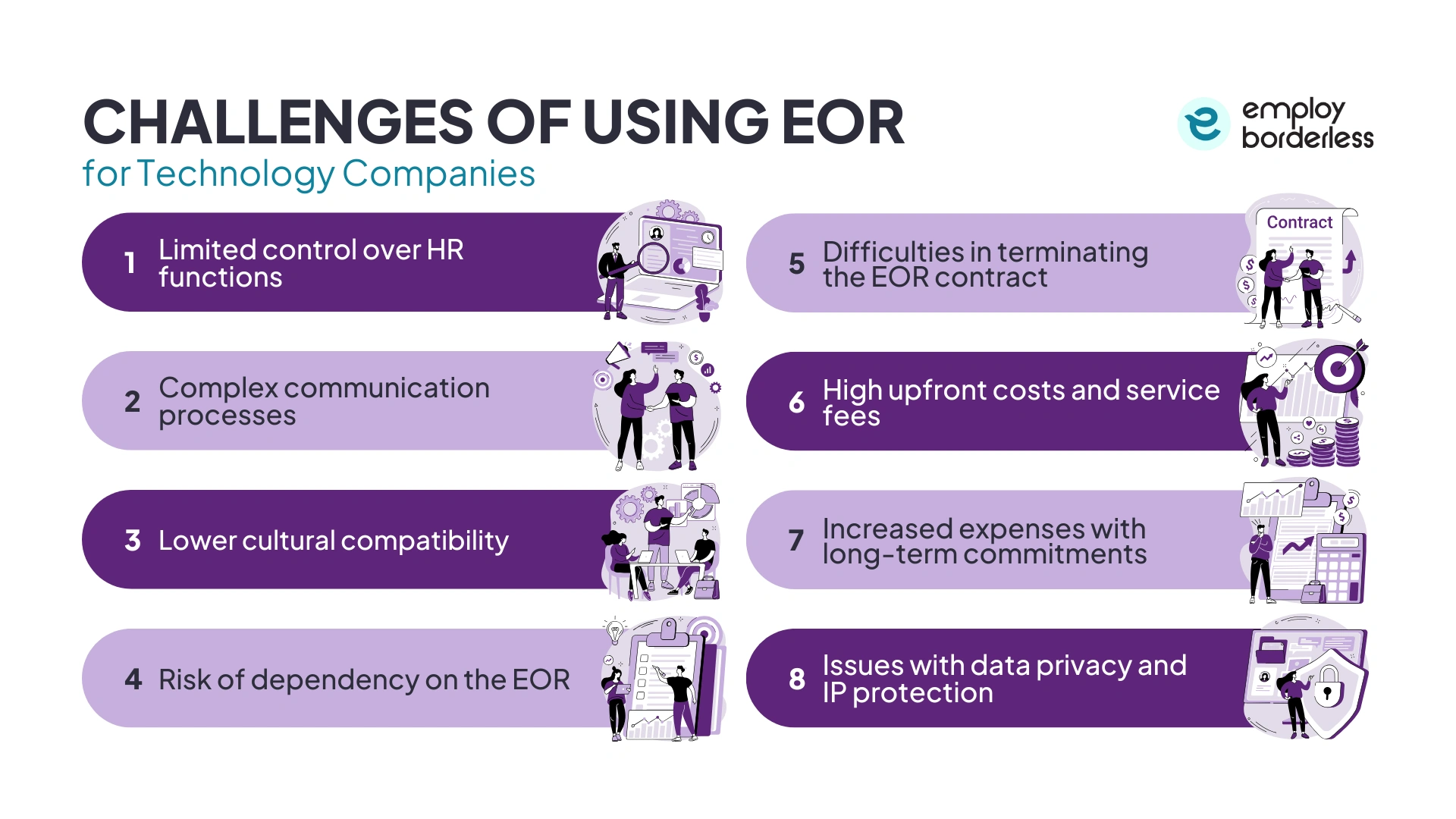
The challenges of using EOR for technology companies include limited control over HR functions, complex communication processes, lower cultural compatibility, risk of dependency on the EOR, and difficulties in terminating the EOR contract.
The challenges of using EOR for technology companies are listed below.
- Limited control over HR functions: Technology companies experience less control over HR functions, such as payroll policies, employee benefits, and compliance management, when partnering with an EOR. The company must rely on the EOR's systems and schedules since the EOR acts as the legal employer.
- Complex communication processes: Technology companies working with an EOR need to coordinate between multiple teams across different time zones and systems. Miscommunication occurs if the EOR does not handle sensitive matters, such as employee disputes or payroll changes, accurately.
- Lower cultural compatibility: Technology companies operating globally sometimes find it difficult to align EOR processes with their corporate culture and work practices. The client company faces differences in the communication styles, workplace values, or management expectations that affect employee satisfaction and integration.
- Risk of dependency on the EOR: A technology company that relies on an EOR for global workforce management becomes dependent on third-party systems and expertise. This dependency also makes it difficult to transition back to in-house management later.
- Difficulties in terminating the EOR contract: Companies face operational challenges when transferring workers to a new entity or provider. Terminating the EOR contract without careful planning also disrupts operations and increases administrative burdens for the technology company.
- High upfront costs and service fees: EOR services involve setup fees, management costs, and additional charges for specific services. Technology startups find it difficult to budget for these upfront expenses, as the initial investment is higher compared to internal HR management.
- Increased expenses with long-term commitments: EORs simplify expansion, but long-term commitments become costly as service fees increase. Companies planning permanent operations in a region find it more economical to establish their own legal entity.
- Issues with data privacy and IP protection: Technology companies handle sensitive information, such as IP (Intellectual Property) and personal data. Working with an EOR increases exposure to data security risks and privacy breaches.
How does EOR for technology companies manage legal and tax complexities?
The EOR for technology companies manages legal and tax complexities by understanding international labor laws, managing global payroll and tax compliance, protecting intellectual property across borders, handling employee classification and contract management, and maintaining data security and regulatory compliance.
EORs help technology companies handle complex labor regulations across different countries. They keep employment contracts, working hours, and benefits in line with local laws like the FLSA (Fair Labor Standards Act).
This global employment approach handles payroll taxes, deductions, and filings according to each country's financial regulations. It manages legal obligations on behalf of the technology firm, which includes income tax, social security, and corporate contributions.
Technology firms often rely on company-owned software, designs, and patents. EORs establish legal systems that assign IP ownership to the parent company rather than the local entity or employee.
Technology companies that misclassify employees or contractors have to pay fines or deal with legal issues. EORs accurately classify workers based on local employment standards and create compliant contracts.
EORs put strict data protection protocols in place to comply with laws such as GDPR (General Data Protection Regulation) and CCPA (California Consumer Privacy Act). They protect sensitive employee and company data through encrypted systems and regular audits.
What are the current EOR and global hiring trends in the technology industry?
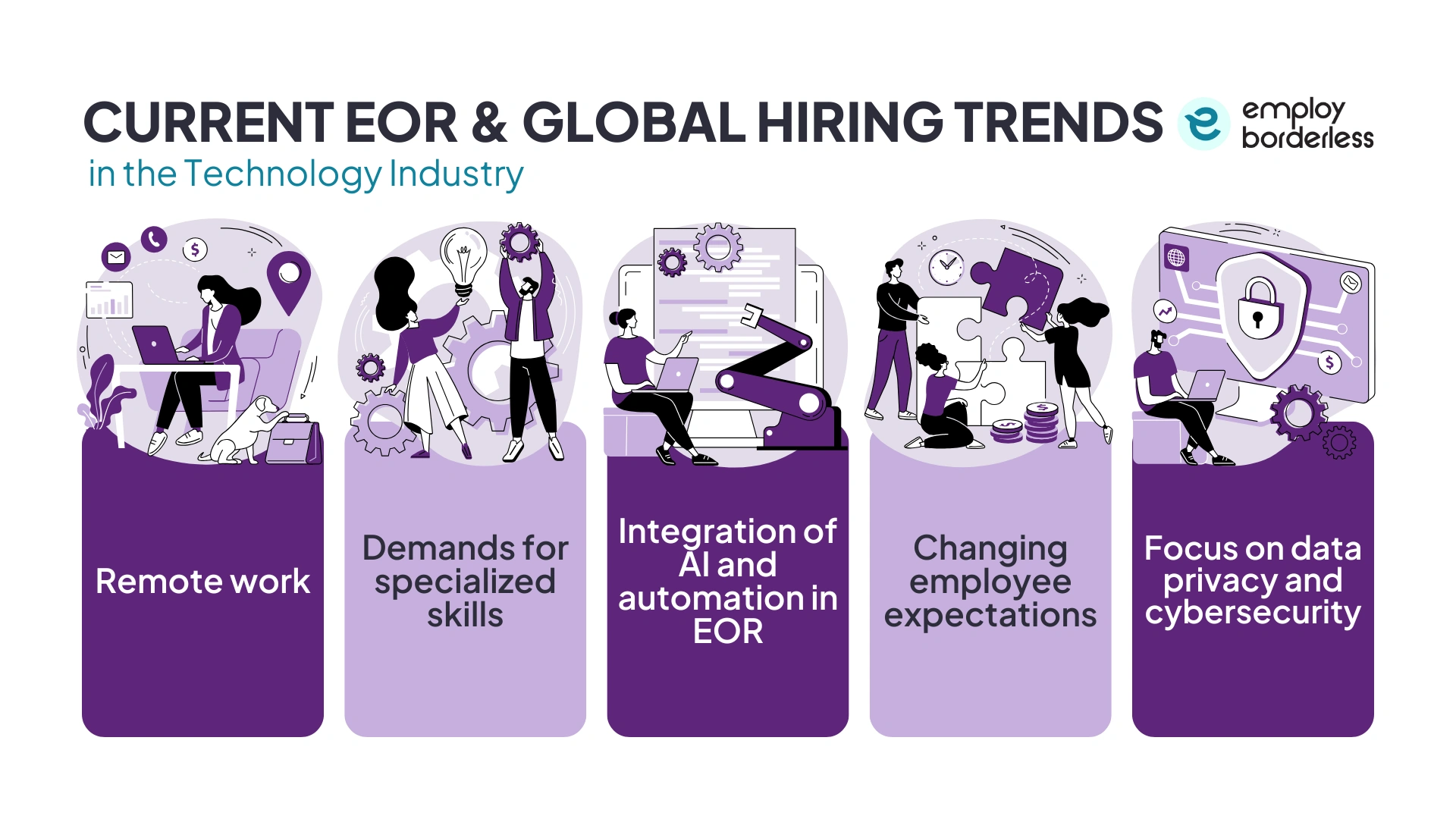
The current EOR and global hiring trends in the technology industry are remote working, demands for specialized skills, integration of AI and automation in EOR, changing employee expectations, and a focus on data privacy and cybersecurity.
The current EOR and global hiring trends in the technology industry are listed below.
- Remote work: EORs simplify the process of remote work by managing international payroll, taxes, and compliance for employees working remotely. This allows companies to hire talent from anywhere.
- Demands for specialized skills: This global hiring partner helps technology companies quickly onboard specialized professionals from different countries, as the growing need for experts in areas like AI, cybersecurity, and cloud computing increases.
- Integration of AI and automation in EOR: Modern EOR platforms increasingly use artificial intelligence and automation for payroll processing, compliance tracking, and employee management to improve operational accuracy.
- Changing employee expectations: Employees in technology companies now expect flexibility, competitive benefits, and a healthy work-life balance. EORs help companies meet these expectations by providing customized benefit plans and compliant employment contracts.
- Focus on data privacy and cybersecurity: EORs now strictly focus on cybersecurity protocols and compliance with data privacy laws like GDPR (General Data Protection Regulation) and CCPA (California Consumer Privacy Act). This trend helps companies maintain trust in this third-party service provider while expanding internationally.
When should technology companies consider using an EOR?
Technology companies should consider using an EOR when expanding internationally, accessing a global talent pool, maintaining legal and tax compliance, and testing new markets.
Consider using an EOR when your technology company plans to enter new global markets without setting up local entities. The EOR manages employment, payroll, and compliance in each country and allows your business to scale faster.
Use this global hiring partner to access talent, especially when hiring specialized tech professionals across borders. The EOR handles local employment laws, contracts, and payments while providing a smooth hiring process.
Employ an EOR to stay compliant with international labor laws, tax regulations, and data protection standards. It handles accurate filings and proper documentation in each region.
Use this global employment approach when exploring new countries to evaluate the company's growth without committing to building full technological systems. The EOR employs local talent, manages compliance, and provides insights into market performance.
How to choose the right EOR for your technology company?
To choose the right EOR for your technology company, assess your business needs, review the provider's expertise in local laws, evaluate its ability to manage multi-country operations, compare pricing models, and review data security measures.
Start by identifying your company's specific goals, such as global expansion, cost control, or talent acquisition, before partnering with an EOR. Technology companies that define these needs are better able to choose an EOR that matches their business priorities.
Choose an EOR with a proven record of managing compliance across multiple countries. Verify that it understands local employment laws, tax rules, and data protection standards.
Select an EOR that handles payroll, benefits, and compliance across multiple regions at the same time. Confirm that it has experience supporting businesses with global teams and complex regulations.
Review the EOR's pricing structure to confirm transparency and value for operational cost. Compare service packages and check for hidden fees or long-term contract obligations.
Make sure the EOR uses strong cybersecurity measures and complies with global data privacy standards like GDPR (General Data Protection Regulation). Ask about its encryption practices, access controls, and incident response policies.
What impact does AI have on EOR trends and services?
The impact AI has on EOR trends and services is the automation of payroll processing, compliance monitoring, and employee data management. These services increase payroll accuracy, reduce manual errors, and handle onboarding and reporting tasks.
What is EOR software?
EOR software is a service platform that helps international businesses manage the complexities of employment, payroll, and compliance responsibilities. EOR software automates tasks like payroll, benefits, compliance, and tax management across multiple countries.
What is the difference between EOR and HRIS?
The difference between EOR and HRIS is that an EOR (Employer of Record) is a service provider that legally employs workers on behalf of a company and manages payroll, compliance, and benefits. An HRIS (Human Resources Information System) is software that manages HR data and processes, but does not take on any legal employer responsibilities.
How are EOR services for industries becoming more specialized?
EOR services for industries are becoming more specialized, as they provide tailored approaches to meet sector-specific needs, which include compliance with unique labor laws and safety standards. EOR services for industries now offer customized payroll systems, benefits packages, and onboarding processes designed for each industry.
How do EOR and IT recruitment agencies differ?
EOR and IT recruitment agencies differ in that an EOR (Employer of Record) legally employs workers on behalf of a company and manages their payroll, taxes, compliance, and benefits, while an IT recruitment agency focuses on sourcing, screening, and recommending qualified candidates for tech roles.
How much do EOR services cost?
EOR services cost either a flat monthly fee per employee, usually between $200 and $2,000, or a percentage of the employee's salary. Additional EOR costs include setup or onboarding service fees, benefits administration, international payroll taxes, currency conversion charges, and compliance or legal support.

Co-founder, Employ Borderless
Robbin Schuchmann is the co-founder of Employ Borderless, an independent advisory platform for global employment. With years of experience analyzing EOR, PEO, and global payroll providers, he helps companies make informed decisions about international hiring.
Learning path · 8 articles
EOR fundamentals
Master the fundamentals with our step-by-step guide.
Start the pathReady to hire globally?
Get a free, personalized recommendation for the best EOR provider based on your needs.
Get free recommendations