How EOR trends are defining the future of global businesses

Robbin Schuchmann
Co-founder, Employ Borderless
EOR (Employer of Record) is a third-party organization that legally employs workers on behalf of a company and manages compliance, payroll, and HR responsibilities across regions. The current EOR industry trends include growing complexity of international employment regulations, rising demand for flexible workforce services, increased globalization of business operations, tailored EOR options for SMBs (Small and Medium-Sized Businesses), and a push toward cost-effective expansion strategies.
EOR market size and growth
The EOR market was valued at around USD 5237.11 billion in 2024 and is projected to reach approximately USD 9176.77 billion by 2033, growing at a CAGR (Compound Annual Growth Rate) of 6.8%. This growth reflects a rising number of companies turning to EOR services to manage global hiring, compliance, and workforce planning without opening local legal entities.
Current trends in the EOR industry
Five forces are shaping how businesses use EOR today: increasing globalization of business operations, rising demand for flexible workforce arrangements, growing complexity of international employment regulations, tailored EOR services for SMBs, and the need for cost-effective expansion strategies.
- Globalization of operations: businesses enter new markets faster than before, and EORs let them hire across borders without setting up a local entity, supporting compliant expansion while cutting operational risk.
- Flexible workforce demand: hybrid and remote work models are now standard, and EORs let companies hire full-time, part-time, or contract staff globally, adjusting quickly to shifting market demands.
- Regulatory complexity: employment laws change frequently across countries, and EORs track local labor, tax, and benefits rules so businesses stay compliant and avoid legal risk.
- SMB-focused EOR services: small and medium-sized businesses use EORs to reach international talent and manage payroll without the cost of setting up foreign entities.
- Cost-effective expansion: EORs handle HR, payroll, and compliance so companies can grow into new markets without heavy investment in legal entities, freeing budget for core operations.
Technology reshaping EOR services
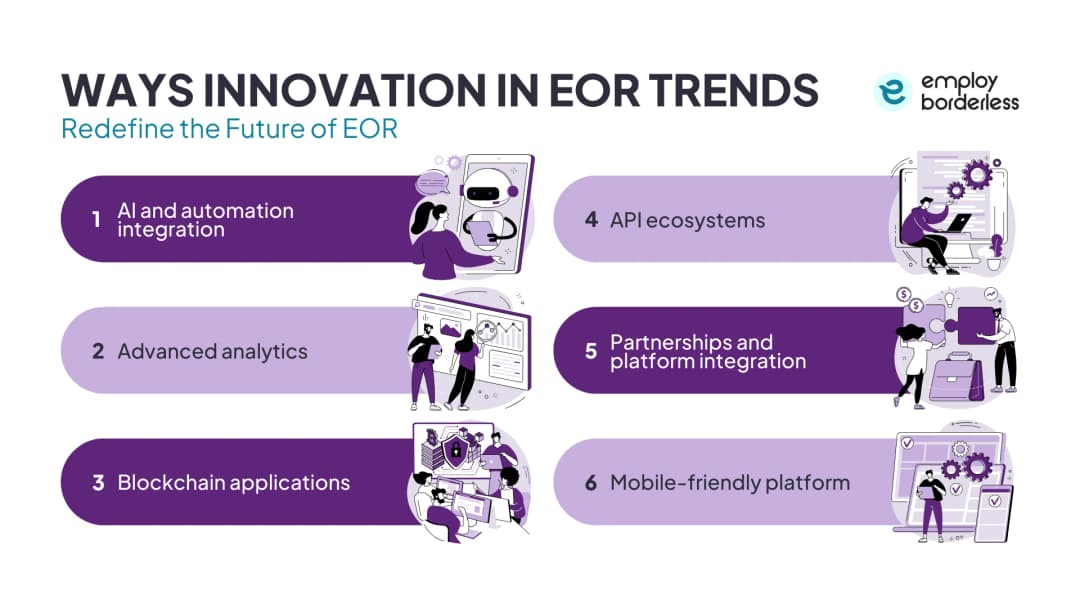
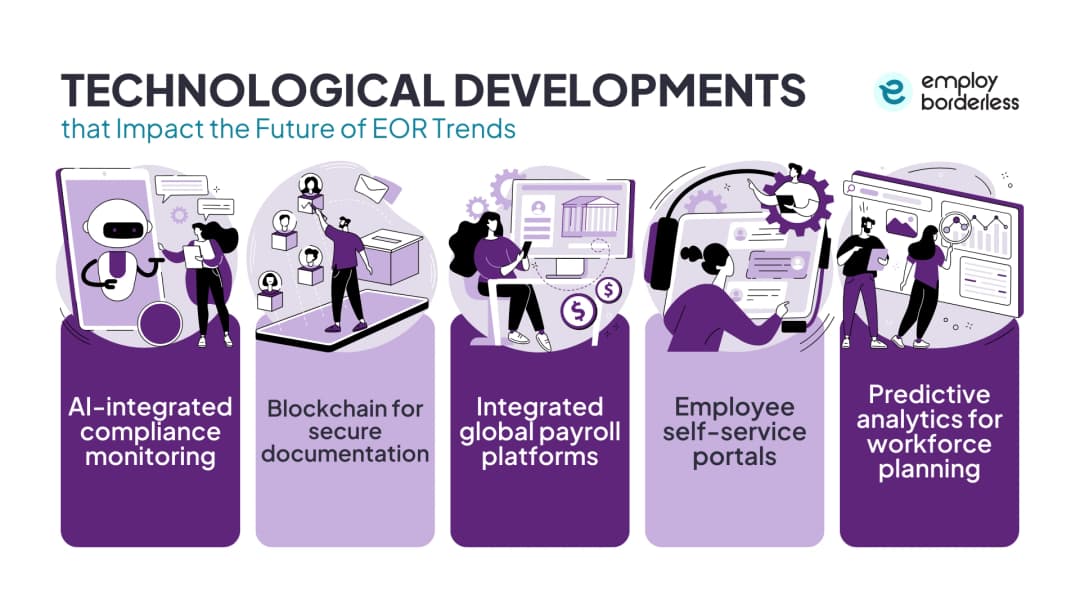
Technology is redefining how EOR providers operate and how far their services reach. The main developments are AI and automation, advanced and predictive analytics, blockchain applications, integrated global payroll platforms, employee self-service portals, API ecosystems, partnerships and platform integration, and mobile-friendly access.
| Technology | How it changes EOR |
|---|---|
| AI and automation (including AI-integrated compliance monitoring) | Simplifies payroll, onboarding, and compliance management; automatically flags regulatory changes and updates policies in real time, cutting manual errors for HR teams. |
| Advanced and predictive analytics | Turns workforce data into decisions on hiring, performance, and compliance risk, and helps companies forecast staffing needs and skill gaps. |
| Blockchain applications (secure documentation) | Stores contracts, payroll records, and employee data in a transparent, tamper-resistant format, reducing fraud risk across borders. |
| Integrated global payroll platforms | Manages payments, currency conversion, and tax withholding for employees in multiple countries from a single system, improving accuracy and timeliness. |
| Employee self-service portals | Lets employees manage profiles, access payslips, and update details directly, reducing HR workload and improving communication. |
| API ecosystems and platform partnerships | Connects EOR platforms with existing HR, payroll, and accounting tools, and links EORs with HR technology providers for a single connected service. |
| Mobile-friendly access | Gives employers and employees instant access to payroll, benefits, and compliance tools from anywhere, suited to hybrid and remote work. |
Regulatory changes influencing EOR trends
Regulatory shifts are pushing EOR providers to update their systems continuously. Four areas stand out: employment law updates, tax compliance evolution, data protection rules, and cross-border agreements.
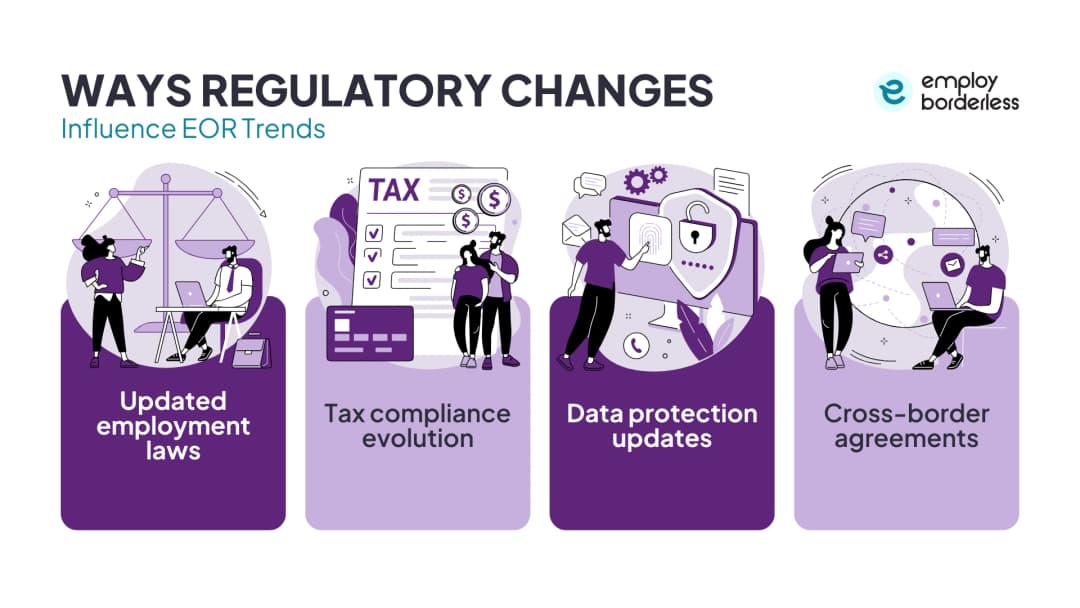
- Updated employment laws: frequent changes to hiring practices, employee classification, and workplace rights across countries require EORs to adjust compliance systems constantly. Statutory notice periods alone vary widely, from a median of 4.3 weeks, per our Global Employer Burden Index dataset (198 countries), to as high as 26 weeks in Gambia, per the same dataset.
- Tax compliance evolution: new reporting requirements and digital tax systems mean EORs must handle accurate filings, withholdings, and adherence to local and international tax rules. Employer social security contributions alone range from a median of 12.6%, per the same dataset (196 countries), to as high as 36.49% in New Caledonia, per the same dataset.
- Data protection updates: stricter privacy laws such as the GDPR (General Data Protection Regulation) and CCPA (California Consumer Privacy Act) require EORs to strengthen security protocols and data transparency.
- Cross-border agreements: new trade and labor agreements affect visa rules, labor rights such as the FLSA (Fair Labor Standards Act), and taxation, all of which EORs must manage by country.
Business benefits of adopting EOR trends
| Benefit | What it means for businesses |
|---|---|
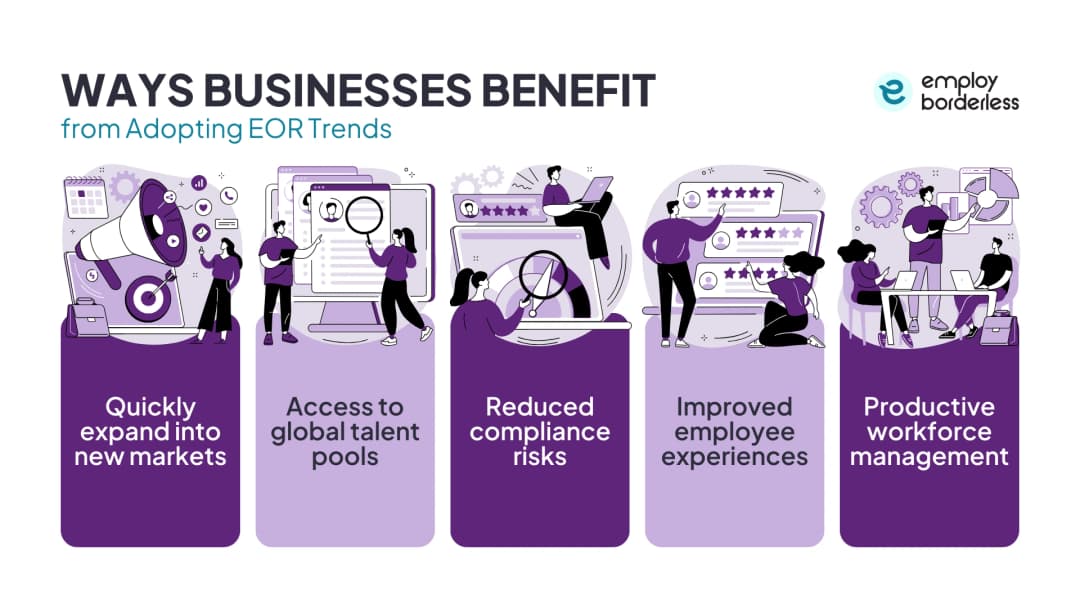
| Quick market entry | EORs handle compliance, hiring, and payroll so companies can enter new countries without setting up a local entity, saving time and avoiding administrative delays. |
| Access to global talent | Removes barriers tied to visas, contracts, or regional labor laws such as the FLSA, letting businesses hire specialized talent and build diverse teams. |
| Reduced compliance risk | EORs keep employment practices aligned with local labor and tax law, lowering the risk of fines, penalties, and reputational damage. |
| Better employee experience | Accurate, on-time payroll and reliable HR handling build trust with staff, improving engagement and retention. |
| Productive workforce management | Simplified HR systems and real-time data tracking of attendance, performance, and compliance support informed staffing decisions. |
Challenges affecting EOR adoption
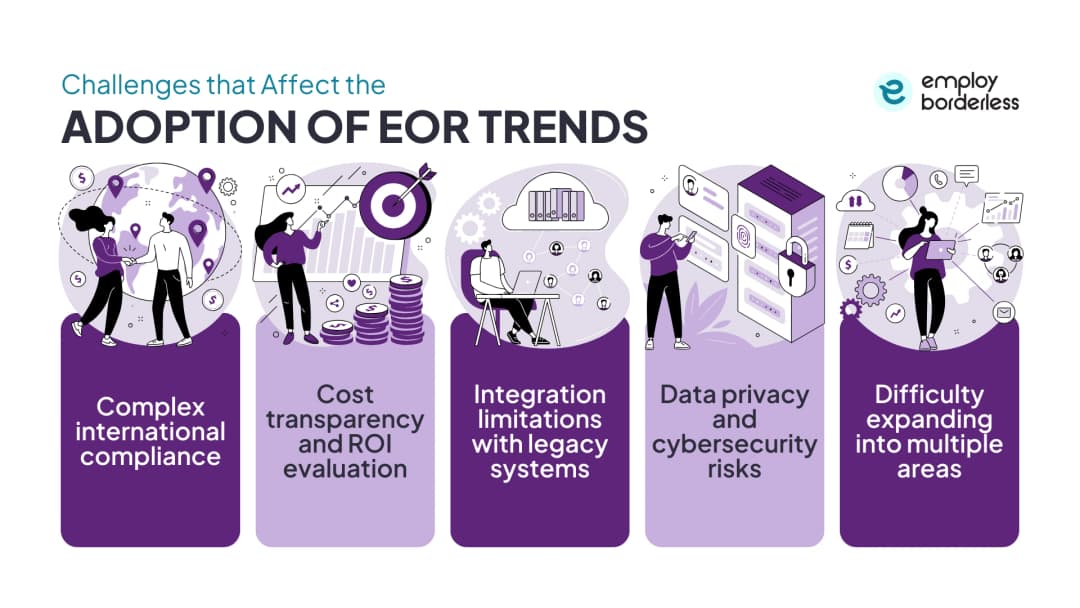
| Challenge | Detail |
|---|---|
| Complex international compliance | Every region has distinct and frequently changing labor laws, tax systems, and regulations for EORs to track. |
| Cost transparency and ROI evaluation | Hidden fees or unclear pricing models make it hard for businesses to assess the true cost of EOR services. |
| Integration limits with legacy systems | Outdated HR or payroll systems do not connect easily with EOR platforms, causing data errors and reporting delays. |
| Data privacy and cybersecurity risk | EOR platforms hold sensitive cross-border data, so breaches can violate laws such as HIPAA (Health Insurance Portability and Accountability Act) and COPPA (Children's Online Privacy Protection Act); providers need strong measures such as SSL encryption and multi-factor authentication. |
| Difficulty expanding into multiple areas | Differing employment practices, taxes, and documentation across locations make multi-country EOR coordination complex without careful management. |
Future trends in global EOR services
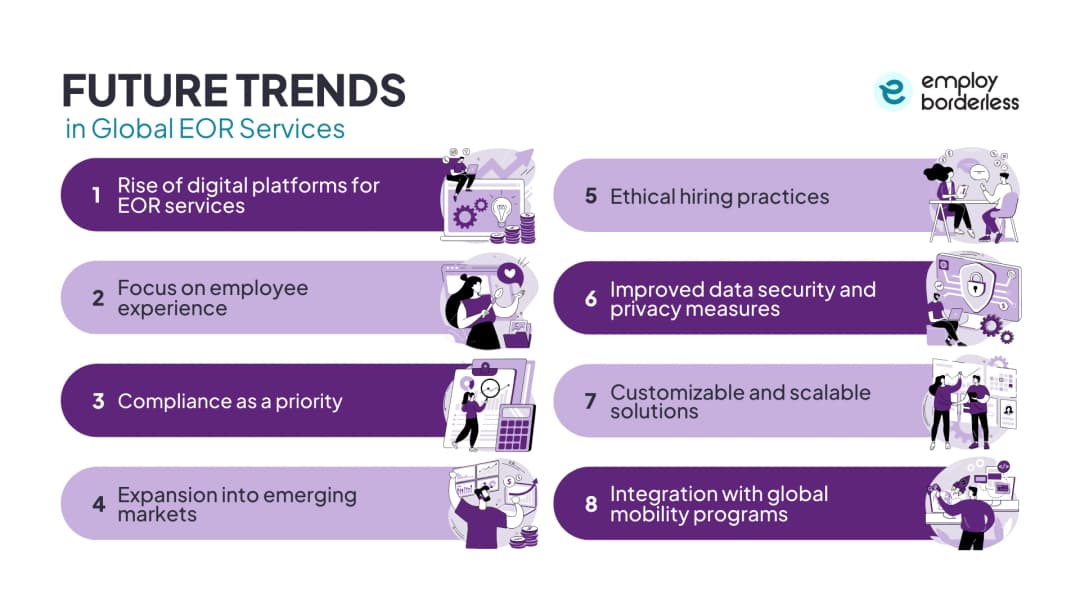
- Rise of digital platforms: automated HR, payroll, and compliance tools let businesses manage global employees in real time, cutting administrative cost and error.
- Focus on employee experience: personalized onboarding, localized benefits, and continuous support are becoming standard, boosting productivity and reducing turnover.
- Compliance as a priority: automated systems paired with local legal teams help companies follow changing labor, tax, and employment law accurately.
- Expansion into emerging markets: businesses are working with EORs to enter regions such as Asia-Pacific and Latin America for growing talent pools and cost-effective labor.
- Ethical hiring practices: transparent hiring supports international labor standards, workforce diversity, and reduces discrimination risk.
- Improved data security and privacy: SSL encryption, multi-layer authentication, and secure cloud storage help providers meet the GDPR and CCPA.
- Customizable, flexible solutions: EORs design offerings matched to business size, industry, and growth stage so companies can adjust workforce size to demand.
- Integration with global mobility programs: EOR services now coordinate with relocation programs to manage visas, work permits, and international tax compliance for remote staff.
How EOR providers are evolving
Providers are investing in AI, automation, and cloud platforms to improve payroll accuracy and cut administrative work. Many are expanding into new countries so clients can hire in additional markets without opening local entities. Multilingual client and employee support is becoming standard, helping businesses navigate local payroll, benefits, and HR rules. Legal and tax compliance systems are being upgraded to keep pace with changing regulations across regions, and providers increasingly offer industry-specific packages for sectors such as technology, healthcare, and manufacturing.
How to choose an EOR provider that supports current trends
To select an EOR provider aligned with these trends, evaluate its technology, global reach, compliance standards, industry expertise, and transparency.
- Technology: look for AI, automation, and data analytics in payroll, compliance, and HR management for real-time reporting and fewer errors.
- Global reach: a provider with broad country coverage supports expansion without switching vendors as the business grows.
- Compliance and data security: check for certifications such as ISO 27001 and adherence to the GDPR to protect sensitive employee data.
- Industry expertise: a provider familiar with your sector's payroll complexity and labor requirements can offer relevant, tested solutions.
- Transparency and support: clear pricing, detailed reporting, and responsive customer support maintain trust and smooth daily operations.
Are EOR services evolving to serve specific industries?
Yes. EOR providers now offer specialized, industry-focused packages for sectors such as technology, healthcare, manufacturing, and retail. See EOR services for industries for sector-specific detail.
How does EOR software contribute to current EOR trends?
EOR software automates payroll, compliance, and employee management across countries, and centralizes data and analytics for better monitoring and cost control. See EOR software for more.
How do EOR trends impact technology companies?
EOR trends let technology companies hire globally, grow quickly, and stay compliant by outsourcing legal and administrative HR work. EOR for technology gives access to a wide talent pool and flexible remote or hybrid arrangements that lower the cost of international expansion.
What new features should we expect from EOR platforms?
Expect more AI and automation for productivity, specialized services such as equity management, expanded global benefits packages, and closer integration with existing HR systems.
How are global workforce trends affecting EOR services?
Remote work, digital collaboration, and cross-border hiring are pushing companies to rely on EORs to manage compliance, payroll, and benefits across regions without opening local entities.
How are compliance standards changing with current EOR trends?
New technologies such as AI and blockchain are tightening compliance standards as countries update labor, tax, and data privacy law. EOR compliance support now needs automation, legal expertise, and localized monitoring to protect employers from risk.

Co-founder, Employ Borderless
Robbin Schuchmann is the co-founder of Employ Borderless, an independent advisory platform for global employment. With years of experience analyzing EOR, PEO, and global payroll providers, he helps companies make informed decisions about international hiring.
Learning path · 8 articles
EOR fundamentals
Master the fundamentals with our step-by-step guide.
Start the pathReady to hire globally?
Get a free, personalized recommendation for the best EOR provider based on your needs.
Get free recommendations