EOR services for industries: definition, benefits, industry-specific requirements, and considerations

Robbin Schuchmann
Co-founder, Employ Borderless
EOR services are solutions that an Employer of Record provides to client companies, which include payroll, taxes, benefits, and compliance. This third-party service provider manages these HR functions on behalf of a client company and allows the employer to focus on core business operations.
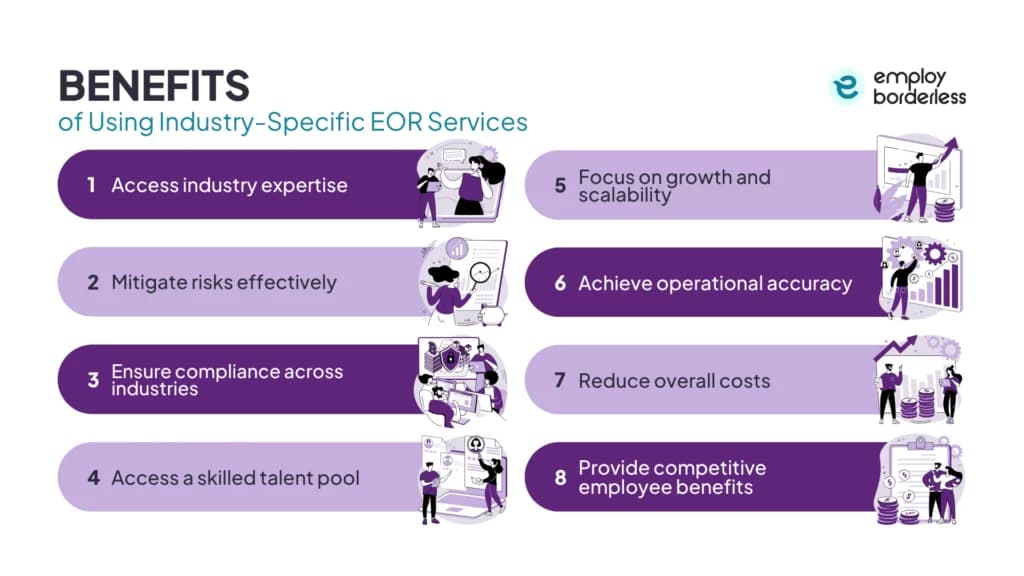
The benefits of using industry-specific EOR services include access to industry expertise, mitigating risks effectively, maintaining compliance across industries, access to a skilled talent pool, focus on growth and flexibility, achieving operational accuracy, reducing overall costs, and providing competitive employee benefits.
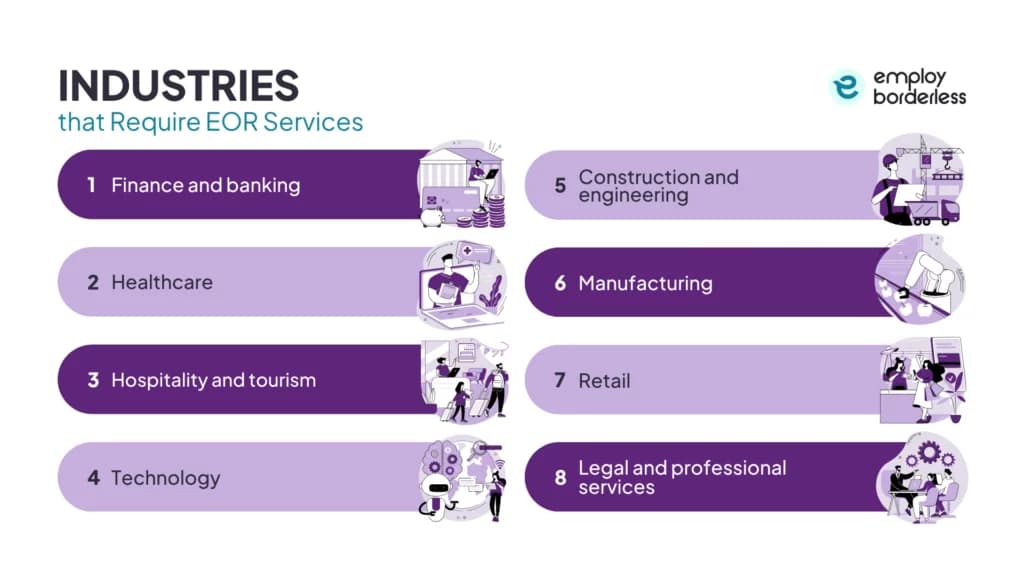
The industries that require EOR services include finance and banking, healthcare, hospitality and tourism, technology, construction and engineering, manufacturing, retail, and legal and professional services. The considerations when selecting an industry-specific EOR include service offerings, industry expertise, technology features, geographic reach, compliance and regulatory knowledge, pricing transparency, and client references and testimonials.
What are EOR services?
EOR services are professional solutions in which an Employer of Record legally handles payroll, taxes, benefits, and compliance with local labor laws. The main purpose of EOR services is to help businesses hire and manage international employees quickly and legally without the need to establish a local entity.
What are the benefits of using industry-specific EOR services?
The benefits of using industry-specific EOR services are to access industry expertise, mitigate risks effectively, maintain compliance across industries, achieve operational accuracy, and provide competitive employee benefits.
The benefits of using industry-specific EOR services are mentioned below.
- Access industry expertise: Industry-specific EOR services provide expert knowledge of labor laws, payroll practices, and HR requirements according to each sector. Industry expertise helps businesses handle complex regulations and avoid common industry challenges.
- Mitigate risks effectively: EOR services help businesses reduce legal, financial, and compliance risks by making sure all employment practices meet local regulations. They manage contracts, taxes, and employee documentation according to country-specific laws.
- Ensure compliance across industries: Each industry follows different employment standards and compliance rules. EOR providers monitor these changes to keep companies in line with legal requirements, maintain correct tax filings, manage benefits administration, and follow safety and licensing laws.
- Access a skilled talent pool: Industry-focused EORs connect businesses with qualified professionals who meet specific skill and experience requirements. They help companies hire globally without the delays of setting up entities and allow them quick access to top talent in their field.
- Focus on growth and flexibility: EOR services free up company resources and leadership time by handling complex HR, payroll, and compliance tasks. Businesses can expand into new markets, launch products, and improve operations without worrying about administrative challenges.
- Achieve operational accuracy: EOR providers use advanced tools and standardized procedures for accurate payroll processing, tax deductions, and benefits management. Their systems reduce human errors, support timely payments, and maintain accurate employee records.
- Reduce overall costs: EOR services reduce the need to establish local entities, hire legal experts, or maintain internal payroll teams. They help businesses reduce administrative overhead and save on compliance and HR management costs.
- Provide competitive employee benefits: Industry-specific EORs help businesses offer benefits packages that match local standards and employee expectations. The employee benefits include health insurance, retirement plans, and other perks that improve satisfaction and retention.
Which industries require EOR services?
The industries that require EOR services include finance and banking, healthcare, hospitality and tourism, technology, construction and engineering, manufacturing, retail, and legal and professional services.
Finance and banking
The finance industry demands strict compliance with data security, AML (Anti-Money Laundering), and financial reporting regulations. EORs in this sector have to make sure that payroll accuracy and employee background checks meet legal standards. They also manage cross-border payments while maintaining confidentiality and regulatory compliance.
Healthcare
The healthcare industry requires EORs to comply with patient privacy laws, medical licensing, and health and safety regulations. EORs handle employee credentials, shift scheduling, and benefits suited for medical staff. They also maintain compliance with standards like HIPAA (Health Insurance Portability and Accountability Act) for data protection and ethical employment practices.
Hospitality and tourism
The hospitality and tourism industry needs flexible staffing solutions and seasonal workforce management. EORs help with fast hiring, visa processing, and payroll for employees across multiple locations. They also keep companies in line with labor laws regarding working hours, overtime, and benefits across different countries.
Technology
The technology sector demands global talent acquisition, remote work management, and IP (Intellectual Property) protection. EORs help technology companies hire skilled professionals across borders while protecting IP rights. They also handle multi-currency payroll and comply with employment laws, such as privacy rights and wage and hour laws.
Construction and engineering
Construction and engineering companies use EOR software to manage payroll and compliance for on-site and remote workers across multiple regions. It helps handle project-based contracts, maintain safety and labor law compliance, and simplify payments for diverse teams working under different jurisdictions.
Manufacturing
Manufacturing firms use EOR software to manage large, shifting workforces across factories and worksites. The software automates payroll for hourly workers, tracks overtime, and keeps companies compliant with local employment and safety regulations while maintaining legal accuracy.
Retail
Retail companies rely on EOR software to manage distributed staff in stores, warehouses, and customer service centers. It helps keep payroll accurate, manage benefits and shift-based payments, and stay compliant with labor laws across different regions or countries.
Legal and professional services
Legal and professional service firms use EOR software to hire consultants, paralegals, and remote professionals globally. It allows them to comply with global laws, manage payroll confidentiality, and automate benefits while reducing the administrative burden on HR teams.
What are the considerations when selecting an industry-specific EOR?
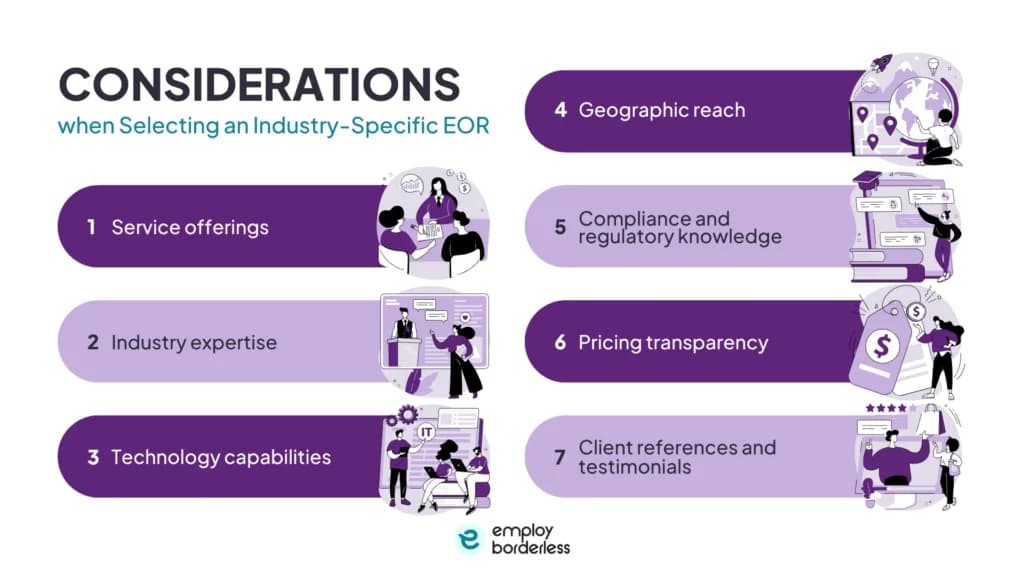
The considerations when selecting an industry-specific EOR are service offerings, industry expertise, technology features, geographic reach, compliance and regulatory knowledge, pricing transparency, and client references and testimonials.
The considerations when selecting an industry-specific EOR are listed below.
- Service offerings: Service offerings are solutions that an EOR provides to businesses, such as payroll management, employee onboarding, benefits administration, and compliance support. Businesses need to assess whether these services match their operational and industry requirements.
- Industry expertise: Industry expertise means the EOR's experience and understanding of the unique regulations, challenges, and workforce needs within a specific sector. An EOR with proven knowledge in your industry is able to better handle compliance, hiring norms, and reporting requirements.
- Technology features: Technology features refer to the software tools and systems the EOR uses to manage payroll, compliance, and employee data. A reliable EOR provides a secure, cloud-based platform with automation and analytics features.
- Geographic reach: Geographic reach shows the EOR's ability to operate in multiple countries or regions. A wide global presence allows businesses to hire internationally without setting up local entities and helps maintain compliance across global markets.
- Compliance and regulatory knowledge: Compliance and regulatory knowledge refers to the EOR's understanding of local labor laws, tax regulations, and employment standards. An EOR with strong compliance expertise helps businesses avoid penalties, legal issues, and reputational risks.
- Pricing transparency: Pricing transparency means the EOR provides clear and detailed information about its costs and fee structures. Businesses should choose providers that show all charges upfront, like setup fees and ongoing service costs.
- Client references and testimonials: Client references and testimonials show the EOR's credibility and track record with other businesses. Reviewing client feedback helps assess service reliability, responsiveness, and performance quality. An EOR with positive reviews and long-term partnerships demonstrates consistency and customer satisfaction.
What is a suitable alternative to EOR services for industries?
A suitable alternative to EOR services for industries is partnering with a PEO (Professional Employer Organization).
Partnering with a PEO (Professional Employer Organization) provides shared responsibility for HR functions such as payroll, benefits, and compliance. The PEO helps manage employees expertly while the business maintains control over daily operations, like performance management. It also handles complex employment functions such as tax filings, benefits negotiations, and regulatory compliance while the business focuses on its core operations and strategic growth.
How does the EOR provider offer the level of customization required by each industry?
The EOR provider offers the level of customization required by each industry through assessment, customized contracts and benefits, compliance with industry-specific regulations, onboarding and offboarding practices, and flexible operating and reporting processes.
An EOR provider begins by assessing the unique needs, workforce structure, and compliance requirements of each industry. This evaluation helps customize payroll processes, benefits, and HR support to match operational goals. An experienced EOR provider understands industry challenges for accurate workforce management.
EOR providers design employment contracts and benefits packages that demonstrate industry standards and comply with legal requirements. For example, healthcare workers may receive specialized insurance, while technology employees may obtain equity-based benefits.
This third-party service provider makes sure that all employment practices comply with the legal and regulatory frameworks governing each industry. The EOR provider monitors changing labor laws, health and safety standards, and tax obligations. This up-to-date knowledge reduces legal risks and confirms that the business operates within the law across all regions.
The EOR provider customizes onboarding and offboarding processes to meet the operational needs of the industry. For example, manufacturing roles may require safety training during onboarding, while technology roles may need account access removal and data transfer during offboarding.
This third-party employer offers flexible systems that adjust to different reporting needs, workforce sizes, and operational models. It provides real-time payroll and compliance reports according to management and audit requirements. This flexibility helps businesses maintain control and transparency across their workforce operations.
How can EOR support the real estate industry?
An EOR can support the real estate industry by handling the complexities of employing staff in different locations. EOR for real estate allows firms to access a global talent pool for tasks like digital marketing, customer service, and virtual assistance, which reduces operational costs and internal administrative burdens.
What is the role of EOR in the construction industry?
The role of EOR in the construction industry is to manage employment, payroll, and compliance for local and international workers on behalf of construction companies. EOR for construction complies with the labor laws, safety regulations, and tax requirements across multiple project sites.
What is the difference between EOR and AOR?
The difference between EOR and AOR is that an EOR (Employer of Record) legally employs workers on behalf of a company and manages payroll, taxes, benefits, and compliance with labor laws. An AOR (Agent of Record) handles insurance, benefits administration, and related documentation for employees or contractors.
What EOR services are available for healthcare organizations?
The EOR services that are available for healthcare organizations include managing payroll, taxes, and compliance for medical staff across different regions. EOR for healthcare also handles employee onboarding, credential verification, and benefits administration while complying with healthcare labor and safety regulations.
How do manufacturers benefit from EOR?
Manufacturers benefit from EOR by simplifying hiring, payroll, and compliance across multiple locations or countries. EOR for manufacturers makes sure that all workers meet labor laws, safety standards, and tax regulations.
How does EOR help the retail industry?
EOR helps the retail industry by handling payroll, compliance, and employee benefits for both local and international staff. EOR for the retail industry supports seasonal hiring, keeps companies in line with labor and tax laws, and reduces administrative tasks.
How does EOR work for technology companies?
EOR works for technology companies by managing global hiring, payroll, and compliance for remote and international employees. EOR for technology companies complies with local labor laws, handles tax and benefits administration, and simplifies cross-border employment.

Co-founder, Employ Borderless
Robbin Schuchmann is the co-founder of Employ Borderless, an independent advisory platform for global employment. With years of experience analyzing EOR, PEO, and global payroll providers, he helps companies make informed decisions about international hiring.
Learning path · 8 articles
EOR fundamentals
Master the fundamentals with our step-by-step guide.
Start the pathReady to hire globally?
Get a free, personalized recommendation for the best EOR provider based on your needs.
Get free recommendations