5 types of PEOs every business owner should know

Robbin Schuchmann
Co-founder, Employ Borderless
A Professional Employer Organization (PEO) is a third-party organization that enters into a co-employment arrangement with a business, handling payroll, benefits administration, workers’ compensation, tax filing, and HR compliance while the client retains full control over day-to-day operations, hiring, and management.
More than 230,000 US businesses use PEO services, employing approximately 4.5 million workers through PEO arrangements per NAPEO data. NAPEO’s October 2025 PEO Clients white paper (by Bassi and McMurrer) found that 35% of PEO clients have fewer than 10 employees, while half have between 10 and 49. Businesses that partner with a PEO grow at twice the rate of comparable non-PEO businesses, experience 12% lower employee turnover, and are 50% less likely to go out of business.
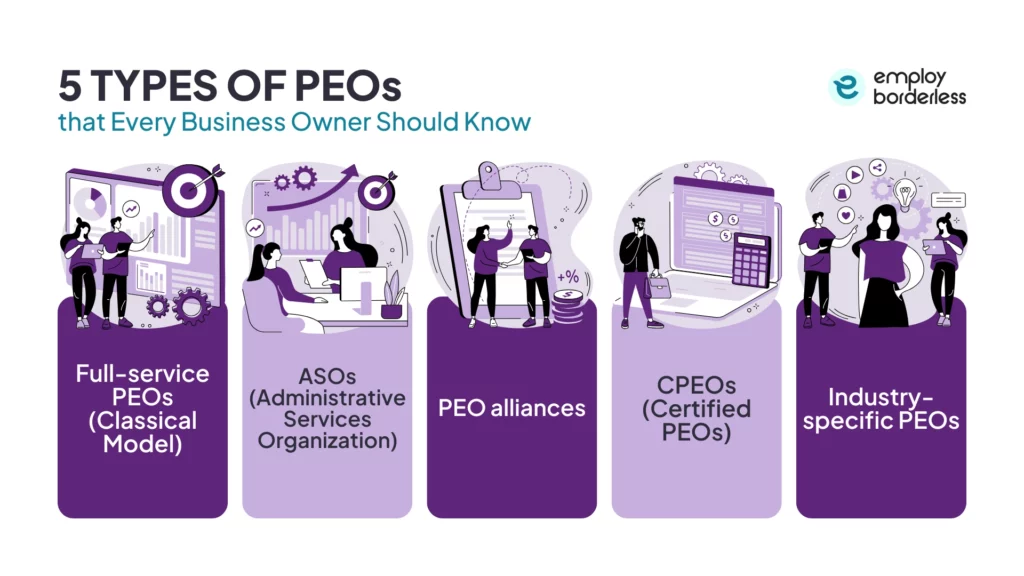
There are three PEO types (full-service, certified, and industry-specific) plus two related HR outsourcing models (ASOs and PEO alliances) that business owners should understand. The core difference is the co-employment structure and the degree of liability transfer, particularly for federal employment taxes. Note that some older state laws and IRS guidance use "employee leasing" as a synonym for PEO co-employment (the IRS itself uses this language in Rev. Proc. 2023-18). This is distinct from staffing agencies, which supply temporary workers who are the staffing firm’s employees, not the client’s.
1. Full-service PEOs
A full-service PEO enters into a co-employment agreement and processes payroll, files employment taxes under its own EIN as the statutory employer for withholding purposes under IRC § 3401(d)(1), and administers workers’ compensation, benefits, and HR compliance. The client company remains the common-law employer under longstanding IRS common-law rules (Rev. Rul. 87-41) and retains full control over hiring, firing, job assignments, and daily management. In a non-CPEO arrangement, the PEO operates as a third-party payer. If the PEO fails to deposit taxes, the IRS typically pursues the client as the common-law employer.
The primary advantage is access to benefits buying power. By pooling employees across all client companies, a full-service PEO negotiates group health insurance, dental, vision, life, disability, and 401(k) plans at rates typically available only to Fortune 500-level companies. PEOs typically offer a Multiple Employer Plan (MEP) for retirement benefits, where your business becomes an adopting employer of the PEO’s 401(k) plan rather than sponsoring its own. Per NAPEO, 52% of PEO clients with 10 to 49 employees offer a retirement plan, compared to 23% of similar-sized non-PEO businesses.
Contract flexibility ranges from bundled packages (where you receive all services the PEO offers) to carve-out arrangements where you keep existing benefits, workers’ comp, or other services outside the PEO and opt into only the specific PEO services you need. Most full-service PEOs default to bundled packages, though some (Justworks, Rippling) are more flexible on carve-outs while others (TriNet) have historically leaned toward bundled-only. Pricing is typically 3% to 8% of gross payroll or $80 to $200 per employee per month, depending on services and headcount.
2. Certified PEOs (CPEOs)
A CPEO is a PEO that has earned voluntary IRS certification under the Small Business Efficiency Act (SBEA), enacted in December 2014 with the IRS accepting applications from July 2016 and first certifications effective January 2017. The IRS maintains a public list of currently around 90 active certified CPEOs, out of roughly 500 total PEOs operating in the US. To earn certification, the CPEO must post an annual surety bond equal to the greater of $50,000 or 5% of its federal employment tax liability (capped at $1 million), maintain positive working capital, pass background checks on all responsible persons, and undergo periodic CPA audits.
The most important practical benefit is the elimination of the federal employment tax wage-base restart when transitioning to a CPEO. Under IRC § 3511(c), a CPEO is treated as a successor employer for federal wage bases (Social Security and FUTA). This matters for employees earning above the Social Security wage base ($184,500 in 2026). An employee earning $200,000 who switches mid-year from one non-CPEO PEO to another could generate up to $11,439 in duplicate employer Social Security tax, because the wage base restarts at the new PEO’s EIN. For a company with 10 such employees, that’s up to $114,390 in duplicate employer FICA. FUTA also restarts at $7,000 per employee. A CPEO eliminates this federal restart. State unemployment (SUTA) wage bases are not covered by SBEA and may still restart depending on the state’s own successor employer rules.
The CPEO assumes sole federal employment tax liability under IRC § 3511. If the CPEO fails to deposit federal taxes, the IRS looks to the CPEO, not the client. State employment tax obligations (SUTA, state disability, state-mandated paid leave) remain with the client under state law. IRC § 3511(d)(2) specifically preserves client eligibility for federal tax credits including the Work Opportunity Tax Credit (WOTC, § 51), Indian employment credit (§ 45A), paid family and medical leave credit (§ 45S), small employer health insurance credit (§ 45R), employer-provided childcare credit (§ 45F), and military spouse retirement credit (§ 45AA). For the R&D credit, the qualified small business payroll tax credit under §§ 41(h) and 3111(f) has explicit IRS pass-through procedures for CPEO clients via Form 8974. The income tax portion of the § 41 credit is claimed directly by the client.
3. Industry-specific PEOs
Industry-specific PEOs specialize in a single sector, tailoring their compliance expertise, workers’ comp programs, and benefits offerings to that industry’s workforce and regulatory requirements. Examples include construction PEOs (OSHA compliance, certified payroll, prevailing wage, multi-site workers’ comp where rates for specialty trades like roofing and structural steel can reach 15% to 25%+ of payroll depending on jurisdiction and experience rating), healthcare PEOs (HIPAA compliance, credentialing, shift scheduling), and hospitality PEOs (tip reporting, high turnover, seasonal staffing).
The advantage is the depth of expertise that generalist PEOs don’t match. The disadvantage is scope limitation. If your business diversifies into a second industry, the PEO’s specialization may not transfer. Industry-specific PEOs also charge higher fees because the specialized compliance and higher-risk workers’ comp coverage cost more to deliver.
4. PEO alliances
A PEO alliance is a network of PEOs that pool resources, technology platforms, and benefits to purchase power while each member PEO maintains its own operations and client relationships. Client businesses access the alliance through one member PEO but benefit from the collective scale for insurance negotiations and technology investments. For a full overview of what PEOs deliver, see PEO benefits.
The advantage is combining local expertise with national scale. The disadvantage is coordination complexity. Different alliance members may use different systems, offer different service levels, or interpret compliance requirements differently. If your business operates in multiple states served by different alliance members, the inconsistency can create administrative friction.
5. Administrative services organizations (ASOs)
An ASO is not technically a PEO type because it doesn’t use co-employment. It’s included in this guide because business owners evaluating PEOs frequently encounter ASOs as an alternative. An ASO provides HR outsourcing services (payroll processing, tax filing assistance, benefits administration, HR compliance guidance) while the client company remains the sole legal employer, files taxes under its own EIN, and retains all employment-related liability.
The key advantage is control. The client selects its own insurance carriers, negotiates its own rates, and picks individual services a la carte. The key disadvantage is zero liability transfer and no pooled benefits purchasing power. ASOs suit companies that already have an internal HR function and want to outsource administration without changing their employment structure. For companies exploring outsourcing for the first time, see our guide to finding a PEO for small businesses.
How does a PEO compare to other HR outsourcing models?
PEOs are one of several HR outsourcing options, and the differences matter for liability, cost, and scope of service.
Model | Co-Employment | What It Covers | Best For |
Full-Service PEO | Yes | Payroll, benefits, workers’ comp, HR compliance, tax filing, risk management. Bundled or carve-out. | SMBs (5-500) wanting full HR outsourcing with Fortune 500-level benefits. |
ASO | No | Selected HR services a la carte (payroll, benefits admin, compliance guidance). Client retains all liability. | Companies with internal HR that want to outsource specific admin tasks. |
HRO (single-function) | No | One or a few HR functions (payroll only, benefits only, recruiting only). | Companies that need help with one specific function, not full HR. |
Staffing Agency | No (different model) | Supplies temporary or contract labor. The agency is the employer of the placed workers. | Businesses with immediate or seasonal labor needs, not ongoing HR management. |
EOR | No (sole legal employer) | Becomes the sole legal employer for tax and compliance. Used for international hiring without a local entity. | Companies hiring in countries where they have no legal entity. |
The key distinction is scope. An HRO provider handles one function. An ASO handles multiple admin functions without co-employment. A PEO handles full-scope HR through co-employment, sharing liability and providing pooled benefits. A staffing agency supplies workers. An EOR becomes the sole legal employer for international hires.
When should you consider a PEO?
A PEO makes the most sense when your in-house team is spending too much time on HR administration instead of revenue-generating work. Consider a PEO if you’re hiring across multiple states and need help with varying labor laws and tax jurisdictions, if you want to offer competitive benefits but can’t get large-group rates on your own, if you’re preparing to scale quickly or adopt a remote working model, if you want to reduce compliance risk and legal exposure, or if your business is an international company looking to enter the US market. A 2019 NAPEO-commissioned study using 2018 cost data estimated the average ROI from PEO cost savings at 27.2%.
What should you look for in a PEO?
Evaluate prospective PEOs across seven criteria before signing.
Certifications and accreditations
Is the PEO IRS-certified as a CPEO (currently around 90 out of roughly 500 PEOs)? Is it ESAC-accredited (Employer Services Assurance Corporation, which verifies financial stability and ethical standards and accredits roughly 5% to 7% of PEOs, an even more selective credential than CPEO status)? Is it a NAPEO member?
Benefits plans and carriers
What health insurance carriers does the PEO offer? Are plans customizable or preset? What retirement options are available (MEP 401(k), Roth options, employer match flexibility)? Ask for coverage areas, levels, and underwriting criteria.
Industry expertise
Does the PEO have experience in your specific sector? Industry-specific compliance, workers’ comp programs, and regulatory knowledge can significantly impact the value you receive.
Customer service model
Do you get a dedicated account manager or HR representative? Or are you routed to a call center? Responsive, knowledgeable support is critical when compliance questions arise.
Technology platform
Is the HRIS user-friendly on both desktop and mobile? Does it include employee self-service (pay stubs, PTO requests, benefits enrollment, W-4 updates)? Does it integrate with your existing accounting and time-tracking systems?
Cost transparency
Does the PEO charge a percentage of payroll or a flat PEPM? Are there hidden fees for setup, benefit plans, technology, or EPLI? Request an itemized breakdown and a sample invoice before signing.
Workers’ comp structure
Does the PEO place clients into a shared risk pool, or does your business maintain its own experience modification rating? Your experience mod affects future premiums, so confirm whether you retain your own claims history.
What PEO contract terms should you review?
The client service agreement (CSA) defines the PEO relationship. Review these terms carefully before signing.
Pricing and fee structure
The CSA should specify whether fees are charged as a flat per-employee rate, percentage of payroll, or a combination. Check whether the agreement caps price increases and how much notice the PEO must give before raising rates.
Auto-renewal and cancellation
Many PEO contracts renew automatically unless canceled within a narrow window, typically 30 to 90 days before the term ends. Know the notice requirements and penalties for early exit.
Insurance and benefits
A PEO arrangement doesn’t guarantee lower health premiums. COBRA costs can increase significantly if you cancel PEO services, because your employees may lose access to the PEO’s group plan. Confirm who pays premiums, how costs are shared, and what happens if carriers change mid-year.
EPLI coverage
Most PEOs require clients to carry Employment Practices Liability Insurance, which protects against claims like harassment or wrongful termination. Some PEOs provide EPLI coverage; others require you to obtain it separately. Review deductibles and coverage limitations.
Data ownership and transition
Confirm who owns the HR and payroll data. Check the process for exporting data if you leave, what formats are supported, and how long you can access HRIS tools after canceling services. A well-structured exit clause protects you from being locked into a relationship that isn’t working.
How do you choose the right PEO type?
The decision comes down to three factors. How much federal employment tax liability do you want to transfer (CPEO only), how much control over benefits and HR systems do you want to retain (ASO for maximum control, full-service PEO for maximum outsourcing), and what is your industry’s risk profile (industry-specific PEO for regulated or high-risk sectors). For foundational guidance, see our main PEO guide.
If you’re switching providers mid-year, choose a CPEO specifically to avoid the federal wage-base restart. Before signing with any PEO, verify CPEO certification status (IRS maintains a public list), ESAC accreditation, and NAPEO membership. About 42 states have some form of PEO licensing or registration requirement. Check your state’s requirements. Nonprofits have specific PEO considerations. See our guide to finding a PEO for nonprofit organizations.
Is a PEO the same as an EOR?
No. A PEO creates a co-employment arrangement in which the client company remains the common-law employer. An EOR becomes the sole legal employer. PEOs are primarily a US domestic model requiring the client to have a legal entity. EORs are used for international hiring where the client has no local entity.
How much does a PEO cost?
PEO pricing uses two models. Percentage of payroll (typically 3% to 8% for small businesses) or per-employee-per-month flat fee ($80 to $200 PEPM). A 2019 NAPEO-commissioned study using 2018 cost data estimated the average ROI from PEO cost savings at 27.2%. The cost typically includes payroll processing, tax filing, workers’ comp administration, benefits administration, and HR compliance support. Request an itemized breakdown to identify any hidden fees for setup, technology, or EPLI.
What is the difference between a PEO and an HRO?
A PEO provides full-scope HR outsourcing through co-employment, including payroll, benefits, workers’ comp, and compliance as a bundled or carve-out package. An HRO provider handles one or a few specific functions (payroll only, recruiting only) without co-employment. If you need competitive benefits at better rates and full compliance support, a PEO is likely the better fit. If your HR team handles strategy and you just need someone to run payroll, an HRO or payroll-only provider may be sufficient.
Can a PEO help with international hiring?
Standard US PEOs handle domestic co-employment only. For hiring employees in countries where you don’t have a legal entity, you need an Employer of Record (EOR), not a PEO. Some providers offer both domestic PEO and integrated EOR services under one relationship. Justworks (Justworks EOR), Rippling, and Deel each offer PEO and EOR products on the same platform. For PEOs with global capabilities, see our guide to international PEOs.
Do I lose control of my business when I use a PEO?
No. You retain full control over hiring, firing, job assignments, compensation decisions, workplace culture, and daily operations. The PEO handles employment administration (payroll, taxes, benefits, compliance) but does not make business or personnel decisions. The co-employment relationship is an administrative structure, not a management one.

Co-founder, Employ Borderless
Robbin Schuchmann is the co-founder of Employ Borderless, an independent advisory platform for global employment. With years of experience analyzing EOR, PEO, and global payroll providers, he helps companies make informed decisions about international hiring.
Ready to hire globally?
Get a free, personalized recommendation for the best EOR provider based on your needs.
Get free recommendations