11 core services provided by PEO (professional employer organizations)

Robbin Schuchmann
Co-founder, Employ Borderless
A PEO (Professional Employer Organization) service provider is a third-party company that partners with businesses through a co-employment arrangement to handle important human resources functions. These providers manage payroll processing, employee benefits administration, tax filings, workers' compensation, and regulatory compliance.
PEO service providers also help businesses understand employment laws at federal, state, and local levels to reduce legal risks for their clients. They provide additional services such as recruiting support, training programs, risk management, and HR technology platforms for better workforce management.
The core services provided by PEO are compliance, payroll management, benefits administration, compensation, recruitment, hiring and onboarding, HR consulting, technology solutions, risk management, employee training and development, time and attendance tracking, and workplace safety programs.
If you're weighing whether a PEO is right for your company, understanding exactly what these organizations do is a good place to start. Here's a breakdown of what PEO services actually cover.
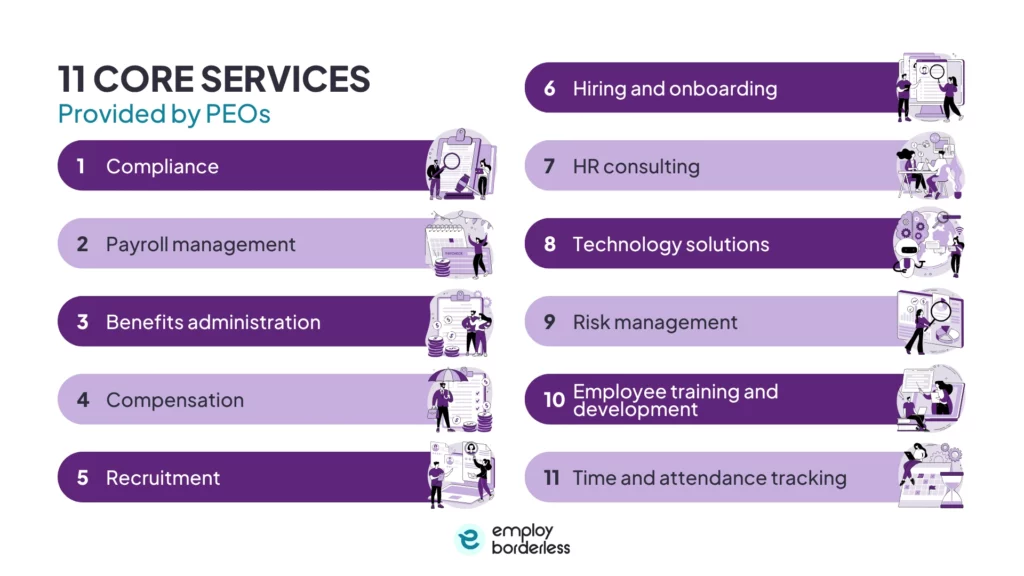
1. Compliance
Compliance means following all federal, local, or state laws that provide information about employee compensation, tax withholding, benefits administration, and labor standards.
Employment laws differ from state to state and are continuously updated by federal agencies like the IRS and the Department of Labor. PEO compliance plays an important role in keeping businesses compliant with changing regulations by covering updates regarding payroll, tax reporting, employee classification, benefits administration, and labor standards.
PEOs also handle the application of employment practices, such as federal and state tax reporting, and wage and hour requirements under the FLSA (Fair Labor Standards Act) and DOL (the U.S. Department of Labor). PEOs work quickly with businesses to prevent costly penalties and legal issues, by staying current with these laws.
2. Payroll management
Payroll management is the process of managing employee compensation, including calculating wages, deducting taxes, issuing payments, and keeping operations aligned with legal and regulatory requirements.
PEOs process the payroll of an organization, which includes calculating regular wages, overtime, commissions, and bonuses. Employees get paid accurately and on time through direct deposit or paper checks.
PEOs also manage tax withholding and filing on behalf of an organization by withholding the correct amount of federal, state, and local taxes from employee paychecks and filing these with the relevant agencies, like FLSA or IRS. They also issue W-2 forms to employees and confirm all payroll tax filings are done under their EIN (Employer Identification Number).
PEOs manage deductions for health insurance, retirement plans, and other employee benefits, making sure they are properly calculated and deducted from payroll. They see that businesses adhere to minimum wage laws, overtime rules, and tax regulations. This reduces the risk of costly penalties and audits, saves time, reduces administrative burden, and gives businesses access to payroll and HR experts.
3. Benefits administration
Benefits administration is the process of creating, managing, and updating an organization's employee benefits program, including health insurance, retirement plans, and other benefits.
This includes tasks like plan selection, enrollment, communication, and compliance with regulatory requirements.
PEOs perform the company's benefits administration through a co-employment model, where they share responsibility with the client company. This allows them to offer high-quality benefits at lower rates by combining employees from multiple businesses.
PEOs use their buying power to negotiate with insurance providers and offer more affordable benefits packages that small or mid-sized businesses cannot access on their own. PEOs also manage employee enrollment, including onboarding new hires, life event updates, and open enrollment periods. They provide ongoing support to help employees understand and use their benefits accurately.
Many PEOs use modern technology platforms that centralize benefits information. These self-service portals make it easy for employees to view plans, update information, and make selections online. Better-managed benefits improve employee satisfaction and retention.
4. Compensation
Compensation is the total payment and benefits an employee receives in exchange for their work or services.
PEOs help companies create a compensation model according to their mission, culture, and budget. This includes setting base salaries, bonuses, and incentives to motivate employees and match them with business goals.
PEOs also help professionals design compensation packages for employees, such as health benefits, retirement plans, paid time off, bonuses, and stock options or equity. They see that all pay practices follow federal, state, and local labor laws like the FLSA (Fair Labor Standards Act) and Equal Pay Act, and help with proper employee classification, wage accuracy, and overtime rules.
PEOs also provide performance-based pay systems that link compensation to employee and team achievements, encourage productivity, and support company success.
Through advanced HR technology, PEOs simplify payroll, tax calculations, and benefits management. This reduces errors, saves time, and gives employees easy access to their compensation information.
5. Recruitment
Recruitment is the process of finding, attracting, and hiring qualified candidates for job vacancies within an organization.
PEOs help businesses manage the complete recruitment cycle by creating job descriptions, posting openings on multiple platforms, sourcing candidates, screening resumes, conducting interviews, and checking backgrounds. This makes the hiring process easier for organizations and improves the quality of new hires.
These organizations give companies access to recruitment specialists who understand industry trends and best practices. That helps attract stronger candidates and reduces the chance of hiring mistakes.
PEOs also help speed up the time-to-hire by using tools like ATS (applicant tracking systems), recruitment software, and talent networks. This reduces delays and helps businesses grow faster. They follow hiring laws and equal employment regulations and help businesses avoid discrimination claims or penalties.
PEOs reduce the internal HR workload and cut expenses related to advertising, screening, and onboarding. They also advise companies on workforce planning, employer branding, and diversity recruiting for long-term growth.
6. Hiring and onboarding
Hiring and onboarding refer to the process of bringing new employees into a company, starting from recruitment and ending with their full integration into the team.
Companies use PEOs for the hiring process as PEOs write job descriptions, post vacancies, source candidates, screen resumes, and conduct background checks. This saves time and helps businesses hire qualified candidates. Once a candidate is selected, PEOs handle all new hire paperwork, such as offer letters, tax forms, direct deposit setup, and compliance documents.
PEOs also help new employees in the onboarding phase by providing them access to systems, introducing company policies, providing handbooks, and conducting orientation sessions. They also confirm legal compliance with hiring regulations, such as equal opportunity laws, local ordinances, and labor standards.
Some PEOs provide customized onboarding solutions according to the client's industry and culture, such as specific training, cultural introductions, or role-based onboarding plans. Good onboarding helps new employees feel more connected and confident and gives employers more assurance they've hired the right people.
7. HR consulting
HR (Human Resources) consulting means providing expert advice and support to businesses on different HR-related matters, such as recruitment, compensation, and performance management.
Businesses use PEOs to develop HR strategies according to their business goals, such as workforce planning, organizational design, and talent management advice. PEOs help create customized HR policies and employee handbooks according to current labor laws at the federal, state, and local levels.
PEOs give businesses advice on handling complaints, terminations, disputes, and disciplinary procedures legally and professionally, which helps businesses with employee relations issues. They also help businesses in performance management by creating appraisal processes, setting measurable goals, and training managers to give constructive feedback.
PEOs provide training and development programs, such as leadership training, compliance education, and skill-building workshops to support employee growth and retention. PEOs analyze salary trends and help HR teams set competitive pay structures, and advise on bonuses and incentive programs that match market standards.
PEOs also provide guidance to hiring managers on workplace safety and risk management. They help design safety programs, check compliance with OSHA (Occupational Safety and Health Administration) standards, and train staff on reducing hazards such as physical injuries, chemical exposures, biological risks, electrical dangers, and mechanical equipment risks.
8. Technology solutions
The technology solutions provided by PEOs include a range of cloud-based tools designed to simplify and automate HR tasks. These tools help businesses operate more accurately and stay compliant with labor laws.
PEOs offer payroll and tax administration systems that automate calculations, filings, and payments to reduce errors and save time. They provide benefits administration platforms that help manage employee enrollment, track benefits, and confirm regulatory compliance.
Time and attendance tracking tools monitor work hours, leave, and attendance, making payroll processing more accurate.
PEOs also use applicant tracking systems to make hiring easy by posting and managing candidate applications. They use onboarding platforms to help new employees complete paperwork and training digitally.
Some PEOs offer performance management tools for goal setting, employee evaluations, and feedback to support growth and retention. Their employee self-service portals give workers secure access to pay stubs, personal info, and benefits.
PEOs provide data security with encryption and regular audits. They also provide technical support to keep systems running smoothly. Businesses should check how well a PEO's technology integrates with their existing software, whether it can be customized, and whether the platform is user-friendly.
9. Risk management
Risk management is the process of identifying, assessing, and addressing risks such as errors, fraud, non-compliance, and data breaches to support accurate, timely, and secure payroll operations.
PEOs offer assistance to the administration with workers' compensation insurance. By using their larger employee data, PEOs secure more favorable rates for workers' comp coverage for small to mid-sized businesses. PEOs also focus on workplace safety by conducting safety audits, developing safety programs, and providing training to employees.
Businesses follow different employment laws and regulations, including OSHA standards, with the help of a PEO. These third-party organizations help them maintain proper documentation, confirm timely reporting, and reduce the risk of penalties.
PEOs conduct risk assessments to identify potential problems within a business. They then develop strategies to deal with identified risks and help businesses handle unforeseen challenges.
10. Employee training and development
Employee training and development is the process of improving employees' skills, knowledge, and abilities through organized learning programs and career growth initiatives.
A PEO provides access to structured learning platforms, including LMS (Learning Management Systems) that give employees on-demand access to different training modules, from compliance courses to leadership development.
Businesses can identify skill gaps within the organization with the help of a PEO. It performs assessments and performance evaluations to help businesses pinpoint areas where employees need additional training.
PEOs offer customized training programs according to the specific needs of the business, including workshops on topics such as harassment awareness, I-9 compliance, and leadership development. These training programs are cost-effective because the PEO provides high-quality training at a lower cost than a business would spend to build and run similar programs internally.
PEOs also help with career development initiatives such as mentorship programs, succession planning, and tuition reimbursement. These initiatives show that an organization is committed to employee growth and job satisfaction.
11. Time and attendance tracking
Time and attendance tracking is the process of tracking and recording hours worked by employees in the organization. It involves tracking the employees' arrival, departure, break, or any taken time off.
PEOs use advanced technologies to provide automated time clock systems. These systems replace manual tracking with digital software that lets employees log in and out using biometric devices, mobile apps, or web-based portals. They use HRIS (Human Resource Information Systems) to build employee self-service portals, which help employees complete their timesheets electronically and receive reminders when timesheets are due.
These third-party organizations connect directly with a company's payroll systems, automatically recording and calculating employee work hours for salary processing. Companies use these organizations to reduce manual data recording, which saves time and cuts the risk of errors.
PEOs also help businesses manage their workflows by generating detailed reports on employee clock-ins and clock-outs, leaves, and time taken off. Mobile-based applications give employees easier access to their own records, which supports satisfaction and productivity.
What are the benefits of using PEO services?
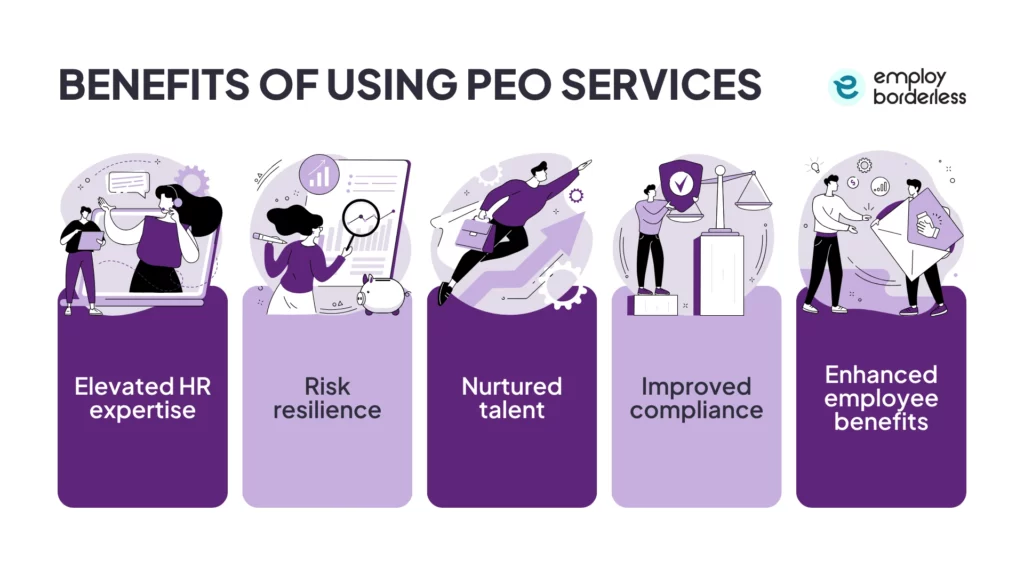
The benefits of using PEO services are elevated HR expertise, risk resilience, nurtured talent, improved compliance, and enhanced employee benefits.
The benefits of using PEO services are listed below.
- Elevated HR expertise: PEOs have experienced HR professionals who offer their expertise to companies in different HR-related functions like compliance, employee relations, benefits administration, and workforce planning. It helps businesses reduce costs, improve payroll accuracy, and reduce the administrative burden.
- Risk resilience: PEOs help small businesses remove financial risks by giving them low worker's compensation and health insurance coverage. It helps HR teams create policies regarding workplace safety, supports compliance with changing regulations, and reduces fines and penalties.
- Nurtured talent: PEOs can help businesses increase employee engagement and reduce the turnover rate by offering better benefits and improving the workplace environment. PEO clients have a 10 to 14 percent lower turnover rate and it retains approximately 89% of clients from year to year, according to a factsheet titled "PEO Facts" published by NAPEO (National Association of Professional Employers Organization).
- Improved compliance: A PEO has expertise in employment laws, tax regulations, and workplace requirements at the federal, state, and local levels. Businesses confirm that their payroll, benefits administration, and HR practices comply with current legal standards. PEOs help businesses reduce the risk of penalties and lawsuits by providing compliance strategies and resources.
- Enhanced employee benefits: PEO gives small and mid-sized businesses access to lower health insurance premiums, better coverage options, and national insurance carriers they couldn't access on their own. Employees can enjoy benefits like health insurance, 401(k), and wellness programs by using PEO services. Better benefits help businesses stay competitive in the job market, improve employee satisfaction, reduce turnover, and help attract top talent.
What are the KPIs for measuring PEO performance?
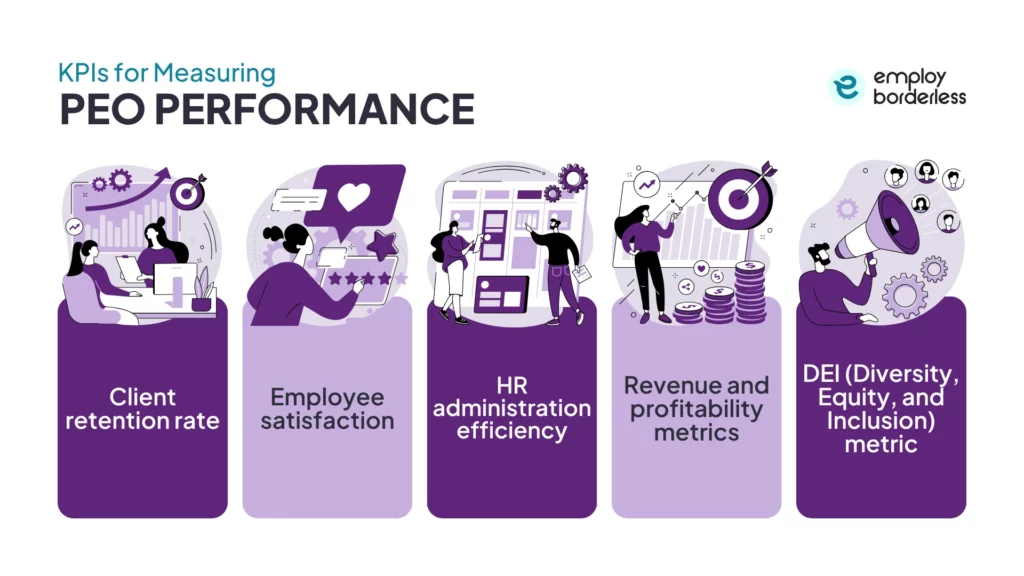
The KPIs for measuring PEO performance include client retention rate, employee satisfaction, HR administration efficiency, revenue and profitability metrics, and DEI (Diversity, Equity, and Inclusion) metrics.
The KPIs for measuring PEO performance are listed below.
- Client retention rate: The retention rate measures how well a company is keeping clients over time. It's a direct indicator of client satisfaction and your ability to deliver ongoing value. A high retention rate means that clients are satisfied with the PEO's services and their values. A low retention rate identifies issues with the PEO's service, pricing, or client engagement.
- Employee satisfaction: Employee satisfaction is the level of satisfaction that employees have with their job and the company. High satisfaction levels are associated with higher employee morale, productivity, and retention. Low satisfaction levels can lead to higher turnover rates and decreased employee engagement.
- HR administration efficiency: This metric measures the effectiveness and speed at which the PEO handles core HR tasks, such as payroll processing, benefits enrollment, compliance reporting, and employee onboarding. High HR efficiency means HR processes are accurate, errors are reduced, and businesses have fewer administrative burdens. A low score in HR efficiency means processes may be slow, error-prone, or frustrating for both employers and employees.
- Revenue and profitability metrics: Revenue and profitability metrics measure financial performance indicators such as gross revenue, profit margins, and revenue per employee. High values of this metric suggest strong client demand and operational efficiency. Low revenue or profitability shows weak service demand, poor cost control, or structural issues that affect service quality over time.
- DEI (Diversity, Equity, and Inclusion) metric: DEI measures how well the PEO applies inclusive hiring practices, equitable policies, and supportive workplace environments. High DEI scores show a strong commitment to a fair and inclusive work culture. A low DEI performance may damage the PEO's reputation, limit access to diverse talent, or create legal risks related to discriminatory practices.
How much do PEO services cost?
PEO services cost depends on different factors, including pricing models, company size, industry, and required services. PEOs charge either a flat fee per employee per month, ranging from $40 to $160, or a percentage of total payroll, between 2% and 12%. Additional expenses include setup fees between $1000 and $5000, administrative fees, and charges for optional services such as recruiting or specialized HR support.
Costs of PEO services depend on factors such as workforce size, industry risk level, service complexity, and geographic location. For example, businesses in high-risk industries like construction may incur higher fees due to increased workers' compensation and compliance requirements.
PEO pricing also depends on the scope of services it offers, including payroll processing, benefits administration, tax filing, and legal compliance support. Companies should request detailed quotes from providers to understand all costs and check compatibility with their HR and operational needs.
How to choose the right PEO provider?
To choose the right PEO provider, assess your business's specific needs in different areas such as payroll, benefits administration, compliance, and HR support. Check that the PEO offers services that match these requirements and provides solutions that can grow with your business.
Verify the PEO's credentials by checking the accreditations like the ESAC (Employer Services Assurance Corporation) and IRS certification, which shows financial stability and compliance with industry standards. Request detailed service agreements and a complete breakdown of fees to identify any hidden costs.
Evaluate the PEO's experience in your industry and ask about their current client base and retention rates. A familiar provider can better understand industry-specific regulations and challenges. Then, consider the quality of customer support the provider offers. Check whether they will provide you with a dedicated account manager and access to subject matter experts.
How does a PEO compare to other outsourcing models like HRO or EOR?
A PEO compares to other outsourcing models like HRO (Human Resource Outsourcing) or EOR (Employer of Record) through a co-employment relationship where the PEO shares employer responsibilities with the client company, while HRO (Human Resource Outsourcing) performs specific HR functions such as payroll, recruiting, and training without co-employment. HRO providers manage HR services independently, while PEOs combine HR functions under a shared employer model, such as access to better benefits, compliance support, and risk management.
EORs serve companies in hiring employees internationally or in states without a local legal entity. EORs act as the official employer for payroll, compliance, and taxes, which helps businesses hire quickly without running local operations. PEOs require clients to maintain a legal entity and share employer responsibilities under a co-employment agreement. This makes EORs ideal for global expansion, while PEOs focus on domestic HR management.
Is PEO the right fit for a small business or startup?
Yes, PEO is the right fit for a small business or startup because PEO for small businesses provides access to affordable benefits, handles payroll and compliance, and reduces HR burdens. This allows startups to focus on growth while keeping legal compliance and employee support in place.
Do PEOs offer more flexibility than traditional HR?
No, PEOs do not offer more flexibility than traditional HR as in the PEO vs. traditional HR comparison, PEOs can limit a company's ability to customize HR policies, benefits, and systems. Traditional HR departments allow businesses to customize HR practices to their specific needs and culture.
How does using a PEO improve the employee experience?
Using a PEO improves employee experience by providing access to benefits, simplifying HR processes, and supporting professional development. PEOs offer advanced benefit packages, including health insurance and retirement plans, to improve employee satisfaction and retention. They also support employee growth through training programs and career advancement opportunities.
What payroll services do PEOs typically offer?
The payroll services PEOs typically offer are payroll processing, tax withholding and filing, direct deposit, wage garnishment management, and time tracking integration. PEOs also confirm compliance with employment laws and regulations and reduce the risk of penalties.

Co-founder, Employ Borderless
Robbin Schuchmann is the co-founder of Employ Borderless, an independent advisory platform for global employment. With years of experience analyzing EOR, PEO, and global payroll providers, he helps companies make informed decisions about international hiring.
Ready to hire globally?
Get a free, personalized recommendation for the best EOR provider based on your needs.
Get free recommendations