What is the effect of using a PEO on employee experience?

Robbin Schuchmann
Co-founder, Employ Borderless
A PEO (Professional Employer Organization) is a third-party organization, also known as an outsourcing model, that offers complete HR services to businesses under a co-employment agreement. These HR services include employee recruitment and onboarding, payroll processing, and employee benefits administration.
PEOs play an important role in employee experience as they offer employees access to high-quality benefit packages, which include retirement plans and health insurance. This outsourcing model also supports employee training, development, and provides feedback systems that help employees feel valued and supported in their workplace.
Some of the best strategies PEOs use to improve employee experience are personalized workspaces, flexible scheduling support, standardized recruitment and onboarding, team building programs, HR technology and self-service tools, and workplace safety programs.
The main benefits PEOs offer to improve employee experience are competitive benefit packages, fair employee treatment, and positive workplace culture. Despite these benefits, there are also some challenges to using PEO in employee experience, which include employee loyalty concerns, cultural misalignment, and unclear roles and responsibilities.
What is the role of a PEO in employee experience?
The role of a PEO in employee experience is to give employees access to premium benefits, which include health insurance, retirement plans, and wellness programs that are only available to larger companies. The PEO makes sure that employees’ daily work experience is smooth by accurately managing payroll, PTO (Paid Time Off), onboarding, and issues related to compliance, which results in higher retention rates.
PEOs also offer learning resources, performance reviews, and HR advice to support employee development and engagement. This outsourcing model helps employees by handling paperwork and compliance, so they can only prioritize important work, meet deadlines, and focus on professional growth.
How do PEOs improve employee experience?
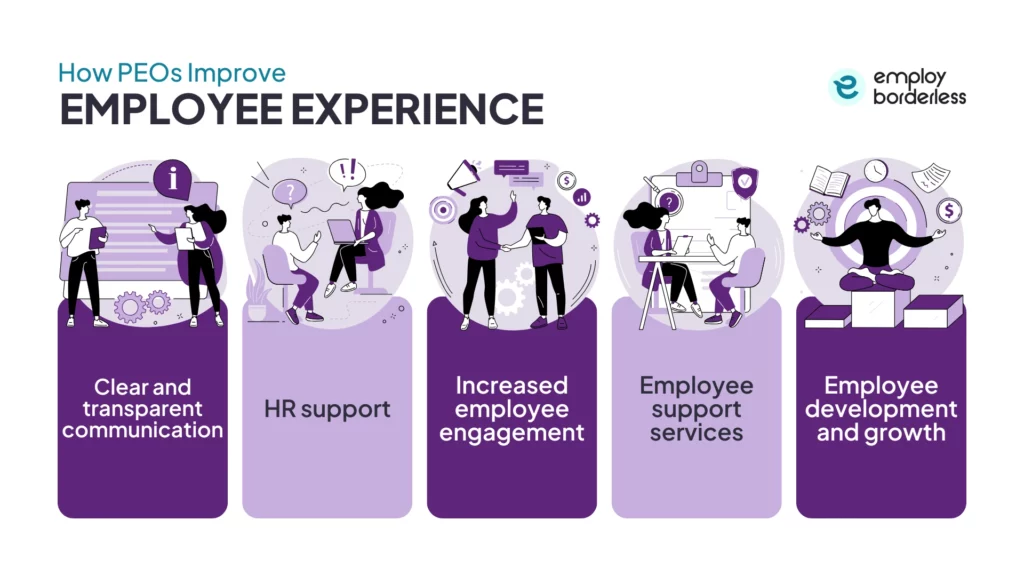
PEOs improve employee experience through clear and transparent communication, HR support, increased employee engagement, employee support services, and employee development and growth.
Clear and transparent communication
PEOs make sure employees receive important updates on time, such as changes to benefits, payroll information, or policy adjustments, to help employees stay informed about their job status and opportunities. PEOs provide companies with different communication channels, such as emails, instant messaging, intranet portals, and employee communication apps, to reach a wide range of employee groups. These communication channels make it easy for all staff members to receive and understand important information.
This third-party service provider offers procedures and tools like questionnaires, feedback systems, and open lines of communication that allow staff members to convey their problems, ask questions, and offer feedback. The PEO reduces misunderstandings by accurately translating complex information related to benefit changes or regulatory compliance into simple and understandable language for staff members. This transparency increases employee engagement and promotes a positive working culture.
HR support
HR support means offering services to manage human resources operations within a company, such as recruiting and onboarding, training and development, and performance management.
The PEO manages time-consuming HR tasks like payroll processing, tax filing, benefits enrollment, and claims processing. It makes sure that employees receive accurate payment and there are no issues or delays related to their wages. This outsourcing model helps in hiring, onboarding, training, engagement strategies, and performance reviews. These services help employees grow professionally and feel valued, which increases motivation and retention.
This outsourcing solution provides HR specialists to ensure that their clients comply with employment policies, like harassment and remote work, tax regulations, such as FUTA (Federal Unemployment Tax Act) and SUTA (State Unemployment Tax Act), and labor laws, like FLSA (Fair Labor Standards Act), to prevent wage and hour violations. The PEO also creates workplace safety standards, according to the OSHA (Occupational Safety and Health Administration) standard, to protect employees’ rights.
Increased employee engagement
Increased employee engagement means a higher level of workers’ emotional commitment and involvement in their work and company.
PEOs help companies regularly collect employee feedback through surveys to understand employee needs and identify areas for improvement. The relationship between employees and the company becomes stronger as the PEOs offer benefits, career growth, and communication according to their needs.
This third-party service provider gives employees access to quality retirement plans and other competitive benefits to show that the company values their long-term financial security and well-being. These benefits increase employee engagement because workers feel appreciated and supported.
Employee support services
Employee support services mean resources and programs that a company offers to help employees deal with both personal and professional difficulties.
A PEO offers employee support programs, such as EAPs (Employee Assistance Programs), short-term therapy, and confidential counselling related to professional and personal concerns like stress and family difficulties. They provide resources, which include digital insurance platforms, credit counselling, and financial planning to reduce financial stress and increase employee retention and productivity.
PEOs provide telehealth access and health consulting, which support employees’ mental and physical health to create a healthy workplace. They also help client companies implement strategies like team-building activities and employee recognition programs to increase employee satisfaction and engagement.
Employee development and growth
Employee development and growth mean the continuous process of improving an employee’s knowledge and skills for better performance and preparing them for future responsibilities.
The PEO allows employees to grow professionally by offering resources for career development and focused training programs, which include leadership training, safety training, technical skills development, soft skills training, and performance management training.
This outsourcing model provides tools for tracking skills and abilities through digital platforms, like Engage PEO, which allow for customized learning plans that match both individual and company objectives. This third-party service provider also offers easily available training libraries and facilitates performance reviews and leadership development using LMS (Learning Management Systems).
What strategies do PEOs use to improve the employee experience?
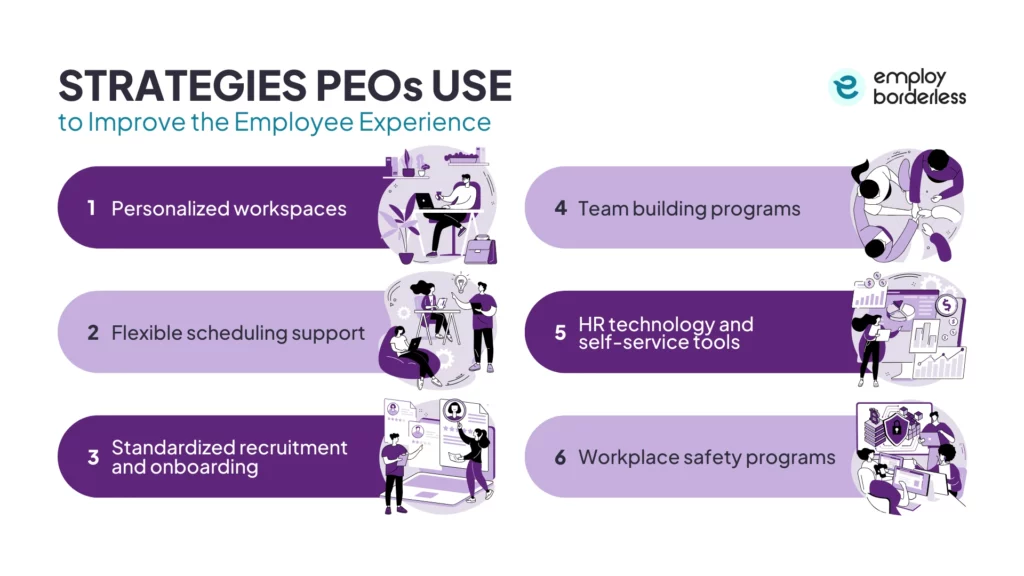
The strategies PEOs use to improve the employee experience are personalized workspaces, flexible scheduling support, standardized recruitment and onboarding, team building programs, HR technology and self-service tools, and workplace safety programs.
Personalized workspaces
Personalized workspaces mean a workspace that is customized according to an employee’s unique needs and working style.
This outsourcing model provides guidance and resources for designing customized work environments that are furnished with advanced technology and movable furniture, like supportive seats, adjustable desks, and flexible layouts. These options are suited to each employee’s particular requirements for health and productivity. This also helps reduce physical discomfort and promote creativity while increasing employee health and productivity.
Flexible scheduling support
Flexible scheduling support means giving employees control over their workday’s start and end times and sometimes their workplace site.
Companies legally implement flexible schedules like part-time choices, fewer workweeks, remote work, and flexible time by partnering with a PEO. The third-party service provider helps create clear regulations that maintain a balance between operational requirements and employee flexibility. It also offers technological platforms for scheduling and timekeeping, and monitors the administration of payroll and benefits for employees with different schedules or locations.
This strategy of PEO helps companies increase productivity, access top talent, and reduce turnover costs. It also gives employees more freedom over where and when they work, which improves their work-life balance, job satisfaction, and engagement.
Standardized recruitment and onboarding
Standardized recruitment and onboarding means creating uniform processes for attracting, hiring, and onboarding skilled candidates into a company.
PEOs help companies implement organized recruiting processes, such as communicating job offers clearly, submitting documents online, and completing pre-employment screening. This standardized procedure makes sure that new hires get all the information, tools, and resources they require in a quick and easy way. These resources include payroll setup, benefits enrollment, and training related to their specific role in the company.
The third-party service provider simplifies communication between managers and HR staff, automates manual tasks, and provides new hires access to self-service portals. This standardized onboarding process immediately increases employee engagement because it provides clear objectives, creates a sense of community, and promotes early productivity.
Team building programs
Team-building programs are activities, events, or exercises designed to build strong relationships, promote communication, collaboration, and trust among employees within a team or company.
A PEO creates customized team-building programs that are performed in-person, virtually, or in a remote setting, depending on the needs of the workforce. These activities range from social gatherings and interactive games to problem-solving seminars and trust-building exercises. Employees are able to respect and trust one another through these programs, while adjusting to the company culture to create a positive and engaging work environment.
HR technology and self-service tools
HR technology and self-service tools involve digital platforms and systems used by employers and employees to handle HR-related tasks, such as compliance tracking, time and attendance, and employee records management.
The PEO gives companies access to advanced digital systems that automate daily administrative duties, which include time tracking, benefits enrollment, payroll processing, and compliance management. Employees have access to self-service tools to examine their invoices, change personal information, request time off, and manage benefits at any time and from any location. This reduces the delays as they no longer depend on HR staff for standard enquiries and documentation. These tools produce a smooth, modern work environment that improves employee engagement and increases retention and satisfaction.
Workplace safety programs
PEOs create and implement safety programs according to each company’s unique needs and risks while ensuring compliance with industry, state, and federal regulations. The PEO offers continuous safety education and training, which gives employees the skills they need to reduce risks by understanding safety procedures and emergency protocols.
The outsource model implements regular safety training, environmental evaluations, and incident reporting systems, such as OSHA-compliant digital reporting systems, live safety displays, and danger tracking applications. These programs create a safe and predictable workplace where staff members feel supported and protected, and also help in active risk management and follow-up. These safety standards reduce the chance of accidents, injuries, and long-term health problems, which greatly improves employee morale and well-being.
How do PEOs contribute to employee advancement opportunities?
PEOs contribute to employee advancement opportunities by training and development, performance feedback, career growth support, mentorship and coaching, and employee recognition programs.
PEOs provide access to a wide range of training modules that focus on technical skills, such as software competence, compliance, or industry-specific technologies, and soft skills, which include teamwork, communication, and leadership. Employees have to stay up to date with changing industry standards and advances in technology through these customized learning programs to improve employee performance and continuous learning.
This third-party service provider offers correct and helpful feedback to improve employee development through regular and annual performance reviews. Employees use tools like SMART goal tracking platforms and IDP (Individual Development Plans) to stay focused on their career advancement.
A PEO also helps employees in planning their career development and preparing them for internal promotions in the company. The PEO supports their development, so they move into leadership roles when employees show great expertise and skills. The employees also have access to HR consultants who offer guidance based on their individual objectives and professional interests. This support makes it easier for employees to grow, succeed, and feel valued in their workplace.
PEOs offer important career guidance by pairing employees with experienced mentors and certified professional coaches who are experts in their fields. These coaches help employees manage workplace difficulties, build confidence, and develop important leadership skills, such as problem-solving, strategic thinking, team building, and conflict resolution.
This outsourced solution implements publicly recognized employee achievements, which increases their morale and encourages them. Professional growth achievements are directly connected to promotions, performance bonuses, and meaningful rewards to promote the importance of continuous development. Recognition programs, such as employee of the month awards, spot awards, service awards, gift cards, or learning milestone celebrations, help build a work environment that celebrates progress, effort, and success.
In what ways do PEOs manage employee concerns and issues?
The ways in which PEOs manage employee concerns and issues are strategic HR support, clear policies and procedures, conflict mediation and resolution, compliance with employment laws, and confidential reporting channels.
The PEO provides employees access to HR professionals and employee relations specialists, so employees can easily communicate their issues and concerns related to harassment, workplace misbehavior, discrimination, or conflict resolution. These professionals make sure to handle these issues quickly and carefully, and build a safe working environment for the employees.
This third-party service provider helps companies implement and create employee handbooks, grievance procedures, and code of conduct policies to make sure employees and other staff members in the company understand how to properly report and handle problems.
PEOs act as unbiased and third-party mediators in disputes between employees or between employees and management to make sure that conflicts are solved smoothly and fairly. Their skilled HR specialists use strategies for conflict resolution, which include interest-based negotiation, structured dialogue, and formal mediation procedures. These strategies reduce the possibility of legal issues or employee turnover while promoting a healthy workplace culture.
Some PEOs offer hotlines and anonymous reporting platforms such as AllVoices, FaceUp, and STOPitSolutions to encourage employees to report workplace concerns confidentially without any fear of penalties. The outsourced model makes sure to solve employee issues and concerns according to federal and state employment regulations, such as the EEOC (Equal Employment Opportunity Commission), and helps companies avoid legal risks, such as wrongful termination, discrimination claims, and failure to accommodate employees under the ADA (Americans with Disabilities Act).
What benefits do PEOs offer to improve employee experience?
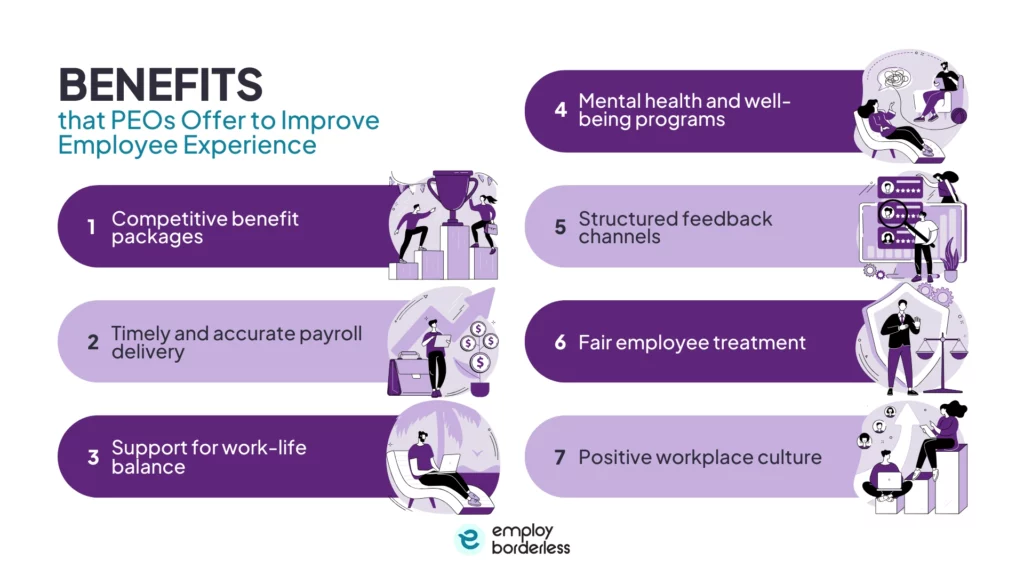
The benefits PEOs offer to improve employee experience are competitive benefit packages, timely and accurate payroll delivery, support for work-life balance, mental health and well‑being programs, structured feedback channels, fair employee treatment, and positive workplace culture.
Competitive benefit packages
Competitive benefit packages mean employee benefit programs that are better than those offered by other employers in the market, such as health insurance and retirement plans.
The PEO employs employees from multiple client companies and forms a large workforce to give employees, particularly small and medium-sized companies, access to premium benefit packages. The client companies can negotiate lower prices and more coverage for wellness programs, retirement plans, health insurance, life insurance, and dental and vision.
These competitive benefit packages increase employees’ security and satisfaction, and help a company attract, keep, and motivate workers by showing that the company values them and is prepared to make investments in their future and well-being.
Timely and accurate payroll delivery
PEOs conduct accurate and timely payroll delivery and make sure employees receive their correct pay on scheduled payday, which builds trust between employers and employees. PEOs use standardized payroll systems that automatically calculate wages, tax withholdings, benefits deductions, and overtime, which reduces human error and legal issues.
The PEO provides compliance expertise to monitor all tax filings, and tax forms, such as W-2s and 1099s, and compliance with taxes, which include FICA (Federal Insurance Contributions Act), FUTA (Federal Unemployment Tax Act), and SUTA (State Unemployment Insurance Act). The PEO ensures that the client company complies with regulatory requirements, and employees’ paychecks show accurate tax calculations. This outsource model quickly identifies and solves differences, to keep payroll accurate and compliant for both employers and employees.
Support for work-life balance
Support for work-life balance means programs that help employees successfully balance their professional duties with their personal and family lives, to improve well-being and reduce stress.
The PEO helps companies implement flexible work arrangements, such as PTO (Paid Time Off), flexible scheduling, and remote or hybrid work options. These agreements are designed to satisfy the requirements of both companies and employees to improve work-life balance and reduce stress.
This outsource model also supports client companies with flexible paid leave policies to help employees in case of serious life events, which involve illness, disability accommodations, and caregiving responsibilities. These policies comply with state and federal labor laws, such as the FMLA (Family and Medical Leave Act) and remote work tax regulations. PEOs give employees access to behavioural health programs, EAPs (Employee Assistance Programs), and other wellness programs that support both physical and mental health and improve well-being.
Mental health and well-being programs
Mental health and well-being programs are organized programs that employers offer to help employees’ psychological, emotional, and mental health in the workplace, and promote a positive mindset and well-being.
A PEO offers EAP programs, which provide private counselling, treatment, and support services to employees who are dealing with mental health issues, such as anxiety, depression, or stress at work. This facilitates employees as they get timely care and consultation without facing serious challenges. PEOs provide competitive group benefits packages that include therapy sessions, mental health screenings, mental health resources, mindful programs, and other behavioural health services by using their workforce and insurance partners.
Employees of small and medium-sized companies get access to affordable mental health care that promotes a supportive and psychologically safe working environment by partnering with a PEO. These programs also improve employees’ emotional well-being, morale, and workforce productivity.
Structured feedback channels
Structured feedback channels mean platforms that allow employers and employees to provide daily feedback for workplace improvement.
PEOs help companies establish regular performance review cycles, such as quarterly or annual evaluations, to guarantee that employees receive timely feedback on their work. This helps employees better understand their areas of strength and growth, which is important for work productivity.
Some PEOs offer or interact with technological platforms that make it easier for companies to track employees’ goals, like OKRs (Objectives and Key Results), collect structured feedback, provide immediate comments, and document performance. PEOs improve the quality of communication by training HR staff on how to provide helpful feedback, which is related to professional development, to increase employee retention and motivation.
Fair employee treatment
Fair employee treatment means making sure every employee is treated equally and with respect at work.
The PEO gives companies access to skilled HR and legal specialists to ensure compliance with important employment laws, such as wage and hour laws, workplace safety standards, anti-discrimination laws, and the EPA (Equal Pay Act). This legal control lowers the chances of lawsuits, protects employee rights, and reduces bias or unfair treatment.
This third-party service provider helps companies create uniform, transparent workplace policies and employee handbooks, which include equal opportunity, disciplinary actions, attendance, and harassment avoidance. These policies make sure that companies provide a fair work environment where employees feel supported and encouraged, which improves engagement, loyalty, and productivity.
Positive workplace culture
A PEO handles time-consuming HR functions like payroll, benefits administration, and compliance, so companies focus on creating a positive work environment. PEOs help employees feel valued by providing them with programs like engagement surveys or employee recognition platforms. This outsource model encourages professional and personal development that improves employee loyalty, reduces turnover rates, and improves mental health.
What are the challenges in employee experience when using a PEO?
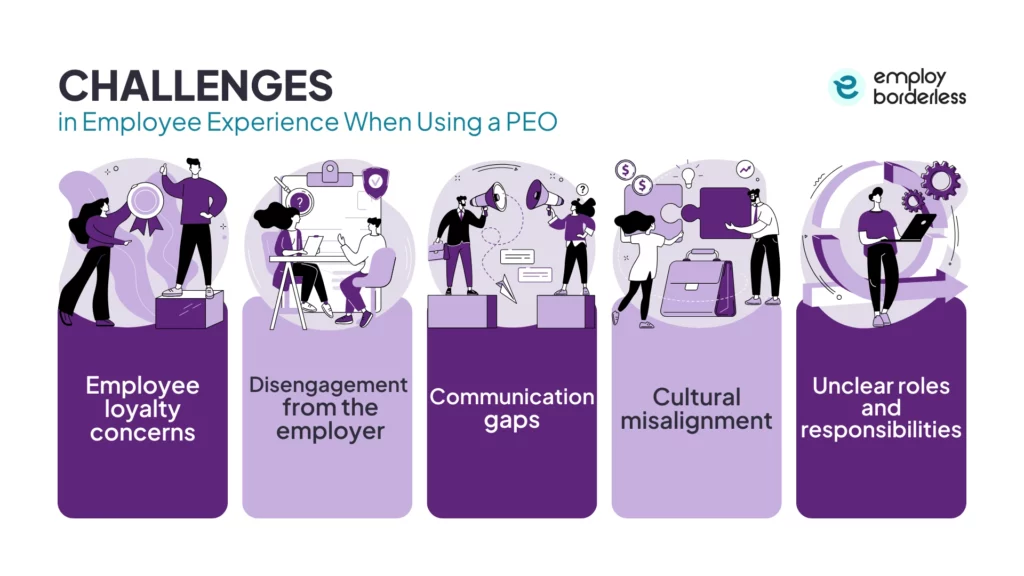
The challenges in employee experience when using a PEO are employee loyalty concerns, disengagement from the employer, communication gaps, cultural misalignment, unclear roles and responsibilities.
The challenges in employee experience when using a PEO are listed below.
- Employee loyalty concerns: Employee loyalty concerns mean employees’ commitment and loyalty decrease when companies partner with a PEO. The PEO becomes the co-employer for administrative purposes, which makes employees feel less connected with their company and culture. This results in lower employee involvement, a low sense of brand identity, and decreased loyalty, particularly when the employer fails to make employees understand the PEO’s responsibilities.
- Disengagement from the employer: Disengagement from the employer means employees become confused about the role of the employer, as the company and PEO are co-employers. The employees sometimes develop a stronger bond with the PEO than with their real employer. It also makes the employees feel less engaged when PEO is solving their workplace issues, and particularly if the company does not have a strong internal culture and communication.
- Communication gaps: Communication gaps mean both the employees and employers lack effective communication, because they are depending on a PEO. Employees sometimes receive incorrect information from both the company and the PEO about important workplace policies and changes. Employees suffer because they miss important benefits information due to miscommunication, and they sometimes feel uncertain about whom to contact for help.
- Cultural misalignment: Cultural misalignment occurs when a company, its employees, and a PEO have different values, work styles, and goals. When a company partners with a PEO, it sometimes does not match its policies and values according to the client company’s culture so employee confusion, low engagement, and a misalignment of expectations at work occur.
- Unclear roles and responsibilities: Unclear roles and responsibilities mean employees who are working under a PEO are not sure what tasks they are supposed to perform and who to report to, which causes confusion and mistakes at work. The employees also sometimes miss important assignments, repeat work, or place the responsibility on another employee, which limits productivity and affects teamwork.
How to choose between a PEO and in-house HR for employee engagement?
To choose between a PEO and in-house HR for employee engagement, consider cost structure, employee benefits scope, compliance and risk management, cultural alignment and customization, responsiveness, and strategic engagement control.
Determine your HR operations cost and carefully consider both models. Choose A PEO as it provides packaged services at a lower total cost than hiring and managing an internal HR team to reduce administrative expenses. Select in-house HR if you are able to afford internal HR recruitment, buy software, and compliance tools.
Identify the benefits that are most important to your employees. Use a PEO because it gives access to large-group benefits, such as retirement plans and premium health insurance, to increase employee satisfaction. Consider choosing in-house HR to have complete control over creating specific benefit plans to the unique requirements of your employees, but it offers basic benefits packages.
Assess if your company has the expertise to maintain compliance with payroll, tax, and labor requirements. Choose a PEO as it ensures companies comply with employment regulations, such as FLSA (Fair Labor Standards Act) and OSHA (Occupational Safety and Health Administration Act) to reduce legal risks and penalties. Use an internal HR staff if you have internal legal resources or want complete control over compliance, risk management, and policy decisions.
Consider how important it is that your company’s values and culture are shown in its HR procedures and policies. Select a PEO if your company needs standardized solutions and operates well without highly customized HR policies. This is ideal for companies that value stability in different sites or where cultural alignment is less important. Choose in-house HR to create policies that closely match the company culture.
Consider the responsiveness of an HR department. Use a PEO as it carefully manages employee concerns remotely, which sometimes feels less personal but is helpful for remote team members. Choose in-house HR because they offer quick, in-person support, which improves responsiveness and employee engagement.
What is a PEO?
A PEO is a third-party organization that offers HR services under a co-employment agreement. The PEO (Professional Employer Organization) handles payroll processing, employee benefits, and compliance, while the client company maintains control over daily operations, such as employee management, sales and marketing, and product development.
What are the benefits of a PEO?
The benefits of a PEO are HR expertise, legal support, compensation, benefits administration, and recruiting and onboarding. PEO benefits also include compliance and risk management, payroll and tax administration, and cost savings.
Do PEOs help reduce turnover and increase employee retention?
Yes, PEOs help reduce turnover and increase employee retention by offering a complete HR solution. Businesses that use PEO have 10 to 14% lower employee turnover as compared to those who do not use this third-party HR model, according to a white paper titled “Professional Employer Organizations: Keeping Turnover Low and Survival High”, published by the NAPEO (National Association of Professional Employer Organizations).
What is the employment relationship of a PEO?
The employment relationship of a PEO is a co-employment arrangement, which means both PEO and the client company share employer responsibilities for the same employees. The client company is the main employer and manages all business decisions, like hiring, firing, employee compensation, and company culture, while the PEO becomes the employer of record for tax and benefit purposes.
Can employees directly interact with the PEO?
Yes, employees can directly interact with the PEO as it provides employees access to self-service portals to monitor benefit details, handbooks, HR documents, and payroll. PEOs also provide employees with feedback channels, discussion forums, EAP counselling, and grievance support. PEOs also offer a professional HR support team for employees’ enquiries related to payroll, benefits, workers’ compensation, leave policies, and other concerns.
What is the difference between PEO and HRO?
The difference between PEO and HRO is that a PEO becomes a co-employer and manages payroll, benefits, and compliance for the client company’s employees, while sharing legal responsibilities with the company. HRO only helps with specific HR duties, such as processing payroll or helping with hiring, and the company is the only employer and keeps full responsibility.

Co-founder, Employ Borderless
Robbin Schuchmann is the co-founder of Employ Borderless, an independent advisory platform for global employment. With years of experience analyzing EOR, PEO, and global payroll providers, he helps companies make informed decisions about international hiring.
Learning path · 9 articles
PEO fundamentals
Master the fundamentals with our step-by-step guide.
Start the pathReady to hire globally?
Get a free, personalized recommendation for the best EOR provider based on your needs.
Get free recommendations