PEO vs HRO: definitions, differences, similarities, benefits, and drawbacks

Robbin Schuchmann
Co-founder, Employ Borderless
A PEO (Professional Employer Organization) is a third-party company that manages a business's HR functions through a co-employment agreement, covering payroll processing, benefits administration, and compliance. HRO (Human Resource Outsourcing) is the practice of hiring an outside provider to handle some or all HR tasks without any co-employment relationship. The core difference: a PEO becomes a co-employer and shares legal liability; an HRO stays an independent vendor while the client remains the sole legal employer.
PEO vs HRO at a glance
A PEO co-employs staff and charges 2% to 12% of payroll or a per-employee fee for full, packaged HR services, while an HRO stays an independent vendor charging pay-as-you-go for selected services. PEOs share legal liability and offer group-level benefits; HROs leave compliance and taxes with the client.
| Feature | PEO | HRO |
| Employment model | Co-employment | Independent third-party vendor |
| Cost structure | Percentage of payroll (2% to 12%) or a PEPM (Per Employee Per Month) fee | Charges based on the selected service, pay-as-you-go |
| Scope of HR services | Full, packaged HR services | Selective or bundled services chosen by the client |
| Employee benefits access | Fortune 500-level group benefits | Support administering the client's own benefit plans |
| Legal responsibility | Shared with the employer under co-employment | Stays fully with the client for taxes, compliance, and liabilities |
| Flexibility and control | Less flexibility; standardized plans and policies | More control and customization over vendors and processes |
| Growth fit | Grows with clients that need full HR support | Fits companies with existing in-house HR capacity |
| Effect on culture | Introduces external policies that can shift company culture | Integrates around the client's existing culture |
What is a PEO?
A PEO is a third-party company that provides full-service HR outsourcing under a co-employment model, handling payroll administration, employee benefits, compliance, and risk management for a client business.
A PEO works by forming a co-employment partnership with the client and sharing employer responsibilities such as payroll processing, workers' compensation claims, health and retirement benefits, and tax compliance. The PEO acts as employer of record and files taxes under its own EIN (Employer Identification Number), while the client manages daily operations and employee performance.
What is HRO?
HRO is the practice of businesses hiring an external provider to handle some or all of their HR functions, from specific services like payroll and benefits administration to fuller responsibilities such as recruitment, training, and employee development.
HRO works by delegating specific tasks or entire HR functions to an outside provider. The client decides what to outsource, such as payroll, benefits administration, compliance, or recruiting. The provider sets up systems, connects technology, and matches its processes to the client's requirements, while the client keeps control of strategic HR decisions.
Where PEO and HRO differ
PEO and HRO differ mainly in employment model, cost structure, and legal liability. A PEO co-employs staff, bundles payroll, benefits, and compliance, and shares legal responsibility, while an HRO stays an independent vendor charging pay-as-you-go for services the client selects, leaving compliance and legal risk with the client.
- Employment model and setup: PEOs are co-employers of record for tax and benefit purposes while the client keeps authority over daily operations. HRO providers act as independent vendors, never entering a co-employment arrangement; the client stays the sole legal and worksite employer.
- Cost structure: PEOs charge a percentage of payroll, typically 2% to 12%, or a flat fee per employee. The upfront cost is high but can lead to long-term savings through bundled services and group benefits. HRO uses a pay-as-you-go model, so companies pay only for the services they select, which suits larger businesses that already run in-house HR teams.
- Scope of HR services: A PEO bundles payroll, tax filing, benefits, compliance, hiring, onboarding, training, and risk management. HRO lets a company pick specific services, for example outsourcing payroll or compliance to an HRO while keeping recruitment in-house.
- Employee benefits access: PEOs group employees from many client companies to negotiate large-group health insurance and retirement plans at rates usually reserved for larger organizations. HRO providers do not sponsor benefits directly; they administer whatever plans the client already selects, which sometimes cost more without a PEO's group purchasing power.
- Legal responsibilities: PEOs share compliance liability under the co-employment agreement, filing payroll taxes under their own EIN and handling workers' compensation and unemployment insurance for the client. HRO providers carry no shared legal responsibility; the client remains fully liable for taxes, compliance, and legal risk.
- Flexibility and control: A PEO requires clients to use its benefit plans and standardized policies, trading some flexibility for simplicity and compliance support. HRO gives clients control to choose vendors, plans, and processes that match their own policies and culture.
- Growth fit: A PEO's bundled services grow automatically alongside a client's headcount and needs. HRO's a la carte model lets companies add outsourced functions selectively as they grow.
- Effect on workplace culture: PEOs bring standardized HR policies and benefits across all client organizations, which can create uniformity but sometimes clashes with a company's own culture, denting morale or engagement. HRO does not touch company culture directly since it offers vendor support without a co-employment tie, leaving the client in charge of HR policy and practice.
Where PEO and HRO overlap
PEO and HRO overlap in outsourcing payroll, compliance support, and HR expertise to an external provider, reducing internal administrative work. Both help with risk mitigation and workforce guidance, though a PEO shares legal liability while an HRO offers advisory support only.
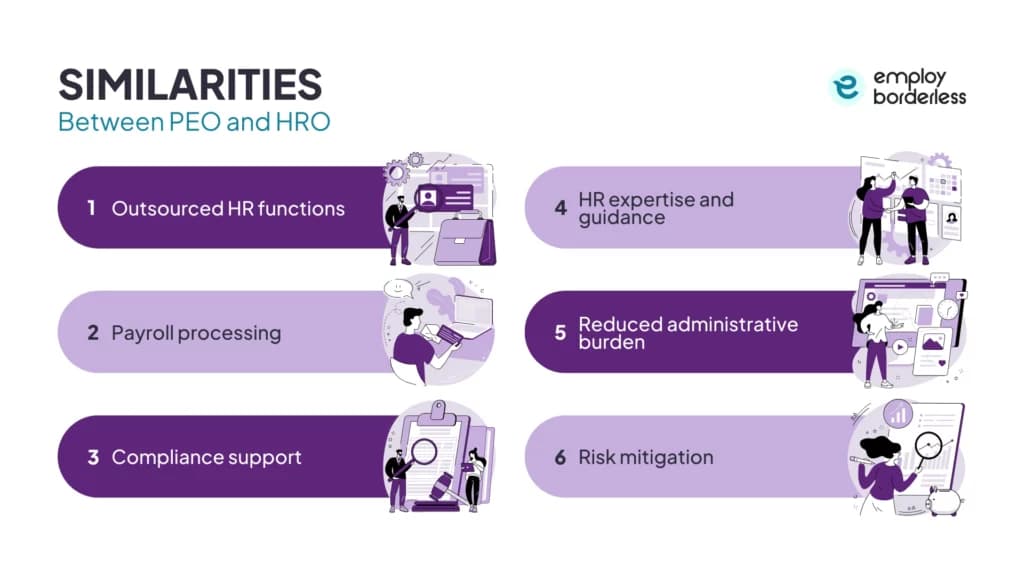
- Outsourced HR functions: Both hand off HR tasks to an external provider so the client can focus on core operations. A PEO bundles payroll, benefits, and compliance, keeping the business aligned with regulations like FLSA (Fair Labor Standards Act). HRO gives clients the flexibility to outsource only what they need, from payroll to talent acquisition, onboarding, training, and compliance.
- Payroll processing: Both PEOs and HRO providers calculate wages, withhold deductions, and file payroll taxes on the client's behalf, cutting administrative workload and payroll errors.
- Compliance support: A PEO helps clients follow employment laws such as OSHA (Occupational Safety and Health Administration) and FMLA (Family and Medical Leave Act), guiding compliance with federal, state, and local labor rules. HRO providers advise on best practices and legal requirements too, but they carry no liability if a violation occurs, since the client is the sole legal employer.
- HR expertise and guidance: Both give clients access to professional HR knowledge for workforce management, employee engagement, and strategic planning. PEOs offer guidance on HR policies, employee relations, and organizational development, and their experience helps companies implement effective HR strategies according to their business goals, such as improving compliance management and creating a positive working environment by giving access to premium employee benefits, like health insurance and retirement plans, like 401 (k).. HRO providers bring specialized expertise in talent acquisition, performance management, and employee development.
- Reduced administrative burden: Outsourcing payroll, benefits enrollment, and compliance to either model frees internal teams to focus on sales, marketing, or product work instead of paperwork.
- Risk mitigation: PEOs share employment-related liability, helping with workers' compensation, unemployment insurance, and labor law compliance. HRO providers offer guidance on risk management, updated workplace policies, and employee relations to reduce lawsuit exposure, even without sharing legal liability.
How HCM platforms fit in
An HCM (Human Capital Management) platform is software that runs payroll, benefits, and workforce data inside a company's own systems, alongside tools like ATS (Attendance Tracking System) and HRIS (Human Resource Information System). It automates and connects HR processes but does not take on any employer liability. A PEO differs by becoming a co-employer under its own EIN and sharing legal responsibility; an HRO differs by staying an outside vendor that runs chosen tasks on the client's behalf without owning the employment relationship. Many PEOs and HRO providers use HCM-style technology to deliver their services, but the platform itself is a tool, not an employer or a vendor arrangement.
PEO vs HRO vs ASO vs EOR vs fractional HR
A PEO co-employs staff for full HR outsourcing, while an HRO stays an independent vendor handling selected tasks. An ASO offers administrative support without co-employment, an EOR becomes the legal employer for hiring where the client has no entity, and fractional HR places a part-time leader inside the business for strategy.
| Model | Employment relationship | Typical use |
| PEO | Co-employer, files under its own EIN | Full HR outsourcing: payroll, benefits, compliance, risk management |
| HRO | Independent vendor, no co-employment | Selected HR tasks while the client stays the sole legal employer |
| ASO (Administrative Services Organization) | No co-employment; client keeps full control and liability | Payroll processing, benefits administration, and compliance support with direct client control retained |
| EOR (Employer of Record) | Legal employer of the client's workers | Hiring in regions where the client has no legal entity; global or remote expansion |
| Fractional HR | Contracted individual, not a vendor relationship | Part-time or interim in-house HR leadership for strategy rather than outsourced processing |
An ASO offers administrative HR support, such as payroll and benefits administration, without forming a co-employment relationship, so the client keeps full control over employment decisions and liabilities. An EOR becomes the legal employer of the client's workers and takes on compliance, payroll, benefits, and tax filings, which lets a company hire in a country or state where it has no legal entity. Fractional HR places a part-time or contracted HR leader inside the business for strategic guidance, unlike a PEO or HRO, which run outsourced processes rather than sit inside the org chart. Some companies also work with HRO advisors, independent consultants who review provider contracts, pricing, and service scope before recommending a vendor.
Benefits of using a PEO
A PEO offers benefits such as improved onboarding, better benefit coverage through pooled purchasing power, simplified payroll administration, and support with employment compliance. These advantages can lower HR costs and improve employee satisfaction compared to managing HR fully in-house.
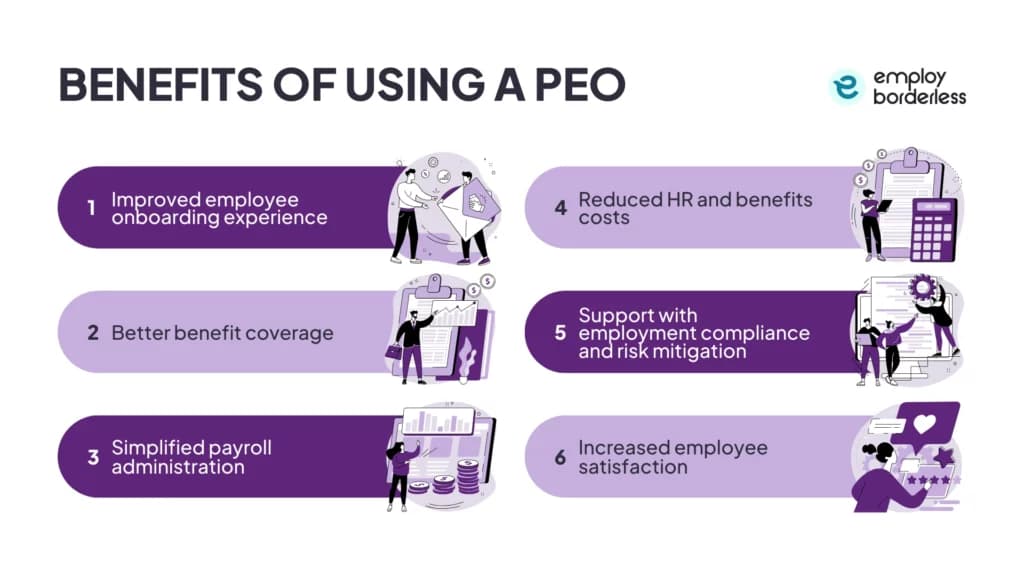
- Improved employee onboarding: PEOs use digital platforms and standardized workflows, including pre-filled forms, self-onboarding portals, checklists, and digital signatures, so new hires adjust quickly.
- Better benefit coverage: PEOs pool employees from multiple client companies to negotiate competitive rates on health and disability insurance, 401(k) retirement plans, and dental and vision coverage, plus extras like mental health and wellness programs, flexible spending accounts, and life or disability insurance.
- Simplified payroll administration: PEOs manage wage calculations, tax withholdings and filings, direct deposits, pay slips, and wage-and-hour compliance, cutting errors and freeing time for core activities.
- Reduced HR and benefits costs: Outsourcing to a PEO lowers spending on internal HR staff, office space, and technology, while group purchasing power reduces benefit costs below what a small or mid-sized business could negotiate alone.
- Support with employment compliance and risk mitigation: PEOs bring knowledge of the ACA (Affordable Care Act), the EPA (Equal Pay Act), and the OSHA (Occupational Safety and Health Act), plus EPLI (Employment Practices Liability Insurance) covering claims like wrongful termination or discrimination, along with safety training and workplace audits.
- Increased employee satisfaction: Competitive benefits, accurate HR processes, and technology platforms that give employees easy access to HR resources support work-life balance and free internal teams for employee development.
Benefits of using an HRO
An HRO gives companies access to specialized HR expertise, advanced technology, and flexible service selection without the cost of a full in-house team. This setup supports operational focus, cost savings, and legal and regulatory guidance as the business grows.
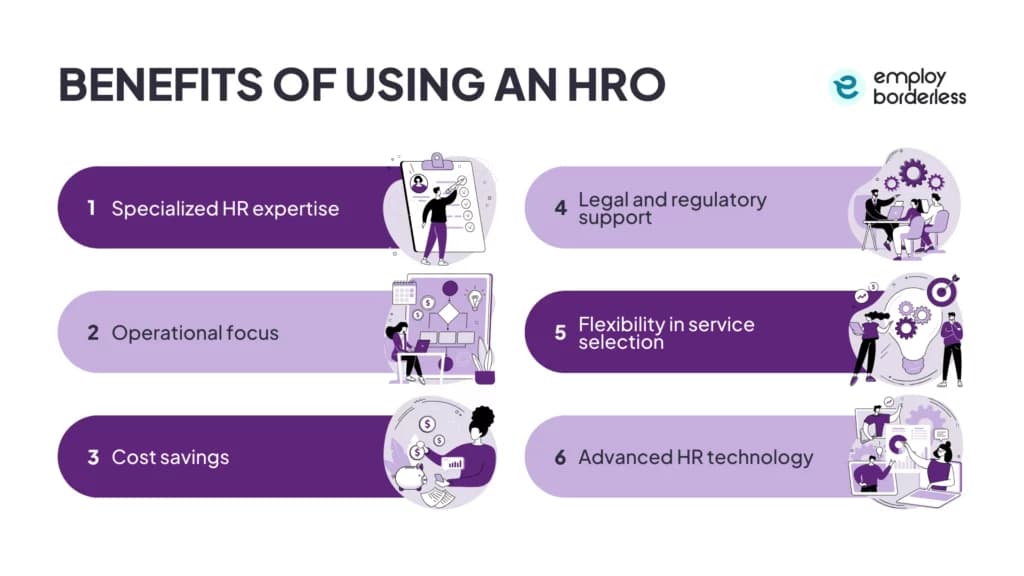
- Specialized HR expertise: HRO providers bring professionals skilled in compliance, talent management, and employee relations, plus tools like ATS, HRIS, and HCM platforms.
- Operational focus: Delegating HR tasks lets a company put resources into growth and customer satisfaction instead of processing payroll and invoices, maintaining databases, and preparing reports.
- Cost savings: Outsourcing avoids the cost of hiring, training, and maintaining a full in-house HR team, and technology like HRIS and HCM speeds up processes while cutting errors.
- Legal and regulatory support: HRO providers monitor multi-state regulations, flag non-compliance risks, and put current employee handbooks and workplace policies in place.
- Flexibility in service selection: Companies choose payroll, benefits administration, or compliance support individually, avoiding the cost of a full HR department.
- Advanced HR technology: Automated payroll, benefits administration, and time tracking, plus analytics tools that support workforce planning, performance management, and retention decisions.
Drawbacks of using a PEO
Using a PEO can mean less control over HR functions, standardized services that limit customization, and shared liability risks tied to co-employment. Dependency on a single provider and hidden fees in payroll or benefit pricing are other common drawbacks.
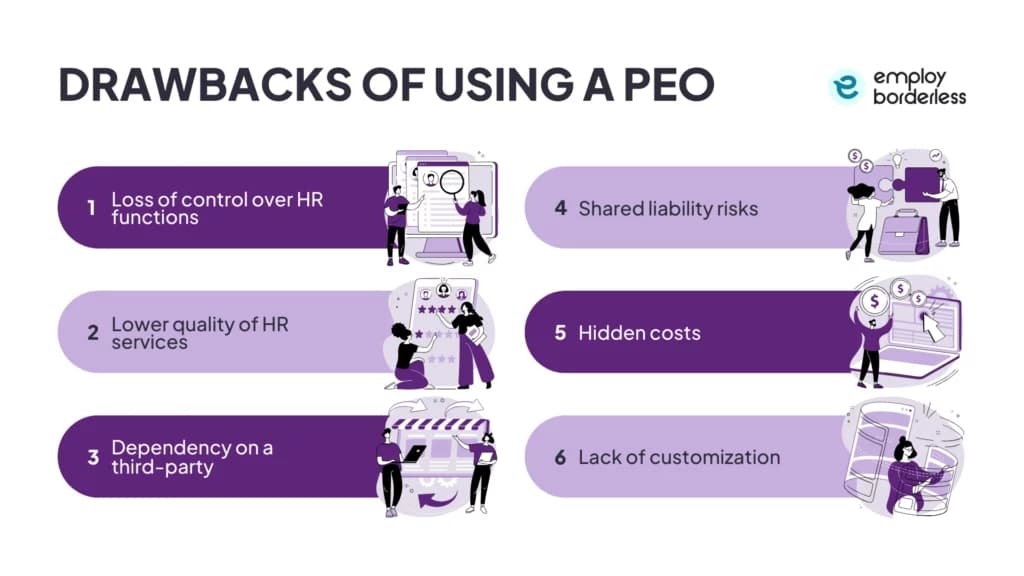
- Loss of control over HR functions: Standardized systems limit flexibility on benefit plans, vendor choice, and HR technology, and the co-employment tie means the PEO shares responsibility for employment decisions.
- Lower quality of HR services: Handling many clients at once can mean less personalized service or slower responsiveness, with employee inquiries redirected instead of handled by a dedicated representative.
- Dependency on a third-party: Relying on a PEO for payroll, compliance, and benefits creates exposure to administrative errors, data breaches, or compliance gaps that damage employee trust and risk fines.
- Shared liability risks: Errors in compliance or payroll taxes handled by the PEO can still leave the client legally responsible for wrongful termination or discrimination claims, financial penalties, and reputational harm.
- Hidden costs: Pricing built on a percentage of payroll or per-employee fees can bury extra charges like onboarding fees, benefit markups, add-on charges, and exit penalties in complex clauses.
- Lack of customization: Standard, one-size-fits-all services can be hard to adjust to a business's specific policies, benefits, or workflows.
Drawbacks of using an HRO
Using an HRO can raise data security and privacy risks, since the client shares employee information with a third party while keeping full compliance responsibility. Other drawbacks include reduced control, higher costs for customized services, and communication challenges across providers.
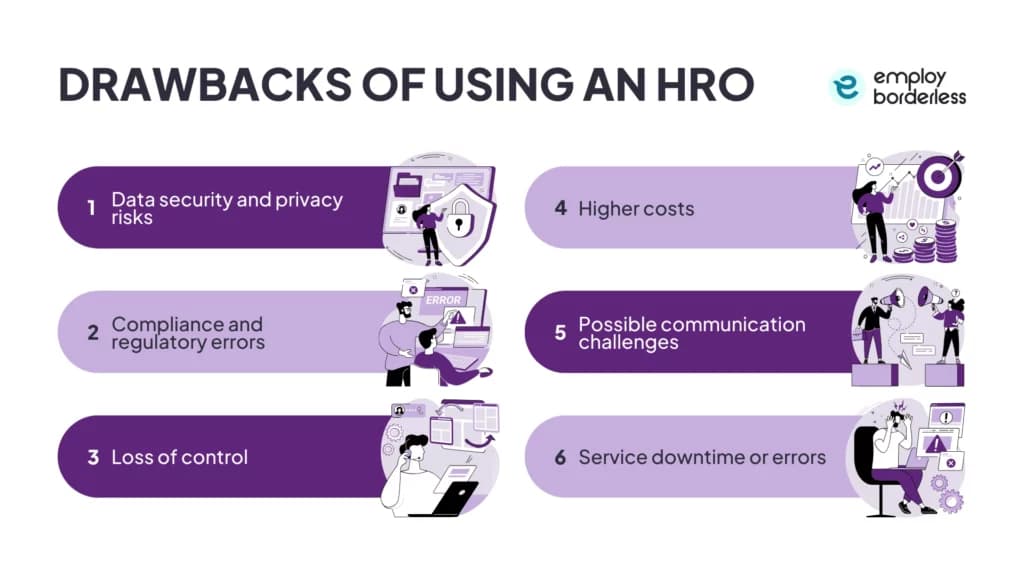
- Data security and privacy risks: Sharing personal, financial, or medical employee data with a third party reduces control over access and raises the risk of breaches, misuse, and compliance violations.
- Compliance and regulatory errors: The client stays fully responsible for compliance, so a provider's misfiled payroll taxes or missed labor law updates still result in penalties, lawsuits, or audits for the client.
- Loss of control: Less direct management of HR processes can slow issue resolution and create misaligned policies if the provider does not fully understand the client's culture.
- Higher costs: Customized services often come at a premium versus basic HR options, and managing multiple providers adds complexity and integration cost.
- Communication challenges: Distance, differences in company culture, and confidentiality concerns can slow issue resolution and cause misunderstandings in policy rollout.
- Service downtime or errors: System outages or software malfunctions can disrupt payroll processing and benefits administration, delaying employee payments and creating compliance issues.
When a PEO fits
A PEO fits startups and small businesses without an in-house HR team, medium-sized businesses managing growing complexity, companies expanding into new markets, and industries with high employee turnover such as retail or hospitality.
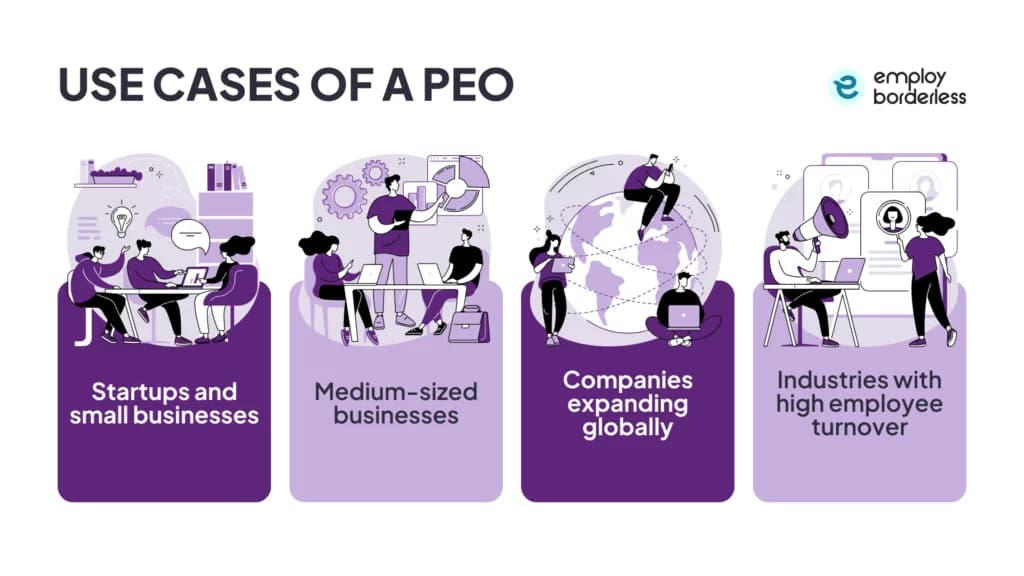
- Startups and small businesses: Access expert HR support and cost-effective benefits without building an in-house team, reducing compliance risk while founders focus on growth.
- Medium-sized businesses: As staff grows, PEOs handle the added complexity in payroll, risk management, employee relations, and regulatory compliance without expanding the internal HR team.
- Companies expanding globally: PEOs manage local hiring, payroll, benefits, and compliance with international labor law, speeding up market entry.
- Industries with high employee turnover: Retail, hospitality, and manufacturing use PEOs to simplify hiring, onboarding, and benefits administration in high-churn environments.
When an HRO fits
An HRO fits growing companies that want specialized HR expertise without a full in-house team, organizations with remote or distributed workforces, enterprises that need recruiting expertise, and companies needing temporary HR support during periods of change.
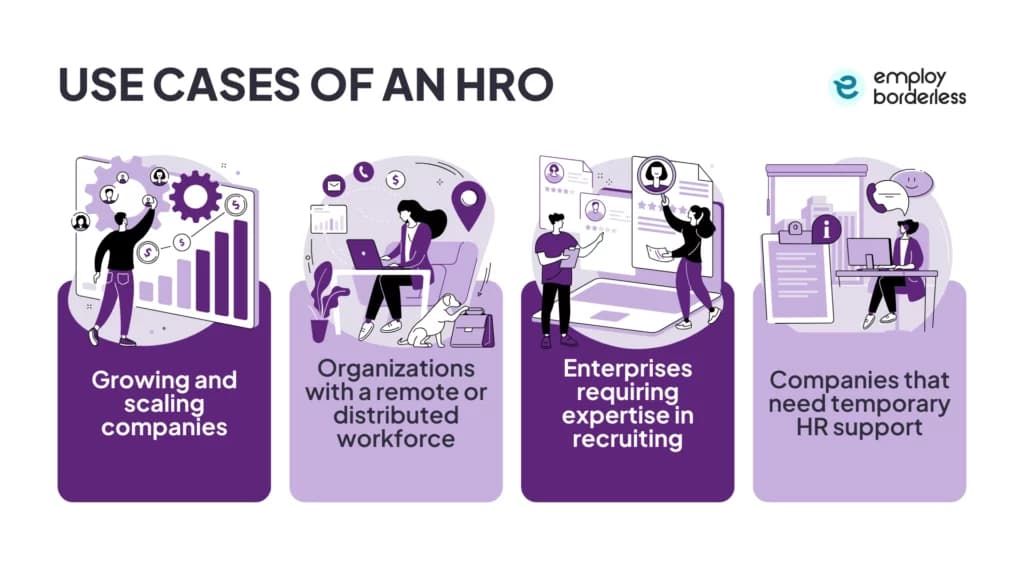
- Growing and scaling companies: Access specialized HR expertise and technology without the cost of a full in-house team while compliance and payroll stay accurate.
- Organizations with a remote or distributed workforce: HRO providers offer digital onboarding, compliance support, and performance management tools across multiple locations.
- Enterprises requiring recruiting expertise: Providers specialized in candidate sourcing, screening, and placement bring technology and industry knowledge to hiring.
- Companies that need temporary HR support: Flexible staffing, including temporary HR professionals, covers recruitment, onboarding, and compliance during periods of high demand or organizational change.
PEO vs in-house HR and fractional HR
A PEO handles payroll, benefits, and compliance through a co-employment model, sharing responsibility to reduce workload. Traditional, in-house HR keeps full control but requires more internal resources and staff. Read the full PEO vs traditional HR comparison for detail. A fractional HR leader, brought on part-time or under contract, sits inside the business for strategic direction rather than running outsourced payroll or benefits processes, which separates it from both the PEO and HRO models.
How to choose between a PEO and an HRO
Weigh HR needs, cost structure, compliance requirements, provider credibility and experience, and security measures. Choose a PEO for full HR support through a co-employment arrangement; choose an HRO for specific services, such as recruitment or compliance guidance, without shared legal responsibility.
On cost, a PEO typically charges a percentage of payroll or a per-employee fee that bundles benefits and payroll management; an HRO charges for the services selected, offering more cost flexibility but requiring in-house HR management for anything not outsourced.
On compliance, a PEO shares responsibility for employment law and regulations, reducing legal risk; an HRO offers advisory support only, leaving the client fully responsible for employment-related requirements.
On credibility, look for an IRS-certified PEO or one with experience in the client's industry; for an HRO, look for specialized expertise in the specific HR functions being outsourced.
On security, a PEO should show strong protocols such as SSL encryption and compliance with standards like GDPR (General Data Protection Regulation); HRO security varies by provider, so each vendor's data protection policy needs its own review.
PEO vs PPO
A PEO manages HR functions such as payroll, benefits, compliance, and risk management through co-employment. A PPO is a type of health insurance plan offering a network of healthcare providers, letting members see specialists and out-of-network doctors without referrals.
HR vs HRO
HR is an internal department managing hiring, training, payroll, and compliance. HRO means contracting an external provider for some or all of those functions, letting a business lean on outside expertise while focusing on core operations.
Which is better, PEO or HRO?
Choose a PEO for a full-service HR arrangement covering payroll, benefits, and compliance. Choose an HRO if the business already has an in-house HR team and needs specific, flexible services without a co-employment arrangement.
What does PEO stand for?
PEO stands for Professional Employer Organization, a third-party company offering payroll, benefits administration, and compliance services under co-employment. PEO in HR also covers recruitment, onboarding, training, and employee development.

Co-founder, Employ Borderless
Robbin Schuchmann is the co-founder of Employ Borderless, an independent advisory platform for global employment. With years of experience analyzing EOR, PEO, and global payroll providers, he helps companies make informed decisions about international hiring.
Learning path · 9 articles
PEO fundamentals
Master the fundamentals with our step-by-step guide.
Start the pathReady to hire globally?
Get a free, personalized recommendation for the best EOR provider based on your needs.
Get free recommendations