Certified PEO: definition, functions, benefits, drawbacks, and how to choose the right certified PEO

Robbin Schuchmann
Co-founder, Employ Borderless
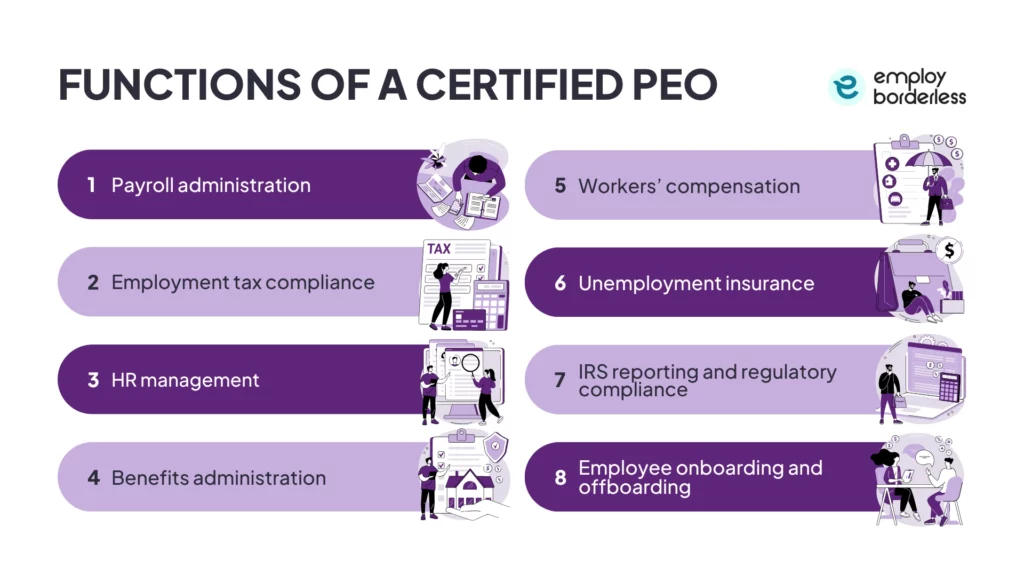
A CPEO (Certified PEO) is a professional employer organization that routinely passes through strict background, financial, and reporting requirements set by the IRS (Internal Revenue Service). The main functions of a CPEO are payroll administration, employment tax compliance, HR management, benefits administration, workers' compensation, unemployment insurance, IRS reporting and regulatory compliance, and employee onboarding and offboarding.
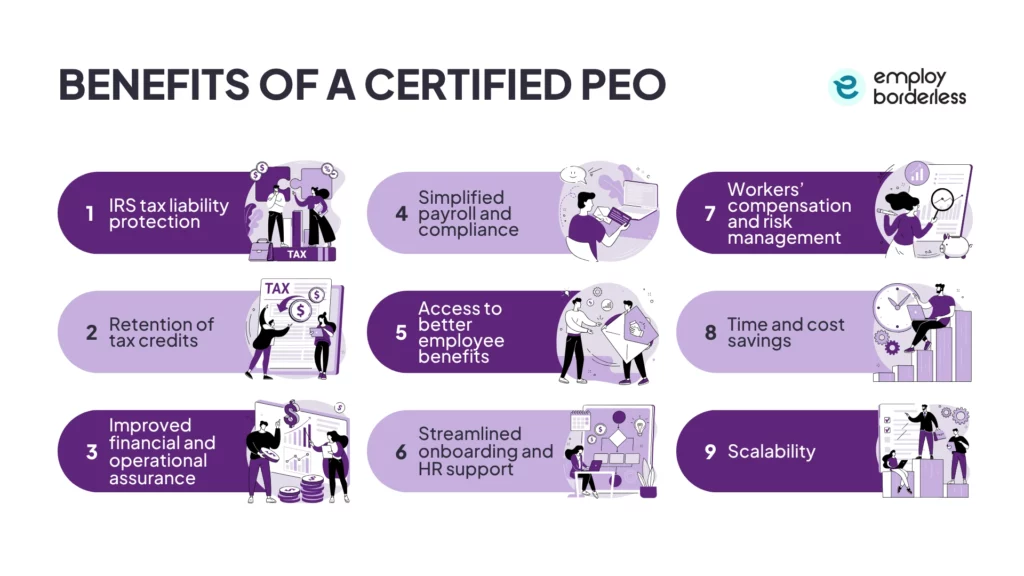
The major benefits of a certified PEO include IRS tax liability protection, retention of tax credits, improved financial and operational assurance, simplified payroll and compliance, access to better employee benefits, efficient onboarding and HR support, workers' compensation and risk management, time and cost savings, and growth support.
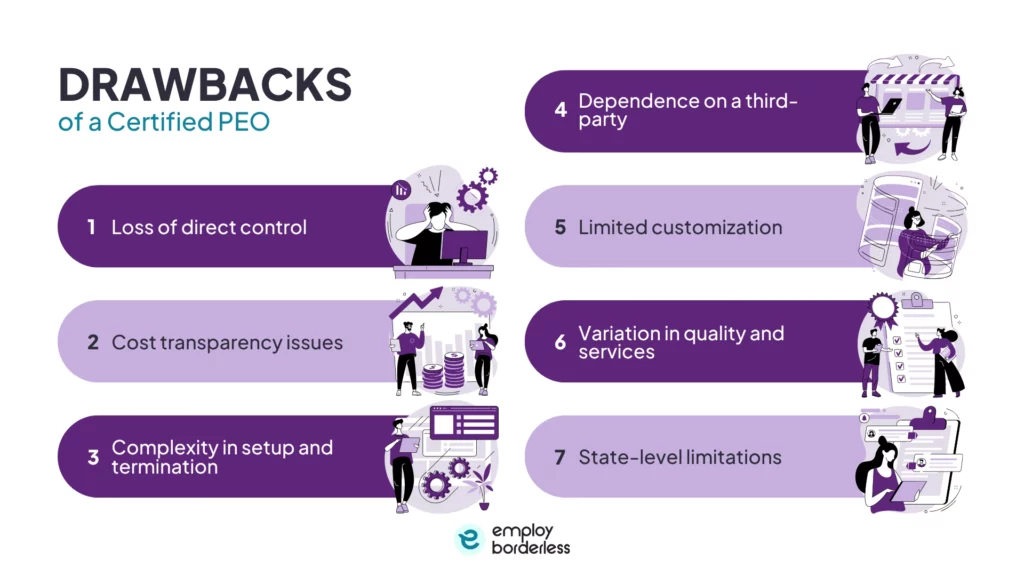
Despite these benefits, the drawbacks of CPEO are loss of direct control, cost transparency issues, complexity in setup and termination, dependence on a third-party, limited customization, variation in quality and services, and state-level limitations.
Choosing the right certified PEO depends on your business needs and goals, the PEO's certifications and accreditations, its reputation and client satisfaction, financial and operational stability, the range of services offered, and its expertise in legal compliance and regulatory matters.
What is a certified PEO?
A CPEO (Certified PEO) is an IRS-certified (Internal Revenue Service) organization that provides HR services to companies, which include payroll and tax management, benefits administration, compliance support, and risk management. The IRS established a voluntary certification program for PEOs under SBEA (Small Business Efficiency Act), which means that CPEOs have to meet strict financial and reporting requirements. Not every PEO goes through this process, so the certification is a meaningful distinction when you're comparing providers.
How does a CPEO work?
A PEO works by operating under the same co-employment model as a traditional PEO and handles HR tasks, payroll, benefits, and workers' compensation. It is solely responsible for federal employment tax filing and payments, which reduces tax liability risk and maintains client eligibility for federal tax credits.
What are the functions of a certified PEO?
The functions of a certified PEO are payroll administration, employment tax compliance, HR management, benefits administration, workers' compensation, unemployment insurance, IRS reporting and regulatory compliance, and employee onboarding and offboarding.
Payroll administration
Payroll administration is the complete handling of payroll operations by a certified PEO on behalf of the client business, which includes calculating employee wages, withholding, and submitting payroll taxes to legal authorities.
A Certified PEO is solely responsible for deducting and remitting federal payroll taxes on time and accurately under its own EIN (Employer Identification Number), which includes income tax withholdings, Social Security (6.2%), and Medicare (1.45%) for both employees and employers. It also manages benefit deductions and submits W-2 and 941 forms while performing standard payroll duties, such as processing employee compensation. Companies that work with a Certified PEO have lower tax liability risks, more financial transparency, and continuous access to specific tax credits, which makes payroll administration both accurate and secure.
Employment tax compliance
Employment tax compliance means CPEO helps businesses comply with federal employment taxes, which include FICA (Federal Insurance Contributions Act) and FUTA (Federal Unemployment Tax Act).
A CPEO withholds the correct amount of employment taxes from employee wages based on IRS rules and employee W-4 forms. It also files quarterly and annual tax returns, which involve Forms 941, 940, W-2, and W-3 under the CEO's EIN. A client business is not responsible for filing the Form 941-X, but it is the legal responsibility of the CPEO to identify an error or a mistake in a previously submitted Form 941. This correction involves fixing underreported or overreported wages and taxes, paying additional tax, claiming a refund or credit, and documenting and justifying the changes. CPEO properly manages errors through Form 941-X to maintain compliance status with the IRS and prevent penalties or audits for the clients.
HR management
HR management means a CPEO handles human resource functions under a co-employment agreement, such as employee onboarding, performance management, and policy development.
The CPEO shares employer responsibilities and provides expert HR support, which includes providing strategic HR advice and access to premium benefits that are usually unavailable to smaller enterprises. The client company maintains control over daily business operations, such as handling finances, inventory management, and customer service. Its HR services are integrated with legally accountable payroll and tax compliance, as it is certified by the IRS, to make sure that HR practices stay current with employment regulations and reduce organizational risk.
Benefits administration
Benefits administration is the management and coordination of employee benefits programs, such as health and life insurance, by CPEO while maintaining regulatory compliance.
CPEOs negotiate more affordable group insurance rates by using their combined purchasing power, which many small or medium-sized enterprises are unable to secure on their own. These benefit programs include health, dental, vision, life, disability, and retirement policies. They manage employee enrollment, life-event updates, and eligibility tracking by integrating online platforms. CPEOs provide benefits support through employee portals, contact centers, and educational materials to help employees understand their benefits options.
The certified PEO monitors COBRA (Consolidated Omnibus Budget Reconciliation Act) continuation notices, premium billing, and premium reconciliation. It also makes sure that benefit plans comply with legal requirements under ERISA (Employee Retirement Income Security Act), COBRA, HIPAA (Health Insurance Portability and Accountability Act), ACA (Affordable Care Act), and applicable state laws, while issuing all important notices and filings to maintain compliance.
Workers' compensation
Workers' compensation means CPEO is responsible for maintaining mandatory insurance coverage that provides medical care, wage replacement, and rehabilitation benefits to employees who suffer job-related injuries or illnesses.
A CPEO negotiates competitive workers' compensation insurance rates by pooling employees from multiple client companies and using established partnerships with insurance carriers to simplify the claims process. The CPEO takes full responsibility for managing claims, which include incident reporting, claim submission, coordination with insurance carriers, and return-to-work planning, as the policyholder or named insured on the workers' compensation policy.
The certified PEO maintains compliance with state workers' compensation law, which includes FECA (Federal Employees' Compensation Act) and ADA (Americans with Disabilities Act). It also provides safety program support and loss prevention training to employees, such as PPE (Personal Protective Equipment), to help prevent workplace injuries. CPEOs help client companies put risk management strategies in place to reduce their exposure to legal actions.
Unemployment insurance
Unemployment insurance means a CPEO completely manages state and federal unemployment insurance duties on behalf of client businesses.
The CPEO acts as the employer of record and handles the calculation, reporting, payment, and compliance aspects of both SUTA (State Unemployment Tax) and FUTA (Federal Unemployment Tax), by using its account and EIN (Employer Identification Number).
A Certified PEO reviews unemployment claims, submits objections to invalid or questionable claims, and carefully manages the client company's unemployment insurance performance metrics to help control and reduce future tax liabilities. The CPEO calculates unemployment insurance contributions and remits payments on time using tax withholding schedules or integrated reporting systems.
IRS reporting and regulatory compliance
IRS reporting and regulatory compliance mean a CPEO performs federal tax reporting and compliance responsibilities, as required under the IRS certification program.
The CPEO has to file quarterly attestations and annual audited financial statements with the IRS to show financial stability and operational reliability, which are important for maintaining its certified status. CPEOs are required to maintain a federal surety bond, minimum $50,000, maximum $1 million, and report material changes, which include financials, ownership, and personnel, within 30 days, as part of their ongoing compliance function.
The IRS only grants certification to PEOs that consistently show full regulatory compliance, which assures clients that they are partnering with a financially stable and IRS-certified organization. This reduces client audit risk and supports tax transparency.
Employee onboarding and offboarding
Employee onboarding and offboarding refer to CPEO's administration of smooth and legally compliant entry and exit processes of employees.
Certified PEOs help in digital onboarding by collecting identification details, payroll tax forms, direct deposit information, and completing background checks before a new hire's start date. They automate document submission and track completion through centralized online platforms and self-service portals for new employees. The CPEO also handles first-day integration of new hires, which includes setting up email, logins, orientation, and introducing company culture through manager and HR guidance.
CPEOs also manage structured offboarding processes, which include exit interviews and final feedback collection to identify areas for improvement. They handle compliance-related tasks such as final payroll processing, benefits termination, tax documentation, and compliance with local exit regulations. A CPEO also monitors asset recovery and system access termination, which involve deactivating logins, reclaiming company devices, like laptops and badges, and maintaining data security.
What are the eligibility requirements for CPEO status by the IRS?
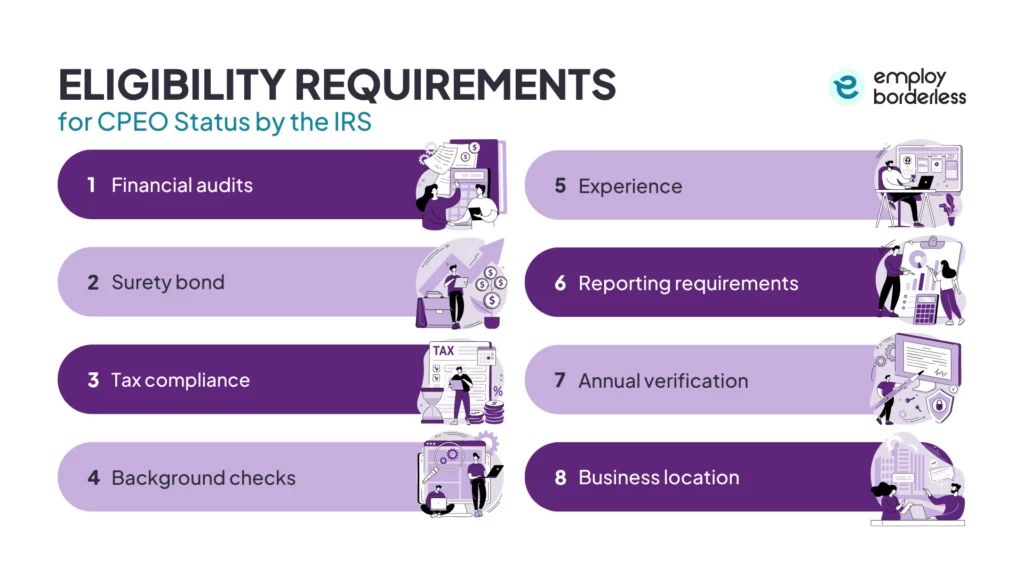
The eligibility requirements for CPEO status by the IRS are financial audits, surety bond, tax compliance, background checks, experience, reporting requirements, annual verification, and business location.
The eligibility requirements for CPEO status by the IRS are listed below.
- Financial audits: Financial audits require an unqualified (clean) opinion from a CPA (Certified Public Accountant) and a working capital statement, which shows the CPEO's ability to meet short-term financial responsibilities. The annual audit must follow GAAP (Generally Accepted Accounting Principles) and show financial strength, typically positive working capital or, if not, a justified explanation under regulatory exceptions.
- Surety bond: A certified PEO must post a surety bond to secure payment of federal employment tax liabilities under IRC section 3511. The bond amount must be at least 5% of the CPEO's prior-year federal employment tax liability, with a minimum bond of $50,000 and a maximum of $1,000,000. The CPEO has to submit the proof of the bond (Form 14751) through the IRS Online Registration System within 30 days of receiving the notice of certification, and the certification is not provided if they fail to do so.
- Tax compliance: CPEOs must maintain strict federal tax compliance to qualify and remain certified by the IRS. They are solely liable for collecting, depositing, and paying employment taxes under their own EIN, and must file Forms 941 and 940 with Schedule R. Quarterly CPA attestations and working capital statements must also be submitted through the IRS Online Registration System.
- Background checks: Background checks require CPEO candidates to have credible leadership and honesty to qualify for IRS certification. Each applicant is required to submit a RIPA (Responsible Individual Personal Attestation) for the IRS to begin a thorough suitability review. CPEO applicants must also complete fingerprinting and criminal background checks through Fieldprint or similar providers, and authorize IRS access to records like credit history, tax compliance, and professional licenses.
- Experience: Certified PEOs and their applicants must prove their expertise in important employment-related tasks. These include payroll processing and accounting on behalf of clients, accurate recordkeeping systems, federal and state employment tax compliance, maintaining qualified or legal advisors, and general business and risk management practices.
- Reporting requirements: A CPEO must file Form 8973 (Certified PEO/Customer Reporting Agreement) within 30 days of the start or termination of any CPEO contract or related service agreement with a client, which includes providing the client's name and EIN. CPEOs and each responsible individual must notify the IRS of material changes, such as changes in ownership, financial status, responsible parties, tax compliance, or business structure, within 30 days (or 45 days for changes related to new responsible individuals).
- Annual verification: Each Certified PEO must submit an annual verification through the IRS Online Registration System to maintain certification status, under IRS regulations. The yearly verification must be submitted 30 days before the anniversary of the date (month and day) that the CPEO's accreditation became effective. A CPEO must pay a $1,000 annual verification user fee before processing.
- Business location: All CPEOs and CPEO applicants are required to have a company that is established in the United States. It has to maintain at least one physical business location within the country where its normal PEO-related operations are performed and administrative records are maintained.
What are the benefits of a certified PEO?
The benefits of certified PEO are IRS tax liability protection, retention of tax credits, improved financial and operational assurance, simplified payroll and compliance, access to better employee benefits, efficient onboarding and HR support, workers' compensation and risk management, time and cost savings, and growth support.
IRS tax liability protection
IRS tax liability protection means the IRS recognizes the CPEO as the sole legal employer for employment-tax purposes when a business contracts with a CPEO. The certified PEO is responsible for remitting the employees' payroll taxes under its own EIN. It protects client companies from liability for federal employment taxes on wages paid to employees at the workplace.
Retention of tax credits
Retention of tax credits means a CPEO has to provide client companies with important information about claim eligibility for federal employment tax credits, such as the WOTC (Work Opportunity Tax Credit) and other credits specified under IRC Section 3511(d)(2) or future guidance. CPEOs must provide clients with credit-related data and allocations to make sure they remain eligible to claim tax credits they are entitled to, even though the CPEO files collective employment tax returns, such as Form 941 and Schedule R, under its own EIN.
Improved financial and operational assurance
Improved financial and operational assurance involves CPEOs' compliance with federal tax laws and operational best practices. They have to meet strict initial and continuous requirements related to financial audits, background checks, and bonding obligations, which shows CPEO's stability and builds client confidence.
Certified PEOs are required to have positive working capital and provide yearly audited financial statements that comply with GAAP. Clients are protected from financial risk by a central bonded amount of up to $1 million, which further supports fiscal reliability. CPEOs manage payroll, tax compliance, benefits administration, and regulatory reporting for clients, which reduces errors and provides uniform service quality through centralized systems.
Simplified payroll and compliance
Simplified payroll and compliance mean CPEOs provide centralized reporting and standardized processes that reduce administrative burden and compliance risk for client businesses.
CPEOs act as the employer of record to file all federal employment tax returns, such as Forms 940 and 941, under their own EIN and attach Schedule R to allocate tax liabilities accurately across client companies. It is responsible for calculating, depositing, and remitting employment taxes on behalf of clients, which reduces the client's exposure to IRS liability for tax errors.
Access to better employee benefits
Access to better employee benefits refers to a CPEO's grouping of employees from multiple client companies to secure group insurance and benefits plans that are typically available only to large enterprises.
CPEOs allow client companies access to premium employee benefits, which include retirement plans, like 401(k), life, long-term, short-term disability coverage, health, dental, and vision insurance. These employee benefits also include FSAs (Flexible Spending Accounts), HSAs (Health Savings Accounts), and wellness programs. The certified PEO also handles benefits administration, such as plan enrollment, open enrollment coordination, compliance with ACA, COBRA, and reduces the administrative burden for clients.
Efficient onboarding and HR support
Efficient onboarding and HR support means CPEOs automate and simplify human resources tasks from hiring to post-hiring.
CPEOs provide new hires with automated onboarding platforms where they complete tax withholding forms, benefits elections, and other paperwork online before their start date, to save time and reduce errors. Digital signatures, automatic checks, and mobile-friendly interfaces are common features of these platforms. This simplified onboarding keeps the process compliant with state-specific laws and documentation requirements like I-9, W-4, and E-Verify.
Certified PEOs provide businesses with expert HR professionals who manage employee training, policy introductions, and recommended practices for onboarding without hiring internal HR teams. This smooth onboarding provides a consistent experience for all new hires, which supports engagement, reduces turnover rates, and allows businesses to operate efficiently and productively.
Workers' compensation and risk management
Workers' compensation and risk management mean CPEOs provide mandatory workers' compensation insurance and put safety measures in place to reduce workplace injury risks and expenses.
A CPEO manages workers' compensation insurance and gives access to more affordable premiums and more thorough coverage than individual companies negotiate on their own, through collective or pooled programs. The CPEO handles incident reporting, submission of claims to insurers, authorizes timely medical care, and manages return-to-work planning to reduce operational disruptions and long-term costs.
Certified PEOs put risk management strategies in place to identify workplace hazards, develop safety procedures, and establish loss-control programs. These efforts help reduce the number of workers' compensation claims and improve the client company's safety record and claim history over time.
Time and cost savings
Time and cost savings are the reduction in operating costs and administrative workload that client companies experience by partnering with CPEOs.
CPEOs reduce costs related to staffing, software, and compliance by managing core HR functions through integrated platforms. They handle payroll, tax filings, benefits administration, and regulatory compliance, which lowers the need for separate systems or in-house HR teams. This allows client companies to focus their resources on core operations and expansion goals.
Flexibility
Flexibility refers to the adaptable administrative and HR support that CPEOs provide, which adjusts easily as a company grows or enters new markets. A CPEO scales its services as needed without requiring additional internal HR resources, whether a business expands its workforce or operations.
What are the drawbacks of a certified PEO?
The drawbacks of certified PEO are loss of direct control, cost transparency issues, complexity in setup and termination, dependence on a third-party, limited customization, variation in quality and services, and state-level limitations.
The drawbacks of certified PEO are listed below.
- Loss of direct control: Loss of control occurs when businesses partner with CPEOs and assign them HR and compliance responsibilities. The client gives up some control of administrative processes, as the CPEO becomes the employer of record, but still maintains authority over employee performance and daily management.
- Cost transparency issues: Cost transparency issues involve problems with CPEO's pricing models as they bundle multiple services together, which makes it challenging for client businesses to know exactly what they are paying for. The client sometimes struggles to identify individual service costs, like payroll or benefits administration, and track fees related to compliance or extra insurance plans.
- Complexity in setup and termination: Complexity in setup and termination occurs because CPEO onboarding requires payroll integration, employee data transfer, and benefits alignment, which is time-consuming and demands effort. Termination is equally challenging as it involves ending the co-employment agreement and transferring the tax account.
- Dependence on a third-party: Partnering with a CPEO means relying on an external provider for important HR, payroll, tax, and compliance functions. This dependency exposes employers to risks if the CPEO experiences service issues, delays, or policy changes, which affect business operations and employee satisfaction.
- Limited customization: Limited customization refers to the standardized systems and processes CPEOs use to serve multiple clients at the same time. This prevents companies from customizing payroll, benefits, or HR policies according to their business needs and culture, which ultimately reduces flexibility and personalization.
- Variation in quality and services: Not all CPEOs offer the same level of expertise, technology, or customer support. Service quality, responsiveness, and available features differ between providers, which makes it important for businesses to carefully evaluate and choose a CPEO that fits their needs.
- State-level limitations: Businesses with personnel in different jurisdictions run into difficulties because CPEOs are not permitted or authorized to operate in every state. This results in limited service availability, gaps in compliance, or the requirement for more local HR support in some areas.
How to choose the right certified PEO?
To choose the right certified PEO, identify your business needs and goals, verify certifications and accreditations, assess client experience and reputation, evaluate financial and operational stability, understand service scope, and check compliance and legal expertise.
Start by identifying HR and risk management services your organization needs, such as payroll, benefits administration, tax compliance, workers' compensation, and employee onboarding and offboarding, to select the right CPEO according to your business requirements.
Make sure the CPEO is IRS-certified or accredited by ESAC (Employer Services Assurance Corporation) and a member of NAPEO (National Association of Professional Employer Organizations). These credentials confirm financial stability, compliance, and professional standards. Ask for references, testimonials, or case studies, and find businesses of similar size or industry to evaluate service quality, responsiveness, and credibility, before choosing the right CPEO.
Confirm the CPEO conducts annual audited financial reviews, maintains positive working capital, and meets bonding requirements, which helps determine reliability and stability. Carefully understand which services are included in the contract, such as payroll processing, benefits enrollment, and compliance support, and also evaluate the optional services. Ask whether the provider actively monitors compliance with state and federal labor laws and regulations, provides risk and audit guidelines, and supports important legal documents.
What are the differences between a certified PEO and a regular PEO?
The differences between a certified PEO and a regular PEO are IRS certification, wage-based restart (FUTA and SUTA), compliance and regulatory requirements, client protection, fiduciary and tax responsibilities, bonding requirements, and market reputation.
The differences between a certified PEO and a regular PEO are listed below.
| Features | Certified PEO | Regular PEO |
| IRS certification | Must be IRS certified and meet strict requirements | Not certified by the IRS |
| Wage-based restart (FUTA and SUTA) | No wage base restart when joining mid-year | Result in double taxation or a restart of tax bases |
| Compliance and regulatory requirements | Required quarterly attestations, bonding, reporting, background checks, and IRS audits | Compliance and regulatory standards differ among providers |
| Client protection | Offers legal and tax protection to clients | Limited or depends on PEO's internal practices |
| Fiduciary and tax responsibilities | Holds fiduciary duty and full accountability for employment tax compliance | Shares tax liability and employer responsibilities with the client |
| Bonding requirements | Required to post a bond of up to $1M as a financial assurance for clients. | No mandatory bonding requirement |
| Market reputation | More reliable and trustworthy because of the IRS certification | Reputation differs according to PEO procedures and the experiences of clients. |
IRS certification
A certified PEO has completed the IRS's voluntary certification procedure under the SBEA (Small Business Efficiency Act), which includes bonding, annual audits, financial review, and organization background checks. Regular PEOs do not follow the same federal standards as certified PEOs and have not received IRS accreditation.
Wage-based restart (FUTA and SUTA)
The business avoids a wage-based restart for FUTA (Federal Unemployment Tax), SUTA (State Unemployment Tax Act), and FICA (Social Security and Medicare), with a CPEO when switching mid-year, because the CPEO is legally recognized as a subsequent employer for tax wage limits. Switching to a regular PEO mid-fiscal year results in wage base restarts, which means small businesses have to pay payroll taxes twice on the same employees due to a change in the EIN (Employer Identification Number).
Compliance and regulatory requirements
CPEOs have to maintain strict ongoing IRS administration, which includes auditing financial statements, bonding, positive working capital, quarterly attestations, and background checks on the responsible individual, and any failure risks suspension of certification. The non-certified PEOs are regulated at the state level or by general licensing, so they are not required to perform federal IRS monitoring other than routine employer responsibilities.
Client protection
A certified PEO's clients are legally protected from federal employment tax responsibilities because the IRS considers the CPEO solely liable for paying the taxes after the client has sent payments to the CPEO on schedule. Clients of a regular PEO share responsibility for any unpaid or late employment taxes. The IRS still holds the client directly liable, even if the client has transferred the funds to the PEO.
Fiduciary and tax responsibilities
A CPEO is fully responsible for the accurate withholding, reporting, and payment of federal employment taxes under its EIN, which includes FUTA (Federal Unemployment Tax Act) and FICA (Federal Insurance Contributions Act). A regular PEO shares or maintains partial responsibility in a co-employment model, while the client is still responsible for monitoring and possible liabilities.
Bonding requirements
CPEOs have to post a surety bond, typically up to $1 million or 5% of employment tax liability, to guarantee correct tax deposit payments. Non-certified PEOs have no IRS-mandated bonding requirements, so in their case, any bonding is optional or non-standard.
Market reputation
CPEO provides strong credibility and trust to its clients due to its IRS certification, which shows financial stability and strict legal requirements. Regular PEOs do not have IRS-backed validation, so clients have to rely on their own assessment of a provider's financial stability and compliance reputation.
What are the other accreditations to consider beyond CPEO?
The other accreditations to consider beyond CPEO are ESAC accreditation (Employer Services Assurance Corporation), CI (Certification Institute), SOC 1 Type II, and NAPEO (National Association of Professional Employer Organizations) membership.
ESAC (Employer Services Assurance Corporation) accreditation verifies a PEO's ongoing financial stability, operational standards, regulatory compliance, and ethical business conduct. ESAC accreditation provides services to PEOs, state regulatory authorities, and business owners through its proven accreditation and financial assurance programs.
The CI certification is a voluntary, independent credential issued by the Certification Institute, which particularly evaluates a PEO's workers' compensation risk management program against established insurance industry best practices. CI assesses a PEO's policies and procedures around loss prevention, safety, claims handling, and regulatory compliance.
A SOC 1 Type II audit (formerly SSAE 18) is a recognized independent assessment of a PEO's financial reporting and operational controls. It verifies that the organization has established effective systems to protect data, maintain compliance, and preserve internal process reliability, which is conducted by a third-party auditor, such as a PEO.
NAPEO (National Association of Professional Employer Organizations) membership means a PEO is actively involved in the business and dedicated to maintaining professional standards. It shows how committed the company is to remaining up to date on changing laws, regulations, and ethical business conduct, even though it is not a formal accreditation.
When do you need a certified PEO?
You need a certified PEO when you want to reduce federal tax liability risks, avoid wage-base restarts, and switch payroll providers mid-year. CPEOs are especially suitable for small to medium-sized businesses that are looking for IRS-backed assurance of financial stability and regulatory compliance.
Is a PEO worth the cost?
Yes, a PEO is worth the cost because it uses economies of scale to provide access to high-quality benefits at lower rates, reduces administrative overhead, lowers unemployment claims, and improves employee retention. PEO cost typically ranges from 2% to 12% of total payroll or about $100 to $200 per employee per month, which depends on services and business size.
How is PEO support different for nonprofits compared to small businesses?
PEO support is different for nonprofits compared to small businesses due to their unique regulatory structure, workforces, and funding sources. PEOs for nonprofits help with grant compliance, 501(c)(3) standards, and registration in different states related to their fundraising strategies. PEOs for small businesses focus on simplifying commercial requirements to support business expansion and market competitiveness.
Is a PEO the right fit for small businesses?
Yes, a PEO is a strong fit for small businesses because it simplifies HR, payroll, benefits administration, workers' compensation, and compliance, which allows employers to focus on growth. PEOs for small businesses allow access to large-group health plans and reduce legal and tax risks that small businesses struggle to manage in-house.
How does an EOR compare to a PEO?
An EOR compares to a PEO in terms of legal employer status, entity requirements, compliance liability, payroll and tax handling, and geographic flexibility. PEO and EOR options both support employee management, but differ in legal responsibility and global hiring capabilities.

Co-founder, Employ Borderless
Robbin Schuchmann is the co-founder of Employ Borderless, an independent advisory platform for global employment. With years of experience analyzing EOR, PEO, and global payroll providers, he helps companies make informed decisions about international hiring.
Learning path · 9 articles
PEO fundamentals
Master the fundamentals with our step-by-step guide.
Start the pathReady to hire globally?
Get a free, personalized recommendation for the best EOR provider based on your needs.
Get free recommendations