Hybrid payroll: definition, benefits, challenges, and factors to consider

Robbin Schuchmann
Co-founder, Employ Borderless
Hybrid payroll is a payroll system that combines internal management with outsourced services. Companies handle sensitive tasks in-house - such as employee data collection and basic wage calculations - while outsourcing complex functions like tax filing, compliance, and multi-state payroll to external providers. This gives businesses control over sensitive information alongside the expertise of third-party specialists.
- Payroll software cost: Average payroll software ranges from $20 to $200 per month, plus a per-user fee.
- Payment flexibility: Hybrid payroll supports direct deposit, digital wallets, payroll cards, checks, and cryptocurrencies like Bitcoin and Ethereum.
- Who it suits: Businesses of all sizes, especially those managing remote or geographically diverse teams.
- Key tradeoff: Outsourcing reduces compliance penalties and hiring costs; keeping some processes in-house prevents complete dependence on vendors.
What is hybrid payroll?
Hybrid payroll is a payroll system that combines internal management with outsourced services. This hybrid model allows a company to manage easier tasks, such as employee data collection or basic wage calculations, while relying on external providers for complex processes like tax filing, compliance, or multi-state payroll. This combination gives businesses the flexibility to retain control over sensitive information and benefit from the efficiency and expertise of third-party providers.
Hybrid payroll is suitable for businesses of all sizes, especially those managing remote or geographically diverse teams, as it offers a customizable balance between internal control and outsourced support.
What is the impact of hybrid payroll on remote workforces?
The impact of hybrid payroll on remote workforces is that it smoothly supports them by accommodating employees across different geographical locations and time zones. It allows businesses to process payments consistently, regardless of where employees are located, in compliance with their local tax rules.
What are the benefits of hybrid payroll?
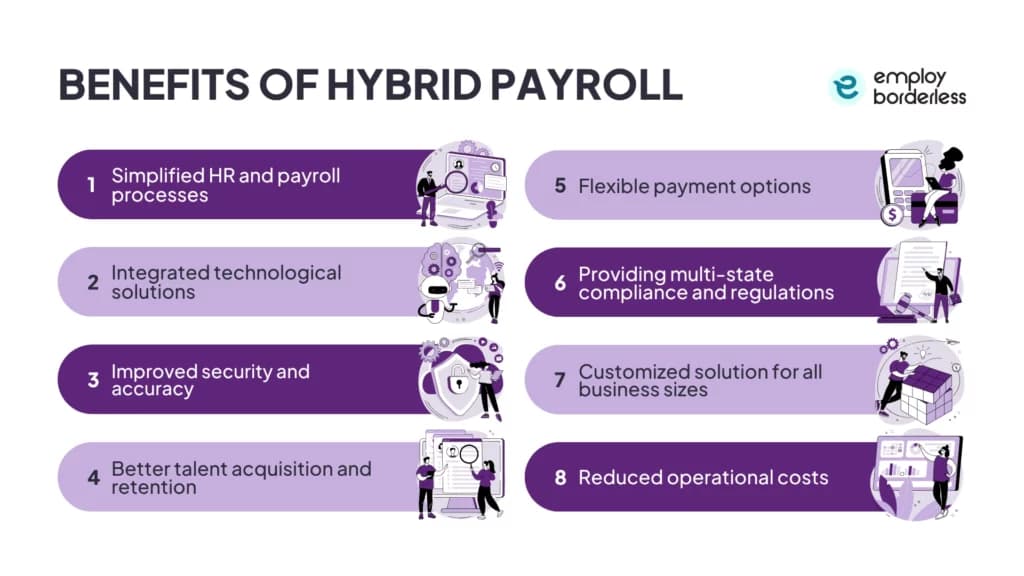
The benefits of hybrid payroll include simplified HR and payroll processes, integrated technological solutions, improved security and accuracy, better talent acquisition and retention, and flexible payment options. It also supports multi-state compliance and regulations and offers customized solutions for all business sizes.
Simplified HR and payroll processes
Hybrid payroll simplifies administrative work by dividing responsibilities between internal teams and external providers. HR departments focus on employee management, while outsourced partners handle tax filings, compliance reports, and multi-state regulations. This division reduces duplicate work, lowers administrative pressure, and creates a smoother payroll cycle.
Integrated technological solutions
Hybrid payroll systems integrate with HR software, time tracking tools, and accounting platforms. This reduces data entry errors and creates real-time visibility into labor costs. Businesses connect multiple systems to gain accurate reporting and a single source of information for both financial and employee data.
Improved security and accuracy
Payroll involves sensitive employee information such as salaries, tax details, and banking data. Hybrid systems improve security by keeping critical records in-house while outsourcing error-prone tasks to third-party experts. This model reduces the risk of internal fraud and increases accuracy by relying on professionals trained in payroll compliance.
Better talent acquisition and retention
Hybrid payroll addresses modern employee expectations, such as flexible pay options, built-in live reporting, and accurate benefits tracking. It provides employees with clear, timely, and transparent payroll, builds trust, and strengthens the employer's reputation. Companies with reliable payroll have higher employee retention and attract more talent in competitive markets.
Flexible payment options
Hybrid payroll allows businesses to offer multiple payment methods, such as direct deposit, digital wallets, payroll cards, or traditional checks. Modern hybrid payroll systems also support the payment of salaries in cryptocurrencies like Bitcoin and Ethereum through blockchain-based payment systems. This flexibility matches diverse employee preferences and makes global and remote payments easier. The ability to adjust pay cycles or issue on-demand payments adds value for workers seeking financial flexibility.
Providing multi-state compliance and regulations
Hybrid payroll benefits companies operating in more than one state or region that face complex payroll regulations. Hybrid payroll systems help track local wage laws, tax rules, and benefit requirements across different states and geographical regions. Outsourcing compliance tasks reduces the risk of penalties, while in-house oversight keeps control of sensitive employee data.
Customized solution for all business sizes
Hybrid payroll adapts to the scale of a business and offers customized solutions for all business sizes. Startups outsource complex compliance while keeping basic data internal. Large multinational organizations integrate multiple systems across various regions. This flexibility allows businesses of different sizes to choose hybrid payroll solutions that match their structure, workforce, and budget.
Reduced operational costs
Outsourcing selected payroll functions lowers hiring costs, training expenses, and the risk of compliance penalties. Keeping some processes in-house prevents complete dependence on vendors. This balance lowers overall payroll management costs while maintaining accuracy and efficiency.
What are the challenges in implementing hybrid payroll?
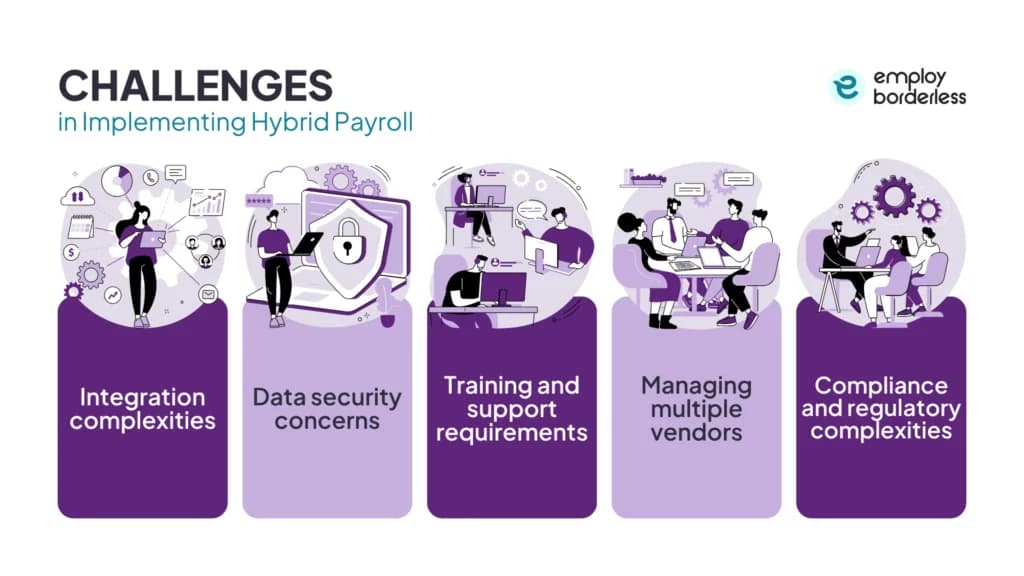
The challenges in implementing hybrid payroll are integration complexities, data security concerns, training and support requirements, and managing multiple vendors.
Integration complexities
Hybrid payroll requires a smooth connection between internal HR systems, accounting platforms, and external payroll providers. Broken software connections or inconsistent data formats lead to errors, delayed payments, and reporting issues. Businesses must either use manual data exchange and reconciliation or invest in custom integrations for smooth data flow between systems.
Data security concerns
Hybrid payroll handles sensitive employee information like salaries, tax IDs, and banking information. Sharing this data across multiple platforms and vendors increases the risk of data breaches and cyber fraud. Companies must use strong encryption, controlled access, and secure data transfer methods to safeguard information.
Training and support requirements
Hybrid payroll introduces new workflows and technologies, so employees and HR staff need training to operate the system effectively. Without proper support, businesses risk overlooking or misusing features, which compromises efficiency and accuracy. Vendor training and internal education are essential.
Managing multiple vendors
Hybrid payroll requires working with different third-party providers for compliance, benefits, or regional payroll. Coordinating with multiple outsourced payroll vendors creates risks of communication gaps and inconsistent service quality. Businesses must establish clear vendor management practices and service agreements to maintain consistency.
Compliance and regulatory complexities
A hybrid payroll system is subject to multiple layers of regulations when operating across different states or countries, which requires specialized knowledge to manage differing tax laws, reporting rules, and compliance deadlines. Without strong oversight, businesses face risks of penalties or legal disputes.
| Challenge | Main Risk | How to Address It |
|---|---|---|
| Integration complexities | Errors, delayed payments, reporting gaps | Invest in custom integrations or middleware |
| Data security concerns | Data breaches, cyber fraud | Strong encryption, controlled access, secure transfers |
| Training and support | Misuse of features, reduced accuracy | Vendor training and internal education |
| Managing multiple vendors | Communication gaps, inconsistent quality | Clear service agreements and vendor management practices |
| Compliance complexities | Penalties, legal disputes | Specialized compliance oversight per region |
What factors should businesses consider when implementing a hybrid payroll?
The factors businesses should consider when implementing hybrid payroll include conducting a thorough needs assessment, selecting reliable service providers, supporting dual-currency payment flexibility, investing in integration technology, establishing clear communication channels, and monitoring performance regularly.
Assess organizational needs to identify which payroll tasks should stay in-house and which can be outsourced. Critical and sensitive data should remain in-house, while routine administrative tasks can be outsourced.
Evaluate service providers for reliability, compliance expertise, and the ability to match business growth.
Organizations should evaluate whether the hybrid payroll system can support dual-currency payments, which include traditional and digital currencies like Bitcoin and Ethereum. Integrations such as blockchain, wallet management, and currency conversion must align with compliance regulations and employee preferences.
Businesses should also invest in integration technology that connects HR, accounting, and payroll systems to reduce errors and cut down on manual workflows.
It is important to establish clear communication channels between internal teams and external vendors to prevent misalignment and delays.
Monitor and review payroll operations regularly to verify accuracy, compliance, and cost-effectiveness, and make adjustments as the company's workforce or regulatory environment changes.
What does payroll mean?
Payroll means the system a business uses to calculate, manage, and deliver employee compensation. It covers every step from recording working hours or owed salaries to applying deductions for taxes, benefits, and retirement contributions. Payroll also includes issuing payments through direct deposit, checks, or digital wallets, along with preparing reports for compliance and tax purposes.
Payroll represents the full set of records that document each employee's earnings, deductions, and contributions, which are essential for audits and financial reporting. A well-managed payroll system maintains compliance with labor and tax regulations, protects sensitive data like banking information, and makes sure employees are paid correctly and on time. Payroll connects both HR and financial functions and is an important link between employee satisfaction, business operations, and legal accountability.
How does the payroll process work?
The payroll process works by collecting employee data such as hours, salaries, and benefits, calculating gross pay, applying deductions for taxes and contributions, and then issuing net pay. Businesses file tax reports and update payroll records. This cycle repeats each pay period so that employees are compensated accurately while complying with all the regulations.
Should you choose PEO or EOR for payroll outsourcing?
A business should choose a PEO or EOR for payroll outsourcing based on its local operations or hiring across the global market. A PEO (Professional Employer Organization) is beneficial because it allows businesses to share the responsibility for payroll, HR, and compliance while remaining the legal employer. An EOR (Employer of Record) is better for hiring in new regions, as it becomes the legal employer and handles payroll, compliance, and contracts directly on the company's behalf.
What is the impact of hybrid payroll systems on business growth?
The impact of hybrid payroll systems on business growth is that they combine a business's internal control with outsourced expertise. They also scale easily as a workforce expands, simplify compliance in multiple regions, and reduce administrative strain on HR and finance teams.
How much does it cost to manage payroll?
The cost to manage payroll depends on business size, employee count, and the chosen system. Manual payroll only involves staff time, but carries a higher risk of errors. Average payroll software ranges from $20 to $200 per month with an additional user fee, while outsourcing or hybrid models add charges for services. Larger firms invest more in compliance and growth capacity.

Co-founder, Employ Borderless
Robbin Schuchmann is the co-founder of Employ Borderless, an independent advisory platform for global employment. With years of experience analyzing EOR, PEO, and global payroll providers, he helps companies make informed decisions about international hiring.
Learning path · 10 articles
Payroll fundamentals
Master the fundamentals with our step-by-step guide.
Start the pathReady to hire globally?
Get a free, personalized recommendation for the best EOR provider based on your needs.
Get free recommendations