Payroll records: what to keep, why it matters & best practices

Robbin Schuchmann
Co-founder, Employ Borderless
Payroll records are the official documents and data that track all aspects of employee compensation, such as pay rates, hours worked, taxes withheld, benefits, and deductions. They provide a complete history of payroll transactions, confirm compliance with labor and tax laws, and are used as proof of employment, supporting audits, reporting, and dispute resolution.
The information included in payroll records is employee details, dates of employment, pay information, timesheets, tax documents, and benefits and deductions. Other important information involves paid and unpaid leave records, time and attendance records, direct deposit information, and reimbursement forms.
Payroll records are maintained for tax, legal, financial, and employee purposes. The recommended practices for keeping payroll records are to select a reliable recordkeeping method, use a standardized payroll records template, use payroll software, follow record retention requirements, safely dispose of outdated records, and schedule periodic reviews and cleanups.
What are payroll records?
Payroll records are documents and data that track employee compensation, the methods used to calculate it, tax deductions, hours worked, benefit contributions, and more. They are important for legal compliance, transparency, and financial accuracy across any business location.
Why is it important to maintain accurate payroll records?
It is important to maintain accurate payroll records because they protect both employers and employees by providing a clear report of compensation. Governments rely on payroll records to confirm tax compliance, fair wages, and proper contributions to social programs, with agencies such as the IRS using them to verify conformity to regulations.
Employees also sometimes request these records for purposes like loan applications, visa processing, or resolving wage disputes. Companies have to make sure payroll records are secure, accurate, and accessible for legally required retention periods to serve their purpose. Maintaining detailed records, accountability, and transparency in all payroll processes helps companies protect themselves against compensation disputes and potential legal claims.
What information is included in payroll records?
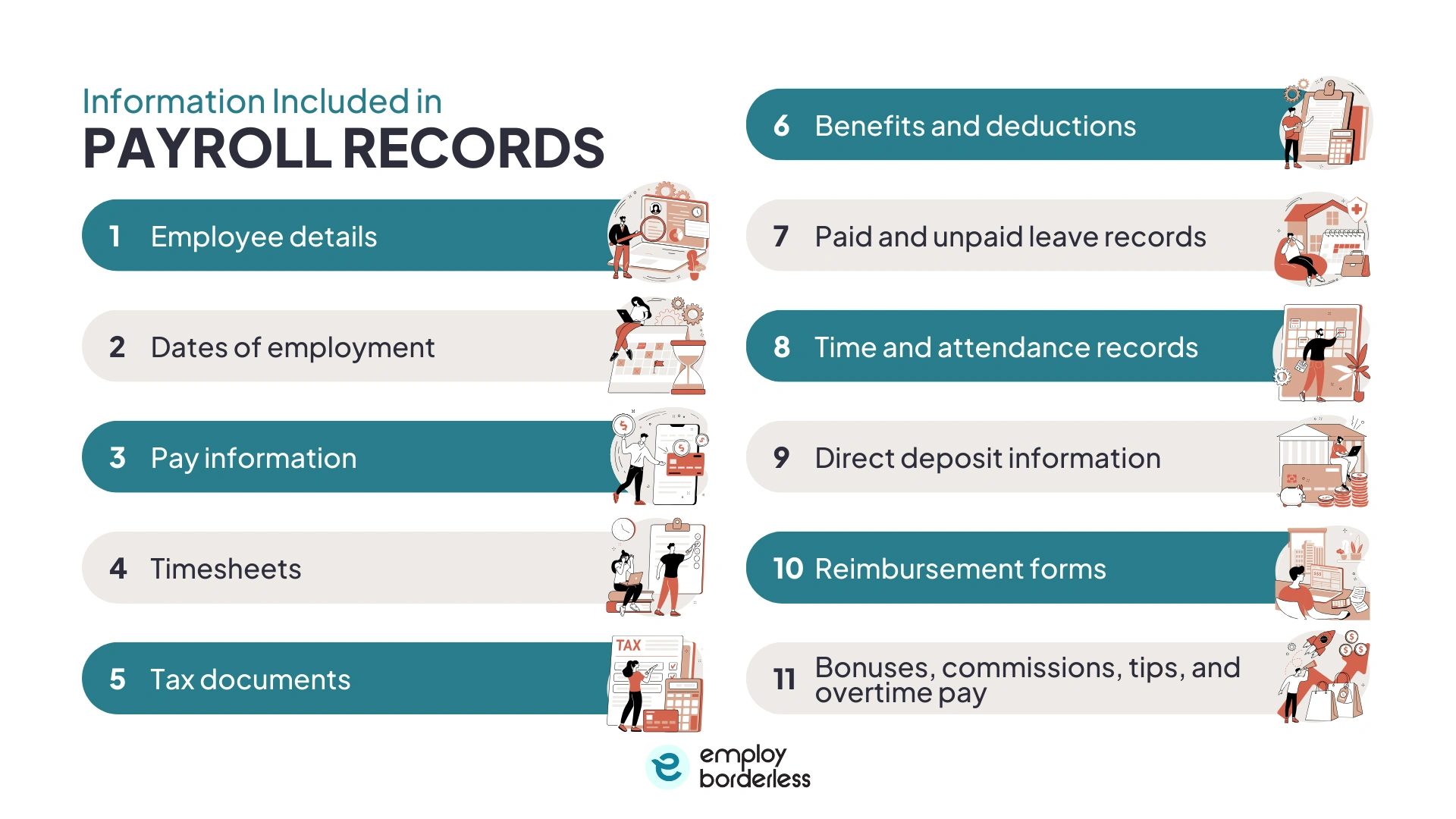
The information included in payroll records is employee details, dates of employment, pay information, timesheets, tax documents, and benefits and deductions. Other important information includes paid and unpaid leave records, time and attendance records, direct deposit information, and reimbursement forms.
The information included in payroll records is discussed below.
Employee details: Payroll records need to include accurate and up-to-date employee information to support proper tax reporting, record keeping, and compliance with labor laws. This information includes full legal names, current addresses, and government-issued identification numbers, such as Social Security Numbers. Additional essential details include telephone numbers, e-mail addresses, direct deposit information, emergency contacts, date of birth, job title and classification, employment contract, and benefit plan enrollment information.
Dates of employment: Payroll records document hire dates, termination dates, and any periods of leave. These dates are important for determining benefit eligibility and calculating employee tenure.
Pay information: Pay information involves the employee's rate of pay, workweek start and end dates, total hours worked, pay structure, such as hourly, salary, or commission, and employee classification, like exempt or nonexempt.
Timesheets: Timesheet data consists of regular working hours, overtime hours, and total hours worked per day, workweek, and pay period.
Tax documents: Tax documentation includes W-2, W-3, W-4, and 1099 forms, Forms 940, 941, and other quarterly or year-end filings. These documents also have records of employment tax payments and federal, state, and local tax forms, such as withholding certificates and tax return copies. Tax authorities require that organizations keep tax documents for specific periods to support compliance, accurate reporting, and audit verification.
Benefits and deductions: Payroll records involve benefits enrollment forms, retirement plan contributions, health insurance premiums, wage garnishments, and child support withholdings. The U.S. Department of Labor's ERISA (Employee Retirement Income Security Act) and other benefit-related laws usually mandate that organizations keep these records for extended periods.
Paid and unpaid leave records: Paid and unpaid leave records form records of PTO (Paid Time Off), vacation balances, and related payment amounts. They also document other leave types, such as family and medical leave, state-paid leave programs, and paid sick leave.
Time and attendance records: Time and attendance records involve the time and day an employee's workweek begins, hours worked each day, and total hours worked each workweek. The FLSA (Fair Labor Standards Act) requires employers to maintain these records to support accurate time tracking and proper wage payments.
Direct deposit information: Direct deposit information has details such as financial institution names, account numbers, and routing numbers used for employee wage payments.
Reimbursement forms: Reimbursement forms have expense reports and supporting documentation for work-related costs, such as business travel, office supplies, and other approved employee expenses.
Bonuses, commissions, tips, and overtime pay: Payroll records have documentation of additional compensation other than base wages. These forms of compensation are performance bonuses, sales commissions, gratuities, and overtime earnings, all of which affect taxable income and employee benefits.
| Record Type | Examples |
|---|---|
| Employee details | Full name, SSN, address, job title, employment contract |
| Pay information | Pay rate, pay structure, employee classification |
| Timesheets | Daily hours, overtime hours, total hours per pay period |
| Tax documents | W-2, W-4, 1099, Forms 940 and 941 |
| Benefits and deductions | Retirement contributions, health premiums, garnishments |
| Leave records | PTO balances, FMLA documentation, sick leave |
| Additional compensation | Bonuses, commissions, tips, overtime earnings |
Why do businesses need to keep payroll records?
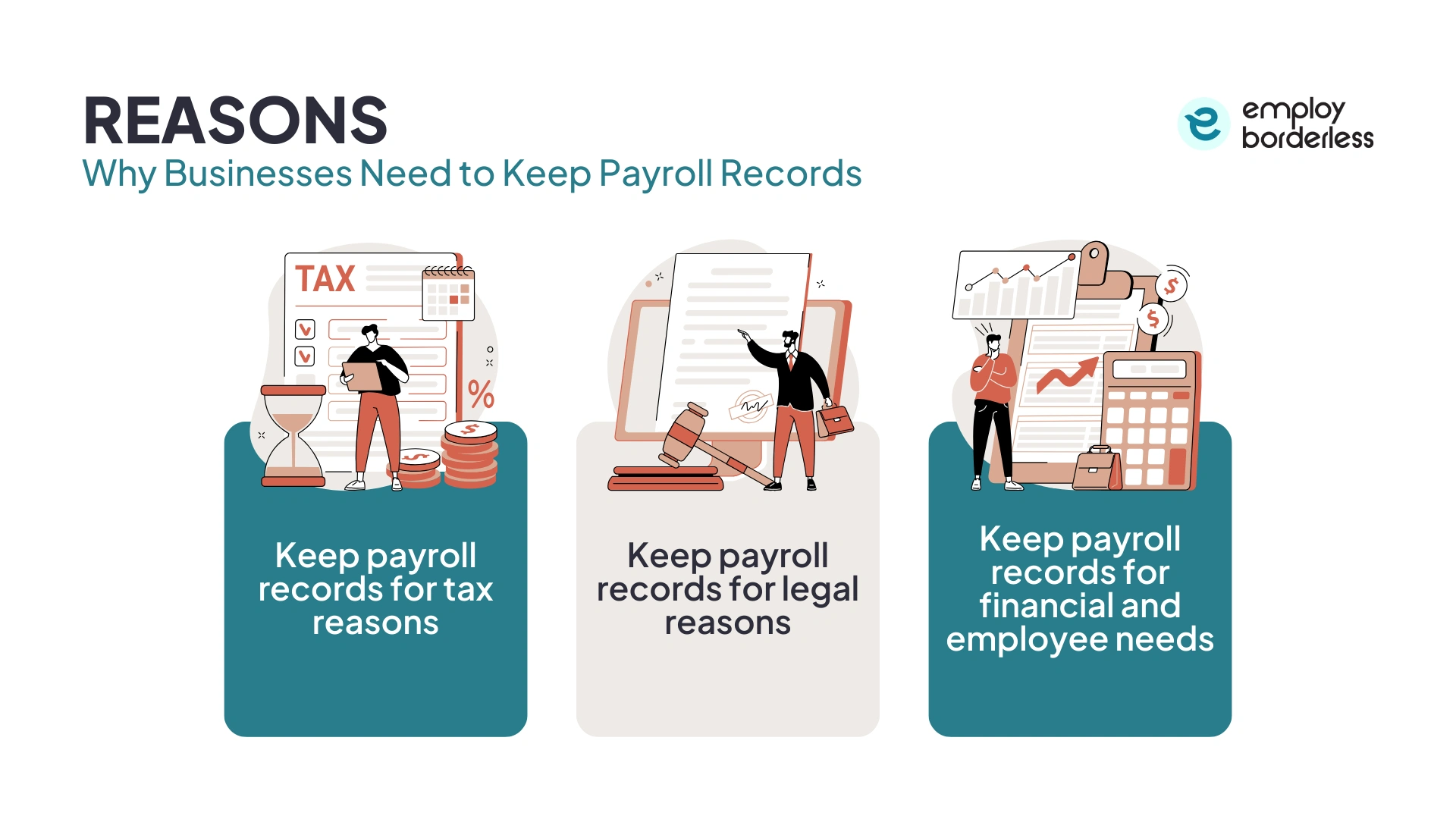
Businesses need to keep payroll records for tax reasons, legal reasons, and financial and employee purposes.
Keep payroll records for tax reasons
Employers must keep at least four years of payroll tax records readily available to simplify IRS audits. Well-organized records also simplify tax preparation and filing with government agencies. Employers using payroll software with self-service features further improve the employee experience while allowing staff to access their pay and tax information and download forms independently.
Keep payroll records for legal reasons
Both federal and state laws require employers to maintain accurate payroll records. Employers must comply with applicable regulations and make sure records are kept for the legally mandated retention periods. For example, employers must keep payroll records for non-exempt employees for at least three years, and they must store timesheets or wage calculation documents for at least two years under the FLSA (Fair Labor Standards Act).
The EEOC (Equal Employment Opportunity Commission) mandates that employers retain personnel and employment records for one year, which includes records of employees who are involuntarily terminated. Section 107 of ERISA (Employee Retirement Income Security Act) requires employers and plan administrators to retain retirement savings plan documents for at least six years, with some records requiring longer retention.
Keep payroll records for financial and employee needs
Payroll records provide important information on wages and taxes, which helps businesses plan budgets and manage labor costs more effectively. They also benefit employees, who sometimes need these records to verify employment when renting an apartment, applying for a loan, or for other official purposes.
Key takeaway: Federal retention requirements vary by record type - FLSA mandates three years for payroll records, the IRS requires four years for tax records, and ERISA requires six years for benefit-related documents. Knowing which rule applies to which record keeps you compliant across the board.
How long should employers keep payroll records?
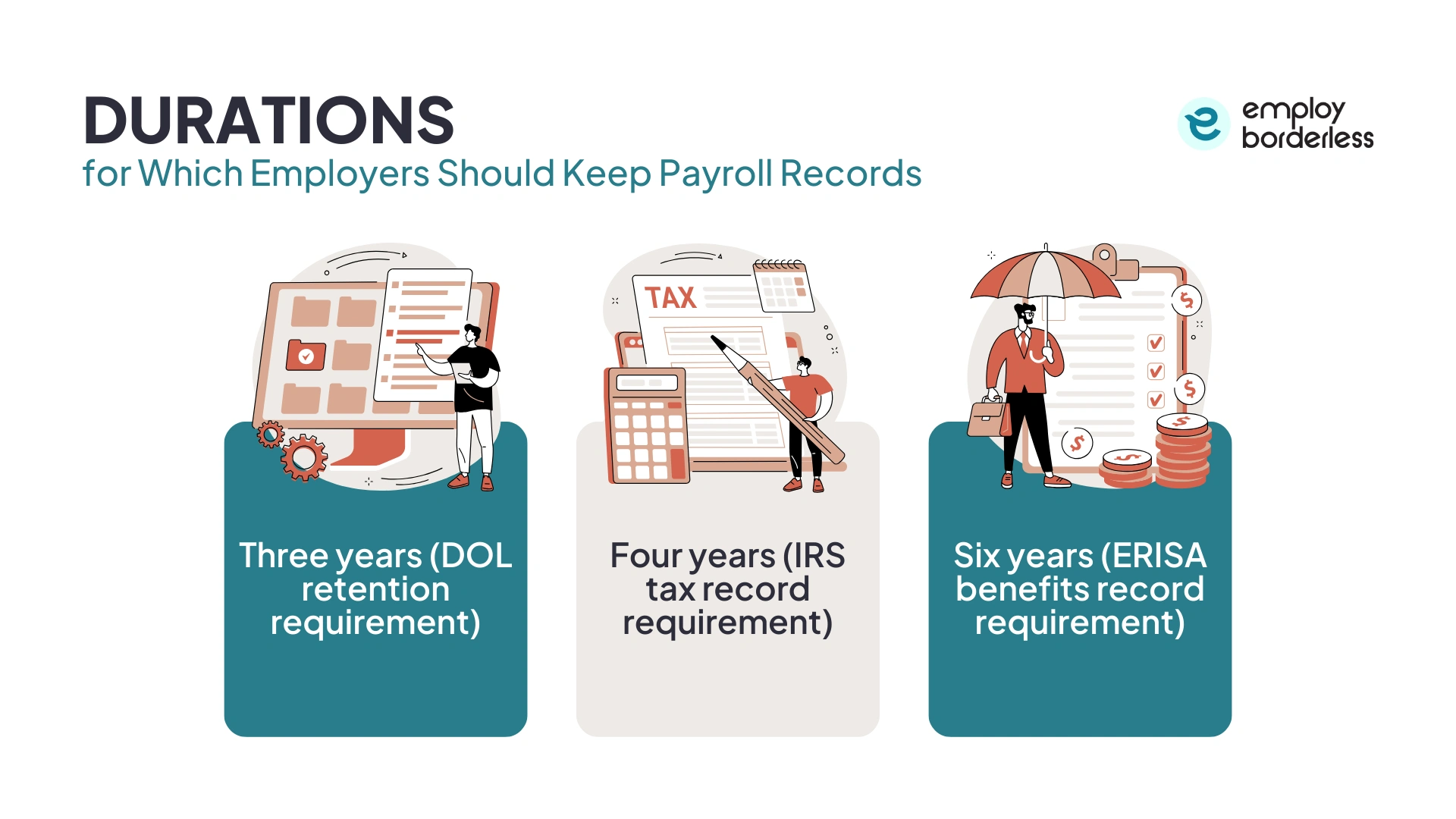
Employers should keep payroll records for three years (DOL retention requirement), four years according to IRS tax record requirements, and six years based on ERISA benefits record requirements.
The durations for which employers should keep payroll records are listed below.
Three years (DOL retention requirement): The U.S. Department of Labor requires employers to keep payroll records for at least three years. The EEOC (Equal Employment Opportunity Commission) requires employers to keep all employment-related documentation for one year. Employers have to retain these records for one year after the termination date of employees who are involuntarily terminated.
Four years (IRS tax record requirement): The IRS requires businesses to retain employment tax records for at least four years after the tax is due or after it is paid, whichever occurs later.
Six years (ERISA benefits record requirement): ERISA requires plan administrators to keep benefit-related records for a minimum of six years.
| Requirement | Governing Body | Retention Period | Record Types Covered |
|---|---|---|---|
| DOL retention requirement | U.S. Department of Labor | 3 years | Payroll records, EEOC employment documentation |
| IRS tax record requirement | Internal Revenue Service | 4 years | Employment tax records |
| ERISA benefits record requirement | Employee Retirement Income Security Act | 6 years | Benefit-related and retirement plan records |
What are the recommended practices for keeping payroll records?
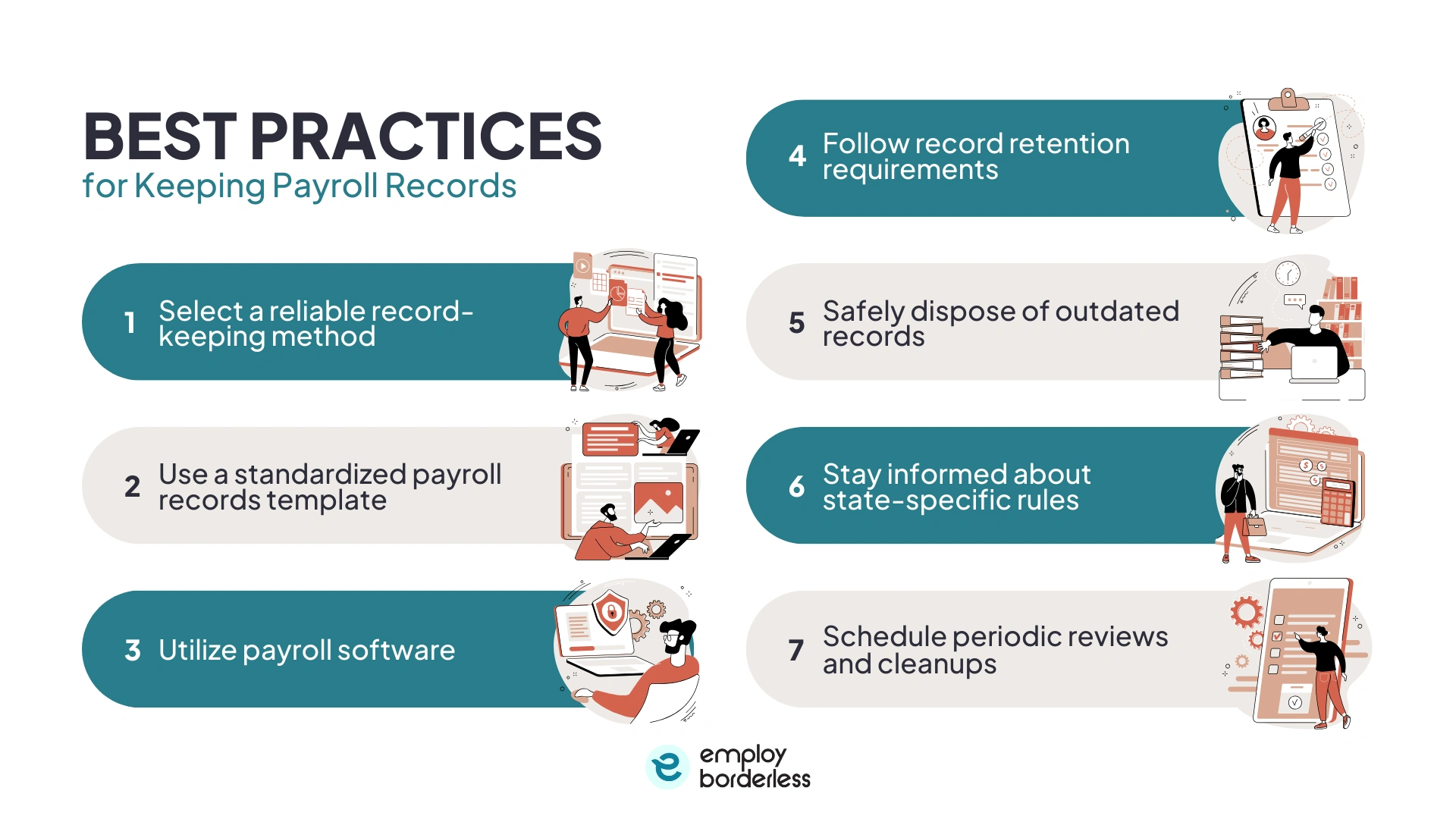
The recommended practices for keeping payroll records include selecting a reliable recordkeeping method, using a standardized payroll records template, using payroll software, and following record retention requirements. Some other recommended practices are safely disposing of outdated records, staying informed about state-specific rules, and scheduling periodic reviews and cleanups.
Select a reliable record-keeping method
Select reliable payroll software or an integrated digital system to securely store and organize all records in one location. This software automates calculations and compliance tasks, which reduces errors related to manual data entry and improves payroll accuracy. Advanced payroll systems offer features like automatic tax updates, audit trails, data backups, role-based access controls, and employee self-service portals to maintain compliance, security, and payroll accuracy.
Use a standardized payroll records template
Using a standardized payroll records template helps promote consistency, accuracy, and compliance in the payroll process. A well-designed template provides predefined fields for employee details, hours worked, wages, taxes, and deductions, which reduces manual errors and keeps information organized and easy to review. This structured approach makes it simple to track payroll data over time, support legal compliance, and prepare for audits or reporting requirements.
Use payroll software
Use payroll software that automates payroll recordkeeping with time tracking, electronic signatures, and cloud-based storage, and reduces manual work and errors. Payroll professionals can access the documents they need through HR software in just a few clicks rather than searching through filing cabinets or multiple local files.
Follow record retention requirements
Follow record retention requirements to stay compliant with federal, state, and local laws and protect the business during audits or legal challenges. Mandated retention periods differ by type of record, such as tax documents, wage and hour records, and employment files. Building and applying a retention schedule helps prevent early disposal or over-retention of sensitive information.
Keeping records for the legally required timeframes also makes it easy to respond to inquiries from government agencies, support tax filings, and defend against disputes. Organized retention policies also reduce the risk of fines or penalties for non-compliance.
Safely dispose of outdated records
Safely disposing of outdated payroll records is important because employee files have sensitive personal data that can be misused if left unsecured after their retention period ends. Employers dispose of paper documents through shredding or incineration and permanently delete digital files to prevent data breaches or identity theft once records reach the end of their legal retention period. A documented, secure disposal process protects privacy, supports compliance with data protection standards like ISO/IEC 27001 and SOC 2 (Service Organization Control 2), and reduces unnecessary storage risks.
Stay informed about state-specific rules
Staying informed about state-specific payroll laws helps businesses remain compliant with changing regulations at the state and local levels. Governments and labor departments frequently update tax codes, wage requirements, and recordkeeping obligations, so employers need to monitor official government sites, legal updates, and payroll service communications. Knowing these state-specific requirements helps confirm that payroll practices match local rules, reduces the risk of non-compliance penalties, and supports accurate recordkeeping across different jurisdictions.
Schedule periodic reviews and cleanups
Regularly auditing payroll records is important whether using a digital or paper filing system. Audits verify that documents are kept for the legally required periods, stored securely, and complete. Comparing records against federal and state retention guidelines and identifying any missing items confirms conformity. Establishing a consistent review schedule, like quarterly, biannually, or annually, makes record retention more manageable and reliable.
Key takeaway: Payroll software does more than automate calculations - it creates audit trails, manages retention schedules, and controls access to sensitive data. Choosing a platform that handles these tasks reduces your exposure to both errors and compliance penalties.
How do businesses select the right platform to simplify payroll records?
Businesses select the right platform to simplify payroll records by prioritizing automation, integration with existing systems, accuracy and compliance, reporting and analytics, and flexibility.
Automation reduces manual data entry by calculating wages, taxes, deductions, and benefits automatically. It prevents human errors, saves time, and makes sure payroll tasks are completed consistently and quickly.
A reliable payroll platform integrates with HR, time tracking, accounting, and benefits management systems. Integration improves data accuracy, removes duplicate entries, and creates a centralized recordkeeping process.
Payroll platforms with built-in compliance tools automatically update tax regulations, labor laws, and reporting requirements. These built-in tools help businesses maintain accurate payroll records and reduce the risk of penalties or legal issues.
Strong reporting tools generate detailed payroll reports, wage summaries, tax records, and workforce cost insights. These analytics support companies in financial planning, audits, and strategic decision-making.
Payroll systems that adjust to business growth, workforce changes, and multi-location operations give you more room to scale. Flexible platforms handle different pay structures, employee classifications, and regulatory requirements across jurisdictions.
Where should payroll documents be kept?
Payroll documents should be kept in a secure, organized system that protects sensitive employee data while allowing easy access for audits and compliance checks. Many businesses use encrypted cloud-based payroll or HR software to centralize records and improve security. Physical documents are stored in locked cabinets or restricted areas, with access controlled by password protection and regular data backups.
What payroll records must be kept?
Payroll records that must be kept include hours worked, wages and compensation, tax withholdings and employer contributions, deductions (such as retirement and healthcare), pay periods and pay dates, filed tax forms, and employee classification and job title. Records in many countries also include documentation of time off, commissions, and employment agreements.
What is included in a payroll file checklist?
A payroll file checklist usually includes employee personal details, job classification, employment agreements, pay rates, hours worked, and timesheets. It also involves tax forms, withholding records, benefits and deductions, leave records, compensation adjustments, and filed payroll tax reports.
How to create a payroll record?
To create a payroll record, collect employee details, employment agreements, pay rates, and tax forms. Track hours worked, wages, deductions, and benefits accurately. Use payroll software or standardized templates to organize and calculate payments. Regularly review records for compliance with tax and labor laws, and securely store them for the required retention period.
Do I need a payroll record for one employee?
Yes, you need a payroll record for one employee, as employers must complete payroll, track hours, wages, taxes, and required documentation for every worker to comply with federal and state laws. This legal obligation applies regardless of the number of employees and helps make sure reporting is accurate and compliant.
How to keep payroll records secure and compliant?
To keep payroll records secure and compliant, use encrypted, centralized systems or secure physical storage with controlled access to protect sensitive data. Set up role-based access controls, regular backups, or secure cloud solutions, and match retention practices with legal requirements. Make sure records remain protected from breaches and available for payroll regulations and compliance checks.
What are the two primary records for payroll?
The two primary records for payroll are the payroll register and the employee earnings record.
How far back can a payroll audit go?
A payroll audit goes back three years for standard federal tax (IRS) and FLSA (Fair Labor Standards Act) compliance. This period, however, extends to six years if major errors, such as important underreporting of income or misclassification of employees, are identified. The role of audits in payroll is to support accuracy, compliance, and proper reporting of employee wages and taxes.

Co-founder, Employ Borderless
Robbin Schuchmann is the co-founder of Employ Borderless, an independent advisory platform for global employment. With years of experience analyzing EOR, PEO, and global payroll providers, he helps companies make informed decisions about international hiring.
Learning path · 10 articles
Payroll fundamentals
Master the fundamentals with our step-by-step guide.
Start the pathReady to hire globally?
Get a free, personalized recommendation for the best EOR provider based on your needs.
Get free recommendations