Payroll reconciliation: definition, how it works, steps, benefits, challenges, and best practices

Robbin Schuchmann
Co-founder, Employ Borderless
Payroll reconciliation is the process of comparing payroll records, such as hours worked, wages, deductions, and tax withholdings, against a company's financial accounts, bank statements, and tax filings to confirm the numbers match before and after employees are paid.
There is no single standard method for how to reconcile payroll because systems and payroll complexity differ by company. The core process stays the same: verify amounts paid to employees against what's posted in the general ledger and bank statements, then investigate and resolve any discrepancies.
Types of payroll reconciliation
The main types of payroll reconciliation are payroll account reconciliation, payroll bank reconciliation, payroll tax reconciliation, and payroll control account reconciliation, each comparing payroll data against a different source such as the general ledger, bank statements, or tax filings.
Payroll reconciliation covers several sub-checks, each comparing payroll data against a different source. Businesses often run all of these within one reconciliation cycle rather than treating them as separate tasks.
| Type | What it compares |
|---|---|
| Payroll account reconciliation | Payroll entries against general ledger control accounts for wages, deductions, and liabilities |
| Payroll bank reconciliation | Net pay amounts against actual bank deposits or payment files, checking for fees or delays |
| Payroll tax reconciliation | Withheld taxes and employer contributions (Social Security, Medicare) against tax reports, IRS records, and Form 941 filings |
| Payroll control account reconciliation | Liability account balances against payroll system totals to confirm nothing was posted twice or left out |
Why payroll reconciliation matters
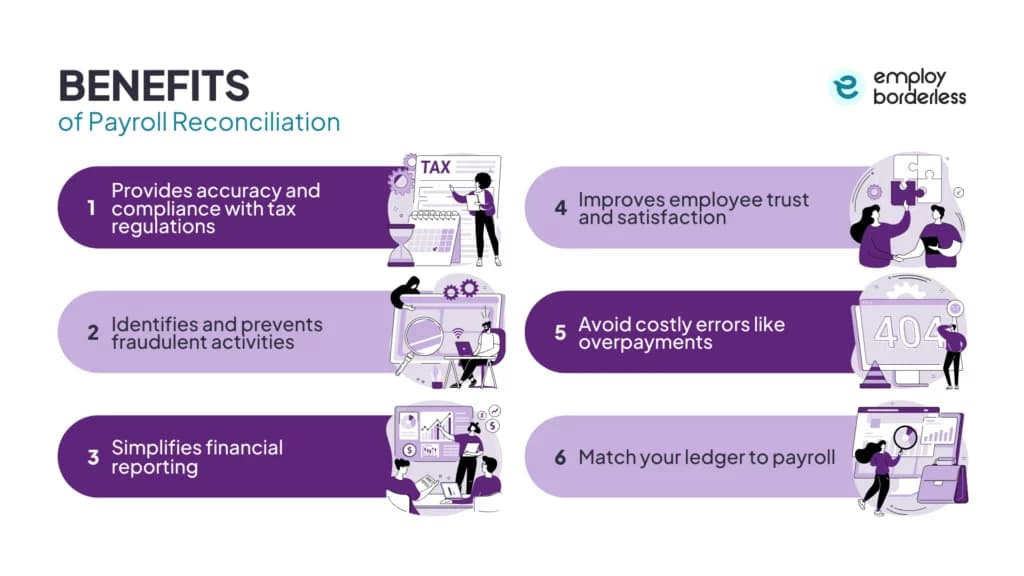
Payroll is one of the largest expenses for most businesses, so errors carry both financial and legal weight. Reconciliation delivers several benefits at once:
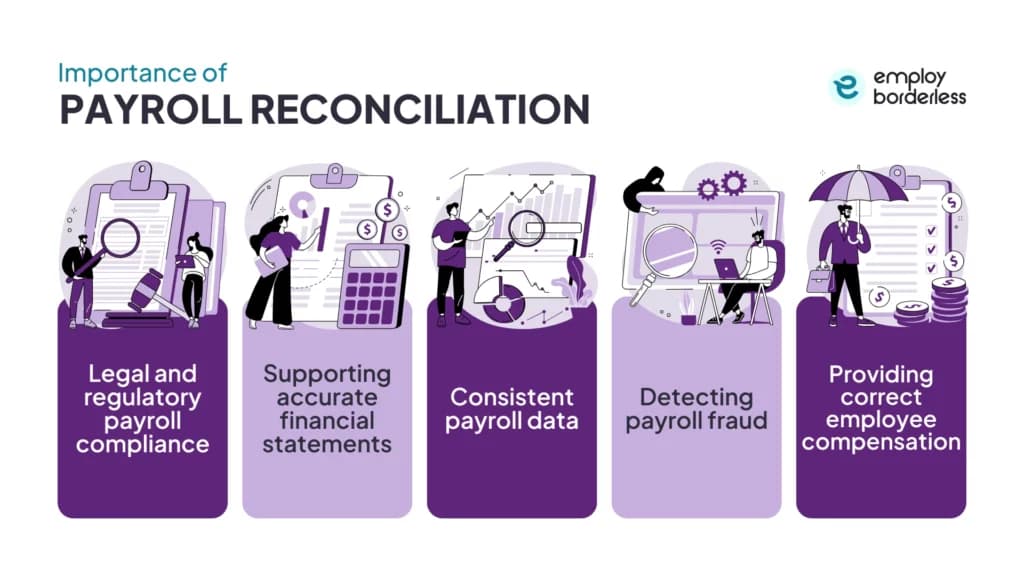
- Legal and regulatory compliance: confirms tax withholdings, social contributions, and deductions match current laws, reducing the risk of fines, penalties, or audits.
- Accurate financial statements: matches wages, benefits, and tax liabilities to accounting records so management can rely on the numbers for decisions.
- Consistent payroll data: keeps HR, accounting, and finance systems aligned, reducing mismatched entries and improving reporting for internal teams and auditors.
- Fraud detection: surfaces ghost employees, duplicate payments, or unauthorized salary adjustments before they cause bigger losses. See payroll fraud for more on these schemes.
- Correct employee compensation: checks pay against hours worked, benefits, and deductions, preventing under or overpayments and preserving trust.
- Fewer costly errors: catches wrong overtime, duplicate entries, or miscalculations before overpayments occur, which are often hard to recover.
- Ledger-to-payroll matching: confirms the general ledger and payroll system show the same wage and deduction totals, which smooths audits and reviews.
Payroll reconciliation checklist: the 12 steps
The payroll reconciliation checklist covers 12 steps, from setting a reconciliation schedule and collecting source records through verifying pay details, calculating earnings, checking deductions, comparing net pay to bank transactions, recording entries in the general ledger, confirming tax liabilities, and documenting the final approval.
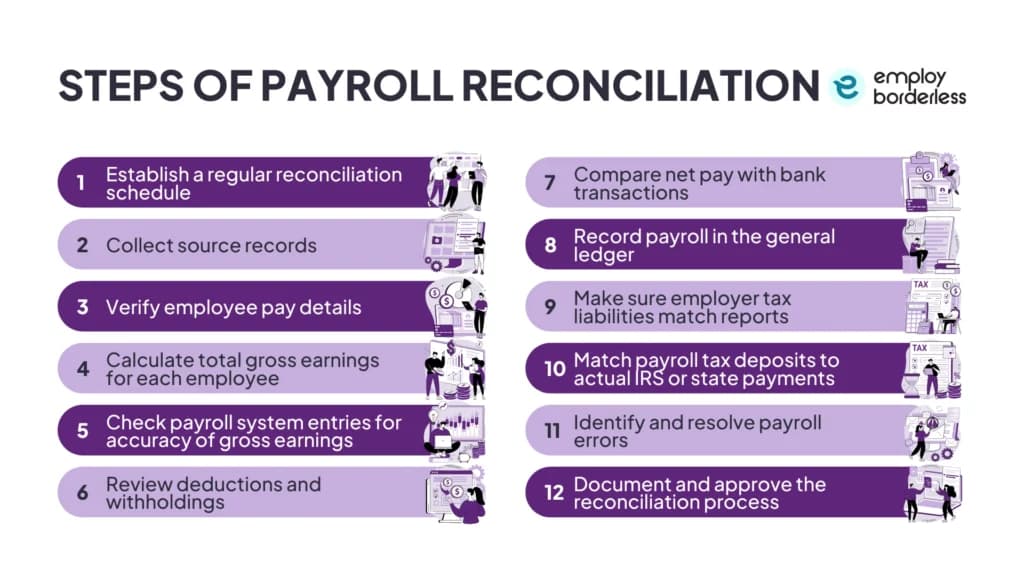
- Establish a regular reconciliation schedule. Check before every payroll run, monthly against tax filings, and quarterly or annually for audits and year-end forms.
- Collect source records. Gather time cards, payroll registers, and bank statements so hours, pay amounts, and payments made are all documented.
- Verify employee pay details. Confirm job classifications, tax withholdings, and benefit elections are current so every employee is paid correctly under labor law.
- Calculate total gross earnings. Multiply hourly rate by hours worked for hourly staff, use fixed salary for salaried staff, and add overtime, bonuses, or commissions.
- Check payroll system entries against gross earnings. Compare manual calculations to system totals and document any adjustments needed.
- Review deductions and withholdings. Confirm tax rates, benefit contributions, and garnishments are applied correctly and match current rates.
- Compare net pay with bank transactions. Match net pay to actual deposits and investigate differences such as bank fees or transaction delays.
- Record payroll in the general ledger. Debit gross pay expense accounts, credit liability accounts for deductions, and credit cash or bank accounts for net pay.
- Confirm employer tax liabilities match reports. Compare payroll tax reports to general ledger entries for Social Security and Medicare contributions and fix mismatches.
- Match payroll tax deposits to actual IRS or state payments. Reconcile deposit records against internal figures and resolve discrepancies quickly.
- Identify and resolve payroll errors. Review reports for unusual entries, trace the cause (data entry mistakes, software glitches), and correct promptly.
- Document and approve the reconciliation. Record all steps and results as a payroll reconciliation report, get manager sign-off, and retain it for audits.
Payroll reconciliation example
A single pay period reconciliation typically walks through the same data points against the same source documents:
| Data point | Source | Compared against |
|---|---|---|
| Hours worked | Time cards or timesheets | Payroll system entries |
| Gross earnings | Payroll register | Manual calculation (rate x hours, plus overtime or bonuses) |
| Deductions and withholdings | Payroll system | Current tax rates and benefit elections |
| Net pay | Payroll register | Bank statement or payment file |
| Employer tax liability | Payroll tax report | General ledger entries (Social Security, Medicare) |
| Tax deposits | IRS or state payment confirmation | Internal deposit records |
Common payroll reconciliation challenges
Common payroll reconciliation challenges include high data volume and complexity, managing multi-jurisdiction payrolls, disconnected systems requiring manual entry, timing mismatches between payroll and bank records, and handling changes or corrections that don't propagate across all systems.
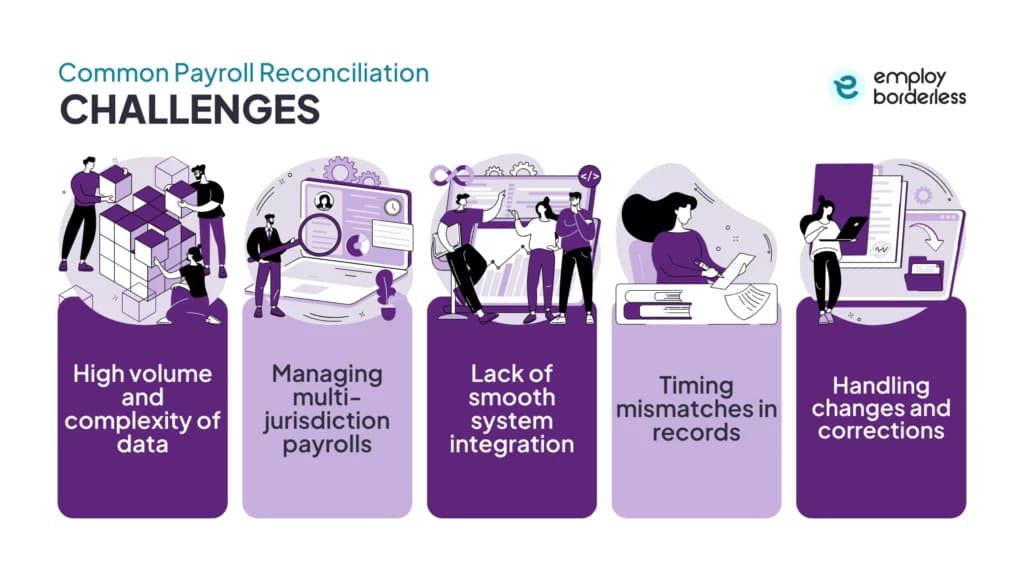
- High volume and complexity of data: large businesses process thousands of entries per pay cycle, and that volume makes small errors easy to miss.
- Managing multi-jurisdiction payrolls: employees across states or countries mean different tax rates, deadlines, and compliance requirements to reconcile against.
- Lack of smooth system integration: disconnected payroll, HR, and accounting systems force manual entry, which increases mismatches and slows reconciliation.
- Timing mismatches in records: payroll and bank records don't always update simultaneously, creating temporary differences that need extra checks.
- Handling changes and corrections: tax status, benefits, or pay rate updates that don't propagate across all systems lead to errors in payroll records.
Issues payroll reconciliation helps identify
Payroll reconciliation helps identify issues such as miscalculated employee earnings, incorrect tax deductions, missing bonuses or benefits, errors in overtime payments, and unauthorized payments like ghost employees or duplicate salary entries.
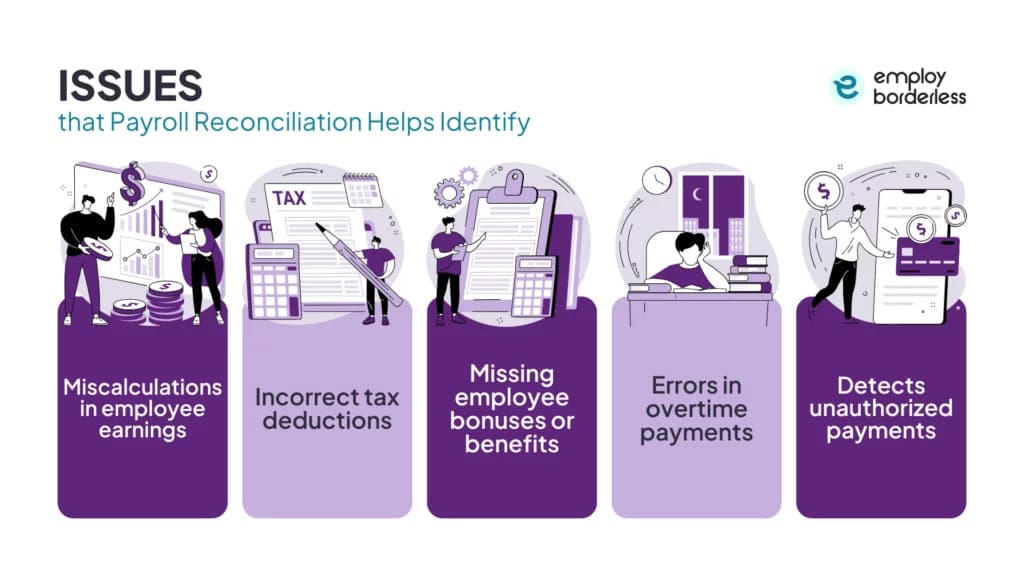
- Miscalculations in employee earnings caused by wrong hours or salary rates, which erode trust if left uncorrected.
- Incorrect tax deductions from outdated rates or late updates, caught before filings go to tax authorities.
- Missing bonuses or benefits that employees are entitled to but haven't received.
- Errors in overtime payments from incorrect hourly rates or missed entries.
- Unauthorized payments such as ghost employees, duplicate salary entries, or payments routed to the wrong account.
Best practices for payroll reconciliation
Best practices for payroll reconciliation include setting a consistent schedule, communicating clearly with the finance team, using a dual verification process, educating staff on accurate time tracking, and keeping detailed records for audit readiness.
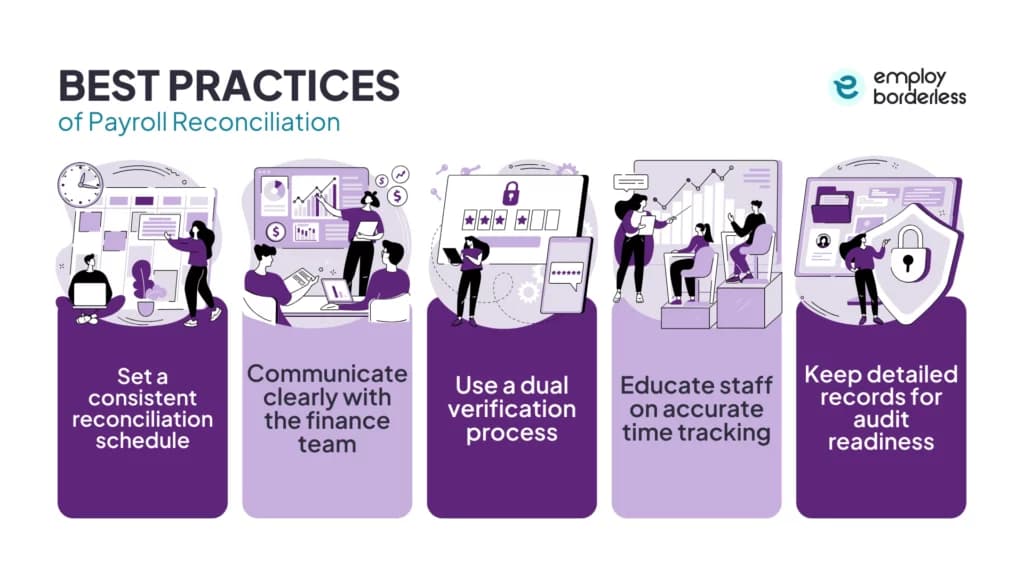
- Set a consistent reconciliation schedule - before every payroll run and at month-end - so errors are caught early rather than at year-end.
- Communicate clearly with the finance team to avoid mismatches between payroll records and financial reports and resolve issues faster.
- Use a dual verification process with at least two reviewers checking calculations before finalizing, which reduces errors and fraud risk.
- Educate staff on accurate time tracking for hours, overtime, and leave, since reliable input data makes reconciliation easier from the start.
- Keep detailed records for audit readiness, documenting transactions, corrections, and approvals to support compliance checks and smoother audits.
How to handle payroll mistakes found in reconciliation
Handling payroll mistakes found in reconciliation involves identifying the error quickly, correcting it in payroll records, communicating with the affected employee, adjusting payments and withholdings, and strengthening controls to prevent future errors.
- Identify the mistake quickly by reviewing payroll reports to pinpoint whether the error is in hours, rates, or deductions.
- Correct the error in payroll records, updating the payroll system so both payroll and accounting records reflect accurate data.
- Communicate with the affected employee whether they were underpaid or overpaid, so trust is preserved while the issue is resolved.
- Adjust payments and withholdings, paying the difference for underpayments or agreeing on a fair, compliant recovery method for overpayments.
- Strengthen controls to prevent future errors by reviewing the root cause and adding training, dual verification, or better software checks.
Payroll reconciliation FAQ
Who is responsible for payroll liabilities?
The employer is responsible for payroll liabilities, including withheld employee taxes and its own contributions. This legal responsibility stays with the employer even when payroll is outsourced; tax authorities hold the employer, not the provider, accountable for errors.
How do you reconcile Form 941 with payroll records?
Compare wages, tips, and compensation reported on Form 941 with payroll registers, match federal income tax, Social Security, and Medicare withholdings to payroll system totals, then confirm deposits made to the IRS match reported liabilities and investigate any differences.
What are the basic steps in processing payroll?
The basic steps are collecting employee data and timekeeping records, calculating gross pay, determining taxes and deductions, calculating net pay, processing payments, and maintaining detailed records for compliance. See the full payroll process for details.
How often should you reconcile payroll?
Reconcile payroll after every pay period, before each monthly tax deposit, before quarterly Form 941 filings, and annually before W-2 filings. More frequent, even continuous, reconciliation is best practice since it catches errors early.
Should payroll report to HR or accounting?
Payroll can report to either HR or accounting depending on company size, needs, and resources. Reporting to HR offers real-time data integration, while reporting to accounting provides greater financial expertise for tax compliance.
What do payroll regulations and compliance mean?
Payroll regulations and compliance mean employers must follow all federal, state, and local laws governing how employees are paid, taxed, and compensated, including minimum wage, overtime pay, and correct payment for all hours worked. See payroll compliance for more.
Is payroll reconciliation handled in-house or through outside services?
Businesses handle payroll reconciliation either internally through finance and HR staff or by using outside payroll reconciliation services and providers. Either way, legal responsibility for accuracy and tax compliance remains with the employer, not the provider.
What is payroll reconstruction?
Payroll reconstruction means rebuilding payroll records from source documents, such as timesheets, bank statements, and tax filings, when data is missing, corrupted, or in dispute. It draws on the same records used for standard payroll reconciliation.
Payroll reconciliation, in every form above, comes down to the same discipline: comparing what payroll systems say against what accounting records, bank statements, and tax authorities confirm, then fixing whatever doesn't match before it becomes a compliance problem or an employee complaint. For more on withholding accuracy, see tax withholdings, and for the payroll basics this process depends on, see payroll.

Co-founder, Employ Borderless
Robbin Schuchmann is the co-founder of Employ Borderless, an independent advisory platform for global employment. With years of experience analyzing EOR, PEO, and global payroll providers, he helps companies make informed decisions about international hiring.
Learning path · 10 articles
Payroll fundamentals
Master the fundamentals with our step-by-step guide.
Start the pathReady to hire globally?
Get a free, personalized recommendation for the best EOR provider based on your needs.
Get free recommendations