Payroll optimization: strategies to improve accuracy & performance

Robbin Schuchmann
Co-founder, Employ Borderless
Payroll optimization means improving payroll operations by using technology, automation, and advanced processes to reduce manual work, save costs, lower errors, and support compliance with tax and labor laws. It is important for improved accuracy, better operational performance, cost reduction, risk mitigation, and data-driven decision-making.
Advanced strategies for payroll optimization include integrating the payroll platform with other systems, adopting cloud-based payroll services, and using standalone payroll options. Other strategies involve outsourcing payroll and tax compliance, managing global payroll, and using payroll data analytics for workforce and cost optimization.
The recommended practices for payroll optimization are automating manual payroll tasks and workflows, centralizing payroll data for accurate reporting, providing employee and manager self-service portals, and conducting regular payroll audits and process reviews. Payroll optimization also offers advantages like compliance with regulatory updates, cost-effectiveness, expertise and accuracy, and the ability to scale as your business grows.
What is payroll optimization?
Payroll optimization is a strategic practice of making the payroll process simple, reliable, and accurate. This process focuses on creating clear, organized workflows and using the right tools to lower errors, reduce delays in payroll cycles, maintain compliance with tax and labor regulations, and protect sensitive employee data.
Think about what happens when payroll data lives in three different systems and nobody owns the reconciliation process. Errors compound, staff spend hours on manual fixes, and employees lose trust when their pay is wrong. Payroll optimization closes those gaps. It involves automating timesheet approvals, integrating payroll systems with HR, accounting, and time-tracking platforms, and giving employees secure, convenient access to their pay information. These measures lower administrative burdens, create transparency, keep records accurate and up to date, and build trust by handling employee payments correctly and securely.
Why is payroll optimization important?
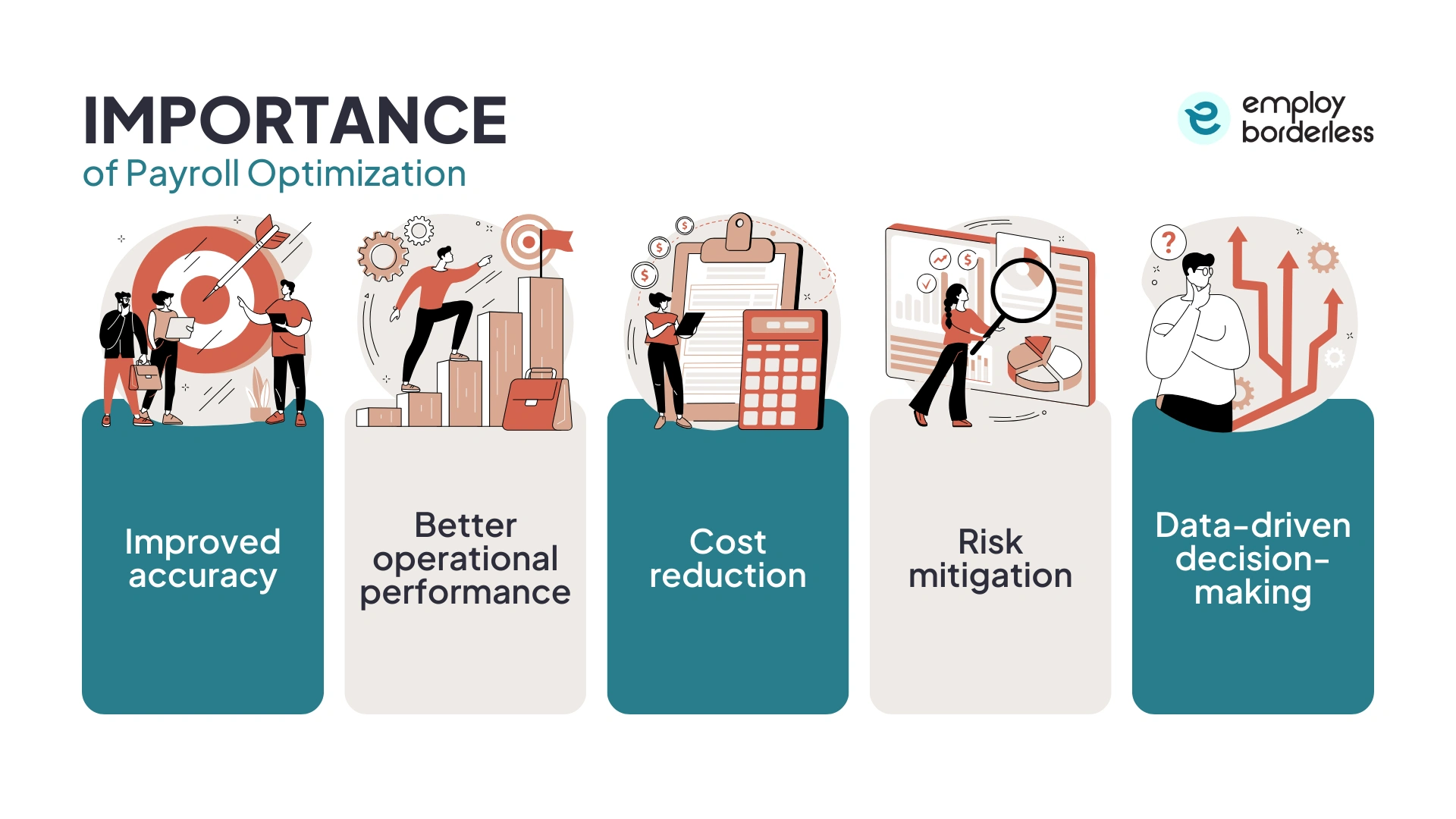
Payroll optimization is important for improved accuracy, better operational performance, cost reduction, risk mitigation, and data-driven decision-making.
The reasons payroll optimization is important are listed below.
Improved accuracy: Payroll optimization improves accuracy by supporting the organization's financial position and regulatory compliance. It reduces the need for time-consuming corrections, lowers the risk of fines or penalties from authorities, and helps maintain employee trust when payroll data is correct.
Better operational performance: Optimized payroll leads to better operational performance by automating routine tasks and simplifying workflows. This automation saves HR and finance teams time and resources and allows them to focus on strategic initiatives, such as workforce planning or budgeting.
Cost reduction: Payroll optimization helps organizations reduce expenses by removing ineffective manual processes and automating routine tasks. Automated systems reduce labor costs by lowering the need for extensive payroll staff or external service fees. These systems also reduce operating costs by cutting paper, printing, and administrative overhead. They also prevent costly errors, such as incorrect calculations, missed tax filings, or compliance violations, which result in expensive corrections, penalties, and legal fines.
Risk mitigation: Payroll optimization helps mitigate risk by improving accuracy, compliance, and control in payroll processing. Optimized payroll systems reduce human errors and make sure tax calculations and filings are correct, which lowers the possibility of penalties or fines. They also keep up with changing regulations, simplify compliance reporting, and maintain data security to protect sensitive employee information and reduce operational issues.
Data-driven decision-making: Optimized payroll systems offer insights into workforce patterns, labor costs, productivity, and financial trends by collecting accurate, timely payroll data. Organizations use this information to compare labor expenses across departments, identify issues such as excessive overtime, predict future payroll costs, and plan staffing more effectively. These insights help HR and finance teams make informed decisions on compensation, hiring, resource allocation, and workforce planning.
Key takeaway: Payroll optimization doesn't just cut costs - it gives HR and finance teams reliable data to make better staffing and compensation decisions.
What are the advanced strategies for payroll optimization?
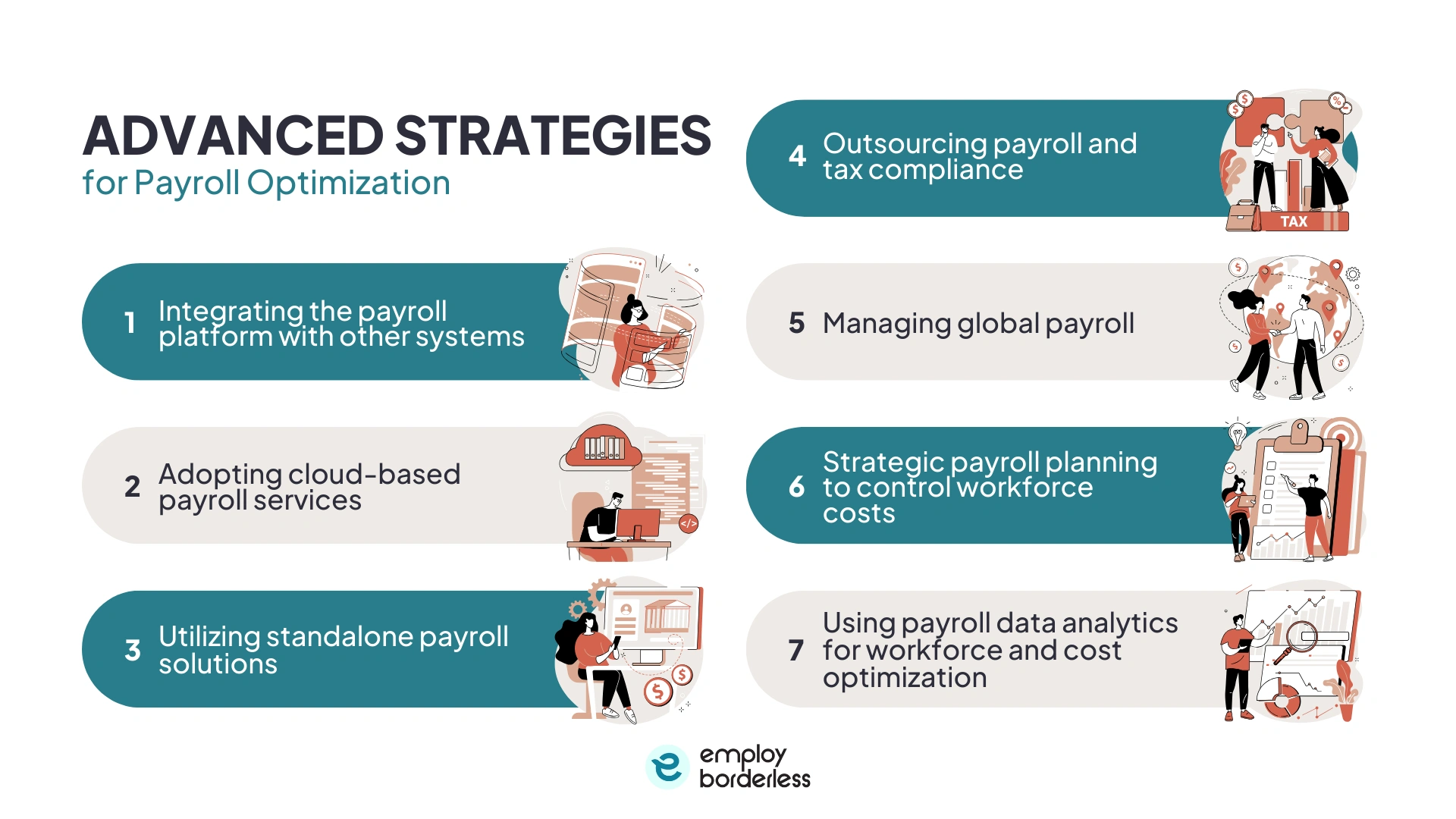
The advanced strategies for payroll optimization include integrating the payroll platform with other systems, adopting cloud-based payroll services, using standalone payroll options, and outsourcing payroll and tax compliance. Other advanced strategies are managing global payroll, strategic payroll planning to control workforce costs, and using payroll data analytics for workforce and cost optimization.
Integrating the payroll platform with other systems
Connecting payroll software with human resources and accounting platforms allows a smooth flow of data, reduces manual entry errors, and improves reporting functions. Updates to employee status, benefits enrollment, or time-tracking information are automatically shown in payroll. This integration lowers the need for manual adjustments and improves overall accuracy and performance.
Adopting cloud-based payroll services
Adopting cloud-based payroll systems simplifies accessibility, capacity management, and security. Organizations manage payroll from any location, quickly adjust capacity as the workforce grows, and rely on strong security measures like SSL encryption and strict access controls from the cloud provider. These platforms are regularly updated with the latest tax rates and regulatory changes, which helps maintain compliance while simplifying payroll management.
Using standalone payroll options
A standalone payroll option is a dedicated system designed exclusively for managing payroll functions, rather than being part of a larger HR or accounting system. These systems focus solely on payroll processing, tax calculations, compliance updates, reporting, and payslip generation, which helps organizations simplify and standardize payroll operations.
Outsourcing payroll and tax compliance
Outsourcing payroll and tax compliance offers a strategic advantage by supporting business growth while maintaining compliance with local and international regulations. Outsourced payroll providers handle payroll distribution with accuracy while making sure employees are paid correctly and on time according to employment agreements and local regulations. Payroll outsourcing arrangements also securely manage employee records, payroll documentation, and sensitive information.
Managing global payroll
Optimized payroll systems help with global payroll management by coordinating and standardizing payroll processes across all countries where a business operates, rather than handling payroll separately in each location. It is considered an advanced optimization strategy because it centralizes data, automates complex tasks, and reduces risk for multinational organizations.
Strategic payroll planning to control workforce costs
Strategic payroll planning is the process of integrating payroll operations with workforce planning and organizational financial goals to effectively manage labor expenses. Predicting workforce expenses and monitoring compensation structures by analyzing payroll data helps organizations control spending. This strategy allows businesses to track labor costs across departments, anticipate seasonal or project-based staffing needs, and prevent unnecessary expenses such as overstaffing or excessive overtime.
Using payroll data analytics for workforce and cost optimization
Using payroll data analytics involves examining payroll records, compensation trends, and workforce metrics to identify cost patterns and performance insights. Organizations monitor labor expenses, evaluate productivity levels, and identify issues such as excessive overtime or inconsistent pay structures by turning payroll data into useful intelligence.
| Strategy | Primary benefit | Best suited for |
|---|---|---|
| Platform integration | Reduces manual data entry errors | Companies with separate HR and accounting systems |
| Cloud-based payroll | Remote access and automatic compliance updates | Growing or distributed teams |
| Standalone payroll options | Focused payroll processing without added complexity | Businesses that don't need full HR integration |
| Payroll outsourcing | Compliance expertise and reduced internal workload | Companies expanding into new markets |
| Global payroll management | Standardized processes across multiple countries | Multinational organizations |
| Strategic payroll planning | Controls labor costs and prevents overstaffing | Organizations with seasonal or project-based staffing |
| Payroll data analytics | Workforce cost insights and trend identification | HR and finance teams making compensation decisions |
What are the recommended practices for payroll optimization?
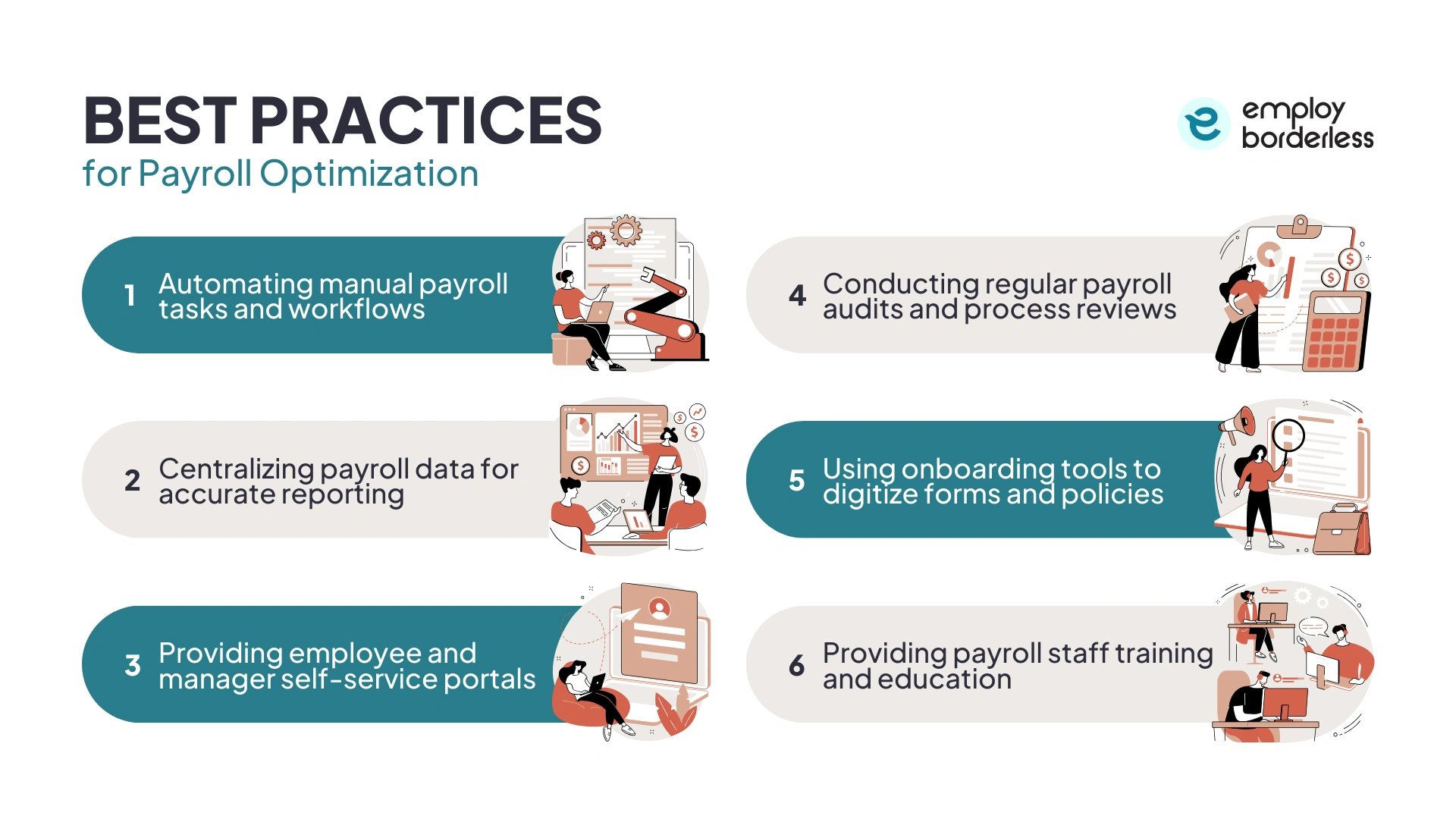
The recommended practices for payroll optimization are automating manual payroll tasks and workflows, centralizing payroll data for accurate reporting, and providing employee and manager self-service portals. Other recommended practices include conducting regular payroll audits and process reviews, using onboarding tools to digitize forms and policies, and providing payroll staff training and education.
Automating manual payroll tasks and workflows
Simplify payroll operations by automating routine activities such as data entry, payroll calculations, tax deductions, and report generation. Automation reduces manual workload, improves accuracy, and saves processing time.
Centralizing payroll data for accurate reporting
Centralizing payroll data helps organizations maintain consistent and easily accessible employee and payroll information. This centralization involves standardizing payroll processes across all locations, which includes uniform pay schedules, data formats, and reporting procedures.
Centralized payroll platforms also allow organizations to integrate data from multiple payroll providers into one standardized reporting structure. These platforms create a clear, overall view of payroll operations, improve data transparency, support compliance, and enable better decision-making through reliable workforce insights.
Providing employee and manager self-service portals
Self-service payroll portals give employees secure access to their personal and payroll information. Such portals allow workers to complete onboarding steps, update banking and personal details, submit tax and compliance documents, request leave, and submit expense claims.
Employees are also able to review compensation and benefits enrollment forms, sign agreements, and download pay statements. Self-service tools reduce HR and payroll administrative burdens, improve data quality, and quickly respond to common requests. These portals improve communication and transparency between employees, managers, and payroll teams.
Conducting regular payroll audits and process reviews
Conducting regular payroll audits helps organizations detect errors, inaccuracies, and possible compliance issues within the payroll process. These reviews, performed either internally or by external professionals, help verify data accuracy, offer conformity to applicable laws and regulations, and identify opportunities for process improvement. Regular audits support a more reliable and compliant payroll system while reducing the risk of costly errors and penalties.
Using onboarding tools to digitize forms and policies
Digital onboarding platforms allow employees to complete tax forms, policy approvals, and personal information submissions electronically, while making sure payroll data is collected quickly and stored securely. These onboarding platforms support compliance with regulatory requirements and help maintain consistent, up-to-date employee records, which leads to more effective payroll processing.
Providing payroll staff training and education
Providing payroll staff training and education confirms payroll professionals stay updated on changing tax laws, labor regulations, and payroll technologies. Continuous training improves accuracy in payroll processing and helps staff effectively manage complex payroll tasks. Well-trained payroll teams identify errors early, adjust to new systems quickly, and build reliable processes, which results in smooth payroll operations and reduced compliance risks.
Key takeaway: Centralizing payroll data and running regular audits are the two practices most likely to catch errors before they become compliance issues or employee complaints.

What are the advantages of payroll optimization?
The advantages of payroll optimization are maintaining compliance with regulatory updates, cost-effectiveness, strategic focus, expertise and accuracy, and flexibility.
The advantages of payroll optimization are discussed below.
Staying compliant with regulatory updates: Payroll optimization helps organizations stay consistent with changing tax laws, labor regulations, and reporting requirements. Automated and optimized payroll systems reduce compliance risks by updating tax rules in real time and providing accurate filings, which lowers the chances of audits, penalties, and legal issues.
Cost-effectiveness: Improving payroll processes reduces administrative expenses by cutting manual work, payroll errors, and overhead costs. Automation and organized workflows lower operational costs while improving productivity and allowing organizations to allocate resources more effectively.
Strategic focus: Simplified payroll systems free HR and finance teams from routine administrative tasks, which allows them to concentrate on workforce planning, business growth, and strategic decision-making. Payroll optimization also provides valuable workforce insights that support better financial planning and resource management.
Expertise and accuracy: Optimized payroll processes improve calculation accuracy, tax withholding detail, and reporting reliability. Advanced payroll tools and trained payroll professionals help identify errors early, reduce payment discrepancies, and maintain employee trust while preserving financial integrity.
Flexibility: Payroll optimization helps businesses manage payroll smoothly as they expand. Flexible payroll systems handle growing employee numbers, multiple locations, and complex payroll structures without increasing administrative burden, which supports ongoing business growth.
What are the challenges in payroll optimization?
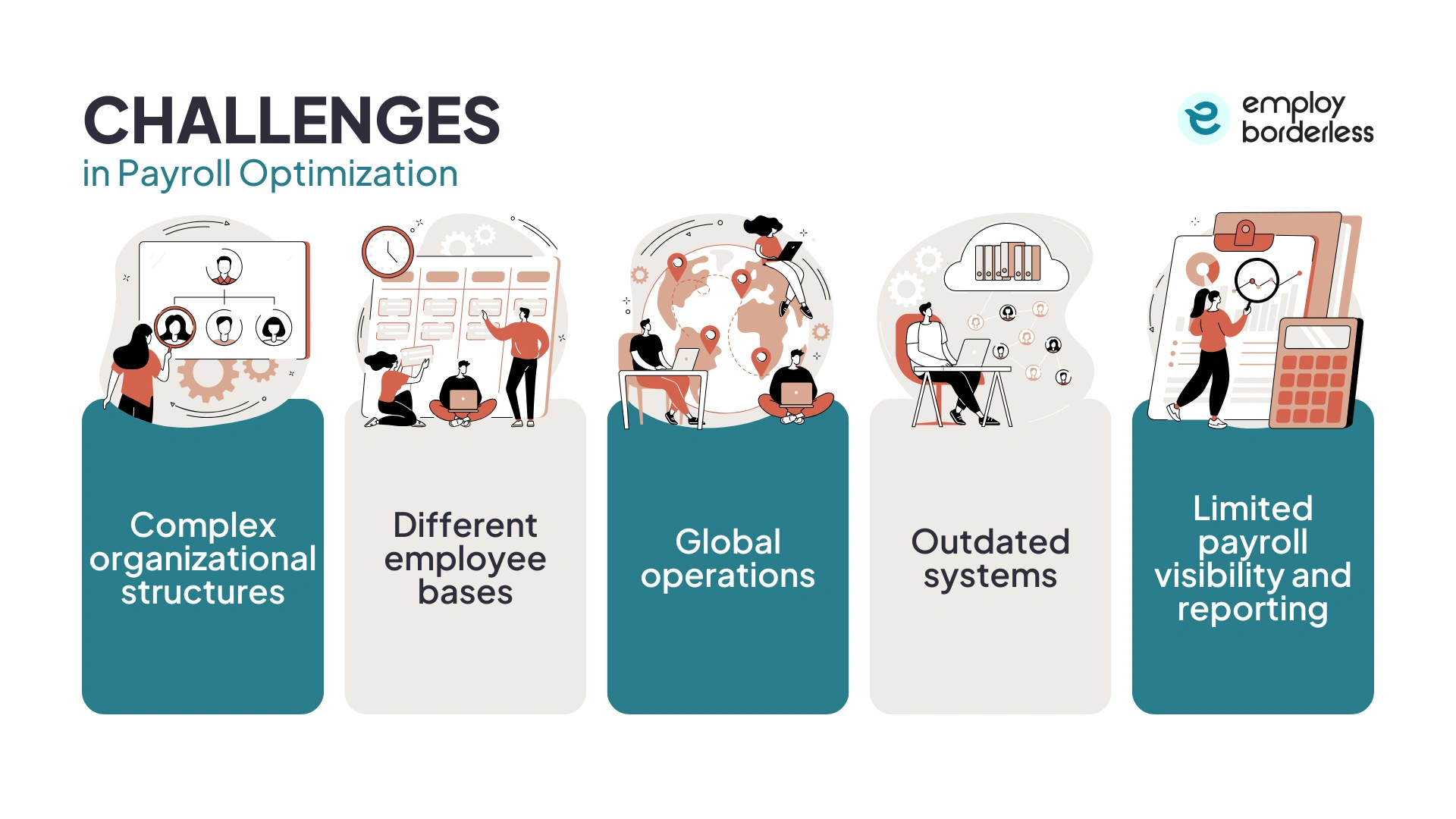
The challenges in payroll optimization are complex organizational structures, different employee bases, global operations, outdated systems, and limited payroll visibility and reporting.
The challenges in payroll optimization are mentioned below.
Complex organizational structures: Large organizations usually operate with multiple departments, entities, or regional divisions, which lead to inconsistent payroll processes, duplicated work, and difficulties standardizing workflows across the business. Separate systems and differing reporting formats make it hard to maintain accuracy and uniformity across the organization.
Different employee bases: Managing payroll for multiple workforces, which include full-time staff, part-time workers, contractors, and gig-economy workers, introduces complexity. Each group has unique pay structures, tax rules, benefits, and compliance requirements, which increases the risk of errors and requires more manual involvement.
Global operations: Companies operating in multiple countries face increased payroll complexity due to different labor laws, tax regimes, currencies, reporting standards, and statutory requirements. Companies have to handle these differences while trying to standardize processes, which makes compliance and accurate cross-border payments challenging.
Outdated systems: Legacy or disconnected payroll systems that do not integrate well with HR, time tracking, or finance platforms lead to data errors, manual data reconciliation, and limited automation. These outdated tools slow down payroll cycles, increase errors, and make it difficult to adjust to change.
Limited payroll visibility and reporting: Organizations lack a real-time overview of costs, compliance, and workforce trends when payroll data is distributed across systems. These separate systems make consolidated reporting difficult, delay strategic decision-making, and increase the risk of compliance issues going unnoticed.
How to choose the right software for payroll optimization?
To choose the right software for payroll optimization, consider customization, built-in payment features, advanced reporting, employee self-service functions, and high security standards.
Choose payroll software that offers flexibility and customization, as payroll and bookkeeping requirements differ across businesses. Organizations need the ability to personalize workflows, reporting formats, payment structures, and compliance settings to match their specific operational needs. Software that lacks customization or configuration options limits functionality and fails to support changing payroll requirements, which makes it less effective for long-term business growth and optimization.
Select a payroll system with built-in payment features that support the accurate and timely distribution of employee wages. Payroll software helps automate salary disbursements and allows organizations to process bulk payments to employees smoothly. It also reduces manual effort while improving payment accuracy and consistency.
Choose payroll software that generates accurate statutory and government reports related to payroll operations and supports detailed internal reporting. The system needs to help HR, payroll, and accounting teams extract and analyze relevant data for financial reporting, compliance monitoring, and strategic workforce planning.
Choose payroll software that gives employee self-service functions to improve the employee experience. It must allow staff to independently update personal and payment details, access payroll information, and manage routine requests. Self-service tools reduce the administrative burden on HR and payroll teams by handling routine inquiries, so they focus on more strategic responsibilities.
Prioritize a payroll option that offers strong security measures, such as SSL encryption, access controls, and compliance with data protection regulations like GDPR (General Data Protection Regulation). Avoid options that do not meet strong security requirements, as payroll information involves highly sensitive employee and financial data. This data needs protection to prevent breaches, fraud, and compliance risks.
What options are available for businesses to improve their payroll software?
The options available for businesses to improve their payroll software are integrated payroll with HRIS (Human Resources Information System) providers, global payroll management, managed payroll services, and standalone payroll systems.
How do standalone payroll options differ from integrated options?
Standalone payroll options differ from integrated options in terms of functionality, connectivity, and scope. Standalone systems focus only on payroll processing and require manual data transfer between HR, accounting, and benefits systems. Integrated options connect payroll with other business systems, allowing real-time data sharing, automation, improved reporting, and simplified workflows across multiple HR and finance functions.
When to consider integrated and standalone options for payroll optimization?
Consider integrated payroll options when companies want smooth data sharing among payroll, HR, time tracking, and benefits systems. Consider standalone payroll options when businesses need a simple, focused system that handles payroll calculations and compliance without requiring full HR or workforce integration.
Can payroll optimization reduce compliance risks?
Yes, payroll optimization reduces compliance risks through automated calculations, centralized data, and up-to-date compliance rules. It prevents manual errors, misclassification, and regulatory penalties while supporting overall payroll risk management.
How does payroll optimization impact workforce cost management?
Payroll optimization impacts workforce cost management by improving accuracy and visibility into labor expenses. Organizations track productivity, control overtime, reduce unnecessary costs, and make informed staffing and compensation decisions by integrating payroll with employee management systems.

Co-founder, Employ Borderless
Robbin Schuchmann is the co-founder of Employ Borderless, an independent advisory platform for global employment. With years of experience analyzing EOR, PEO, and global payroll providers, he helps companies make informed decisions about international hiring.
Learning path · 10 articles
Payroll fundamentals
Master the fundamentals with our step-by-step guide.
Start the pathReady to hire globally?
Get a free, personalized recommendation for the best EOR provider based on your needs.
Get free recommendations