EOR for healthcare: benefits, patient-care solutions, and how to choose

Robbin Schuchmann
Co-founder, Employ Borderless
EOR (Employer of Record) is a complete workforce management approach that allows healthcare organizations to hire, manage, and pay employees across different regions without setting up local entities. It handles complex HR functions such as payroll, compliance, and employee onboarding.
Healthcare companies work with an EOR to focus on patient care and service quality as the EOR takes care of legal compliance, reduces administrative burden, and helps attract qualified healthcare professionals globally.
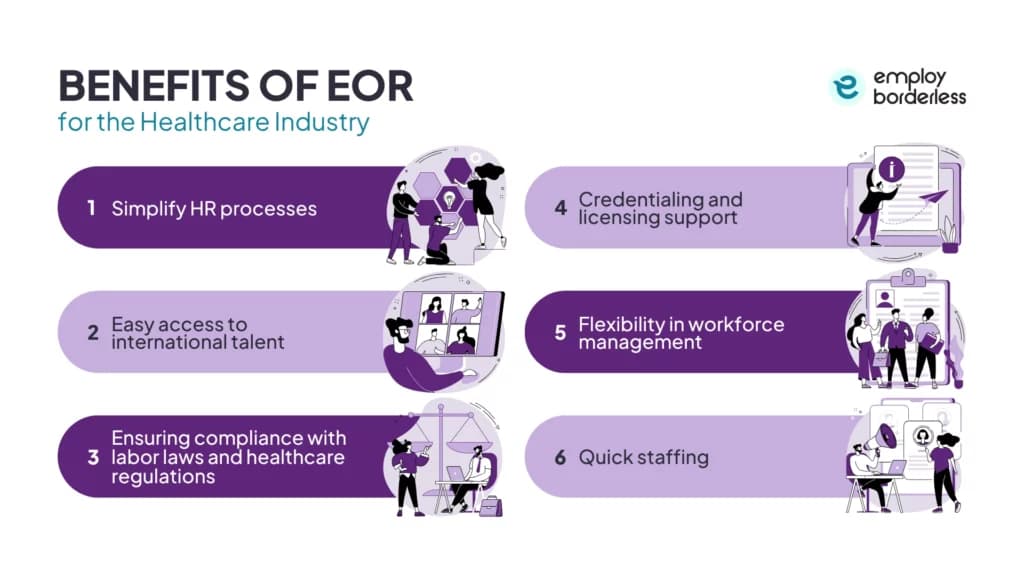
The benefits of an EOR for the healthcare industry include simplified HR processes, easy access to international talent, compliance with labor laws and healthcare regulations, credentialing or licensing support, flexible workforce management, and quick staffing.
The factors to consider when choosing the right EOR for your healthcare organization include expertise in healthcare compliance, accurate global expansion, customized payroll and benefits packages, and a focus on patient care.
What is an EOR?
An EOR (Employer of Record) is a third-party organization that legally employs workers on behalf of a company. It manages all employment-related responsibilities such as payroll, taxes, benefits, and compliance with local labor laws, while the company manages the employees' daily work and business operations.
Why should healthcare companies work with an EOR?
Healthcare companies should work with an EOR because it helps resolve major industry challenges such as strict regulatory compliance, workforce shortages, high turnover, and complex compensation and reimbursement processes.
The healthcare industry must follow complex regulations like HIPAA (Health Insurance Portability and Accountability Act) and OSHA (Occupational Safety and Health Administration) standards. An EOR helps healthcare organizations stay compliant with these regulations by managing employee documentation, data security, and workplace safety standards.
Healthcare organizations often struggle to find qualified professionals due to global skill shortages. EORs help by expanding access to international talent pools and simplifying global hiring.
Frequent staff turnover disrupts patient care and increases recruitment costs. EORs help reduce turnover by providing competitive benefits, proper onboarding, and employee engagement programs.
Healthcare payroll involves different pay structures, shift differentials, and complex reimbursements. EORs manage these processes accurately and on time, while complying with wage laws and payment transparency standards.
Key takeaway: An EOR doesn't just handle paperwork - it directly addresses the staffing and compliance challenges that most healthcare organizations struggle with every day.
What are the benefits of EOR for the healthcare industry?
The benefits of EOR for the healthcare industry include simplified HR processes, easy access to international talent, compliance with labor laws and healthcare regulations, credentialing and licensing support, flexible workforce management, and quick staffing.
Simplify HR processes
An EOR simplifies HR operations by handling payroll, benefits, onboarding, and administrative tasks for healthcare organizations. It reduces the burden on internal HR teams and allows them to focus more on patient care and operational productivity rather than paperwork and compliance management.
Easy access to international talent
Healthcare providers, through an EOR, are able to hire qualified medical professionals from different countries without setting up a legal entity abroad. This third-party service provider helps fill workforce gaps quickly, especially in specialized fields like nursing or medical technology, where local talent is limited.
Ensuring compliance with labor laws and healthcare regulations
EORs make sure that healthcare organizations comply with local and international labor laws, tax obligations, and healthcare-specific regulations. They lower the risk of penalties, audits, or legal issues and keep healthcare providers compliant and reputable.
Credentialing and licensing support
An EOR helps verify and manage healthcare workers' professional licenses, certifications, and credentials. It makes sure to hire only qualified and properly certified professionals and maintains safety and compliance with medical standards.
Flexibility in workforce management
EORs offer flexible workforce arrangements that allow healthcare organizations to scale staffing levels based on patient volume or seasonal needs. This flexibility is important for hospitals and clinics dealing with fluctuating workforce demand.
Quick staffing
EORs allow quick onboarding of medical staff with their established global networks and simplified hiring processes. EORs help healthcare facilities maintain proper staffing levels and provide continuous patient care without delays.
| Benefit | What the EOR handles | Impact on your organization |
|---|---|---|
| Simplified HR processes | Payroll, benefits, onboarding, admin tasks | Frees internal HR to focus on patient care |
| International talent access | Cross-border hiring without a local entity | Fills workforce gaps in specialized fields |
| Regulatory compliance | Labor laws, tax obligations, HIPAA, OSHA | Reduces risk of penalties and audits |
| Credentialing and licensing | License verification, certification management | Only qualified professionals are hired |
| Workforce flexibility | Scalable staffing based on demand | Adapts to patient volume and seasonal shifts |
| Quick staffing | Fast onboarding via global networks | Maintains continuity of patient care |
How do EOR services improve patient care in healthcare organizations?
EOR services improve patient care in healthcare organizations by automating credentialing and compliance workflows, using healthcare HR technology, establishing clear malpractice and indemnity terms, conducting regular compliance audits, and supporting workforce stability and retention.
This global employment partner automates the verification of medical licenses, certifications, and compliance documents, and hires only qualified professionals. This automation speeds up onboarding, reduces human error, and guarantees that all staff meet healthcare standards, which improves patient safety and care quality.
An EOR uses specialized HR software designed for healthcare organizations to manage payroll, scheduling, and employee records accurately. EOR technology reduces administrative delays and allows healthcare teams to focus more on treating patients rather than handling paperwork.
This third-party service provider helps define and manage malpractice coverage and liability agreements for healthcare workers. It makes sure that healthcare professionals perform their duties confidently by establishing transparent legal protections.
EORs perform regular audits to make sure that healthcare facilities comply with labor laws, safety standards, and healthcare regulations. These audits help prevent legal or operational disruptions to maintain consistent and high-quality patient care.
This third-party employer handles employee benefits, payroll accuracy, and professional development support, which leads to higher staff satisfaction and retention. A stable and motivated workforce contributes to better continuity of care and improved patient experiences.
Key takeaway: EOR services improve patient care indirectly - by removing the administrative and compliance burdens that pull healthcare teams away from clinical work.
How to choose the right EOR for your healthcare company?
To choose the right EOR for your healthcare company, consider factors like expertise in healthcare compliance, accurate global expansion, customized payroll and benefits solutions, and a focus on patient care.
Choose an EOR that understands healthcare-specific regulations, such as HIPAA (Health Insurance Portability and Accountability Act) and OSHA (Occupational Safety and Health Administration), along with local labor laws.
Select an EOR with experience in managing international healthcare staff and operations. The right partner helps you expand into new regions smoothly while keeping you compliant with each country's employment and tax regulations.
Prioritize an EOR that customizes payroll, insurance, and benefits packages to meet the needs of healthcare professionals. A customized approach helps attract and retain skilled talent by providing fair compensation and relevant benefits.
Partner with an EOR that reduces your administrative burden so your healthcare team focuses on delivering quality patient care. Expert HR and compliance management directly support improved patient results.
How does an EOR work?
An EOR works by legally employing workers on behalf of a company, especially in countries where the company has no legal entity. The EOR manages payroll, taxes, benefits, and compliance with local labor laws, while the company handles the employees' daily work.
What types of industries benefit from EOR services?
The types of industries that benefit from EOR services include healthcare, technology, manufacturing, retail, construction, and professional services. EOR services for industries are important because they face challenges such as complex compliance requirements, international hiring, and workforce management at scale.
What is the difference between EOR and COR?
The difference between EOR and COR is that EOR (Employer of Record) is a third-party organization that legally employs workers on behalf of a company, handling payroll, taxes, and compliance. COR (Contractor of Record) manages independent contractors instead of full-time employees.
What are the latest EOR trends in the healthcare industry?
The latest EOR trends in the healthcare industry include the use of AI and automation to improve payroll accuracy, compliance, and onboarding. Healthcare companies now rely on EORs to manage workforce shortages through fast and flexible staffing arrangements.
How do EOR services support compliance?
EOR services support compliance by making sure that the employment practices follow local labor laws, tax regulations, and industry standards. EOR compliance support handles payroll taxes, employee documentation, and benefits according to legal requirements.

Co-founder, Employ Borderless
Robbin Schuchmann is the co-founder of Employ Borderless, an independent advisory platform for global employment. With years of experience analyzing EOR, PEO, and global payroll providers, he helps companies make informed decisions about international hiring.
Learning path · 8 articles
EOR fundamentals
Master the fundamentals with our step-by-step guide.
Start the pathReady to hire globally?
Get a free, personalized recommendation for the best EOR provider based on your needs.
Get free recommendations