11 factors to consider when choosing an employer of record (EOR)

Robbin Schuchmann
Co-founder, Employ Borderless
An employer of record is a third-party service provider responsible for managing the legal and administrative operations related to another company's employment processes ranging from hiring to off-boarding along with legal regulations and considerations.
There are several complex considerations involved while choosing an employer of record (EOR). Define your goals and requirements, find good EOR teams, screen their processes and experience, get in touch with them and ask relevant questions, take time to review, and hire the EOR that fits your culture and requirements.
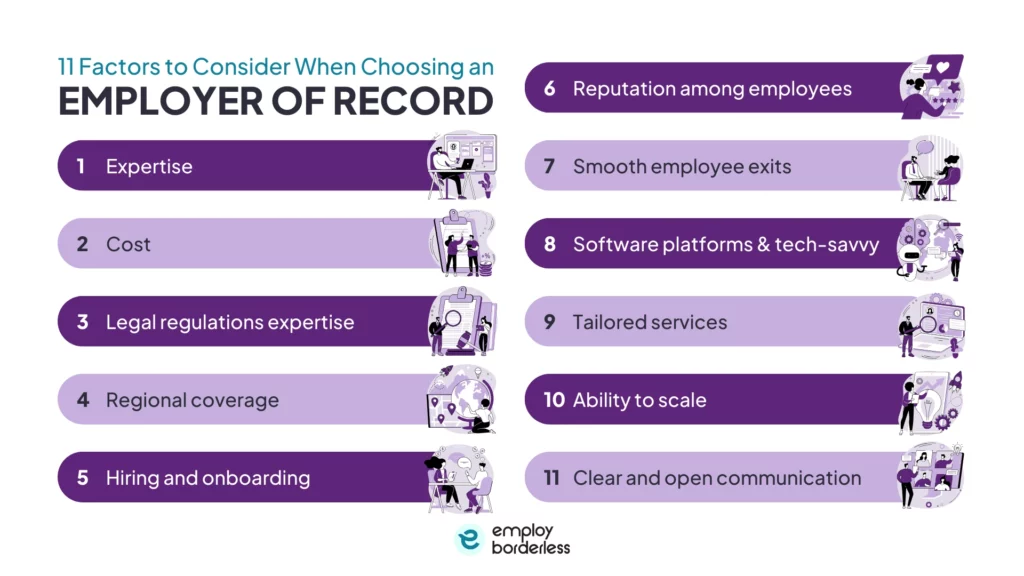
Some main factors to consider when choosing an employer of record EOR include expertise, cost, legal regulations expertise, regional coverage, hiring and onboarding, reputation among employees, smooth employee exits, software platforms or tech-savvy, tailored services, ability to scale, and clear communication.
Expertise
Proven experience is one of the most important things you need to consider when choosing an EOR. Find an EOR with a solid track record and collaborations with noteworthy names. Go through their portfolio, processes, and reviews to understand their credibility better. Ask them questions about the complexities associated with their services and management like payroll, employment, termination, and compliance. A good EOR will explain the processes and complications for different reasons and requirements.
This matters because it helps confirm that operations will run smoothly and you'll have confidence in the EOR's credibility. While it is time-consuming and more expertise results in an extra cost, it offers reliable solutions with prior experience that shows how they handle all kinds of scenarios.
Cost
EORs have various pricing models based on the services they offer and their expertise. Set aside a budget you want to allocate for the employment process. Try to look for the EORs that come within the budget bracket you have set for this. Keep a slightly wider bracket so that you finalize a cost-effective team. When you find an EOR team that fits your requirements, ask for their pricing in detail like upfront cost, fixed prices, hidden cost, and any reliant or variable costing.
The cost usually varies based on the number or type of employees, locality, and the services offered. Transparent costing results in cost-effective and better financial planning. However, some hidden or unpredictable costs lead to disrupted budgeting for the company. Before you start working with an EOR, discuss all the costs in terms of fixed pricing, variables, and hidden cost estimations to plan out a better budget allocation.
Legal regulations expertise
Make sure to check the EOR's knowledge of legal regulations and compliance with laws like labor, tax, or employment benefits. Legal regulations are different in various localities and the company has to comply with the laws being practiced in that specific locality. The EOR has to confirm that the company is complying with all the laws.
EOR helps the company dodge fines or penalties due to violations of legal regulations and eventually helps to save the company's reputation. Companies are often unaware of complex laws that land them at big risks. Legally aware EORs help to reduce the chances of that happening.
While it eliminates the need to have an in-house legal team and reduces risk, it increases the reliance on the EOR team for all legal matters. Errors within legal work can have high-value impacts. To avoid this, choose an EOR with strong know-how regarding legal matters and proven experience helping other businesses navigate similar legal ground. Ask questions and request a detailed overview of how they manage legal regulations and complexities.
Regional coverage
Before choosing an EOR, make sure to check their regional coverage and the number of localities they have expertise in. Some EORs are experts within a certain city or a country only whereas some EORs cover various countries offering services on a global scale. Global coverage makes it easier to hire reliably when you want resources from various parts of the world. Good EORs help to manage global teams effectively and eliminate the need to work with different EOR teams to manage employees from different regions individually.
However, EORs offering global coverage are often costly and expertise is usually limited when it comes to lesser-known areas. So before choosing an EOR, research their coverage by asking questions and reviewing their portfolio. You'll need an EOR that offers global coverage, especially if you're planning to expand your workforce into new markets.
Hiring and onboarding
While choosing an EOR, make sure to consider the hiring and onboarding services offered by them. Ask about the whole process from finding new talent to screening, interviews, and onboarding. A smooth onboarding process shapes the employment experience and that depends heavily on the services the EOR provides. A good start with efficient hiring and smooth onboarding enables a welcoming relationship between the company and the employee, leading to long-term mutually beneficial collaboration.
An efficient onboarding process by the EOR helps to improve the company's reputation and create good first impressions while bringing down the time required for hiring new employees. Delays and disruption occur when a poor EOR has been selected. Make sure you choose a team that fits well with your onboarding requirements.
Reputation among employees
While an EOR's relationship with the company is important, their interaction with the employees should be equally satisfactory. Before hiring an EOR make sure their dealings with companies and employees are fair, respectful, and professional. The EOR will be the main point of contact for the employees regarding matters like payroll, benefits, or HR support.
An EOR that maintains good relationships with employees helps to improve satisfaction and retention, resulting in better day-to-day operations and productivity. To get a sense of this, review the EOR's history with other clients and how they deal with both the company and employees. While it helps to increase employee satisfaction while bringing down the burden from internal teams, too much micromanagement results in disruptive operations, so there has to be a balance between supportive and overseeing service.
Smooth employee exits
Whether it's onboarding or offboarding, the EOR has to manage everything carefully so that it neither impacts the company operations nor the employees' experience. Exit laws vary based on region. Some localities require no notice period before exiting while some require 1, 2, 3, or more months prior notice. There are also other legal matters like proceeding with a smooth transition or managing clearances that the EOR has to oversee in order to provide the company with a burden-free exit process.
Before choosing an EOR, make sure to check if they provide legal services associated with exiting and termination. Ask about their processes and how they manage offboarding both generally and legally. It helps to reduce risks like termination lawsuits. However, the cost of thorough offboarding processes is often higher than normal services. Make sure to ask how they manage the employee exit process in a way that results in fair outcomes for both the company and the employee. Also confirm they offer post-termination support so it doesn't come as a burden or damage the company's reputation.
Software platforms and tech-savvy
With the increasing need for technology integration to ease processes, companies should have most of their processes automated through software. Before choosing an EOR check the software platforms and technology they use to manage their processes including payroll, onboarding, and compliance. Working with an EOR that values automation and technology means simpler management of processes and smoother integration with your current setup. It helps to reduce manual efforts while managing processes on a global level if need be.
A tech-savvy EOR supports better communication and data sharing while providing real-time insights using the latest software tools to improve overall efficiency. It decreases the manual burden on teams and gives a better experience to both the company and employees. However, EORs with the latest tech are often costly and less tech-savvy teams usually cause disruptive operations. Before choosing an EOR, check their technical processes and the software they use to manage their operations. This will give you a clearer picture of their technical expertise before you start working with them.
Tailored services
Each company works differently and requires EOR service that is tailored to its operations and requirements. Before choosing an EOR, make sure to check whether they offer custom services based on client requirements. Ask about their customization related to contracts, benefits, compliance, analytics and reporting, and day-to-day operations. This will give you a better idea of how well they can adapt to your team, culture, and operations along with your basic requirements.
Tailored operations help to improve overall efficiency and experience for the company and employees as the EOR adapts to the company's norms. While choosing the EOR, ask for examples or portfolios where they have customized their services for other clients. Customization helps to address specific requirements and improves the overall experience, but it often comes with additional costs and takes time to get right. Make sure the EOR can efficiently manage that customization before you commit.
Ability to scale
All companies plan to grow at some point and require their operations to expand alongside. While choosing an EOR, make sure they have the ability to grow into new markets as your company grows. Expansion often happens quickly and having an EOR that can keep pace is important so that a single process doesn't hold back your growth. A reliable EOR should have experience and knowledge supporting that growth, especially while entering new markets and going global.
During expansion, companies require hiring from different regions and the EOR is responsible for managing all the processes and growing the workforce. This support helps to provide a smoother growth transition and offers long-term value to the company. While the ability to grow with the company helps reduce the administrative burden, the costs for a capable EOR often come at a higher price. When choosing an EOR, ask for previous examples where they had to expand their operations alongside a growing company. This will give you a better idea of how they approach that kind of growth in practice.
Clear and open communication
While choosing an EOR, make sure they have an open and transparent communication pattern with the company and employees. When working with third-party service providers, clear communication is highly important to keep both teams aligned and to reduce the risk of any disruptive operation. When selecting an EOR, monitor how they communicate their services and respond to your requirements. Ask about how they maintain a transparent flow of communication. This will help you get a better idea of their credibility regarding collaboration and trust.
Ask about the EOR's preferred communication channels and regular update processes. A clear flow of communication helps to build healthy and long-term relationships while offering better resolution to issues and promoting trust. Poor communication flows lead to disruptive operations and regular issues. Before choosing an EOR, make sure their communication style and transparency fit your requirements, goals, and trust policy within your team.
What is an employer of record (EOR)?
Employer of record (EOR) is a service offered by third-party service providers who take legal and administrative responsibilities for the employment of individuals on behalf of another company. The EOR is responsible for managing the hiring process, payroll, benefits, exits, and adherence to legal regulations. The company gets engaged in managing their day-to-day operations and the EOR manages the employees.
The employer of the record creates and maintains contracts as per the company requirements and local labor laws. Along with deductions and legal regulations, EORs provide employees with benefits like health insurance, leaves, and increments. From hiring and onboarding the employee to the termination and resignation process EOR manages everything efficiently while taking off the burden from the client.
Some of the main key service highlights related to an employer of record EOR are listed below:
The EOR is responsible for managing the payroll processes, including the calculation of salaries, deductions, salary distributions, or any issues regarding the payroll like delayed management, or miscalculations resulting in disruptive operations.
- EOR handles all the taxation related to the laws of each locality. They manage the filing of proper taxes including income tax or social security contributions along with other tax laws.
- An EOR helps companies find new talent based on their requirements, screen the employees, interview them, and proceed with the hiring or onboarding processes. Based on the company requirements and EOR's expertise, the EOR supports local and global hiring as per legal regulations.
- An EOR helps to manage employee benefits that comply with labor laws. They help companies to meet employee expectations by offering medical insurance, retirement plans, and satisfactory leave policies.
- Good EOR helps companies comply with local laws and regulations like minimum wage, overtime policies, and more labor laws that often result in fines or penalties if violated by the company. The EOR stays updated with the latest laws and policies to keep the company away from any risk or policy violation.
Working with a good EOR team helps companies reduce the burden of hiring multiple entities for individual tasks like legal regulations or hiring. They also get access to local and global pools of talent that support a smooth growth transition when the company plans to expand its workforce. When choosing an EOR, make sure you hire a team that builds a good long-lasting relationship between your company and employees and offers a positive experience to both.
What is the history of EOR?
The history of EOR is related to global expansions and the need to hire and retain international talent. The evolution of EOR services initially emerged in early 2001 when remote work and global workforces gained popularity and there was a need for international hiring, and better use of technical resources. While expanding into new markets, the businesses needed detailed know-how about the local laws and workforce management. This led to companies looking for solutions that outsourced the hiring and employee management processes while offering them a smooth global expansion. This resulted in the emergence of employer of record (EOR).
What are the responsibilities of an employer of record (EOR) service provider?
The responsibilities of an employer of record (EOR) revolve around legal and administrative processes regarding employment that help companies manage their day-to-day operations separately. Some of the main responsibilities of an EOR include management of salary processing, incentives, taxes, and deductions, compliance with labor laws and legal regulations associated with employment, and management of employee benefits like health insurance, leaves, and retirement plans. The EOR is also responsible for managing onboarding and offboarding contracts, offering support to employees and the company, and assisting with legal permissions and documentation for global expansion.
What are the benefits of using an employer of record service (EOR)?
The benefits of using an employer of the record (EOR) include easy expansion into global markets with legal regulations, reduced risks of lawsuits and violation of legal regulations, cost-effective operations, smoother transitions, and contracts, greater access to a global pool of talent, speedy global operations with technical expertise. The advantages and disadvantages of using an EOR depends on the services provider you are working with.
What are the drawbacks of using an employer of record service (EOR)?
The drawbacks of using an employer of record EOR include higher operational costs, reduced control over employee contracts, reliance on EOR for legal and administrative matters, lack of expertise in certain regions, and disruptive employee relationships if not managed correctly. To reduce risks and drawbacks while working with an EOR, make sure to screen the team properly before hiring and ask all the relevant questions to confirm credibility.
Which services do employer of record (EOR) provide?
The services that employer of record EOR provides include payroll management, tax processes, employee benefits, compliance with legal regulations, onboarding and off-boarding management, HR support, and assistance with global expansion. Before choosing an EOR, go through all the services they offer and the extent of customization they provide for those services. Select the services that you require or the ones that benefit your operations.
Do all EORs operate globally?
No, all EORs do not operate globally. Based on the services offered, some EORs operate within a certain city or country only whereas others have expertise in global operations and adhere to international laws as well to support global operations. Make sure to review the EOR services and ask them about their global services.
Who are the top EOR providers?
The top EOR providers include Remote, Safeguard Global, Deel, Globalisation partners, and Velocity Global. To hire the best EOR services providers, get in touch with their teams and review their services or expertise to confirm that it fits your requirements.
What support does the Employer of Record offer for termination?
The support that the employer of record offers for termination includes adherence to legal regulations like documentation, notice period, and dues clearance. EORs also reduce the risk of wrongful termination, manage complex termination communication, and provide post-termination support. Before choosing an EOR, make sure to ask them about the services they offer regarding terminations and employee exits.

Co-founder, Employ Borderless
Robbin Schuchmann is the co-founder of Employ Borderless, an independent advisory platform for global employment. With years of experience analyzing EOR, PEO, and global payroll providers, he helps companies make informed decisions about international hiring.
Ready to hire globally?
Get a free, personalized recommendation for the best EOR provider based on your needs.
Get free recommendations