PEO vs staffing agency: key differences explained

Robbin Schuchmann
Co-founder, Employ Borderless
A PEO (Professional Employer Organization) is a third-party organization that helps businesses manage HR-related functions under a co-employment agreement, such as payroll administration, benefits enrollment, compliance support, and training and development. A staffing agency is a company that provides qualified job candidates to employers for temporary, permanent, or contract positions.
The PEO differs from a staffing agency in terms of employment relationship, employer of record, recruitment process, liability handling, scope of services, payroll and benefits administration, and HR technology and support tools. Both PEO and staffing agencies also share some similarities, like HR-related services, administrative burden reduction, recruitment support, workers’ compensation coverage, and a third-party employer relationship.
The major benefits of a PEO include simplifying the HR process, time and cost savings, access to employee benefits, compliance and liability protection, and scalability for projects. Staffing agencies also have benefits like workforce flexibility, access to specialized talent, reduced hiring time, lower administrative burden, and limited commitment.
Despite these benefits, PEOs also have some drawbacks, which include high long-term costs, less control over HR functions, dependency on an external provider, data privacy concerns, and limited customization. The drawbacks of a staffing agency are increased labor costs, quality variability, limited integration, misalignment of workplace expectations, and recruitment challenges.
What is a PEO?
A PEO (Professional Employer Organization) is a third-party company that provides outsourced HR services to businesses under a co-employment model. The human resources services that the PEO handles include payroll processing, benefits administration, compliance support, and risk management.
How does a PEO work?
A PEO works by establishing a co-employment agreement with the client business and acts as a co-employer for payroll, compliance, and benefits purposes. The PEO processes mandated payroll taxes and maintains workers’ compensation coverage using its own EIN (Employer Identification Number). The client maintains control over daily operations, like customer service, sales, and marketing, and manages employees and workflow performance.
What is a staffing agency?
A staffing agency, also known as a staffing firm or a recruitment agency, is a company that provides qualified candidates to business employers for temporary, contract, and permanent positions. These employment agencies connect qualified candidates with job openings according to their skills.
How does a staffing agency work?
A staffing agency works by handling the entire recruitment process from sourcing and screening candidates to placement and managing administrative tasks related to employment. The purpose of a staffing firm is to provide companies with temporary or extra personnel, which allows them to meet immediate workforce needs without going through the process of recruiting and training new employees.
What are the differences between a PEO and a staffing agency?
The differences between a PEO and a staffing agency are employment relationship, employer of record, recruitment process, liability handling, scope of services, duration and purpose of engagement, payroll and benefits administration, and level of integration.
| Features | PEO | Staffing agency |
| Employment relationship | Co-employment relationship | No co-employment relationship |
| Employer of record | Acts as the employer of record for tax and legal purposes | Employer of record only for temporary workers |
| Recruitment process | Supports recruitment, but the client controls hiring decisions | Manages the entire recruitment process |
| Liability handling | Shares liability with the business | Limits liability mainly to recruitment and placement |
| Scope of services | Offers full HR service | Limited HR or payroll services |
| Compliance and risk management | Provides compliance support and manages regulatory risk | Limited compliance role, client manages employment compliance post-hire |
| Duration and purpose of engagement | Long-term partnerships for administration and employee engagement | Short-term or project-based staffing |
| Payroll and benefits administration | Manages payroll processing and employee benefit programs | Does not manage payroll or benefits administration |
| HR technology and support tools | Provides integrated HR platforms and support tools to manage the workforce | Does not offer HR technology or ongoing employee support tools |
| Level of integration | Full integration into the client’s HR functions | External provider with limited integration into client HR processes |
Employment relationship
The PEO enters into a co-employment relationship with the client business, which means employees are co-employed by both the company and the PEO. The PEO shares responsibility for HR functions, such as payroll management, benefits enrollment, and compliance support, while the client manages daily operations, like sales and marketing.
The staffing agency and the client do not have a co-employment relationship, as the staffing firm directly employs workers and assigns them to work at the client’s worksite. The client is unable to directly fire, pay, or formally manage the worker in legal terms, and only manages their daily tasks.
Employer of record
The PEO acts as an employer of record to handle compliance, payroll, unemployment insurance, and files taxes using its own EIN (Employer Identification Number) on behalf of the client. The staffing agency is the sole employer of record for the temporary workers it places, and handles all employment paperwork and legal obligations for the duration of the work assignment.
Recruitment process
PEOs offer businesses recruitment support, which involves writing job descriptions, screening resumes, and conducting initial interviews to simplify the hiring process. The client company maintains full control over hiring decisions. A staffing firm manages the complete recruitment process as it sources top talent across multiple channels, screens and assesses candidates in detail, sets up interviews, and places individuals into roles that match both job requirements and company culture.
Liability handling
A PEO handles many employment-related liabilities, such as payroll compliance, benefits administration, and workers’ compensation. It also makes sure businesses comply with labor laws, which include FLSA (Fair Labor Standards Act), FMLA (Family and Medical Leave Act), and OSHA (Occupational Safety and Health Administration), to reduce legal risks and penalties.
The staffing agency’s liability covers the recruitment and placement phases, as it only takes responsibility for employment matters related to temporary employees. Employment liability is usually transferred to the client after placement for permanent hires.
Scope of services
The PEO offers full HR services to client businesses, which include payroll processing, employee benefits, compliance, risk management, and HR technology. The staffing firm focuses mainly on talent acquisition, which involves placement of contract, temporary, or sometimes permanent staff. A staffing agency does not provide ongoing HR services to its clients’ workforce, so all long-term HR duties remain the responsibility of the client.
Compliance and risk management
A PEO provides compliance support by managing complex employment regulations, tax filings, wage laws, and labor rules across states. It helps businesses stay compliant with changing federal and local labor laws, such as the ADA (Americans with Disabilities Act) and ACA (Affordable Care Act), to reduce legal risks and costly penalties.
The recruitment agency ensures compliance for workers’ placements, such as correct worker classification and background checks, but does not manage legal or regulatory compliance for the client’s workforce.
Duration and purpose of engagement
PEOs form long-term partnerships with client companies and focus on ongoing and comprehensive HR administration, payroll, benefits, compliance, and employee management. The PEO acts as a co-employer, so it supports the client throughout the employee’s work duration, which increases employee engagement and productivity and allows businesses to concentrate on core operational activities and growth.
A staffing agency usually works on a short-term or project basis to fill immediate workforce gaps or temporary staffing needs quickly. The recruitment agency’s purpose is to provide quick recruitment, screening, and placement of temporary or contract workers for fluctuating or short-duration projects. It does not manage employee relations or HR functions over the long term.
Payroll and benefits administration
A PEO manages payroll processing by handling payroll tax filings and making accurate and timely paycheck delivery. This third-party service provider also manages enrollment and claims for health insurance, retirement plans, vision, and dental insurance by negotiating affordable insurance rates.
The staffing firm usually does not manage payroll or employee benefits for permanent hires. The recruiting agency acts as the employer of record and only manages payroll and benefits for temporary employees. Payroll and benefits responsibilities for permanent hires remain with the client company or the employee themselves.
HR technology and support tools
The PEO provides integrated HR platforms that combine payroll, benefits enrollment, compliance, onboarding, time tracking, and performance management into a single unified system. These platforms include features like employee self-service portals, mobile access, customizable dashboards, real-time tracking, compliance monitoring, and integration with accounting and ATS (Applicant Tracking System). This HR technology support helps businesses accurately manage their workforce, automate HR tasks, and reduce administrative burden.
Staffing agencies usually do not offer HR technology or ongoing employee support tools. Their role focuses mainly on recruiting and placing staff rather than managing HR functions through technology. Clients rely on their internal HR systems or third-party platforms to handle workforce management other than recruitment.
Level of integration
A PEO fully integrates into a client’s HR functions and employee management through a co-employment model. This integration involves onboarding the PEO into the payroll processing, benefits administration, compliance monitoring, employee recruitment, and performance management. PEO integration includes data migration, employee training on new systems, and regular management reviews.
A staffing agency operates externally with limited integration into the client’s HR systems or processes. Staffing agencies mainly supply a temporary or contract workforce without becoming part of the client’s ongoing HR management. Their role is transactional and short-term, focused on recruitment and placement rather than integrating into HR operations. The client’s internal HR team manages employee management, payroll for permanent staff, compliance, and benefits.
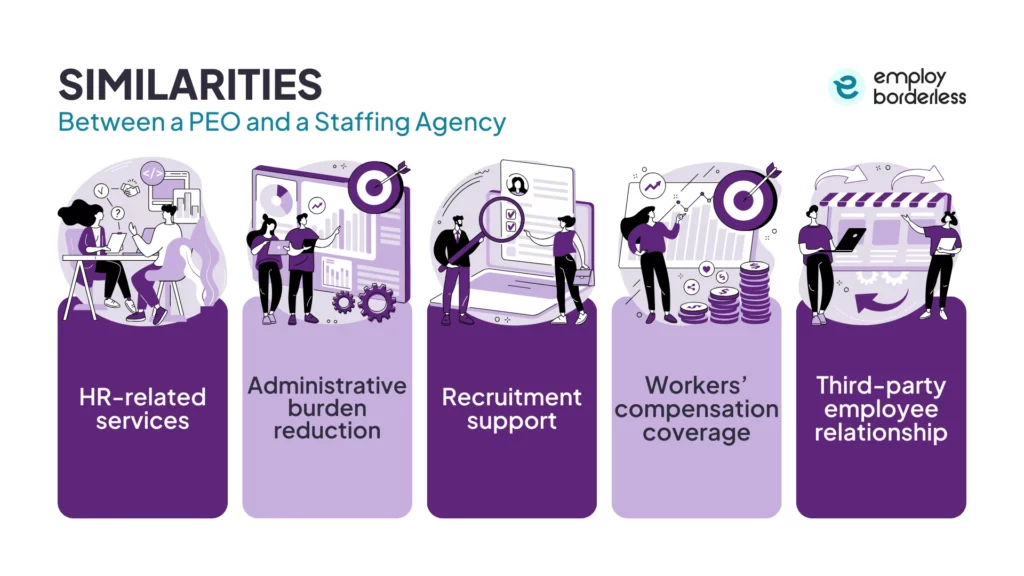
What are the similarities between a PEO and a staffing agency?
The similarities between a PEO and a staffing agency are HR-related services, administrative burden reduction, recruitment support, workers’ compensation coverage, and a third-party employer relationship.
Administrative burden reduction
Administrative burden reduction means companies outsource HR tasks to an external provider, like a PEO or a staffing agency. This outsourcing reduces internal workload for routine regulatory compliance and performance management.
PEOs reduce the administrative burden of businesses by handling comprehensive HR functions, which include payroll processing, benefits administration, tax filings, compliance management, and risk mitigation. They allow businesses to outsource complex and time-consuming HR tasks and focus more on core operations and growth.
Staffing agencies reduce administrative burden mainly by handling recruitment, screening, hiring, and onboarding of temporary or permanent staff. They help companies quickly fill workforce needs without managing the recruitment process internally, which lowers the workload related to talent acquisition.
Recruitment support
Recruitment support means that both PEOs and staffing agencies help companies find and hire qualified candidates to fill open positions.
PEOs help businesses recruit talented candidates by posting job openings and conducting candidate interviews, while the client maintains final hiring authority, which simplifies the hiring process for businesses without losing control. Recruitment agencies help businesses hire employees quickly for their workforce needs by sourcing and placing candidates in their workplace. They create job descriptions, screen applicants, conduct interviews, and present suitable candidates for the client to match their job post requirements.
Workers’ compensation coverage
Workers’ compensation coverage is a state-mandated insurance program that provides benefits to employees who suffer job-related injuries or illnesses.
Both the PEO and a staffing agency are legally mandated to provide workers’ compensation insurance to protect employees against workplace-related injuries and diseases. PEOs provide workers’ compensation insurance through pooled master policies or multi‑coordinated policies, which allow businesses to benefit from lower rates and simplified compliance. The PEO handles the entire process of insurance claims and also makes sure to cover new hires’ insurance.
Staffing agencies also handle workers’ compensation for their temporary or contract workers. They are responsible for purchasing workers’ compensation coverage and paying premiums based on their employees’ classifications to manage claims when contract workers report work-related injuries.
Third-party employee relationship
A third-party employee relationship is when a company partners with an external provider, such as a PEO or staffing agency, to manage employee-related processes such as compensation and employee benefits through a service contract.
A business enters into a service agreement with a PEO or staffing agency, which allows the company to outsource HR duties while the third party acts as either the employer of record or co-employer for the client’s employees. PEOs form a co-employment relationship and handle employee responsibilities, like benefits enrollment or offboarding, on behalf of the clients. Staffing agencies act as employers of record only for the temporary workers they place at the client’s worksite.
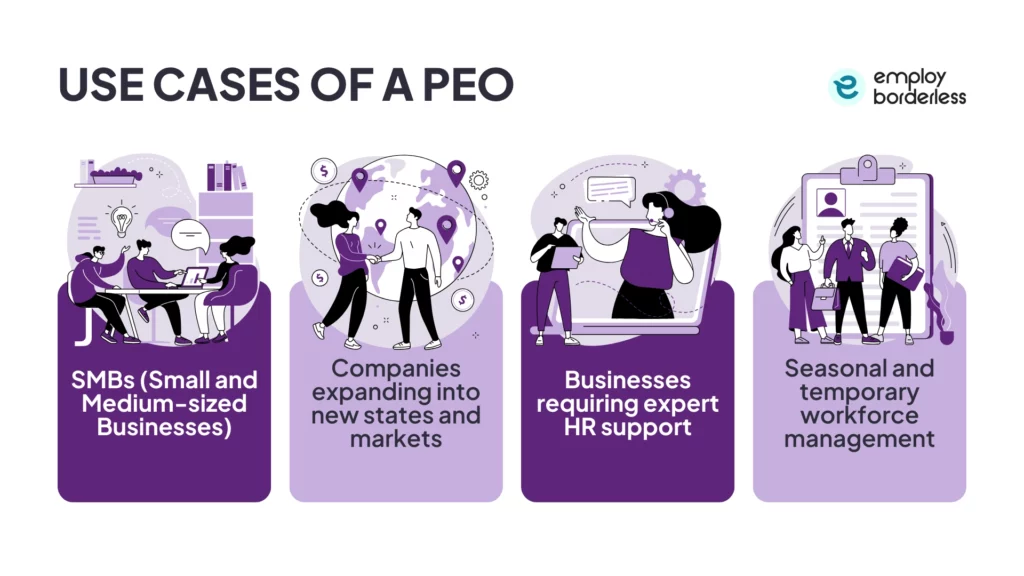
What are the use cases of a PEO?
The use cases of a PEO are SMBs (Small and Medium-Sized Businesses), companies expanding into new states and markets, businesses requiring expert HR support, and seasonal and temporary workforce management.
The use cases of a PEO are listed below.
- SMBs (Small and Medium-sized Businesses): SMBs use PEOs to outsource HR functions that they are unable to manage in-house due to limited resources. PEOs help small and medium-sized businesses scale their HR by handling compliance, benefits enrollment, and recruitment and onboarding. This scalability helps SMBs grow without hiring a full human resources department.
- Companies expanding into new states and markets: Businesses entering into new states use PEOs to follow federal, state, and local labor laws, such as FLSA (Fair Labor Standards Act) and FMLA (Family and Medical Leave Act), and compliance requirements. PEOs provide multi-state payroll, tax filing, and workers’ compensation management to businesses that expand into new states or markets.
- Businesses requiring expert HR support: Businesses that require expert HR support use PEOs as they manage complex HR processes, which include payroll, compliance, benefits administration, and employee relations. The PEO helps businesses reduce the risk of HR errors, ensure legal compliance, and gain access to strategic HR guidance without hiring full-time HR staff.
- Seasonal and temporary workforce management: Companies with fluctuating staffing needs use PEOs to manage payroll, benefits, and compliance for seasonal or temporary employees. For example, businesses with fluctuating staffing needs, such as retailers during the holiday season, hospitality companies during peak travel months, or agricultural operations during harvest, partner with PEOs to manage the administrative workload of hiring and supporting temporary workers.
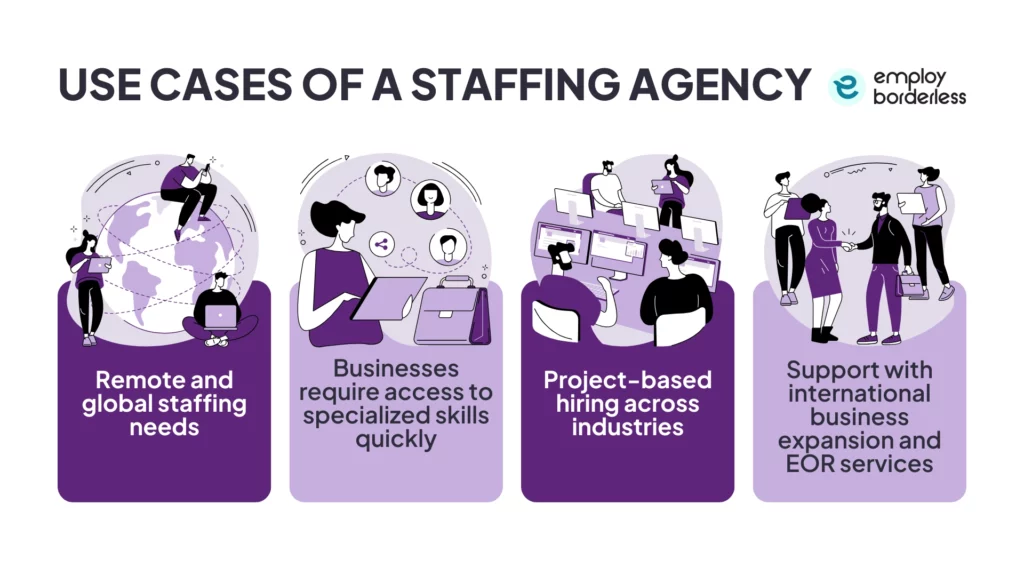
What are the use cases of a staffing agency?
The use cases of a staffing agency include remote and global staffing needs, businesses requiring access to specialized skills quickly, project-based hiring across industries, and support with international business expansion and EOR services.
The use cases of a staffing agency are listed below.
- Remote and global staffing needs: Staffing agencies support remote and global staffing needs by connecting businesses with qualified professionals, such as developers, marketers, virtual assistants, and support staff, from global talent pools.
- Businesses require access to specialized skills quickly: Businesses use recruitment agencies as they offer pre-screened candidates that are ready for project-based roles. These candidates have expertise in industries relevant to the businesses, such as cybersecurity specialists or data analysts.
- Project-based hiring across industries: Companies that need temporary or project-based employees use staffing firms because they offer flexibility for businesses, such as startups launching new products, marketing teams running campaigns, or consulting firms handling short-term projects.
- Support with international business expansion and EOR services: Staffing agencies support businesses with expansion and EOR (Employer of Record) services, like employment contracts, visas, and work permit assistance. Businesses use staffing firms as they help them hire compliantly in new international markets without setting up local legal entities, which reduce risk and administrative burdens.
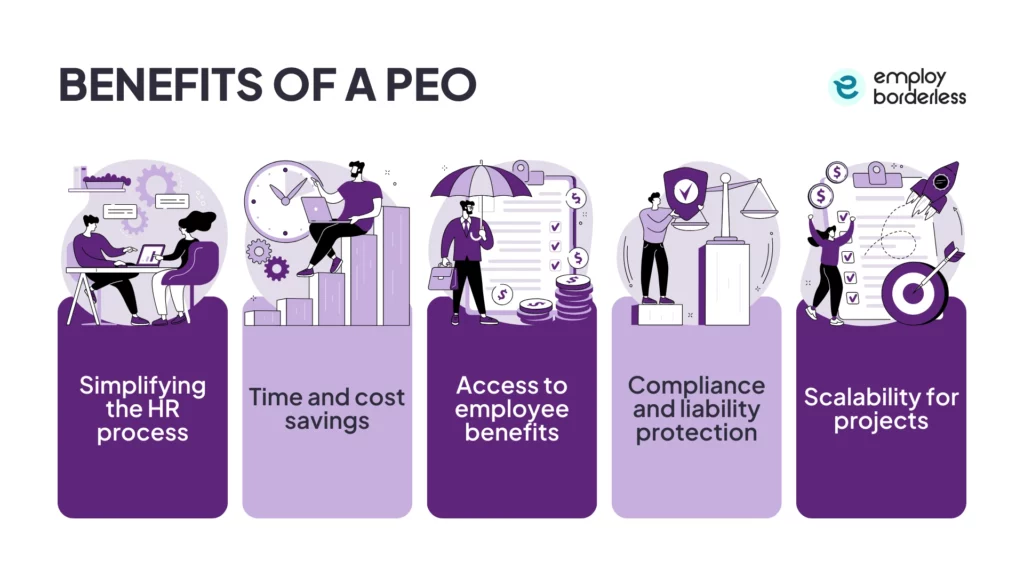
What are the benefits of a PEO?
The benefits of a PEO are simplifying the HR process, time and cost savings, access to employee benefits, compliance and liability protection, and scalability for projects.
Simplifying the HR process
Simplifying the HR process means that a PEO handles complex HR tasks, such as payroll processing, benefits administration, compliance support, and risk mitigation, which help the clients reduce administrative burden. PEO platforms centralize HR and employee data through automation and integrated tools to offer quick reports and dashboards for payroll, benefits, and compliance metrics, and help businesses make data-driven workforce decisions.
Time and cost savings
Time and cost savings mean a PEO manages time-consuming HR tasks, which include tax filing, compliance monitoring, and workers’ compensation management, which also reduces HR overhead expenses. Businesses that use PEOs see an ROI (Return On Investment) of around 27.2% annually, which is obtained from savings in HR personnel costs, employee health benefits, workers’ compensation, unemployment insurance, payroll processing, and retirement plans. The PEO allows businesses to focus on core operational activities and growth strategies, like expanding sales channels and product development, rather than spending time on
administrative tasks.
Access to employee benefits
Access to employee benefits means PEOs secure better benefit rates by using their group negotiating power to get competitive benefit packages, like health insurance, disability, life, vision, dental, and retirement plans, on behalf of their clients. This group buying power gives small businesses access to Fortune 500–level benefits that they are unable to secure independently.
Compliance and liability protection
Compliance and liability protection means PEOs help client businesses follow employment laws and regulations while reducing the risk of lawsuits, fines, or legal penalties. A PEO provides expert compliance management and risk mitigation, which includes areas like wage regulations, tax requirements, safety mandates, and EPLI (Employment Practices Liability Insurance).
This third-party service provider actively monitors and implements workplace policies with changing federal, state, and local labor laws, such as OSHA (Occupational Safety and Health Administration), to protect the company’s legal standing. The PEO also shares legal responsibility under the co-employment model, which also reduces the client’s exposure to liabilities.
Scalability for projects
Scalability for projects means PEOs provide businesses with a scalable HR support structure that flexibly adjusts to changing workforce needs, like business expansion, seasonal demands, or scaling project teams. PEOs use advanced HR platforms and automation to handle increased administrative demands, such as managing more payrolls, benefits, and compliance tasks as the business grows. This third-party service provider reduces the need to replace their in-house HR systems and provides smooth company scalability.
What are the benefits of a staffing agency?
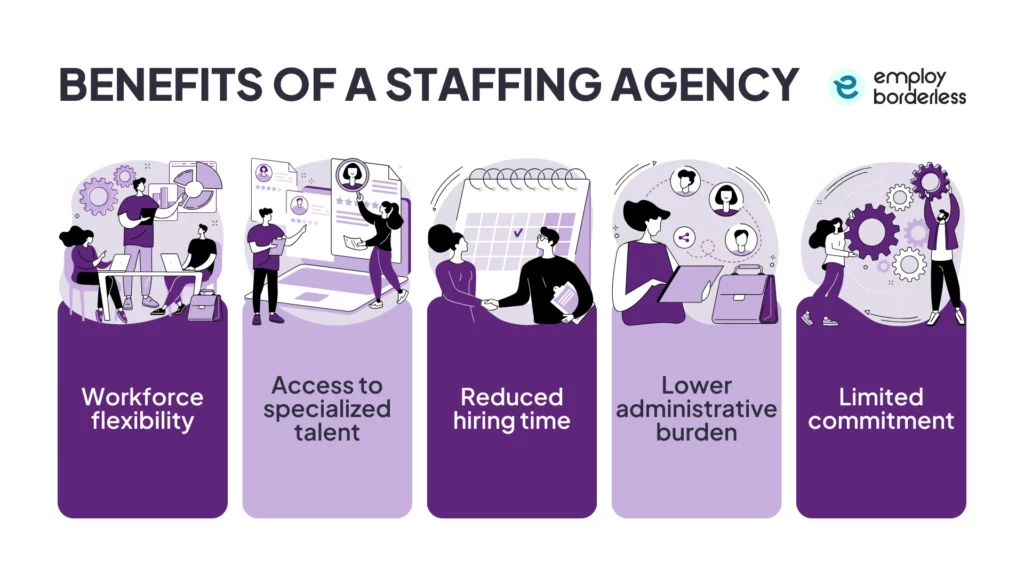
The benefits of a staffing agency are workforce flexibility, access to specialized talent, reduced hiring time, lower administrative burden, and limited commitment.
Workforce flexibility
Workforce flexibility refers to staffing agencies’ ability to provide workers on demand, which allows businesses to adjust their workforce according to their needs, such as seasonal demands, urgent projects, different locations, or coverage gaps. This approach helps companies stay productive and responsive without the obligations of full-time hiring.
Access to specialized talent
Access to specialized talent means businesses help companies hire skilled professionals that match their industry roles, which includes temporary, contract-based, or full-time workers, through pre-selected candidates and industry-specific talent pools. Staffing firms specialize in fields like IT, finance, and healthcare, which allows them to match candidates not only based on technical skills but also on their understanding of industry-specific workflows, regulations, and cultural fit. This unique recruitment support also improves clients’ placement quality and retention.
Reduced hiring time
Reduced hiring time means a staffing agency maintains pre‑screened candidate pools, which help companies fill open job roles in hours or a few days, rather than weeks or months. The agencies also handle background checks, skills testing, drug screens, interviews, and candidate qualification before placing them at the employer’s worksite, which saves the company’s time for recruiting and training the workers.
Lower administrative burden
Lower administrative burden means staffing firms take over time-consuming tasks related to contracted workers, which include payroll, benefits, tax withholdings, workers’ compensation, and unemployment insurance. They also manage the full recruitment process from job postings, candidate sourcing, and screening to credentialing, so internal teams focus only on evaluating top candidates. This simplified recruitment saves internal resources, improves hiring accuracy, reduces operational overhead, and allows businesses to concentrate on strategic growth rather than administrative tasks.
Limited commitment
Limited commitment means staffing agencies offer a flexible hiring model to client companies that reduces long-term obligations towards temporary workers. A staffing firm helps businesses hire temporary workers only for a limited duration, seasonal peaks, special projects, or gaps due to turnover. Companies use contract-to-hire arrangements to evaluate candidates provided by a recruitment agency before making permanent job offers.
Recruitment agencies manage the administrative and legal responsibilities for temporary employees, such as payroll, benefits, and unemployment insurance, to avoid long-term financial liabilities. This flexibility helps businesses to scale their workforce productively in response to market demands without requiring permanent employment agreements.
What are the drawbacks of a PEO?
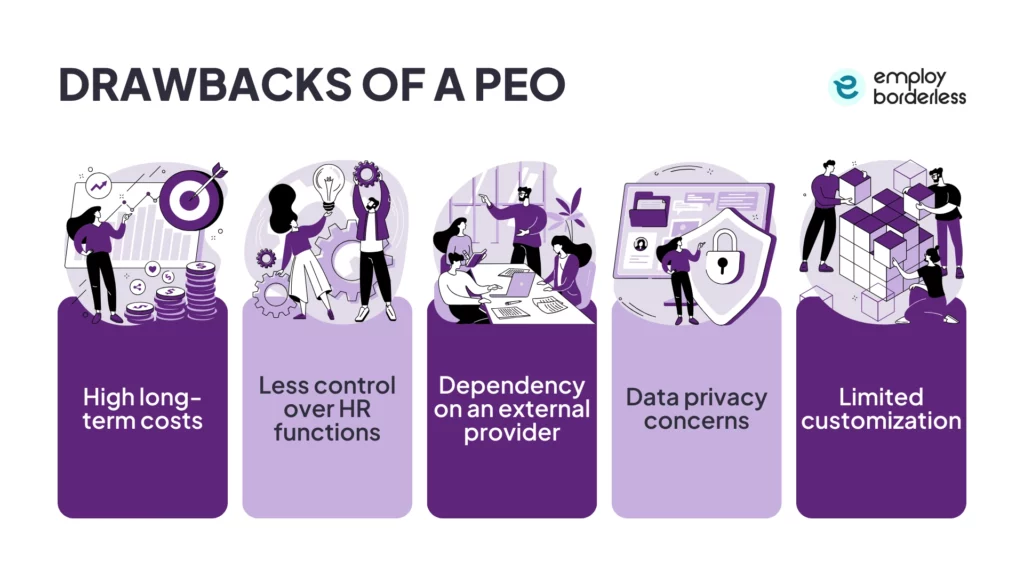
The drawbacks of a PEO are high long-term costs, less control over HR functions, dependency on an external provider, data privacy concerns, and limited customization.
The drawbacks of a PEO are listed below.
- High long-term costs: PEOs usually offer bundled service packages that include payroll, benefits administration, and HR support. These packages charge fees as a percentage of payroll or a per-employee-per-month rate, which increases as the workforce grows. The total PEO fees rise over time, as a company’s workforce expands and charges scale with employee count or payroll size. These rising PEO service charges lead to high long-term costs for companies, especially if they do not fully utilize all the included services.
- Less control over HR functions: Less control over HR functions means the PEO manages the client company’s human resources operations, such as employee benefits, compensation, and compliance support, which results in a loss of full control over HR policies. This also limits the company’s decision-making authority over these HR processes as PEOs operate on standardized procedures and share legal responsibilities through a co-employment model.
- Dependency on an external provider: Dependency on an external provider means a business has to follow the PEO’s processes and timelines, even for routine changes. For example, a company can not make adjustments to payroll or benefits directly without going through the PEO, which slows down responses to urgent needs or organizational changes. The PEO manages core HR functions, so any issue, such as compliance failures or payroll errors, directly impacts the client company, which affects employee morale, productivity, and the company’s legal standing.
- Data privacy concerns: Data privacy concerns occur because PEOs manage sensitive company and employee information, from Social Security numbers, payroll details, health records, to employment histories. This important data also makes PEOs targets for cyberattacks and data breaches. For example, if a PEO causes a data breach, it damages a company’s reputation and client trust, which results in serious financial consequences such as costly legal fees, regulatory fines, and even the loss of clients.
- Limited customization: Limited customization means PEOs manage core HR functions like payroll, benefits, compliance, and HR policies through standardized systems and processes. This limits a company’s ability to customize these HR processes fully according to its company culture and operational requirements. Businesses have to implement the PEO’s established policies and benefit plans, which sometimes do not meet the needs of company employees and the workplace.
What are the drawbacks of a staffing agency?
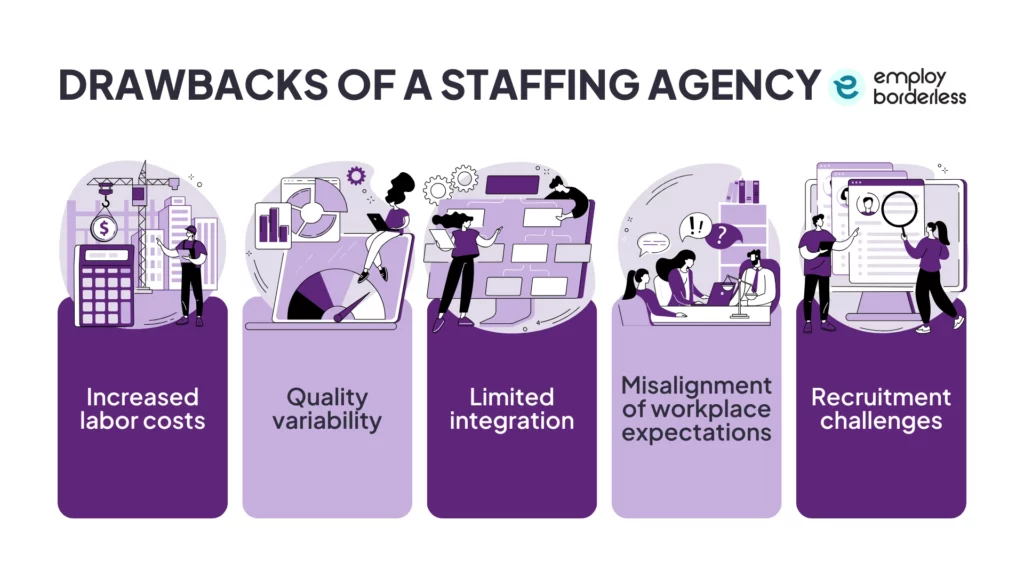
The drawbacks of a staffing agency are increased labor costs, quality variability, limited integration, misalignment of workplace expectations, and recruitment challenges.
The drawbacks of a staffing agency are listed below.
- Increased labor costs: Increased labor costs occur because staffing agencies usually charge employers a fee of about 15% to 25% of an employee’s annual salary, with even higher rates for hard-to-fill job roles. This fee is charged with the employee’s regular salary. For example, in industries like healthcare, staffing agencies also charge higher hourly rates than permanent staff, which means businesses pay more per hour for contract workers.
- Quality variability: Quality variability means the skills, experience, and reliability of candidates provided by staffing firms differ, as they prioritize filling roles quickly through a selected talent pool. Employers sometimes face worker placements that lack the skills or professional experience, which results in inaccuracy and extra work in training or screening for the client company.
- Limited integration: Limited integration means staffing agencies sometimes use separate systems for spreadsheets or disconnected HR tools, which limits integration and makes progress tracking difficult while increasing compliance risks. Poor coordination with client companies also results in unprepared roles, missing workplace setups, and unclear responsibilities, which makes clients dissatisfied with the staffing firm.
- Misalignment of workplace expectations: Staffing agencies sometimes place candidates who do not fully match the demands of a job role, as they rely on basic job descriptions and screening. Staffing firms risk mismatching candidates without developing an understanding of the employer’s workplace culture, industry standards, or technical requirements. This misalignment in fields like IT or healthcare leaves workers without the required skills or certifications, which creates frustration for both staff and employers.
- Recruitment challenges: Staffing agencies face recruitment challenges such as handling large applicant pools, competition for talent, outdated systems that reduce productivity, candidate withdrawals, and delayed hiring processes. These challenges cause candidate disengagement and misaligned expectations with clients, which slow placements and affect candidate quality.
How to choose between a PEO and a staffing agency?
To choose between a PEO and a staffing agency, assess your business needs, cost structure, and project duration, perform a thorough background check, and evaluate each provider’s compliance and risk management support.
Choose a PEO if your company needs ongoing HR support, such as payroll management, benefits enrollment, recruitment and onboarding, and access to HR technology. Consider partnering with a staffing agency if your business requires filling job roles quickly, especially temporary or project-based roles.
Select PEOs as they usually charge a percentage of payroll or per-employee monthly fees, which makes them cost-effective for long-term HR support. Choose a staffing agency if your focus is recruitment, but they charge placement fees, usually 15% to 25% of a candidate’s salary, which increases for hard-to-fill job roles.
Partner with a PEO for long-term workforce stability and support compliance, benefits, and employee retention. Choose a staffing agency for short-term projects or seasonal demands, as they provide flexibility for hiring temporary workers.
Perform a thorough background check on both the PEO and the staffing firm, which focuses on their technology, financial stability, and client feedback before partnering. Both the PEO and the staffing agency’s records help make sure they offer reliable and compliant service.
Choose a PEO as they specialize in handling complex employment laws, like tax filings, workers’ compensation, multi-state compliance, and preventing legal risks and costly penalties for the client. Select a staffing firm as they provide compliance mainly for their placed temporary workers, but do not offer full HR legal support for the client’s permanent employees.
Does a PEO take over all HR functions for a business?
No, a PEO does not take over all HR functions for a business, but becomes a strategic partner under a co-employment model and handles payroll management, employee benefits, and recruitment and onboarding. PEO in HR also provides compliance support and allows businesses to focus on core workplace operations.
What is the ideal company size to benefit from a PEO?
The ideal company size to benefit from a PEO is usually between 20 and 75 employees, especially businesses with a working business model, a skilled team, and regular income. The PEO is also suitable for startups with just 3 to 5 employees who need full HR support, like health insurance, payroll administration, and compliance support.
Is a PEO the same as a staffing firm?
No, the PEO is not the same as a staffing firm because it forms a co-employment agreement with the client business and shares employer and legal responsibilities, such as payroll, benefits, and compliance. A staffing firm simply provides temporary or permanent workers, handles recruitment, and manages those workers directly.
Is a PEO considered the legal employer of your workforce?
No, a PEO is not considered the legal employer of your workforce because it only forms a co-employment partnership with the client company to manage human resources functions. The PEO becomes the employer for tax purposes, and the client maintains control over daily workforce management.
Is a PEO the right solution for your small businesses?
Yes, a PEO is the right solution for your small businesses that need help with HR administration, high-quality benefits, and compliance. PEO for small businesses allows them to focus on growth and strategic initiatives, like market expansion and product development, rather than managing complex administrative functions.
Are staffing agencies still relevant today?
Yes, staffing agencies are still relevant today and are especially valuable for companies that need to hire quickly, access skilled talent worldwide, manage flexible staffing needs, and get expert help with workforce planning.

Co-founder, Employ Borderless
Robbin Schuchmann is the co-founder of Employ Borderless, an independent advisory platform for global employment. With years of experience analyzing EOR, PEO, and global payroll providers, he helps companies make informed decisions about international hiring.
Learning path · 9 articles
PEO fundamentals
Master the fundamentals with our step-by-step guide.
Start the pathReady to hire globally?
Get a free, personalized recommendation for the best EOR provider based on your needs.
Get free recommendations