PEO vs PPO: definitions, differences, similarities, benefits, and drawbacks

Robbin Schuchmann
Co-founder, Employ Borderless
A PEO (Professional Employer Organization), also known as an HR outsourcing solution, is a third-party organization that provides human resource services to businesses under a co-employment arrangement, such as payroll management, employee benefits, and compliance support. PPO (Preferred Provider Organization) is a type of medical plan in which health coverage is provided to participants through a network of selected healthcare providers, such as hospitals, doctors, and physicians.
The main differences between PEO and PPO are employment relationship, scope of services, cost structure, risk sharing, control over employees, and benefits access, while they also share some similarities, like employee benefit solutions, outsourcing HR functions, cost management, and a focus on operational accuracy.
A PEO provides major benefits to businesses, such as reduced liability and HR burden, access to competitive employee benefits, handling payroll tax and unemployment administration, recruiting and talent management support, and cost savings. The benefits of PPO are offering healthcare coverage, increased employee satisfaction and retention, direct access to specialists, flexibility for travelers or those relocating, and a wide network of healthcare providers.
The drawbacks of PEO include fluctuating benefits costs, co-employment confusion, service quality, communication and responsiveness issues, cultural disconnect, and employee adjustment. The drawbacks of PPO are rising costs, complexity in management, increased risk of annual deductible, greater cost burden for out-of-network care, and lack of coordinated care.
What is a PEO?
A PEO (Professional Employer Organization) is a third-party company that provides complete HR services to businesses, which include payroll processing, employee benefits, compliance support, and risk management, through a co-employment arrangement.
How does a PEO work?
A PEO works by entering into a co-employment agreement and becomes the employer of record for tax and compliance purposes. The client company remains the worksite employer and is responsible for daily business operations such as sales, marketing, customer service, and employee management. The PEO handles administrative HR tasks, which include payroll processing, benefits administration, tax withholdings, filing, submitting, and reporting to legal authorities.
What is PPO?
A PPO (Preferred Provider Organization) is a type of health insurance plan that partners with a network of doctors, hospitals, and clinics to provide medical care. It offers health insurance coverage to individuals and families and allows them to see specialists or other providers without needing a referral from a PCP (Primary Care Physician).
How does PPO work?
PPOs work with a network of healthcare providers who offer services at discounted, negotiated rates. Participants who use these in-network PPO providers pay lower out-of-pocket costs, such as deductibles, copayments, and coinsurance. PPO members still receive care from providers outside the network, but it usually costs more because of higher deductibles, higher coinsurance, and the possibility of balance billing.
What are the differences between PEO and PPO?
The differences between PEO and PPO are employment relationship, scope of services, cost structure, risk sharing, control over employees, and benefits access.
| Features | PEO | PPO |
| Employment relationship | Co-employer as PEO shares employer responsibilities | No employment relationship |
| Scope of services | Complete HR support (payroll, benefits, and compliance) | Healthcare coverage only |
| Cost structure | Service fees (percentage of payroll or flat fee per employee per month) | Insurance premiums, deductibles, copays, coinsurance, and in- or out-of-network usage |
| Risk sharing | PEO shares employment-related risks and compliance responsibility | No employment risk sharing |
| Control over employees | The client manages employees directly, while PEO handles HR functions | No involvement in employee management |
| Benefits access | Access to PEO-negotiated benefits | Provide discounted insurance rates from network providers |
Employment relationship
The PEO becomes the employer of record in this co-employer arrangement for tax, benefit, and compliance purposes. The client is the worksite employer who handles routine workforce operations, such as product development, sales, and marketing, and manages employee performance. A PPO does not have an employment relationship, as it is only a health insurance plan that connects members to a network of healthcare providers.
Scope of services
PEOs offer a full-service HR package to client businesses, which includes payroll processing, employee benefits administration, workers’ compensation, health insurance, risk management, compliance, onboarding, and HR support. PPO only focuses on healthcare coverage and provides members access to doctors, hospitals, and clinics in its network at discounted rates.
Cost structure
Businesses that partner with a PEO usually pay either a percentage of payroll or a per-employee fee for bundled HR services. A client also receives access to group-rate benefits that the PEO negotiates through its larger employee pool. PPO members pay monthly premiums for health insurance coverage through their healthcare providers. The members’ out-of-pocket costs, such as deductibles, copayments, and coinsurance, are lower when using in-network providers and higher when choosing out-of-network providers.
Risk sharing
PEOs share employment-related risks under the co-employment model, such as compliance, tax liability, and workers’ compensation claims, with the client company. This helps businesses to avoid costly fines and legal penalties. PPO does not share risk with the employers, as it only provides healthcare coverage between members and providers.
Control over employees
The client company maintains full control over employees, which involves decisions about hiring, firing, training, monitoring, and performance management. The PEO manages only HR and administrative tasks, like recruiting and onboarding, training, and development, to help the client focus on core business activities like customer service, finance, and marketing. PPO has no control over employees, as it is only an insurance arrangement and is not related to employment management.
Benefits access
A PEO allows small and medium-sized businesses access to Fortune 500-level benefits, which include health insurance, retirement plans, and life insurance, through group negotiating power. PPO provides members access to discounted healthcare services from in-network providers, while still including out-of-network care at a higher cost.
What are the similarities between PEO and PPO?
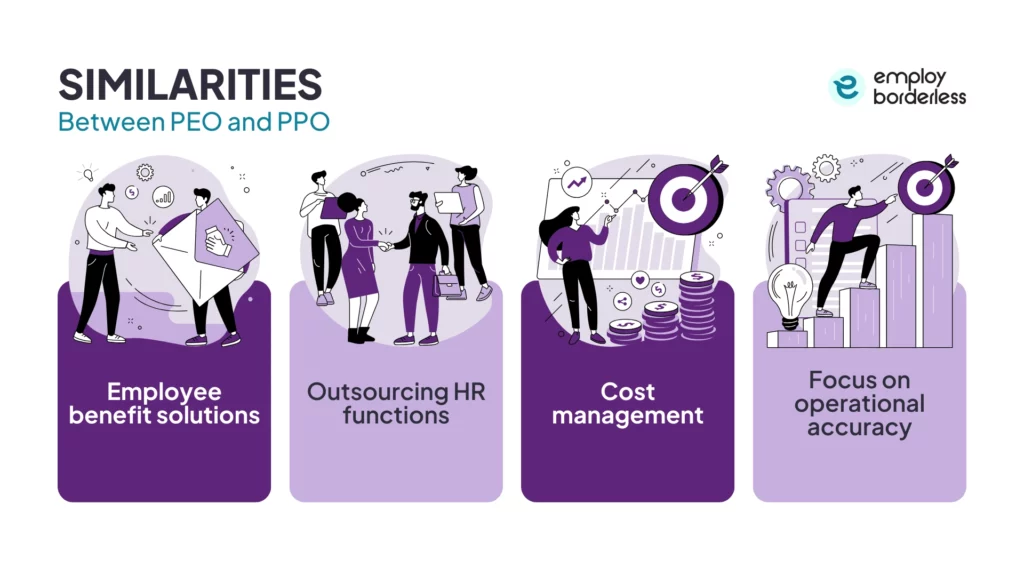
The similarities between PEO and PPO include employee benefit solutions, outsourcing HR functions, cost management, and a focus on operational accuracy.
Employee benefit solutions
Employee benefit solutions mean non-monetary compensation that employers offer to employees with their standard salary through service providers, like PEO and PPO. The employee benefits include financial security, health insurance, and life insurance.
A PEO uses its group purchasing power to provide access to premium employee benefits, such as health insurance, dental, vision, and retirement plans. This access allows companies, particularly small businesses, to offer better benefit packages that they are unable to secure on their own. PPOs function as a health plan option within those benefits to offer members discounted healthcare services, which include emergency care, hospital stays, specialist consultations, and lab tests, through a network of preferred providers.
Outsourcing HR functions
Outsourcing HR functions involves contracting an external provider, such as a PEO or PPO, to handle HR tasks, like payroll, recruitment, and benefits administration.
PEOs allow businesses to outsource important HR functions, such as payroll, tax filing, benefits administration, compliance, and risk management, so that company leaders focus on growth, strategy, and core goals rather than performing administrative work. PPOs outsource healthcare provider networks on behalf of insurers and employers by negotiating provider contracts and administering claims, which reduces the burden of direct management from the sponsoring organization.
Cost management
Cost management is the process of planning and controlling a business budget through a third-party service provider, like PEO or PPO.
Businesses partner with a PEO as it negotiates lower rates for employee benefits and workers’ compensation by grouping employees from different client companies, which saves expenses in both HR operations and employee benefits. PEOs also reduce the need for hiring a full in-house HR team or investing in HR technology and software because they accurately handle payroll, benefits administration, tax filing, reporting, and compliance.
PPOs form networks of providers who agree to discounted rates to help members save expenses when they use these in-network providers. The participants pay the lower, pre-negotiated fees rather than the fully billed amounts.
Focus on operational accuracy
Focus on operational accuracy means PEOs use HR expertise, technology, and regulatory knowledge to provide accurate payroll, compliance, and benefit administration. PPO also manages provider credentialing, claims processing, and payment systems to give smooth, accurate healthcare billing and access.
What are the use cases of a PEO?
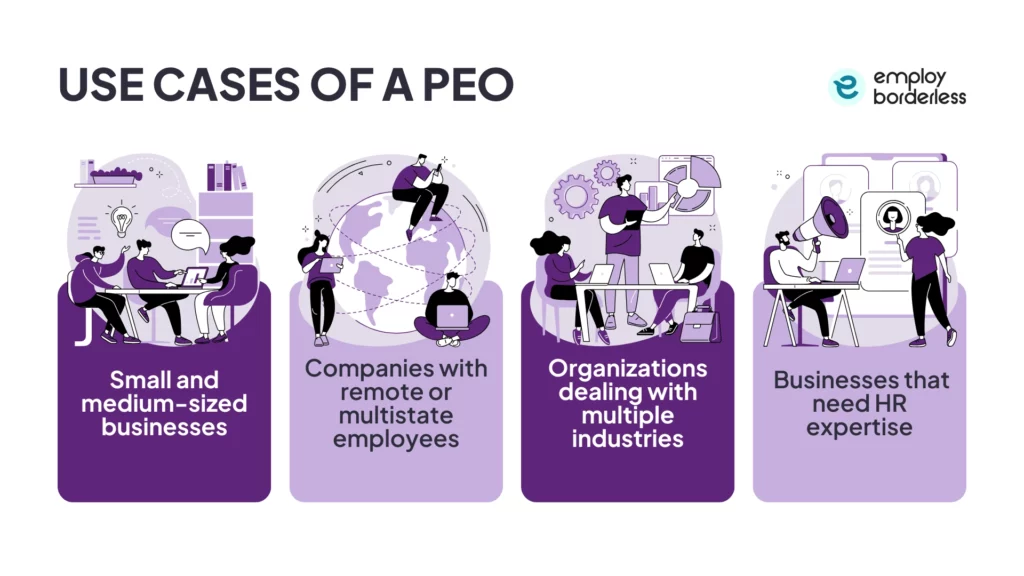
The use cases of a PEO include small and medium-sized businesses, companies with remote or multi-state employees, organizations dealing with multiple industries, and businesses that need HR expertise.
The use cases of a PEO are listed below.
- Small and medium-sized businesses: Small and medium-sized businesses use PEOs because they lack the resources to build a full in-house HR department. They outsource HR functions to a PEO, like payroll, compliance, and benefits administration, to focus on business growth and maintain HR accuracy.
- Companies with remote or multistate employees: PEOs support companies with remote or multi-state workforces by managing payroll, tax withholdings, and compliance across different state labor laws. This helps businesses reduce legal risks, save administrative time, and make sure all categories of employees are paid accurately.
- Organizations dealing with multiple industries: Organizations that work with different industries use PEOs as they provide regulatory and industry-specific expertise. This includes support with complex compliance issues and HR challenges unique to some industries. For example, a PEO supports a construction company by ensuring OSHA (Occupational Safety and Health Administration) compliance and managing related HR requirements.
- Businesses that need HR expertise: Businesses use PEOs for expert HR strategy in areas like policy development, employee handbooks, training programs, and compliance. PEOs provide up-to-date HR knowledge, reduce the risk of legal issues, and help create a reliable, professional workplace culture.
What are the use cases of PPO?
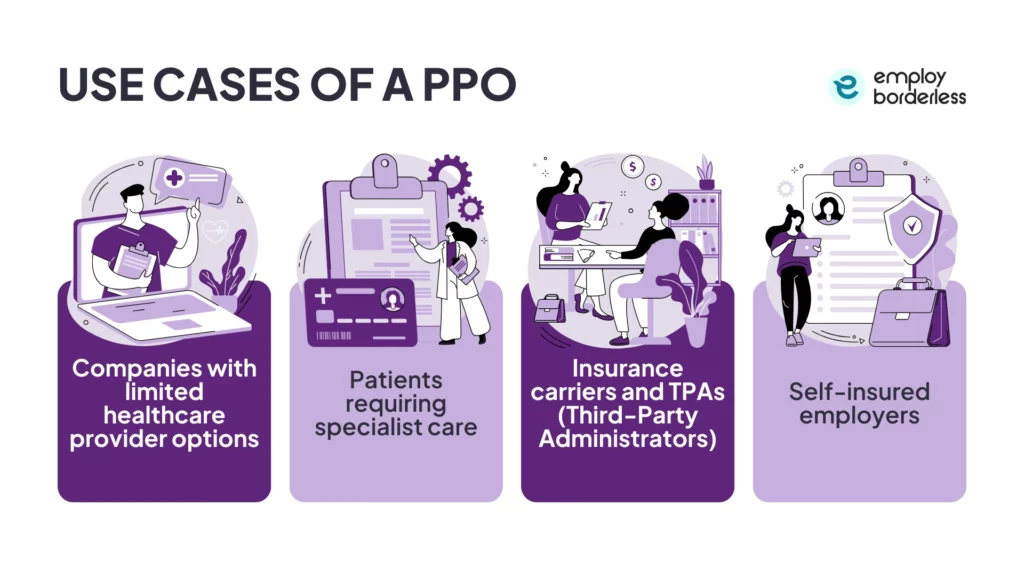
The use cases of PPO are companies with limited healthcare provider options, patients requiring specialist care, insurance carriers and TPAs (Third-Party Administrators), and self-insured employers.
The use cases of PPO are listed below.
- Companies with limited healthcare provider options: Companies in regions with limited healthcare options use PPOs because they provide networks of healthcare providers. Their employees have access to in-network providers even in regions with few options to reduce out-of-pocket costs.
- Patients requiring specialist care: Patients requiring ongoing medical care from specialists use PPOs because they allow direct access to medical consultants without referrals from a PCP (Primary Care Doctor).
- Insurance carriers and TPAs (Third-Party Administrators): Insurance carriers and TPAs use PPO to negotiate discounted provider rates, simplify claims processing, and give network access, which helps reduce administrative burdens and control healthcare costs.
- Self-insured employers: Self-funded employers use PPOs to customize coverage, access discounted in-network rates, control costs, and maintain flexibility. This also improves employee satisfaction as PPO offers provider choice and reduces the risk of unexpected healthcare expenses.
What are the benefits of PEO?
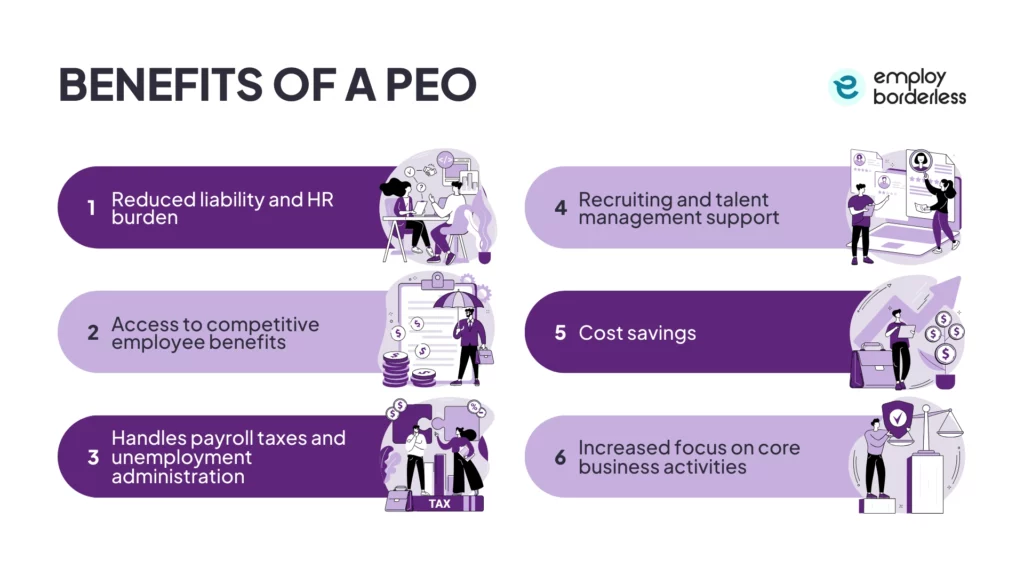
The benefits of PEO are reduced liability and HR burden, access to competitive employee benefits, handling payroll taxes and unemployment administration, recruiting and talent management support, cost savings, and increased focus on core business activities.
Reduced liability and HR burden
Reduced liability and HR burden means PEOs help reduce legal liability and HR burden by managing compliance, risk, payroll, benefits, safety protocols, and employment-related administration of the client’s business. They provide expert guidance in handling changing employment laws, such as FLSA (Fair Labor Standards Act) and FMLA (Family and Medical Leave Act), help avoid fines, and free internal teams from time-consuming tasks.
Access to competitive employee benefits
Access to competitive employee benefits means PEOs help small and medium-sized businesses offer premium benefit packages to employees, such as health, dental, vision, and retirement plans, by using their group purchasing power. This third-party service provider handles benefits enrollment and carrier coordination, which helps business leaders focus on strategy rather than coordinating with multiple carriers.
Handles payroll taxes and unemployment administration
Handling payroll taxes and unemployment administration means PEO, as a co-employer, is responsible for processing payroll and handling employment-related taxes, such as FICA (Federal Insurance Contributions Act), Social Security, and Medicare. This also includes unemployment taxes, like FUTA (Federal Unemployment Tax Act) and SUTA (State Unemployment Tax Act), usually under the PEO’s own EIN (Employer Identification Number).
Recruiting and talent management support
Recruiting and talent management support means a PEO manages the complete recruitment process by writing job descriptions and posting job openings on multiple talent management platforms to hire and onboard the right candidates. PEOs source candidates, screen resumes, conduct initial interviews, and handle background checks through ATS (Applicant Tracking System). PEOs improve the client’s recruitment advantage by offering superior benefits packages, like health, dental, and retirement, particularly against competitors who are unable to offer these benefits.
Cost savings
Cost savings mean businesses outsource payroll, benefits administration, compliance, and recruitment to a PEO, which reduces the need for a full HR team and lowers expenses on salaries, training, and overhead. PEOs group multiple client businesses, which gives them more negotiating power with benefit providers. They negotiate competitive insurance rates on health and life insurance, retirement plans, and workers’ compensation, which results in savings that individual small businesses are unable to access on their own.
Increased focus on core business activities
PEOs handle administrative and regulatory HR tasks, such as payroll and compliance, so businesses focus on their core operations, like product development or market expansion. This third-party service provider also uses technology and automation to reduce administrative work, which also helps businesses focus more on their main goals.
What are the benefits of PPO?
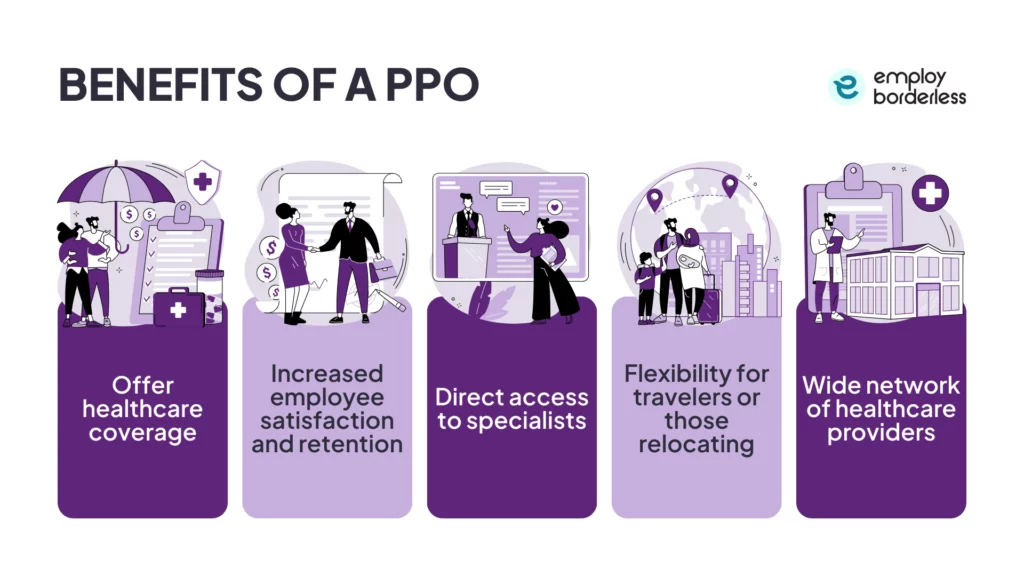
The benefits of PPO include offering healthcare coverage, increased employee satisfaction and retention, direct access to specialists, flexibility for travelers or those relocating, and a wide network of healthcare providers.
Offer healthcare coverage
Offering healthcare coverage means PPO provides access to a large network of in-network providers at low cost, as well as partial coverage for out-of-network care. PPOs usually provide many important healthcare services, which include preventive, emergency, maternity, and chronic disease care, with lower cost-sharing for in-network services.
Increased employee satisfaction and retention
PPO group health plans provide affordable access to quality care to support employee satisfaction and a positive workplace culture, and give employers a strong advantage in attracting and keeping top talent. Most PPOs cover preventive services, like checkups, screenings, and vaccines, with no extra expenses under ACA (Affordable Care Act) requirements. These benefits help employees focus on their roles rather than stress over healthcare costs, which increases both retention and productivity.
Direct access to specialists
PPO plans offer greater flexibility and provider choice, which helps members schedule appointments with specialists directly without needing a referral from a PCP (Primary Care Physician). This direct access saves time, reduces delays caused by referrals, and makes it easy to coordinate care, and makes sure members receive timely treatment and better management of their health needs.
Flexibility for travelers or those relocating
Flexibility for travelers or those relocating means PPO plans offer access to a large network of providers across the region, which makes them ideal for travelers or people who change locations.
Some insurers offer out-of-area PPO Plans designed specifically for individuals living or working outside their primary service region. These plans include in-network coverage for preventive services, such as screenings for cancer, diabetes screening, immunizations, and HIV screening, even when away from home. PPO networks usually include multiple states, which is particularly beneficial for families with members who live, study, or work in different locations.
Wide network of healthcare providers
A wide network of healthcare providers means PPO gives members access to a large, contracted network of healthcare providers, which includes doctors, hospitals, specialists, and other medical professionals, who offer services at negotiated and lower rates. PPO plans offer expansive provider networks, which give members both the flexibility to choose physicians and locations and the benefit of in-network savings.
What are the drawbacks of PEO?
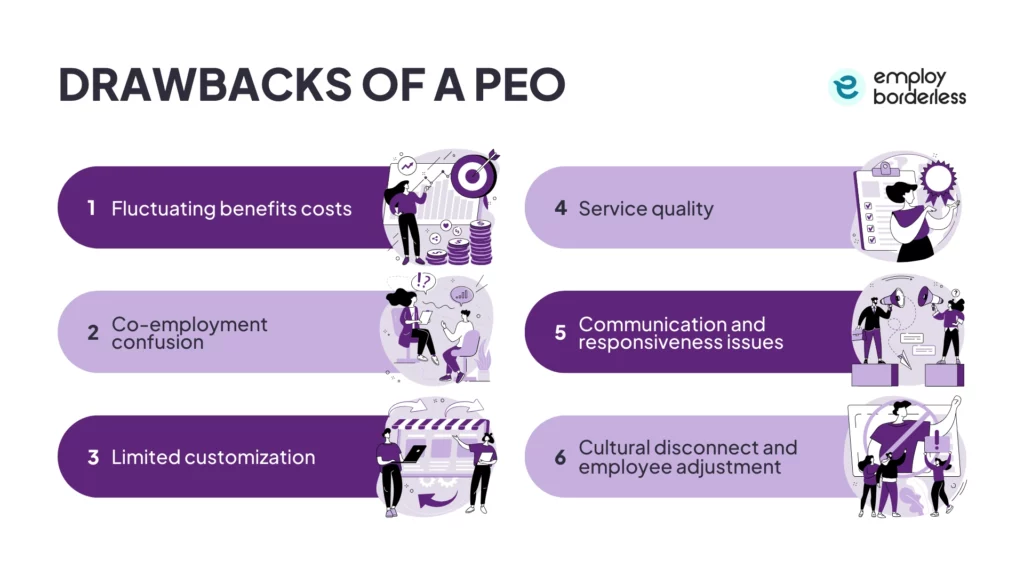
The drawbacks of PEO are fluctuating benefits costs, co-employment confusion, limited customization, service quality, communication and responsiveness issues, cultural disconnect, and employee adjustment.
The drawbacks of PEO are listed below.
- Fluctuating benefits costs: Fluctuating benefits costs mean PEOs offer cost savings initially, but benefit costs rise unpredictably, and pricing models are also complex and poorly explained. PEOs sometimes do not provide transparent and detailed billing, which makes it difficult for businesses to clearly understand how much they are paying for benefits compared to service fees.
- Co-employment confusion: Co-employment confusion occurs when both the client and the PEO share employer responsibilities without clearly defined roles in the PEO agreement. This exposes the client company to legal disputes and operational disruptions, particularly if accountability for HR policies, benefits administration, payroll, or compliance is unclear. Employees also feel unsure whether to contact the employer or the PEO for HR matters, and this confusion negatively impacts their morale, productivity, and trust in the company.
- Limited customization: Limited customization means PEOs provide standardized, one-size-fits-all HR solutions that sometimes do not match the client company’s unique requirements. They usually require compliance with the PEO’s established policies, procedures, and benefit packages, which limit the client’s flexibility and ability to maintain company culture. This lack of customizable options makes it difficult for businesses with specialized needs, such as industry-specific compliance, unique employee benefits, or unique cultural values, to adjust HR services accurately.
- Service quality: Not all PEOs maintain high levels of service quality, which results in employee and employer frustration and delays, especially when urgent HR issues require timely support. PEOs struggle to respond quickly to client needs as they provide services to multiple clients at the same time, which also affects the service quality. For instance, issues like payroll errors, benefits queries, or compliance questions take time to resolve because response times depend on the assigned account manager or team.
- Communication and responsiveness issues: Communication and responsiveness issues occur when working with a PEO because of the added complexity of external coordination and the provider’s capacity. The PEO works with many clients, so it sometimes delays communication and conflict resolution in the absence of a dedicated representative, which limits timely responses. Employees also face impersonal support when contacting the PEO’s general service center, which results in dissatisfaction and frustration, particularly when dealing with benefits or claims questions.
- Cultural disconnect and employee adjustment: Cultural disconnect and employee adjustment occur when employees feel less connected to the business because the PEO’s policies, values, or communication methods do not match the workplace culture. This misalignment leads to disengagement, reduced loyalty, and confusion about workplace identity. For example, when a company outsources its HR responsibilities to an external provider, it introduces new systems, contacts, and processes, which cause temporary confusion and adjustment challenges for staff.
What are the drawbacks of PPO?
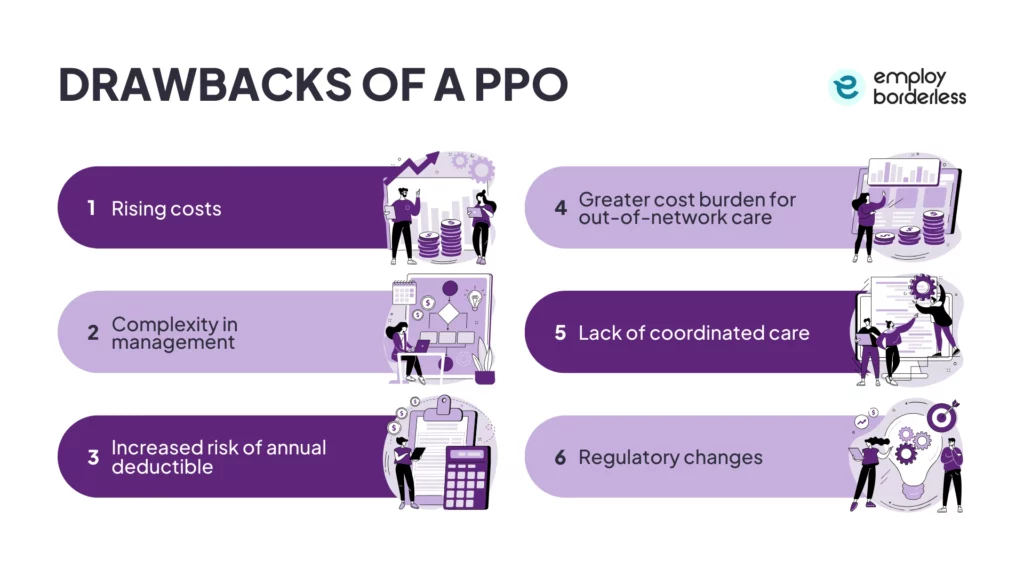
The drawbacks of PPO are rising costs, complexity in management, increased risk of annual deductible, greater cost burden for out-of-network care, lack of coordinated care, and regulatory changes.
The drawbacks of PPO are listed below.
- Rising costs: PPOs are particularly costly because they cover out-of-network care, sometimes even partially. This flexibility raises expenses for both members and employers who provide PPO plans as part of their employee benefits.
- Complexity in management: A PPO allows patients to see providers without referrals, but this flexibility increases administrative work for insurers and third-party administrators who have to manage large provider networks. They have to process high volumes of claims, handle out-of-network billing, and deal with pre-authorization disputes. These administrative demands reduce PPOs’ ability to control costs and make them less accurate than other insurance models.
- Increased risk of annual deductible: PPO plans usually have higher annual deductibles, as individuals have to pay more out-of-pocket costs before their insurance coverage begins. For example, PPOs require higher deductibles and out-of-pocket maximums, which leads to increased financial burden for individuals who require regular medical care.
- Greater cost burden for out-of-network care: PPO members pay more when they use out-of-network care, even after meeting their deductible. For example, in an Aetna PPO plan, the insurance may cover 80% of out-of-network costs, while the member pays the remaining 20%. This extra cost-sharing increases the member’s out-of-pocket expenses.
- Lack of coordinated care: PPO members see specialists without referrals, but this reduces coordination between healthcare providers. Limited communication between participants and providers also results in repeated tests, overlapping procedures, and delayed diagnoses or treatments. These gaps increase costs and reduce the accuracy of member health care.
- Regulatory changes: PPOs work within a healthcare system that is influenced by new regulations, such as the No Surprises Act, which protects patients from unexpected out-of-network bills, particularly in emergencies when they have no choice of provider. This act limits PPOs’ ability to control out-of-network costs even if it improves patient protection.
How to choose between a PEO and a PPO?
To choose between a PEO and a PPO, consider your HR outsourcing or healthcare needs, level of control and customization, administrative complexity and accuracy, overall costs and savings, and the quality of employee benefits and health care.
Choose a PEO if you need full HR support, like payroll, benefits administration, compliance, and recruitment and onboarding. PEOs act as co-employers and share compliance and legal liabilities with the employer. Select a PPO if you require large provider access, as it includes medical, hospital, and preventive care, and offers lower costs for in-network services while still allowing out-of-network care at a higher price.
Choosing the PEO helps businesses outsource time-consuming HR functions, but it offers standardized systems and vendor choices, which reduces employer control over HR policies and benefit plan design. This lack of customization and control makes it difficult to adjust HR and benefit plans according to company requirements. Select a PPO as it provides flexibility in choosing healthcare providers, which includes specialists and out-of-network options. Employees or employers using PPO plans maintain control over their healthcare decisions.
Select this third-party HR service provider as it reduces administrative burden and complexity by accurately managing HR tasks, unemployment claims, compliance, and onboarding. Choose a PPO as it only focuses on healthcare coverage and does not help with managing complexity in organizational administration.
Choose a PEO because it reduces expenses through economies of scale, such as lower benefit rates and less HR overhead, but service fees are charged as a percentage of payroll, which increases as the workforce expands. Selecting PPOs usually costs more than other health plans because of the flexibility of in-network and out-of-network access.
Select PEOs as they provide access to high-quality benefit packages that smaller companies are unable to secure on their own, such as Fortune-500 level health, retirement, and supplemental plans. Choose a PPO because it offers flexible access to a large provider healthcare network. It is suitable if employees prefer choice in care providers, but it is only a healthcare coverage network, not a benefits platform.
What is a PEO used for?
A PEO is used for outsourcing HR functions, such as payroll processing, employee benefits, compliance, and workers’ compensation, through a co-employment model. It is also used to reduce administrative burden and access better employee benefit options.
What are the types of PEO?
The types of PEO are full-service PEO, industry-specific PEO, ASO (Administrative Services Organization), PEO alliances, and CPEO (Certified PEO). PEO types differ in terms of business size, service scope, geographic reach, industry focus, cost structure, and technology offerings.
Should you choose a PEO or a PPO?
You should choose a PEO if your business wants to simplify HR by outsourcing payroll, benefits administration, tax compliance, and risk management. You should choose a PPO if you require flexible healthcare access, such as doctors and specialists without referrals. PPOs include both in-network and out-of-network care, though costs are lower within the preferred network.
What role does a PEO play in health insurance?
A PEO plays an important role in health insurance by grouping employees from multiple client companies and negotiating more affordable group plans, such as medical, dental, vision, life, and disability insurance.
In what ways does a PEO offer more value than a PPO?
A PEO offers more value than a PPO by providing complete HR services, such as payroll, benefits administration, compliance, and risk management, through a co-employment model. PEO integration simplifies operations, reduces administrative burdens, and offers access to employer-level benefits.
Is PPO relevant in an HR context?
Yes, a PPO is relevant in an HR context because it is a type of health insurance plan that the human resources department offers to attract and keep top employees. It also provides employees with flexibility to choose healthcare providers, which include out-of-network options, though at higher costs.
Can a PEO or PPO better serve small businesses?
A PEO better serves small businesses as it handles complex HR tasks, such as payroll processing, benefits administration, tax filing, and compliance support. PEO for small businesses allows access to premium benefits, such as health and retirement plans, by negotiating more affordable group plans, which small companies are unable to secure independently.
How does a PEO improve compliance as compared to a PPO?
A PEO improves compliance as compared to a PPO by making sure businesses follow federal, state, and local employment laws, which include FLSA (Fair Labor Standards Act) and FMLA (Family and Medical Leave Act). PEO compliance helps businesses stay current with regulations and reduce the risk of legal penalties.

Co-founder, Employ Borderless
Robbin Schuchmann is the co-founder of Employ Borderless, an independent advisory platform for global employment. With years of experience analyzing EOR, PEO, and global payroll providers, he helps companies make informed decisions about international hiring.
Learning path · 9 articles
PEO fundamentals
Master the fundamentals with our step-by-step guide.
Start the pathReady to hire globally?
Get a free, personalized recommendation for the best EOR provider based on your needs.
Get free recommendations