PEO vs HRIS: definitions, differences, similarities, benefits, and drawbacks

Robbin Schuchmann
Co-founder, Employ Borderless
A PEO (Professional Employer Organization) is an HR outsourcing solution that partners with businesses to manage their human resources functions, such as payroll processing, benefits administration, compliance, and risk management, through a co-employment agreement. An HRIS (Human Resources Information System) is a software solution that helps companies manage and organize important details about employees and automate HR processes, such as payroll, benefits, and time and attendance tracking.
PEO and HRIS differ in terms of service offering, ownership, customization, scalability, cost model, exit complexity, control level, and implementation, while they also share some similarities like employee data management, onboarding support, reporting and analytics, HR process automation, and reducing administrative burden.
PEO provides major benefits to businesses, which include compliance expertise, support for workers’ compensation coverage, simplified payroll administration, and better employee benefit packages. The benefits of HRIS are operational accuracy and time-saving, centralized employee data, improved data storage and security, performance management tools, and simplified onboarding and offboarding.
There are some drawbacks of PEO, like loss of operational control, contract and cost issues, data security and privacy issues, co-employment risks, and employee resistance. There are also some drawbacks of HRIS, such as high costs for purchase and implementation, training requirements for HR staff and employees, ongoing maintenance and update needs, security and data privacy risks, and complexity to learn and use.
What is a PEO?
A PEO is a third-party organization that provides a full-service HR solution to businesses under a co-employment model. The PEO helps businesses by handling their human resources functions, which include employee benefits, payroll administration, and compliance support.
How does a PEO work?
A PEO works by entering into a co-employment agreement with the client business, where the PEO manages HR and payroll responsibilities, while the client maintains control over routine operations and employee management. The PEO becomes the employer of record for tax and benefit purposes and withholds taxes using its EIN (Employer Identification Number) on behalf of the client.
What is HRIS?
An HRIS (Human Resources Information System) is a type of software solution that HR departments use to collect, store, and manage employee data. An HRIS helps businesses simplify human resources processes, which reduces HR teams’ time on manual administrative tasks and focus more on strategic initiatives and employee engagement.
How does HRIS work?
An HRIS works by centralizing employee data, such as personal, demographic, and compensation information, and automating HR tasks, which include payroll processing, benefits administration, recruitment and onboarding, time and attendance tracking, and compliance reporting.
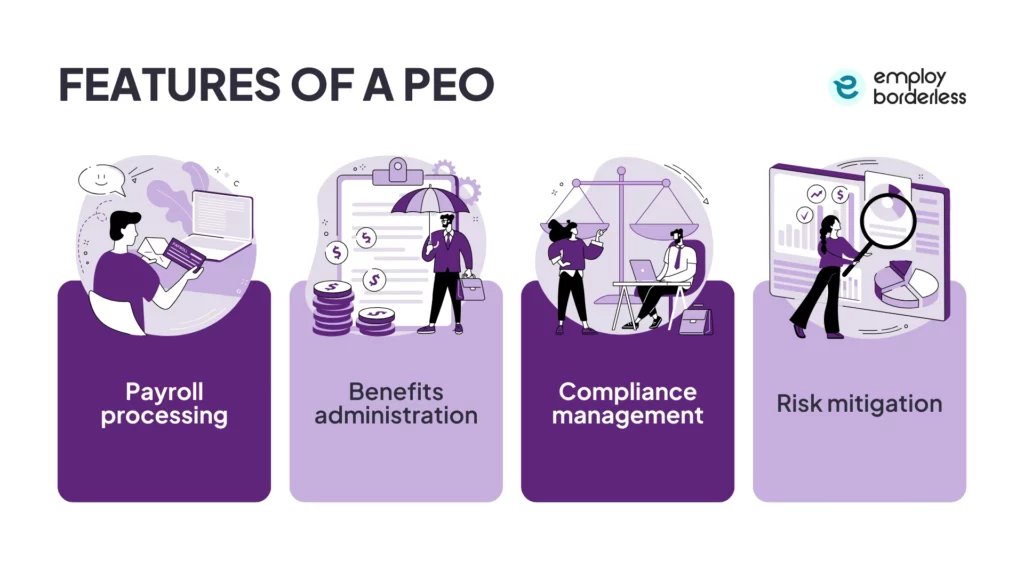
What are the features of a PEO?
The features of a PEO are payroll processing, benefits administration, compliance management, and risk mitigation.
The features of a PEO are listed below.
- Payroll processing: Payroll processing means a PEO provides full management of payroll administration, which includes wages, taxes, and deductions, while making sure employees are paid accurately and on time for the hours they work.
- Benefits administration: This third-party service provider offers competitive benefits that help businesses attract and keep top talent. A PEO pools resources to negotiate better rates and make the client company an attractive place for employees to work productively.
- Compliance management: Compliance management involves the PEO making sure businesses stay informed and compliant with changing federal, state, and local regulations, such as the FICA (Federal Insurance Contributions Act) and the FUTA (Federal Unemployment Tax Act), to reduce legal risks and penalties.
- Risk mitigation: PEOs provide active risk mitigation by offering comprehensive HR and safety support, which includes conducting risk assessments to identify workplace dangers and compliance gaps. A PEO also develops and implements safety programs, such as employee training and incident prevention policies like PPE (Personal Protective Equipment).
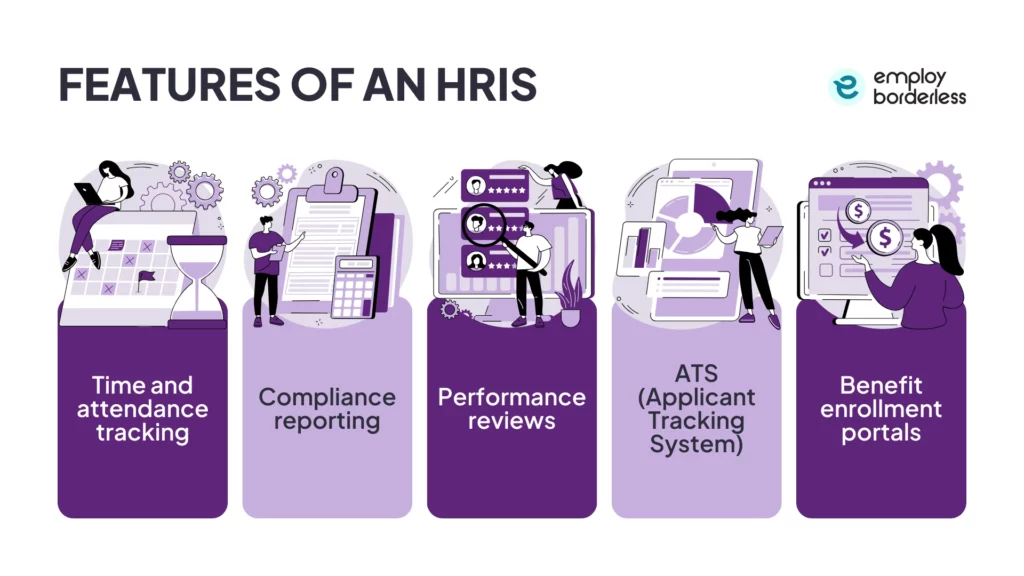
What are the features of HRIS?
The features of an HRIS include time and attendance tracking, compliance reporting, performance reviews, ATS (Applicant Tracking System), and benefit enrollment portals.
The features of an HRIS are listed below.
- Time and attendance tracking: Time and attendance tracking in an HRIS allows businesses to monitor employee work hours, schedules, and other timekeeping details. It simplifies payroll calculations and helps businesses control overtime costs by preventing employee overwork.
- Compliance reporting: Compliance reporting means HRIS helps create mandated compliance reports, such as the EEO-1, which reports on diversity in the workplace, and the ACA (Affordable Care Act), which includes healthcare coverage.
- Performance reviews: An HRIS supports businesses in managing annual performance reviews by providing a structured system for evaluating employee performance. It helps managers offer feedback on employees’ skills, competencies, knowledge, and behaviors uniformly.
- ATS (Applicant Tracking System): An ATS within HRIS simplifies the recruitment and hiring process by managing job postings, applications, resumes, and applicant tracking in a single centralized database.
- Benefit enrollment portals: A benefit enrollment portal is a self-service feature within HRIS that allows employees to view, select, and manage their benefits online. It centralizes plan details, eligibility, and coverage while automating the enrollment process to reduce manual paperwork and administrative work.
What are the differences between PEO and HRIS?
The differences between PEO and HRIS are service offering, ownership, customization, workforce analytics, internal resource requirements, scalability, cost model, exit complexity, control level, and implementation.
| Features | PEO | HRIS |
| Service offering | Full-service HR outsourcing (payroll, benefits, and compliance) | Software platform automating HR tasks (payroll and recruitment) |
| Ownership | Co-employer as PEO shares employer responsibilities | Full ownership and control over HR processes |
| Customization | Limited flexibility, standardized processes | Highly customizable to meet business needs |
| Workforce analytics | Basic reporting and a limited scope for strategic workforce analytics | Advanced analytics and strategic workplace planning tools |
| Internal resource requirements | Less internal HR needed as PEO handles HR functions | Requires internal HR staff to manage the system |
| Scalability | Easily scalable with business growth | Scales easily by adding software upgrades and new modules |
| Cost model | Fee based on a percentage of payroll or flat rate per employee | Subscription-based with licensing, implementation, and maintenance fees |
| Exit complexity | Complex to leave due to bundled services and a co-employment relationship | Easier to exit as the client owns and manages the software internally |
| Control level | Less control, dependence on third-party processes and carriers | Companies maintain full control |
| Implementation | Quick onboarding with PEO managing HR processes | Requires software implementation, staff training, and maintenance |
Service offering
PEOs offer complete HR services, which include payroll, benefits administration, compliance, and risk management, through a co-employment model. An HRIS provides software tools to automate HR tasks, such as payroll, applicant tracking, and record keeping, but the company is responsible for managing and maintaining the system.
Ownership
The PEO shares employer responsibilities with the client and becomes the employer of record for tax and compliance purposes through a co-employment agreement. An HRIS is an internal tool for the company’s HR department, which means the company maintains full employment ownership.
Customization
This third-party service provider offers standardized, packaged services with limited flexibility, which restricts companies from customizing services and benefits according to workplace requirements and employee needs. HRIS allows organizations to choose specific HR functions, such as performance management, learning and development, payroll, or analytics and reporting, and create customized system setups and HR workflows.
Workforce analytics
PEO provides standard reporting features that involve compliance, payroll, and benefits administration to make sure businesses are legally compliant, but advanced analytics, such as workforce planning, engagement metrics, or strategic HR insights, are limited compared to an HRIS system.
HRIS provides advanced analytics for workforce planning and strategic HR insights as it centralizes employee data into one platform. This helps companies monitor employee turnover rates, measure hiring productivity, and make data-driven decisions that improve talent management and long-term business growth.
Internal resource requirements
A PEO requires fewer internal HR resources, as the provider’s outsourced expertise manages payroll, benefits, compliance, and risk administration. This allows businesses, particularly small and medium-sized companies without an expert HR team, to focus on important workplace operations while reducing administrative burden and compliance risk. An HRIS requires in-house HR and IT involvement for implementation, system management, and ongoing support, so this dependency on internal resources increases the company’s initial costs.
Scalability
The PEO scales quickly for small businesses as it provides them with immediate access to HR expertise, payroll, benefits, and compliance support without building an internal HR team. It is suitable for startups, but as the workforce grows, payroll-based or per-employee fees increase, and long-term scalability becomes less cost-effective.
HRIS scales with the company’s growth, as it adds new modules and features according to the company’s needs. This flexibility allows businesses to start with functions like payroll or time tracking and later expand into areas such as performance management, learning, or advanced analytics, so it supports long-term scalability in a more cost-effective way than a PEO.
Cost model
PEOs usually charge a percentage of payroll, approximately 2% to 12%, or a flat monthly fee per employee, which ranges from $100 to $200 per employee. An HRIS cost model is based on PEPM (Per Employee Per Month), which ranges from $5 to $30. The cost of HRIS depends on features, the number of employees, deployment complexity, and the vendor.
Exit complexity
Exiting a PEO is complex because of co-employment arrangements, notice periods and termination clauses, payroll tax transfers, and benefits administration. Businesses also face challenges such as re-establishing benefits, managing compliance responsibilities, and setting up new HR systems after leaving a PEO.
An HRIS is easy to exit since the business manages data migration and setup internally, which reduces legal or compliance difficulties. It allows organizations to transition smoothly, maintain full control of their data, and adopt new solutions without external restrictions. A successful HRIS migration still requires careful planning, dedicated resources, and internal expertise to avoid operational disruptions.
Control level
The companies that partner with a PEO have limited control over HR policies, as this outsourced model implements standardized policies that sometimes do not match the company culture. The company also has limited control over the selection of the benefit providers, as PEOs offer pool resources by grouping multiple clients. An HRIS integration allows a company to have full control from policy implementation to benefits and workflow strategies.
Implementation
PEO offers quick and guided onboarding, bundled with its own HR platform, and the PEO provider manages payroll setup, benefits enrollment, and compliance processes, which reduces administrative burden and helps HR operations start more quickly. This makes the PEO particularly ideal for small or startups that lack an internal HR team.
HRIS requires a software implementation process, which involves installing and configuring the HR software, employee data migration, and training internal HR teams and employees on how to use the system. HRIS implementation becomes more time-consuming because it involves customizing the software according to the company’s workflows and policies and integrating with other business systems, which suits companies that manage HR internally with technology support.
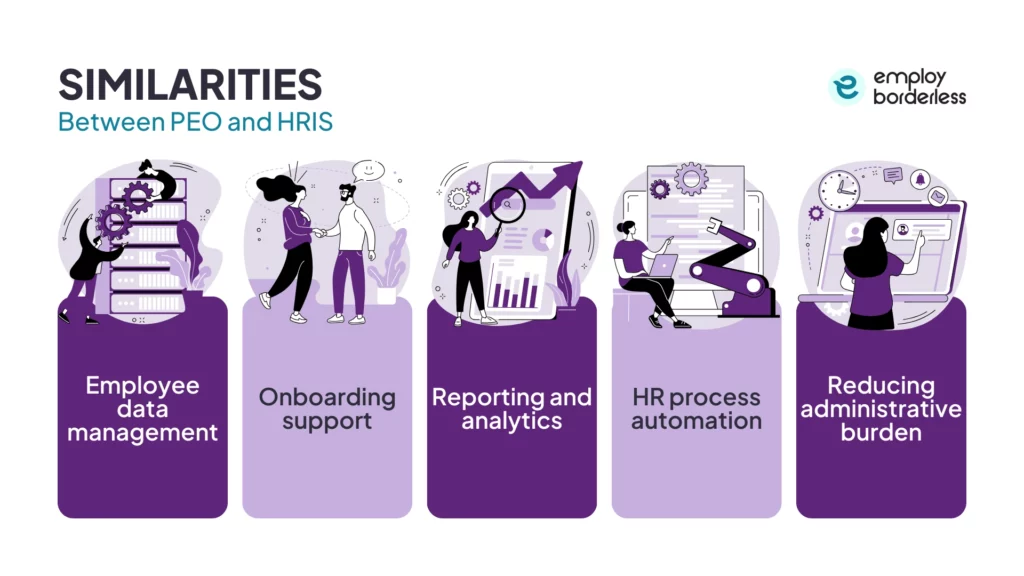
What are the similarities between PEO and HRIS?
The similarities between PEO and HRIS are employee data management, onboarding support, reporting and analytics, HR process automation, and reducing administrative burden.
Employee data management
Employee data management means PEO and HRIS both centralize and manage employee data and simplify HR functions, which include payroll, recruitment and onboarding, and benefits administration. PEOs integrate HRIS platforms into their services to provide a reliable system for handling employee records and compliance, which confirms uniform data management and reduces administrative burdens. HRIS platforms serve as separate, independent systems that businesses implement internally to manage employee information, as they offer flexibility and control over HR processes.
Onboarding support
Onboarding support means PEOs and HRIS help businesses with the employee onboarding process to improve operational productivity and compliance. PEOs offer complete, guided onboarding services, which involve the requirements of company policies, benefits information, and compliance documentation, through user-friendly platforms and expert support teams. HRIS platforms provide digital tools that automate and simplify onboarding tasks, such as document management, training modules, and compliance tracking. It also allows businesses to manage the onboarding process internally with greater control and flexibility.
Reporting and analytics
Reporting and analytics means both PEO and HRIS offer reporting and analytics tools to help companies make informed, data-driven HR decisions. PEOs integrate HRIS platforms into their services to provide businesses with access to centralized records and analytics tools for safety audits and training programs. These tools help track important employee metrics such as turnover rates, benefits utilization, and compliance status, which helps the HR team plan company objectives strategically.
HRIS platforms offer customizable reporting features for time tracking reports, attendance reports, and leave management reports. This helps organizations create detailed insights on different HR metrics, improve workforce management, and match HR strategies with business goals.
HR process automation
This outsourced HR model and HRIS (Human Resources Information System) provide automation of different HR processes, such as automated onboarding and offboarding, recruitment, and compliance management, which improves company operations and reduces administrative burden.
A PEO integrates HRIS platforms into its services, which gives businesses access to centralized systems that automate tasks such as payroll processing and benefits administration. HRIS platforms also provide tools to automate human resources processes like employee onboarding, time and attendance tracking, and performance evaluations, which help businesses maintain control over their HR operations while automating workflow.
Reducing administrative burden
PEOs and HRIS platforms help reduce the administrative burden for businesses by handling payroll processing, onboarding new hires, attendance tracking, and compliance reporting. PEOs offer comprehensive HR services, which include HR compliance, workforce management, and benefits administration. These services automate and centralize important HR functions, which saves the time and effort of businesses to focus on core business activities, such as marketing, customer support, and product development.
HRIS platforms provide automated tools and centralized data storage to reduce manual and repetitive tasks. They simplify processes like employee record-keeping, employee engagement, and time tracking, which help HR teams work more productively and prioritize income-producing tasks.
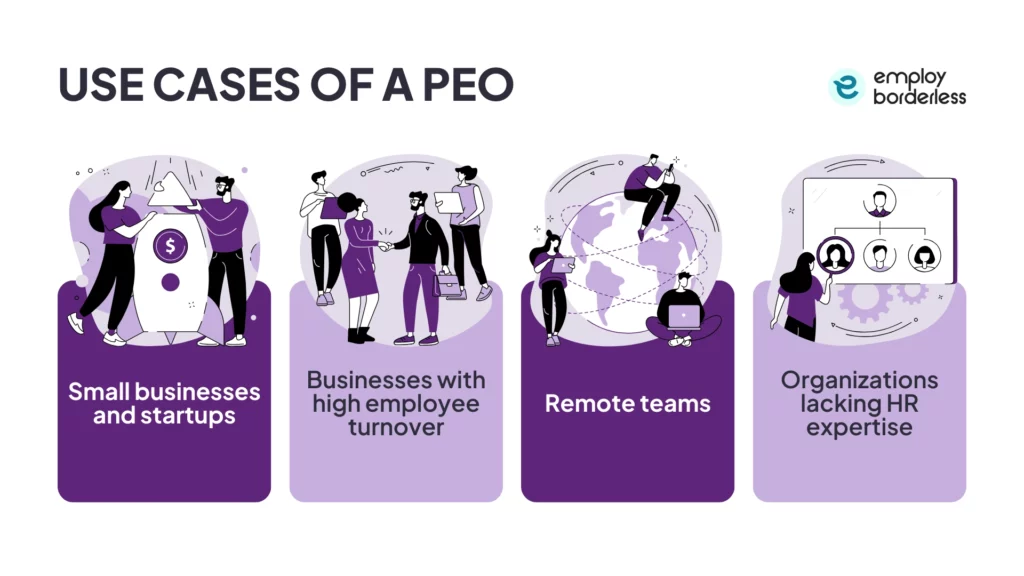
What are the use cases of a PEO?
The use cases of a PEO include small businesses and startups, businesses with high employee turnover, remote teams, and organizations lacking HR expertise.
The use cases of a PEO are listed below.
- Small businesses and startups: Small businesses and startups use PEOs to access a complete package of HR, payroll, benefits, and compliance services without building a large in-house human resources team. This helps them focus on business growth rather than managing time-consuming administrative work by outsourcing these functions to a PEO. PEOs also support faster global expansion of a business by handling international hiring and compliance, which makes it easy for startups to enter and scale in new markets.
- Businesses with high employee turnover: Businesses use PEOs to help reduce employee turnover by providing access to competitive benefits. They also offer advanced integrated HR software and employee support resources, which include EAPs (Employee Assistance Programs) and coverage for accidents or illnesses, that many small businesses are unable to offer on their own.
- Remote teams: Remote teams use PEOs to simplify payroll, onboarding, and compliance across multiple locations. PEOs centralize HR services, confirm uniformity in policies, benefits, and legal compliance, where employees are performing company operations. This reduces the complexity of managing distributed workforces and also helps businesses stay compliant with state or international labor laws, such as GDPR (General Data Protection Regulation).
- Organizations lacking HR expertise: Organizations that lack HR expertise use PEOs as they help fill the gaps in HR capabilities by providing expertise in legal compliance, benefits administration, payroll, and safety regulations. Businesses achieve stability, reduce compliance risk, and make sure employees receive proper support without needing to hire a full in-house HR team by partnering with a PEO.
What are the use cases of an HRIS?
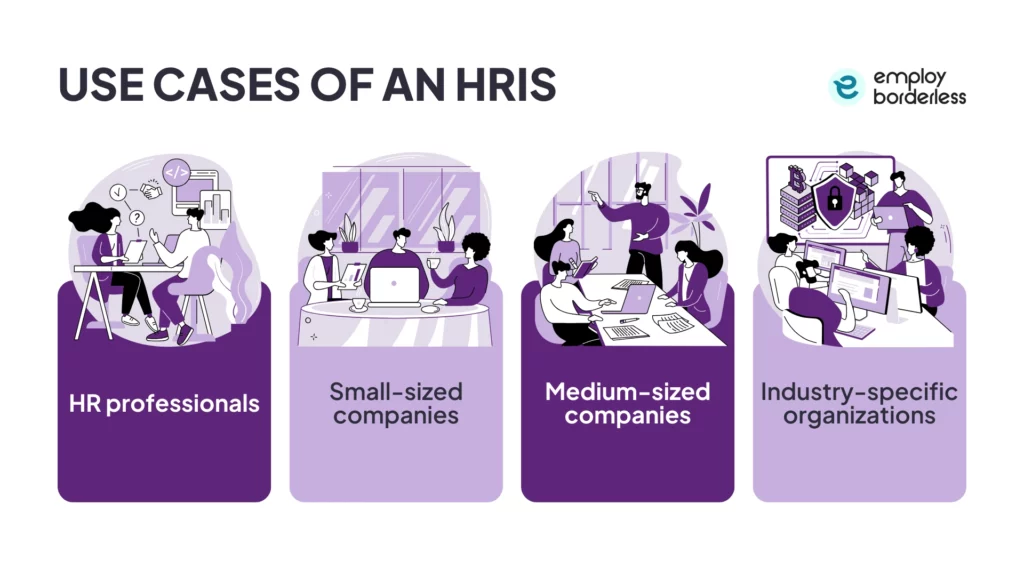
The use cases of an HRIS include HR professionals, small-sized companies, medium-sized companies, and industry-specific organizations.
The use cases of an HRIS are listed below.
- HR professionals: HR teams across organizations, from small companies to large enterprises, use HRIS to automate human resources operations like onboarding, document management, and compliance. This reduces manual work for the HR staff, simplifies HR processes, and gives HR professionals more time to focus on strategic initiatives such as employee engagement and workforce planning.
- Small-sized companies: Small-sized companies without large HR teams benefit from HRIS by centralizing routine HR tasks, such as payroll, time-off tracking, and recordkeeping, into one system. This helps them save time, reduce errors, and stay compliant while performing operations more productively.
- Medium-sized companies: Medium-sized companies and growing organizations use HRIS to support talent management, hiring automation, performance reviews, feedback, and offboarding, which improves employee engagement and retention while reducing administrative burden.
- Industry-specific organizations: Industry-specific organizations use HRIS to manage complex HR requirements, such as payroll, compliance, and performance tracking, across large workforces. HRIS helps companies in industries like technology, retail, healthcare, and manufacturing to improve accuracy and support both on-site and remote employees by centralizing these functions. For example, in the retail industry, Walmart uses HRIS to manage payroll, scheduling, and employee benefits for its large workforce, and also provides access through mobile platforms.
What are the benefits of using a PEO?
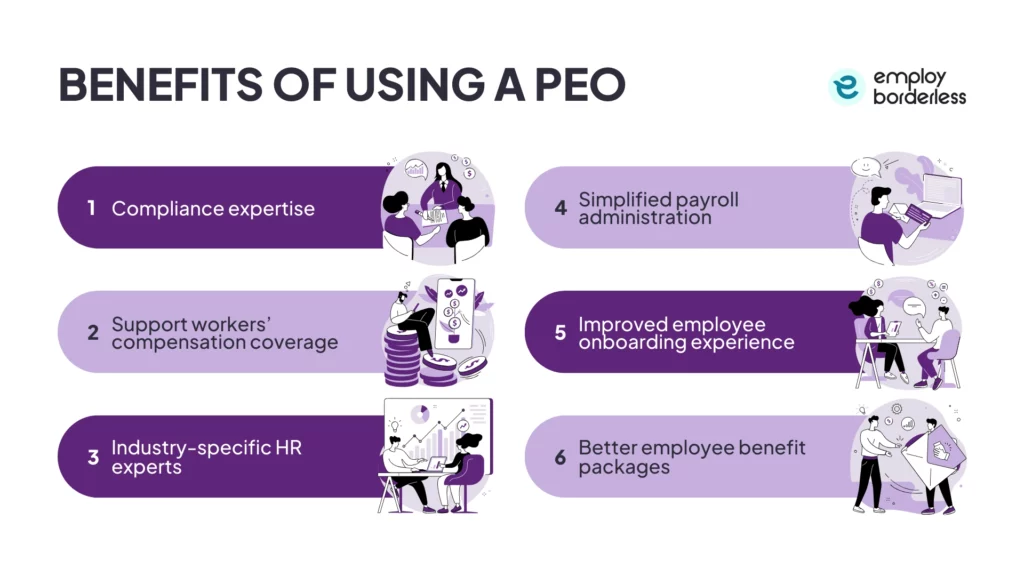
The benefits of using a PEO are compliance expertise, support for workers’ compensation coverage, industry-specific HR experts, simplified payroll administration, improved employee onboarding experience, and better employee benefit packages.
Compliance expertise
Compliance expertise means PEOs offer specialized compliance support to make sure businesses follow state and federal employment regulations, such as FLSA (Fair Labor Standards Act), ADA (Americans with Disabilities Act), FMLA (Family and Medical Leave Act), and OSHA (Occupational Safety and Health Administration). This third-party service provider stays informed of changing federal, state, and local labor regulations, from minimum wage and overtime requirements to employee classification rules and safety mandates. PEOs help businesses avoid costly fines and legal penalties by updating policies and systems and preventing compliance violations.
Support workers’ compensation coverage
PEOs support workers’ compensation coverage by acting as co-employers and grouping multiple client businesses. This larger group allows them to have more negotiating power with insurance carriers and helps companies secure better coverage at more affordable rates. PEOs manage the full claims process from coordinating with healthcare providers to supporting injured employees from injury reporting through resolution. This reduces administrative burdens while making sure injured workers receive timely medical care and support. PEOs actively manage filings, renewals, and compliance requirements and make sure that businesses meet all relevant workers’ compensation laws and regulations, such as EPLI (Employment Practices Liability Insurance).
Industry-specific HR experts
The PEO offers access to industry-focused HR professionals who understand the unique requirements of specific industries. For example, PEOs help construction industries understand OSHA (Occupational Safety and Health Administration) requirements and safety protocols. The PEO also makes sure businesses receive advice according to their market trends, from recruitment strategies to benefits, compliance, and workforce management.
Simplified payroll administration
PEOs simplify payroll administration by handling the complete payroll process, which includes wage calculation, direct deposit issuance, tax withholdings, and creating year-end documents like W-2s and 1099s. The PEO also monitors changing federal, state, and local payroll laws, such as FICA (Federal Insurance Contribution Act), FUTA (Federal Unemployment Tax Act), and SUTA (State Unemployment Tax Act), to make sure businesses remain legally compliant and help reduce manual errors and legal penalties.
Improved employee onboarding experience
An improved employee onboarding experience means PEOs deliver cloud-based onboarding platforms that automate important hiring tasks, such as document submission, benefits enrollment, and tax form completion, in a single platform. PEO platforms also support digital document handling and self-onboarding, while ensuring compliance with employment regulations, such as I-9 verification and tax documentation, which improves accuracy and legal safety.
Better employee benefit packages
Better employee benefit packages mean PEOs negotiate group rates on health, dental, vision, life insurance, disability coverage, and retirement plans similar to Fortune 500 offerings, which makes them affordable for smaller employers. The PEO also includes other benefits like wellness programs, commuter benefits, and EAPs (Employee Assistance Programs), which help companies in a competitive labor market.
What are the benefits of using HRIS?
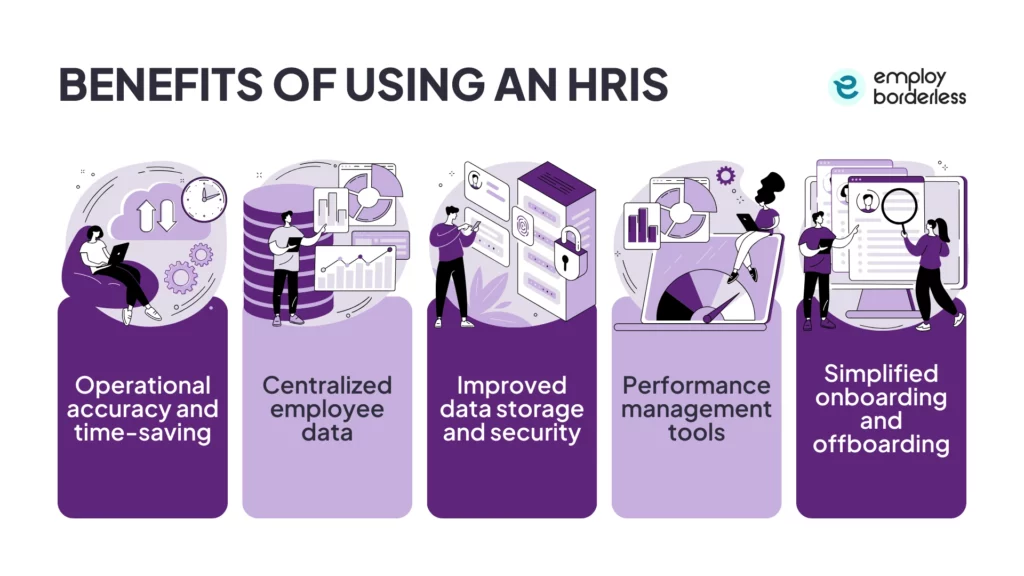
The benefits of using HRIS include operational accuracy and time-saving, centralized employee data, improved data storage and security, performance management tools, and simplified onboarding and offboarding.
Operational accuracy and time-saving
HRIS platforms automate routine HR tasks like payroll calculations, benefits deductions, tax filings, leave management, and document processing for operational accuracy. This automation reduces manual effort and errors, and helps HR teams focus on strategic work such as workforce planning, employee engagement, and talent development, which directly contribute to business growth.
Centralized employee data
Centralized employee data means HRIS platforms integrate all employee information, such as personal details, employment history, payroll, benefits, and performance records, into a single, secure system. HRIS removes duplicate entries, errors, and data inaccuracies to make records accurate and up to date by maintaining a centralized database. This helps businesses improve their data protection, controlled access, and audit trails to meet regulatory requirements and maintain compliance.
Improved data storage and security
HRIS (Human Resources Information System) platforms offer reliable systems for HR data by combining centralized storage, encryption, controlled access, and activity monitoring. It protects businesses’ sensitive information from unauthorized access and ensures compliance with data protection regulations, such as HIPAA (Health Insurance Portability and Accountability Act) and GDPR (General Data Protection Regulation).
Performance management tools
HRIS platforms improve performance management by allowing managers and employees to collaboratively set SMART (Specific, Measurable, Achievable, Relevant, Time-bound) goals and monitor them in real time. Automated reminders and feedback cycle guarantee performance stays visible and aligns with business objectives. Immediate access to performance data and dashboards, integrated with HRIS, provides timely check-ins and informed coaching, which creates a more responsive and development-focused performance culture.
Simplified onboarding and offboarding
HRIS simplifies the onboarding and offboarding process by automating paperwork, which includes employment contracts, benefits enrollment, and tax forms. New employees are able to complete and submit these documents online, which reduces the need for manual paperwork, errors, and delays. HRIS serves as a centralized system for all employee-related documents, so HR professionals are able to easily store, organize, and retrieve important onboarding documents, such as employee handbooks, policies, and training materials. This accessibility makes sure employees have quick access to important information, which promotes a smooth onboarding experience.
What are the drawbacks of using a PEO?
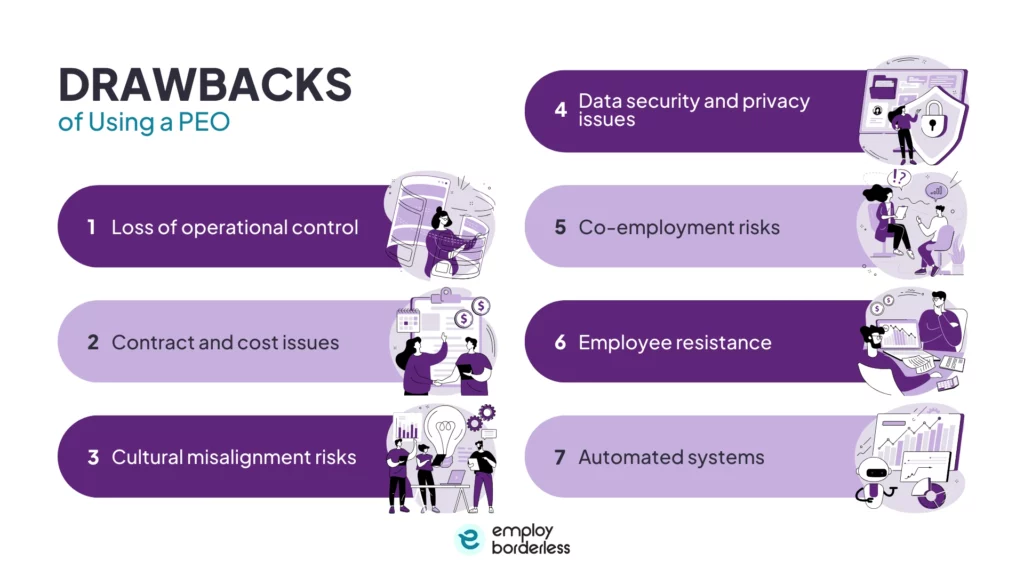
The drawbacks of using a PEO are loss of operational control, contract and cost issues, cultural misalignment risks, data security and privacy issues, co-employment risks, employee resistance, and automated systems.
The drawbacks of using a PEO are listed below.
- Loss of operational control: The PEO enters into a co-employment agreement with businesses and becomes a co-employer for HR functions, which means companies lose some control over areas such as benefits, payroll, and compliance. They also face difficulties in customizing policies or resolving issues quickly, as they have to follow PEO’s standardized procedures.
- Contract and cost issues: A PEO charges for its services as a percentage of payroll or a flat per-employee fee. These expenses increase as the workforce grows, and PEO agreement contracts include hidden fees or pricing structures that limit flexibility and affect the budget, particularly for small businesses.
- Cultural misalignment risks: Cultural misalignment risks occur because PEOs use standardized systems and policies that do not match a company’s culture or operations. For example, PEOs provide standardized tools for tracking or onboarding, which feel less personalized for employees.
- Data security and privacy issues: PEOs control important payroll and employment data, as a co-employer, so businesses have concerns about ownership, accessibility, and privacy, especially when transitioning away from the PEO. Data migration is a difficult process, and companies risk losing detailed records or facing compliance gaps if information is not transferred securely. These risks make some organizations hesitant to fully rely on a third party for handling sensitive employee data.
- Co-employment risks: Both the PEO and the company share liability for HR compliance issues under the co-employment model. This includes risks such as employee misclassification, payroll errors, or monitoring of professional licenses. For example, if a PEO processes payroll inaccurately, the client company is held legally responsible and faces fines or legal penalties.
- Employee resistance: Employees of the client company find co-employment structures confusing, which causes doubts about reporting channels, benefits, and loyalty. This confusion reduces morale and creates disengagement if it is not managed carefully by the company. Clear communication and reliable HR support are important to maintain trust and a positive employee experience.
- Automated systems: PEOs’ automated systems sometimes do not meet the unique needs of each employee or client business. The business also becomes dependent on software, and if the system does not work properly, it disrupts HR and payroll operations. For example, a PEO has an automated portal for leave requests, which is easy to use, but sometimes it does not handle complex situations, such as overlapping leaves or special accommodations.
What are the drawbacks of using HRIS?
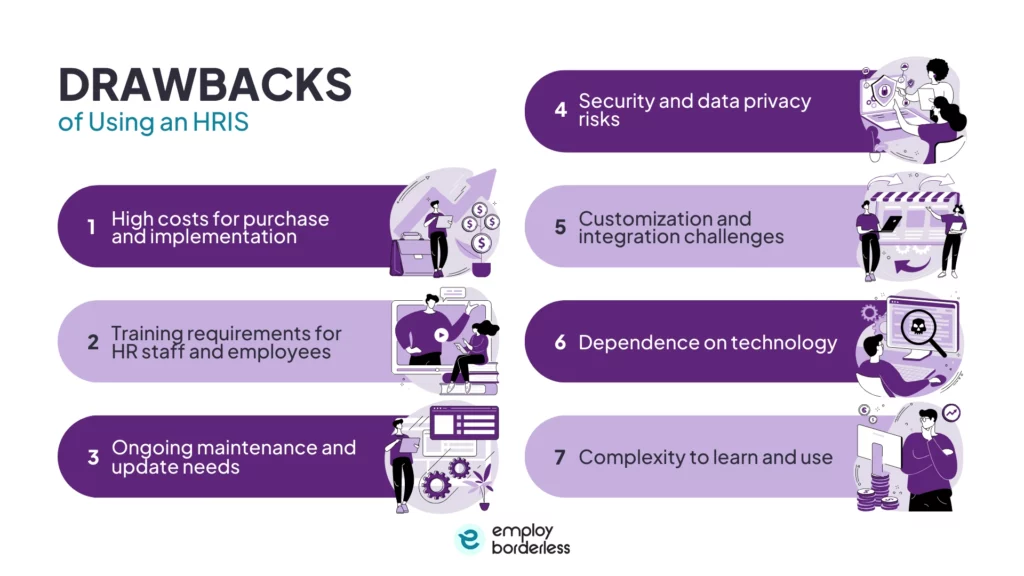
The drawbacks of using HRIS are high costs for purchase and implementation, training requirements for HR staff and employees, ongoing maintenance and update needs, security and data privacy risks, customization and integration challenges, dependence on technology, and complexity to learn and use.
The drawbacks of using HRIS are listed below.
- High costs for purchase and implementation: HRIS software is expensive to buy and set up, with costs including licensing fees, hardware, consulting, and ongoing implementation support. Businesses also face extra expenses for customization and integration with existing systems, which increases the overall cost.
- Training requirements for HR staff and employees: Companies that use HRIS platforms have to train employees and HR staff to use the system correctly. Lack of proper training leads to errors and inaccuracies in workflow operations.
- Ongoing maintenance and update needs: HRIS systems require regular updates and maintenance to fix bugs, comply with new laws, and improve functionality, which is time-consuming and costly, particularly for small businesses.
- Security and data privacy risks: An HRIS stores sensitive employee information, so businesses feel concerned about the risk of data breaches, hacking, or unauthorized access if not properly secured.
- Customization and integration challenges: Customizing an HRIS according to the company’s unique requirements or integrating it with other systems, such as payroll or benefits software, becomes both complex and costly. These expenses depend on the company size and system complexity.
- Dependence on technology: Dependence on technology means businesses that rely on the HRIS system for HR processes sometimes face system failures, which disrupt workflow operations and result in employee dissatisfaction.
- Complexity to learn and use: Some HRIS systems are complex because they have many features that become confusing for employees and HR staff, which leads to mistakes or limited use of the HRIS system.
How to choose between a PEO and HRIS?
To choose between a PEO and HRIS, consider the scope of support, control, and customization, cost structure, scalability and flexibility, compliance and risk management, and employee experience and company culture.
Choose a PEO to outsource HR services like payroll, benefits, compliance, and risk management. This helps businesses reduce administrative burden and errors, and it is ideal for small to medium businesses without an expert HR team. Select an HRIS to automate and simplify HR tasks such as record-keeping, payroll, and benefits. It helps internal HR teams to manage operations more productively and accurately.
Choosing the PEO involves a co-employment model, where the PEO shares responsibilities like onboarding, recruiting, HR policy implementation, and benefits administration. This arrangement reduces the company’s direct control over HR and employee relations. Select HRIS as it allows businesses to maintain full control over HR processes and policies. It offers greater flexibility and customization according to company culture and objectives.
Select a PEO because it offers scalability through bundled services, but companies lack the flexibility to adjust these standardized service packages according to workplace needs or changes in HR policies. Choose an HRIS platform to access scalability through software upgrades and modules, which allow businesses to customize and expand HR functionalities as they grow.
Choose PEOs as they take responsibility for compliance with employment laws and regulations, which include FLSA (Fair Labor Standards Act) and FMLA (Family and Medical Leave Act), which reduce legal risks for the business. Select HRIS because it provides tools to help businesses manage compliance internally, but requires an active approach to stay updated with changing laws and regulations.
Choose this third-party provider for access to competitive benefits like health insurance and retirement plans, though the co-employment model that PEOs create creates a disconnect between company and staff, which results in lower employee engagement and morale. Select an HRIS as it helps businesses maintain a uniform company culture and direct communication with employees, to promote better engagement and satisfaction.
What are some other HR outsourcing solutions apart from PEO and HRIS?
Some other HR outsourcing solutions apart from PEO and HRIS include ASO (Administrative Services Organization), HRO (Human Resources Outsourcing), EOR (Employer of Record), and BPO (Business Process Outsourcing).
An ASO (Administrative Services Organization) is a third-party service provider that manages administrative HR functions like payroll processing, benefits administration, and compliance support, without entering into a co-employment relationship. This means the client company maintains full control over employment decisions and legal responsibilities.
HRO (Human Resources Outsourcing) involves contracting an external provider to handle specific HR tasks or entire HR functions, such as payroll, employee benefits, recruitment, and employee relations, which allows businesses to focus more on growth-related objectives. Services range from basic HR services to comprehensive partnerships that include strategic planning and daily administrative support.
An EOR (Employer of Record) is a third-party organization that becomes the full legal employer of a company’s workforce and is responsible for all employer-related responsibilities and tasks. This includes managing payroll, benefits, compliance with local labor laws, which involve wage, leave, and termination laws, and other HR functions, while the client company maintains control over routine operations and employee performance. It is suitable for companies that hire employees in foreign countries without establishing a local entity.
BPO (Business Process Outsourcing) involves contracting specific business operations to third-party vendors, which include outsourcing functions like payroll, recruitment, and benefits administration. BPO allows companies to focus on core activities while using external expertise to handle routine functions.
What is the difference between a PEO and HRM?
The difference between a PEO and HRM (Human Resource Management) is that a PEO enters into a co-employment agreement with a client company, and shares employer responsibilities such as payroll, benefits administration, and compliance. HRM is the internal management of these functions within an organization, where the company maintains full control and responsibility over its workforce.
What are the three types of PEO?
The types of PEO are full-service PEOs, industry-specific PEOs, CPEOs (Certified PEOs), PEO alliances, and ASO (Administrative Services Organization). PEO types differ in terms of business size, scope of services, co-employment arrangements, and geographic coverage.
What are the 5 types of HRIS systems?
The 5 types of HRIS systems are operational HRIS, tactical HRIS, strategic HRIS, comprehensive HRIS, and limited-function HRIS. These systems automate daily HR tasks, support long-term workforce planning, integrate all HR functions, or focus on specific processes for smaller or specialized organizations.
Is an HRIS more cost-effective than a PEO?
Yes, an HRIS is generally more cost-effective than a PEO because HRIS platforms involve lower per-employee fees and fewer ongoing service costs. The PEO cost model involves a percentage of payroll or a fee per employee per month, which includes a range of HR services and increases as the workforce expands.
What is the difference between a PEO and a staffing agency?
The difference between a PEO and a staffing agency is that a PEO forms a co-employment relationship with a client company and shares responsibility for HR functions such as payroll, benefits, and compliance. A staffing agency recruits and places temporary or contract workers for short-term needs, and handles hiring and placements, but does not manage ongoing HR functions like payroll or compliance.

Co-founder, Employ Borderless
Robbin Schuchmann is the co-founder of Employ Borderless, an independent advisory platform for global employment. With years of experience analyzing EOR, PEO, and global payroll providers, he helps companies make informed decisions about international hiring.
Learning path · 9 articles
PEO fundamentals
Master the fundamentals with our step-by-step guide.
Start the pathReady to hire globally?
Get a free, personalized recommendation for the best EOR provider based on your needs.
Get free recommendations