How do PEOs help with risk management?

Robbin Schuchmann
Co-founder, Employ Borderless
A PEO (Professional Employer Organization), also known as an outsourced HR model, is a third-party service organization that provides HR services to businesses. These include payroll, benefits administration, and compliance support.
Risk management is the process of identifying, assessing, and controlling threats that negatively impact an organization’s operations and financial performance. The role of a PEO in risk management is to support businesses in evaluating and mitigating workplace risks, such as extreme temperature, mental health and stress, slips, trips, and falls. PEOs help reduce liability, prevent incidents, and protect both employees and the organization from financial, legal, and operational challenges.
PEOs help with risk management by identifying and assessing workplace risks, managing workers’ compensation and unemployment claims, ensuring OSHA (Occupational Safety and Health Administration) and workplace safety compliance, providing compliance expertise for wage, tax, and employment law, developing HR policy, employee handbooks, and procedure framework, and administer substance abuse and behavioral management programs.
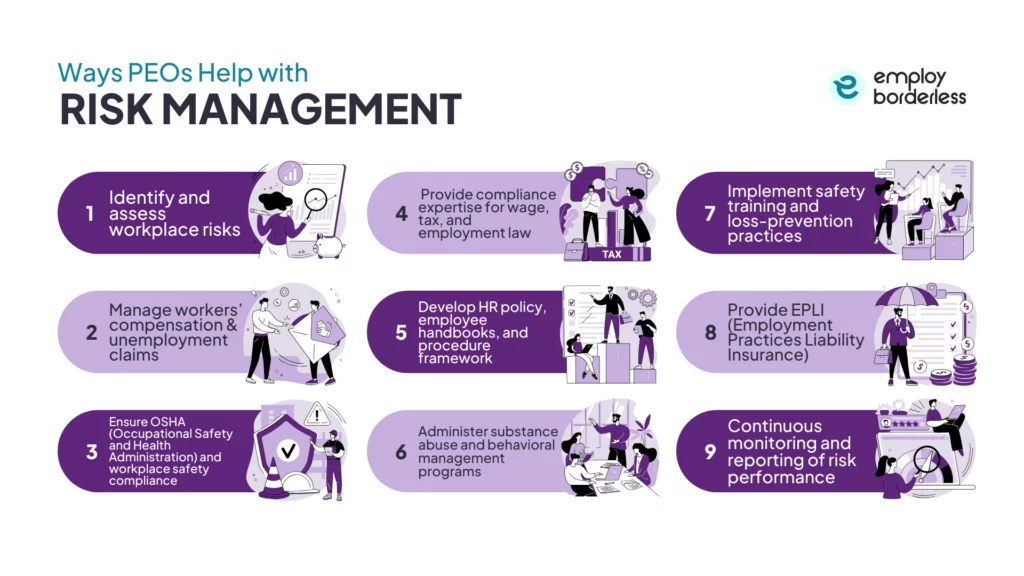
The ways PEOs help with risk management are listed below.
- Identify and assess workplace risks: PEOs identify and assess workplace hazards through audits, site tours, and JHAs (Job Hazard Analysis). They also improve safety strategies by monitoring mitigation measures based on the hazard’s severity.
- Manage workers’ compensation and unemployment claims: This third-party service provider handles workers’ compensation claims, documentation, and securing coverage. They use pooled insurance models, group-based models, and unemployment insurance to negotiate lower rates and maintain detailed employment records.
- Ensure OSHA (Occupational Safety and Health Administration) and workplace safety compliance: PEOs provide OSHA-compliant training programs, manage OSHA record-keeping, conduct formal safety inspections, and develop safety plans to mitigate risk, reduce fines, and operational disruptions.
- Provide compliance expertise for wage, tax, and employment law: The PEO handles payroll tax, withholding, remittance, and filing under their EIN (Employer Identification Number), to maintain accuracy and compliance with wage-related laws.
- Develop HR policy, employee handbooks, and procedure framework: PEOs create comprehensive workplace policies, review them for legal compliance, and manage distribution logistics, which reduces confusion and lowers legal disputes by providing standardized employee handbooks.
- Administer substance abuse and behavioral management programs: This outsourced HR model implements workplace substance abuse policies to ensure compliance with ADA (Americans with Disabilities Act) and federal mandates. They also provide EAPs (Employee Assistance Programs) to promote employee well-being and productivity, which reduces healthcare costs and employee turnover.
- Implement safety training and loss‑prevention practices: PEOs provide structured training, incident records, and specialized loss-prevention strategies for industries like manufacturing, construction, and healthcare, to improve safety outcomes and reduce claims and operational risk.
- Provide EPLI (Employment Practices Liability Insurance): The PEO provides affordable EPLI insurance to protect businesses from claims like wrongful termination and discrimination, and supports fair hiring practices, which ensure compliance and reduce disputes.
- Continuous monitoring and reporting of risk performance: PEOs conduct regular audits, use dashboards, and maintain OSHA records to assess compliance, identify gaps, and improve risk management strategies by using performance data to monitor employee performance metrics, such as training completion and compliance targets.
Identify and assess workplace risks
PEOs identify job-specific and workplace hazards through safety audits, site tours, JHAs (Job Hazard Analysis), and inspections to evaluate issues such as equipment risks, extreme temperatures, chemical exposures, and slip-and-trip hazards.
This third-party service provider reviews workplace conditions, safety programs, and performance trends to customize and improve safety strategies, which include machine guard protocols, improved workstation setups, chemical handling procedures, updated emergency evacuation plans, and targeted safety training for high-risk tasks.
PEOs, after evaluating risks, assess the possibility and severity of each hazard, which includes its financial, operational, and legal impact, and then develop a strategic risk classification and analysis report. They implement and continuously monitor mitigation measures, such as updated policies, delivering industry-specific safety training, managing workers’ compensation, and maintaining compliance, based on the report.
Manage workers’ compensation and unemployment claims
PEOs act as the employer of record and handle the complete workers’ compensation claims process, from securing coverage to managing documentation and coordination. They manage claims quickly and accurately through a specialized claims team to help reduce legal and administrative burdens. The PEOs help with loss prevention, safety consulting and training, and return-to-work programs that support recovery while reducing operational errors.
The PEO uses pooled insurance models, group-based workers’ compensation, and unemployment insurance to negotiate lower rates due to economies of scale. This outsourced HR model secures better premiums and claims risk collectively because it co-employs many workers across multiple clients. Unemployment tax rates are calculated using the PEO’s combined experience rating rather than each client’s record, which also helps smaller employers reduce costs.
This third-party service provider maintains detailed employment records to guarantee accuracy during unemployment insurance audits and to comply with documentation requirements. They manage court disputes for unemployment claims by preparing supporting evidence, responding to settlements, and guiding employers through the appeals process to dispute improper claims.
Ensure OSHA and workplace safety compliance
PEOs deliver OSHA-compliant (Occupational Safety and Health Administration) training programs, aligned with current regulations, to improve safety awareness and reduce incidents, which helps build an active safety culture. They maintain well-organized safety training tracks and periodically update OSHA-mandated courses to keep them effective and relevant.
This third-party service provider manages OSHA record-keeping and reporting requirements, which include preparation, maintenance, and submission of logs such as OSHA Forms 300, 300A, and 301, to save clients from administrative burden. PEOs conduct formal safety inspections that meet OSHA protocols. For example, one provider performs comprehensive on-site evaluations, which include hazard identification, photo documentation, and written findings, similar to official OSHA inspections.
The PEO actively develops safety plans, conducts routine inspections, and provides ongoing training to identify and mitigate risk before violations occur. This helps employers reduce fines, workers’ compensation claims, and operational disruptions by maintaining a compliant safety structure. These active safety programs result in workplace performance improvements and overall compliance.
Provide compliance expertise for wage, tax, and employment law
PEOs manage all aspects of payroll tax, which include withholding, remittance, and filing under their own EIN (Employer Identification Number), and reduce the burden and errors for client businesses. They ensure accuracy in payroll operations and compliance with wage-related laws such as FLSA (Fair Labor Standards Act), ACA (Affordable Care Act), and ADA (Americans with Disabilities Act). PEOs help maintain regulatory compliance and reduce audit risk through active payroll tax management and expert monitoring.
This outsourced model also helps the companies avoid legal penalties, fines, wage-and-hour lawsuits, and class-action risks by the correct application of labor laws, accurate record maintenance, and regular update checks across jurisdictions. PEOs stay informed of changing employment laws by monitoring federal, state, and local labor regulations. They also help clients by automating updates, which include revised labor law policy upgrades or internal communications to ensure ongoing compliance and avoid legal breaches.
Develop HR policy, employee handbooks, and procedure framework
PEOs help businesses create comprehensive workplace policies that meet both organizational values and legal requirements. These policies go through legal review, often with the involvement of employment law experts, to ensure compliance before being distributed to staff through employee handbooks. PEOs also manage the logistics of distribution, such as delivering digital or printed handbooks and updating them systematically.
A PEO offers standardized, customizable documents like job descriptions, codes of conduct, and other personnel forms. PEOs reduce confusion around workplace expectations by delivering well-structured HR policies, transparent employee handbooks, and accurate documentation. This clarity helps reduce incidents of non-compliance and misunderstandings, which lowers the risk of legal disputes.
Administer substance abuse and behavioral management programs
PEOs help businesses implement workplace substance abuse policies that clearly define acceptable behavior and testing procedures, such as random, pre-employment, and reasonable-suspicion tests. They also ensure clients comply with standards such as the ADA (Americans with Disabilities Act) and federal drug-free workplace mandates. A PEO usually handles policy establishment, makes sure employees understand the procedures, and provides monitoring and training for fair and reliable behavioral management programs.
This HR service model also helps with EAPs (Employee Assistance Programs) in their service offerings. These programs deliver confidential assessments, short-term counseling, referrals, and follow-up care for employees dealing with substance misuse or personal challenges. EAPs help maintain productivity, reduce absenteeism, and support long-term employee well-being.
The PEO protects organizations from legal and financial risk by combining clearly defined substance policies with accessible EAP services. Early intervention, structured support, and reliable policy implementation result in fewer incidents, lower healthcare costs, and reduced employee turnover.
Implement safety training and loss‑prevention practices
PEOs establish structured training schedules and maintain detailed records of incidents to ensure safety compliance and effectiveness. Employers benefit from organized timelines for initial and refresher training sessions. They also help track incidents, near-misses, injuries, or unsafe acts, and assess program effectiveness, which results in targeted safety improvements.
This third-party service provider offers specialized loss-prevention strategies in industries with unique risks, such as manufacturing, construction, or healthcare. These include creating customized safety manuals, workplace inspections, and policies that meet the compliance needs of each industry. PEOs bring industry-focused expertise to reduce claims and operational risk while improving overall safety outcomes.
Provide EPLI (Employment Practices Liability Insurance)
The PEO offers access to EPLI (Employment Practices Liability Insurance), which protects businesses from employment-related claims, such as wrongful termination, discrimination, harassment, and unfair treatment. It also covers legal defense costs, settlements, and regulatory actions like those from the EEOC (Equal Employment Opportunity Commission). These policies are more affordable due to the PEO’s ability to negotiate group rates, and allow clients access to legal experts or attorneys who guide them through claims or legal concerns under the policy.
PEOs support employers in implementing fair, uniform practices in hiring, managing discipline, and executing terminations. They provide best-practice frameworks and HR guidance to reduce the possibility of disputes, and make sure that these practices align with legal standards, and help mitigate risk, settlements, court judgments, and legal fees.
Continuous monitoring and reporting of risk performance
PEOs conduct systematic, periodic audits to assess compliance status and identify gaps by using structured assessments across HR, safety, and risk management functions. They use dashboards and reporting tools, such as Tableau and Domo, to monitor performance metrics, like compliance targets and training completion, which guarantee ongoing alignment with organizational and regulatory requirements.
They also maintain OSHA-mandated (Occupational Safety and Health Administration) records, such as Forms 300, 300A, and 301, and handle required postings and data submissions. PEOs detect patterns in near-misses, injuries, or hazards and issue safety alerts or recommendations to prevent problems by analyzing incident trends. PEOs help clients improve their risk management strategies through protocol updates, targeted training programs, or new control measures to manage changing workplace conditions and increasing threats using this performance data.
Why should businesses partner with a PEO for risk management?
Businesses should partner with a PEO for risk management to access expertise and compliance guidance, receive comprehensive insurance, reduce costs and administrative burden, improve business stability and growth opportunities, and share an employment risk model.
PEOs provide businesses with expert guidance on managing complex HR regulations and compliance requirements. They stay up-to-date with changing laws, help develop and implement effective policies and procedures, and mitigate legal and regulatory risks. This support helps businesses maintain compliance and reduce the risk of costly penalties or legal issues.
Companies that partner with a PEO receive access to comprehensive insurance coverage, which includes workers’ compensation and EPLI (Employment Practices Liability Insurance). PEOs use their collective purchasing power to offer cost-effective insurance rates and help businesses mitigate financial risks related to workplace incidents and employment-related claims.
Businesses reduce administrative burdens and operational costs by outsourcing HR functions to a PEO. This outsourced model handles tasks such as payroll processing, benefits administration, and compliance management without the need to hire an in-house team. This also helps businesses focus on core operations, like customer support and product development.
PEOs contribute to business stability by implementing risk management strategies that reduce workplace incidents and legal liabilities. Their support in compliance and HR functions allows businesses to operate smoothly and promotes a workplace culture that helps them grow.
This third-party service provider shares employer responsibilities, which include tax filings and workers’ compensation coverage with businesses through a co-employment arrangement. This shared model helps divide employment-related risks and protect businesses by reducing their exposure to possible liabilities.
Do PEOs help with compliance?
Yes, PEOs help with compliance by offering expert guidance on managing complex employment laws and regulations. PEO compliance support helps businesses meet federal, state, and local requirements, which reduces the risk of legal issues and penalties.
How do PEOs mitigate risk management for small businesses?
PEOs mitigate risk management for small businesses by providing expert risk management services, which include compliance guidance, safety training, and workers’ compensation handling. PEOs for small businesses help identify and mitigate workplace hazards, reduce legal liabilities, and ensure compliance with employment laws, which allows businesses to focus on growth while reducing operational risks.
What is the purpose of a PEO?
The purpose of a PEO is to provide complete HR services to businesses, such as employee recruiting and onboarding, payroll processing, benefits enrollment, and compliance with employment laws. This allows businesses to focus on growth and operations while the PEO handles complex HR tasks.
Do PEOs help with employee relations to reduce HR risk?
Yes, PEOs help with employee relations to reduce HR risk by offering expert guidance on conflict resolution, disciplinary actions, and employee communications. PEO in HR helps manage disputes and reduce the risk of legal issues related to employee relations by helping develop and implement HR policies that promote fairness and transparency.
How do PEOs reduce workers’ compensation costs?
PEOs reduce workers’ compensation costs by using their collective purchasing power to secure competitive rates for small businesses. They offer pay-as-you-go premium structures, which improve cash flow management and lower financial burden.

Co-founder, Employ Borderless
Robbin Schuchmann is the co-founder of Employ Borderless, an independent advisory platform for global employment. With years of experience analyzing EOR, PEO, and global payroll providers, he helps companies make informed decisions about international hiring.
Learning path · 9 articles
PEO fundamentals
Master the fundamentals with our step-by-step guide.
Start the pathReady to hire globally?
Get a free, personalized recommendation for the best EOR provider based on your needs.
Get free recommendations