9 payroll services offered by PEOs and their benefits

Robbin Schuchmann
Co-founder, Employ Borderless
A PEO (Professional Employer Organization), also known as an HR outsourcing model, is a third-party organization that manages the HR functions of the client company under a co-employment agreement. The HR functions that a PEO handles include payroll management, employee benefits, and compliance support.
A PEO works by forming a co-employment agreement with the client businesses and becomes the employer of record for tax, payroll, and benefit purposes. It also shares liability with the client’s business and files taxes using its own EIN (Employer Identification Number).
The main payroll services offered by PEOs are payroll processing for employees and contractors, payroll tax management and year-end reporting, and handling payroll tax notices and inquiries. The major benefits of using a PEO for payroll services are cost savings, time savings and simplified operations, improved data security, better employee experience, increased accuracy, and reduced liability.
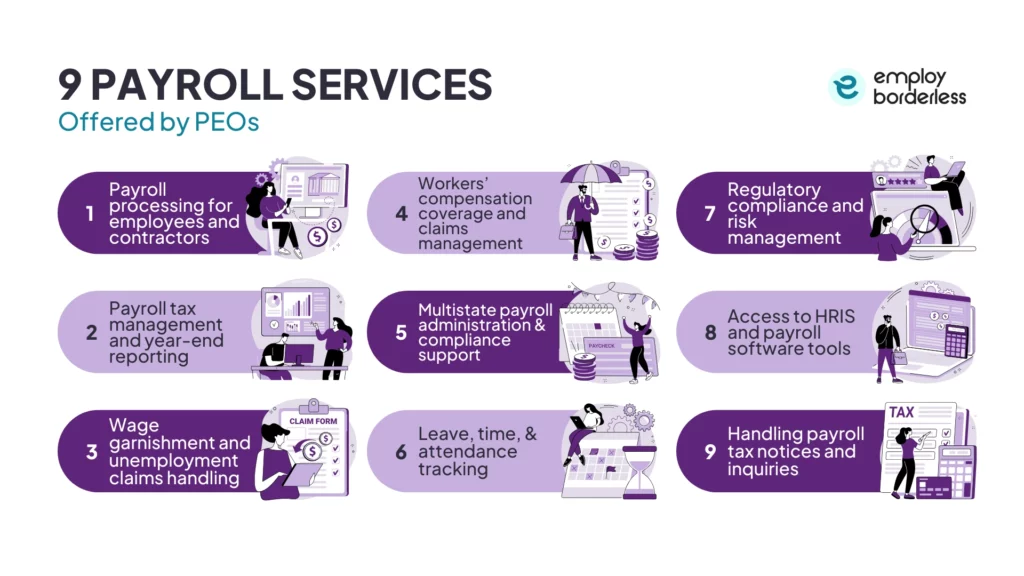
The 9 payroll services offered by PEOs are listed below.
- Payroll processing for employees and contractors: PEOs handle payroll processing for employees and contractors, which includes calculating wages and withholding taxes, and act as the employer of record for payroll tax filings and wage reporting.
- Payroll tax management and year-end reporting: A PEO manages payroll tax calculations, issuance, and filings for co-employment partnerships. It follows IRS rules, prepares W-2 forms, and issues Form 1099s. The PEO also conducts routine audits, uses HRIS systems, and tracks deadlines across jurisdictions.
- Wage garnishment and unemployment claims handling: This third-party service provider processes wage garnishments and employee benefit deductions by calculating and withholding required amounts from employees’ net earnings.
- Workers’ compensation coverage and claims management: PEOs offer workers’ compensation coverage, manage the claims process, report injuries, and improve workplace safety to reduce employee claims and lower insurance premiums.
- Multistate payroll administration and compliance support: A PEO helps businesses manage payroll laws and taxes across multiple states. It also adjusts tax withholdings, minimum wage laws, and follows state-mandated benefits policies.
- Leave, time, and attendance tracking: This outsourced HR solution uses time and attendance systems to accurately record employee hours and leave balances, calculate payroll, manage leave, and provide real-time insights.
- Regulatory compliance and risk management: The PEO monitors labor laws, conducts regular audits, and uses advanced payroll systems to make sure businesses remain compliant with federal, state, and local laws. It also provides updates on changes and prevents legal penalties for client businesses.
- Access to HRIS and payroll software tools: PEOs offer cloud-based HR and payroll software for businesses to help with real-time data management, onboarding, and tax compliance. These tools improve data accuracy, workflow productivity, and employee self-service capabilities.
- Handling payroll tax notices and inquiries: This third-party service provider manages payroll-related communications from tax agencies, reviews tax notices, verifies records, and prepares responses. It resolves compliance issues quickly to prevent legal penalties or operational disruptions.
1. Payroll processing for employees and contractors
PEOs provide complete payroll processing for both employees and independent contractors, which includes calculating gross wages, tax withholdings, and distributing payments. A PEO also creates accurate payroll reports, such as pay registers, wage summaries, and tax liability reports, to ensure compliance with labor laws, like FLSA (Fair Labor Standards Act), the FICA (Federal Insurance Contributions Act), and state-specific payroll tax regulations.
The PEO collects important employee and contractor data, such as hours worked, base wages, overtime, bonuses, commissions, deductions, and benefits or garnishment eligibility. This data is collected through integrated time-tracking and HR systems, like biometric systems, ATS (Applicant Tracking System), and computer-based systems with automated timesheet generation, to provide accuracy and timeliness.
This third-party service provider manages payroll through automated systems that reduce human errors, simplify data entry, and increase operational productivity. The PEO becomes the employer of record for tax and payroll purposes in a co-employment agreement, which means the PEO handles payroll tax filings, wage reporting, and compliance, while the client company maintains responsibility for daily workforce management.
2. Payroll tax management and year-end reporting
Payroll tax management and year-end reporting mean a PEO takes responsibility for payroll tax calculations, paycheck issuance, and filing taxes under its own EIN (Employer Identification Number) when it forms a co-employment partnership with the client company. PEOs manage the timing and submission of payroll tax deposits based on IRS rules, which usually follow monthly or semi-weekly schedules depending on the volume of taxes.
PEOs handle quarterly and annual payroll tax filings such as Form 941 for federal income and employment taxes and Form 940 for unemployment taxes, like FUTA (Federal Unemployment Tax Act). They also manage forms like 944, 945, and 943 to provide accuracy and compliance while reducing the client’s risk of penalties. PEOs prepare and distribute W-2 forms to employees and file them with the SSA (Social Security Administration) by January 31, and also issue Form 1099s to contractors for their earnings.
This outsourcing HR model conducts routine audit checks, such as internal HR audits to verify payroll accuracy and policy compliance, review procedures, handbooks, and payroll workflows. The PEO also uses HRIS systems to track deadlines and regulatory changes and make timely filings across federal, state, and local jurisdictions, which is particularly valuable for businesses operating in multiple states with different tax laws.
3. Wage garnishment and unemployment claims handling
PEOs take responsibility for processing mandated wage garnishments and employee benefit deductions during payroll. They calculate and withhold the required amount from the employee’s disposable earnings (the amount left after required tax deductions) when they receive a garnishment notice, such as for child support, government tax orders, or student loans, and submit it to the relevant authority or creditor.
The PEO calculates and prioritizes payroll deductions according to legal requirements, such as the CCPA (Consumer Credit Protection Act). This law defines disposable earnings and places limits on the amount withheld, usually up to 25% for ordinary debts, with higher allowances (up to 60%) for obligations like child support or alimony.
This third-party service provider relies on official documents to provide correct wage garnishment processing, which includes garnishment orders (courts or government agencies) that explain the deduction amount and recipient. Other official documents are benefit election forms, when deductions are voluntary, like insurance, and payroll deduction summaries, for transparency and record-keeping.
4. Workers’ compensation coverage and claims management
PEOs provide workers’ compensation coverage by securing insurance policies that protect employees in case of work-related injuries or illnesses. They manage the entire claims process, from reporting and tracking injuries to providing timely submission of important documentation forms. These forms include injury logs, like OSHA 300 (Occupational Safety and Health Administration), claims records, insurance certificates, medical reports, and return-to-work forms.
Workers’ compensation insurance premiums are usually calculated based on the actual payroll of the client’s business, with rates fluctuating according to factors such as industry classification and claims history. PEOs make sure that workplace injuries are reported quickly and accurately, as it helps companies complete required forms, submit to the appropriate authorities, and track the progress of claims. This active approach of PEOs helps manage workers’ claims expertly and reduces the risk of legal disputes.
A PEO helps improve workplace safety, apply risk management strategies, provide safety training, and ensure compliance with safety regulations such as OSHA standards and state-specific workplace safety laws. It also helps mitigate employment-related risks through EPLI (Employment Practices Liability Insurance), to protect the client against claims such as wrongful termination, discrimination, or harassment. PEOs create a safer and legally compliant work environment to reduce both physical and employment-related claims, which lowers insurance premiums over time.
5. Multistate payroll administration and compliance support
PEOs help businesses operate across multiple states by managing different payroll laws and taxes, such as California’s PFL (Paid Family Leave) and Texas’s TUCA (Texas Unemployment Compensation Act). This third-party service provider also customizes payroll processing according to location-specific regulations as it adjusts tax withholdings based on state income tax rates, applies the correct minimum wage laws, and follows state-mandated benefits and leave policies. For example, states like California and New York have progressive income tax systems, while others, like Texas and Florida, do not impose state income tax.
The PEO uses different documents to provide compliance, like state W-4 equivalents, wage notices, and compliance reports. These documents help withhold taxes accurately, meet state reporting requirements, and maintain transparent records for audits. PEOs actively monitor legal changes across jurisdictions to maintain accurate and compliant payroll processing. They stay updated on state and local tax law updates, evaluate local tax liabilities for remote employees, and use automated payroll and compliance systems to manage these complexities expertly.
6. Leave, time, and attendance tracking
A PEO implements time and attendance systems to accurately record employee hours and leave balances. Employees clock in and out using biometric devices, mobile apps, or web portals, and the system logs their hours and leaves automatically. The system uses the recorded hours to calculate payroll and pay employees accurately. PEOs also manage different types of leave, such as PTO (Paid Time Off), sick leave, and FMLA (Family and Medical Leave Act), to apply the relevant rules and comply with federal and state regulations.
PEOs maintain digital timesheets, leave request logs, and attendance dashboards to track hours, leave, and attendance patterns, and provide managers with real-time insights into workforce availability and leave usage. Timekeeping tools that PEO offers integrate smoothly with payroll systems and allow hours and leave data to flow directly into payroll. These tools help companies reduce manual errors and also improve workplace productivity. PEOs prevent issues such as buddy punching and overtime mistakes by using these systems and provide accurate and timely payroll processing.
7. Regulatory compliance and risk management
Regulatory compliance and risk management mean that the PEO monitors federal, state, and local labor laws, such as the ACA (Affordable Care Act), the EPA (Equal Pay Act), and OSHA (Occupational Safety and Health Act), to help businesses comply with these labor laws. It provides updates on changes such as minimum wage adjustments, overtime rules, and employee classification standards. For example, in April 2024, the Department of Labor increased the standard salary level for exemption from overtime under the FLSA (Fair Labor Standards Act).
PEOs conduct regular audits and identify compliance issues to help businesses avoid legal penalties. They also help prepare audits by maintaining thorough records and documentation, and use advanced payroll systems that provide alerts for compliance deadlines and regulatory changes. These systems help prevent missed filings or outdated practices and provide professional monitoring of payroll, employee classification, benefits administration, and regulatory compliance.
8. Access to HRIS and payroll software tools
PEOs provide businesses with cloud-based HR and payroll software tools that allow real-time management of employee data and payroll. These tools include features such as pay history, where employees view their past pay statements, onboarding modules for new hire paperwork and orientation, and time-off requests that help employees submit and track their leave. HRIS systems also allow businesses access to downloadable tax forms like W-2s and 1099s.
The PEO commonly uses platforms such as HRIS dashboards, which provide centralized interfaces for managing employee information, mobile apps that allow employees to access HR services, and integrated payroll portals that simplify payroll processing and provide tax compliance. These systems improve data accuracy, improve workflow productivity, and offer employees self-service capabilities to reduce administrative burdens and help businesses stay compliant with labor laws.
9. Handling payroll tax notices and inquiries
PEOs handle official payroll-related communications from federal, state, and local tax agencies and review each tax notice carefully to understand the issue. They check payroll records and tax filings to find any differences in reported wages, tax withholdings, or filings. A PEO also prepares and submits responses or corrections to the tax authorities within the specified deadlines, when necessary.
The PEO resolves compliance issues quickly to prevent costly penalties, interest, or disruptions to payroll operations. It implements active monitoring strategies, such as regular audits and reviews, to identify issues that affect the client company. A PEO also maintains systems to handle reactive responses and provide timely and accurate replies to agency inquiries.
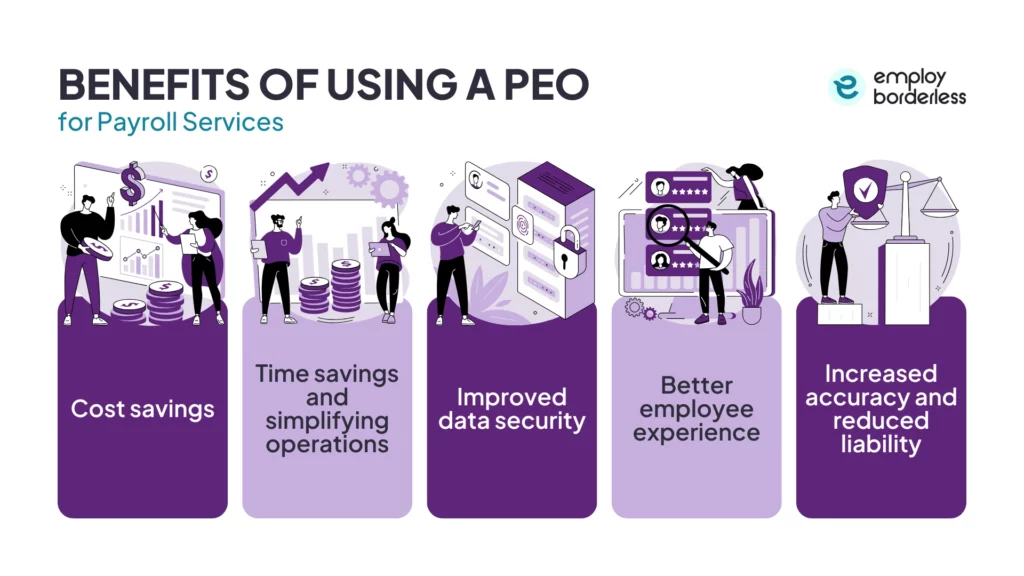
What are the benefits of using a PEO for payroll services?
The benefits of using a PEO for payroll services are cost savings, time savings and simplified operations, improved data security, better employee experience, increased accuracy, and reduced liability.
Cost savings
Cost savings mean using a PEO for payroll services helps businesses save expenses by reducing administrative costs, workers’ compensation insurance, and offering access to affordable employee benefits. Companies that partner with a PEO see an average ROI of 27.2%, which means these savings allow businesses to use their internal resources toward growth and strategic initiatives.
Time savings and simplifying operations
Time savings and simplifying operations mean a PEO simplifies payroll processes by automating tasks such as calculating wages, withholding taxes, and managing deductions, which reduces manual errors and saves time for the in-house HR team. PEO integration simplifies operations and confirms reliability across HR tasks to lower the complexity of managing multiple vendors and systems. This integration also allows businesses to focus their time on core operational activities, like sales and marketing, customer service, and product development.
Improved data security
Improved data security means PEOs implement advanced security measures and protocols, like SSL encryption, multi-factor authentication, and secure cloud-based systems to protect sensitive employee information, like Social Security numbers, bank details, and salary data. PEOs also conduct regular security audits and comply with data protection regulations, such as GDPR (General Data Protection Regulation) and HIPAA (Health Insurance Portability and Accountability Act), to mitigate risks of unauthorized access and data breaches. A PEO maintains the confidentiality of the client businesses’ payroll data, which builds employee trust and protects the company’s reputation.
Better employee experience
Better employee experience means PEOs offer employees access to Fortune 500-level benefits, like health insurance, retirement plans, and wellness programs that are usually available only to larger companies, which increases job satisfaction and employee retention. A PEO also provides clear and transparent communication through different channels such as emails, instant messaging, and intranet portals, to make sure that employees stay informed about important updates like changes to benefits, payroll, or workplace policies. This approach helps reduce misunderstandings and promotes a positive working environment.
Increased accuracy and reduced liability
Increased accuracy and reduced liability mean that a PEO takes responsibility for payroll processing and tax filings, which reduces the employer’s risk of legal issues. PEOs rely on automated systems and expert compliance checks to lower errors in wage calculations and tax submissions. The PEO is contractually responsible for correcting the error and covering any related fines or penalties if it makes a payroll error, such as incorrect tax withholdings or filing mistakes, on behalf of the client.
What should businesses consider when choosing a PEO for payroll services?
The factors that businesses should consider when choosing a PEO for payroll services are compliance support, scalability and flexibility, advanced technology integration, and accreditation and certification.
Choose a PEO for payroll services that actively manages compliance by staying updated with federal, state, and local labor laws, like FLSA (Fair Labor Standards Act). This also includes compliance with payroll, taxes, worker classification, and benefits regulations. A reliable PEO also provides clear guidance on employer responsibilities and supports businesses in preparing for compliance audits.
Select a PEO that grows with your business and adjusts to changing HR and payroll needs. It should provide flexible pricing options and service packages that are suitable for your organization as the workforce changes, which helps you manage costs accurately while maintaining reliable payroll and HR support.
Choose the PEO that offers advanced HR technology and smoothly integrates with your existing systems, such as accounting, HRIS (Human Resource Information System), or payroll platforms, while also offering mobile access, dashboards, and analytics to improve operational accuracy.
Partner with a PEO that holds recognitions such as ESAC (Employer Services Assurance Corporation) accreditation, IRS certification, or CPEO (Certified PEO) status, as these credentials show that the provider follows strict guidelines and is trusted to manage payroll and HR responsibilities reliably.
How much does PEO payroll cost?
A PEO payroll costs about 2% to 12% of total payroll or a flat fee of $100 to $200 per employee per month, which depends on the pricing model and services selected. The PEO costs help businesses plan operational expenses more easily.
How many types of payroll systems are there?
The types of payroll systems are manual payroll, online payroll services, payroll cards, payroll software, and outsourced payroll. These payroll systems help businesses calculate wages accurately, manage tax withholdings, track employee hours, generate reports, and ensure compliance with labor regulations.
What payroll forms does a PEO take care of?
The payroll forms that a PEO takes care of are Form 941 for quarterly federal taxes, Form 940 for annual unemployment taxes, W-2s for employees, 1099-NEC for contractors, and state-specific tax filings. The PEO provides accurate reporting, timely submission, and compliance with federal and state regulations by managing these forms, which reduces the administrative burden and risk for the client company.
How many types of PEO are there?
There are five types of PEO, such as PEO alliances, industry-specific PEO, CPEO (Certified PEO), full-service PEO, and ASO (Administrative Services Organization). These PEO types serve different business needs, offer different levels of HR support, payroll management, benefits administration, compliance support, and risk management.
What is the difference between a PEO and a payroll service?
The difference between a PEO and a payroll service is that a PEO offers complete HR services, which include payroll processing, benefits administration, and compliance support, by forming a co-employment relationship. A payroll service provider focuses solely on payroll processing and related tax compliance, without entering into a co-employment model or providing complete HR duties.
Why do we use a PEO?
We use a PEO to outsource complex HR functions, like payroll, benefits, compliance, and risk management. This partnership helps companies focus on core operations, reduce administrative burdens, and access premium employee benefits.

Co-founder, Employ Borderless
Robbin Schuchmann is the co-founder of Employ Borderless, an independent advisory platform for global employment. With years of experience analyzing EOR, PEO, and global payroll providers, he helps companies make informed decisions about international hiring.
Learning path · 9 articles
PEO fundamentals
Master the fundamentals with our step-by-step guide.
Start the pathReady to hire globally?
Get a free, personalized recommendation for the best EOR provider based on your needs.
Get free recommendations