Payroll vs bookkeeping: definitions, working, differences, similarities, benefits, and drawbacks

Robbin Schuchmann
Co-founder, Employ Borderless
Payroll is the system employers use to calculate wages, withhold taxes, and pay employees. Bookkeeping is the process of recording, organizing, and reconciling a business's financial transactions. Payroll covers employee compensation and labor-law compliance; bookkeeping covers the full range of financial records, from sales and expenses to ledgers and reports.
What is payroll?
Payroll is the system a business uses to manage and distribute employee salaries and compensation. It covers wage and salary calculation, tax deductions, retirement contributions, benefit allocations such as health insurance, and payment distribution. Payroll records also track each employee's earnings, withholdings, and net pay. Payroll is a financial and legal responsibility of the employer tied to labor-law and tax compliance, and accurate payroll builds trust between employees and employers.
Payroll works in stages: a company sets its payroll policy (schedules, overtime rules, benefit eligibility, deductions), collects employee data (personal information, tax forms, bank details, hours worked) to calculate gross pay, then deducts income tax, social security contributions (a median of 7% for employees, per our Global Employer Burden Index dataset (191 countries), though Romania withholds as much as 35%), and retirement contributions to arrive at net pay, paid by direct deposit, check, or other methods. Payroll also covers reporting and compliance: submitting payroll tax returns, preparing year-end forms, and storing payroll records for audits. Larger companies often use payroll software or outsourced providers for accuracy.
What is bookkeeping?
Bookkeeping is the systematic process a business uses to record, organize, and maintain its financial transactions: sales, purchases, expenses, and payments, classified into accounts and reconciled against ledger balances. These records support operations, tax reporting, and decision-making.
A bookkeeper records each transaction from source documents (invoices, receipts, bills) into a general ledger that tracks assets, liabilities, equity, revenue, and expenses, then uses those entries to build income statements and balance sheets, manually or with software. Bookkeeping also manages accounts payable and receivable, reconciles bank statements, and maintains tax records year-round. Two methods guide the process: the single-entry system, which tracks transactions like a simple cash register, and the double-entry system, which records matching debits and credits to keep the books balanced.
Payroll services vs bookkeeping services
Payroll services handle wage calculation, tax forms, benefits tracking, and payment processing, while bookkeeping services manage the general ledger, transaction classification, vendor tracking, and financial reporting. Payroll focuses on employee compensation and compliance; bookkeeping covers the business's broader financial records.
Core payroll services
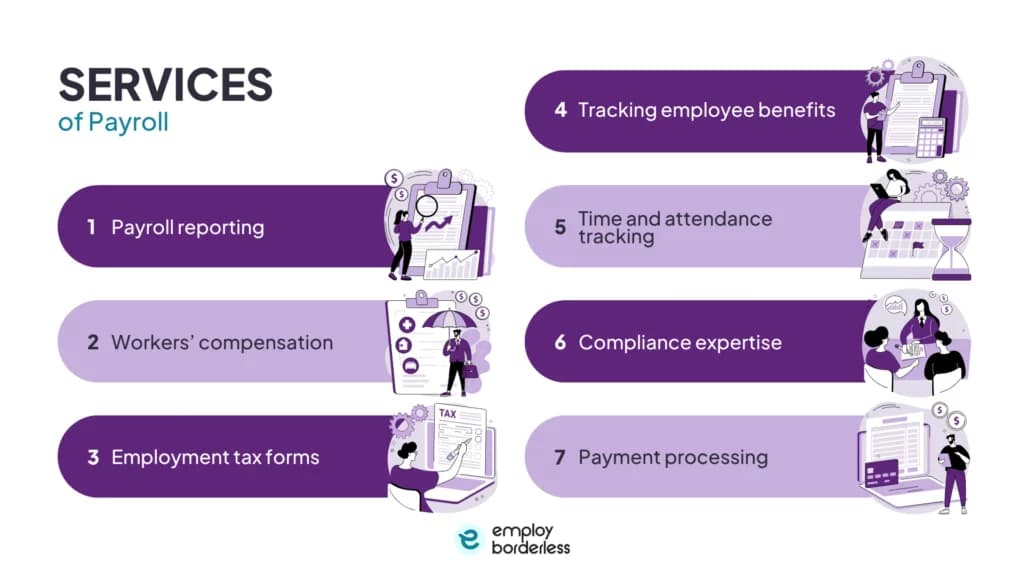
- Payroll reporting: summarizes wages, deductions, and employer liabilities for cost tracking, internal audits, and compliance checks.
- Workers' compensation: covers medical bills, rehabilitation costs, and a portion of lost wages for employees injured on the job; premiums are calculated from wages and risk category.
- Employment tax forms: year-end preparation of Form W-2 for employees and Form 1099-NEC for contractors to report income and tax data to government agencies.
- Tracking employee benefits: monitors health insurance, retirement, and other contributions so payroll deductions match each employee's elections.
- Time and attendance tracking: logs hours worked, overtime, and leave balances - statutory annual leave has a median of 20 days per our Global Employer Burden Index dataset (115 countries), rising to 30 days in the United Arab Emirates - to calculate accurate pay each period.
- Compliance expertise: tracks wage and tax law changes, filing deadlines, and labor regulations to cut penalty risk.
- Payment processing: distributes pay through direct deposit, checks, or payroll cards, cutting manual work.
Core bookkeeping services
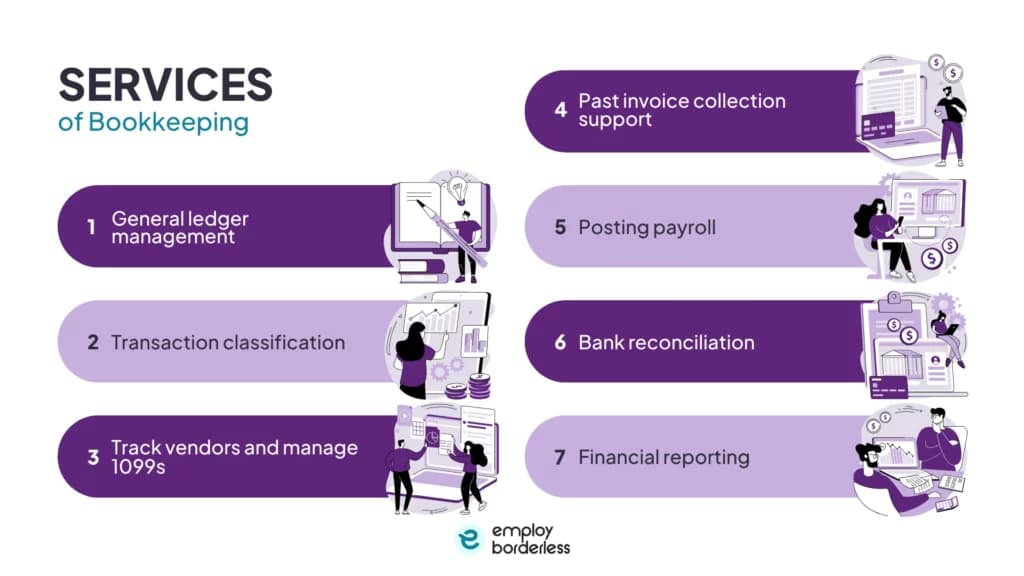
- General ledger management: posts every transaction to a central record of assets, liabilities, equity, revenue, and expenses.
- Transaction classification: sorts activity into income, expense, asset, or liability so reports and tax filings match the nature of each transaction.
- Vendor tracking and 1099 management: tracks vendor payments and prepares 1099-NEC forms for contractor reporting.
- Overdue invoice collection support: monitors accounts receivable and follows up on unpaid invoices to protect cash flow.
- Posting payroll: records payroll entries into the financial system so salary expense matches company accounts and profit-and-loss statements.
- Bank reconciliation: compares business records against bank statements to catch errors, missing entries, or fraud.
- Financial reporting: prepares trial balances, income statements, and balance sheets for management and tax filings.
Payroll vs bookkeeping: key differences
The two functions differ in focus, compliance rules, core tasks, output, software, timing, and transaction type.
| Feature | Payroll | Bookkeeping |
|---|---|---|
| Purpose and focus | Manages employee compensation and benefits. | Manages overall financial records of the business. |
| Compliance | Compliance with labor laws and tax withholding rules. | Compliance with accounting standards and tax reporting. |
| Core tasks | Calculates wages, deducts taxes, issues payments, and files payroll taxes. | Records transactions, reconciles accounts, and prepares financial reports. |
| Effect on records | Updates employee-level records and generates payroll summaries. | Updates the ledger and generates accurate and reliable financial statements. |
| Reports | Pay slips, tax forms, and employee benefit records. | Ledgers, balance sheets, income statements, and cash flow reports. |
| Interaction | Interacts with HR and compliance teams. | Interacts with accountants, auditors, and management. |
| Software | Uses payroll-specific tools like ADP, Gusto, or QuickBooks Payroll. | Uses accounting software like QuickBooks, Xero, or FreshBooks. |
| Timing | Occurs periodically (weekly, biweekly, or monthly pay cycles). | Occurs continuously as transactions happen. |
| Transaction type | Salary, tax, and benefits transactions. | Sales, purchases, expenses, and vendor payments. |
| Policy development | Company HR policies and government labor laws. | Based on accounting principles and financial regulations. |
Timing is the clearest operational split: payroll runs on fixed cycles, such as weekly, biweekly, or monthly, according to the pay periods decided by the employer. while bookkeeping records transactions continuously as they happen. Payroll policy follows HR rules and labor law; bookkeeping policy follows accounting standards and internal financial controls.
Payroll vs bookkeeping: similarities
Payroll and bookkeeping both manage sensitive financial data, maintain records for audits and tax filings, support legal compliance, and rely on specialized software. Both functions also produce documentation that stands up to internal and external audits.
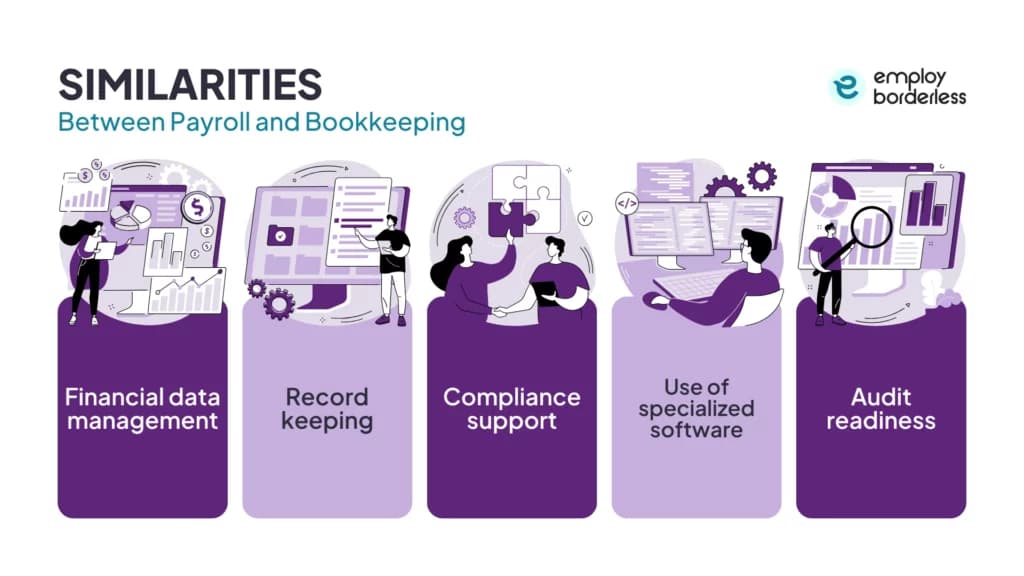
- Financial data management: both handle sensitive financial information: payroll covers earnings, deductions, and benefits, while bookkeeping covers sales, expenses, and overall accounts.
- Record keeping: both maintain records (compensation histories, transaction histories) needed for audits, tax filings, and financial review.
- Compliance support: payroll supports wage-law and tax-withholding compliance; bookkeeping supports accounting-standard and reporting compliance. Inaccuracies in either can trigger penalties or legal issues.
- Specialized software: payroll software automates wage calculation, deductions, and reporting, while bookkeeping software handles categorization, reconciliation, and reporting. Integrating the two produces more reliable financial reports.
- Audit readiness: both create verifiable records for internal and external audits: payroll supplies wage, deduction, and tax-filing documentation, and bookkeeping supplies ledgers and financial statements.
Who uses payroll and bookkeeping
Payroll is used by HR teams, accounting and finance staff, PEOs, business owners, employees, and government agencies. Bookkeeping is used by business owners, accounting teams, external bookkeepers, investors, tax authorities, auditors, and vendors, each relying on the records for compliance, planning, or funding decisions.
Payroll use cases
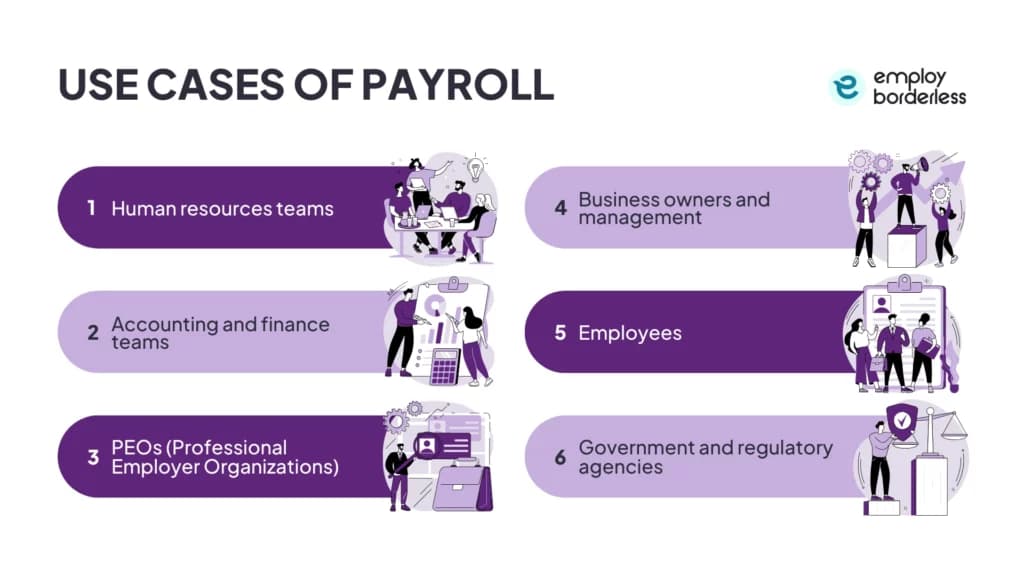
- Human resources teams use payroll to organize compensation packages, manage benefits like statutory maternity and paternity leave, and stay compliant with labor law, which reduces wage and benefit disputes. Statutory maternity leave has a median of 14 weeks per our Global Employer Burden Index dataset (190 countries), ranging up to 174.4 weeks in Belarus, while paternity leave typically runs far shorter, with a median of just 0.4 weeks per our Global Employer Burden Index dataset (190 countries) and a high of 56.1 weeks in Japan.
- Accounting and finance teams use payroll data for budgeting, expense tracking, and tax filings, since payroll entries post to the general ledger alongside other company accounts.
- PEOs (Professional Employer Organizations) run payroll, tax filings, and benefits for client companies, giving small and medium-sized businesses enterprise-level accuracy and compliance expertise without an in-house HR team.
- Business owners and management use payroll data to measure labor cost, plan staffing, and judge profitability.
- Employees depend on payroll for timely, accurate pay along with clear pay stubs, tax forms, and benefit records.
- Government and regulatory agencies track payroll submissions covering income tax, social security, and other contributions to confirm compliance.
Bookkeeping use cases
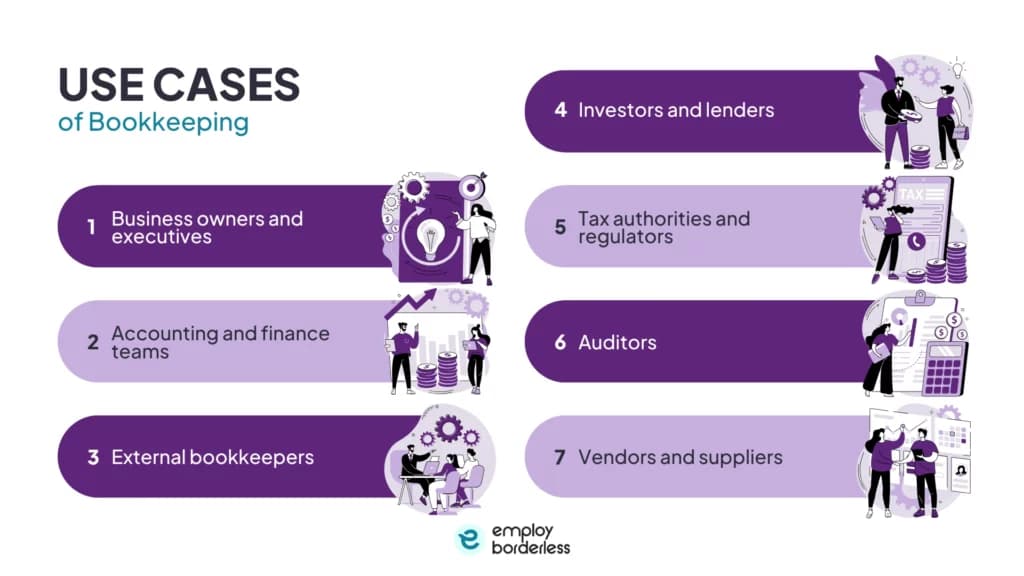
- Business owners and executives use bookkeeping to track cash flow, profit margins, and overall financial health before deciding on investment, expansion, or cost cuts.
- Accounting and finance teams use bookkeeping records to prepare financial statements, file taxes, run audits, and build budgets and forecasts.
- External bookkeepers and bookkeeping firms provide outsourced recordkeeping and financial expertise.
- Investors and lenders review balance sheets and income statements to judge financial stability before funding a business.
- Tax authorities and regulators rely on bookkeeping records to calculate and verify taxes owed.
- Auditors trace entries to check for irregularities and confirm financial statements are accurate, which shortens the audit process.
- Vendors and suppliers benefit from accurate bookkeeping through on-time accounts-payable payments, which strengthens relationships and credit terms.
Benefits of payroll and bookkeeping
Payroll benefits include better time management, accurate records, data security, employee satisfaction, reduced costs, regulatory compliance, and management transparency. Bookkeeping benefits include simplified tax preparation, audit readiness, cash flow monitoring, clear financial statements, fraud detection, better planning, and investor confidence.
Payroll benefits
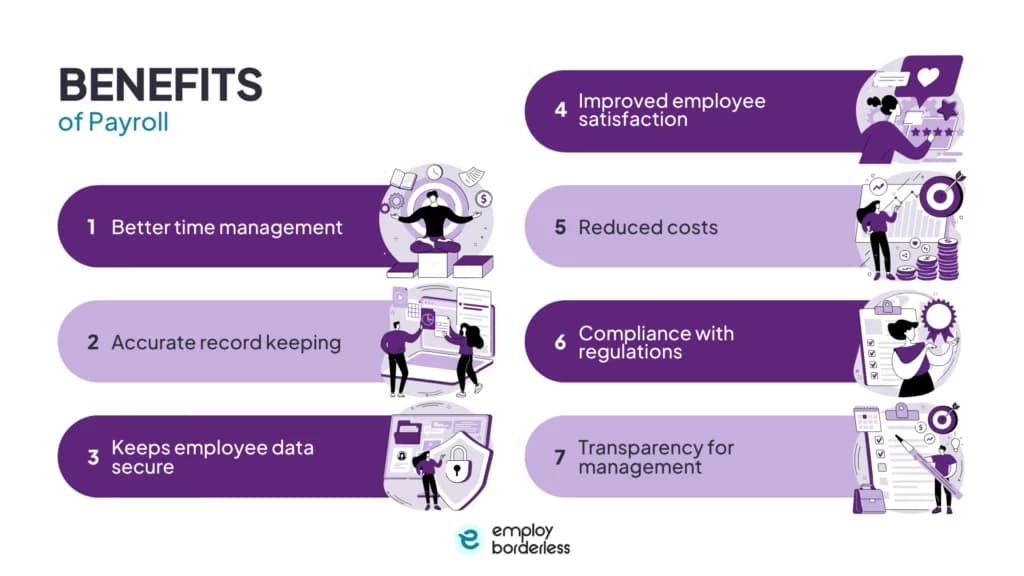
- Better time management: automation cuts hours spent on manual salary calculations and tax paperwork, freeing HR and finance staff for planning and compliance work.
- Accurate record keeping: structured records of earnings, deductions, tax withholdings, and benefits create an audit trail and simplify tax preparation.
- Data security: encryption, access controls, and secure storage protect salary details, ID numbers, and bank accounts from fraud and identity theft.
- Employee satisfaction: timely, accurate pay and transparent pay stubs build trust, improve morale, and support retention.
- Reduced costs: automation and outsourcing lower administrative expense and cut compliance mistakes, which prevents penalties.
- Regulatory compliance: payroll systems track wage laws, tax codes, and filing deadlines across jurisdictions and update deductions automatically.
- Management transparency: payroll reports break down labor cost, overtime, and benefits usage for budget planning and workforce decisions.
Bookkeeping benefits
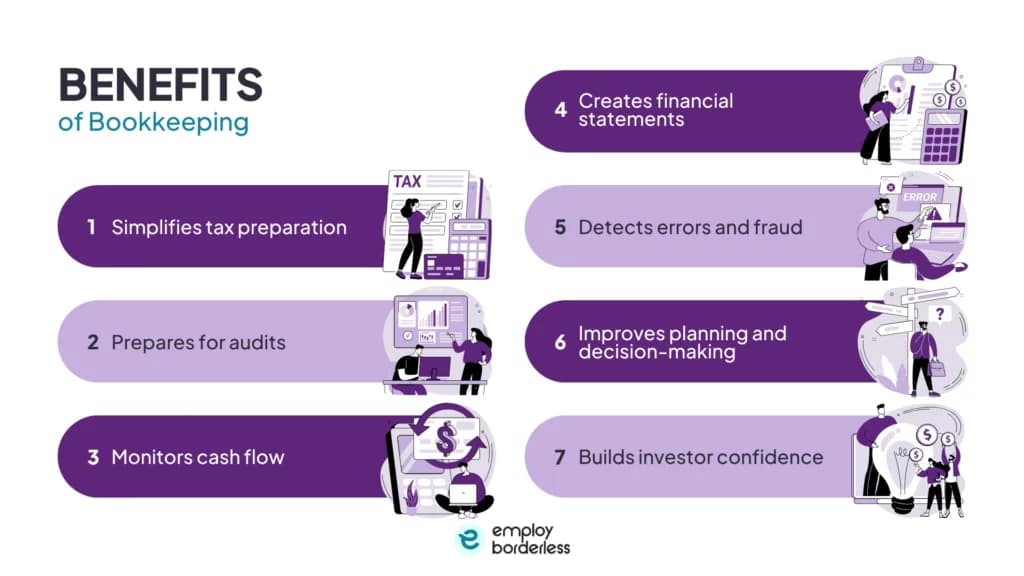
- Simplifies tax preparation: organized income and expense records speed up filing, cut errors, and help claim eligible deductions.
- Audit preparation: chronological, source-linked records shorten the audit process and reduce penalty risk.
- Cash flow monitoring: tracking money in and out gives real-time visibility that prevents shortfalls and supports spending decisions.
- Financial statements: balance sheets, income statements, and cash flow statements give owners performance insight and support loan or investment applications.
- Error and fraud detection: regular reconciliation catches unusual transactions early, before small mistakes become major losses.
- Better planning: revenue and expense trends inform budgets, pricing, and growth forecasts.
- Investor confidence: clean, consistent records reassure lenders and investors and speed up credit evaluation.
Drawbacks of payroll and bookkeeping
Payroll drawbacks include time-consuming tasks, complex management, high costs, error risk, legal compliance issues, security concerns, and limited growth capacity in manual systems. Bookkeeping drawbacks include time-consuming record keeping, liability issues, client dependency, increased work demands, technological disruption, service costs, and fraud risk.
Payroll drawbacks
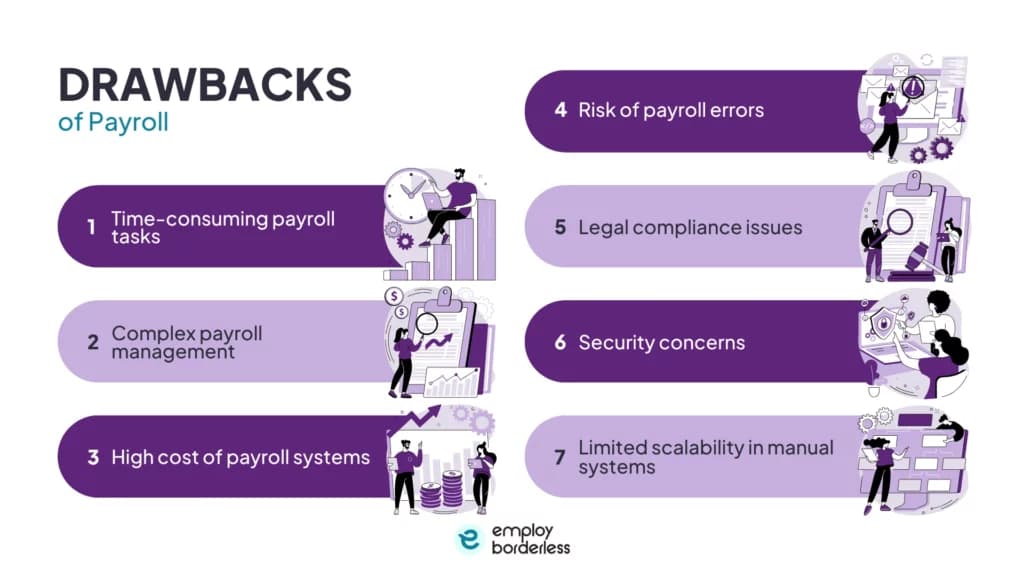
- Time-consuming tasks: gathering employee data, reviewing hours, and handling overtime or bonus exceptions burden small businesses without dedicated staff.
- Complex management: tax, benefit, and wage rules vary by state or country - employer social security contributions alone range from a median of 12.6% per our Global Employer Burden Index dataset (196 countries) to as high as 36.49% in New Caledonia - raising the risk of mistakes if the system is not kept current.
- High cost: payroll software, compliance tools, or specialist staff are expensive for smaller firms compared with manual methods.
- Risk of errors: incorrect withholdings, miscalculated overtime, or missed deductions cause employee dissatisfaction and compliance issues, and cost extra time and money to fix.
- Legal compliance issues: frequent labor and tax law changes require constant system updates; failure to comply risks audits, fines, or lawsuits.
- Security concerns: stored salary and social security data exposes businesses to cyber risk and identity theft if protection is weak.
- Limited growth capacity in manual systems: manual payroll slows down and grows error-prone as a business expands, delaying payments and disrupting operations.
Bookkeeping drawbacks
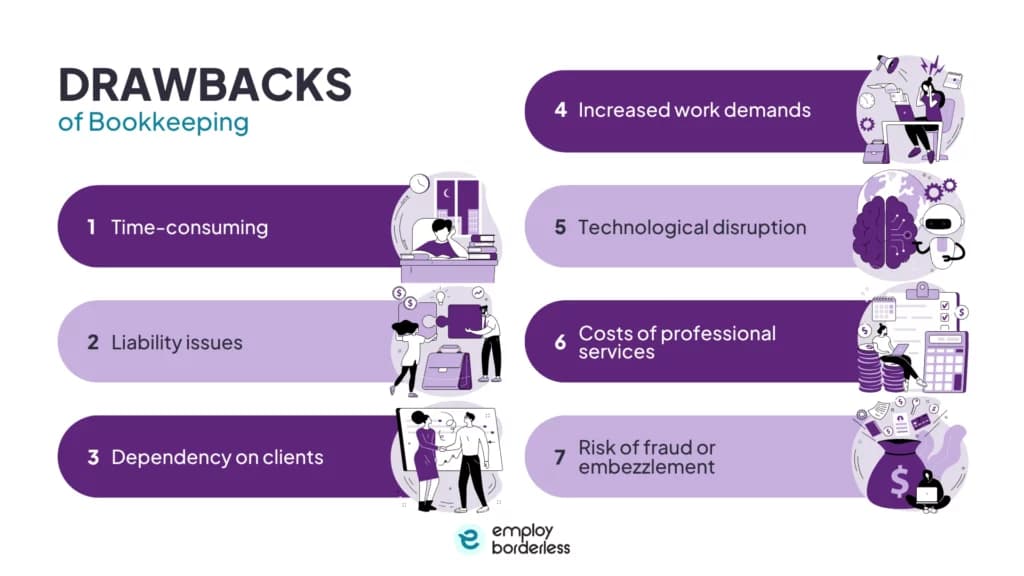
- Time-consuming: recording every transaction, reconciling accounts, and preparing reports takes time away from core operations, especially for owners who manage their own books.
- Liability issues: mistakes produce incorrect statements or tax filings, creating penalty, audit, and lender-relationship risk.
- Dependency on clients: in outsourced bookkeeping, accuracy depends on how quickly clients supply invoices, receipts, and bank statements.
- Increased work demands: a growing transaction volume without a proper system overburdens staff and causes missed entries and delayed reconciliations.
- Technological disruption: outdated systems disrupt bookkeeping processes, and switching to modern platforms costs money and time to learn.
- Cost of professional services: qualified bookkeepers or accountants are expensive for small firms, and software adds subscription costs plus oversight needs.
- Risk of fraud or embezzlement: weak internal control lets unauthorized changes or fraudulent entries go unnoticed, raising the risk of financial loss.
When to outsource payroll and bookkeeping
A business should consider outsourcing payroll and bookkeeping when it lacks internal expertise, faces compliance risk, needs to cut costs, is growing rapidly, struggles with delayed financial closing, or wants to refocus on core operations.
Check the workload at tax season or financial closing, when accurate filings leave no room for error; outsourcing brings faster reporting and real-time dashboards. Weigh whether the current team can keep pace with changing tax codes, labor laws, or reporting standards, since manual errors carry costly penalties and can strain employee relationships.
Business size matters too: an in-house payroll or bookkeeping team carries salary, benefit, software, and training costs. Outsourcing becomes a strategic move when a company expands into new regions or adds complex benefit structures that need specialist knowledge, freeing owners to spend time on growth, planning, and customer relationships instead of administrative tasks.
Frequently asked questions
Which is better, payroll or bookkeeping?
Neither is "better": each serves a different purpose, and a business needs both to operate effectively. Payroll manages employee compensation and compliance with labor laws, while bookkeeping manages overall financial records and reporting.
What are the types of payroll systems?
The types of payroll systems are manual payroll systems, payroll software systems, online payroll services, payroll card systems, and outsourced payroll systems.
Does a bookkeeper pay invoices?
Yes, as part of managing accounts payable. Bookkeepers record supplier bills, schedule payments, and confirm vendors are paid on time, which keeps expenses organized, maintains vendor relationships, and prevents late fees.
Is payroll more HR or accounting?
Payroll involves functions of both. HR supplies employee data and manages benefits and labor-law compliance; accounting records payroll expense, files tax reports, and feeds payroll data into the company's financial system. The split depends on the company's size, structure, and work culture.
Does a small business need bookkeeping?
Yes, for recording sales, expenses, and cash flow, which keeps financial documents clear and helps file taxes correctly. Without it, a business risks inaccurate records, compliance issues, and poor decision-making; proper bookkeeping also makes it easier to apply for loans, attract investors, and plan for sustainable growth.
Is outsourcing payroll more cost-effective?
Yes, for many businesses. Outsourcing payroll reduces the need to hire specialized staff, lowers software and training expenses, and removes the risk of compliance penalties, offering expertise and automation that save time and money, especially for small and medium-sized businesses with limited resources or complex payroll requirements.

Co-founder, Employ Borderless
Robbin Schuchmann is the co-founder of Employ Borderless, an independent advisory platform for global employment. With years of experience analyzing EOR, PEO, and global payroll providers, he helps companies make informed decisions about international hiring.
Learning path · 10 articles
Payroll fundamentals
Master the fundamentals with our step-by-step guide.
Start the pathReady to hire globally?
Get a free, personalized recommendation for the best EOR provider based on your needs.
Get free recommendations