Payroll onboarding: steps, legal rules & mistakes to avoid

Robbin Schuchmann
Co-founder, Employ Borderless
Payroll onboarding is the process by which employers set up new hires in their payroll system. Employers collect, verify, and enter all necessary employee information, tax forms, benefit elections, and deductions to make sure new hires are paid correctly and on time. This process is important because it establishes compliance with tax and labor laws, reduces errors, and prevents legal disputes. It also allows for a smooth and transparent transition into the company's compensation and benefits systems.
The important steps of the payroll onboarding process involve collecting employee information, verifying tax and employment documents, setting up the payment method and payroll schedule, and configuring benefits and payroll deductions. Other steps of the process include entering and validating employee payroll data, running a pre-payroll audit, and reviewing and confirming the first paycheck.
The legal requirements that apply to payroll onboarding are correct employee classification, taxes and deductions, anti-discrimination laws, wage and hour laws, record-keeping requirements, local regulations, and employee benefits compliance. Some payroll onboarding mistakes to avoid include inaccurate employee data, misclassifying the worker, failing to use technology, noncompliance with state and federal payroll laws, and poor data entry and recordkeeping practices.
What is payroll onboarding?
Payroll onboarding is the process by which companies set up new hires in their payroll systems so they receive accurate and timely payment. It makes sure that employers collect, verify, and enter all necessary payroll-related information in compliance with tax or employment laws, such as FLSA (Fair Labor Standards Act) and FICA (Federal Insurance Contributions Act).
Why is payroll onboarding important?
Payroll onboarding is important because it makes sure that new employees are correctly set up in the company's payroll system. A clear and simple payroll onboarding process reduces confusion for new hires and helps them understand payment procedures from the start. An organized onboarding process also creates a positive first impression of the company by showing its commitment to accuracy, compliance, and employee support. This impression contributes to a smooth transition into the role and promotes confidence and satisfaction among employees.
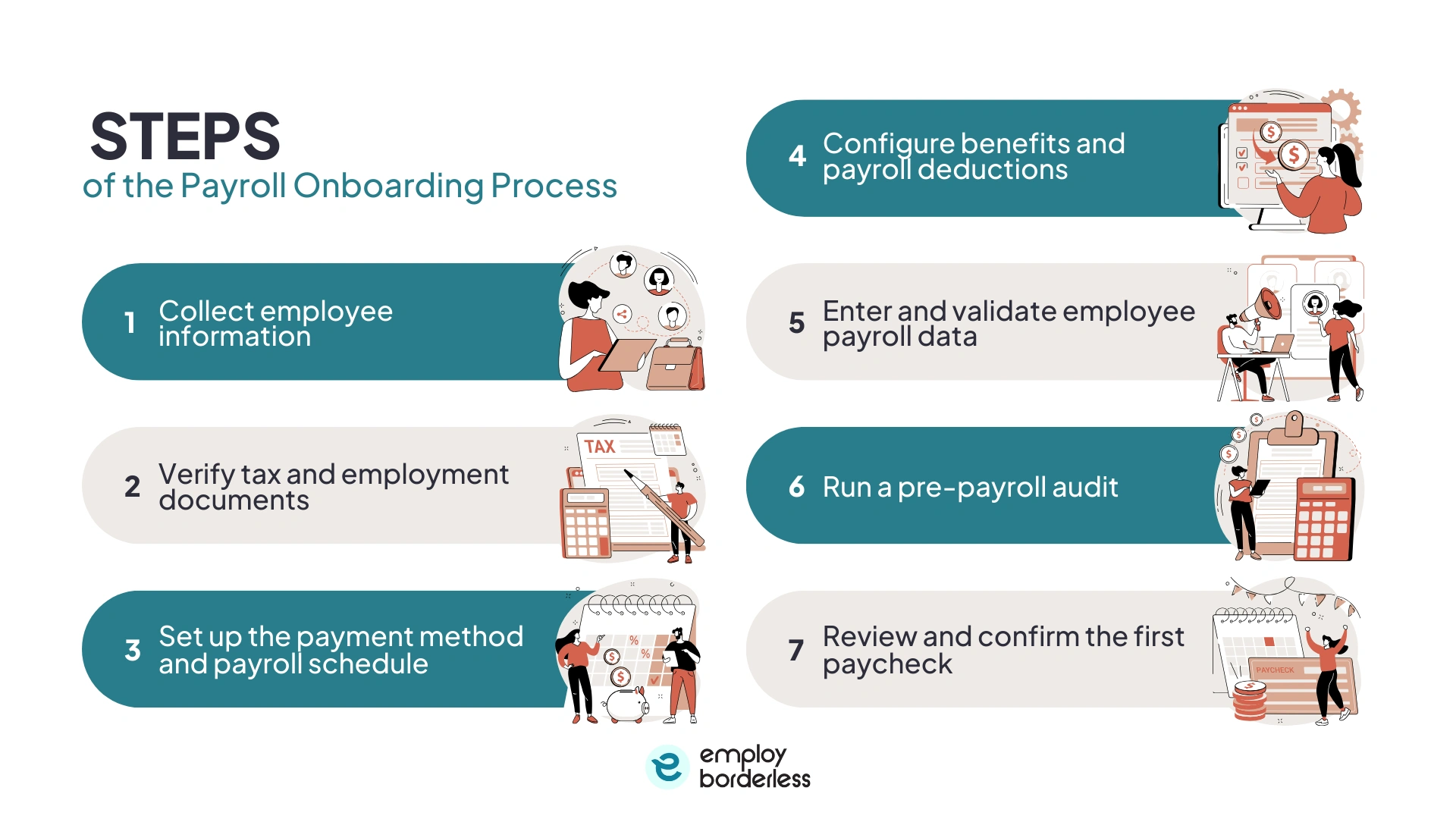
What are the steps of the payroll onboarding process?
The steps of the payroll onboarding process are collecting employee information, verifying tax and employment documents, setting up the payment method and payroll schedule, and configuring benefits and payroll deductions. Other steps of the payroll onboarding process include entering and validating employee payroll data, running a pre-payroll audit, and reviewing and confirming the first paycheck.
Collect employee information
Collect accurate employee information, which includes the employee's full legal name, date of birth, tax identification number, such as SSN (Social Security Number) or local equivalent, current address, and contact details. Employers must verify that new hires complete the required tax and withholding forms so that the correct tax withholdings are applied.
Gather banking information for direct deposit setup and verify the completeness and accuracy of all submitted data, which helps prevent errors in payroll calculations and government reporting. Even small errors lead to compliance and payment issues when the first payroll is run, so verify these details carefully.
Verify tax and employment documents
Payroll onboarding focuses on the accurate completion of tax and employment forms, which is essential to legal compliance and correct payroll withholding. This process involves mandatory forms, such as Form I-9, which verifies that the employee is legally authorized to work, Form W-4, which determines federal income tax withholding, and any required state or local tax forms. Employees complete Section 1 of the I-9 upon hire, while employers review original, unexpired identity and work authorization documents within three days to complete Section 2.
Employees must fill out the W-4 form, which is now based on dollar amounts instead of exemptions, and use the IRS online calculator for accuracy. Employers must also collect any applicable state or local tax forms to meet full compliance requirements. Gather and verify all forms for accuracy, and securely store them according to recordkeeping regulations.
Set up the payment method and payroll schedule
Set up direct deposit and establish the pay schedule once employee banking information is collected. Employers have to ask new hires for their bank account and routing numbers, account type, such as checking or savings, and a signed authorization for direct deposit so wages are transferred electronically to the employee's account. Direct deposit is usually fast, secure, and preferred by many workers compared with paper checks, and it must be connected to the company's payroll system before the first pay run.
Decide on the pay schedule, for example, weekly, biweekly, semimonthly, or monthly, and communicate the first payday and regular pay dates to employees. Confirming these details in advance helps guarantee timely and accurate payment each pay period and matches payroll processes with both company policy and employee expectations.
Configure benefits and payroll deductions
Employers must collect and verify all required enrollment forms for employees wanting to enroll in health insurance, retirement plans, or other voluntary benefits. They have to make sure that the correct deductions are applied in the payroll system. Employee benefits include medical, dental, and vision insurance premiums, retirement contributions such as 401(k) plans, and any applicable wage garnishments.
Payroll deductions also handle mandatory items, which involve federal and state taxes, insurance premiums, and other legally required withholdings. Communicating clearly with employees about when coverage begins, the purpose of each deduction, and the amounts withheld helps prevent confusion and keeps the process compliant. Review all deductions carefully before processing payroll to guarantee that the correct amounts are withheld from each paycheck.
Enter and validate employee payroll data
Enter employee data, which includes tax forms, pay schedule details, benefits selections, and deduction instructions, into the company's payroll system and verify its accuracy before processing any pay runs. Validate that the information matches the original documents and complies with company policy and legal requirements.
Data entry confirms that only current employees are included and former or incorrect records are excluded. Careful validation helps prevent payroll errors, underpayments, overpayments, and compliance issues. Integrate HR and payroll systems to reduce manual entry errors and maintain consistent, up-to-date records.
Run a pre-payroll audit
Conduct a pre-payroll audit to verify that all employee data and payroll settings are entered correctly before processing the first payroll that includes a new hire. This step involves running a report from your payroll system and comparing the entered information, such as tax withholdings, benefit deductions, pay rate, and direct deposit details, against the original documents and signed forms.
Identifying discrepancies by reviewing these elements before any payments are made reduces the risk of incorrect withholdings or deduction errors. A thorough audit at this stage is an important quality check, as it prevents costly corrections, compliance penalties, and dissatisfaction for the employee.
Key takeaway: Running a pre-payroll audit before the first pay run is the single most effective step for catching data errors, incorrect withholdings, and classification issues before they become recurring problems.
Review and confirm the first paycheck
Schedule a brief check-in to review the pay stub together after the new employee receives their first paycheck. Encourage the employee to verify that their hours, pay rate, and deductions are accurate and to ask any questions. Actively responding to concerns helps promote understanding of the payroll process, increases transparency, and builds trust between the employee and the company. This step also allows employers to quickly identify and correct any errors before they become recurring issues.
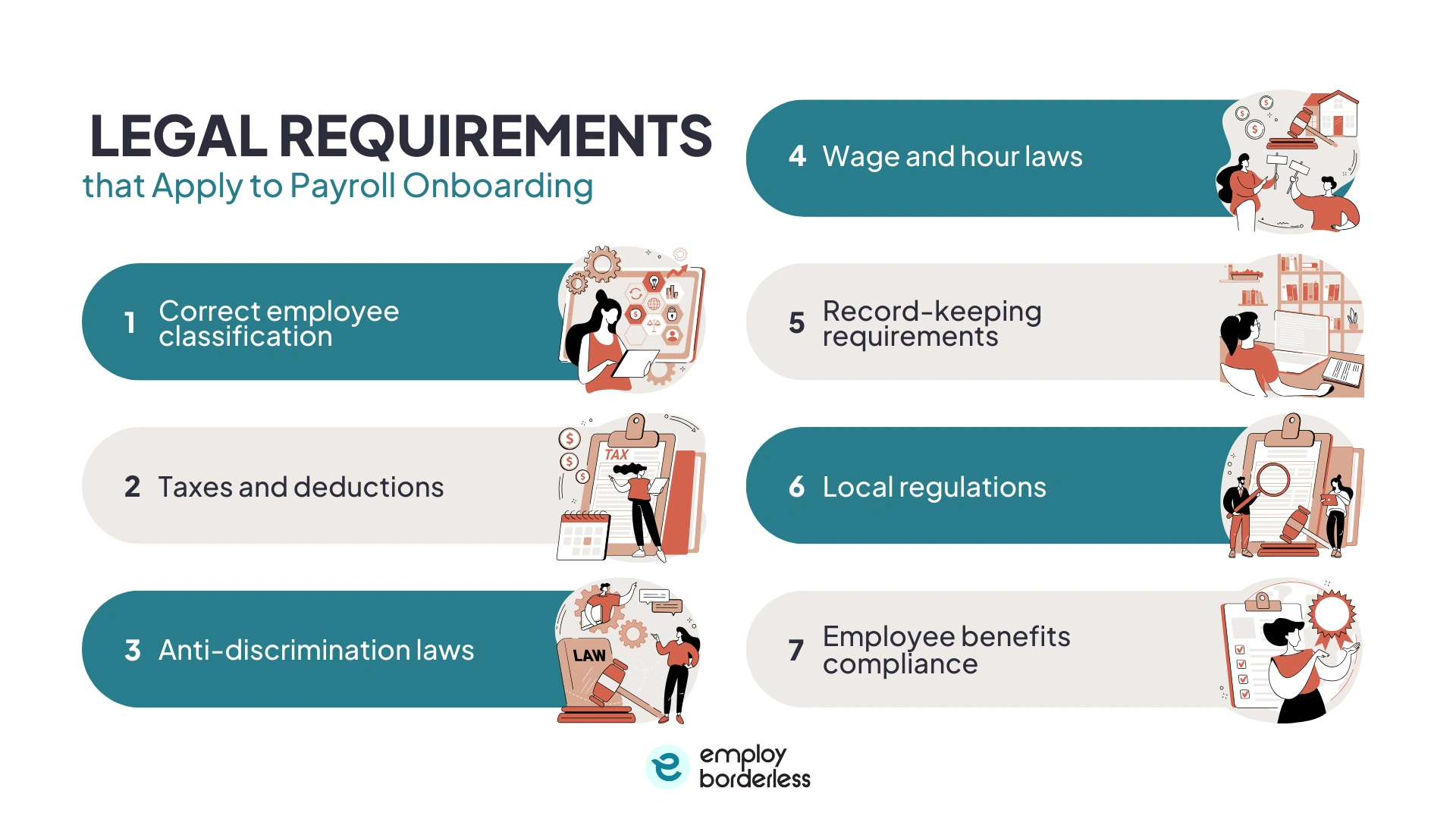
What legal requirements apply to payroll onboarding?
The legal requirements that apply to payroll onboarding are correct employee classification, taxes and deductions, anti-discrimination laws, wage and hour laws, record-keeping requirements, local regulations, and employee benefits compliance.
The legal requirements that apply to payroll onboarding are listed below.
Correct employee classification: Companies must legally classify employees under wage and hour laws to determine the payment method and overtime eligibility. For example, nonexempt employees receive minimum wage and overtime for hours over 40 per week, whether hourly or salaried. Exempt employees earn a fixed salary and usually do not receive overtime if they meet legal salary and job requirements. Correct classification requires the right pay procedures and compliance with federal and state labor standards.
Taxes and deductions: Employers are legally required to withhold federal income tax and payroll taxes such as Social Security and Medicare from employee wages and to deposit those amounts with the relevant tax authorities. They must also pay the employer's share of Social Security and Medicare taxes and file accurate tax reports and returns, such as Forms 941 and W-2, with the IRS and other relevant agencies. Employers have to make sure that they remit payroll taxes correctly and on time in compliance with tax laws, like FUTA (Federal Unemployment Tax Act).
Anti-discrimination laws: Compliance with anti-discrimination laws requires that payroll practices treat all employees fairly and equally, without basing pay decisions on characteristics such as gender, race, age, disability, national origin, or other protected traits. Employers have to make sure that compensation and payroll processes follow laws like Title VII of the Civil Rights Act, the Age Discrimination in Employment Act, and the Americans with Disabilities Act.
Wage and hour laws: Wage and hour laws require employers to pay all employees at least the applicable minimum wage for every hour worked and to provide overtime pay for eligible employees. Overtime pay is calculated at one and one-half times the regular rate for hours over 40 in a workweek. Employers must also compensate employees for all time worked, which includes training, meetings, and travel, and comply with any higher state or local wage requirements. These laws guarantee fair pay, prevent underpayment, and protect workers' rights to proper compensation for their time.
Record-keeping requirements: Employers must maintain accurate, up-to-date payroll records to comply with wage, hour, and tax laws and support audits or inspections. Records include employee details, hours worked, pay rates, total wages, tax withholdings, benefits, and any deductions. Federal rules require retention of payroll data for three years and tax records for at least four years. Proper recordkeeping ensures correct pay, legal compliance, documentation for disputes, and secure storage of sensitive information.
Local regulations: Employers must follow all applicable state, regional, and local payroll laws along with federal regulations. Local rules sometimes set higher minimum wages, different overtime, tax obligations, paid leave, or pay frequency requirements. Companies with employees in multiple locations must monitor and comply with each jurisdiction to avoid penalties and provide accurate, fair, and up-to-date payroll.
Employee benefits compliance: Businesses that offer employee benefits such as health insurance or retirement plans have to correctly deduct any employee-paid portions from payroll. They must follow all federal, state, and local rules for plan compliance, documentation, and employee communication to provide accurate, legal, and transparent payroll processing for benefits.
| Legal Requirement | What It Covers | Key Forms or Laws |
|---|---|---|
| Correct employee classification | Exempt vs. nonexempt status, overtime eligibility | FLSA |
| Taxes and deductions | Federal income tax, Social Security, Medicare withholding | Forms 941, W-2, FUTA |
| Anti-discrimination laws | Equal pay practices, protected characteristics | Title VII, ADEA, ADA |
| Wage and hour laws | Minimum wage, overtime at 1.5x for hours over 40 | FLSA |
| Record-keeping requirements | Payroll data retention (3 years), tax records (4 years) | IRS, DOL requirements |
| Local regulations | State and local wage, leave, and tax rules | Varies by jurisdiction |
| Employee benefits compliance | Correct deductions, plan documentation, employee communication | Federal, state, and local benefit laws |
Key takeaway: Misclassifying an employee as exempt or as an independent contractor is one of the most common legal mistakes in payroll onboarding - it triggers back pay claims, tax penalties, and compliance audits.
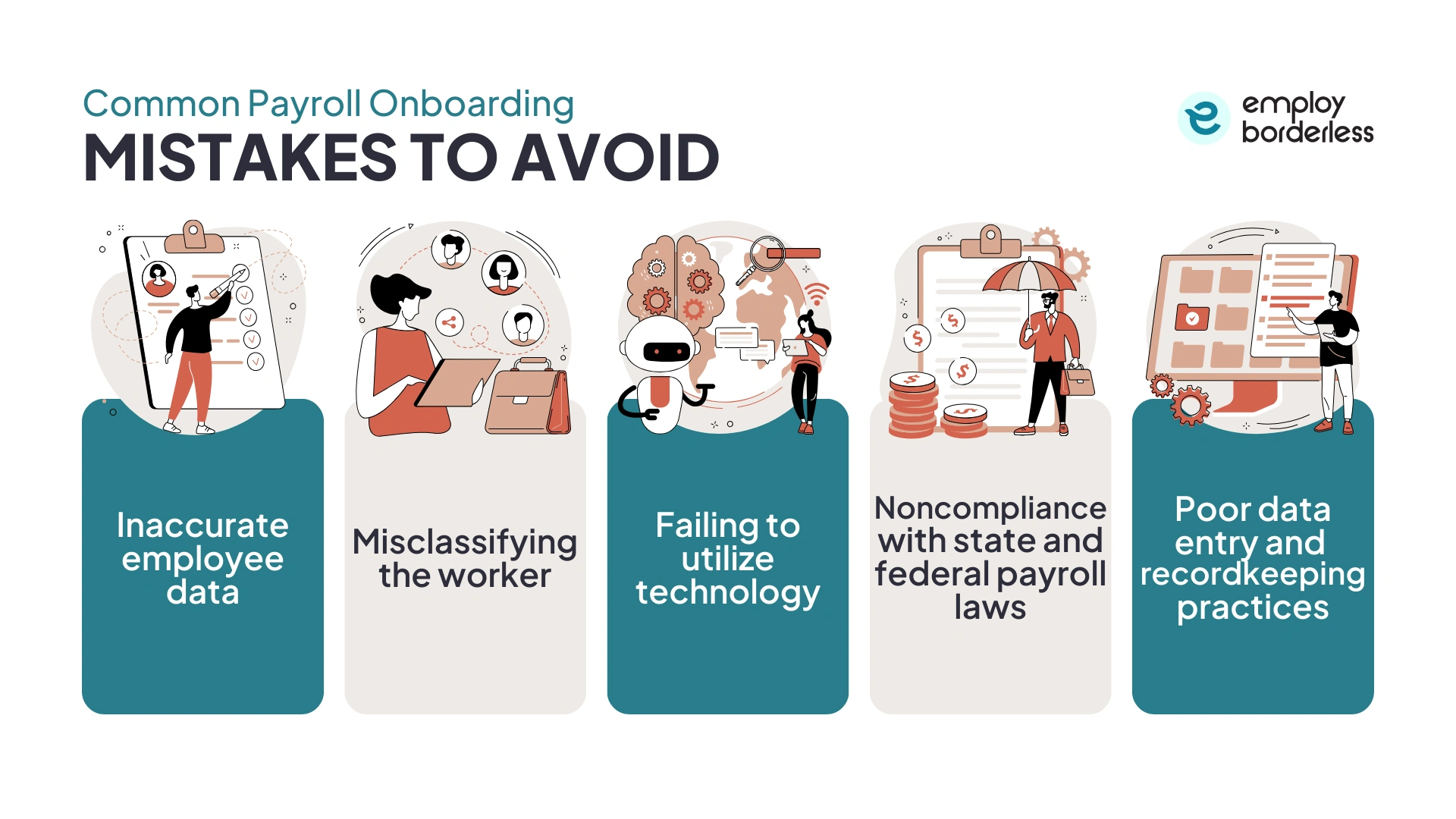
What are the common payroll onboarding mistakes to avoid?
The common payroll onboarding mistakes to avoid are inaccurate employee data, misclassifying the worker, failing to use technology, noncompliance with state and federal payroll laws, and poor data entry and record keeping practices.
The common payroll onboarding mistakes to avoid are discussed below.
Inaccurate employee data: Missing or incorrect details, such as Social Security or tax identification numbers, bank account information, addresses, or tax forms, delay payroll processing and result in incorrect payments and compliance issues or fines. These errors mostly occur when onboarding paperwork is not checked thoroughly before data entry. Verifying all important data before the first payroll run helps prevent costly payroll mistakes and supports accurate tax reporting and employee payments.
Misclassifying the worker: Misclassifying workers, such as listing an employee as an independent contractor or mislabeling exempt versus nonexempt status, leads to unpaid taxes, missed overtime and benefits, and legal or financial penalties. Payroll obligations differ based on classification, so incorrect categorization exposes the employer to back pay claims, fines, and compliance audits.
Failing to use technology: Relying too much on manual methods, such as paper forms or spreadsheets, rather than using modern payroll and onboarding software, increases the risk of data entry mistakes, slows down processing, and creates more work for HR teams. Using technology, like integrated payroll systems and automation tools, helps simplify data collection, reduce administrative burden, and increase accuracy in calculations and tax withholdings. Modern payroll systems improve the overall onboarding experience for both employers and new hires.
Noncompliance with state and federal payroll laws: Failing to follow applicable federal and state payroll regulations during onboarding leads to legal issues for employers. This lack of compliance includes not keeping up with statutory requirements such as correctly withholding and reporting taxes, applying minimum wage and overtime rules, and following all relevant labor laws. Ignoring changes in payroll regulations results in penalties, audits, and legal liabilities, which makes it necessary for businesses to stay informed and apply compliant processes from the start of payroll onboarding.
Poor data entry and recordkeeping practices: Errors in manually entering employee information, such as names, identification numbers, pay rates, hours worked, or tax details, lead to incorrect wages, tax withholdings, and deductions and cause disputes, penalties, or rework. Disorganized recordkeeping makes it difficult to track changes, resolve discrepancies, or comply with audits, which increases the risk of compliance issues and employee dissatisfaction. Employers need to reduce these problems by using reliable payroll systems, automating data capture where possible, and regularly verifying records against original documents.
How to simplify the payroll onboarding process?
To simplify the payroll onboarding process, create a payroll onboarding checklist, integrate payroll and HR systems, implement payroll policies, and use payroll software.
A structured checklist outlines all important tasks, from collecting employee information and tax forms to verifying deductions and approvals. It also makes sure no necessary steps during onboarding are missed. Using a checklist brings consistency, reduces errors, and helps train payroll staff on required steps.
Connecting the payroll system with HR and related tools makes employee data flow automatically between platforms, which removes duplicate entry and reduces mistakes. Integration shares information such as pay rates, tax status, benefits, and updates like address or job changes across systems, while improving payroll accuracy.
Clear, documented payroll policies define how the organization handles pay schedules, overtime, deductions, benefits, and compliance rules. Well-communicated policies make sure all payroll staff follow consistent processes, support compliance with laws and internal standards, and help resolve questions or disputes more quickly.
Modern payroll software automates repetitive tasks, which include wage calculations, tax withholdings, deductions, and compliance updates. It reduces manual work, prevents errors, keeps payroll data current with changing regulations, and often integrates with time, HR, and accounting systems to support smoother payroll processing.
Key takeaway: Integrating your HR and payroll systems eliminates duplicate data entry - the most common source of errors during the payroll onboarding process.
How long does the payroll onboarding process take?
The payroll onboarding process takes only a few days to complete the administrative setup, especially when done with digital tools. This work ideally finishes by the first day or within the first few days of employment. The broader onboarding payroll process that offers full integration into the company usually continues for a few weeks or up to about 90 days.
What important forms are required for payroll onboarding?
The important forms required for payroll onboarding are Form I-9 (employment eligibility verification), Form W-4 (federal income tax withholding), and any state or local tax withholding forms. Employers sometimes also need direct deposit authorization and benefit enrollment forms for health insurance or retirement plans. Collecting and verifying these forms guarantees accurate pay, compliance, and proper payroll reporting.
What happens if an employee submits incomplete payroll forms?
If an employee submits incomplete payroll forms, like a W-4 form, the IRS requires the employer to withhold federal income tax using the default settings, treating the employee as single with no adjustments. Employers must continue using these default withholding rules until a completed, valid W-4 form is received, while also making reasonable efforts to receive the correct form from the employee.
How do employees submit tax and banking details during payroll onboarding?
Employees submit tax and banking details during payroll onboarding through secure digital platforms, HR or payroll portals, or physical forms. Tax forms like the W-4 and state withholding forms are completed and signed, while banking details for direct deposit are provided through secure submission methods.
Should independent contractors go through payroll onboarding?
No, independent contractors should not go through standard payroll onboarding because they are not employees and are responsible for their own taxes. Contractors complete a Form W-9 to provide tax information, and payments are processed as non-employee compensation. Proper documentation ensures compliance with tax reporting requirements, which include the accurate issuance of Form 1099 at year-end.
How does payroll onboarding differ for contractors and employees?
Payroll onboarding differs for contractors and employees in terms of payroll tax withholding, benefits, and documentation. Employees complete W-4 forms, enroll in benefits, and have payroll taxes withheld automatically. Contractors provide a W-9, receive payments as non-employees, and are responsible for their own taxes, with no employer-provided benefits. Compliance and recordkeeping procedures also differ for each arrangement.
How does payroll onboarding ensure legal and tax compliance?
Payroll onboarding ensures legal and tax compliance by requiring new hires to complete all necessary tax and eligibility forms and setting up accurate withholding and deductions based on those forms.

Co-founder, Employ Borderless
Robbin Schuchmann is the co-founder of Employ Borderless, an independent advisory platform for global employment. With years of experience analyzing EOR, PEO, and global payroll providers, he helps companies make informed decisions about international hiring.
Learning path · 10 articles
Payroll fundamentals
Master the fundamentals with our step-by-step guide.
Start the pathReady to hire globally?
Get a free, personalized recommendation for the best EOR provider based on your needs.
Get free recommendations