13 common global payroll challenges in 2026

Robbin Schuchmann
Co-founder, Employ Borderless
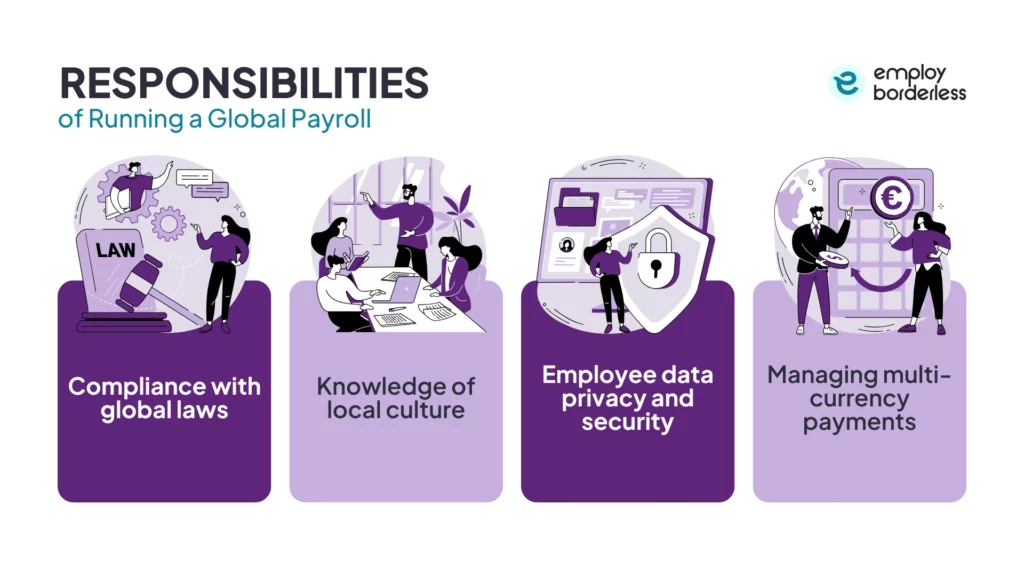
Global payroll is the process of managing and paying employees across multiple countries and regions. It simplifies payroll operations by handling different local tax laws, labor regulations, currencies, and compliance requirements. The responsibilities of running a global payroll include compliance with global laws, knowledge of local culture, employee data privacy and security, and managing multi-currency payments.
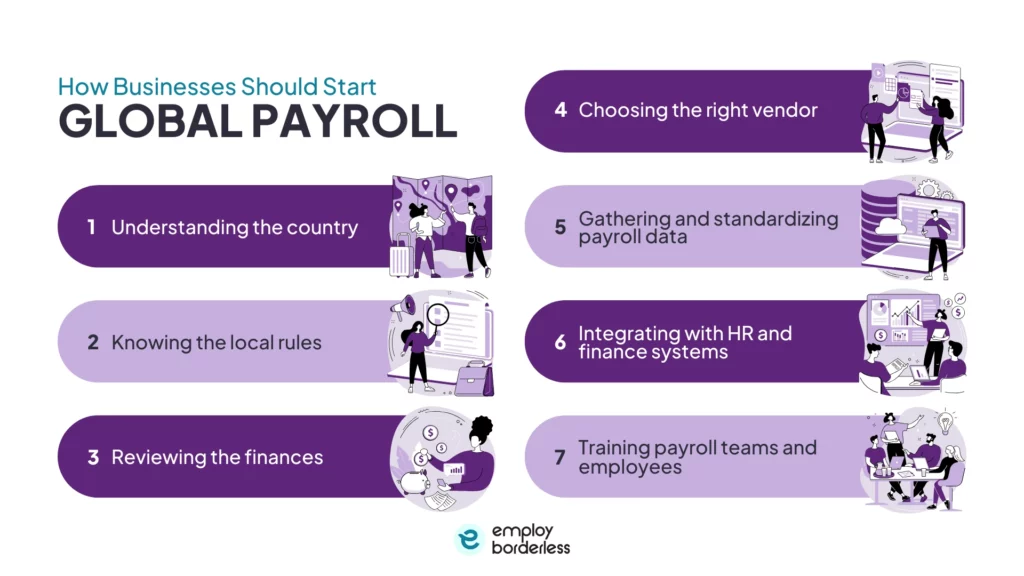
The steps businesses should consider when starting global payroll are understanding the country, knowing the local rules, reviewing the finances, choosing the right vendor, gathering and standardizing payroll data, integrating with HR and finance systems, and training payroll teams and employees.
The challenges of global payroll are different regulations and legal requirements across countries, employee classification, compliance with data protection regulations, balancing global standardization with local flexibility, managing compensation, benefits, and statutory requirements, and payroll taxation and filing obligations across jurisdictions.
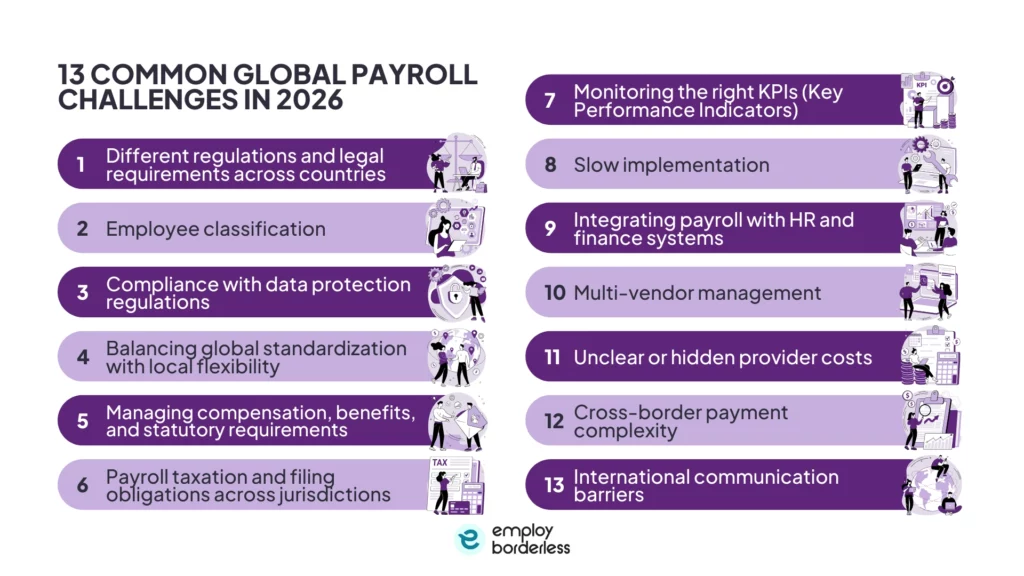
The 13 common challenges of global payroll are listed below.
- Different regulations and legal requirements across countries: Managing payroll internationally requires understanding each region's legal and regulatory systems, as payroll rules, labor laws, tax withholding, and reporting standards differ widely.
- Employee classification: Different contractor and employee definitions and payroll tax rules across countries risk misclassification, fines, and compliance issues without accurate classification practices.
- Compliance with data protection regulations: Sensitive global payroll data has to comply with multiple international privacy laws like GDPR (General Data Protection Regulation), as it requires secure transfers and strict data control.
- Balancing global standardization with local flexibility: Standard reporting requirements differ from local payroll practices, so flexible processes are important for accurate, compliant global payroll.
- Managing compensation, benefits, and statutory requirements: Different wage levels, benefits structures, and social security rules demand specific payroll and benefits administration in each country.
- Payroll taxation and filing obligations across jurisdictions: Cross-border tax filings, local financial institution requirements, and different tax treaties make timely, compliant payroll tax submissions difficult.
- Monitoring the right KPIs (Key Performance Indicators): Tracking accuracy, timeliness, cost, and compliance across regions requires balanced and consistent measurement tools.
- Slow implementation: Choosing the correct global payroll model and setting up systems across countries is complex and time-consuming without experienced partners.
- Integrating payroll with HR and finance systems: Misaligned systems of HR and finance teams cause errors and compliance risks.
- Multi-vendor management: Managing multiple local payroll vendors involves communication, trust, and process coordination across regions and partners.
- Unclear or hidden provider costs: Unexpected wages, taxes, and vendor fees make cost tracking difficult without combined expense transparency tools.
- Cross-border payment complexity: Multi-jurisdiction payments face foreign exchange issues, banking rules, compliance checks, and high fees that delay employee compensation.
- International communication barriers: Language, cultural differences, and time zone gaps slow payroll communication and require tools and structured coordination.
Different regulations and legal requirements across countries
Managing payroll across multiple countries requires a thorough understanding of each region's unique legal and regulatory system, as payroll rules, labor laws, tax withholding requirements, and reporting standards differ from one jurisdiction to another. These differences also include differing tax and reporting deadlines that are necessary in each country to remain compliant and avoid costly penalties.
Many companies choose to partner with a global payroll provider to outsource the burdens of compliance, deadlines, and documentation. It's difficult for in-house teams to keep up with changing laws and administrative requirements in every location. A qualified global payroll service regularly tracks statutory updates across countries and informs businesses of mandatory changes. It also helps maintain ongoing compliance and reduces the risk of fines or legal issues.
Employee classification
Hiring international contractors is common as businesses expand globally, but it also involves complex country-specific payroll and tax rules that differ across regions and, if not handled properly, result in misclassification risks. Countries establish their own regulations that explain how they pay and tax their citizens and residents. These regulations also define who qualifies as an independent contractor or employee, along with related tax and social security obligations. Foreign companies engaging talent abroad have to make sure they follow local rules on worker payment, taxation, and business operations.
The multinational companies that fail to follow employment laws face fines, tax liabilities, and legal penalties if a contractor is classified as an employee under local law. Having a physical office in a country makes contractor classification difficult under local laws, sometimes creating a permanent establishment risk. Regularly reviewing global contractor relationships and classifications helps companies verify proper classification and maintain compliance with changing international employment and tax regulations.
Compliance with data protection regulations
Global payroll data is highly sensitive, as it involves personal and financial details that require strong safety measures to protect employee privacy and organizational reputation. Companies have to comply with multiple data security and privacy laws across different countries in global payroll operations, such as the GDPR (General Data Protection Regulation) and different regional regulations. These different regulations set strict standards for managing, storing, and transferring global payroll data.
Global payroll data commonly flows between systems and countries, so these multiple data transfers also create security risks if they are not managed properly. Reliable global payroll providers maintain high security standards and keep operations in line with major data protection regulations like CCPA (California Consumer Privacy Act).
Such global payroll providers apply advanced security measures such as strong SSL encryption and access controls to protect information. International companies using a global payroll platform with built-in security features and encrypted data transfers improve data protection while reducing compliance risks across borders.
Balancing global standardization with local flexibility
Differing reporting requirements, payroll practices, and data formats in each country make it difficult to generate unified payroll data without adjusting to local standards. Converting country-specific reports into a standardized format improves the reliability of global payroll insights. These insights help with unified reporting and strategic decision-making across the organization.
A strong focus on standardization, however, reduces flexibility to meet unique local compliance changes, cultural payroll practices, and regulatory demands in specific markets, which affect responsiveness and accuracy. A hybrid approach that standardizes core processes while allowing custom local adjustments helps organizations maintain governance and control at the global level. This approach also meets the demands of individual jurisdictions and maintains compliance with local laws.
Managing compensation, benefits, and statutory requirements
Managing compensation, benefits, and statutory requirements across multiple countries is challenging because wage types, minimum salary levels, overtime rules, and statutory deductions differ from one jurisdiction to another. Global payroll calculations are complex due to changing exchange rates, which impact salary conversions, budgeting precision, and employee compensation across different currencies.
Shared currencies, such as those used within specific economic regions, simplify payroll processing and reporting. Many countries, however, continue to operate with unique monetary systems that require careful handling and localized payroll expertise. Employee benefits also differ across countries, as differences in health insurance, pension plans, and social security contributions require companies to match compensation with local statutory requirements.
Payroll taxation and filing obligations across jurisdictions
Global payroll taxation and filing requirements across jurisdictions require coordination between payroll and finance departments, especially because of regulations related to cross-border transactions and tax reporting. Some countries mandate that employers maintain a relationship with a local financial institution to pay employees, while others permit direct international transfers, which makes global payroll setup complex.
Understanding financial and tax treaties between countries is important for setting up payroll operations in a new location, as these agreements influence withholding and reporting obligations. All countries require employers to submit wage and tax information to government authorities, but the rules, timelines, and submission methods differ. Building and maintaining strong relationships with local tax authorities or a trusted payroll vendor supports accurate filings, timely payments, and ongoing compliance.
Monitoring the right KPIs
Monitoring the right KPIs (Key Performance Indicators) in global payroll means tracking the same metrics used in local payroll while analyzing performance on a country- or region-specific basis to show local conditions and requirements. Using a balanced approach helps organizations measure payroll performance across locations and match results with core business objectives.
Important global payroll KPIs include payroll accuracy, processing timeliness, cost savings, compliance levels, and employee or contractor satisfaction. Simple tools such as spreadsheets are used to compile these metrics centrally and distribute clear reports to local payroll teams for corrective action or continuous improvement.
Slow implementation
Implementing a global payroll system is slow and complex due to the need to select the right payroll model and maintain compliance across multiple countries. Choosing the right model takes weeks or even months, while the full implementation process sometimes takes even longer, particularly during periods of global expansion. Partnering with a global payroll provider or using a specialized platform simplifies implementation, as experienced providers already have the necessary tools and expertise to set up payroll effectively. This partnership helps companies reduce delays and run fast and smooth global payroll operations.
Integrating payroll with HR and finance systems
Integrating payroll with HR and finance systems is difficult and, if not performed correctly, results in misalignment between departments or compliance issues due to outdated data flowing between systems. Separate systems involve data transfer mismatches and duplicate entries, which result in payroll inaccuracies, tax filing problems, and reporting delays. These issues expose the company to regulatory penalties when HR, payroll, and finance operate on separate platforms.
Integration efforts also include technical challenges such as differing data formats, limited compatibility between systems, and the need for ongoing maintenance. Effective integration improves data accuracy and simplifies payroll processes. It also keeps compliance intact by automatically updating payroll and finance records to align with changes in HR information, such as new hires, salary updates, or benefits.
Multi-vendor management across countries
Managing multiple local payroll vendors across different countries creates challenges due to differences in payroll practices, legal requirements, and communication expectations. Finding reliable vendors and maintaining consistent communication across time zones and languages is difficult for global payroll operations. Partnering with an EOR (Employer of Record) or a centralized global payroll provider helps simplify communications, organize vendor management, and maintain consistent processes. Such providers make it easy for companies to maintain compliance and operational performance across multiple regions.
Cross-border payment complexity
Sending salaries and contractor payments across countries involves multiple intermediaries, changing banking rules, and differing regulatory requirements, which slow down processing and increase costs. Traditional international transfers take days to settle and require high fees from associated banks and foreign exchange rates, which reduces the amount employees or contractors ultimately receive.
Currency conversion, compliance checks such as AML (Anti-Money-Laundering) and KYC (Know-Your-Customer) requirements, and inconsistent payment data standards across jurisdictions add operational complexity and regulatory burden. Lack of transparency in tracking payment status and fees makes it difficult for payroll teams to manage cash flow and provide timely, accurate disbursements. These factors make cross-border payroll payments more complex than domestic ones and require effective tools and reliable partners to reduce delays, costs, or compliance risks.
International communication barriers
International communication barriers add complexity to global payroll due to cultural differences, language challenges, and different time zones. These factors slow down payroll communication, which makes coordination between teams, vendors, and employees more challenging, with risks of misunderstandings or errors. Time zone challenges are resolved by using communication methods, like shared platforms, emails, and collaborative tools, which allow teams to manage payroll tasks effectively. These communication methods help maintain timely responses and accurate information exchange across regions.
What is global payroll?
Global payroll is the process of managing and processing employee compensation across multiple countries while staying compliant with each country's local labor laws, tax systems, and payment regulations. It involves calculating wages, withholding relevant taxes and social contributions, handling multiple currencies, and meeting reporting requirements for employees located in different jurisdictions. Global payroll platforms centralize and standardize payroll activities into a unified system to reduce errors, improve productivity, and help international companies pay their global workforce accurately and on time.
What are the responsibilities of running a global payroll?
The responsibilities of running a global payroll are compliance with global laws, knowledge of local culture, employee data privacy and security, and managing multi-currency payments.
The responsibilities of running a global payroll are discussed below.
- Compliance with global laws: Global payroll must comply with each country's tax laws, labor regulations, reporting requirements, and statutory contributions, which requires ongoing monitoring of legislative changes.
- Knowledge of local culture: Global payroll calculations and scheduling require an understanding of local holidays, workweeks, and customary overtime practices. This knowledge also involves identifying cultural standards regarding benefits, bonuses, and compensation structures, which helps provide employee satisfaction and retention.
- Employee data privacy and security: Employee data privacy and security means collecting and maintaining up-to-date employee payroll data securely and protecting sensitive information in compliance with data protection regulations like GDPR (General Data Protection Regulation).
- Managing multi-currency payments: Global payroll teams handle payments in different currencies, manage foreign exchange rates, and make sure that employees receive correct net pay even with currency fluctuations.
How should businesses start global payroll?
Businesses should start global payroll by understanding the country, knowing the local rules, reviewing the finances, choosing the right vendor, gathering and standardizing payroll data, integrating with HR and finance systems, and training payroll teams and employees.
Understanding the country
Multinational businesses need to thoroughly research the local labor laws, tax regulations, and social security requirements to maintain payroll compliance. They also need to understand cultural standards, local workweek structures, and common benefits practices to match payroll processes with employee expectations. Understanding local holidays, overtime rules, and customary compensation structures helps avoid errors and improve employee satisfaction. This knowledge supports smooth payroll operations and reduces the risk of legal or financial penalties.
Knowing the local rules
Each country has its own set of payroll, taxation, and social security requirements that global employers must understand and follow to remain compliant. These rules determine how to calculate wages, withhold and remit taxes and contributions, and meet reporting and documentation obligations specific to that jurisdiction. Businesses that fail to comply with local payroll regulations face legal penalties, fines, and compliance issues, which makes thorough knowledge of local requirements important for accurate and lawful payroll operations.
Reviewing the finances
Foreign businesses have to carefully review their finances before launching a global payroll to check that payroll costs match budgets, cash flow plans, and financial predictions. Managing payroll in multiple countries requires active monitoring of currency exchange rate fluctuations, which unpredictably increase payroll expenses and disrupt financial planning.
Unanticipated shifts in exchange rates increase labor costs, affect cash flow, and make it hard to conform to estimated payroll expenses without active strategies or financial reserve funds. Financial review also helps firms plan for transaction fees, banking delays, and cross-border payment costs, all of which impact overall payroll spending.
Choosing the right vendor
Selecting a reliable global payroll provider helps maintain compliance with local tax, labor, and reporting laws across multiple countries, which reduces legal risk and costly penalties. It also saves time and administrative effort by automating complex tasks such as tax calculations, foreign currency handling, and reporting, which helps internal teams focus on strategic priorities.
Gathering and standardizing payroll data
Gathering and standardizing payroll data requires collecting complete employee information, such as personal details, tax identification numbers, bank details, and employment terms, before processing payroll globally. It also involves compiling compensation data like salary, bonuses, deductions, and benefit information to make sure each employee's records are accurate and complete. Standardizing these data components into a uniform format helps simplify payroll calculations, reporting, and cross-country comparisons.
Integrating with HR and finance systems
Maintaining integration between payroll, HR, and finance systems makes sure that employee data flows automatically between platforms, which reduces manual data entry and errors. Integrated systems improve accuracy in global payroll processing and financial reporting by keeping information consistent across all departments. Shared integration also improves collaboration and decision-making by giving HR and finance teams access to up-to-date payroll information in real time.
Training payroll teams and employees
Training payroll teams and employees is important to make sure they understand international payroll rules, compliance requirements, and system processes for accurate and timely payroll across countries. Regular training also helps staff stay up-to-date with changing local laws, tax regulations, and payroll recommended practices, which reduces the risk of errors and legal issues. Providing clear training and communication about international payroll processes and documentation also improves employee understanding and satisfaction with their wages.
How to choose a global payroll provider for smooth international expansion?
To choose a global payroll provider for smooth international expansion, consider its compliance expertise, technology and automation, multi-currency and payment support, vendor reputation, and data security and privacy.
Choose a global payroll provider that maintains compliance with local tax, employment, and payroll laws across countries to avoid penalties. This compliance expertise includes monitoring updates in regulations and applying them correctly across all jurisdictions.
Select a global payroll platform with advanced payroll technology and automation, as it reduces manual work, improves accuracy, and simplifies complex payroll tasks such as calculations, reporting, and processing. This automation helps businesses with fast and smooth international payroll operations.
Prioritize providers that are able to handle payroll in multiple currencies and support international payment methods. Make sure such providers pay employees accurately and on time, no matter where they are located.
Evaluating a provider's track record, industry experience, and customer reviews helps verify that you choose a reliable partner with the proven ability to manage payroll across countries and offer reliable service quality.
Partnering with a global payroll provider involves sensitive employee data, so make sure it follows strong security practices. These practices involve encrypted storage, compliance with standards like GDPR (General Data Protection Regulation), and clear data protection agreements to protect personal information.
What are the types of global payroll providers?
The types of global payroll providers are wholly owned providers, partner network (aggregate) providers, full-service payroll platforms, EOR providers, and global PEO services. These providers differ in how they offer payroll, compliance, and HR services across countries, which helps businesses choose based on coverage, compliance needs, and operational control.
When should you outsource global payroll?
You should outsource global payroll when your business expands internationally, and payroll becomes complex across multiple countries, currencies, and regulations. Global payroll outsourcing helps reduce compliance risk, save time, improve accuracy, and free internal teams to focus on strategic tasks.
How can you track global payroll costs?
You can track global payroll costs by combining payroll data into a single view that shows expenses by country, payslip, or cost center, and comparing planned and actual spending. Dashboards and real-time reporting tools help you see payroll spending, identify trends or errors, and generate consolidated reports for analysis.
What options help with global payroll challenges?
The options that help with global payroll challenges are cloud-based global payroll software and automation tools, EOR (Employer of Record) or managed payroll service providers, and centralized systems with compliance monitoring.
Is there a global payroll system?
Yes, there is a global payroll system, a centralized platform that allows businesses to manage payroll for employees in multiple countries from one interface. This platform automates salary calculations, tax withholdings, compliance, and reporting while maintaining local legal and regulatory standards. Such payroll systems simplify multi-country payroll in a single, compliant record.

Co-founder, Employ Borderless
Robbin Schuchmann is the co-founder of Employ Borderless, an independent advisory platform for global employment. With years of experience analyzing EOR, PEO, and global payroll providers, he helps companies make informed decisions about international hiring.
Learning path · 10 articles
Payroll fundamentals
Master the fundamentals with our step-by-step guide.
Start the pathReady to hire globally?
Get a free, personalized recommendation for the best EOR provider based on your needs.
Get free recommendations