EOR vs BPO: definitions, services, differences, similarities, benefits, drawbacks, and how to choose

Robbin Schuchmann
Co-founder, Employ Borderless
An EOR (Employer of Record) is a third-party organization that legally employs workers on behalf of a company and manages payroll, compliance, taxes, and benefits. A BPO (Business Process Outsourcing) is an external extension of a company's operations that manages specific business functions such as customer service, accounting, or IT support.
An EOR provides services such as payroll management, competitive benefits packages, visa and work permit assistance, onboarding, and tax compliance, while a BPO offers back-office and front-office services.
The differences between an EOR and a BPO are employer control, administrative functions, HR responsibilities, cost structure, and growth and geographic flexibility. An EOR and a BPO share similarities like third-party partnership, business growth and global expansion, remote or distributed team management, service quality and compliance, and flexibility in staffing and operations.
The benefits of an EOR include time and cost savings, reduced administrative burden, compliance with local laws, access to a global talent pool, improved communication, and risk mitigation and control. BPO offers benefits like transparent pricing, process management, time savings, business flexibility, and increased productivity.
The drawbacks of an EOR include co-employment risks, limited specialization, responsibility in team management, and restricted authority over employee management. The drawbacks of BPO are security risks, dependence on the outsourcer's stability, hidden costs and planning requirements, and availability constraints in teams or departments.
The factors to consider when choosing between an EOR and BPO include identifying your business needs, assessing the level of control, considering compliance requirements, analyzing the cost structure, and evaluating growth potential and flexibility.
What is an EOR?
An EOR (Employer of Record) is a third-party organization that helps companies hire and employ workers in new international markets where they do not have a legal entity. This global employment partner legally employs the workers and handles employer responsibilities, such as contracts, payroll, taxes, employee benefits, and compliance with local labor laws.
How does an EOR work?
An EOR works by becoming the legal employer of a company's international or remote employees. The client company manages daily tasks and performance, and the EOR handles all administrative and legal responsibilities. These responsibilities include payroll processing, employee benefits administration, and tax withholding.
What is BPO?
BPO (Business Process Outsourcing) is the practice of outsourcing specific business operations or tasks to an external service provider. These processes include customer support, payroll, data entry, IT services, or accounting. BPO started in the manufacturing industry, where companies improved productivity by outsourcing supply chain management tasks. BPO services are now widely used across industries such as healthcare, asset management, energy, pharmaceuticals, and e-commerce, as businesses continue to find creative ways to improve customer experience and stay competitive in the market.
How does BPO work?
BPO (Business Process Outsourcing) works by allowing companies to outsource non-core business tasks such as customer service, accounting, or IT support to external providers. This outsourcing helps organizations save time, reduce costs, and get access to specialized expertise. Companies also focus on product development, customer engagement, and market expansion by outsourcing major operations.
What services does an EOR provide?
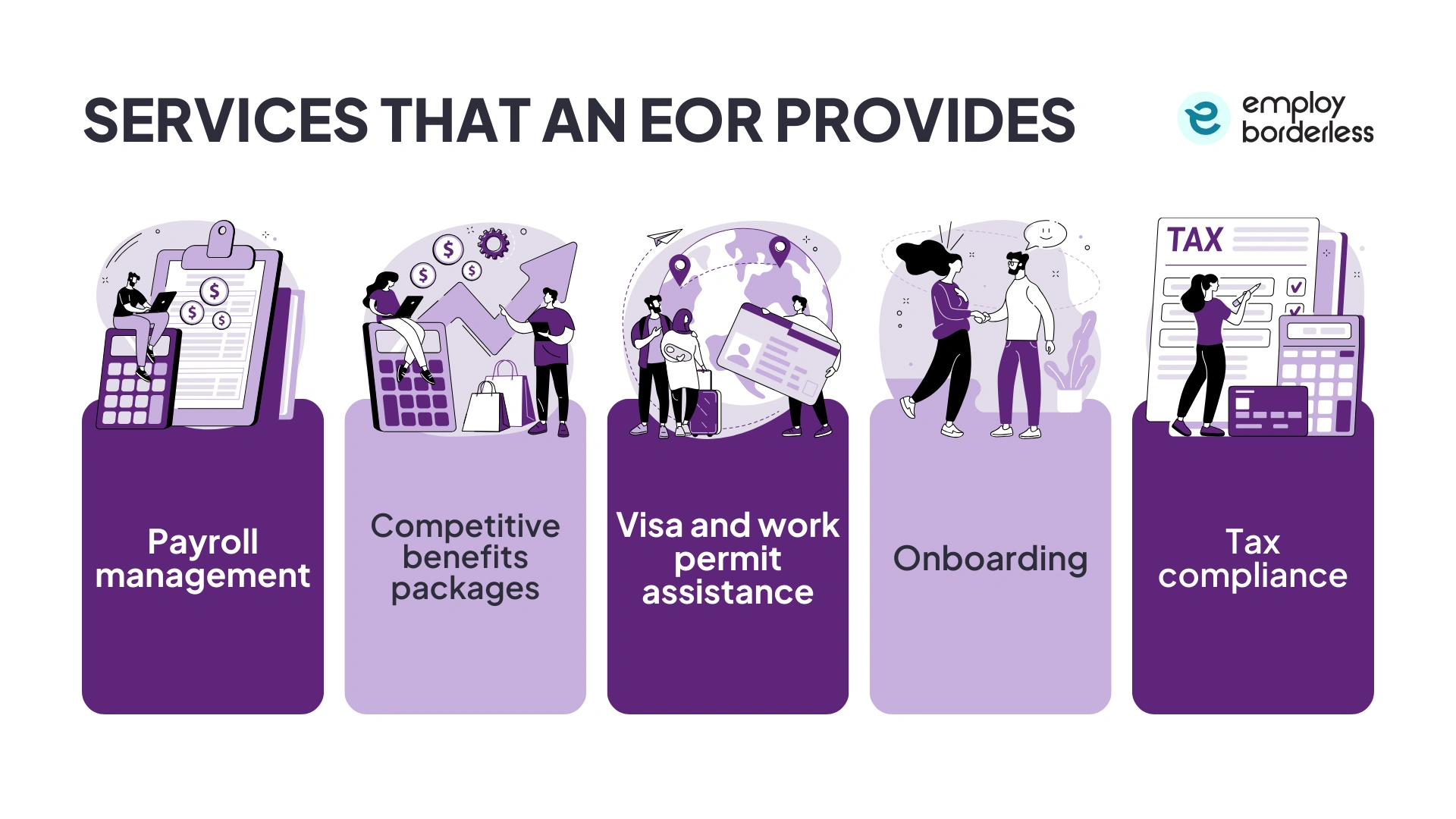
The services that an EOR provides are payroll management, competitive benefits packages, visa and work permit assistance, onboarding, and tax compliance.
The services that an EOR provides are listed below.
- Payroll management: An EOR handles employee payroll accurately and on time and manages salary calculations, deductions, and payments across multiple regions. It reduces administrative burdens and payroll errors.
- Competitive benefits packages: This third-party organization provides access to regionally compliant, competitive employee benefits, such as health insurance, retirement plans, and paid leave. These benefits help companies attract and retain top talent globally.
- Visa and work permit assistance: An EOR supports global hiring by managing visa applications, work permits, and immigration compliance. It makes certain that employees legally work in the host country without administrative delays.
- Onboarding: This third-party employer simplifies the onboarding process by managing employment contracts, orientation, and document verification. It also integrates the new hires smoothly into the company's operations.
- Tax compliance: An EOR keeps companies fully compliant with local tax laws, such as FUTA (Federal Unemployment Tax Act) and SUTA (State Unemployment Tax Act), by managing employee tax withholdings and employer contributions. It stays updated with changing tax regulations in each operating region.
What services does a BPO provide?
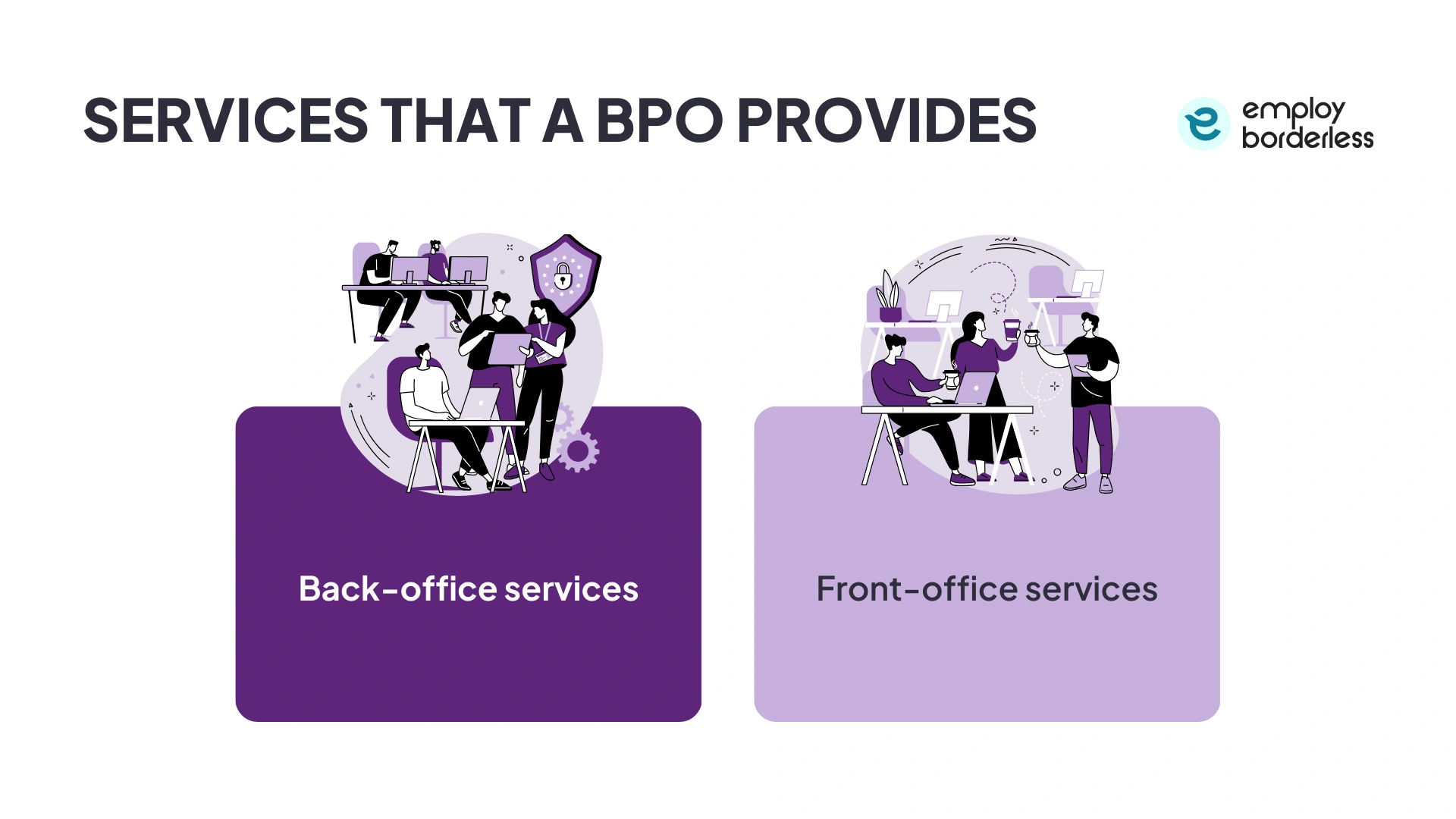
The services that a BPO provides include back-office and front-office services. These services include customer support, telemarketing, claims processing, data entry, and other administrative tasks.
The services that a BPO provides are listed below.
- Back-office services: BPO providers manage important administrative and support functions such as accounting, data entry, HR, and IT management. These services help companies simplify operations and reduce overhead costs.
- Front-office services: BPO providers handle functions that involve direct client contact, such as sales, technical support, and customer service. These services improve customer satisfaction and maintain consistent communication across multiple channels.
What are the differences between EOR and BPO?
The differences between EOR and BPO are employer control, administrative functions, HR responsibilities, compliance with labor laws, risk and liability, cost structure, strategic benefits, and growth and geographic flexibility.
| Feature | EOR | BPO |
| Focus | Focuses on employment management, payroll, and compliance | Focuses on outsourcing specific business processes like IT or finance |
| Employer control | Full legal employer of the client company's workforce | Allows the company to retain full control over core business operations |
| Administrative functions | Handles HR, payroll, benefits, and compliance | Manages operational tasks such as data entry |
| HR responsibilities | Manages hiring, onboarding, and employee relations | Perform non-HR tasks of business processes |
| Compliance with labor laws | Follows employment and tax regulations in each region | Follows operational and service-level compliance standards |
| Risk and liability | Takes responsibility for legal and financial risks | The company takes responsibility for legal and operational risks |
| Cost structure | Based on employee management and service fees | Depend on project scope, volume, and service agreements |
| Employee benefits | Provides compliant and competitive benefits | Does not provide benefits to the client's employees |
| Growth and geographic flexibility | Supports workforce growth across multiple countries | Offers flexible resource allocation and capacity adjustment for business processes |
Focus
An EOR (Employer of Record) focuses on managing employment-related responsibilities such as payroll, benefits, taxes, and compliance. It helps companies hire globally without setting up a local entity. A BPO (Business Process Outsourcing) focuses on handling specific non-core business operations like customer support, IT, or accounting.
Employer control
The EOR allows a company to maintain control over employees' daily tasks, but it becomes the official legal employer for compliance and administrative purposes. The client's business manages employee performance and daily operations, while the EOR handles legal responsibilities. A BPO has no employer authority and only controls the outsourced operations. The client company remains in charge of both its employees and overall workplace decisions.
Administrative functions
EORs handle HR-related administrative tasks, such as payroll processing, tax withholding, and benefits administration. They simplify workforce management across multiple regions while complying with local labor laws, such as the FLSA (Fair Labor Standards Act). BPOs manage business process administration, such as data entry, technical support, or call center operations. Their focus is on operational stability rather than HR compliance.
HR responsibilities
An EOR handles the complete employment process, from hiring and onboarding to payroll, benefits, and termination, and sees to it that all employment practices comply with local laws. The BPO does not manage employees directly and only helps HR teams by outsourcing specific HR or business functions. An EOR engages with employees and manages their operational requirements, while a BPO only handles business processes and operations.
Compliance with labor laws
EORs take full legal responsibility for following local labor laws, which include employee classification, wage laws, and benefit requirements. They confirm that all employment contracts and tax filings follow jurisdictional regulations. BPOs focus on service level compliance rather than labor law compliance. EORs manage legal employment obligations, while BPOs meet operational standards.
Risk and liability
This third-party organization takes full responsibility for employment-related risks, such as payroll errors, worker misclassification, or local labor disputes, and protects the client company from lawsuits. BPOs handle limited risks, mainly related to the quality and timeliness of outsourced services. This liability makes EORs suitable for managing legal risks, while BPOs are more focused on reducing operational risks.
Cost structure
EORs charge per employee or a percentage of the payroll, which ranges from 10% to 20%, and include employment, HR, and compliance services. This cost structure provides transparency and helps companies manage international employment costs. A BPO uses a pricing model based on project scope, service volume, or hours worked. EORs reduce HR overhead costs, while BPOs lower operational costs.
Employee benefits
This third-party provider becomes the legal employer and provides employee benefits like health insurance, paid leave, retirement plans, vision, and dental insurance under local law. BPO does not provide benefits packages to the client company's employees. It manages outsourced business processes and may administer client-sponsored benefits on behalf of the client, but the client company remains responsible for providing and funding employee benefits.
Growth and geographic flexibility
An EOR makes it easy for businesses to hire employees across multiple countries quickly and in a compliant manner. It provides the flexibility to grow operations globally without the need for a local entity. Business Process Outsourcing also offers flexibility, but mainly by adjusting workforce capacity or service levels based on business demand.
What are the similarities between EOR and BPO?
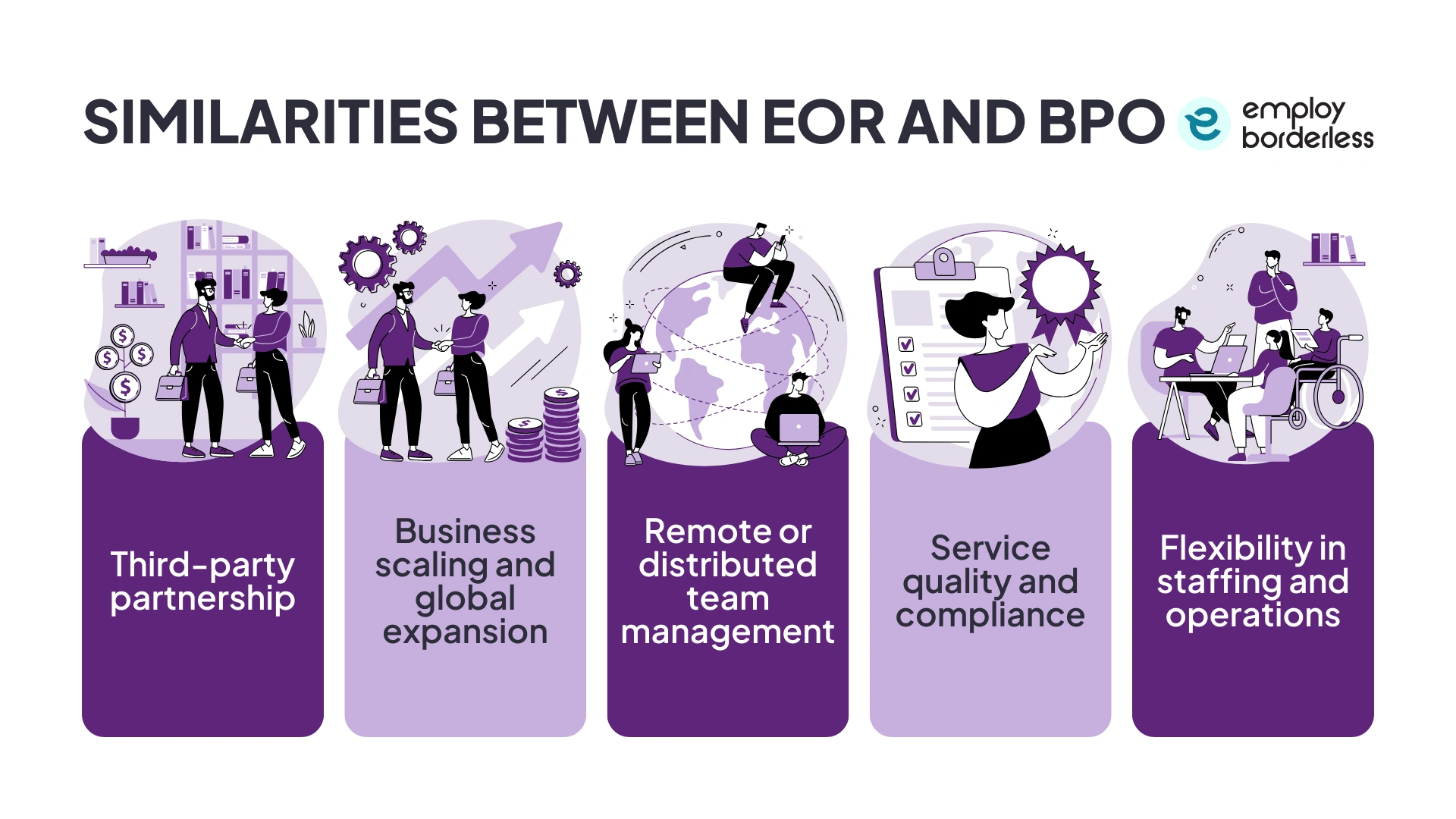
The similarities between EOR and BPO include third-party partnership, business growth and global expansion, remote or distributed team management, service quality and compliance, and flexibility in staffing and operations.
Third-party partnership
Both EOR and BPO models involve collaboration with an external provider to manage specific business operations. They act as trusted partners and allow companies to delegate important administrative and operational functions. This partnership helps reduce internal workload and maintain professional management of specialized functions. It also allows companies to focus on their core objectives while maintaining operational stability.
Business growth and global expansion
EORs and BPOs support business growth by providing access to global resources and solutions. They help companies expand into new markets without establishing a local entity or investing in setup costs. Both models allow for quick team growth or service expansion in response to market demand. This flexibility makes it easy for businesses to stay competitive in global markets.
Remote or distributed team management
Both third-party service providers, EORs and BPOs, allow businesses to manage remote and distributed teams effectively. They handle communication, coordination, and compliance tasks for employees across multiple locations. These services help see to it that remote workers are smoothly integrated into company operations, which allows businesses to maintain productivity across different team locations.
Service quality and compliance
Both models, EORs and BPOs, prioritize compliance with local laws and regulations relevant to their services. EORs take full legal employer responsibilities and maintain compliance with labor laws, payroll, benefits, and tax regulations, which reduces legal risks for the client company. BPOs focus on maintaining compliance within the processes they manage, such as customer service or HR tasks, while seeing to it that these operations meet legal and industry standards.
Flexibility in staffing and operations
EORs and BPOs offer flexible staffing and operational models to match business needs. They allow companies to adjust team size based on administrative needs, project demands, or seasonal trends. This flexibility reduces long-term employment risks and operational overhead. They also help businesses remain responsive and cost-effective in a changing market environment.
What are the use cases of an EOR?
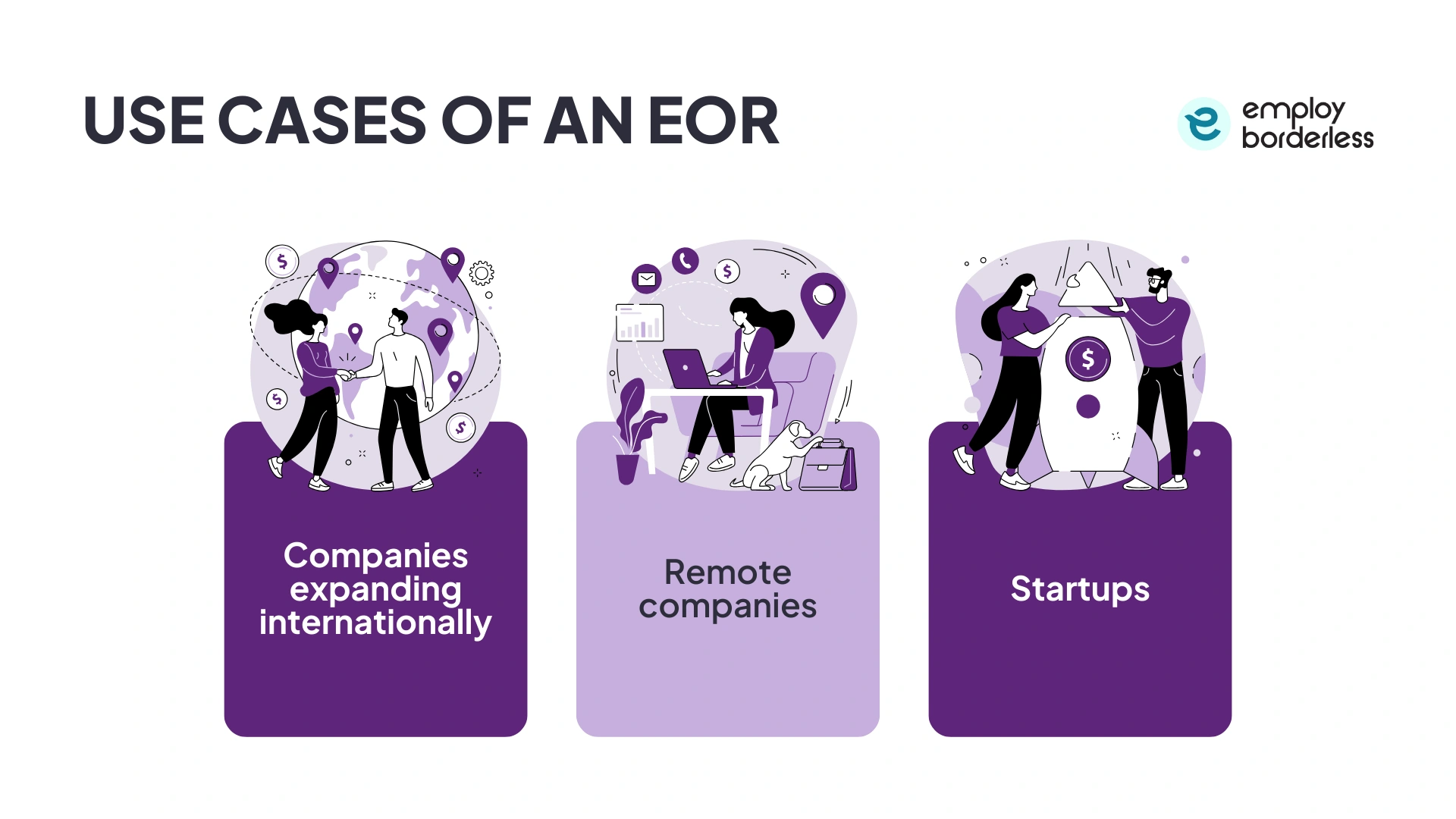
The use cases of an EOR are companies expanding internationally, remote companies, and startups.
The use cases of an EOR are listed below.
- Companies expanding internationally: This third-party employer helps businesses enter new markets without setting up a local legal entity. It manages payroll, taxes, and compliance in each country. This expansion support allows companies to focus on growth while the EOR manages local employment complexities.
- Remote companies: EORs allow remote companies to hire employees from different countries legally. They manage cross-border payroll, benefits, and compliance and reduce the burden on internal HR teams. An EOR helps remote businesses stay compliant while maintaining a global and flexible workforce.
- Startups: This third-party organization helps startups hire global talent quickly without the need for an expensive legal setup. It manages HR, payroll, and regulatory compliance and allows startups to focus on growing their business. The EOR makes global hiring affordable and risk-free for new companies.
What are the use cases of BPO?
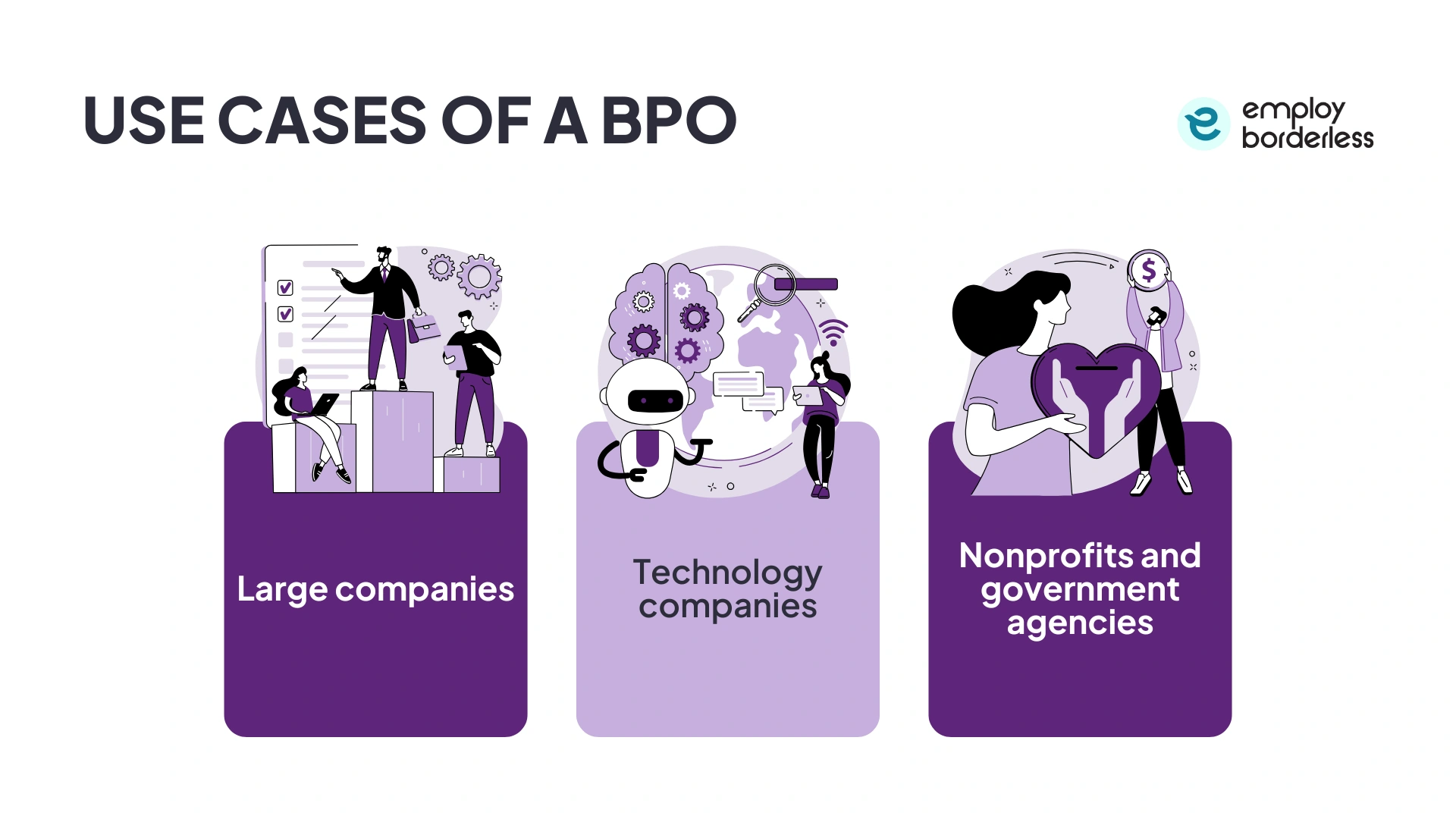
The use cases of BPO are large corporations, technology companies, and nonprofits or government agencies.
The use cases of BPO are listed below.
- Large companies: BPOs help large corporations manage high-volume administrative tasks like customer support, finance, and HR operations. These businesses outsource their processes to reduce overhead costs and improve workforce productivity. A BPO allows organizations to focus on strategy and grow as market leaders.
- Technology companies: Business Process Outsourcing supports technology firms with services such as IT support, software development, and data management. Technology companies outsource these operations to grow more quickly and maintain global support.
- Nonprofits and government agencies: BPOs support nonprofits and government agencies by managing back-office functions such as data entry, payroll, and donor or citizen services. Nonprofits and government agencies outsource these tasks and focus on their mission and public service goals.
What are the benefits of an EOR?
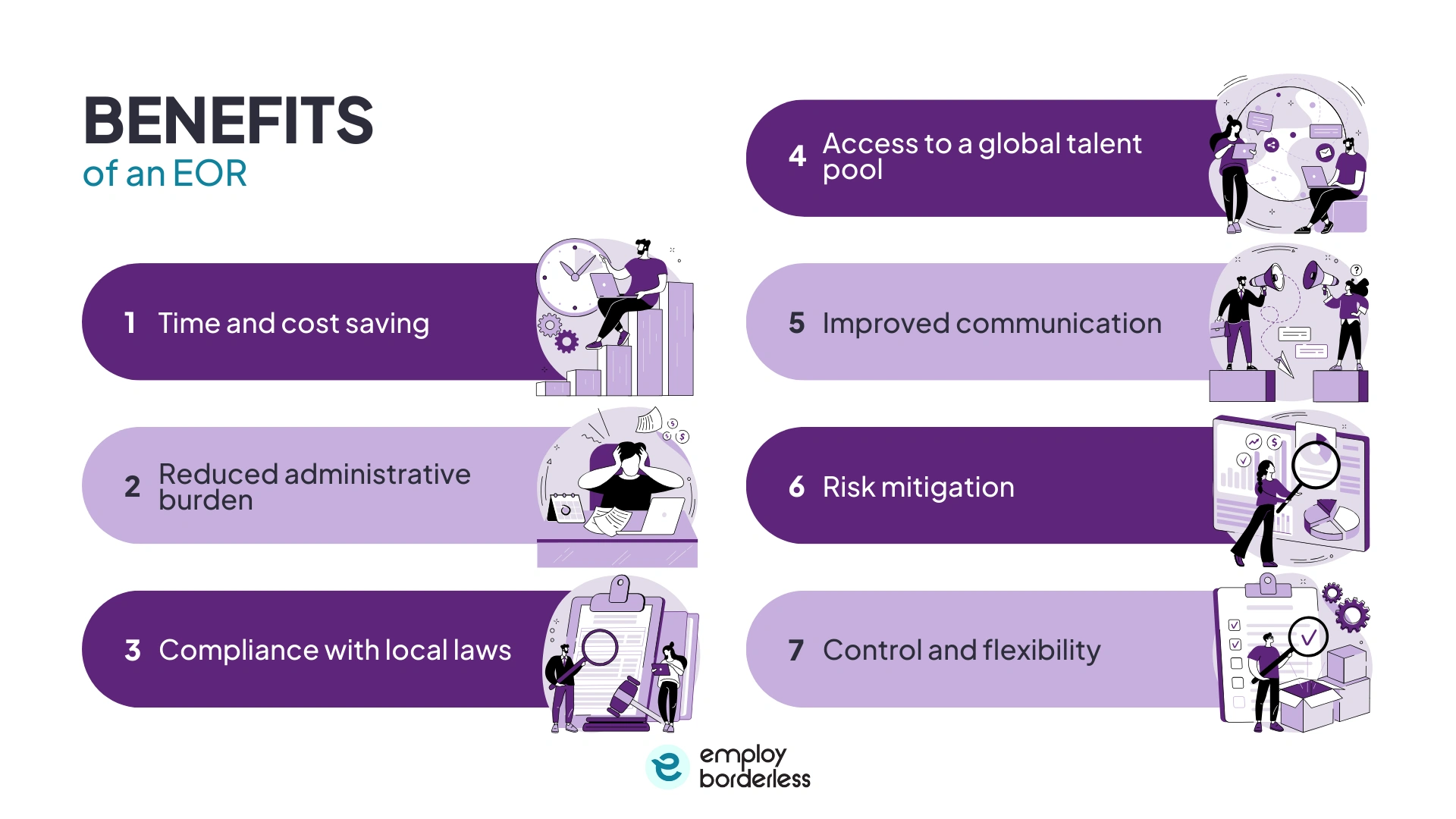
The benefits of an EOR are time and cost savings, reduced administrative burden, compliance with local laws, access to a global talent pool, improved communication, risk mitigation and control, and flexibility.
Time and cost saving
An EOR helps businesses save time by managing complex HR tasks such as payroll, benefits, and tax filing. It also reduces costs related to setting up local entities or hiring in-house compliance teams. This cost-saving allows companies to allocate resources toward growth and focus on business development rather than time-consuming administrative tasks.
Reduced administrative burden
Businesses no longer need to handle time-consuming HR and legal paperwork by working with an EOR. It handles all employment processes, from contracts to employee benefits, and simplifies daily management tasks. This reduced administrative burden helps internal teams stay focused on core business objectives.
Compliance with local laws
EORs see to it that all employment practices comply with local labor, tax, and employment regulations. This compliance reduces the risk of fines or costly legal penalties and allows businesses to operate confidently on a global scale while meeting all legal standards.
Access to a global talent pool
This global employment approach allows companies to hire skilled employees worldwide without setting up a local entity. Businesses have access to a diverse, specialized talent pool, which also helps with fast and compliant international expansion.
Improved communication
EORs simplify communication between employers and remote or global teams through organized HR processes. They provide uniform policies and regional employee support, which helps companies improve their reputation and reduce employee turnover rates. This improved communication helps promote strategic partnership and engagement across regions.
Risk mitigation
This third-party employer protects the client from direct liability and employment-related risks in foreign markets. The EOR helps avoid costly penalties, fines, and lawsuits related to non-compliance or worker misclassification. It conducts regular audits, clears contractual restrictions, and offers risk measures such as dispute resolution and legal support to reduce strategic and operational risks associated with managing an international workforce.
Control and flexibility
The client company maintains control over daily employee operations while outsourcing the administrative, legal, and compliance complexities. The EOR becomes the legal employer and handles payroll, taxes, benefits, and regulatory compliance. This arrangement allows businesses to quickly hire, expand, or reduce teams in new markets without needing to establish a legal entity or follow local employment laws themselves. It offers flexibility to enter and exit markets easily, respond to changing business needs, and focus on core activities while the EOR manages employment logistics and risk.
What are the benefits of BPO?
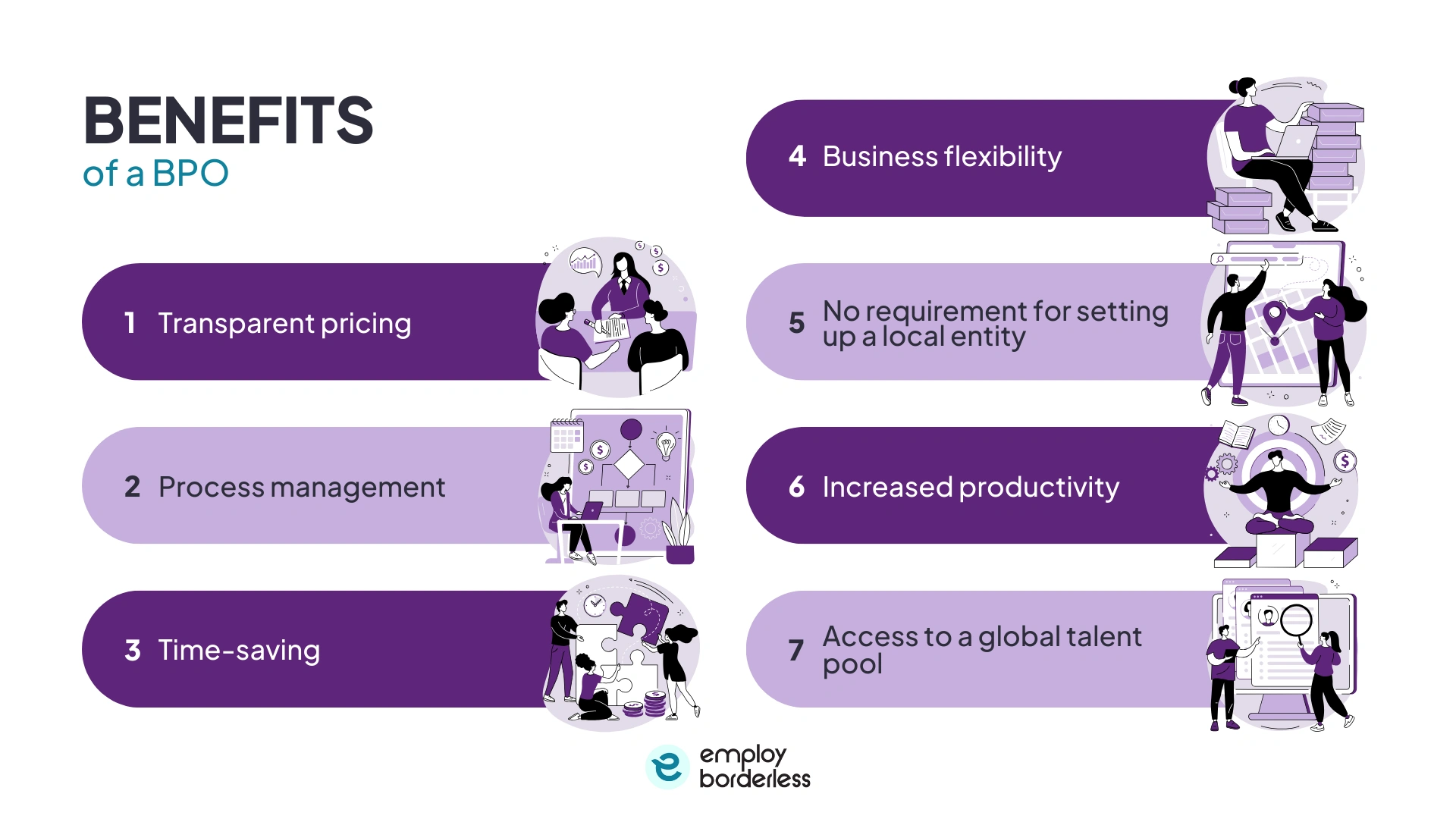
The benefits of BPO include transparent pricing, process management, time saving, business flexibility, no requirement for setting up a local entity, increased productivity, and access to a global talent pool.
Transparent pricing
BPO providers maintain transparent pricing structures that help businesses predict and control costs. The provider's fees are based on specific services or performance metrics, which prevent unexpected charges. This clarity allows companies to choose the right plan according to their needs. Transparent pricing also builds trust and promotes long-term partnerships between clients and providers.
Process management
Business Process Outsourcing provides specialized expertise in managing operational processes such as finance, HR, or customer service. These structured workflows and standardized systems increase operational accuracy, productivity, and accountability. Outsourcing repetitive tasks to BPOs helps businesses improve performance across departments. This outsourcing also allows companies to focus on process quality while supporting continuous workplace improvement.
Time-saving
Companies delegate routine and time-consuming operations to BPO providers, which allows them to redirect resources toward product development and market expansion. BPOs manage outsourced tasks expertly, simplify project completion, and reduce delays. This delegation supports faster company growth and improves overall in-house team productivity.
Business flexibility
BPOs allow companies to adjust operations quickly according to changing market conditions. Businesses have the ability to adjust resources without long-term commitments while expanding or downsizing. This flexibility allows firms to handle fluctuating demands without the fixed costs and delays of hiring or downsizing internally.
No requirement for setting up a local entity
Businesses that work with a BPO do not need to establish legal entities or offices in foreign markets. BPO providers handle specific business processes on behalf of the client from their own established operations within the target market. This arrangement allows companies to enter and operate in new geographic regions without the high costs, regulatory requirements, and administrative burdens related to setting up a local legal entity.
Increased productivity
Outsourcing business processes to a BPO allows internal teams to focus on strategic, high-value work while the outsourcing partner handles routine operations accurately. BPOs increase productivity and turnaround time by using specialized teams, structured workflows, and standardized systems.
Access to a global talent pool
BPOs provide companies with access to skilled professionals and specialized expertise from around the world. Businesses select talented teams with proven industry experience without investing extra effort in recruitment. This global access improves creativity and service quality while helping companies operate smoothly with teams working across different time zones.
What are the drawbacks of an EOR?
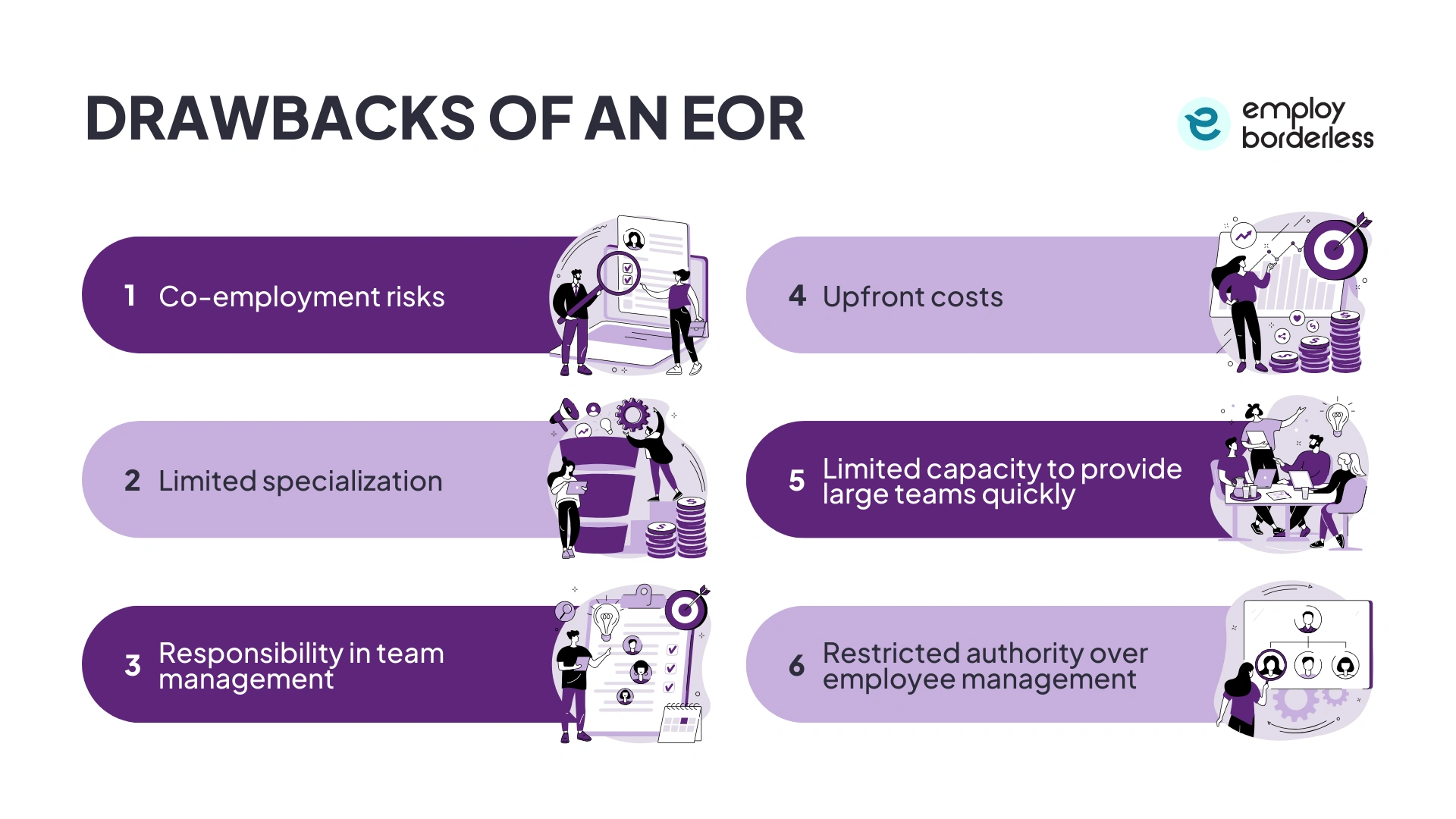
The drawbacks of an EOR are co-employment risks, limited specialization, responsibility in team management, upfront costs, limited capacity to provide large teams quickly, and restricted authority over employee management.
The drawbacks of an EOR are listed below.
- Co-employment risks: Co-employment risks occur when both the EOR and client company share responsibilities for employees. This shared structure sometimes creates confusion about accountability.
- Limited specialization: Limited specialization means the EOR may not fully understand industry-specific needs or technical roles. It sometimes affects the quality of hiring or compliance strategies for businesses with highly specific functions.
- Responsibility in team management: The EOR is the legal employer, so they control employment contracts, benefits, and legal compliance matters. The client company only monitors daily management of employees, which limits its flexibility in customizing employment terms or implementing disciplinary actions and company-specific policies.
- Upfront costs: Upfront costs mean setup fees or higher service charges compared to internal hiring. These expenses include payroll, compliance management, and administrative support. Smaller companies or startups find it difficult to initially manage this cost.
- Limited capacity to provide large teams quickly: The EOR is unable to grow hiring as quickly as high-growth companies require, which makes it difficult to develop larger teams. The onboarding process also takes time due to compliance checks, which may delay urgent project timelines.
- Restricted authority over employee management: Companies cannot make all HR-related decisions themselves since they have restricted authority over employee management. The EOR has complete control over contracts, payroll, and benefits, which limits a business's flexibility in managing internal policies.
What are the drawbacks of BPO?
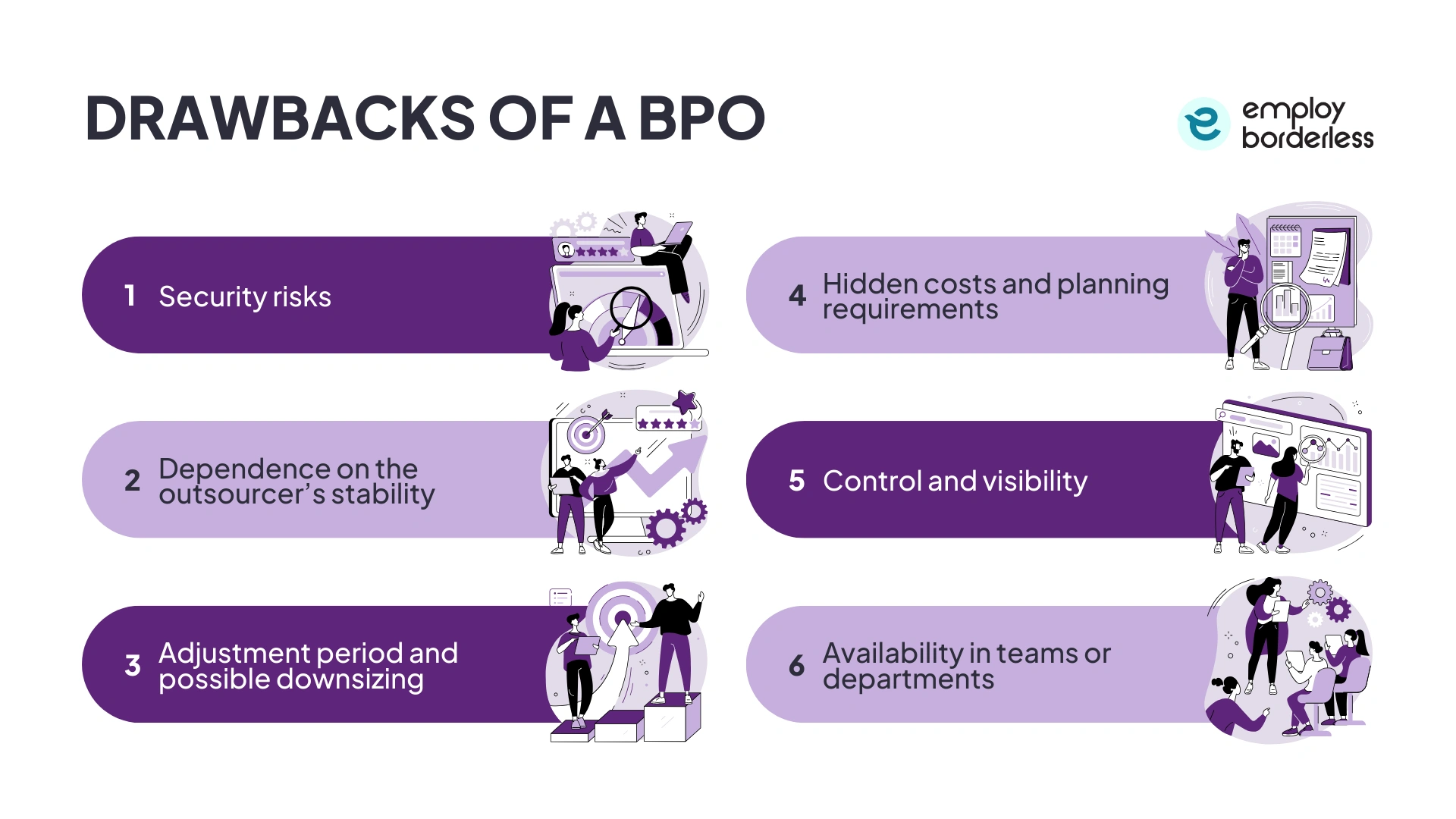
The drawbacks of BPO are security risks, dependence on the outsourcer's stability, adjustment period and possible downsizing, hidden costs and planning requirements, control and visibility, and availability in teams or departments.
The drawbacks of BPO are listed below.
- Security risks: Security risks occur when companies share sensitive company or customer data with an external provider. Breaches or mishandling of information lead to financial or reputational damage if the BPO provider does not carefully handle confidential company information.
- Dependence on the outsourcer's stability: Companies that depend on the outsourcer's financial or operational stability are exposed to organizational risks. Disruption in the BPO provider's operations directly impacts the client's business.
- Adjustment period and possible downsizing: In-house teams require adjustment to new workflows and external communication when companies partner with a BPO. Internal staff see changes in their roles or experience downsizing as the BPO provider manages administrative functions.
- Hidden costs and planning requirements: Hidden costs mean extra services, which include system integration or employee training. Financial teams are unable to budget effectively when contracts lack cost transparency.
- Control and visibility: Companies that delegate daily operations to BPO providers lose control. It becomes difficult for companies to monitor performance or maintain quality when they have limited control over business operations.
- Availability in teams or departments: BPO services are limited only to specific departments such as HR, finance, or customer service. This limitation prevents businesses from achieving full company-wide integration.
What are the factors to consider when choosing between an EOR and a BPO?
The factors to consider when choosing between an EOR and BPO include identifying your business needs, assessing the level of control, considering compliance requirements, comparing the cost structure, and evaluating growth potential and flexibility.
Choose an EOR if your company requires employee management and legal compliance. Prioritize a BPO for process outsourcing, like customer service or data entry. You can select the right model according to your operational goals after carefully identifying your business needs.
Evaluate the level of control you need to maintain over your workforce and operations. An EOR becomes the legal employer of the workforce it manages, while a BPO handles specific business functions under your company's control.
Assess the legal and tax compliance requirements for your business before choosing between an EOR and a BPO. Partner with an EOR for complex compliance support if your company is hiring across borders or managing difficult employment laws. A BPO's compliance responsibility is limited to the particular business processes it manages, such as customer service or IT, and does not include the full range of employment laws.
Compare the pricing models of both EOR and BPO providers to confirm they meet your budget. EOR costs often include employee benefits and compliance management, while BPO pricing depends on service scope and volume.
Choose a provider that is able to grow its services as your business expands into new markets. EORs support fast global hiring, but BPOs provide flexibility in managing workloads and operational processes.
How do EORs and BPOs handle employee termination?
EORs and BPOs handle employee termination by managing the administrative and legal aspects, which include preparing termination letters, calculating final pay and benefits, and maintaining compliance with local labor laws such as the FLSA (Fair Labor Standards Act).
What is the difference between EOR and COR?
The difference between EOR and COR is that an EOR (Employer of Record) is a third-party organization that legally employs workers on behalf of a company. A COR (Contractor of Record) manages independent contractors rather than full-time employees and handles proper classification, contract management, and tax compliance.
How does an EOR differ from a staffing agency?
An EOR differs from a staffing agency in that an EOR becomes the legal employer responsible for payroll, taxes, benefits, and compliance. A staffing agency mainly recruits and places temporary or permanent employees. The main difference between an EOR and a staffing agency is that the EOR manages legal employment across regions, while a staffing agency specializes in sourcing candidates quickly.
What are the types of BPO?
The types of BPO are back-office BPO, front-office BPO, offshore BPO, nearshore BPO, and onshore BPO.
How do the costs of EOR and BPO services compare?
The costs of EOR and BPO compare in terms of purpose and duration, as BPO is for short-term operational tasks, while EOR costs are higher initially but provide long-term stability through legal and compliance management for employees.
How does an EOR provide compliance support?
EOR provides compliance support by making certain that companies follow all local labor laws, tax regulations, and employment standards when hiring globally. EOR compliance support manages employment contracts, payroll taxes, and benefits according to regional requirements.

Co-founder, Employ Borderless
Robbin Schuchmann is the co-founder of Employ Borderless, an independent advisory platform for global employment. With years of experience analyzing EOR, PEO, and global payroll providers, he helps companies make informed decisions about international hiring.
Learning path · 8 articles
EOR fundamentals
Master the fundamentals with our step-by-step guide.
Start the pathReady to hire globally?
Get a free, personalized recommendation for the best EOR provider based on your needs.
Get free recommendations