EOR for manufacturers: benefits, considerations, and how to choose

Robbin Schuchmann
Co-founder, Employ Borderless
An EOR (Employer of Record) is a third-party HR service that allows companies to legally employ workers in different regions without establishing a local entity. It manages payroll, benefits, taxes, and compliance while the business focuses on operations and growth.
The benefits of an EOR for the manufacturing industry include global payroll solutions, onboarding and global mobility support, access to insurance and employee benefits, ongoing compliance, flexible workforce management, support with localized safety regulations, and reduced administrative burden.
The factors to consider when choosing the right EOR for your manufacturing company are experience and expertise, geographic reach, technology and automation, and flexibility.
What is an EOR?
An EOR (Employer of Record) is a third-party organization that officially employs workers on behalf of another company. It takes responsibility for legal and administrative employment tasks, such as payroll, taxes, benefits, and legal requirements. The client company manages the daily activities and work of the employees. The EOR allows a client company to hire workers in a new region or country where they do not have a registered legal entity.
Why does the manufacturing industry need an EOR?
The manufacturing industry needs an EOR because it experiences challenges, such as labor shortages and high turnover, compliance with labor and safety regulations, managing multi-country operations, and complex payroll and benefits management.
Manufacturers often struggle to find and retain skilled workers, especially for specialized or seasonal roles. This challenge impacts operational productivity and leads to costly delays in meeting production goals. An EOR helps by sourcing qualified talent globally and managing recruitment and onboarding.
Manufacturing companies must comply with strict laws such as OSHA (Occupational Safety and Health Administration) standards and the FLSA (Fair Labor Standards Act). An EOR makes sure that worker classifications, safety policies, and wage structures meet all legal requirements.
Global manufacturers face challenges managing staff in multiple countries with different tax, labor, and employment laws. An EOR manages compliance, handles local payroll, and administers benefits according to regional regulations.
Payroll errors in the manufacturing industry result in employee dissatisfaction and regulatory fines. An EOR automates payroll processing and makes sure payments are timely and accurate for all manufacturing workers. It also manages benefits, deductions, and compliance across multiple jurisdictions.
What are the benefits of EOR for the manufacturing industry?
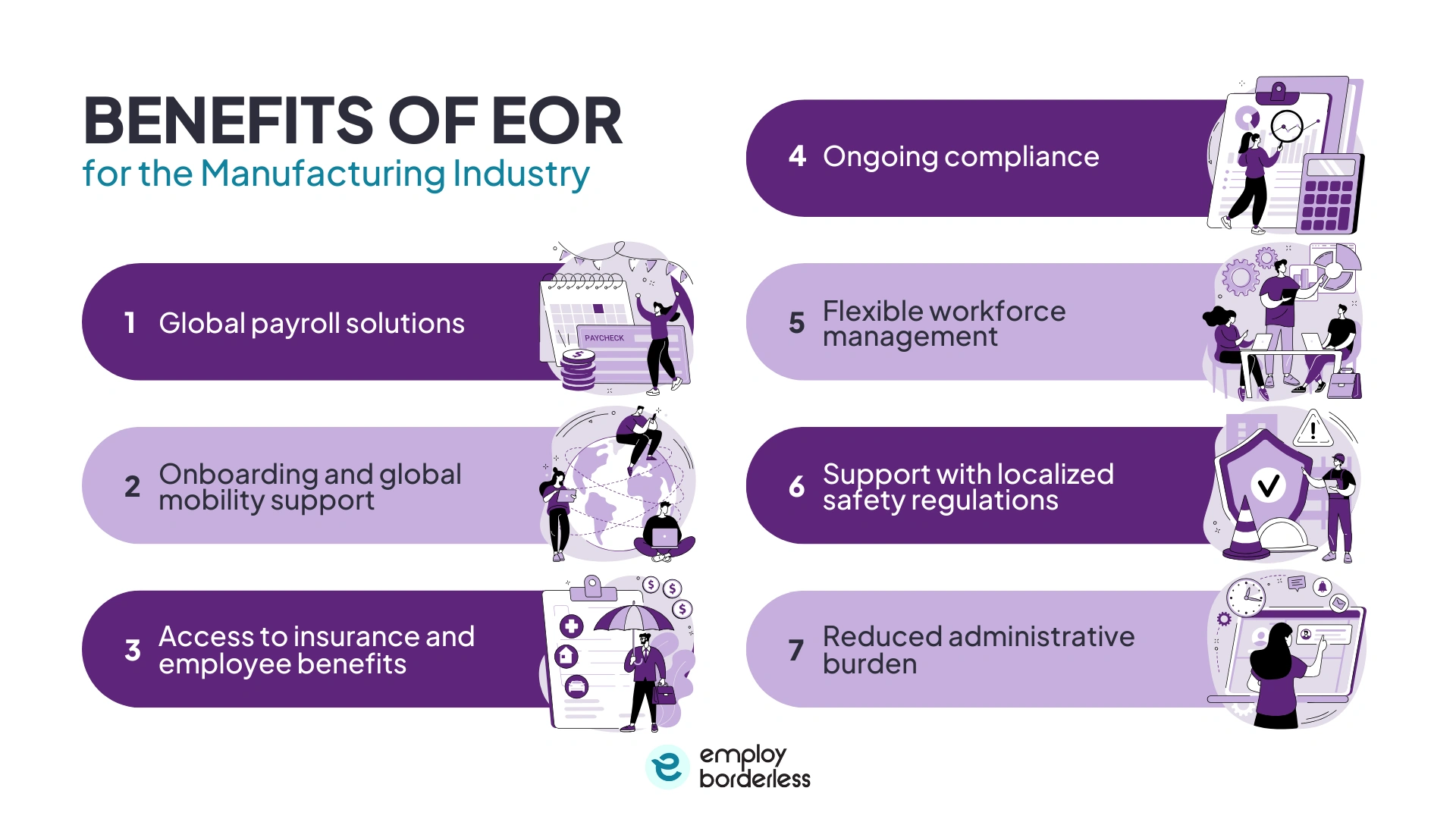
The benefits of EOR for the manufacturing industry include global payroll solutions, onboarding and global mobility support, access to insurance and employee benefits, ongoing compliance, flexible workforce management, support with localized safety regulations, and reduced administrative burden.
Global payroll solutions
Global payroll solutions mean that an EOR makes sure manufacturing companies pay employees accurately and on time across different countries. This external service provider handles multi-currency payments, tax withholdings, and compliance with local payroll laws. It provides consistency in payroll management, which reduces the risk of errors and delays. This uniform payroll management allows manufacturers to focus on operations rather than handling complex international payroll structures.
Onboarding and global mobility support
Onboarding and global mobility support mean simplifying the process of hiring and relocating employees across borders. The EOR handles visa and work permit documentation required for global assignments. This structured approach reduces delays and helps maintain compliance with immigration regulations. It allows manufacturers to onboard skilled talent quickly where it is required.
Access to insurance and employee benefits
Access to insurance and benefits packages allows manufacturers to offer competitive compensation and attract skilled workers. The EOR provides access to healthcare, retirement plans, and other employee benefits, such as vision, dental, and life insurance, according to local standards. These employee benefits create equity across global teams and increase employee satisfaction. An EOR also reduces administrative complexity by centralizing benefit management through a single provider.
Ongoing compliance
Ongoing compliance means an EOR makes sure that manufacturing operations follow labor, tax, and employment laws such as FLSA (Fair Labor Standards Act) in every location. This global employment service actively monitors regulatory changes to prevent non-compliance risks. This active compliance management reduces penalties, legal disputes, and operational disruptions. The EOR helps manufacturers maintain a trustworthy and compliant global presence.
Flexible workforce management
Flexible workforce management allows manufacturers to scale their labor needs based on production demand. The EOR makes it easy to hire temporary, seasonal, or contract workers while maintaining compliance. This flexibility improves operational productivity and reduces additional labor costs during slow periods. This employment partner also supports smooth transitions between projects or production cycles.
Support with localized safety regulations
Support with localized safety regulations means EORs make sure workplace standards comply with country-specific laws, such as OSHA (Occupational Safety and Health Administration). The EOR helps put proper safety measures and training programs in place for manufacturing workers. This guidance protects workers and reduces the risk of liabilities in case of workplace accidents. The Employer of Record also improves the company's reputation for maintaining safe and ethical working conditions.
Reduced administrative burden
Reduced administrative burden allows manufacturers to focus on production and creation rather than managing HR paperwork. The EOR manages payroll, contracts, taxes, and compliance reporting for the manufacturing company. This centralized approach reduces repetitive work and human error, supporting informed decision-making and improving operational productivity across global teams.
How does an EOR simplify HR compliance for manufacturers?
An EOR simplifies HR compliance for manufacturers through centralized compliance management, automated recordkeeping and reporting, regular policy updates and legal monitoring, and proper employee classification and documentation.
Centralized compliance management allows manufacturers to manage all HR regulations through a single EOR partner rather than multiple local entities. This expert compliance management makes sure that tax filings, employee contracts, and labor documentation comply with country-specific legal standards.
The EOR maintains accurate employee data, tax information, and compliance reports through automated systems, which lowers manual errors. This automation allows the EOR to submit payroll taxes, benefits reports, and employment forms on time and provide compliance across all regions where the manufacturer operates.
The EOR provides regular updates to company policies and practices to maintain compliance with changing labor laws, such as OSHA (Occupational Safety and Health Administration) and industry standards. It regularly monitors legal developments in every country where the manufacturer performs business operations.
Proper classification of employees, contractors, and temporary staff prevents legal and tax-related complications. The EOR verifies employment types under local laws to offer accurate payroll and benefit allocation. This process reduces the risk of worker misclassification and possible lawsuits.
How to choose the right EOR for your manufacturing company?
To choose the right EOR for your manufacturing company, consider factors such as experience and expertise, geographic reach, technology and automation capabilities, and scalability and flexibility.
Choose an EOR with proven experience in the manufacturing industry, and make sure they understand workforce challenges such as union relations, shift-based operations, and OSHA (Occupational Safety and Health Administration) compliance.
Select an Employer of Record that offers strong global and local coverage, and verify that it has expertise in handling employment laws, taxes, and benefits across the regions where you operate or plan to expand.
Partner with an EOR that uses modern technology to automate payroll, compliance tracking, and employee data management. Request demonstrations of their reporting dashboards and integration options with your existing systems.
Prioritize an EOR that can scale its services according to your workforce size and business growth. Confirm that it handles seasonal hiring, production surges, and new market entries accurately.
How can an EOR help with skilled labor shortages for manufacturers?
An EOR can help with skilled labor shortages for manufacturers by providing quick access to global talent pools. It manages hiring, onboarding, and compliance for international workers to make sure that production continues without delays. This approach allows manufacturers to fill specialized roles quickly while maintaining compliance with local employment and labor laws.
What is the difference between EOR and COR?
The difference between EOR and COR is that an EOR (Employer of Record) is a third-party organization that legally employs workers on behalf of a company and manages payroll and compliance across different regions. A COR (Contractor of Record) manages independent contractors by handling their classification, payments, and tax compliance without becoming their legal employer.
Can manufacturing companies save costs by using an EOR?
Yes, manufacturing companies can save costs by using an EOR, as it reduces the need to set up local entities, lowers administrative and compliance expenses, and prevents the risk of costly legal penalties. The EOR also simplifies payroll, benefits, and HR operations, which allows manufacturers to focus on production and development.
What role does an EOR play in the retail industry?
An EOR plays an important role in the retail industry by managing HR, payroll, and compliance across multiple locations. The EOR for the retail industry helps retailers hire and onboard staff quickly, especially during peak seasons, while complying with labor laws like the FLSA (Fair Labor Standards Act).
What are the benefits of using EOR software in the manufacturing industry?
The benefits of using EOR software in the manufacturing industry include automating payroll, compliance tracking, and workforce management across multiple sites. EOR software also offers accurate payments, tax filings, and compliance with labor and safety regulations like OSHA (Occupational Safety and Health Administration).

Co-founder, Employ Borderless
Robbin Schuchmann is the co-founder of Employ Borderless, an independent advisory platform for global employment. With years of experience analyzing EOR, PEO, and global payroll providers, he helps companies make informed decisions about international hiring.
Learning path · 8 articles
EOR fundamentals
Master the fundamentals with our step-by-step guide.
Start the pathReady to hire globally?
Get a free, personalized recommendation for the best EOR provider based on your needs.
Get free recommendations