EOR certifications: definition, list, importance, and challenges

Robbin Schuchmann
Co-founder, Employ Borderless
EOR (Employer of Record) certifications make sure that an Employer of Record meets recognized global standards for payroll, compliance, and employee management. The EOR certifications show an EOR's ability to securely handle sensitive employee data, comply with labor laws, and follow international tax and payroll regulations.
The certifications required for a legally compliant EOR include ISO 9001 (Quality), ISO 27001 (Security), SOC 1 (Payroll and financial controls), SOC 2 (Compliance), and GDPR (Privacy). The industry-specific certifications for EORs are PCI DSS (Payment Card Industry Data Security Standard), HIPAA (Health Insurance Portability and Accountability Act), CSA STAR (Cloud Security Alliance Security, Trust, Assurance, and Risk), and OSHA (Occupational Safety and Health Administration).
The certifications are important for EORs because they ensure legal compliance, data security and privacy, risk management, trust and credibility, and operational transparency and auditability. The challenges businesses face when using an EOR without proper certifications are employee dissatisfaction and turnover, legal compliance penalties, reputational damage, operational disruption, and data breaches or privacy violations.
What are EOR certifications?
EOR (Employer of Record) certifications are official credentials that confirm an EOR meets legal, regulatory, and industry standards for managing global employment and payroll. These credentials prove that the EOR is authorized and qualified to handle compliance, tax obligations, employee benefits, and labor laws on behalf of client companies. Without them, your company has no real way to verify who's actually responsible if something goes wrong. An EOR certification makes a business's international workforce legally and professionally recognized.
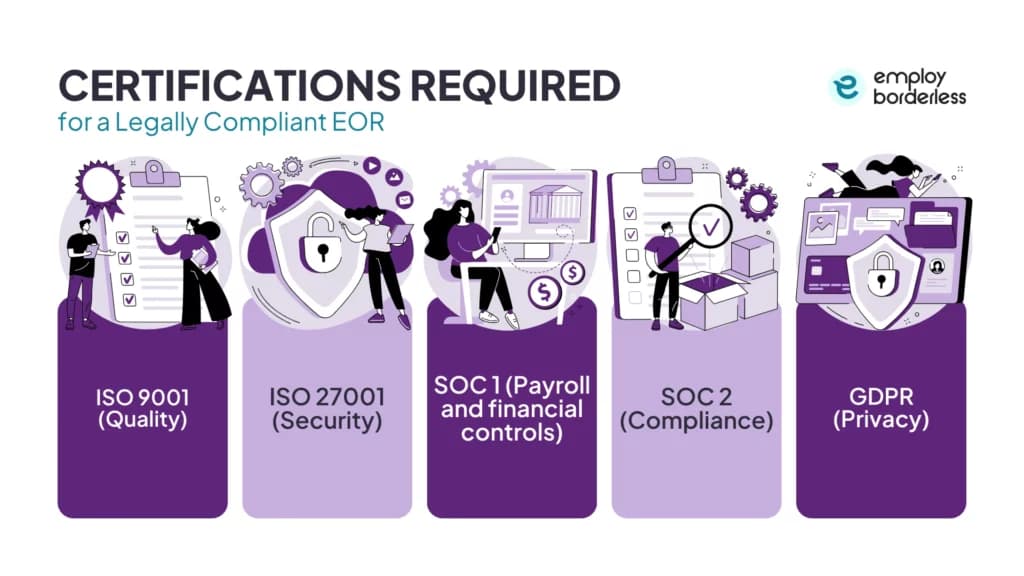
Which certifications are required for a legally compliant EOR?
The certifications that are required for a legally compliant EOR include ISO 9001 (Quality), ISO 27001 (Security), SOC 1 (Payroll and financial controls), SOC 2 (Compliance), and GDPR (Privacy).
ISO 9001 (Quality)
ISO 9001 is a global standard for quality management systems and confirms that an EOR follows structured processes to deliver reliable and consistent HR services. This certification shows that the EOR provider maintains accuracy and expertise in handling employee payments.
ISO 27001 (Security)
ISO 27001 is the international standard for ISMS (Information Security Management). It proves that an Employer of Record has strong controls to protect sensitive employee and financial data. This certification is particularly important for payroll operations, as protecting employees' personal information and preventing company data breaches are top priorities.
SOC 1 (Payroll and financial controls)
SOC 1 certification verifies that an EOR has proper internal controls over payroll and financial reporting. It guarantees clients that salary payments, deductions, and compliance-related transactions are processed accurately and securely, reducing financial risks.
SOC 2 (Compliance)
SOC 2 compliance focuses on security, availability, processing integrity, confidentiality, and privacy of employee data. This certification confirms that the EOR's systems accurately process payroll data and keep it accessible to both employers and employees.
GDPR (Privacy)
An EOR with GDPR (General Data Protection Regulation) compliance protects employees' personal data. It handles employee information, such as tax IDs and bank details, with complete privacy according to international data protection rules.
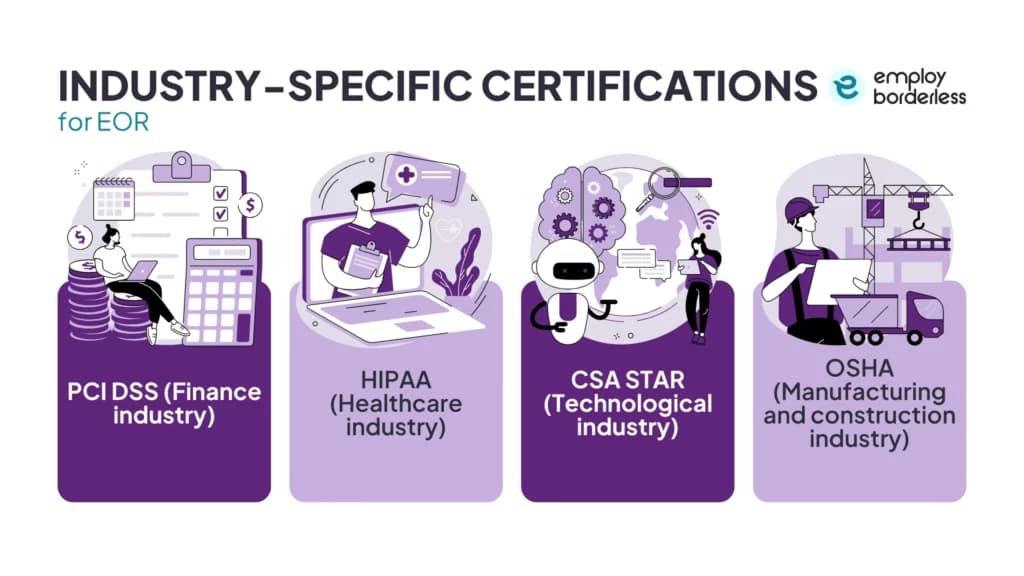
What are some industry-specific certifications for EORs?
Some industry-specific certifications for EORs are PCI DSS (Payment Card Industry Data Security Standard), HIPAA (Health Insurance Portability and Accountability Act), CSA STAR (Cloud Security Alliance Security, Trust, Assurance, and Risk), and OSHA (Occupational Safety and Health Administration).
PCI DSS (Finance industry)
The PCI DSS (Payment Card Industry Data Security Standard) handles payment card data safely. This certification is for an EOR working with financial institutions or employees paid through card systems and provides a secure process for payroll transactions while reducing the risk of fraud.
HIPAA (Healthcare industry)
The HIPAA (Health Insurance Portability and Accountability Act) sets strict rules for handling medical and health-related data. An EOR supporting healthcare must comply with HIPAA to protect employee health benefits, insurance claims, and sensitive medical records.
CSA STAR (Technological industry)
The CSA STAR (Cloud Security Alliance Security, Trust, Assurance, and Risk) certification focuses on cloud security for technology-based businesses. This certification shows that EORs serving technology firms use secure cloud-based payroll and HR systems to keep employee information safe from cyber threats and unauthorized access.
OSHA (Manufacturing and construction industry)
The OSHA (Occupational Safety and Health Administration) sets workplace standards to maintain safe working conditions. An EOR managing employees in manufacturing or construction confirms OSHA compliance and implements safety practices to protect workers from legal and safety risks.
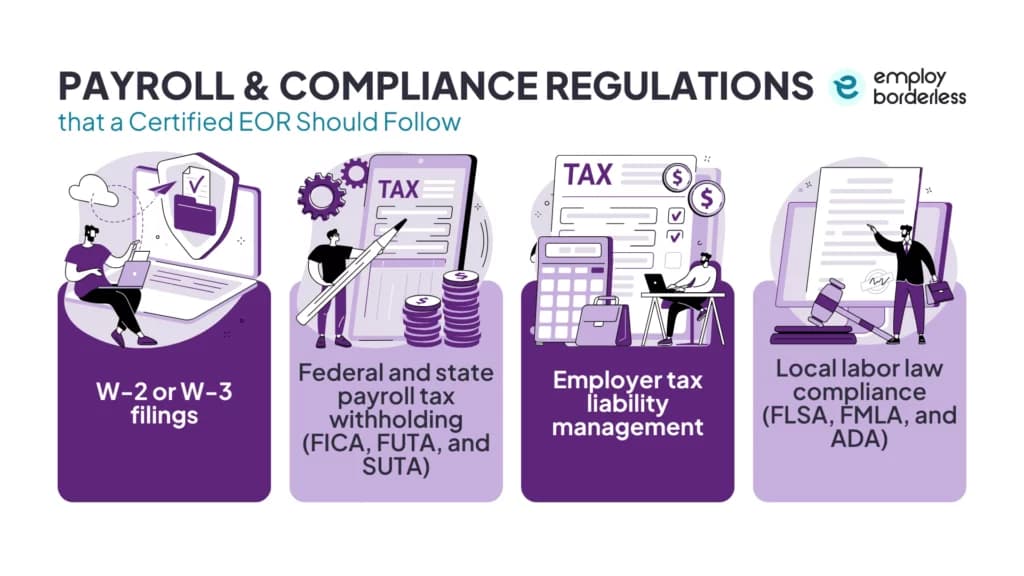
Which payroll and compliance regulations should a certified EOR follow?
The payroll and compliance regulations that a certified EOR should follow include W-2 or W-3 filings, federal and state payroll tax withholding (FICA, FUTA, and SUTA), employer tax liability management, and local labor law compliance (FLSA, FMLA, and ADA).
W-2 or W-3 filings
The W-2 form reports an employee's annual wages and taxes withheld, while the W-3 form summarizes all W-2s for the SSA (Social Security Administration). A certified EOR handles these filings to confirm that all employees and authorities receive accurate year-end payroll information.
Federal and state payroll tax withholding (FICA, FUTA, and SUTA)
The FICA (Federal Insurance Contributions Act) covers Social Security and Medicare taxes, while FUTA (Federal Unemployment Tax Act) and SUTA (State Unemployment Tax Act) cover unemployment insurance. An EOR calculates these withholdings correctly and submits them on time to avoid underpayment or penalties.
Employer tax liability management
Employer tax liability management involves managing the employer's share of payroll taxes, like Social Security, Medicare, and unemployment contributions. A certified EOR tracks all these obligations to pay employees timely and avoids interest charges or legal action while keeping the business compliant.
Local labor law compliance (FLSA, FMLA, and ADA)
Local labor law compliance includes the FLSA (Fair Labor Standards Act), which regulates minimum wage, overtime, and work hours, while the FMLA (Family and Medical Leave Act) provides unpaid leave for eligible workers. The ADA (Americans with Disabilities Act) protects employees against workplace discrimination. A certified EOR confirms that businesses meet these legal standards when managing employees to reduce legal risks and treat employees fairly.
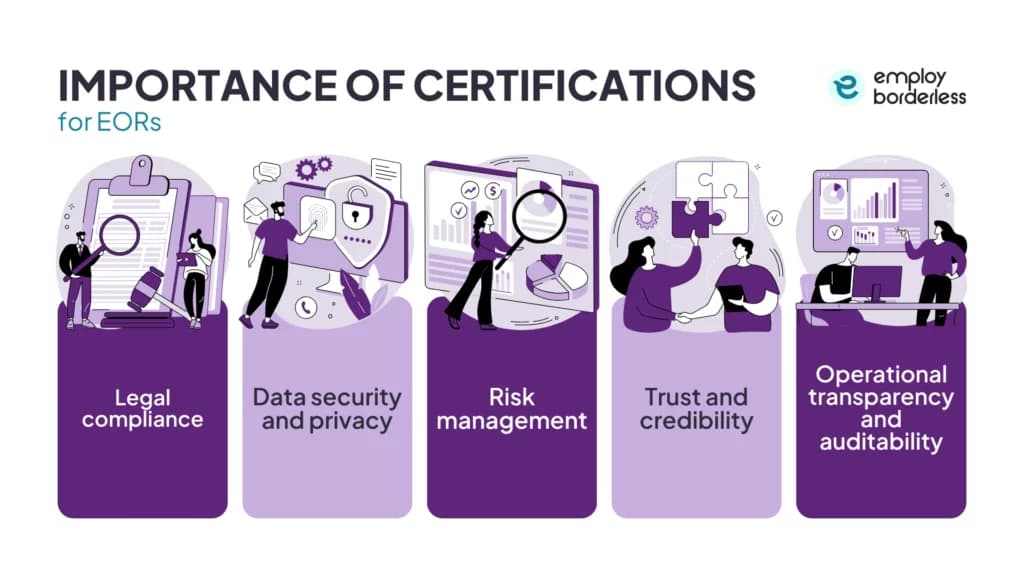
Why are certifications important for EORs?
Certifications are important for EORs because they ensure legal compliance, data security and privacy, risk management, trust and credibility, and operational transparency and auditability.
The reasons why certifications are important for EORs are mentioned below.
- Legal compliance: Certifications show that an EOR follows labor laws, tax regulations, and employment standards in every country where it operates. This compliance reduces the risk of fines or lawsuits for client companies.
- Data security and privacy: EOR certifications like ISO 27001 and GDPR (General Data Protection Regulation) compliance prove that sensitive employee and payroll data is protected against breaches. The increasing cyber threats make it necessary for payroll systems to use SSL encryption, secure servers, and strict access controls.
- Risk management: Certified EORs have structured systems to identify, reduce, and manage risks in payroll, compliance, and data handling. This risk management includes preventing payroll errors, fraud, or incorrect filings that may harm a company financially or legally.
- Trust and credibility: EOR certifications build client confidence that an EOR operates with professionalism and transparency. It reassures businesses that the provider is audited, verified, and capable of managing complex payroll operations across borders.
- Operational transparency and auditability: Certifications require detailed record-keeping and regular audits, which create transparent payroll operations. This transparency means client companies are able to review payroll processes anytime and confirm accuracy.
What challenges do businesses face when using an EOR without proper certifications?
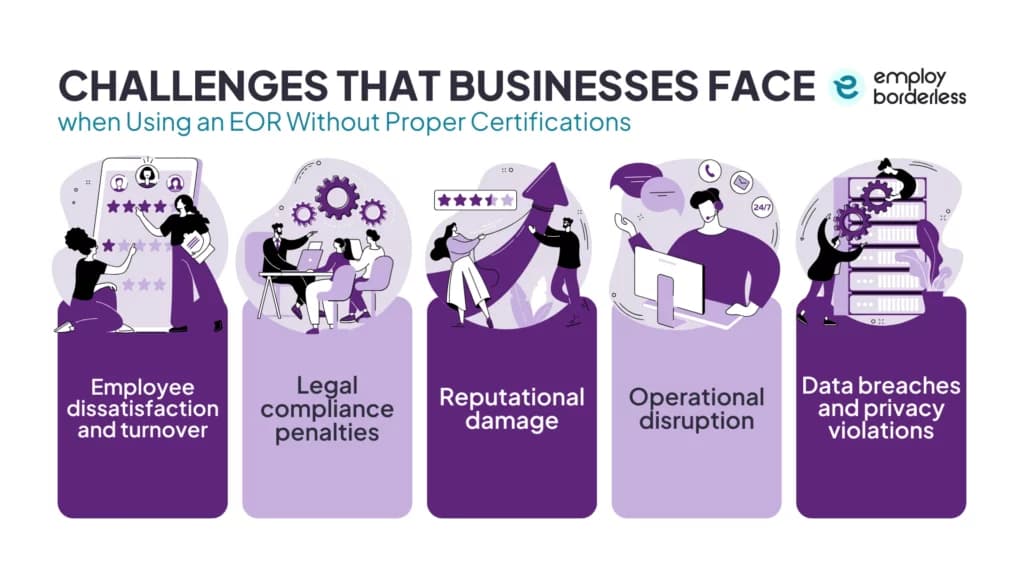
The challenges that businesses face when using an EOR without proper certifications are employee dissatisfaction and turnover, legal compliance penalties, reputational damage, operational disruption, and data breaches and privacy violations.
The challenges that businesses face when using an EOR without proper certifications are discussed below.
- Employee dissatisfaction and turnover: An uncertified EOR often causes payroll delays or inaccuracies, and it directly impacts employees. Such errors reduce trust and increase employee turnover, so businesses need to spend more time and cost on rehiring and training.
- Legal compliance penalties: A provider that lacks proper EOR certifications fails to follow tax, labor, and reporting laws, which puts businesses at risk of fines, penalties, and legal disputes, especially in multi-country operations.
- Reputational damage: A company that works with a non-certified EOR (Employer of Record) is at risk of payroll mistakes, compliance failures, and poor data handling. These issues damage the company's reputation with employees, regulators, and industry partners.
- Operational disruption: An uncertified EOR often lacks a structured system to manage payroll effectively. This unstructured payroll system results in businesses facing payment delays, mismatched records, and interruptions in financial processes.
- Data breaches and privacy violations: An EOR that does not follow certified security practices exposes sensitive employee information. Data breaches and misuse of employee records create serious legal consequences and reduce worker confidence.
How to choose a legally compliant EOR for your business?
To choose a legally compliant EOR for your business, consider factors like evaluating their experience and expertise, checking for certification and accreditations, assessing their service offerings, evaluating their technology and tools, and reviewing client testimonials.
Evaluate the experience and expertise of a reliable EOR, which includes managing payroll compliance and HR across multiple countries. An expert EOR handles complex labor laws and maintains smooth business operations.
Check for certifications and accreditations such as ISO 27001, SOC 1, SOC 2, and GDPR (General Data Protection Regulation) compliance to confirm that the EOR follows these international standards. These accreditations show their commitment to data security, payroll accuracy, and legal compliance.
Assess their service offerings to determine whether the EOR provides more than payroll, such as benefits, administration, compliance management, and employee onboarding. Reviewing their range of services helps confirm they meet current and future business needs.
Evaluate their technology and tools before choosing an EOR to determine whether they use cloud-based platforms and secure integrations. These tools improve payroll accuracy, support compliance, and provide real-time analytics. Businesses should also look for user-friendly technology that simplifies their payroll management.
Reading client testimonials informs clients about the EOR's reliability and quality of service. Positive testimonials show trust, timely payroll processing, and good customer support. Businesses should also review case studies to understand how the selected EOR handles operational challenges.
Can a certified EOR help with international hiring?
Yes, a certified EOR can help with international hiring by legally employing workers on behalf of a company in different countries. It also handles compliance with local labor laws, payroll taxes, and benefits to reduce legal and administrative risks.
Is using an EOR cost-effective for small businesses?
Yes, using an EOR is cost-effective for small businesses because it removes the need to establish costly local entities and hire legal or HR experts in each country. It helps avoid compliance penalties, reduces administrative workload, and makes payroll management smooth.
What services does an EOR provide?
The services that an EOR provides include hiring and onboarding employees on behalf of a company, managing payroll, handling tax compliance, and administering benefits. EOR services also include compliance with local labor laws to reduce compliance risks.
What is the difference between a PEO and an EOR?
The difference between a PEO and an EOR is that a PEO collaborates with a business through a co-employment model, where both the company and the PEO share employer responsibilities. An EOR (Employer of Record) becomes the sole legal employer and takes full legal responsibility for employment, which includes compliance with local labor laws and tax regulations.
Can EOR work globally without certifications?
No, an EOR cannot work globally without certifications, because expert understanding of local laws and regulations is important. The main function of an EOR is to ensure compliance and manage HR complexities in multiple countries, which is not possible without the proper certifications and expert understanding of local regulations.
How much does an EOR cost?
An EOR costs $200 to $500 per employee per month. EOR cost depends on the pricing structure, company size, employment contract type, and the number of employees the company plans to hire.
Which terms should a certified EOR contract include?
The terms of a certified EOR contract should include clearly defined responsibilities for both the EOR and the client company, detailed employment terms (job role, salary, work hours), and transparency regarding all fees and costs.

Co-founder, Employ Borderless
Robbin Schuchmann is the co-founder of Employ Borderless, an independent advisory platform for global employment. With years of experience analyzing EOR, PEO, and global payroll providers, he helps companies make informed decisions about international hiring.
Learning path · 8 articles
EOR fundamentals
Master the fundamentals with our step-by-step guide.
Start the pathReady to hire globally?
Get a free, personalized recommendation for the best EOR provider based on your needs.
Get free recommendations