PEO vs payroll service: definition, differences, similarities, benefits, and drawbacks

Robbin Schuchmann
Co-founder, Employ Borderless
A PEO (Professional Employer Organization) is a human resource outsourcing service that helps businesses with different HR tasks, such as onboarding, payroll, and benefits administration. A payroll service provider is a third-party service that manages payroll functions, such as pay calculations, tax withholding, and compliance.
The main differences between PEO and a payroll service are legal and compliance responsibilities, HR services and employee benefits, cost structures and pricing models, scalability and flexibility, technology use, employer control and autonomy, and termination and exit considerations. The similarities between PEO and a payroll service are payroll administration, compliance support, tax management, employee tax reporting, and access to technology.
The major benefits of PEO are HR compliance, payroll and tax administration, employee benefits access, recruiting and talent management support, and cost savings, while the payroll service’s benefits include time savings, accuracy and compliance, direct deposit and pay stub generation, and employee self-service portals.
Despite these benefits, there are some drawbacks to using a PEO, which include loss of control, co-employment confusion, cost transparency issues, and limited customization, while those of a payroll service are data security and privacy risks, compliance and regulatory errors, loss of control, and hidden costs.
What is a PEO?
A PEO is a third-party organization that enters into a co-employment agreement with businesses to provide HR services, which include payroll and tax administration, benefits administration, compliance, employee recruiting and onboarding, and risk management.
How does a PEO work?
A PEO works by forming a co-employment relationship with a client business, where this outsourced model becomes the official employer of record for payroll, tax, and benefit purposes. The client company maintains control over daily operations, which include employee and performance management, finances, and product development. The PEO and the client company both share employer and legal responsibilities in this partnership.
What is a payroll service?
Payroll service is a third-party PSP (Payroll Service Provider) that manages the calculation and distribution of employee compensation on behalf of the client business. This saves businesses from manual payroll processing and ensures compliance with legal requirements.
How does a payroll service work?
Payroll service works by automating payroll tasks, such as paying employees, handling calculations, wage deductions, and tax filings. It makes sure employees receive accurate and timely payments while reducing the risk of overpayment and underpayment and manual errors in payroll processing.
What are the differences between PEO and a payroll service?
The differences between PEO and payroll service are legal and compliance responsibilities, HR services and employee benefits, cost structures and pricing models, scalability and flexibility, technology access, employer control and autonomy, and termination and exit considerations.
| Differences | PEO | Payroll service |
| Legal and compliance responsibilities | Responsible for tax liabilities and filings | Prepare tax forms only, and the employer handles liabilities |
| HR services and employee benefits | Offers complete HR services and premium employee benefits | Focus on payroll and taxes |
| Cost structures and pricing models | Percentage of payroll or PEPM (Per Employee Per Month) | Flat fee or per employee |
| Scalability and flexibility | Ideal for growing businesses, but it offers limited flexibility | Works best for basic payroll needs |
| Technology use | Provides advanced HR technology (HRIS platform and employee self-service tools) | Focused on payroll software and platforms |
| Employer control and autonomy | Co-employer and shared control | Employer maintains full control and autonomy |
| Termination and exit considerations | More complex to terminate | Easy to switch or terminate |
Legal and compliance responsibilities
A PEO enters into a co-employment agreement, which means it becomes the employer of record for purposes such as payroll, tax filings, benefits administration, and regulatory compliance. The business maintains control over routine daily operations and employee management. Both the business and the outsourced model share legal responsibility in case of a legal violation, even if the PEO makes errors in tax filings or compliance breaches.
A PSP (Payroll Service Provider) does not become the legal employer. The business remains fully responsible for its employees and all compliance responsibilities. The PSP acts as a service vendor that handles payroll processing and does not share any legal or regulatory responsibility.
HR services and employee benefits
This third-party HR service provider offers complete access to HR solutions, which include employee onboarding and offboarding, policy development, employee handbooks, performance management, benefits administration, and compliance support. PEOs also allow small and medium-sized businesses access to high-quality and large-group benefits, such as health insurance and retirement plans, at affordable insurance rates. Payroll service only focuses on wages and tax administration, which means they do not manage benefits, handle employee relations, or provide HR consulting.
Cost structures and pricing models
PEOs charge a percentage of a business’s total payroll, which ranges from 2 to 12%, or a PEPM fee (Per Employee Per Month). It includes bundled services like benefits, HR support, and compliance support. Payroll service charges a flat monthly fee or per-employee charge, as it offers fewer services, which include payroll calculations, basic reporting, and tax filings. The businesses have the flexibility to purchase only the services they require, which also reduces cost.
Scalability and flexibility
PEOs are ideal for growing companies as they handle complex HR tasks and ensure compliance. They provide HR consulting and handle time-consuming administrative duties like payroll processing and employee documentation, which allow businesses to focus on scaling and improving productivity. The PEO offers standardized service packages, which limit flexibility and the client’s ability to customize the services according to their needs.
Payroll services are ideal for businesses with basic payroll needs, and they also offer flexibility as the business grows. These systems easily scale to handle fluctuating numbers of employees, seasonal hiring, and multi-location operations. Payroll providers give businesses the ability to customize services, such as adding time tracking or benefits administration based on changing needs, but they do not provide full HR support. This saves cost for companies that need to manage growth without immediately investing in a full-service HR solution.
Technology use
This outsourcing model offers businesses access to advanced HR technology tools and platforms, such as cloud-based HR systems, HRIS (Human Resources Information System), and ATS (Applicant Tracking System). These systems simplify payroll, benefits administration, reporting, and onboarding for the client businesses in a centralized HR platform. These platforms also include employee self-service tools and dashboards so employees are able to update their information in real-time. Payroll service focuses on payroll-only software and a basic reporting tool, which handles paychecks, tax withholdings, and filings.
Employer control and autonomy
The client business and the PEO are co-employers, which means they share responsibility for employees in a PEO arrangement. They also share a decision-making process, and the business also has to adjust to the PEO’s systems for processes like hiring, firing, policy implementation, and employee relations. This arrangement results in less autonomy for the business.
Payroll services give the company complete control over all benefits, rules, and personnel practices. The service provider has no authority in internal HR decisions, as they only help with payroll operations and paperwork.
Termination and exit considerations
Exiting a PEO is administratively complex, as the PEO is the employer of record and files taxes under its own EIN (Employer Identification Number). It becomes difficult for businesses to leave the arrangement as it requires rehiring all employees under their own EIN, setting up new benefit plans, and managing fresh compliance documentation.
Payroll service’s exit process is much simpler because the legal employer relationship never changes. This makes it easy to switch providers or change payroll in-house without major disturbance to operations, employee records, or compliance processes.

What are the similarities between a PEO and a payroll service?
The similarities between a PEO and a payroll service are payroll administration, compliance support, tax management, employee tax reporting, and access to technology.
Payroll administration
Payroll administration involves managing employee compensation, tax withholdings, and regulatory compliance to make accurate and timely payments.
Both PEO and payroll services handle payroll administration, which includes calculating wages, direct deposits, processing paychecks, and distributing employee payslips. These services simplify payroll operations for client businesses, reduce manual errors in tax filings, and guarantee timely and correct employee payments, which improves overall workforce satisfaction and administrative productivity.
Compliance support
Compliance support refers to third-party support that ensures businesses comply with relevant labor and tax laws, regulations, and policies to avoid legal risk and penalties.
The PEO and payroll service help businesses comply with payroll tax regulations and reporting requirements. The outsourced HR model offers more comprehensive compliance support by actively managing regulatory risk, handling filings under their own EIN. They help businesses meet employment-related requirements like workers’ compensation, unemployment insurance, and labor law compliance. PSPs commonly give tools or automated alerts to support timely tax filings and reduce payroll errors, but they do not take legal responsibility.
Tax management
Tax management means accurately calculating, withholding, reporting, and submitting payroll-related taxes to legal authorities through PEO and payroll service providers.
PEOs handle all standard tax management tasks under their own EIN. They calculate and submit payroll taxes and also share legal liability with the client’s business. PEOs use their expertise to manage complex multi-state tax rules, monitor legal changes, and protect clients from penalties and legal actions.
The payroll service provider handles tasks such as calculating payroll taxes, deducting the correct amounts, filing returns, creating tax forms, like W-2s and 1099s, and submitting taxes on behalf of the client company. They provide tools and automation for accurate tax reporting, but the business maintains the legal responsibility.
Employee tax reporting
Employee tax reporting is the process of documenting and reporting employee wages and the withheld taxes to both employees and tax authorities.
PEOs manage employee tax reporting because they are the official employer of record and file taxes under their own EIN. They also make sure that employees receive the correct documents on time. The payroll service also creates forms W-9s and 1099s on behalf of the client business using the client’s EIN, as they are not the legal employer. PSP guarantees proper documentation for the employees and tax authorities.
Access to technology
Access to technology means PEO and the payroll service give client businesses access to advanced technology that helps simplify HR and payroll operations.
Both service providers, PEO and the payroll service, offer digital tools that process pay runs, handle deductions, and generate payroll reports or employee payslips. These platforms integrate time‑tracking tools for accurate data flow and fewer manual errors. PEO’s HR platforms and PSP software both provide client businesses and their employees access to dashboards and portals to view pay history, update personal details, request time off, or submit tax information.
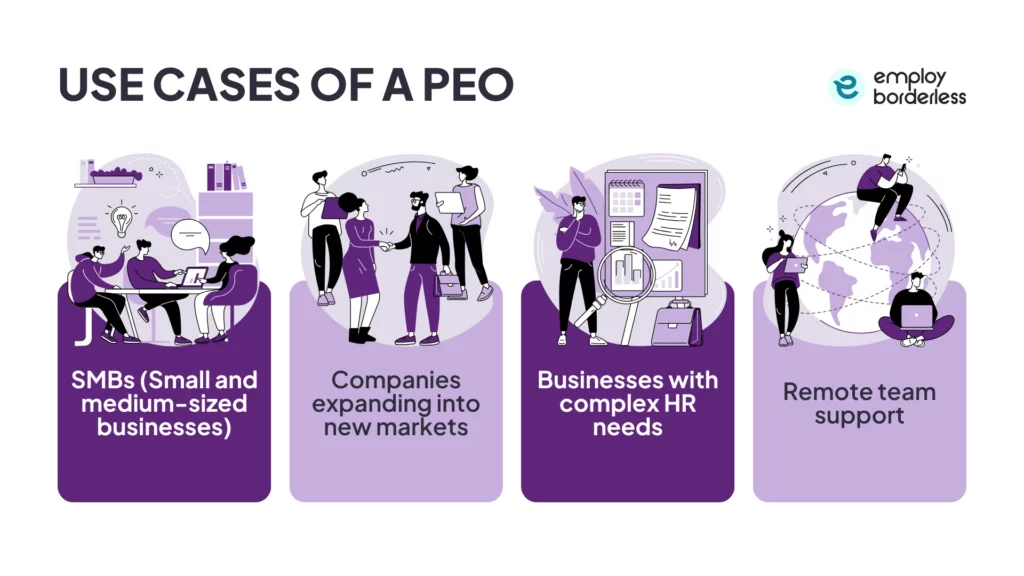
What are the use cases of a PEO?
The use cases of a PEO include small and medium-sized businesses, companies expanding into new markets, businesses with complex HR needs, and remote team support.
The use cases of a PEO are listed below.
- SMBs (Small and medium-sized businesses): Small and medium-sized businesses lack the internal resources for accurate payroll, benefits, HR, and compliance management. A PEO allows SMBs to concentrate on business expansion by reducing administrative costs and improving employee benefit offerings.
- Companies expanding into new markets: Companies expanding into new markets face complex labor regulations and compliance responsibilities. A PEO helps these businesses comply with different local laws and reporting responsibilities in each jurisdiction by providing an expert compliance team. This reduces the risk of legal issues and guarantees a smooth international expansion.
- Businesses with complex HR needs: Businesses deal with complex HR needs, compliance challenges, multi-state operations, or high employee turnover. PEOs help organizations simplify HR procedures, receive professional advice, and maintain uniformity across fluctuating workforces. They also offer risk management, specialised HR support, and solutions that make complex personnel management easier for businesses.
- Remote team support: Businesses face many problems in managing a remote workforce, which include virtual engagement, remote onboarding, and differing state laws. PEOs help simplify remote team operations to ensure compliance across different sites and provide remote workers with dependable support and benefits, such as access to healthcare, retirement plans, and employee self-service portals.
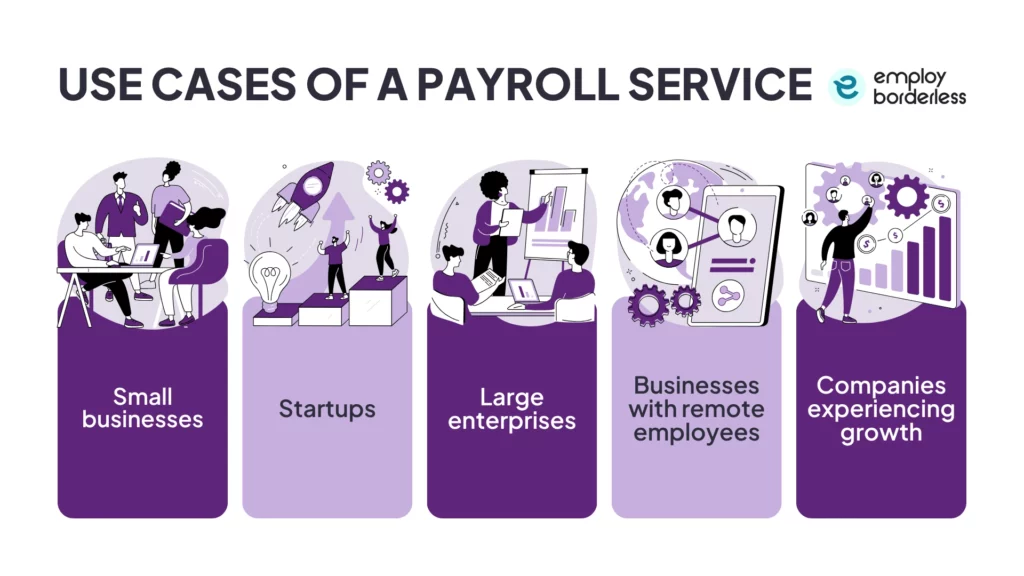
What are the use cases of a payroll service?
The use cases of a payroll service are small businesses, startups, large enterprises, businesses with remote employees, and companies experiencing growth.
The use cases of a payroll service are listed below.
- Small businesses: Small businesses lack dedicated HR or finance departments, so they use payroll services to automate salary processing, tax filing, and compliance, which also saves time and reduces errors.
- Startups: Startups use payroll services as they face challenges like limited administrative resources, lack of payroll expertise, tax compliance risks, and the need to scale their workforce. Payroll services offer scalable solutions that grow with the business. They ensure compliance with local and federal regulations, automate tax filings and withholdings, simplify initial payroll setup, reduce manual work, and save time, which allows employers to focus on business growth.
- Large enterprises: Large enterprises handle complex payroll systems across different workforce departments and locations, so they use payroll services as they offer accurate, on-time payments, provide enterprise-level customization, and integrate advanced payroll software with HR and finance systems. These services reduce compliance risk by automating updates to tax and legal calculations, offer real-time reporting and analytics, and advance payroll operations across multiple locations or globally.
- Businesses with remote employees: Businesses with remote employees have to manage direct deposits, currency conversions, and record different time zones and work hour tracking. They use payroll services to make sure that remote workers are paid on time and accurately by managing direct deposits, multi-state or global tax laws, and compliance for distributed teams.
- Companies experiencing growth: Companies experiencing growth utilize payroll services to manage increased employee services, automate the administration of taxes and benefits, manage compensation, and accurately expand payroll operations to avoid internal HR and finance issues.
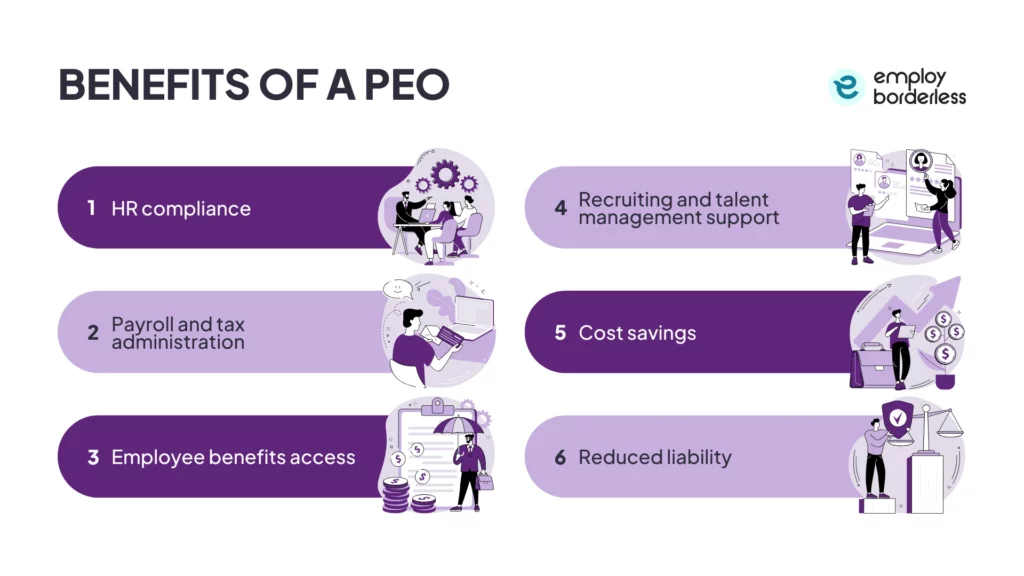
What are the benefits of a PEO?
The benefits of a PEO are HR compliance, payroll and tax administration, employee benefits access, recruiting and talent management support, cost savings, and reduced liability.
HR compliance
HR compliance means PEO makes sure businesses follow employment-related laws and regulations at the federal, state, and local levels, which include wage and hour laws, employee classification, and workplace safety protocols.
PEOs provide compliance experts who stay up to date with changing labor and employment laws across all jurisdictions where the client operates. This ensures the client company remains compliant without needing in-house legal or HR expertise. This third-party service provider reduces internal teams’ daily compliance burden by managing duties, such as payroll tax filings, wage law compliance, employee classification, and benefits administration. The PEO also helps avoid costly fines and legal action for misclassifying employees, tax filing problems, or non-compliance with benefits.
Payroll and tax administration
Payroll and tax administration is the process of managing employee compensation and tax responsibilities. It includes calculating wages, deducting employee and employer taxes, like income tax, Social Security, and Medicare, filing necessary tax reports, and submitting tax payments to legal authorities.
This outsourced model becomes a co-employer when it partners with a business and takes on responsibility for payroll and tax administration. PEOs handle all aspects of payroll, which include calculating wages, deducting federal, state, and local taxes, such as unemployment insurance and income tax, and preparing paychecks or direct deposits.
They also manage all related filings and remittances, filing under their own EIN to guarantee accurate and timely submissions. The PEO also handles payroll tax accounts, withholding, unemployment filings, W‑2 and 1099 distributions, and reduces administrative burdens from client companies as the legal employer on paper.
Employee benefits access
Employee benefits access means PEOs provide non-wage compensation to the employees of a client business, with their regular salary, such as health insurance and retirement plans.
PEOs allow client businesses access to premium employee benefits, which are particularly beneficial for SMBs (Small and Medium-Sized Businesses). PEOs pool employees from many client companies to negotiate better rates and coverage with insurance providers for SMBs, as they are unable to secure these insurance plans on their own.
The types of insurance benefits provided by PEOs are health, dental, vision, group life, and disability insurance. They also offer retirement plans, like 401(k), wellness programs, commuter benefits, and EAPs (Employee Assistance Programs). Businesses that use PEOs provide high-quality benefit plans as they increase employee retention and satisfaction, and also reduce employee turnover rates.
Recruiting and talent management support
Recruiting and talent management support involves PEO’s full-service recruitment and talent management resources to businesses, which include advanced HR tools for simplifying hiring, onboarding, and managing workforce development.
A PEO handles the entire hiring process of recruiting, from creating job descriptions and posting openings to sourcing candidates, screening resumes, and conducting background checks. They also use candidate assessments and ATS (Applicant Tracking Systems) to improve the hiring process and quality. The PEO, after hiring a candidate, manages the new hire’s paperwork, such as tax forms, compliance documentation, enrollment in benefits, and orientation to the company policies and culture.
This third-party service provider also helps establish performance management systems, which include goal-setting systems, regular reviews, and leadership coaching, to match employee performance with strategic objectives. They also provide training and development plans to increase productivity and promote long-term growth.
Cost savings
Cost savings refer to the reduction of business expenses achieved through PEO’s outsourcing of HR functions like payroll, benefits administration, and compliance.
PEOs handle routine administrative HR tasks like payroll, tax filing, and compliance, which reduces the need for in-house HR staff and lowers administrative overhead. PEOs help businesses avoid costly penalties by ensuring compliance with complex employment laws and tax regulations. They offer premium benefits and HR support, improve employee retention, and simplify hiring and onboarding, which also reduces training expenses. These allow companies to operate more cost-effectively and focus resources on core business activities, like product development, sales, and marketing.
Reduced liability
Reduced liability means PEO shares legal and compliance responsibilities, like payroll taxes and compliance audits, which lowers the risk exposure of the client company.
The PEO assumes employer-related legal responsibilities because of the co-employment agreement with the client company. This includes staying up-to-date with employment regulations for handling payroll tax compliance, employee categorization, and workers’ compensation coverage. PEOs help lower the risk of fines, legal action, or audits by managing these complex labor areas with professional guidance. They also handle unemployment claims like discrimination or wrongful termination, such as EPLI (Employment Practices Liability Insurance), which greatly reduces a business’s financial and legal risk.
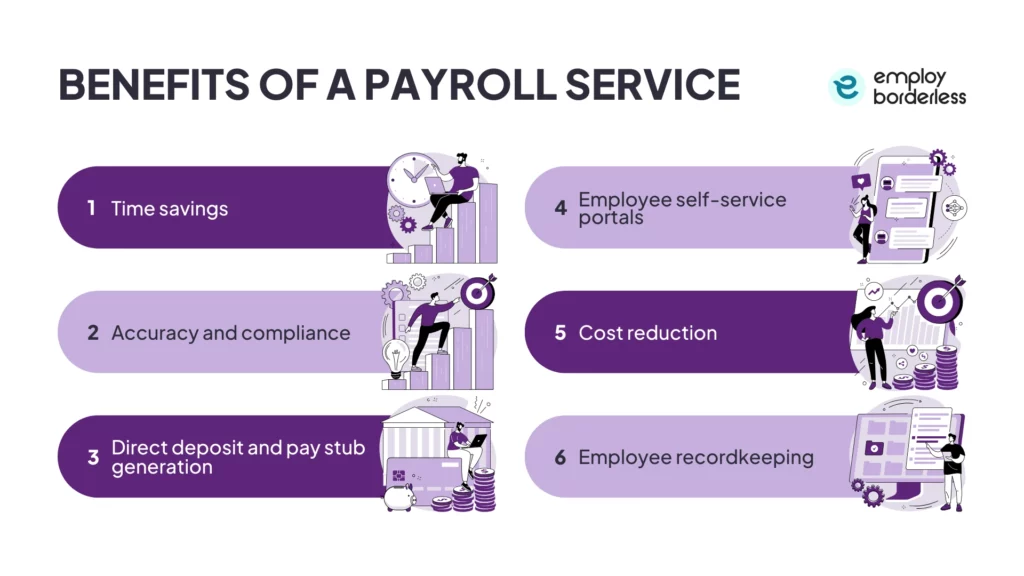
What are the benefits of payroll service?
The benefits of payroll service are time savings, accuracy and compliance, direct deposit and pay stub generation, employee self-service portals, cost reduction, and employee recordkeeping.
Time savings
Time savings is the reduction of time spent on payroll-related activities through automation and outsourcing, which include wage calculations, deduction management, direct deposit processing, and tax filing.
Payroll service automates time-consuming and routine tasks such as direct deposits, tax withholdings, wage computations, and compliance reporting. This reduces manual errors and the workload for internal finance or HR personnel. Businesses save hours or even days every pay cycle through this automation, and it allows teams to concentrate on more important tasks like planning, expansion, and employee development.
Accuracy and compliance
Accuracy and compliance mean that a payroll service makes sure employee wages are calculated and processed correctly and on time. It also ensures compliance with all relevant tax laws and labor regulations.
Payroll outsourcing increases accuracy as providers use advanced technology and expertise to reduce manual errors. Automated computations guarantee accurate tax withholdings, overtime, benefits, deductions, and gross-to-net pay. This accuracy prevents underpayments and overpayments, and increases employee trust.
Payroll services are updated regularly to monitor changes in tax, labor, and regulatory laws. This is to ensure that tax filings, withholdings, and deductions comply with local, state, and federal laws, such as FLSA (Fair Labor Standards Act), FICA (Federal Insurance Contributions Act), and ACA (Affordable Care Act). The payroll service also provides audit-ready documentation and standardized records like W-2s, tax submissions, and reconciliation reports to protect companies from costly fines and audits.
Direct deposit and pay stub generation
Direct deposit is the electronic transfer of an employee’s pay cheques directly into their bank account on payday, without requiring physical checks. Pay Stub Generation means creating thorough records of every pay cheque that include earnings, deductions, such as taxes and benefits. These stubs are usually printed for employee access or sent electronically.
Payroll services allow employee wages to be automatically transferred to their bank accounts electronically through ACH (Automated Clearing House). This reduces the administrative burden and guarantees that workers get paid on time, even when they are working remotely or travelling. Direct deposit simplifies the payroll process and also increases security by reducing the possibility of cheque loss or fraud.
Payroll systems automatically create digital pay stubs, which include earnings, deductions, withholdings, and net pay with direct deposit. These stubs are always available for employees to safely view and download. This transparency increases employee trust and allows them to verify payment data without contacting the HR department.
Employee self-service portals
Employee self-service portals are online platforms integrated with a payroll service that allow employees to independently access and manage their HR-related data, such as pay stubs, tax forms, attendance, and leave requests, without contacting HR personnel.
Payroll services provide client companies’ employees with self-service portals to safely access their pay stubs, tax records, such as W-2s, benefits information, and personal information online at any time and from any location. Employees are also able to monitor their leave balances, request time off, update their financial, contact, or tax information, and download important paperwork quickly.
This payroll service not only increases accuracy and transparency but also increases employee satisfaction by giving employees authority over their own data. This self-service feature also reduces the administrative load on HR departments as they do not have to handle manual updates and frequent employee requests.
Cost reduction
Cost reduction refers to the financial savings a company makes when it outsources payroll tasks, which include calculating gross pay and overtime, rather than managing them in-house.
Companies reduce operating costs by outsourcing payroll operations as they do not have to purchase costly specialized software or hire and train internal payroll employees. These expenses are covered by payroll suppliers instead of maintaining year-round internal payroll resources. Businesses pay a flat service fee or a fee per employee, which is less than the entire internal cost.
Expert payroll providers reduce the risk of errors in payroll calculations or compliance, which results in costly legal fines and penalties. Payroll service also reduces ongoing costs related to software licensing, system updates, and security systems.
Employee recordkeeping
Employee recordkeeping means payroll service carefully administers and maintains important employee data related to pay, tax returns, time worked, benefits, and legal compliance.
A payroll service provider maintains and stores detailed employee records, which include pay history, tax filings, leave and attendance, benefits deductions, and year-end forms, like W-2s or 1099s. It also has a complete audit record, which facilitates internal or external audits and ensures local, state, and federal regulatory compliance from input to payout.
Employees and HR are able to access records at any time using cloud-based, encrypted platforms, so this centralization reduces duplicate spreadsheets and employee data errors. Payroll services help HR and finance teams concentrate on strategic operations rather than document management and save internal teams from manual filing and data storage duties.
What are the drawbacks of PEO?
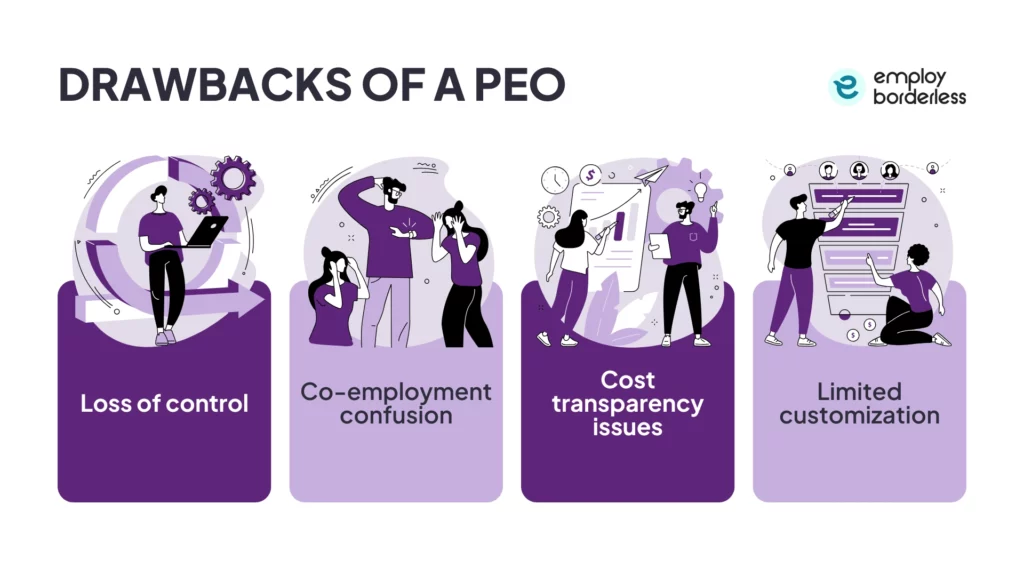
The drawbacks of PEO are loss of control, co-employment confusion, cost transparency, and limited customization. These disadvantages cause operational disruption and make it difficult for companies to keep complete control, customize HR processes to meet their unique requirements, or accurately determine the exact cost of services.
The drawbacks of PEO are listed below.
- Loss of control: Loss of control occurs as PEO manages core HR tasks for companies, such as payroll, benefits administration, compliance, and related workplace policies, according to its procedures. This arrangement limits a company’s control over policy and management decisions, such as benefit plans, payroll timing, and HR policy implementation. Companies also find it difficult to align the PEO’s standardized systems with their own culture, values, or unique operational needs.
- Co-employment confusion: Co-employment confusion arises when both PEO and client businesses are co-employers, which creates confusion for employees about employer status. The PEO manages HR tasks, while the client company controls employee performance, so both are involved in the decision-making process for hiring, firing, disciplinary actions, and compliance monitoring. Unclear roles and responsibilities also cause shared liability legal risks.
- Cost transparency issues: The pricing structure of PEO is either a monthly flat fee per employee or a percentage of payroll, but many contracts include hidden costs in both cost models. These include unclear administrative fees, onboarding fees, exit fines, increasing price on health insurance premiums, and fees for services like compliance audits, COBRA administration, and background checks. Client companies spend a lot more than they anticipated without having a clear understanding of what they are paying for.
- Limited customization: PEOs offer standardized payroll and HR solutions, which limit client companies’ ability to customize services according to their needs or culture. This makes it difficult to offer customized programs or differentiate the employee experience from the PEO’s established benefits, policies, onboarding, or performance systems. This inflexibility also disrupts scaling or the implementation of specialized HR policies or programs within a company.
What are the drawbacks of the payroll service?
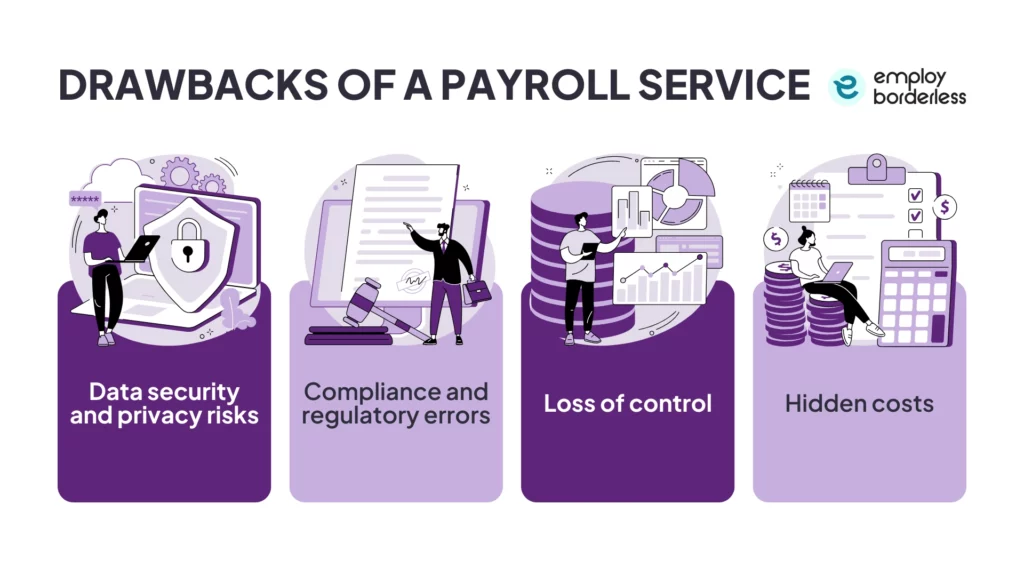
The drawbacks of the payroll service are data Security and privacy risks, compliance and regulatory errors, loss of control, and hidden costs. These disadvantages expose businesses to financial penalties, operational errors, and reduced monitoring, which impact trust and overall payroll accuracy.
The drawbacks of the payroll service are listed below.
- Data security and privacy risks: Payroll systems store sensitive personal and financial employee data, which exposes them to cyberattacks. Sharing payroll responsibility with external payroll providers exposes businesses to legal liability and reputational harm. Outsourced providers without a strong security system sometimes unintentionally leak company and employee data or suffer phishing attacks.
- Compliance and regulatory errors: Compliance and regulatory errors occur when companies outsource payroll services to external payroll providers. These compliance issues include outdated systems, improper configuration, mismanagement of employee compensation, employee misclassification, incorrect tax computations, and delayed filings. Companies dependent on these providers face legal penalties, fines, and audit risks due to non-compliance.
- Loss of control: Companies outsourcing payroll functions experience loss of control over important financial processes, such as pay runs and tax filings. Payroll providers operate on fixed schedules, which makes it difficult for client companies to make urgent changes or run payroll after deadlines. This results in a disconnect from the process and difficulty aligning payroll practices with internal policies or changing business needs.
- Hidden costs: Payroll service providers’ initial payroll cost is reasonable, but extra expenses occur from services not included in the base package, such as customized reports, tax filing support, COBRA administration, direct deposit transactions, setup and termination processing, mid-cycle changes, and contract termination fees. These hidden costs make outsourced payroll services more expensive for client companies than in-house solutions.
How to choose between a PEO and payroll service?
To choose between a PEO and payroll service, consider flexibility and control, scope of services, compliance and liability, budget and resources, and scalability and global expansion. Evaluating these factors helps companies select the right solution that aligns with their existing operations and long-term growth strategy.
Select a PEO if you need complete HR support and comply with standardized processes under a co-employment model, but this limits flexibility and full control for client companies in decision-making and customizing policies. Choose a PSP (Payroll Service Provider) if you need payroll support while keeping full control over HR decisions, benefit plans, and internal policies.
Partner with PEOs as they offer a full range of HR and administrative services, which include payroll, tax administration, benefits management, workers’ compensation, and compliance expertise in a co-employment model. Use a payroll service if your company only requires outsourcing payroll processing and tax filing.
Choose a PEO as they share compliance responsibilities and file taxes under their EIN (Employer Identification Number) and provide active compliance support. This reduces the client company’s exposure to audits and fines. Select a PSP (Payroll Service Provider) as they simply help with tax filings under the client company’s EIN, and the employer maintains all liability for payroll inaccuracy or legal issues.
Use a PEO as it charges a fixed percentage of payroll or per-employee fee for bundled service packages, which reduces administrative overhead. The overall cost increases with extra services, which makes it more expensive for growing businesses. Choose a payroll service that is best suited for companies with tight budgets or low HR complexity because they are usually less expensive up front and charge per pay cycle or employee.
Partner with a PEO as your company grows or expands into multiple states or countries, as it also scales with companies by handling multi-state tax, compliance, benefits, and employee onboarding smoothly. Select a payroll service provider that integrates multiple tools or software to help with the global workforce’s payroll operations.
What are some other HR outsourcing solutions apart from PEO and a payroll service?
Some other HR outsourcing solutions, apart from PEO and payroll service, are HRO (Human Resources Outsourcing), ASOs (Administrative Services Organizations), BPO (Business Process Outsourcing), EOR (Employer of Record), and RPO (Recruitment Process Outsourcing).
HRO (Human Resources Outsourcing) is a third-party company that provides businesses with HR services such as payroll, benefits administration, compliance, and talent management. It allows businesses to scale HR services selectively without relying solely on co-employment arrangements. This helps clients choose HR services that best suit their needs and company culture.
ASOs (Administrative Services Organizations) provide HR support, which includes payroll administration, benefits enrollment, and compliance reporting, without forming a co-employment relationship, and the client remains the legal employer. ASOs are ideal for companies that want outsourced administrative support while maintaining full HR control.
BPO (Business Process Outsourcing) is the practice of contracting out full business functions to outside vendors, which include accounting, customer support, and human resources. BPO is usually suitable for larger businesses and provides scalable, adaptable back-office support.
An EOR (Employer of Record) formally becomes the legal employer for compliance purposes, and is particularly useful when hiring in other countries where the client has no legal entity. The EOR handles payroll, taxes, benefits, and contracts, while the client manages daily work activities.
RPO (Recruitment Process Outsourcing) companies manage the complete hiring process from sourcing and interviewing to onboarding. They bring recruiting expertise, scalable staffing, and advanced recruiting technologies, such as ATS (Applicant Tracking System) and Talent CRMs. RPOs are suitable for organizations with high-volume or specialized hiring needs.
What is the downside of a PEO?
The downside of a PEO is that companies lose full control over HR and the decision-making process. The client companies also face limitations in customizing employee benefits and HR policies because PEOs offer established and standardized service packages. This dependency sometimes also causes shared liability concerns for businesses and exposes them to legal actions.
What are the types of PEO?
The types of PEOs are full-service PEOs, CPEOs (Certified PEOs), industry-specific PEOs, and PEO alliances. These PEO types differ in terms of business size and needs, level of regulatory monitoring, industry specialization, and the range of services offered.
What is the difference between a PEO and a staffing agency?
The difference between a PEO and a staffing agency is that the PEO provides complete HR services, which include hiring and onboarding, payroll processing, benefits administration, and risk management, under a co-employment model. The staffing agency focuses on recruitment and employee placement, typically for temporary and short-term needs.
Should you choose a PEO or a payroll service provider?
You should choose a PEO if your business needs full-service HR support, which includes benefits, compliance, and risk management through a co-employment model. A payroll is a better choice for a business that only needs help with payroll processing and wants to keep control of HR decisions.
What is the difference between a PEO and an EOR?
The difference between a PEO and an EOR is that the PEO acts as a co‑employer and handles administrative tasks like payroll, benefits, and compliance, while the client retains legal employment control. An EOR (Employer of Record) becomes the sole legal employer and takes full responsibility for compliance, payroll, and employment in locations where the client has no legal entity.

Co-founder, Employ Borderless
Robbin Schuchmann is the co-founder of Employ Borderless, an independent advisory platform for global employment. With years of experience analyzing EOR, PEO, and global payroll providers, he helps companies make informed decisions about international hiring.
Learning path · 9 articles
PEO fundamentals
Master the fundamentals with our step-by-step guide.
Start the pathReady to hire globally?
Get a free, personalized recommendation for the best EOR provider based on your needs.
Get free recommendations