9 legal services a PEO can provide for your business

Robbin Schuchmann
Co-founder, Employ Borderless
A PEO (Professional Employer Organization) is a third-party company that allows businesses to outsource complex HR tasks, like payroll processing, benefits enrollment, and compliance management, under a co-employment model. The PEO works by forming a co-employment agreement with the client company and acts as a co-employer for payroll taxes and benefit purposes.
The top legal services that a PEO can provide for your business are employment law compliance, HR and regulatory compliance, workers' compensation and administration claims, risk management, termination guidance and dispute resolution support, employee handbook and policy development, and advising on co-employment and liability allocation.
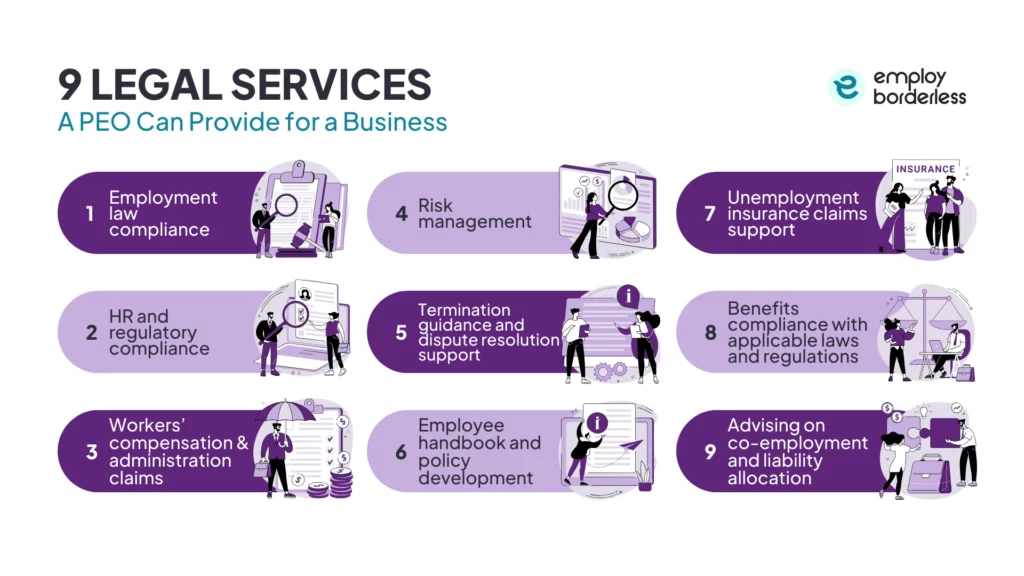
The 9 legal services a PEO can provide for your business are listed below.
- Employment law compliance: PEOs monitor employment laws, keep businesses informed, and manage compliance uniformly across jurisdictions. They create anti-discrimination policies and maintain recordkeeping for tax and payroll purposes.
- HR and regulatory compliance: The PEO helps HR teams provide compliance with employment laws, payroll, and tax regulations. They provide ongoing training and education and support compliance through onboarding, policy training, and workplace safety programs.
- Workers' compensation and administration claims: A PEO offers state-required workers' compensation coverage, negotiates lower premiums, manages claims, supports return-to-work programs, and improves compliance to reduce costs, fraud, and legal disputes.
- Risk management: This third-party service provider helps businesses identify legal risks, review HR policies, set up anti-discrimination protocols, and offer EPLI (Employment Practices Liability Insurance) and legal defense support.
- Termination guidance and dispute resolution support: A PEO offers legal guidance for employer terminations, advising on performance reviews, disciplinary procedures, and documentation practices. They mitigate legal disputes by promoting effective communication and conflict resolution strategies.
- Employee handbook and policy development: This outsourcing HR model supports businesses in creating employee handbooks and policies to meet compliance requirements under laws like FLSA (Fair Labor Standards Act) and ADA (Americans with Disabilities Act).
- Unemployment insurance claims support: PEOs manage unemployment insurance claims for businesses by keeping detailed records, which protects them against fraudulent claims and helps resolve the issues quickly.
- Benefits compliance with applicable laws and regulations: This third-party service provider offers compliance with ERISA (Employee Retirement Income Security Act) and ACA (Affordable Care Act) laws. It also allows access to enterprise-level benefits by securing competitive rates for small and medium-sized businesses.
- Advising on co-employment and liability allocation: The PEO helps businesses understand their CSA (Client Service Agreement) by defining roles. They provide expert legal advice, stay updated on labor laws, and structure agreements to prevent liability gaps.
- Employment law compliance
Employment law compliance means PEOs provide specialized teams that actively monitor employment laws at the federal, state, and local levels. PEOs keep businesses informed about legal changes, such as updates in minimum wage, overtime rules, or new local legislation, to make sure workplace policies stay compliant. They also create or update employee handbooks, policies, and compliance documents to show current laws across all locations in which the client's business is operating.
The PEO becomes the legal employer for tax and payroll purposes, which allows them to manage compliance uniformly across different locations and legal systems. PEOs handle FLSA (Fair Labor Standards Act) compliance to support accurate wage and overtime practices, correct classification of employees, and maintain recordkeeping to avoid lawsuits, penalties, or audits.
This third-party service provider helps businesses create and roll out anti-discrimination and harassment policies according to the ACA (Affordable Care Act) and the EEOC (Equal Employment Opportunity Commission) requirements. PEO also manages FMLA (Family and Medical Leave Act) compliance as they post required notices, track employee leave, maintain benefits during leave, and support a smooth return-to-work program.
- HR and regulatory compliance
HR and regulatory compliance means PEOs help internal HR teams handle routine compliance with federal, state, and local employment laws. This compliance makes sure that HR policies, records, audits, and internal business operations meet all legal requirements. They also provide ongoing training and education to the in-house HR team for laws such as the EPA (Equal Pay Act), ADA (Americans with Disabilities Act), and ADEA (Age Discrimination in Employment Act).
PEOs manage payroll and tax compliance, which includes wage calculations, withholdings, remittance, and proper filing of required forms, such as IRS Form 941, 940, and W-2s. They also handle federal payroll taxes, like FICA (Federal Income Contributions Act), Social Security, Medicare, FUTA (Federal Unemployment Tax Act), and SUTA (State Unemployment Tax Act) unemployment taxes. A PEO makes sure all filings and remittances comply with current laws and regulations to help employers avoid payroll mistakes, late filings, and tax liability.
The PEO also supports compliance with onboarding, policy training, and clear communication of company standards and legal obligations from the start. Many PEOs offer workplace safety programs and training on compliance topics, like FMLA (Family and Medical Leave Act), anti-discrimination, and wage and hour laws. They regularly monitor and respond to changing legal requirements by updating handbooks, policies, and procedures. Their active approach gives businesses uniformity to meet legal standards across all jurisdictions.
- Workers' compensation and administration claims
PEOs secure state-mandated workers' compensation coverage for their clients under a master policy. They use their group purchasing power to negotiate lower premiums than most small or medium-sized businesses are unable to afford on their own, while still providing access to top insurance carriers. They also manage the entire claims process, from filing claims and coordinating with insurance providers to arranging timely medical care and resolving claims expertly to reduce both administrative delays and legal risks.
PEOs support return-to-work programs, customize duties for injured employees, and provide safety consulting, loss prevention training, and regular compliance updates to reduce workplace risks and maintain ongoing compliance. Their expertise helps reduce insurance costs, prevent fraud, and improve documentation and reporting, which protects the business in case of legal disputes.
- Risk management
The PEO helps businesses identify legal risks by reviewing HR policies, employee handbooks, and workplace practices. They help develop and roll out HR practices, such as anti-discrimination policies and workplace safety protocols, to reduce legal exposure and meet compliance requirements under federal, state, and local employment laws.
This third-party service provider also offers EPLI (Employment Practices Liability Insurance) to protect businesses against claims related to employment practices, like wrongful termination, discrimination, harassment, and other employee-related legal issues. This coverage reduces the financial impact of legal disputes and provides businesses with legal defense support.
PEOs provide access to legal counsel specializing in employment law to resolve issues such as harassment, wrongful termination, and other workplace disputes. This support helps businesses work through complex legal situations, develop accurate responses, and reduce the risk of litigation.
- Termination guidance and dispute resolution support
A PEO provides expert guidance to employers on conducting employee terminations in compliance with legal requirements, such as advising on performance reviews, disciplinary procedures, and documentation practices to handle termination lawfully and ethically. PEOs help mitigate legal disputes that occur from termination decisions by offering mentorship to HR staff and managers on effective employee communication and conflict resolution strategies, like mediation and negotiation.
This outsourcing HR model helps employers lower the risk of wrongful termination claims by making sure they follow proper termination procedures to meet employment laws. They make sure that all employees understand their job responsibilities, the company's policies and code of conduct, any performance issues, and ways to improve their performance. PEOs support in-house teams to follow standard company policies, maintain confidentiality, and treat all staff members equally to avoid court disputes.
- Employee handbook and policy development
The PEO helps businesses create employee handbooks and policies that establish clear expectations and define workplace rules. These documents are created to meet compliance requirements under applicable laws, such as the FLSA (Fair Labor Standards Act), the ADA (Americans with Disabilities Act), the FMLA (Family and Medical Leave Act), and anti-harassment regulations.
This third-party service provider stays updated on changes to employment laws and makes sure that updated policies show these changes. For example, a PEO helps update handbooks to comply with new sick leave laws or changes in jury duty pay regulations. PEOs help businesses maintain a well-structured employee handbook that prevents workplace disputes and stabilizes the company's defense in legal matters.
- Unemployment insurance claims support
PEOs manage the unemployment insurance claims on behalf of their client businesses, and offer help to respond to claims, provide necessary documentation, and guide businesses during appeals processes. This support offers compliance with state-level regulations and helps mitigate the risk of increased unemployment tax rates due to disputed claims.
This outsourcing HR model maintains detailed separation reports and accurate documentation related to employee terminations, such as reasons for separation, performance evaluations, and any disciplinary actions taken. These detailed records defend businesses against unemployment claims and make sure that employers have the evidence to support their position during the claims process.
A PEO protects businesses from fraudulent unemployment claims by using strict verification processes and checking for any mistakes or errors in the information. They make sure all claims are valid and handle issues quickly to help businesses avoid financial losses and damage to their reputation.
- Benefits compliance with applicable laws and regulations
The PEO helps businesses make sure that their health, retirement, and supplemental benefit programs comply with laws such as the ACA ( Affordable Care Act) and the ERISA (Employee Retirement Income Security Act). PEOs reduce the risk of non-compliance and costly fines by guiding businesses through complex regulations.
PEOs give small and medium-sized businesses access to enterprise-level benefits through group buying power. They secure competitive rates for health insurance, disability insurance, retirement plans, and vision or dental insurance, while maintaining compliance with federal requirements.
PEOs also manage ERISA compliance as they document and administer benefit plans, conduct annual reporting, and negotiate with carriers. These services help employers meet their legal obligations as plan sponsors while offering strong, compliant benefits packages.
- Advising on co-employment and liability allocation
A PEO offers continuous legal support and helps businesses understand the CSA (Client Service Agreement) by clarifying the assigned roles. The client company is responsible for daily operational management and strategic decisions, while the PEO handles administrative responsibilities like payroll, benefits, compliance, and workers' compensation. This agreement helps businesses in transparent allocation of rights and duties, such as tax filings or benefits administration by the PEO, and workplace management by the client.
This outsourcing model provides expert legal advice to keep co-employment arrangements within legal boundaries. They stay current on changes in labor laws across jurisdictions, help structure agreements to meet regulatory requirements, and suggest regular reviews to prevent liability gaps. This ongoing guidance helps businesses stay protected from misclassification, wage-and-hour issues, or other compliance failures.
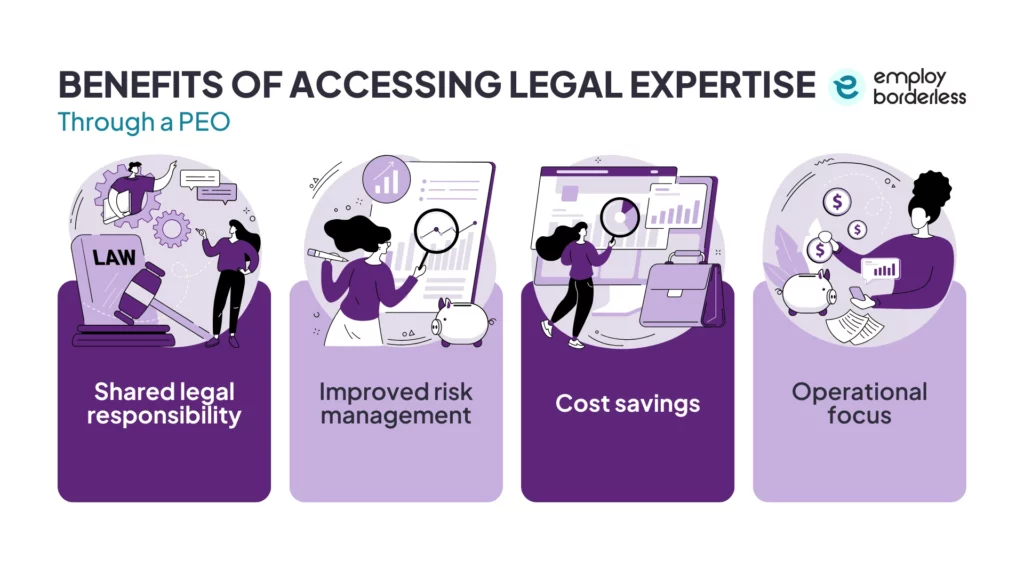
What are the benefits of accessing legal expertise through a PEO?
The benefits of accessing legal expertise through a PEO are shared legal responsibility, improved risk management, cost savings, and operational focus.
Improved risk management
Improved risk management means a PEO improves workplace safety and legal protection by offering risk assessments, OSHA-compliant (Occupational Safety and Health Act) safety programs, employee training, and workers' compensation support. These measures make claims processing easy to handle while reducing the chances of lawsuits, fines, and reputational harm.
Cost savings
Cost savings mean PEOs help businesses reduce expenses as they lower the risk of compliance fines, reduce spending on outside legal counsel, and access more affordable benefits through the PEO's group purchasing. These savings allow businesses to reinvest resources into growth, employee development, and operational improvements. Businesses using PEO services see an average annual ROI (Return On Investment) of 27.2%, which shows net savings from reduced HR staffing, benefits costs, workers' compensation, and unemployment insurance.
Operational focus
Operational focus means the PEO allows businesses to outsource complex HR and legal responsibilities, such as compliance, payroll, and benefits administration. This delegation allows companies to focus on core business operations like customer support, financial management, and product development, for strategic growth.
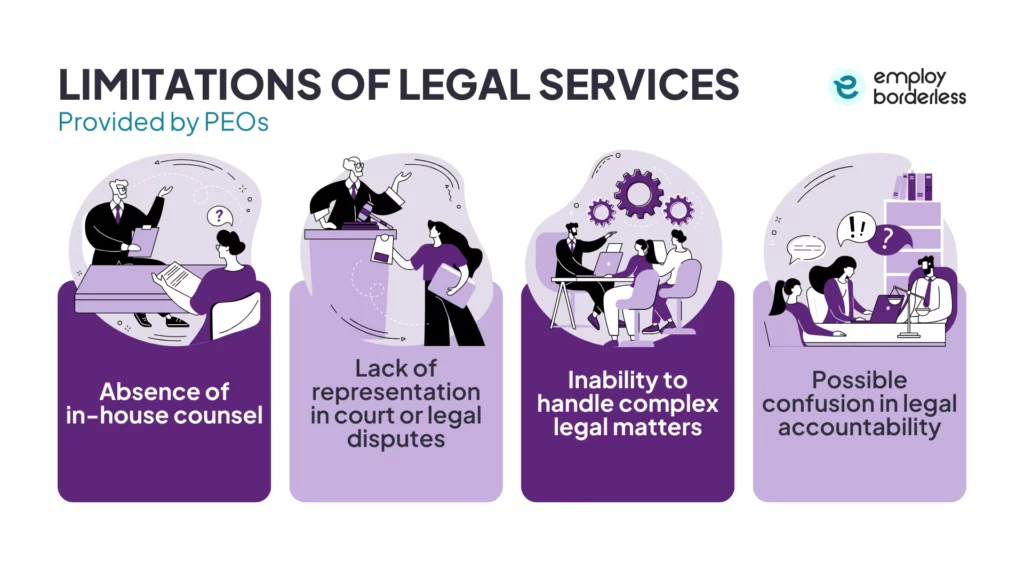
What are the limitations of legal services provided by PEOs?
The limitations of legal services provided by PEOs include the absence of in-house counsel, the unavailability of the company representative, the inability to handle complex legal matters, and possible confusion in legal accountability.
The limitations of legal services provided by PEOs are listed below.
- Absence of in-house counsel: Absence of in-house counsel means that companies partnering with a PEO do not have their own dedicated lawyers on staff. The PEO offers expert HR compliance and legal support for routine employment matters, but it cannot replace a full in-house legal team for complex, specialized, or high-risk legal issues.
- Lack of representation in court or legal disputes: Lack of representation in court or legal disputes means PEOs do not represent client companies in court or during legal disputes. PEOs only guide compliance, policy creation, and implementation, and help businesses avoid regulatory risks, which means if a company faces a lawsuit, legal claim, or needs courtroom representation, it has to hire its own attorney.
- Inability to handle complex legal matters: Inability to handle complex legal matters means PEOs usually are unable to manage complex litigation, intellectual property issues, mergers and acquisitions, or highly specialized regulatory disputes. These legal matters require external or dedicated legal counsel with industry-specific expertise.
- Possible confusion in legal accountability: Possible confusion in legal accountability occurs because co-employment divides legal responsibilities between the PEO and the client company. This shared liability makes it unclear which party is responsible for specific legal risks or compliance issues that affect routine and regulatory workplace operations.
What should companies consider when choosing a PEO for legal services?
The factors that companies should consider when choosing a PEO for legal services are certification and accreditations, pricing transparency, technology and data security, and reputation and references.
Companies should make sure the PEO holds recognized certifications such as ESAC (Employer Services Assurance Corporation) accreditation and IRS-Certified PEO status. These credentials confirm financial stability, ethical operations, and compliance support.
Businesses need to understand the pricing structure when choosing a PEO for legal services, which is either a flat per-employee-per-month fee or a percentage of payroll. The employers should ask for a clear detail of each service, with all add-ons clearly listed, which helps avoid hidden fees and unexpected charges, like onboarding fees, termination fees, or tax filings.
Companies should evaluate whether the PEO offers a reliable and user-friendly HR platform for managing payroll, benefits, and employee self-service. They need to check if the PEO system integrates smoothly with the organization's existing systems. The employers should also make sure PEO provides strong data protection, like SSL encryption, access controls, multi-factor authentication, audits, and privacy regulations.
Businesses should ask for client references, especially those similar in size, industry, and geography to their business. They also need to review the case studies and testimonials, along with third-party reviews, to better understand the service quality that the PEO offers.
Can PEOs replace in-house legal counsel?
No, PEOs cannot replace in-house legal counsel as they only support compliance and routine HR-related legal tasks, but lack the expertise, strategic understanding, and courtroom representation that dedicated in-house lawyers provide.
What legal terms are included in a PEO agreement?
The legal terms that are included in a PEO agreement include terms of agreement, service fees and payment terms, EPLI (Employment Practices Liability Insurance), employee benefits plan, and workers' compensation coverage. The legal terms also include legal inquiries and investigations, scope of services, limits of services, confidentiality, credit approval, termination, and exit terms.
How are PEOs adapting to changes in employment law?
The PEOs are adapting to changes in employment law by staying up to date on employment regulations and new developments. They update workplace policies when required, offer expert legal guidance, and provide risk management across jurisdictions, which includes automation for wage, contract, and privacy law compliance.
Is legal support the most important service a PEO offers?
No, legal support is not the most important service that a PEO offers, as it also provides full HR support through payroll management, employee benefits, compliance support, and risk management, which many businesses consider equally important. PEO services also include technology solutions, risk management, and employee compensation.
What additional legal protections do certified PEOs provide?
The additional legal protections that certified PEOs provide include protection from federal employment tax responsibilities, financial bonding, prevention of wage-based restart, retention of tax credits, and access to regulatory compliance tools and assurance.
How many types of PEOs are there?
There are five main types of PEOs, such as ASO (Administrative Services Organization), PEO alliances, industry-specific PEO, full-service PEO, and CPO (Certified PEO). These PEO types differ in terms of co-employment arrangements, service scope, industry specialization, certification status, and legal protections.

Co-founder, Employ Borderless
Robbin Schuchmann is the co-founder of Employ Borderless, an independent advisory platform for global employment. With years of experience analyzing EOR, PEO, and global payroll providers, he helps companies make informed decisions about international hiring.
Learning path · 9 articles
PEO fundamentals
Master the fundamentals with our step-by-step guide.
Start the pathReady to hire globally?
Get a free, personalized recommendation for the best EOR provider based on your needs.
Get free recommendations