Payroll offboarding: required steps & what not to miss

Robbin Schuchmann
Co-founder, Employ Borderless
Payroll offboarding is the process of managing an employee's departure from a company. It involves finalizing pay, benefits, taxes, documentation, and system access. This process makes sure that the employee's financial and administrative accounts are properly terminated and records are updated.
Effective offboarding helps protect sensitive data, maintain compliance with payroll and labor regulations, and prevent legal or financial issues. It provides a smooth transition of duties and supports a positive final experience that improves employer reputation and relationships with former employees.
The steps of the payroll offboarding process involve final salary payment, settlement of accrued leave, notice period and benefits reconciliation, employer declarations and reporting, payroll documentation and tax forms, and access and system cleanup. Proper payroll offboarding also provides benefits, like a clear benefits timeline, a smooth transition to continued coverage, accurate retirement guidance, financial risk reduction, and a positive employee experience.
What is payroll offboarding?
Payroll offboarding is the structured process of formally separating an employee from a company when they resign, are terminated, retire, or leave their job. It includes processing the final paycheck with any accrued vacation, PTO (Paid Time Off), or bonuses, and verifying the payout date and details. Employers must terminate the employee in the payroll system to prevent ongoing payments and avoid errors like ghost payroll.
Why is payroll offboarding important?
Payroll offboarding is important because it makes sure that all financial, legal, and operational responsibilities are properly completed when an employee leaves an organization. A structured payroll offboarding process helps employers calculate final wages accurately, apply correct tax withholdings, process unused leave or severance, and terminate benefits on time.
Think of it this way: one missed step - a forgotten system account or an incorrect final paycheck - can turn a routine departure into a compliance issue. Payroll offboarding supports administrative control by confirming that employees return all company-provided assets, such as laptops or ID cards. Remote workers receive clear shipping instructions and a designated return location. It also helps employers meet legal obligations and avoid fines, penalties, or disputes with labor authorities.
What are the steps of the payroll offboarding process?
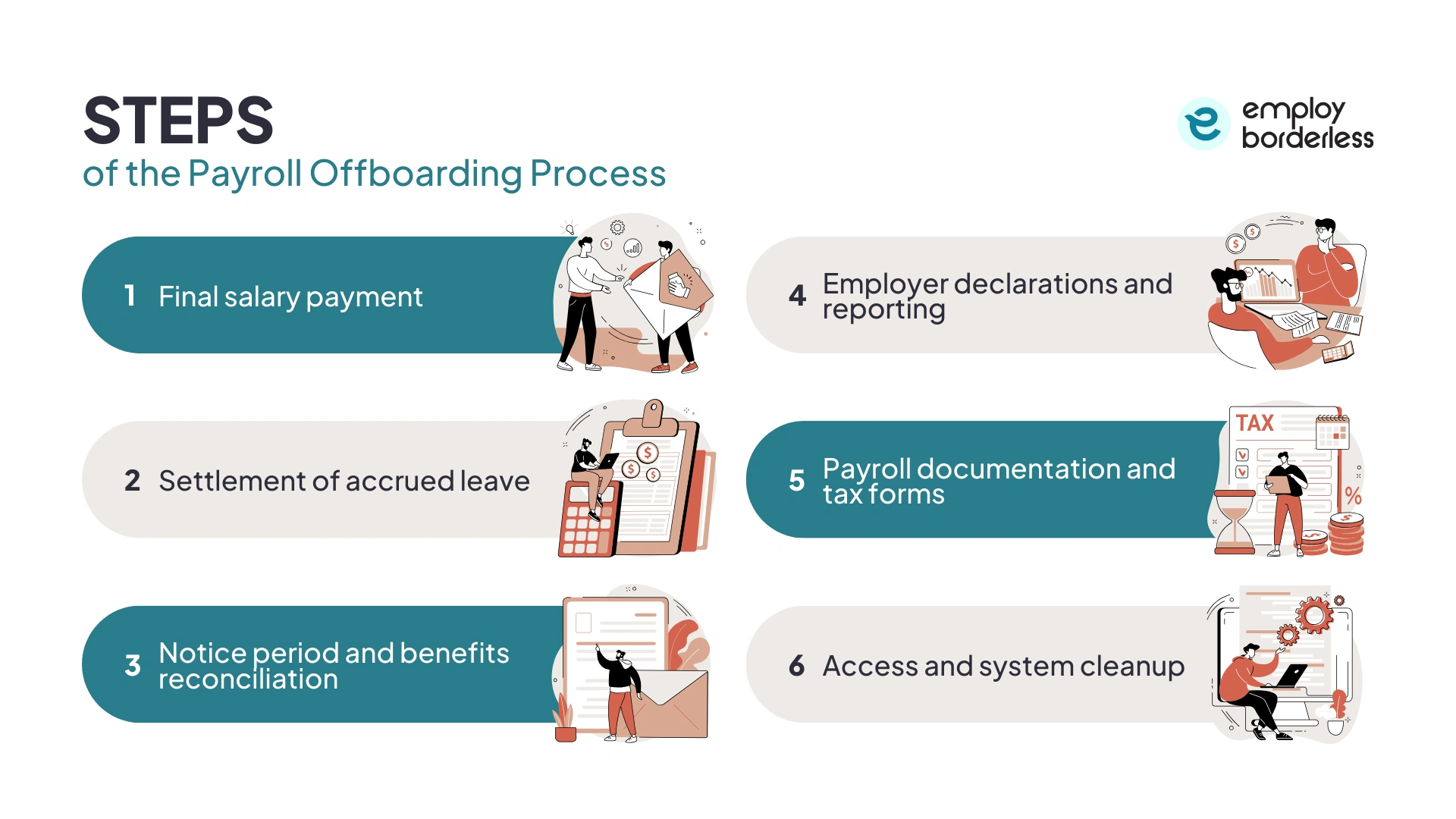
The steps of the payroll offboarding process include final salary payment, settlement of accrued leave, notice period and benefits reconciliation, employer declarations and reporting, payroll documentation and tax forms, and access and system cleanup.
Final salary payment
Final salary payment is the step where an employee receives all wages and entitlements owed upon the termination of employment. It includes the salary for all hours worked up to the employee's last working day. Payroll departments must calculate and process this final paycheck so that the employee is fully paid according to local employment laws and company policy on or before the regular pay date for their last pay period. This final payment terminates the financial relationship between employer and employee and helps prevent disputes over unpaid wages or noncompliance with wage-payment regulations.
Settlement of accrued leave
Settlement of accrued leave is the process by which an employer compensates a departing employee for any unused leave accrued during employment. This payment, often called leave encashment, is usually included in the employee's full and final settlement upon termination of employment. This step makes sure that employees are fairly compensated for leave days earned but unused during their period of service. It is also a recognized component of final payroll calculations under offboarding and labor regulations in many countries.
Notice period and benefits reconciliation
The notice period and benefits reconciliation step make sure both contractual obligations and employee entitlements are correctly handled before an employee's departure. The notice period is the duration during which an employee works or receives payment after submitting or receiving a resignation or termination notice. The employer continues to provide regular pay and applicable benefits during the notice period. In some cases, employers provide payment instead of notice according to the contract or labor laws if the employee does not work.
The employer also reviews and finalizes any remaining compensation, such as bonuses or other benefits owed to the employee, as part of reconciling benefits. This step helps avoid disputes over notice obligations or benefit payments and maintains a fair and compliant offboarding process.
Employer declarations and reporting
Employer declarations and reporting are the administrative and legal reporting obligations an employer must complete when an employee leaves. Employers are required to update payroll records and submit reports to tax or social security authorities in many payroll systems and jurisdictions.
These reports verify that the employee has stopped working and the employer has accurately recorded all earnings, tax withholdings, and contributions to date. These reporting steps help confirm compliance with tax, social insurance, and labor regulations. This step involves maintaining accurate government records and formally closing the employee's payroll file during offboarding.
Payroll documentation and tax forms
Payroll documentation and tax forms are required for an employer to prepare and retain all official records and tax-related paperwork when an employee departs. This documentation includes payroll records detailing earnings, deductions, final pay, and updates to tax withholding information.
This step also involves completing all required tax forms that report wages and taxes withheld to the relevant government authorities. Employers must issue specific tax documents to the departing employee in many countries. For example, in the United States, employers provide a Form W-2 summarizing the employee's earnings and taxes withheld for the year, which the employee uses to file their income tax return.
Access and system cleanup
Access and system cleanup is the process of revoking a departing employee's access to company systems and removing their accounts to protect data and maintain security. Employers must deactivate all user accounts once an employee departs, which includes email, internal networks, cloud services, and software platforms. This deactivation makes sure the former employee no longer has access to sensitive systems or the company's confidential information.
During system cleanup, administrators actively locate and remove orphaned accounts or credentials. They make sure that all employee-related privileges are fully revoked and that company systems remain organized and secure. Performing these actions during offboarding helps maintain organizational security, supports compliance with data protection rules, and protects sensitive business information.
Key takeaway: Each step in the payroll offboarding process carries its own compliance risk. Final pay, accrued leave, tax reporting, and system access all need to be handled separately - missing any one of them can result in penalties or disputes.
What are the benefits of effective payroll offboarding?
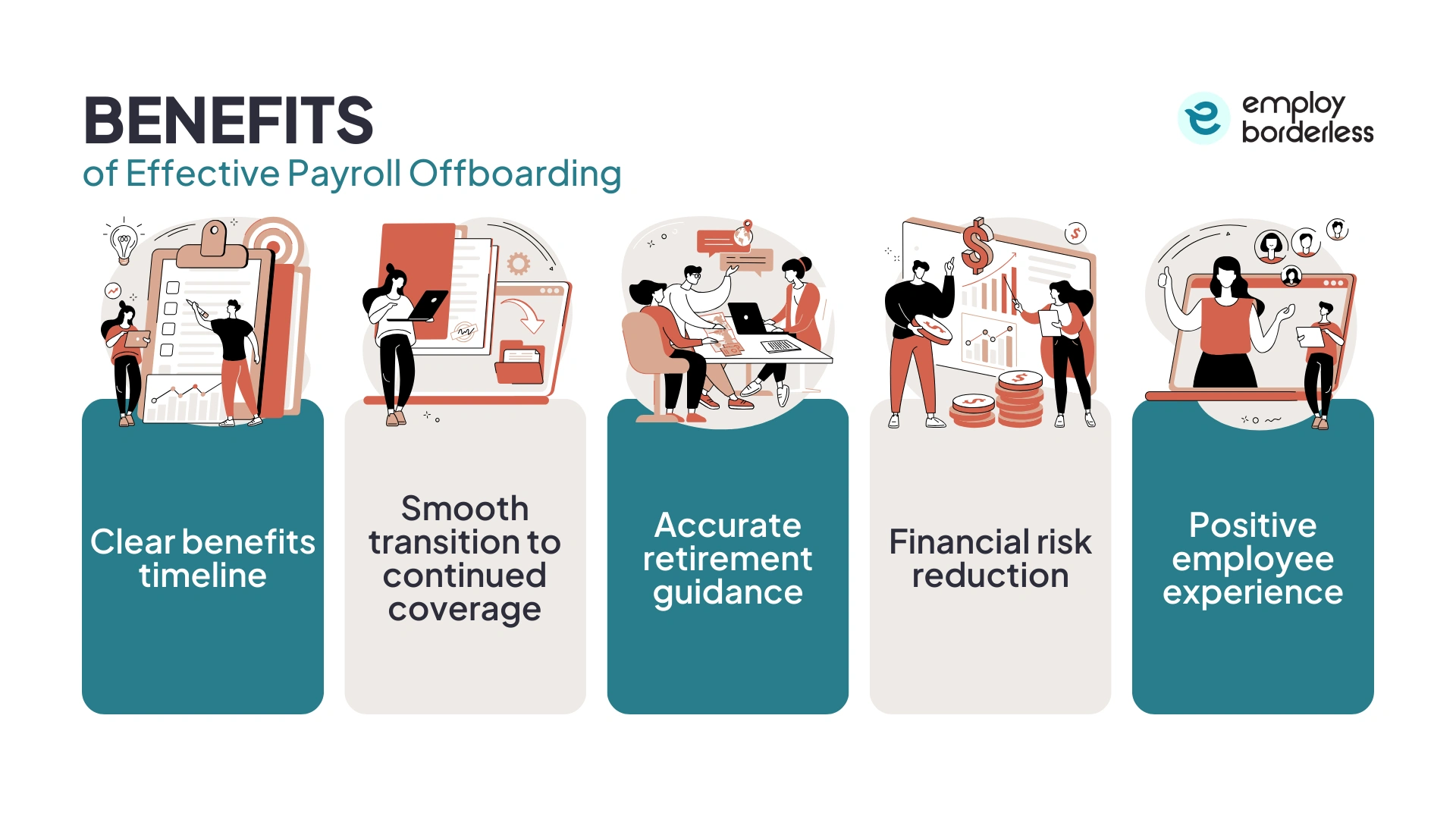
The benefits of effective payroll offboarding include a clear benefits timeline, a smooth transition to continued coverage, accurate retirement guidance, financial risk reduction, and a positive employee experience.
The benefits of effective payroll offboarding are listed below.
Clear benefits timeline: Effective payroll offboarding makes sure that departing employees receive clear information on the timing and details of final pay, accrued leave, and benefits entitlements. Clear communication reduces confusion and helps employees plan their finances during the transition out of the company.
Smooth transition to continued coverage: A structured offboarding process includes communicating how and when benefits such as health insurance or retirement plans continue after departure. This process helps employees avoid gaps in coverage or unexpected deadlines. The smooth offboarding transition supports departing employees in managing their post-employment benefits effectively.
Accurate retirement guidance: Employers provide retiring or departing employees with the correct information about their retirement benefits, pension options, or continuation of contributions during offboarding. This guidance helps employees make informed decisions about their retirement planning.
Financial risk reduction: Proper payroll offboarding accurately handles and submits final pay, taxes, and legal documentation, which reduces the risk of errors, compliance issues, penalties, or legal disputes. A structured process also reduces the chances of missing required filings or final payments.
Positive employee experience: A respectful, organized offboarding process leaves departing employees with a good impression of the company. This impression improves employer reputation, increases the chances that former employees speak positively about the organization, and encourages future rehires or referrals.
| Benefit | What it means in practice |
|---|---|
| Clear benefits timeline | Employees know exactly when final pay, accrued leave, and benefits end |
| Smooth transition to continued coverage | No gaps in health insurance or retirement plan coverage after departure |
| Accurate retirement guidance | Departing employees get the right information on pension options and contributions |
| Financial risk reduction | Correct final pay and tax filings reduce penalties and legal disputes |
| Positive employee experience | Organized offboarding improves employer reputation and supports future rehires |
Key takeaway: Payroll offboarding isn't just about closing out a paycheck. Done well, it protects the company from compliance risk and leaves the door open for former employees to return or refer others.
How to simplify the payroll offboarding process?
To simplify the payroll offboarding process, consider outsourcing the payroll department, getting support from an external consultant, standardizing and documenting the process, automating payroll calculations and settlements, and tracking and auditing the process.
Consider hiring an external payroll service or provider that correctly handles final pay, tax filings, and benefit closures and complies with employment regulations. External providers use standardized workflows and automation to reduce errors and administrative burden.
Working with a payroll consultant helps organizations design compliant offboarding procedures and review final settlement practices. Such a consultant offers guidance on proper handling of taxes, benefits, and documentation, which reduces the risk of legal or financial mistakes.
Establishing clear written payroll offboarding procedures from the beginning of creating the process helps verify consistent handling of final payments, benefits reconciliation, access removal, and documentation. Standardization reduces confusion, improves accuracy, and helps teams follow the same steps for every employee exit.
Automating payroll calculations and settlements through dedicated software simplifies final salary calculations, leave encashment, tax adjustments, and reporting. Automation reduces manual errors and simplifies the offboarding process while maintaining compliance.
Monitoring payroll offboarding tasks and conducting periodic audits helps organizations verify that final pay, reporting, and documentation are completed correctly. Auditing also helps identify process gaps and improve payroll compliance controls.
When should final pay be processed?
Final pay should be processed by the next regular payday, unless state laws require fast payment. Some states require employers to issue the final paycheck immediately upon termination or within a few days after resignation. Employers have to follow applicable state wage laws to avoid payroll tax penalties or disputes.
What is included in the final payroll calculation?
A final payroll calculation includes all unpaid regular wages, overtime earned through the last working day, and any applicable bonuses or commissions. Employers sometimes also include payment for unused vacation or PTO (Paid Time Off) where state law or company policy requires it, plus severance if applicable.
Do employees keep access to payroll accounts after offboarding?
No, employees do not keep access to their payroll accounts after offboarding unless an employer specifically allows temporary access for things like downloading pay stubs or tax forms. Most companies revoke all system access when employment ends to protect sensitive payroll data, as they consider ongoing access a security risk.
How do payroll systems handle post-termination payouts?
Payroll systems handle post-termination payouts by calculating and issuing all earnings owed up to the termination date, like unpaid wages, overtime, and, where required by state law, accrued but unused vacation or leave in the final paycheck. Payroll systems also process any additional payouts, like PTO or severance, either in the final check or as a separate payment, according to company policy and applicable state wage laws.
What documentation should employees receive at the end of payroll?
The documentation employees should receive is the final paycheck, which includes all wages, overtime, and accrued leave, and Form W-2, which summarizes annual earnings and taxes withheld. Provide all documents related to retirement accounts, benefits termination, or COBRA (Consolidated Omnibus Budget Reconciliation Act) health coverage to confirm compliance and smooth transitions.
Can a final severance payment be added during payroll offboarding?
Yes, a final severance payment can be added during payroll offboarding if it is specified in the employee's employment contract or company severance policy. Severance is usually not legally required under federal law, but if agreed, employers often include it as a separate payment in addition to final wages and PTO payouts during offboarding. It is generally processed on the next payroll cycle or as agreed in the severance terms.

Co-founder, Employ Borderless
Robbin Schuchmann is the co-founder of Employ Borderless, an independent advisory platform for global employment. With years of experience analyzing EOR, PEO, and global payroll providers, he helps companies make informed decisions about international hiring.
Learning path · 10 articles
Payroll fundamentals
Master the fundamentals with our step-by-step guide.
Start the pathReady to hire globally?
Get a free, personalized recommendation for the best EOR provider based on your needs.
Get free recommendations