Payroll implementation: step-by-step guide to avoid mistakes

Robbin Schuchmann
Co-founder, Employ Borderless
Payroll setup is the structured process of establishing and launching a payroll system within an organization. It involves configuring payroll software, migrating and entering employee and pay data, and establishing pay rules.
The steps for payroll setup are defining payroll requirements and goals, choosing the right payroll system, setting a clear timeline, forming a setup team, gathering and preparing employee and company data, configuring system settings, running a parallel payroll test, and going live with payroll.
The benefits of payroll setup are reliable and timely salary payments, better compliance with regulations, improved cash flow management, simplified payroll operations, and increased employee satisfaction and engagement. There are also challenges of payroll setup, which include regulatory complexity, integration issues, data security concerns, staff training and user adoption, changing payroll needs, and change management.
What is payroll implementation?
Payroll implementation is the process of integrating a payroll system into the business's operations. This process involves setting up and configuring the payroll software, entering employee data, defining pay structures, and keeping the company compliant with labor and tax laws.
Why is payroll implementation important?
Payroll implementation is important for offering timely payments, accurate tax reporting, and employee confidence. Proper setup helps keep business operations running smoothly and prevents compliance violations with tax and labor regulations. It allows automation and integration with HR and other business systems while maintaining operational stability and focus on growth.
What are the essential items in a payroll implementation checklist?
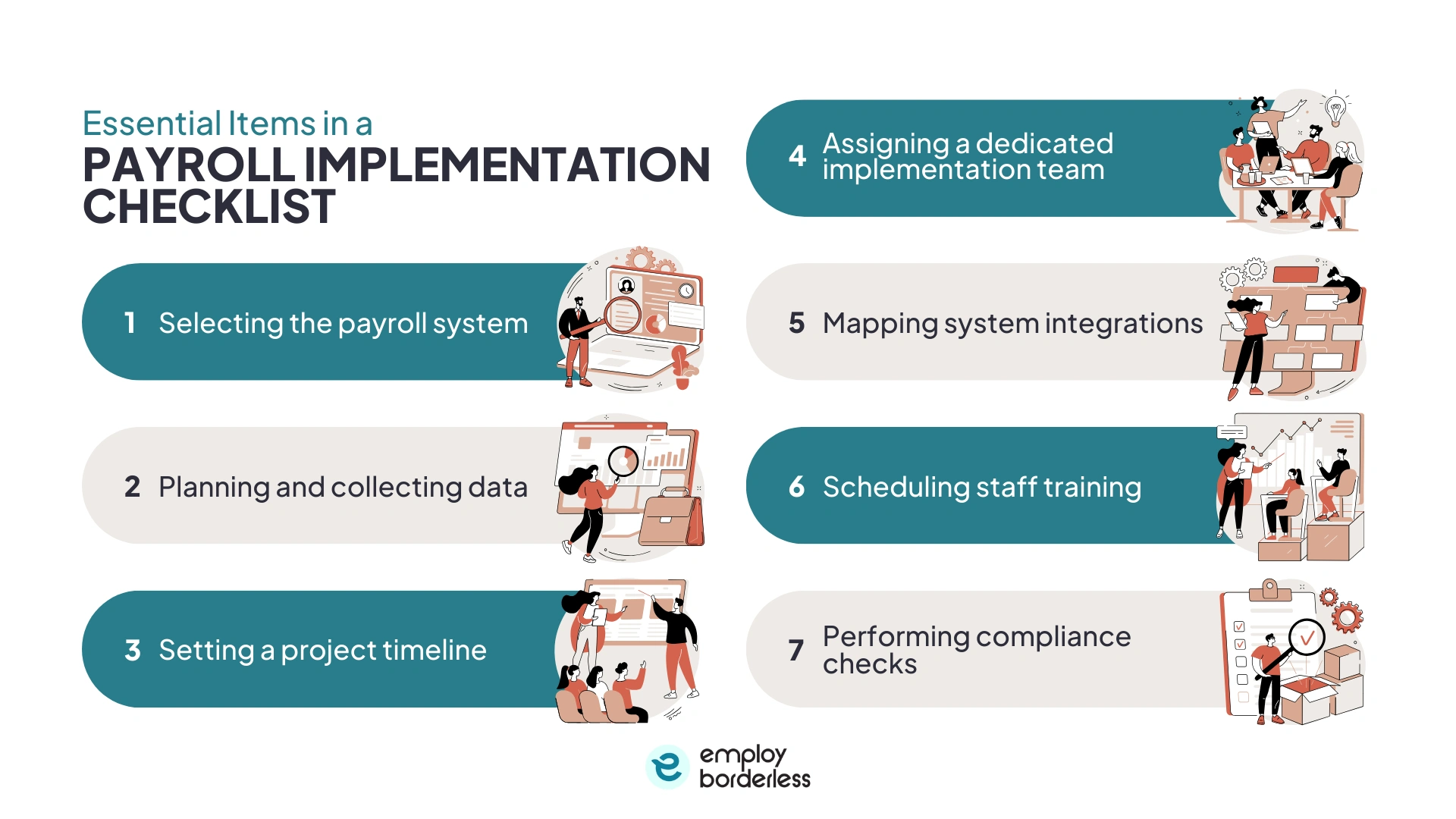
The essential items in a payroll implementation checklist include selecting the payroll system, planning and collecting data, setting a project timeline, assigning a dedicated setup team, mapping system integrations, scheduling staff training, and performing compliance checks.
The essential items in a payroll implementation checklist are listed below.
Selecting the payroll system: Choose a payroll system that meets the business needs and is able to handle compliance, automation, integrations, and employee access.
Planning and collecting data: Collect accurate employee records, pay rates, tax forms, benefit deductions, and other necessary payroll information to prepare for system setup.
Setting a project timeline: Define clear goals and deadlines so the setup stays on schedule and everyone involved remains on board.
Assigning a dedicated setup team: Establish a cross-functional team with a project lead to monitor setup and coordination.
Mapping system integrations: Map integrations with HR, time tracking, and accounting systems to maintain uniform data flow.
Scheduling staff training: Train payroll and HR users on the new system so they are able to process payroll and use features effectively.
Performing compliance checks: Review tax settings, filing rules, deductions, and labor law requirements to confirm the new system meets legal obligations.
| Checklist Item | What It Involves |
|---|---|
| Selecting the payroll system | Match the system to your compliance, automation, and integration needs |
| Planning and collecting data | Gather employee records, pay rates, tax forms, and benefit deductions |
| Setting a project timeline | Define goals, deadlines, and a target go-live date |
| Assigning an implementation team | Cross-functional team with a project lead covering HR, IT, payroll, and finance |
| Mapping system integrations | Connect HR, time tracking, and accounting platforms for consistent data flow |
| Scheduling staff training | Train payroll and HR users before go-live |
| Performing compliance checks | Verify tax settings, filing rules, and labor law requirements |
What are the steps for payroll implementation?
The steps for payroll implementation are defining payroll requirements and goals, choosing the right payroll system, setting a clear timeline, forming a setup team, gathering and preparing employee and company data, and configuring system settings. Other important steps include integrating with other business tools, running parallel payroll tests, training staff and employees, going live with payroll, and post-implementation review and monitoring.
Define payroll requirements and goals
Start by evaluating the company's payroll needs and creating a profile of the ideal provider. Consider factors such as workforce size, tax obligations, employee classifications (full-time, part-time, exempt, non-exempt, contractors, or seasonal workers), growth plans, and important payroll system features, like automation or AI tools. This process not only confirms a smooth setup but also helps identify gaps or issues in the current payroll strategy and determine how the right provider improves overall accuracy.
Choose the right payroll system
Select a payroll system that supports long-term success by growing with the business while reducing compliance risks and motivating employees. Necessary considerations include automation of calculations, tax filings, and reporting, and up-to-date tax compliance for federal, state, and local regulations.
Choose a payroll system that also provides employee self-service for pay stubs, benefits management, and reliable integration with existing platforms such as time tracking, benefits administration, and accounting systems. Prioritize providers with strong data security measures, such as SOC 2 compliance and SSL encryption, as well as dedicated customer support for setup and ongoing use.
Set a clear timeline
Establish clear objectives for payroll setup to keep the project focused and on schedule. Define the specific challenges the setup plans to address, such as reducing manual errors, speeding up processing, or improving data accuracy. Set a target go-live date and identify important objectives leading up to it. Determine which employees require training on the new system and establish timelines for a smooth transition. Clearly defined goals allow for progress tracking, measuring ROI, and involving everyone from leadership to end-users.
Form an implementation team
Proper payroll setup requires a dedicated, cross-functional team of HR, payroll, IT, and finance. Select a project manager to oversee the process, coordinate tasks, and maintain communication. Include representatives from HR to provide employee data or benefits insights, and payroll to manage daily operations and pay rules. The team should also involve the IT lead to handle system integration and data security, and the finance department to match payroll with accounting and reporting requirements. A collaborative team supports smooth data flow, covers all departmental needs, and sets up a successful rollout.
Gather and prepare employee and company data
Collect all necessary employee and payroll information from the previous system or records with accuracy and attention to detail. Essential data includes employee personal information, pay rates, and compensation structures, which include salary, hourly, commissions, and bonuses. This data also involves tax forms and exemptions, benefit deductions like health insurance, 401(k) contributions, garnishments, PTO (Paid Time Off) balances, and year-to-date earnings. Accurate data collection leads to correct payroll processing, compliance, and employee trust.
Configure system settings
Work with a payroll provider that configures the system according to the company's requirements. This collaboration includes setting pay frequencies and schedules, adding deduction codes and benefit plans, configuring time tracking and overtime rules, and defining reporting and compliance settings for federal and state regulations. Proper configuration supports accurate payroll processing and compliance with legal requirements.
Integrate with other business tools
Connect the payroll system with other core business tools to accurately transfer data, reduce manual data entry, and improve overall operational performance. Connect payroll systems with HR software to automatically update employee information, such as new hires, terminations, and status changes.
Integration with time tracking systems allows accurate recording of work hours, overtime, and leave data, which helps prevent payroll calculation errors. Connecting payroll with accounting systems keeps payroll expenses correctly categorized, recorded in the general ledger, and consistent with financial reporting requirements. Effective integrations simplify payroll operations, improve data consistency, and support compliance and reporting accuracy.
Run parallel payroll test
Conduct a parallel payroll test run to evaluate system accuracy before launching live payroll operations. This process involves running payroll using sample or parallel data and comparing results with the previous system to identify differences. Carefully review gross-to-net calculations, tax withholdings, benefit deductions, direct deposit setup, and pay stub accuracy. Identifying and correcting errors during this stage helps maintain reliable payroll processing and prevents issues after launch.
Key takeaway: Running a parallel payroll test before go-live is the single most effective way to catch configuration errors - compare every result against your previous system before processing a single live payment.
Train staff and employees
Provide thorough training to payroll administrators, HR staff, and employees to confirm effective use of the new payroll system. Train payroll and HR teams on processing payroll runs, managing employee records, solving common issues, and generating reports. Educate employees on using self-service features such as accessing pay stubs and tax forms. Document the updated payroll procedures by creating SOPs (Standard Operating Procedures) and establishing clear dispute handling processes for resolving payroll-related issues. Proper training and documentation support effective system adoption and secure payroll operations.
Go live with payroll
Begin processing live payroll using the new system after completing testing and receiving final approval. Carefully monitor payment accuracy, tax calculations, benefit deductions, and direct deposit transactions to confirm employees receive correct and timely payments. Regularly review the process for any errors and resolve issues quickly. Continue monitoring system performance, automate routine payroll tasks where possible, and adjust workflows as business needs change to maintain accuracy and compliance.
Post-implementation review and monitoring
Conduct a detailed review to confirm the system operates accurately after the initial payroll cycles. Monitor payroll records to identify errors or recurring issues and make necessary adjustments. Collect feedback from employees and system users to improve usability and performance. Stay updated with changes in payroll regulations and update payroll policies to maintain compliance. Track payroll performance metrics and use advanced automation features to improve performance and long-term payroll operations.
What are the benefits of payroll implementation?
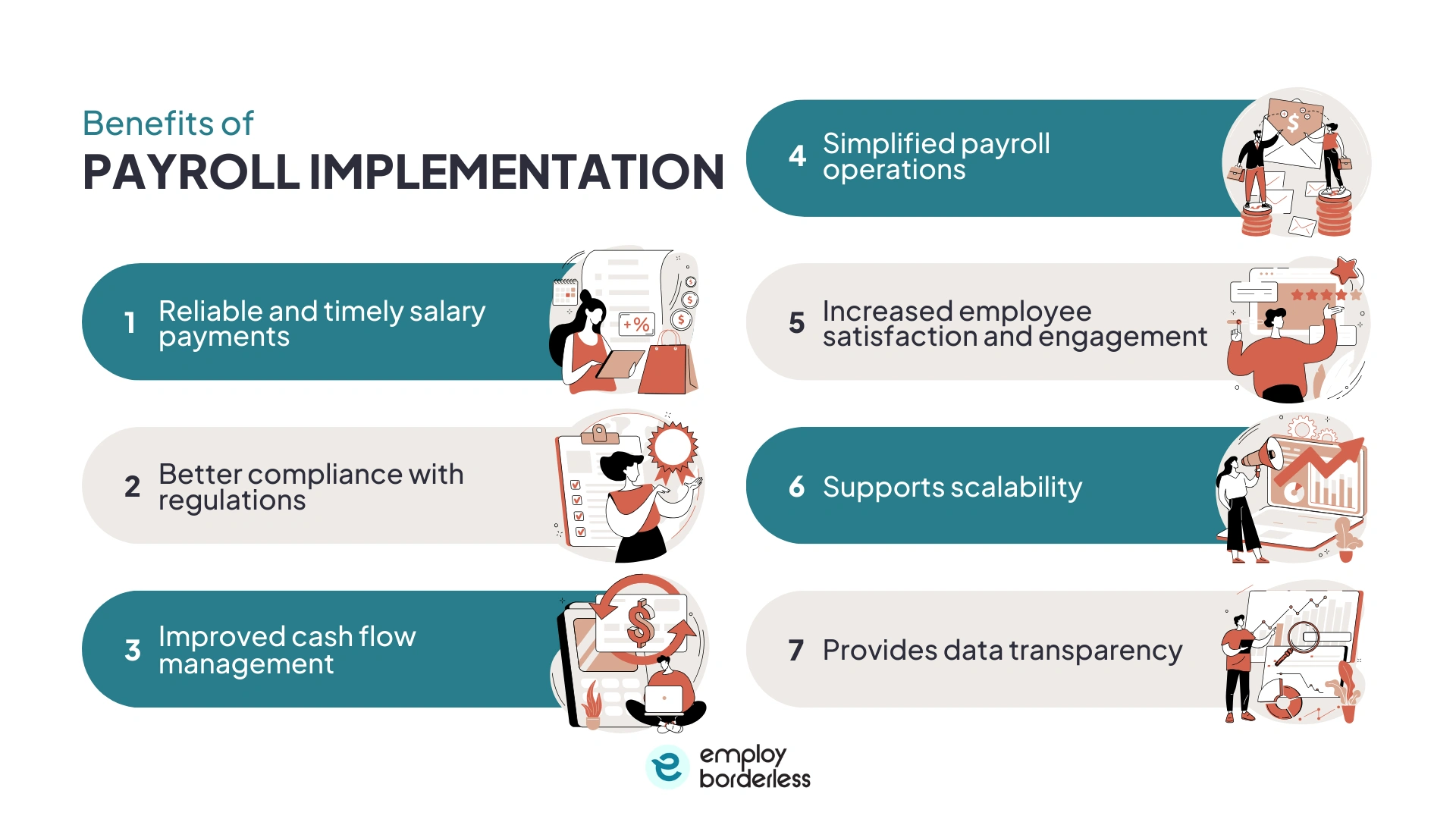
The benefits of payroll implementation are reliable and timely salary payments, better compliance with regulations, improved cash flow management, simplified payroll operations, and increased employee satisfaction and engagement.
Reliable and timely salary payments
Payroll implementation helps organizations confirm employees are paid accurately and on schedule by automating salary calculations, tax deductions, and payment processing. Automated systems reduce manual errors, prevent delays, and improve payment consistency.
Better compliance with regulations
Effective payroll setup keeps the company compliant with all relevant federal, state, and local payroll laws. Automated tax calculations, timely filings, and accurate record-keeping reduce the risk of errors, penalties, and legal issues. This automation improves payroll compliance and reassures both employers and employees.
Improved cash flow management
Payroll implementation helps organizations manage cash flow more effectively by providing accurate predictions of payroll expenses and scheduled payment dates. Automation reduces unexpected payroll errors and keeps funds allocated correctly, supporting better financial planning and operational stability.
Simplified payroll operations
Proper payroll setup simplifies payroll processes by automating calculations, deductions, tax filings, and reporting. This automation reduces manual work, lowers errors, and allows HR and finance teams to manage payroll expertly.
Increased employee satisfaction and engagement
Effective payroll setup confirms employees are paid accurately and on time while providing easy access to pay stubs, tax forms, and benefits information. This transparency and reliability build trust, reduce payroll-related concerns, and increase overall employee satisfaction and engagement.
Supports flexibility
A well-implemented payroll system grows with the organization, easily handling an increasing number of employees, multiple locations, and complex pay structures. This flexibility allows businesses to expand operations without disrupting payroll.
Provides data transparency
A modern payroll system offers real-time dashboards and detailed reports that help employers and employees see labor costs, tax obligations, and payroll trends. Access to accurate and timely data allows business owners and HR managers to make informed strategic decisions, identify patterns, estimate expenses, and better understand workforce-related financial impacts.
Key takeaway: Beyond paying people on time, a well-configured payroll system reduces compliance risk and gives finance teams the real-time data they need to plan accurately - both of which have a direct impact on the bottom line.
What are the most common challenges of payroll implementation?
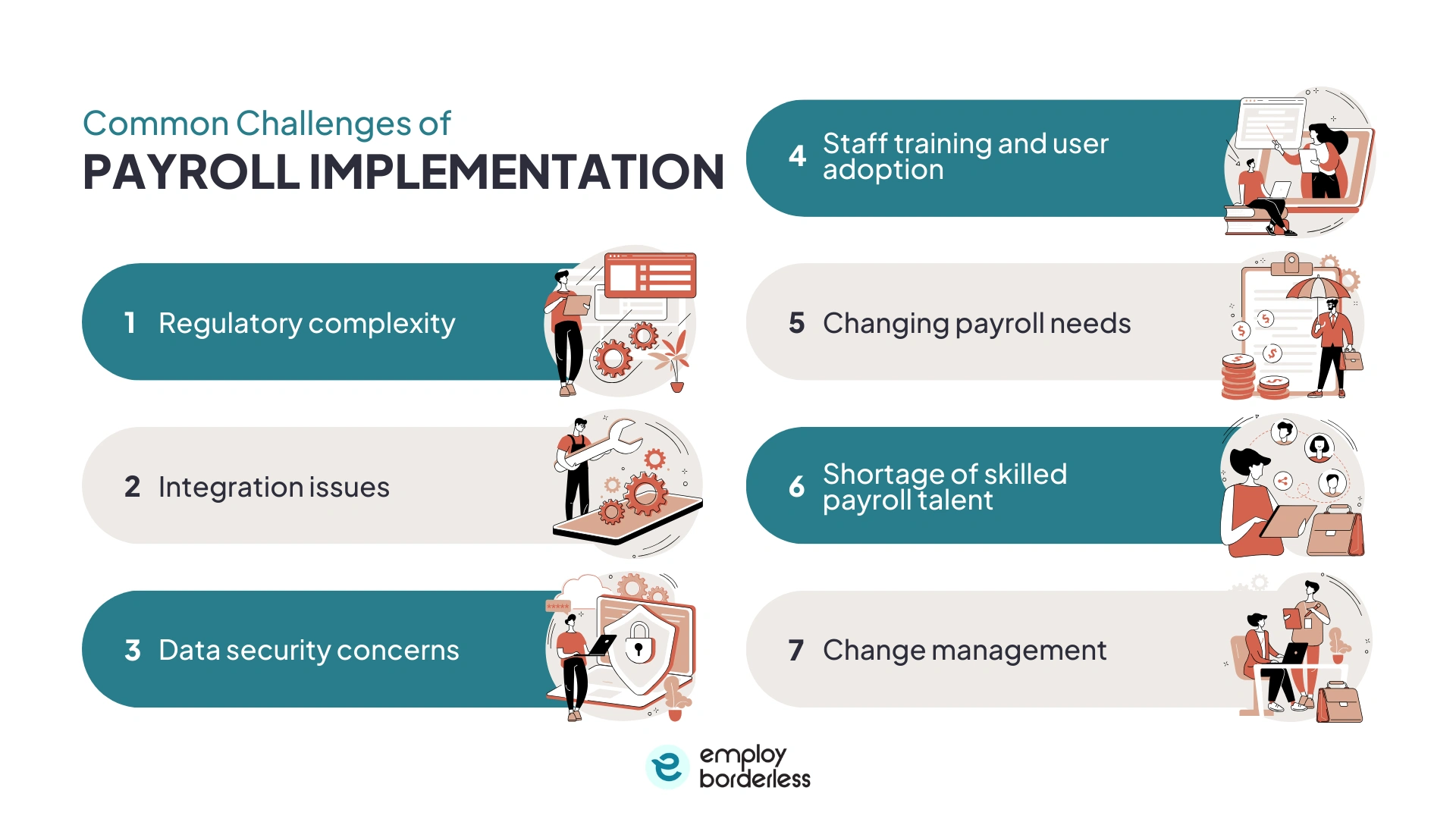
The most common challenges of payroll implementation include regulatory complexity, integration issues, data security concerns, staff training and user adoption, changing payroll needs, and change management.
The most common challenges of payroll implementation are discussed below.
Regulatory complexity: Complying with different payroll laws, tax requirements, reporting standards, and compensation rules across multiple regions becomes difficult during payroll setup. Organizations operating in multiple locations have to confirm the payroll system is able to meet complex legal and regulatory requirements. Managing these differences is challenging and mostly requires support from compliance specialists for accurate payroll processing and to reduce the risk of legal or regulatory issues.
Integration issues: Connecting payroll software with existing systems, such as HRMS (Human Resources Management System), time and attendance, and accounting platforms, is challenging in payroll setup. It requires accurate data synchronization to prevent errors caused by duplicate or inconsistent data entries. Confirming that updates in one system are correctly reflected in payroll is complex and demands careful coordination, customization, and dedicated IT support. Regular and early testing helps identify issues, maintains consistent data flow, and supports accurate financial and workforce reporting.
Data security concerns: Businesses have to protect sensitive employee and financial information and comply with data protection laws across different jurisdictions while confirming secure data transfer between systems. Maintaining the balance between data accessibility and strong protection requires selecting payroll vendors with reliable security measures, such as recognized compliance certifications, encryption protocols, and role-based access controls. Strong data security practices help prevent breaches and increase employee trust.
Staff training and user adoption: Payroll setup requires effective staff training and user adoption, so organizations need to train employees and payroll teams to use the new system confidently and expertly. They have to provide structured training programs, user guides, tutorials, and dedicated support resources. Organizations must also communicate the benefits of the new system, such as simplified payroll processes and self-service access to payroll information, and encourage acceptance.
Changing payroll needs: Organizations have to adjust payroll systems to changing labor laws, regulatory changes, and shifting business priorities. They need flexible solutions that support growth and operational changes. Standardizing payroll processes across locations, automating routine tasks to reduce errors, and unifying systems to reduce complexity help organizations manage changing payroll demands effectively.
Shortage of skilled payroll talent: Companies struggle to find and retain experienced payroll specialists during payroll setup, particularly in regions with limited talent availability. Workforce trends and employee turnover have also increased this gap, which makes it difficult to manage payroll processes and maintain compliance standards.
Change management: Rolling out a new payroll system often meets resistance from employees familiar with existing processes. Transitioning to the new system requires effective change management strategies, clear communication of benefits, and support to help staff move to the new system with confidence.
How to choose the top-rated payroll platform for successful payroll implementation?
To choose the top-rated payroll platform for successful payroll implementation, consider a user-friendly interface, automatic compliance updates, integrated time tracking, flexible payment options, built-in benefits management, and flexibility for growth.
Choose a payroll system that is easy to use, even for non-technical users. An intuitive interface reduces training time, lowers errors, and helps HR staff complete payroll tasks expertly.
Select payroll software that automatically updates tax rules and labor law changes, and confirm payroll calculations and filings stay compliant with current regulations. This automatic update lowers the risk of legal issues and penalties.
Use a payroll system that integrates with time tracking tools and allows payroll to automatically import employee hours, overtime, and leave data. This integration improves accuracy and reduces the need for manual data entry.
Choose payroll systems that support multiple payment methods, such as direct deposit, printed checks, or digital pay options. Flexible payment choices help match employee preferences and simplify payroll processing.
Look for a payroll platform that provides benefits administration features to handle deductions and employer contributions for health insurance, retirement plans, and other benefits.
Select payroll solutions that handle more employees, multiple locations, and different pay structures without needing a system change. This flexibility is important as a business grows and payroll needs become more complex.
Key takeaway: The right payroll platform isn't just about processing payments - automatic compliance updates and clean integrations with your HR and accounting tools will save your team the most time and reduce the most risk over the long term.
How long does payroll implementation take?
Payroll implementation time differs depending on the organization's size and complexity, and most implementations take between 2 and 8 weeks. Smaller businesses with simple payroll needs set up more quickly, while larger organizations or those with complex requirements, such as multi-state operations, detailed pay rules, or multiple system integrations, sometimes require more time.
Can I implement payroll mid-year?
Yes, you can implement payroll mid-year, but it requires careful handling. All year-to-date earnings and tax information must be accurately transferred from the previous system to the new one for a smooth payroll process. Partnering with a payroll provider that supports data migration helps maintain compliance and provides accurate year-end reporting.
What is a payroll implementation specialist?
A payroll implementation specialist is responsible for guiding clients through the process of setting up, configuring, and migrating payroll systems. The specialist assists clients with the new employee onboarding process by confirming all required documentation is collected and accurately processed for payroll. The payroll implementation consultant sets up employee profiles, which include personal information, tax deductions, garnishments, and levies, to support accurate payroll processing.
How to avoid common payroll mistakes during implementation?
To avoid common payroll mistakes during implementation, use reliable payroll software with automation and integrations, maintain accurate and up-to-date employee data, run regular audits and reconciliations, and follow a clear payroll checklist and calendar. These payroll challenges and solutions reduce manual errors, improve compliance, and maintain accurate payroll processing.
What are the two main controls for payroll implementation?
The two main controls for payroll implementation are the division of duties and authorization or approval processes.

Co-founder, Employ Borderless
Robbin Schuchmann is the co-founder of Employ Borderless, an independent advisory platform for global employment. With years of experience analyzing EOR, PEO, and global payroll providers, he helps companies make informed decisions about international hiring.
Learning path · 10 articles
Payroll fundamentals
Master the fundamentals with our step-by-step guide.
Start the pathReady to hire globally?
Get a free, personalized recommendation for the best EOR provider based on your needs.
Get free recommendations