How to evaluate global payroll

Robbin Schuchmann
Co-founder, Employ Borderless
Evaluating global payroll means scoring a provider's technology platform, compliance depth, integration options, currency and payment handling, data security, and support model against the countries and headcount your company operates in before signing a contract. The strongest evaluations check ten factors: platform depth, reporting, HCM/finance integration, process standardization, compliance management, local regulatory knowledge, payroll model fit, currency and payment handling, data security, and employee communication.
Global payroll evaluation checklist

| Factor | What to check |
|---|---|
| Technology platform | Confirm the system handles both global and local payroll, offers employee self-service, secure document storage, check printing or ePayslip generation, and reliable support across regions. |
| Reporting and analytics | Look for one global database with automated reporting and real-time dashboards rather than manual consolidation from separate country systems. |
| HCM and finance integration | Verify certified connectors or APIs with platforms such as Workday, SAP SuccessFactors, and Oracle, plus a documented track record of successful integrations. |
| Process standardization and automation | Look for defined best-practice workflows, a proven rollout method, and vendor-led training for payroll teams in every country. |
| Compliance management | Confirm the vendor tracks statutory filings, sends deadline alerts, and keeps a compliance calendar across every country of operation. |
| Local regulatory knowledge | Check for in-country experts on labor law, tax codes, and payroll rules, since requirements change by jurisdiction. |
| Payroll model | Match in-house, outsourced, or hybrid delivery to company size, local complexity, and internal HR capacity. |
| Currency and payment handling | Confirm multi-currency support, automated conversion, and controls on exchange rate costs and transfer fees. |
| Data security | Require ISO 27001, SOC 1 and SOC 2 reports, SSL encryption, and strict access controls. |
| Employee communication | Check for clear payslips, benefit explanations, and multilingual support where the workforce needs it. |
Technology platform and system integration
Review each provider's platform in detail rather than assuming every unified system offers the same depth. Some vendors still rely on separate or disconnected processes per country. The platform needs to support global and local data collection for accurate reporting, alongside check printing or ePayslip generation, easy self-service tools, secure document storage for payroll records, and support that can handle issues across regions.
Payroll also needs to connect with HR and finance systems so data stays consistent across the business. Check for certified connectors or APIs with leading HCM platforms such as Workday, SAP SuccessFactors, and Oracle; pre-built tools cut integration time and cost. Review each vendor's certifications, in-house expertise, and customer references to confirm they can support your specific integration needs, since this is where fragmented systems and weak tech integrations most often show up during vendor evaluation.
Reporting, standardization, and automation
A single global payroll database centralizes data across countries so reporting and dashboard analytics run automatically, without pulling numbers from disconnected systems by hand. Less manual extraction means faster, more reliable decisions. Vendor evaluation should also check whether analytics cover the full payroll cycle, since that is how delays, recurring errors, and operational gaps get caught early.
Automated, standardized workflows reduce errors and improve output across countries. Look for documented best-practice processes, a proven rollout method, and a plan to support user adoption, so payroll teams follow the same steps everywhere. Vendor-provided training as part of the rollout project helps teams use the new system correctly from day one and reduces the training inconsistencies that come with running payroll across multiple regions.
Compliance and local regulations
Missed or incorrect statutory filings lead to fines, penalties, and reputational damage, so evaluate vendors on in-country expertise and compliance tools that track each jurisdiction's filing status, tax rules, and reporting requirements as laws change. Look for a system with alerts ahead of deadlines and verification that filings and payments went through correctly, plus a compliance calendar showing due dates and major events across every country.
Each country also sets its own labor laws, tax codes, and statutory requirements that affect how pay is calculated and reported. Providers who track and adjust to regulatory changes reduce audit risk and keep calculations and filings correct in every location. Confirm vendors hold security standards such as ISO 27001 certification to protect payroll and employee data alongside regulatory compliance.
Choosing a payroll model
The payroll model determines who runs the process and how much control, cost, and local risk your company carries. Assess internal capacity and business goals before settling on one model.
| Model | How it works | Best fit |
|---|---|---|
| In-house | All payroll functions sit inside the organization. | Companies with strong local HR teams and established systems. |
| Outsourced | A global payroll provider manages compliance, processing, and payments across countries. | Companies wanting to cut internal workload and reliance on local expertise. |
| Hybrid | Combines in-house and outsourced delivery, adjusted country by country. | Companies with mixed complexity, risk, or scale across markets. |
Currency, payments, and data security
Paying across borders requires set procedures for local currencies, exchange rate movements, and transfer fees so the payroll budget stays predictable. Pay has to land in the correct currency, on time, and in line with local tax and banking rules. Many providers build in multi-currency support and automated conversion, which controls exchange-rate and transfer costs and improves payment reliability.
Payroll systems hold highly sensitive employee data, so providers need to hold global security standards such as ISO 27001 and SOC certifications that confirm regular audits and strong security management. Look for SSL encryption on data at rest and in transit, plus strict access controls, all of which reduce breach risk and support data protection regulations and employee trust, directly addressing the vendor security protocols companies expect from a payroll partner.
Employee communication
Employees in every country need to understand their payslips, deductions, and benefits so they trust that pay is accurate. Clear explanations of pay components, plus support in local languages where needed, cut down on confusion and repeat questions, particularly in regions with multiple languages or payroll practices. Timely responses to employee questions and accessible resources raise satisfaction and trust across the workforce and reduce the time HR teams spend fielding routine payroll questions.
What is global payroll?
Global payroll is the process of paying employees working in different countries while meeting the tax and legal requirements of each one. It calculates wages and withholds taxes through one unified system, and manages taxation laws, employee benefits, and social security contributions that differ from country to country.
How does global payroll work?
Global payroll works like local payroll: it delivers accurate, on-time pay to employees regardless of location. The process collects and consolidates employee data from multiple locations, applies local tax laws and labor rules to calculate pay, and handles payments in multiple currencies. Payroll teams run reviews, approvals, and compliance checks and generate reports for internal and regulatory use.
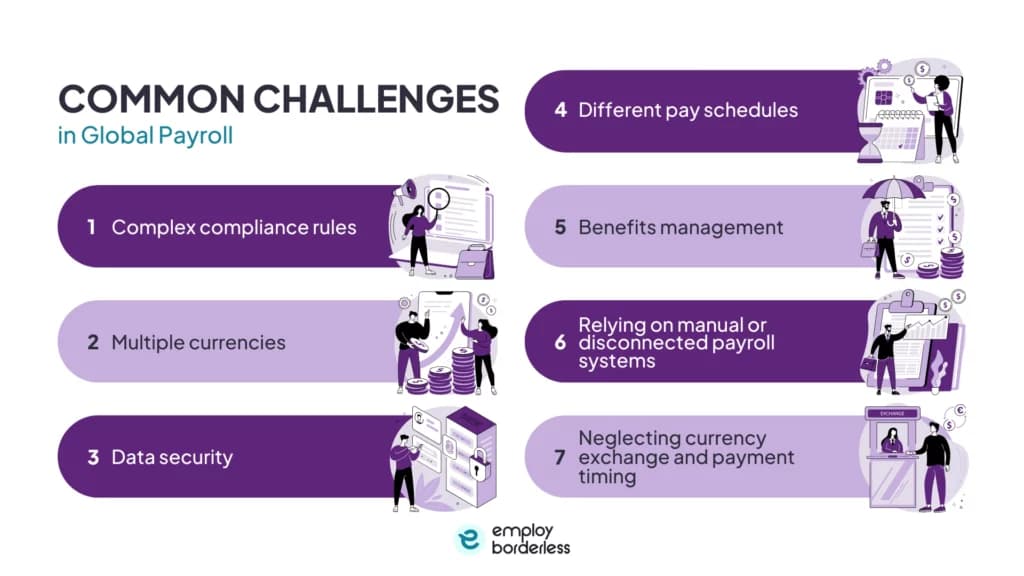
Common challenges in global payroll
| Challenge | Why it happens |
|---|---|
| Complex compliance rules | Every country has different labor, tax, and payroll regulations, and failing to track frequent legal changes results in fines and penalties. |
| Multiple currencies | Fluctuating exchange rates and transaction costs across local currencies make budgeting and accurate payments harder. |
| Data security | Sensitive payroll data crossing borders must meet global and local data protection laws or risk breaches and penalties. |
| Different pay schedules | Companies run different payroll cycles and calendars per country, requiring careful coordination to hit every local pay date. |
| Benefits management | Each market sets its own rules for benefits, statutory contributions, and deductions, complicating consistent payroll calculations. |
| Manual or disconnected systems | Spreadsheets or separate systems per country create disconnected data, inconsistent reporting, more errors, and extra administrative work. |
| Neglecting currency exchange and payment timing | Missing conversion timing, processing delays, and local banking rules slows payments and causes compensation errors. |
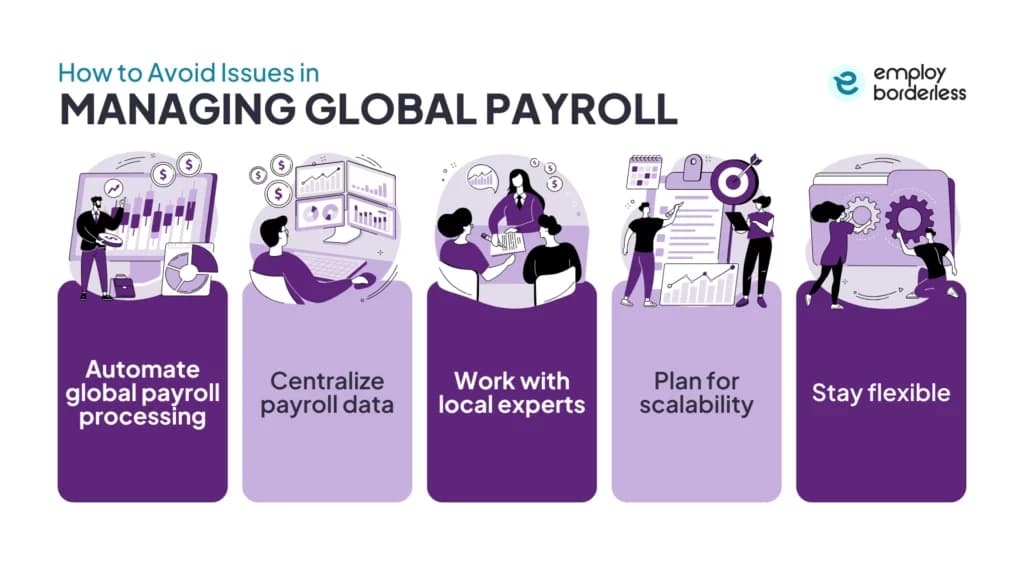
How to avoid issues in managing global payroll
Automate global payroll processing
Automating calculations, tax withholdings, payslip generation, and compliance checks cuts manual errors and frees payroll teams from repetitive tasks. Automated systems apply local tax and labor rules and update them as rules change, keeping companies compliant across jurisdictions without constant manual adjustment.
Centralize payroll data
One consistent dataset for all countries, instead of separate records per system, improves accuracy and cuts payroll issues. Centralized data speeds up reporting and gives a clear view of total payroll costs, trends, and performance, so teams spend less time on reconciliation and more on core work.
Work with local experts
Local payroll and tax experts interpret and apply each country's labor, tax, and compliance rules correctly, avoiding legal missteps. Pairing a global system with local insight keeps payroll processing reliable across countries and simplifies reporting and compliance tracking.
Plan for growth
Choose payroll software that grows with the business, adds countries, and standardizes processes across regions rather than relying on separate tools per market. A centralized system improves accuracy, cuts errors, and makes it easier to expand payroll operations. Match the system and partner to current needs and to expected expansion, so companies avoid costly system replacements later.
Stay flexible
Responsive payroll technology that supports multiple countries, currencies, and local rules lets teams update workflows without major system changes. Automate where possible, monitor regulatory changes continuously, and keep connections with in-country experts so updates go in immediately. Work with providers who can add countries or adjust payment methods as the workforce grows.
How to choose the right global payroll platform
Look at country coverage, security certifications, and pricing transparency. Choose a provider with current knowledge of global and local compliance and responsive customer support.
Full coverage across every country a company operates in avoids managing multiple vendors and keeps payroll processes and compliance uniform. Look for standards such as ISO 27001 or SOC certification to protect payroll data and meet regulations such as GDPR (General Data Protection Regulation) and CCPA (California Consumer Privacy Act). Confirm pricing is upfront with no hidden fees, so budgeting for payroll across countries stays accurate. Prioritize providers with current expertise in local and global tax codes, labor regulations, and reporting requirements, plus support that can resolve complex payroll issues quickly and keep operations running across markets. See how to choose a payroll provider for a full breakdown.
Global payroll FAQs
Are there global payroll systems?
Yes. Global payroll systems let companies pay employees in multiple countries from one central platform, consolidating data, handling local compliance, and processing salaries in different currencies instead of relying on separate local tools.
What are global payroll services?
Global payroll services handle payroll for employees in different countries, covering wage calculation, compliance with local labor laws, withholding of federal income taxes, and currency conversion.
What is the difference between global and international payroll management?
Global payroll management runs payroll centrally across countries on standardized systems for compliance, currencies, and reporting. International payroll management handles payroll country by country and leans more on local processes while still coordinating overall.
How much does a global payroll platform typically cost?
Global payroll typically costs about $20 to $50 per employee per month, with lower rates near $5 to $15 and higher rates above $50 depending on features, support level, and number of countries. Some EORs or enterprise services cost considerably more.
What certifications should a global payroll provider have?
Look for ISO 27001 for information security, SOC 1 and SOC 2 reports for controls over financial data and system security, and GDPR (General Data Protection Regulation) compliance for data privacy.
How do you measure the ROI of a global payroll platform?
Compare total payroll costs before and after rollout, including labor, compliance, and error-correction costs. Track reduced processing time, fewer payroll errors, improved compliance, and lower administrative effort. ROI equals benefits minus costs, divided by costs, shown as a percentage.
How long does it take to set up a global payroll system?
Setup time depends on complexity and scope. Basic rollouts for a few countries take about 10 days to 3 months, while broader rollouts across many countries usually take 3 to 6 months or more, depending on data quality, country count, and integration needs. Larger enterprises sometimes take more than six months.

Co-founder, Employ Borderless
Robbin Schuchmann is the co-founder of Employ Borderless, an independent advisory platform for global employment. With years of experience analyzing EOR, PEO, and global payroll providers, he helps companies make informed decisions about international hiring.
Learning path · 10 articles
Payroll fundamentals
Master the fundamentals with our step-by-step guide.
Start the pathReady to hire globally?
Get a free, personalized recommendation for the best EOR provider based on your needs.
Get free recommendations