How EOR trends are defining the future of global businesses

Robbin Schuchmann
Co-founder, Employ Borderless
EOR (Employer of Record) is a third-party organization that legally employs workers on behalf of a company and manages compliance, payroll, and HR responsibilities across regions. The current trends in the EOR industry are the growing complexity of international employment regulations, rising demand for flexible workforce solutions, increased globalization of business operations, flexible EOR solutions for SMBs (Small and Medium-Sized Businesses), and the need for cost-effective expansion strategies.
Market insights show that the EOR industry is growing quickly, valued at around USD 5237.11 billion in 2024. It is expected to reach approximately USD 9176.77 billion by 2033 with a CAGR (Compound Annual Growth Rate) of 6.8%. This consistent growth shows that more businesses are utilizing EOR solutions to manage global hiring and compliance.
The technological developments that are impacting the future of EOR trends include AI-integrated compliance monitoring, blockchain for secure documentation, integrated global payroll platforms, employee self-service portals, and predictive analytics for workforce planning.
Future trends in global EOR services include the rise of digital platforms, a focus on employee experience, compliance as a priority, expansion into emerging markets, ethical hiring practices, improved data security and privacy measures, and integration with global mobility programs.
EOR providers are evolving and influencing global businesses as they invest in technology, expand coverage, improve client support, advance compliance capabilities, and provide customized industry solutions.
What are the current trends in the EOR industry?
The current trends in the EOR industry are increasing globalization of business operations, rising demand for flexible workforce solutions, growing complexity of international employment regulations, flexible EOR solutions for SMBs (Small and Medium-Sized Businesses), and the need for cost-effective expansion strategies.
Businesses are expanding into new international markets more quickly than before, which creates the need for reliable global workforce management. EORs help companies hire employees across borders without establishing a local entity. This trend supports compliant global expansion while reducing operational risks.
Modern businesses are increasingly implementing hybrid and remote work models. EORs allow companies to hire full-time, part-time, or contract employees globally with ease. This flexibility helps organizations easily adjust to market demands and workforce changes.
Global employment laws are frequently changing and make compliance difficult for companies. EORs keep up with local labor, tax, and benefits regulations to make sure businesses remain compliant. They reduce legal risks and maintain smooth international operations.
Small and medium-sized businesses are using EORs to expand globally without high setup costs. These customized EOR services allow SMBs to access international talent and manage payroll easily. Small businesses also get access to global opportunities, which helps in their business growth.
Businesses require global growth without heavy investments in infrastructure or legal entities. EORs provide a cost-effective way to enter new markets by handling HR, payroll, and compliance. This cost-saving approach allows companies to focus on scaling while reducing financial and legal risks.
How do market insights show the evolution of EOR trends and services?
Market insights show the evolution of EOR trends and services through industry data, which shows that the EOR market is valued at USD 5237.11 billion in 2024 and is expected to reach USD 9176.77 billion by 2033, with a CAGR (Compound Annual Growth Rate) of 6.8%. This growth confirms the rising demand for flexible employment solutions in an unpredictable global business environment.
Industry insights also show businesses are increasingly relying on EOR services to manage global hiring, ensure compliance, and expand smoothly in a shifting global economy. This rising trend demonstrates how organizations consider EOR as a strategic tool to handle workforce complexity, reduce risk, and achieve smooth international operations in a changing market landscape.
How is innovation in EOR trends redefining the future of EOR?
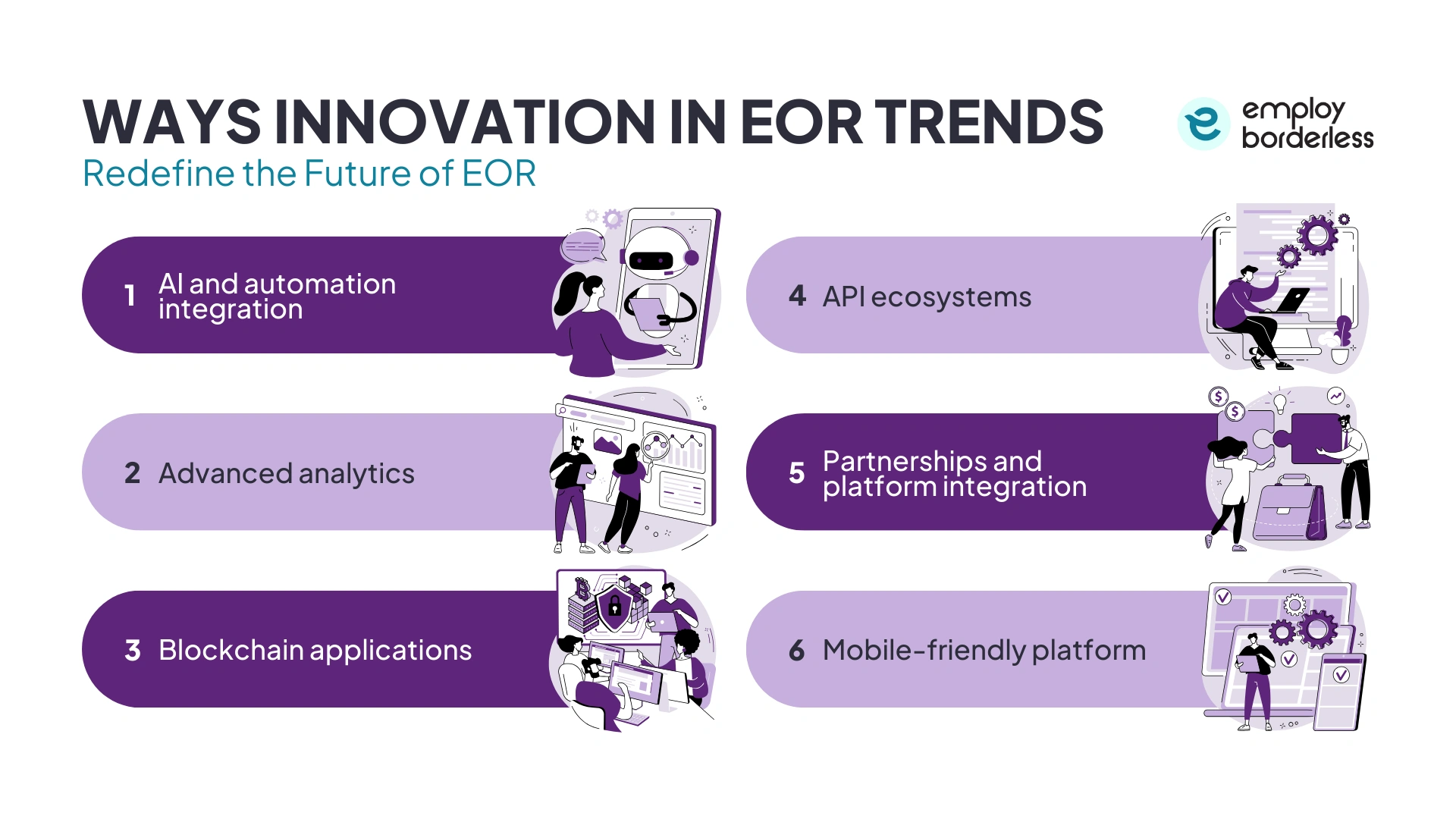
Innovation in EOR trends is redefining the future of EOR through AI and automation integration, advanced analytics, blockchain applications, API ecosystems, partnerships and platform integration, and a mobile-friendly platform.
The ways innovation in EOR trends is redefining the future of EOR are listed below.
- AI and automation integration: AI and automation are transforming EOR operations by simplifying payroll onboarding and compliance management. These technologies reduce manual errors and standardize administrative processes.
- Advanced analytics: Advanced analytics allow EORs to make decisions according to data regarding workforce planning, performance, and compliance risks. They provide real-time insights into employee trends and market conditions.
- Blockchain applications: Blockchain technology improves transparency and security in EOR transactions and employee data management. It maintains regular records for contracts, payroll, and compliance documentation.
- API ecosystems: API ecosystems allow EOR platforms to integrate smoothly with HR, payroll, and accounting systems. These integrations improve data flow and reduce duplication across business tools.
- Partnerships and platform integration: Strategic partnerships between EORs and HR technology providers expand service capabilities and coverage. The integrated platforms create a connected experience for clients and offer all services from payroll to compliance in one system.
- Mobile-friendly platform: Mobile-friendly EOR platforms provide instant access to payroll, benefits, and compliance tools from anywhere. Employees and employers are able to manage HR tasks easily in modern, hybrid, and remote work environments.
How are regulatory changes influencing EOR trends?
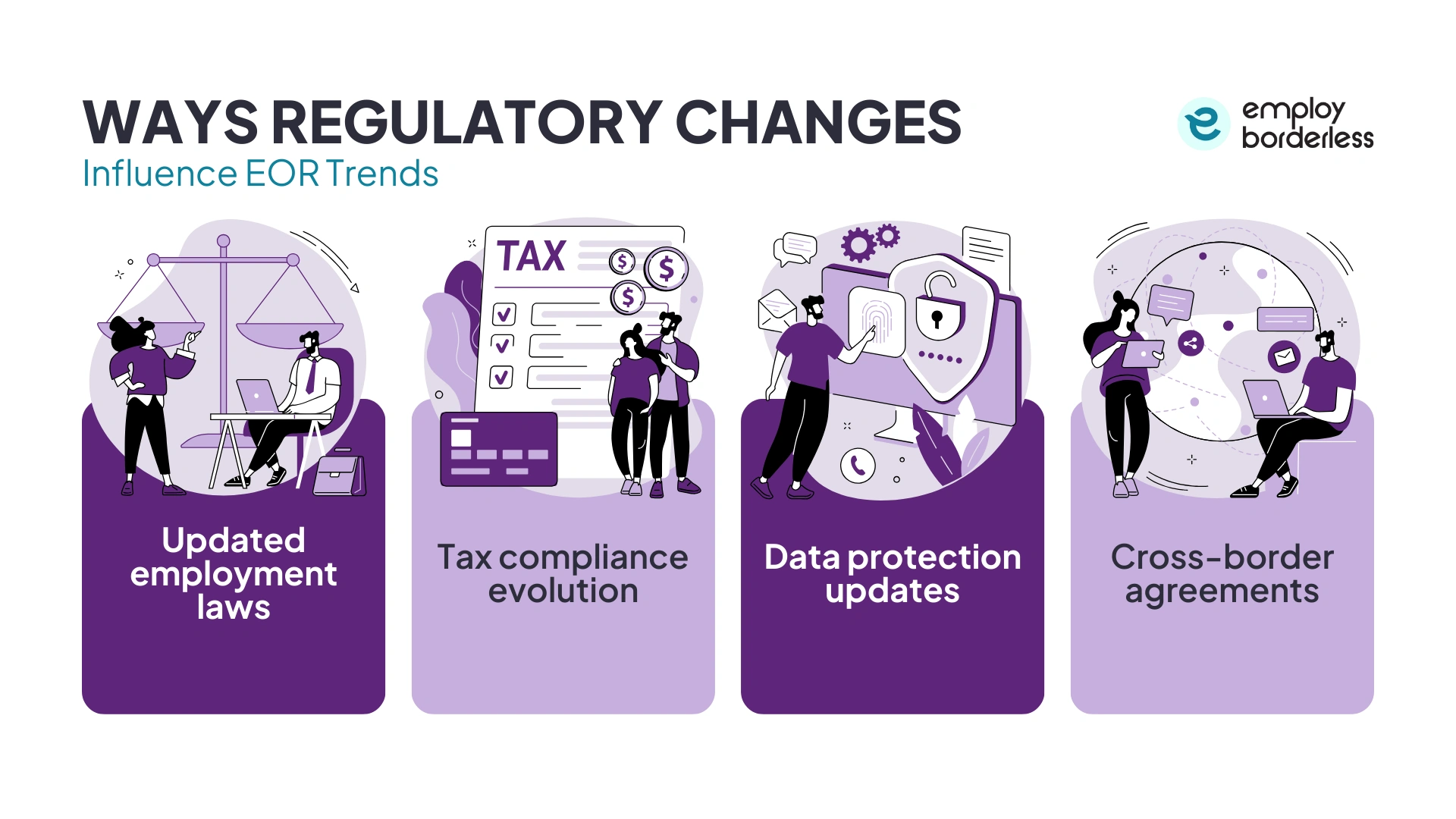
Regulatory changes are influencing EOR trends through updated employment laws, tax compliance, data protection, and cross-border agreements.
The ways regulatory changes are influencing EOR trends are listed below.
- Updated employment laws: Frequent updates in employment laws across countries require EORs to adjust their compliance systems. These changes affect hiring practices, employee classification, and workplace rights.
- Tax compliance evolution: Global tax regulations are becoming more complex, with new reporting requirements and digital tax systems. EORs provide accurate tax filings, withholdings, and compliance with local and international tax rules.
- Data protection updates: Stricter data privacy laws such as the GDPR (General Data Protection Regulation) and CCPA (California Consumer Privacy Act) are reshaping employee data handling. EORs have to implement better security protocols and transparent data practices.
- Cross-border agreements: New trade and labor agreements between countries influence the management of global employment. EORs must manage different visa rules, labor rights such as the FLSA (Fair Labor Standards Act), and taxation systems according to local policies.
What technological developments are impacting the future of EOR trends?
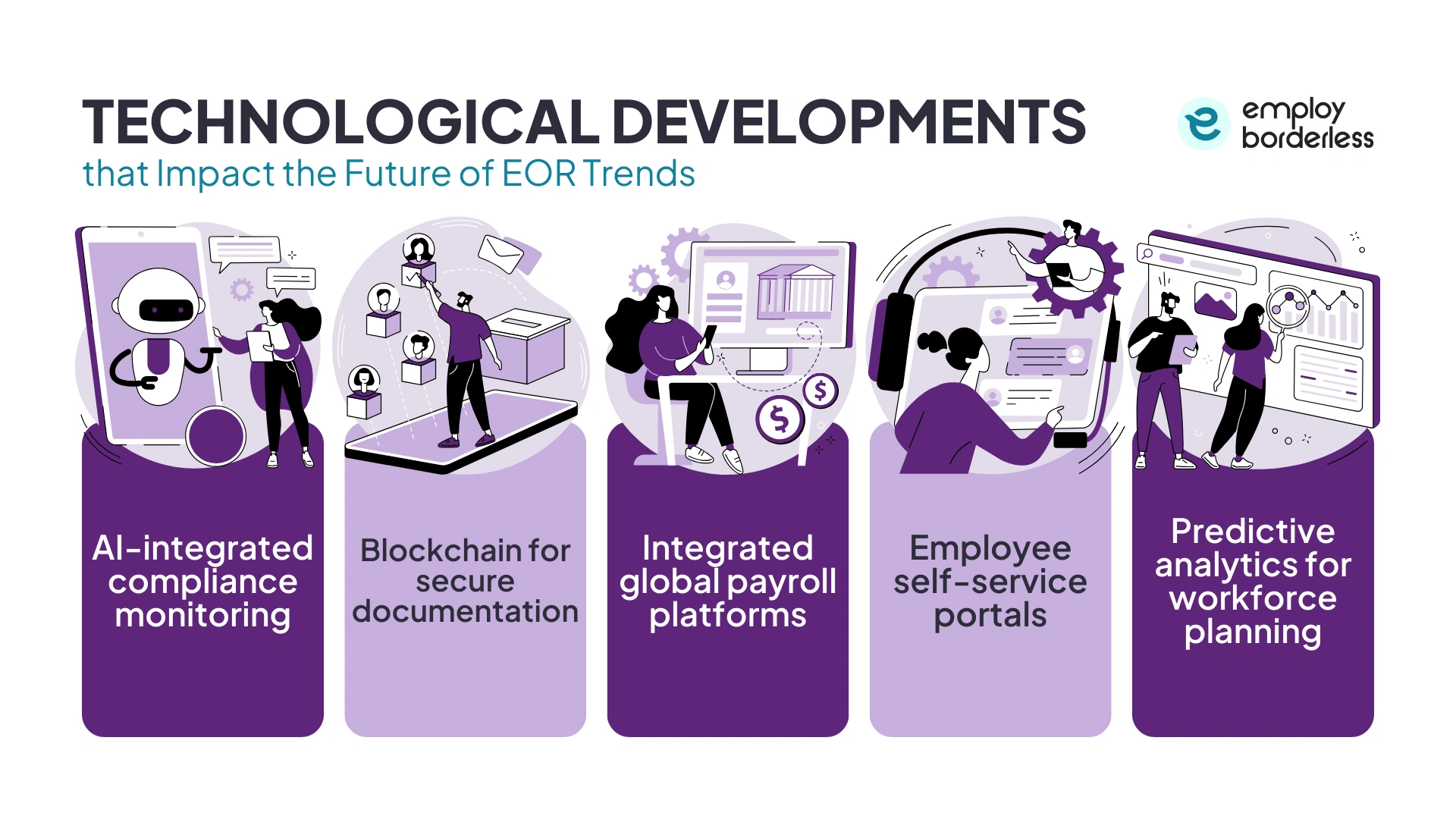
The technological developments that are impacting the future of EOR trends include AI-integrated compliance monitoring, blockchain for secure documentation, integrated global payroll platforms, employee self-service portals, and predictive analytics for workforce planning.
AI-integrated compliance monitoring
AI is helping EORs monitor and manage global laws by automatically detecting changes in local regulations and updating company policies to stay compliant. AI-integrated compliance monitoring helps reduce human errors and saves time for HR teams. It also makes sure that the international operations follow legal requirements in real time.
Blockchain for secure documentation
Blockchain technology helps store and share employment records in a secure way. It provides transparent documentation of contracts, payments, and employee information. This technological development helps build trust between employers and workers while also reducing the risk of fraud and data manipulation across borders.
Integrated global payroll platforms
Modern EORs use integrated payroll systems to manage employees across multiple countries. These integrated global payroll platforms simplify payments, currency conversions, and tax withholdings. Businesses are also able to monitor all payroll data in one place as required. These systems provide accurate and timely payments while complying with each country’s legal requirements.
Employee self-service portals
EORs provide self-service online portals that allow employees to manage their profiles, access payslips, and update personal details. These portals give employees more control over their data while reducing the HR team’s burden. Employees experience a smooth and transparent process and improved communication with management.
Predictive analytics for workforce planning
Predictive analytics uses workforce data to predict hiring needs and workforce trends. It helps EORs and companies make informed decisions about recruitment and staffing. Businesses also prepare for future demands and skill gaps by analyzing workforce patterns. This workforce analysis also helps manage resources properly.
How do businesses benefit from adopting EOR trends?
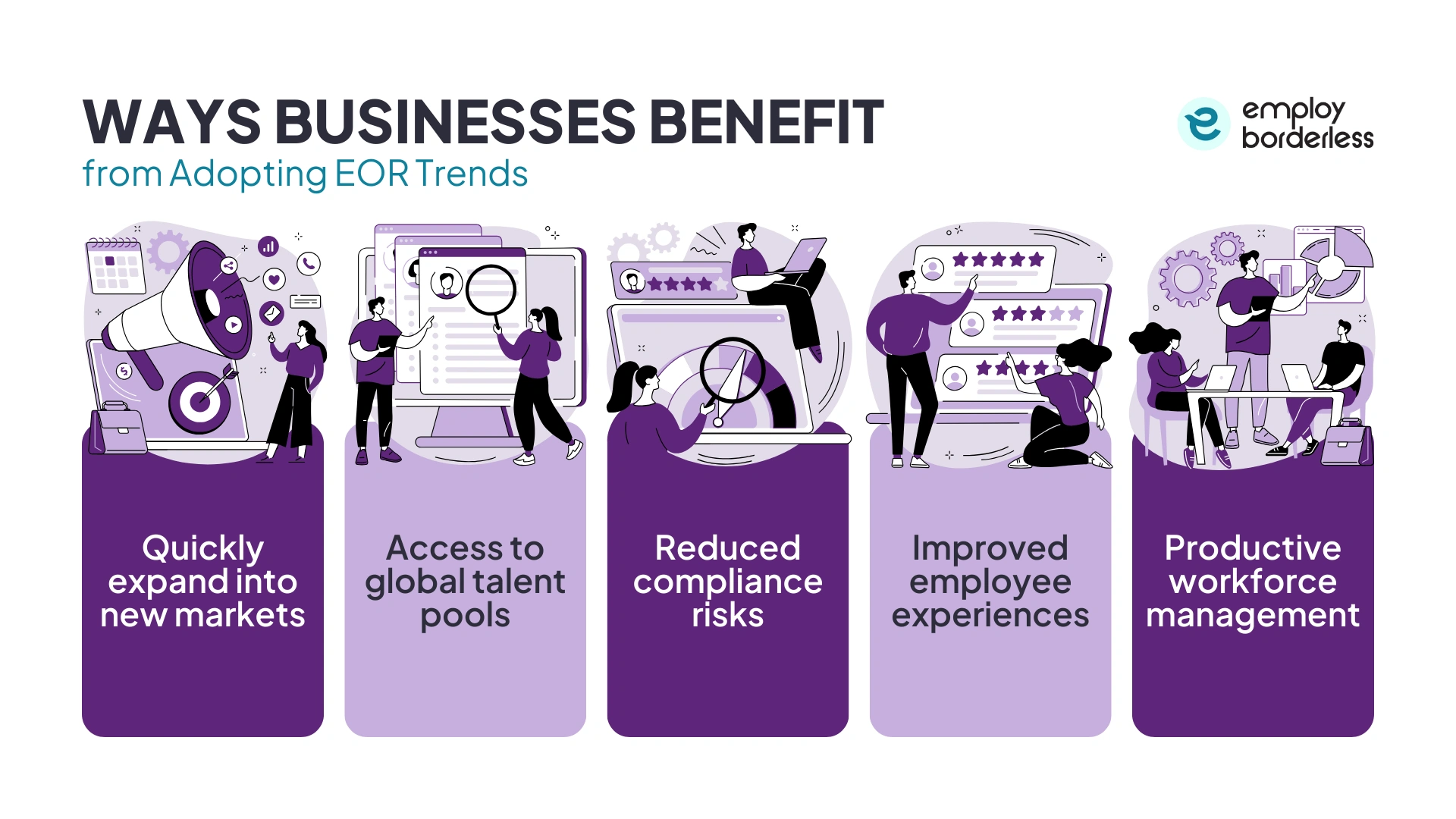
Businesses benefit from adopting EOR trends, as they are able to quickly expand into new markets, access global talent pools, reduce compliance risks, improve employee experiences, and manage their workforce productively.
Quickly expand into new markets
EOR services allow businesses to enter new countries without setting up a local entity. They handle compliance, hiring, and payroll, which helps companies focus on their core operations, such as customer relations and product and service development. EOR services also help companies save time and money during expansion and avoid delays that occur due to legal and administrative problems.
Access to global talent pools
This third-party organization helps companies hire skilled professionals from anywhere in the world. An EOR also helps remove barriers related to visas, contracts, or regional labor laws, such as the FLSA (Fair Labor Standards Act). Businesses get access to top talent in specialized fields and successfully build diverse and creative teams.
Reduced compliance risks
EORs make sure that all employment practices follow local labor and tax laws and stay updated with legal changes to reduce the risk of fines and penalties. These third-party organizations help companies stay compliant in every country where they operate. They also improve a business’s reputation for following ethical and legal standards.
Improved employee experiences
This third-party organization carefully handles HR tasks, such as onboarding and payroll, to provide accuracy and reliability. Employees get paid on time and receive proper support throughout their employment. It creates a sense of trust and satisfaction among the workforce and leads to better engagement and retention.
Productive workforce management
EORs help manage employees through simplified HR systems and data tools. They track attendance, performance, and compliance in real time. This simplified workforce management allows businesses to make informed decisions about workforce needs, improve productivity, and improve the overall performance of their teams.
What challenges are affecting the adoption of EOR trends?
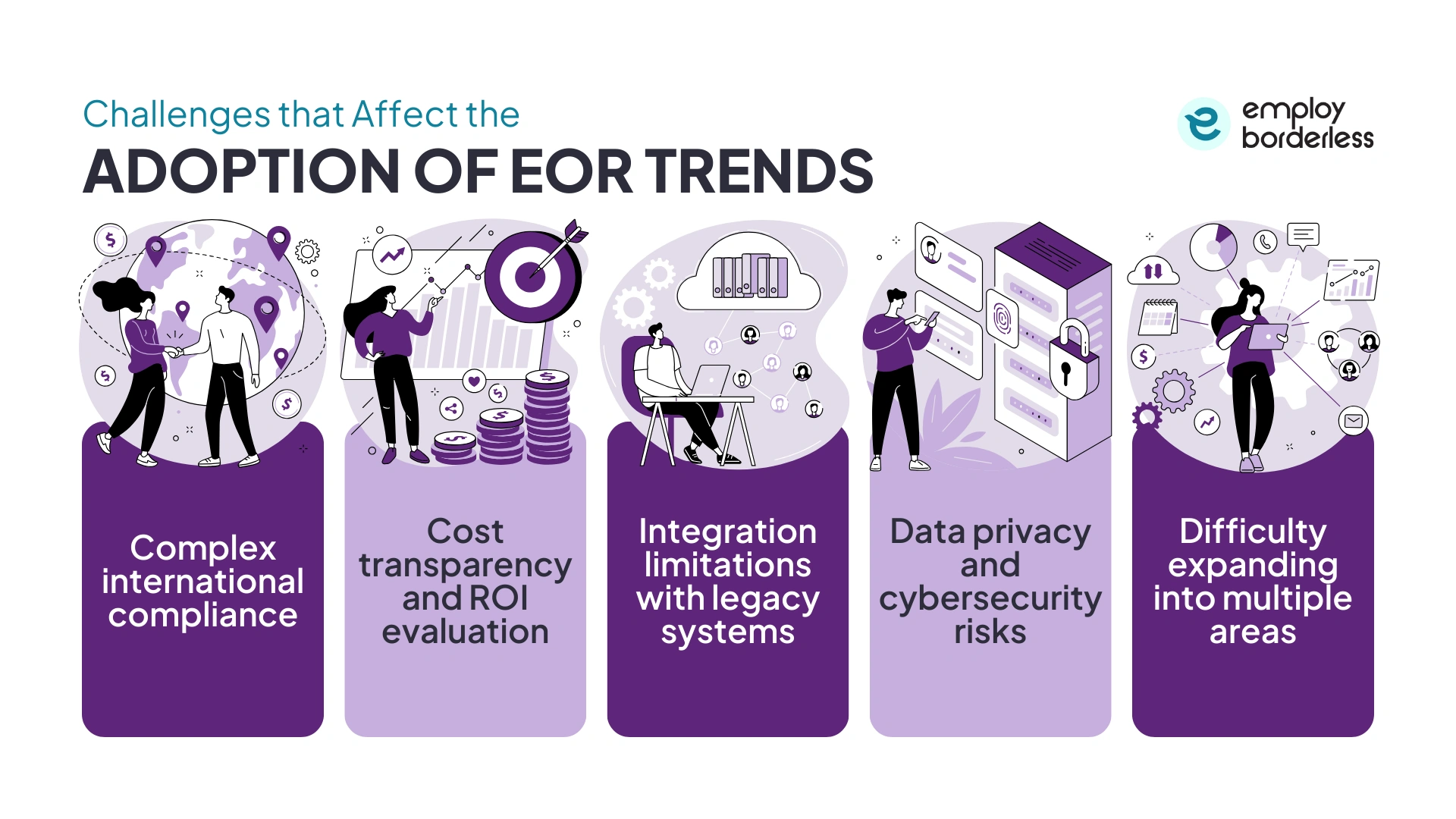
The challenges that are affecting the adoption of EOR trends include complex international compliance, cost transparency and ROI evaluation, integration limitations with legacy systems, data privacy and cybersecurity risks, and difficulty expanding into multiple areas.
The challenges that are affecting the adoption of EOR trends are listed below.
- Complex international compliance: EORs need to manage complex international compliance, which includes different labor laws, tax systems, and regulations across countries. Every region has unique compliance requirements that frequently change.
- Cost transparency and ROI evaluation: Some providers have hidden fees or unclear pricing models, which makes it difficult for businesses to understand the actual cost of EOR services.
- Integration limitations with legacy systems: Many companies use outdated HR or payroll systems that do not easily connect with EOR platforms. These outdated systems affect data accuracy and cause delays in sharing and reporting information.
- Data privacy and cybersecurity risks: EOR platforms handle sensitive employee and company data across borders, so any security breach can expose confidential information or violate data protection laws such as HIPAA (Health Insurance Portability and Accountability Act) and COPPA (Children’s Online Privacy Protection Act). Third-party organizations need to take strong cybersecurity measures, such as SSL encryption or multi-factor authentication.
- Difficulty expanding into multiple areas: Every location has different employment practices, taxes, and documentation requirements, which makes it complex to manage EOR services across several countries. This process of expansion requires proper coordination, or else the company faces administrative challenges.
What are the future trends in global EOR services?
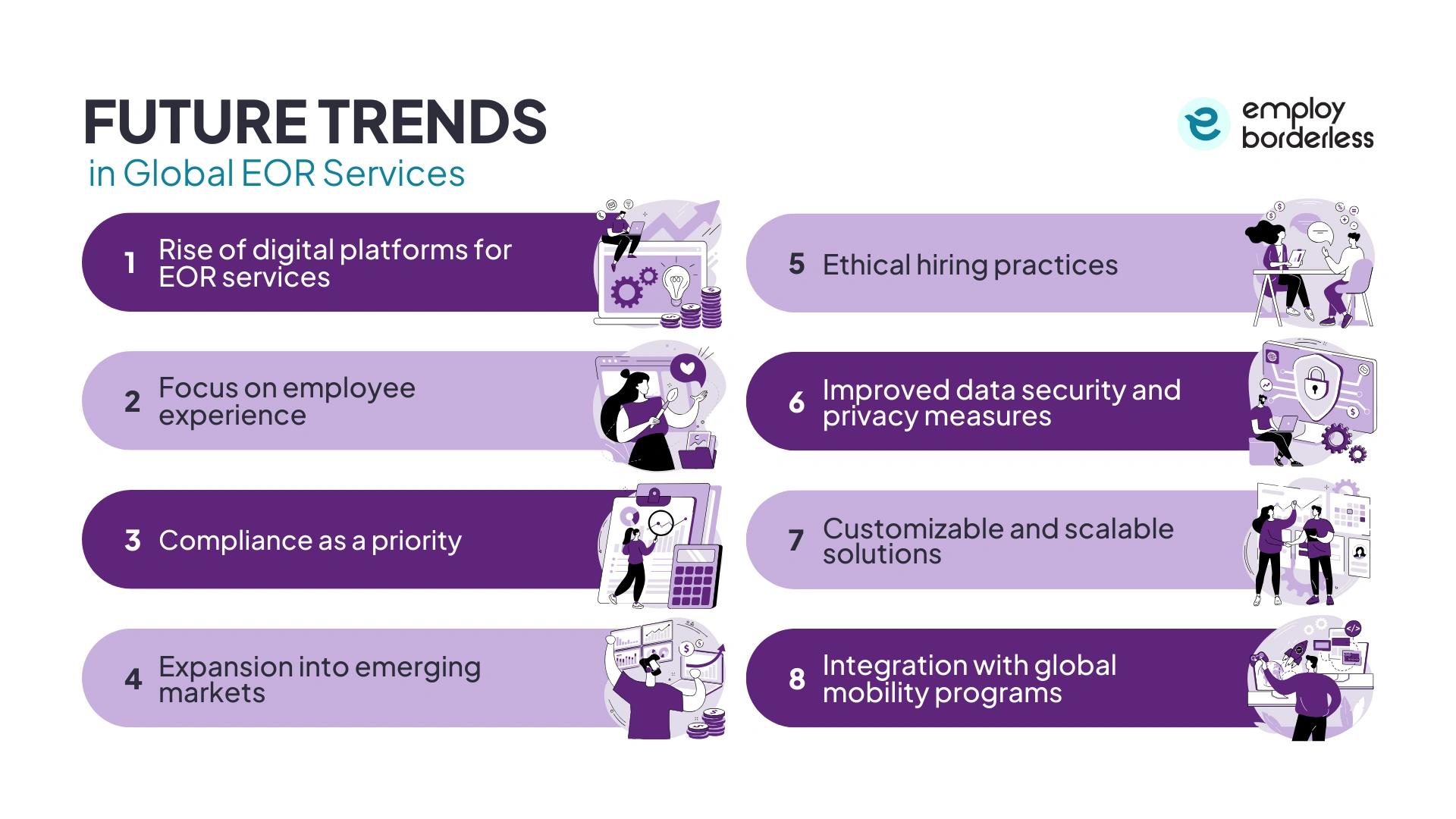
The future trends in global EOR services include the rise of digital platforms for EOR services, a focus on employee experience, compliance as a priority, expansion into emerging markets, ethical hiring practices, and integration with global mobility programs.
Rise of digital platforms for EOR services
EOR providers have started using digital platforms to automate HR, payroll, and compliance tasks. These platforms make it easier for businesses to manage global employees in real time. Digital transformation also improves accuracy and helps companies manage international operations more smoothly. The shift to digital EOR platforms further reduces administrative costs and human error.
Focus on employee experience
The future of EOR services revolves around improving employee satisfaction and engagement. EOR providers make employees feel valued, as they offer personalized onboarding, localized benefits, and continuous support. This personalized approach also helps increase workforce productivity, reduce employee turnover, and improve a company’s global reputation.
Compliance as a priority
EOR companies plan to focus on staying compliant with changing labor, tax, and employment laws across countries. Automated systems and local legal teams help companies follow regulations accurately and prevent fines, disputes, and legal risks. Strong compliance also builds trust with clients and employees and supports long-term business growth.
Expansion into emerging markets
Businesses are collaborating with EORs to enter emerging regions like the Asia-Pacific and Latin America. These regions offer growing talent pools and cost-effective labor options. EORs simplify the process by managing local employment, payroll, and legal compliance. This simplified employment process allows companies to expand globally without setting up a legal entity, which saves businesses both time and money.
Ethical hiring practices
This global employment solution supports transparent hiring processes to help businesses comply with international labor standards and promote diversity in their global teams. Ethical hiring practices also reduce the risk of discrimination and exploitation. This commitment to ethical hiring improves the company’s reputation and conforms to global corporate responsibility values.
Improved data security and privacy measures
Technology solutions help EOR providers manage operations involving sensitive employee and company data. EOR providers utilize SSL encryption, multi-layer authentication, and secure cloud storage to protect confidential company and employee information. This third-party organization makes sure that its global data protection measures comply with privacy laws such as the GDPR (General Data Protection Regulation) and the CCPA (California Consumer Privacy Act).
Customizable and scalable solutions
This third-party employer provides customizable and scalable solutions to match specific business needs and growth stages. Client companies are able to easily scale their workforce depending on market demands. EORs now design flexible solutions that match industry-specific operations and budgets. This customization helps companies grow easily without investing extra resources or time.
Integration with global mobility programs
Employer of Record services now work alongside global mobility and relocation programs to manage visas, work permits, and international tax compliance for remote employees. This integration creates a smoother experience for both employers and employees while accurately handling all legal and financial aspects of international assignments.
How are EOR providers evolving and influencing global businesses?
EOR providers are evolving and influencing global businesses by investing in technology, expanding coverage, improving client support, advancing compliance capabilities, and providing customized industry solutions.
EOR providers are utilizing AI, automation, and cloud-based platforms to simplify payroll, compliance, and employee management. This investment improves payroll accuracy and reduces administrative burden for businesses.
This global employment solution is expanding its services to more countries, which allows businesses to hire and manage employees in new markets. This expansion helps companies grow globally without establishing local entities.
EOR providers offer better client and employee support in multiple languages. This multilingual support helps businesses and their employees follow local employment regulations, payroll, benefits, and HR issues more easily, particularly when operating across diverse regions. This improved support helps build strong relationships and simplifies business operations.
Modern EORs are advancing their legal and tax compliance systems to meet changing global regulations. These advanced compliance systems make sure that businesses confidently operate across multiple regions while reducing the risk of penalties or legal disputes.
EORs offer customized services to meet the specific needs of industries such as technology, healthcare, and manufacturing. This customization supports effective workforce management and provides compliance within each sector.
How to choose the right EOR provider that supports current EOR trends?
To choose the right EOR provider that supports current EOR trends, evaluate its technology capabilities, check global reach and scalability, assess compliance and data security standards, look for industry-specific expertise, and review transparency and client support.
Choose an EOR that uses advanced technology such as AI, automation, and data analytics for payroll, compliance, and HR management. Modern tools improve workforce productivity, reduce human error, and offer real-time reporting for better decision-making.
Select an EOR provider with strong global reach and scalability to support your business as it expands into new markets. This global employment solution ensures smooth hiring and compliance management across multiple countries, so the client company does not need to switch providers frequently.
Make sure the EOR provider follows international compliance certifications such as ISO 27001 and GDPR (General Data Protection Regulation). Strong security measures protect sensitive employee data and help your business comply with changing regulatory requirements.
Collaborate with an EOR that understands your industry’s unique challenges, such as payroll complexity, compliance standards, or labor requirements. An EOR provider with proven industry experience offers customized solutions according to your business needs.
Choose an EOR provider with clear pricing, detailed reporting, and dedicated customer support. Transparent communication and responsive support help maintain trust and smooth daily operations.
Are EOR services evolving to serve specific industries?
Yes, EOR services are evolving to serve specific industries by offering more specialized and customized solutions. EOR services for industries now design industry-focused packages for sectors like technology, healthcare, manufacturing, and retail.
How does EOR software contribute to current EOR trends?
EOR software contributes to current EOR trends by automating payroll, compliance, and employee management across multiple countries. The EOR software improves workforce productivity by providing centralized data and analytics for better monitoring of operations and cost control.
How do EOR trends impact technology companies?
EOR trends impact technology companies by allowing them to hire globally, scale quickly, and maintain compliance by outsourcing legal and administrative HR burdens. EOR for technology provides companies access to a wide talent pool and flexible remote and hybrid work models that reduce the cost of international expansion.
What new features should we expect from EOR platforms?
The new features we should expect from EOR platforms include a focus on AI and automation for productivity, specialized services like equity management, expanded global benefits, and smooth integration with existing HR systems.
How are global workforce trends affecting EOR services?
The global workforce trends are affecting EOR services by promoting remote work, digital collaboration, and cross-border hiring. Companies now rely on EORs to manage compliance, payroll, and employee benefits across multiple regions without establishing local entities.
How are compliance standards changing with current EOR trends?
The compliance standards are changing with current EOR trends due to new technologies such as AI and blockchain. These compliance standards are becoming more strict as countries update labor, tax, and data privacy regulations. EOR compliance support now needs to maximize automation, legal expertise, and localized compliance monitoring to protect global employers from risks.

Co-founder, Employ Borderless
Robbin Schuchmann is the co-founder of Employ Borderless, an independent advisory platform for global employment. With years of experience analyzing EOR, PEO, and global payroll providers, he helps companies make informed decisions about international hiring.
Learning path · 8 articles
EOR fundamentals
Master the fundamentals with our step-by-step guide.
Start the pathReady to hire globally?
Get a free, personalized recommendation for the best EOR provider based on your needs.
Get free recommendations