EOR sponsored visa: definition, types, requirements, benefits, challenges, and how to choose

Robbin Schuchmann
Co-founder, Employ Borderless
An EOR-sponsored visa is a work authorization that an EOR (Employer of Record) sponsors for companies to legally employ foreign professionals without setting up a local entity. The EOR acts as the official employer responsible for payroll, benefits, and immigration compliance on behalf of the company.
EORs sponsor different visa types, such as H-1B, L-1, O-1, and immigrant visas. Eligibility requirements for EOR-sponsored visas include meeting country-specific immigration laws, having a valid business license, maintaining a good reputation, proving financial capability, and making sure employees have relevant qualifications.
The benefits of EOR-sponsored visas include a simplified visa process, reduced legal risk, correct worker classification, time and cost savings, and global talent acquisition. EOR-sponsored visas also involve challenges, like labor law violations, fines, visa delays or rejections, fraudulent providers, and limited legal support from inexperienced EORs.
The factors that businesses should evaluate when choosing the right EOR include the service provider's reputation, legal expertise, pricing transparency, communication quality, and service scope.
What is an EOR-sponsored visa?
An EOR-sponsored visa is a work visa that an EOR (Employer of Record) issues to legally employ a foreign worker. The EOR becomes the official employer responsible for managing payroll, benefits, and compliance with immigration and labor laws, while the client company manages daily work activities. The EOR prepares and submits visa applications, maintains required documentation, and verifies that all employment conditions meet local regulations. This model allows companies to hire international employees without establishing a local entity or handling complex immigration procedures.
What is the process of an EOR-sponsored visa?
The process of an EOR-sponsored visa includes coordination between the employer of record, the foreign worker, the company, and immigration authorities. An EOR submits an initial application that includes the job role, salary, and working conditions. The employer provides employee details, such as education, experience, and identification documents, for verification during the review stage.
The government assesses the sponsorship request and sometimes requires interviews or additional documentation to confirm eligibility. Once approved, the visa is issued under the EOR's name, allowing the employee to work legally for the client company. The EOR manages compliance, renewals, and communication with authorities to make sure that all visa requirements remain valid.
What are the types of visas sponsored by an EOR?
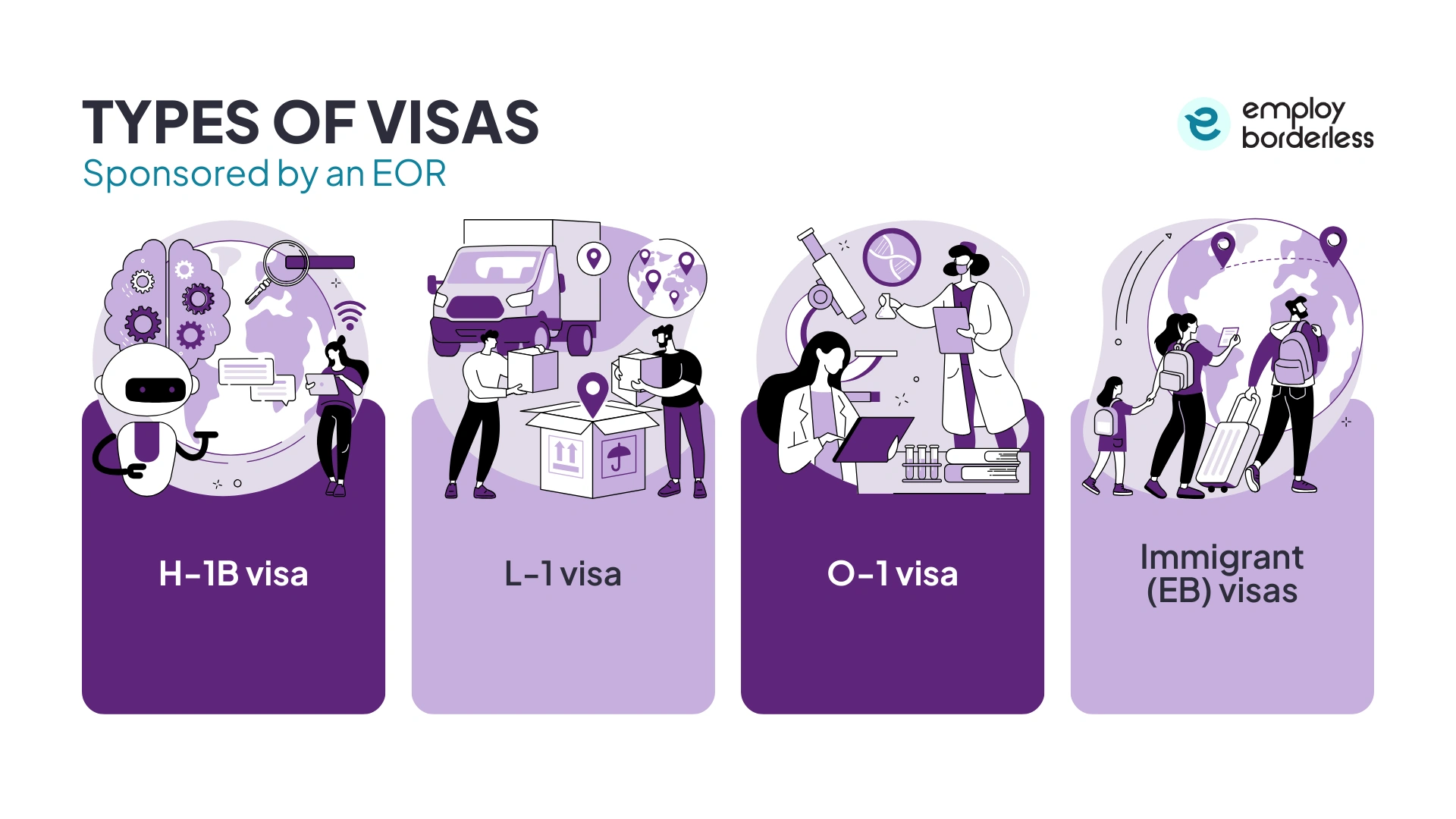
The types of visas sponsored by EORs include the H-1B visa, L-1 visa, O-1 visa, and immigration visas like EB-1, EB-2, and EB-3.
The types of visas sponsored by EORs are listed below.
- H-1B visa: The H-1B visa applies to foreign professionals in specialized fields such as technology, finance, or engineering. The EOR manages the petition process, labor condition applications, and compliance reporting for lawful employment.
- L-1 visa: The L-1 visa allows multinational companies to transfer employees from foreign offices to U.S. branches. EORs handle employer documentation, assignment letters, and compliance with corporate transfer requirements.
- O-1 visa: The O-1 visa is issued to individuals with unique ability in science, education, arts, or athletics and requires detailed documentation of achievements, such as awards or publications. An EOR handles this evidence submission and manages sponsorship to meet government criteria.
- Immigrant (EB) visas: EB (Employment-Based) immigrant visas, also known as green cards in the U.S., are long-term work authorizations that lead to permanent residency. EORs sponsor workers under categories such as EB-1, which is for priority workers with specialized ability or leadership, EB-2, for professionals with advanced degrees, and EB-3 visa for skilled or professional workers. The EOR manages the legal process, which includes filing sponsorship paperwork, eligibility documentation, wage verification, and compliance standards.
What are the eligibility requirements for the EOR-sponsored visa?
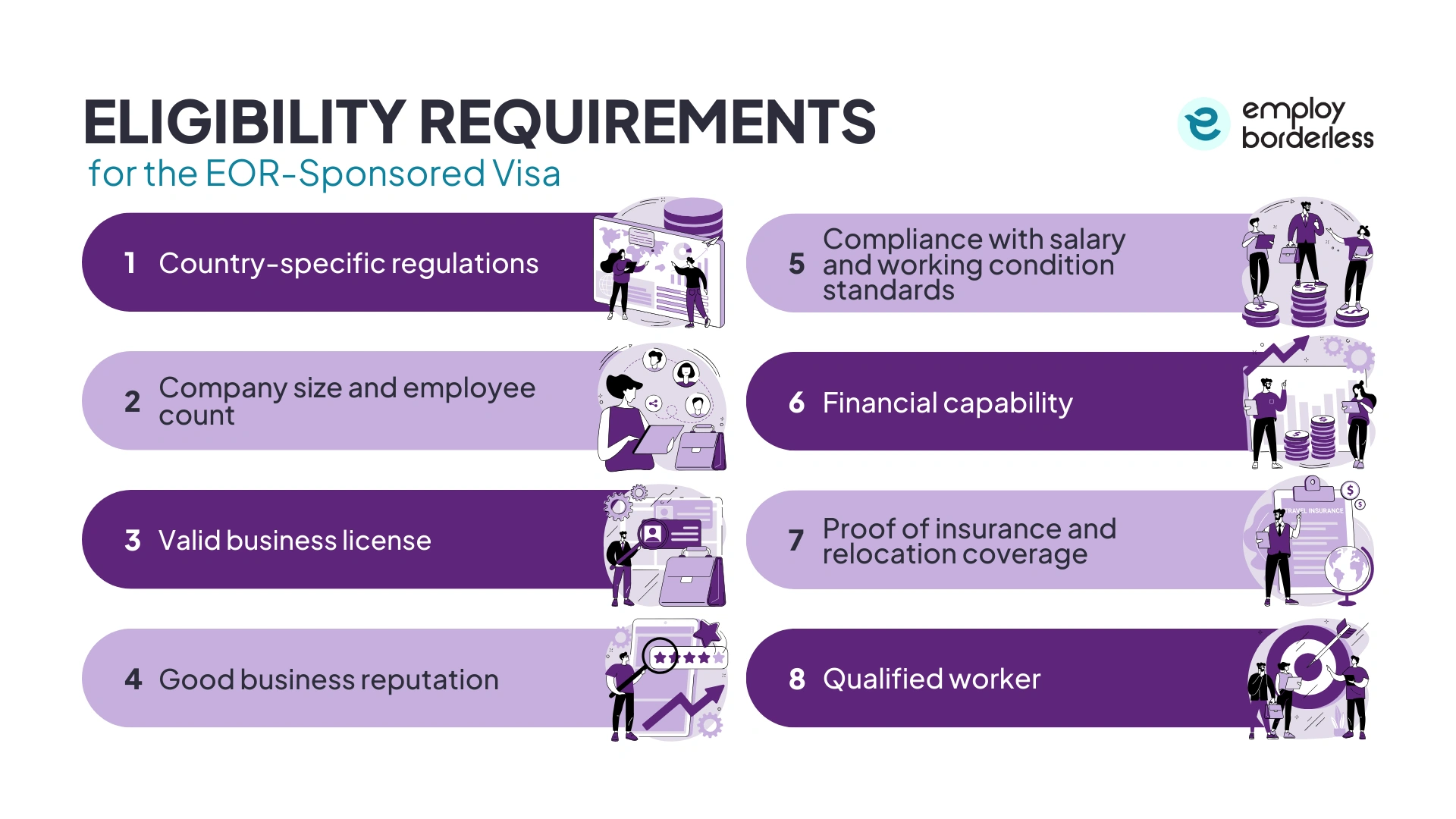
The eligibility requirements for the EOR-sponsored visa are country-specific regulations, company size and employee count, a valid business license, and a good business reputation. These requirements also include compliance with salary and working condition standards, financial capability, proof of insurance and relocation coverage, and a qualified worker.
The eligibility requirements for the EOR-sponsored visa are listed below.
- Country-specific regulations: Country-specific regulations mean every country has its own unique immigration laws, which regulate sponsorships, employment duration, and visa categories. The EOR has to comply with local labor and immigration rules to maintain eligibility.
- Company size and employee count: Many countries require the sponsoring employer to meet a minimum size or staff requirement to prove operational credibility. EORs need to verify this compliance on behalf of client companies.
- Valid business license: An EOR must hold an active, government-recognized business license in the country of sponsorship. This license validates the organization's authority to hire and manage foreign employees.
- Good business reputation: Immigration authorities review the sponsor's compliance history and record of lawful employment. EORs with strong reputations and proven experience increase the chances of visa approval.
- Compliance with salary and working condition standards: An EOR has to verify that employee compensation and working conditions meet or exceed national labor laws and standard wage requirements.
- Financial capability: This third-party organization must show proof of financial stability required to support sponsored employees' wages, benefits, and relocation costs. This financial stability reduces legal and operational risk for both the worker and the government.
- Proof of insurance and relocation coverage: EORs must provide documentation of employee insurance, which includes health, accident, or travel coverage. They must also make arrangements for sponsored employees' relocation.
- Qualified worker: The employee must meet educational and professional criteria relevant to the sponsored visa category, such as an advanced degree for EB-2 or specialized expertise for H-1B.
How to implement an EOR-sponsored visa program in your business?
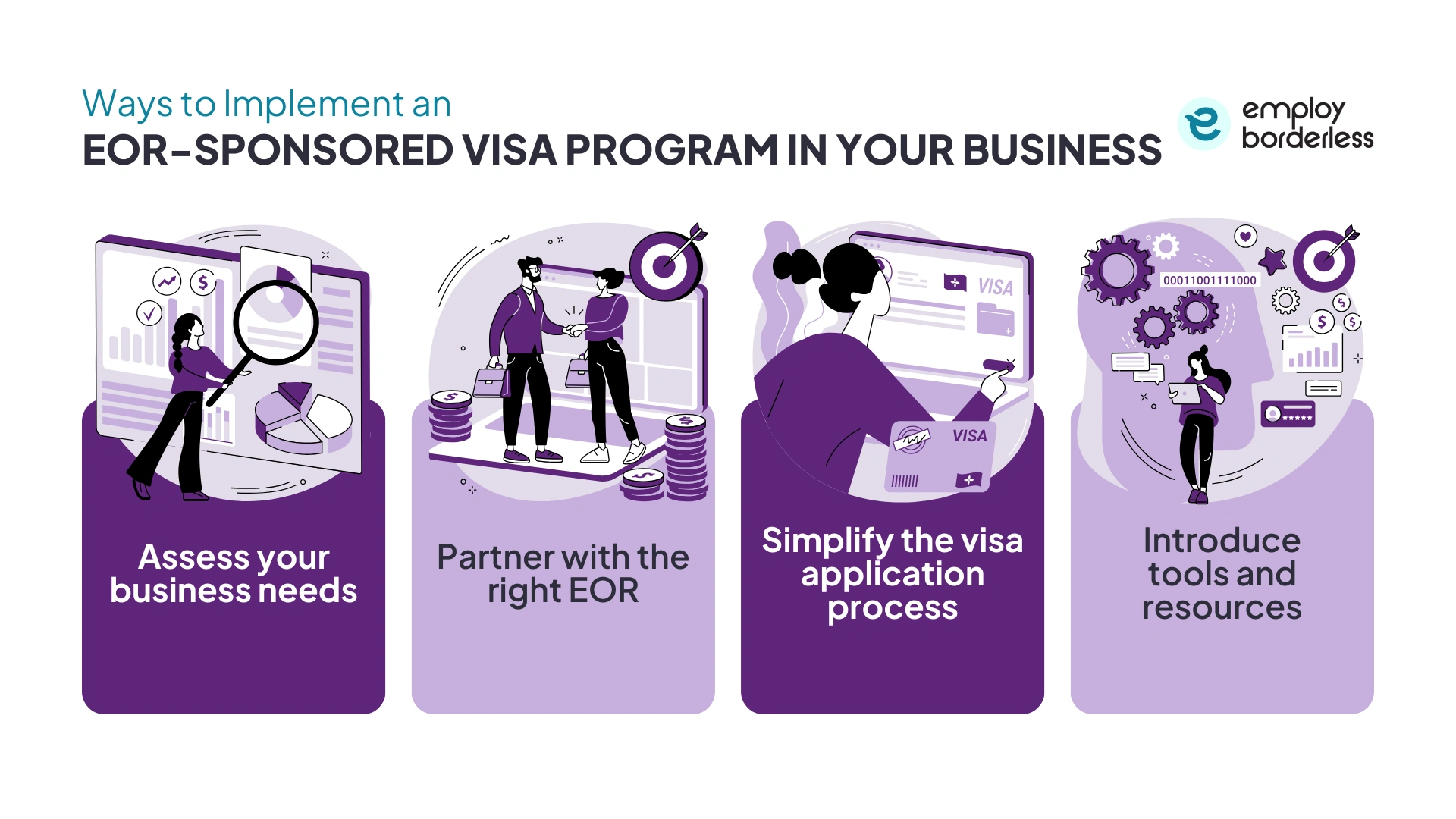
To implement an EOR-sponsored visa program in your business, assess your business needs, partner with the right EOR, simplify the visa application process, and introduce tools and resources.
Assess your business needs
Businesses should assess their needs and determine the importance of EOR sponsorship by evaluating hiring goals, target countries, workforce size, and the types of required roles. Identify compliance challenges or administrative struggles that the current structure faces when hiring abroad. This assessment helps clarify whether you need full EOR visa sponsorship support or a hybrid arrangement where internal HR manages specific processes.
Partner with the right EOR
Partner with the right Employer of Record that has proven experience in visa sponsorship and international employment. Consider selected EORs based on their success rate in handling work visas, knowledge of immigration laws, and coverage across target countries. Check their licensing, compliance history, and client feedback to verify reliability.
The right EOR should offer transparent pricing, effective communication, and strong legal support. Partnering with a credible EOR also helps sponsored employees receive timely documentation, lawful employment status, and consistent support throughout the visa process.
Simplify the visa application process
Organizing documentation and automating communication between the HR team and the EOR simplifies the visa application process. The visa application process includes preparing job descriptions, employment contracts, and salary details that meet immigration requirements. The EOR submits these documents to the relevant authorities and manages the process from initial application to visa approval.
Use digital tracking tools like Envoy Global or choose EOR platforms with built-in dashboards to monitor application progress and receive updates in real time. Simplifying this workflow lowers administrative errors, reduces processing times, avoids unnecessary delays, and keeps every submission within compliance standards.
Introduce tools and resources
Businesses should introduce tools and resources that support EOR-sponsored visa programs. Set up integrations between HR, payroll, and compliance management to maintain accurate employee records and visa documentation. Integrating the right tools allows employers to manage contracts, track visa renewals, and monitor compliance deadlines through a single system. Providing teams with the right digital resources reduces manual errors, supports real-time updates, and improves coordination between the employer, EOR, and employee.
What are the benefits of an EOR-sponsored visa?
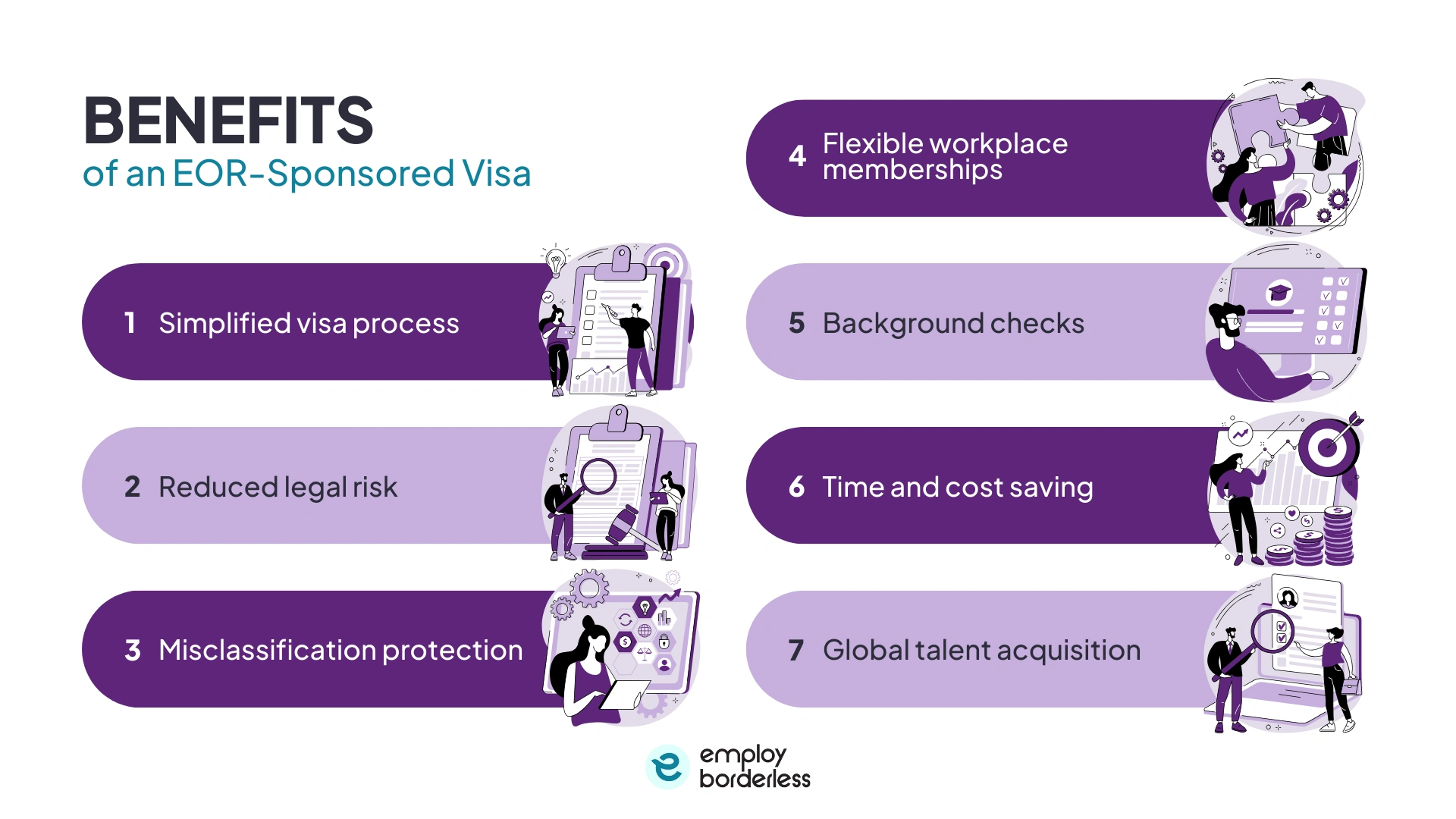
The benefits of an EOR-sponsored visa include a simplified visa process, reduced legal risk, misclassification protection, flexible workplace memberships, background checks, time and cost savings, and global talent acquisition.
Simplified visa process
An EOR manages the complete visa application process, which involves document preparation to submission, on behalf of the employer. Companies don't need to navigate foreign immigration systems or register a local entity. An EOR provides a smooth, fast, and fully compliant visa process that lowers administrative complexity.
Reduced legal risk
EORs take legal responsibility for employment contracts, tax compliance, and labor law requirements. This responsibility reduces the risk of penalties, misfiling, or noncompliance when hiring internationally. Businesses avoid local employment liabilities and maintain legal credibility across borders with an EOR as the official employer.
Misclassification protection
The Employer of Record correctly classifies employees under local regulations, which prevents costly errors that occur from misclassifying foreign employees as contractors. Accurate classification protects both parties during audits and confirms access to lawful benefits, wage protections, and social contributions.
Flexible workplace memberships
EOR-sponsored visas allow employees to work remotely or on-site across multiple regions. The EOR handles location-based compliance, payroll taxes, and employment documentation, which gives companies the flexibility to manage geographically remote teams while meeting every country's legal standards.
Background checks
An EOR performs thorough background checks, such as employment confirmation, academic verification, and criminal record screening, before sponsorship. This verification confirms that all documentation is accurate and the candidate meets immigration and corporate eligibility requirements.
Time and cost saving
Outsourcing visa management through an EOR saves time for HR and legal teams and also reduces costs related to consultants, in-house compliance, or an international entity. Automation and expert management lead to faster visa processing and lower administrative expenses.
Global talent acquisition
An EOR-sponsored visa allows companies to hire skilled professionals from any country without establishing a local branch. This expands the range of talent acquisition and helps organizations access high-demand expertise globally while maintaining full legal compliance in each region.
What are the challenges of an EOR-sponsored visa?
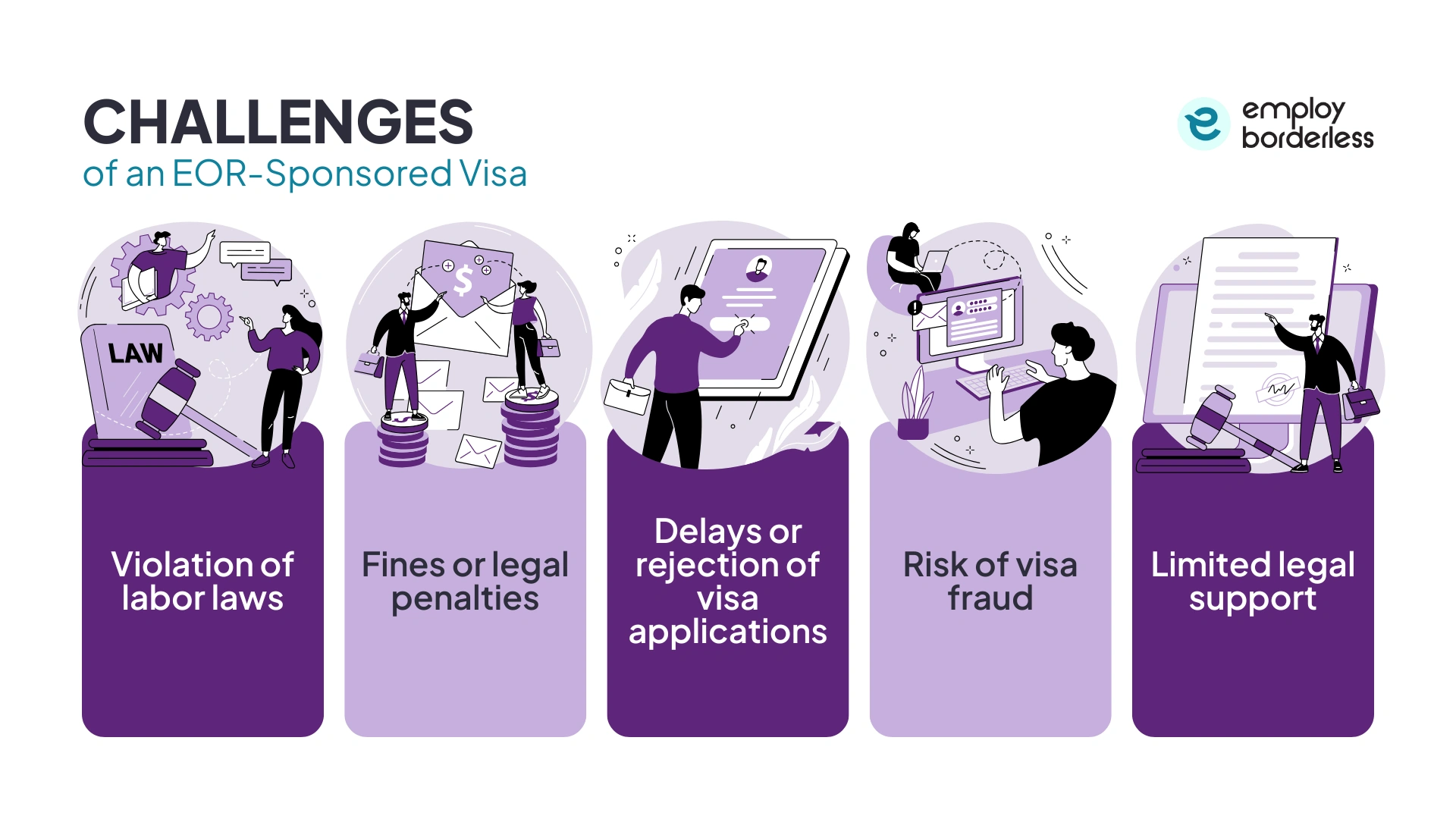
The challenges of an EOR-sponsored visa are violation of labor laws, fines or legal penalties, delays or rejection of visa applications, risk of visa fraud, and limited legal support.
The challenges of an EOR-sponsored visa are listed below.
- Violation of labor laws: EORs must operate according to each country's employment and immigration laws, which differ in sponsorship eligibility and employment duration. Misinterpretation of local labor laws or calculating incorrect wage or benefit standards leads to violations and disputes with local authorities. Some countries restrict third-party sponsorships completely, which limits EORs from offering visa services and requires alternate hiring procedures.
- Fines or legal penalties: Errors in tax filings, visa renewals, or employment documentation result in fines or legal penalties for both the EOR and the client company. Delays or negligence during sponsorship result in audits or penalties from immigration authorities.
- Delays or rejection of visa applications: Visa approval timelines differ by country, and incomplete or inaccurate submissions lead to processing delays or rejection. Limited documentation or inconsistent information delays approval and disrupts planned hiring schedules.
- Risk of visa fraud: Some unauthorized or inexperienced EORs commit fraudulent practices, such as presenting false documentation or making misleading claims about visa eligibility. Such unverified providers expose businesses to legal consequences, damage their reputation, and risk visa bans.
- Limited legal support: Limited legal expertise lowers overall protection for the company and the sponsored employee. Not all EORs have in-house legal teams for handling complex immigration or labor disputes, so employers face difficulties in resolving compliance issues or appealing visa decisions.
How does an EOR-sponsored visa simplify global hiring?
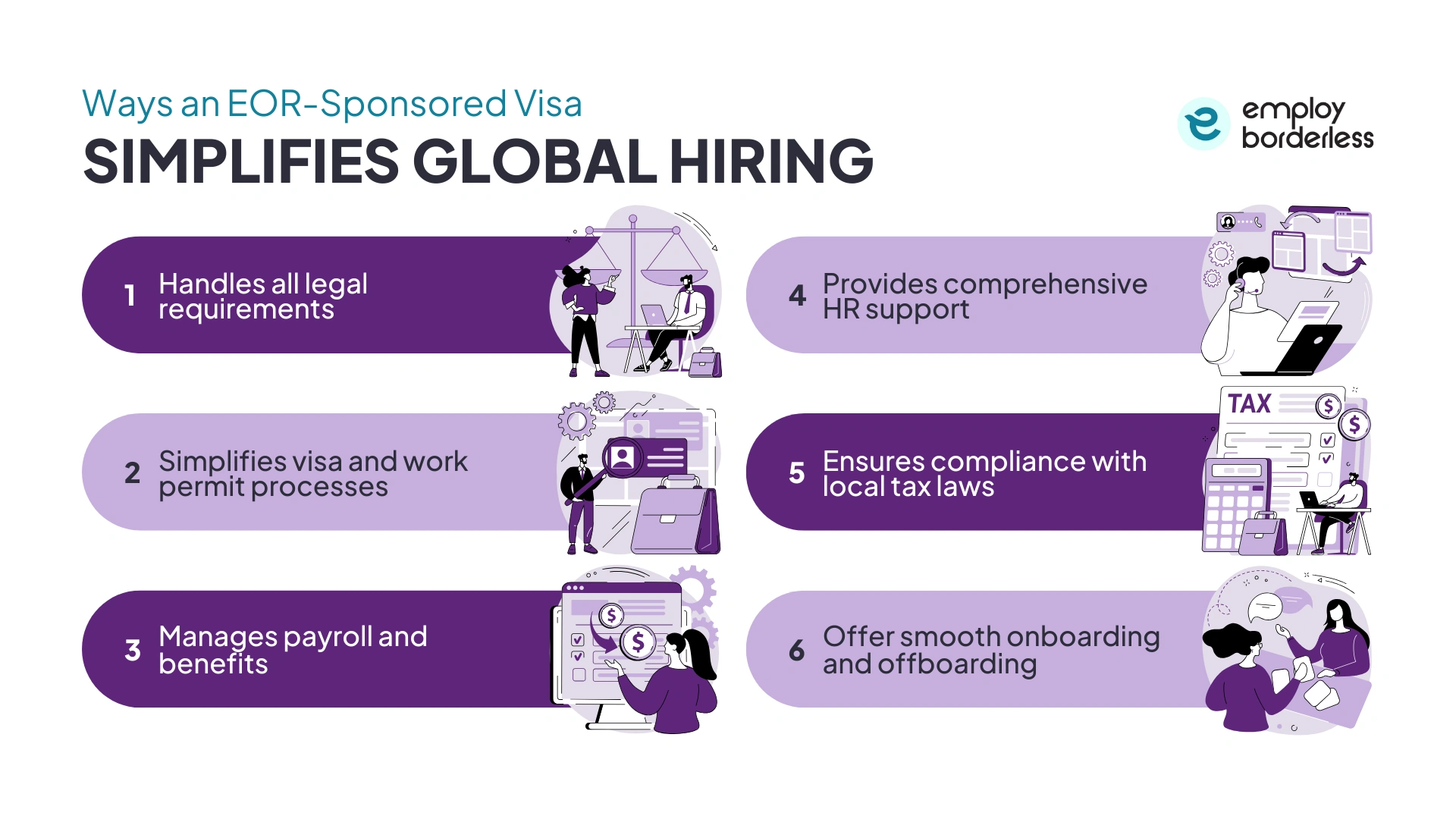
An EOR-sponsored visa simplifies global hiring by handling all legal requirements on behalf of the client. It simplifies visa and work permit processes, manages payroll and benefits, provides complete HR support, ensures compliance with local tax laws, and offers smooth onboarding and offboarding.
The ways an EOR-sponsored visa simplifies global hiring are listed below.
- Handles all legal requirements: The EOR manages labor law compliance, visa sponsorship, and employment contracts on behalf of the company. It meets all legal requirements and local registration without requiring the employer to set up a local entity.
- Simplifies visa and work permit processes: This global employment arrangement manages visa applications, renewals, and documentation. An EOR directly coordinates with immigration authorities to reduce processing time and avoid difficulty with country-specific requirements.
- Manages payroll and benefits: EORs handle salary payments, tax deductions, insurance coverage, and employee benefits according to local regulations. This expertise confirms accurate payroll management and consistency for international employees.
- Provides complete HR support: Hiring an EOR offers businesses full HR support, which includes onboarding, performance management, and employee support. This third-party service provider helps businesses maintain a professional and compliant HR structure in every hiring region.
- Ensures compliance with local tax laws: The Employer of Record accurately handles payroll operations according to each country's tax laws and reporting standards. It manages tax filings, contributions, and deductions to reduce the risk of financial penalties.
- Offer smooth onboarding and offboarding: Companies standardize onboarding procedures for new hires across different geographical regions through an EOR. It handles employment documentation and also takes responsibility for legal offboarding when contracts end. This third-party organization provides a satisfactory experience for both employers and employees worldwide.
What factors should businesses consider when choosing an EOR for visa applications?
The factors businesses should consider when choosing an EOR for visa applications include the reputation of the EOR, the scope of visa services, compatibility with the company's culture, transparent pricing structure, clear communication channels, and the effectiveness of the EOR's services.
Businesses should consider the reputation of the EOR in handling visa processing. This third-party organization with a proven history in handling visa processes provides reliability and legal accuracy.
Assess whether the scope of visa services matches the company's needs and requirements, like support for specific visa types, countries, and employee categories. Businesses should also examine the EOR's compatibility with the company's culture, which includes communication style, work ethics, values, and long-term goals.
Evaluate and establish a transparent pricing structure to avoid hidden costs, maintain a predictable budget, and prevent overspending on unnecessary services that the in-house team can manage. Set up strong and clear communication channels between the employer and EOR to allow quick problem-solving and better coordination during the visa process.
Companies must monitor and evaluate performance regularly by using feedback and metrics like processing time, approval rates, and compliance results to measure the effectiveness of the EOR's services.
What services does an EOR provide to help with visas and work permits?
The services that an EOR provides to help with visas and work permits include visa sponsorship, document preparation, work permit filing, and coordination with immigration authorities. It maintains compliance with local labor laws, manages employee records, and handles renewals or extensions. EORs also support relocation arrangements and monitor work authorization status throughout the employment period.
Is an EOR-sponsored visa affordable for small businesses?
Yes, an EOR-sponsored visa is affordable for small businesses because it removes the need to establish a local entity or hire separate legal and HR teams. Small firms access global talent at predictable costs and avoid administrative expenses by outsourcing compliance, payroll, and visa processing.
What fees are associated with an EOR-sponsored visa?
The fees associated with an EOR-sponsored visa include administrative charges, government visa filing fees, legal documentation costs, and service management fees. Some EORs charge flat rates, while others use per-employee pricing. Additional costs apply for renewals, background checks, or country-specific taxes, which depend on local immigration and labor laws.
How long does it take to apply for an EOR-sponsored visa?
To apply for an EOR-sponsored visa, it takes from four to twelve weeks. This time duration depends on the visa type, destination country, and government processing time. EORs simplify this process by handling documentation and compliance steps expertly, which reduces delays that occur with direct employer applications or incomplete submissions.
What is EOR in immigration?
EOR in immigration is a third-party organization that legally employs workers on behalf of another company. It manages visa sponsorship, payroll, tax compliance, and local labor obligations, which allows businesses to hire foreign employees without creating a legal entity in their country.
How does EOR compliance support help businesses avoid penalties on sponsored visas?
EOR compliance support helps businesses avoid penalties on sponsored visas by maintaining accurate employee records, timely visa renewals, and up-to-date tax and labor filings. The EOR compliance support monitors changing immigration regulations and makes sure every employment contract follows local laws.

Co-founder, Employ Borderless
Robbin Schuchmann is the co-founder of Employ Borderless, an independent advisory platform for global employment. With years of experience analyzing EOR, PEO, and global payroll providers, he helps companies make informed decisions about international hiring.
Learning path · 8 articles
EOR fundamentals
Master the fundamentals with our step-by-step guide.
Start the pathReady to hire globally?
Get a free, personalized recommendation for the best EOR provider based on your needs.
Get free recommendations