EOR for construction: services, benefits, considerations, and how to choose

Robbin Schuchmann
Co-founder, Employ Borderless
An EOR (Employer of Record) is a global employment service that allows businesses to hire, manage, and pay employees across different regions without establishing a local entity. It handles important employment functions such as payroll, taxes, compliance, and benefits on behalf of the client company.
The services that an EOR provides for construction companies include compliant employment contracts, payroll processing, benefits administration, onboarding and offboarding support, and risk mitigation or regulatory compliance.
The benefits of EOR for the construction industry are simplified payroll and workforce management, quick talent acquisition, the ability to focus on project delivery, cost savings and budget stability, and smooth global expansion.
The factors construction companies should consider when choosing the right EOR include industry expertise, compliance evaluation, technology integration, cost transparency, and client support.
What is an EOR?
An EOR (Employer of Record) is a third-party organization that legally employs workers on behalf of another company. The EOR takes responsibility for administrative employment tasks, such as payroll, taxes, benefits, compliance with local labor laws, and employment contracts, while the client company manages the employee's daily work. This arrangement helps businesses hire employees in locations where they do not have a legal entity, as an EOR simplifies global hiring and keeps you compliant with local employment regulations.
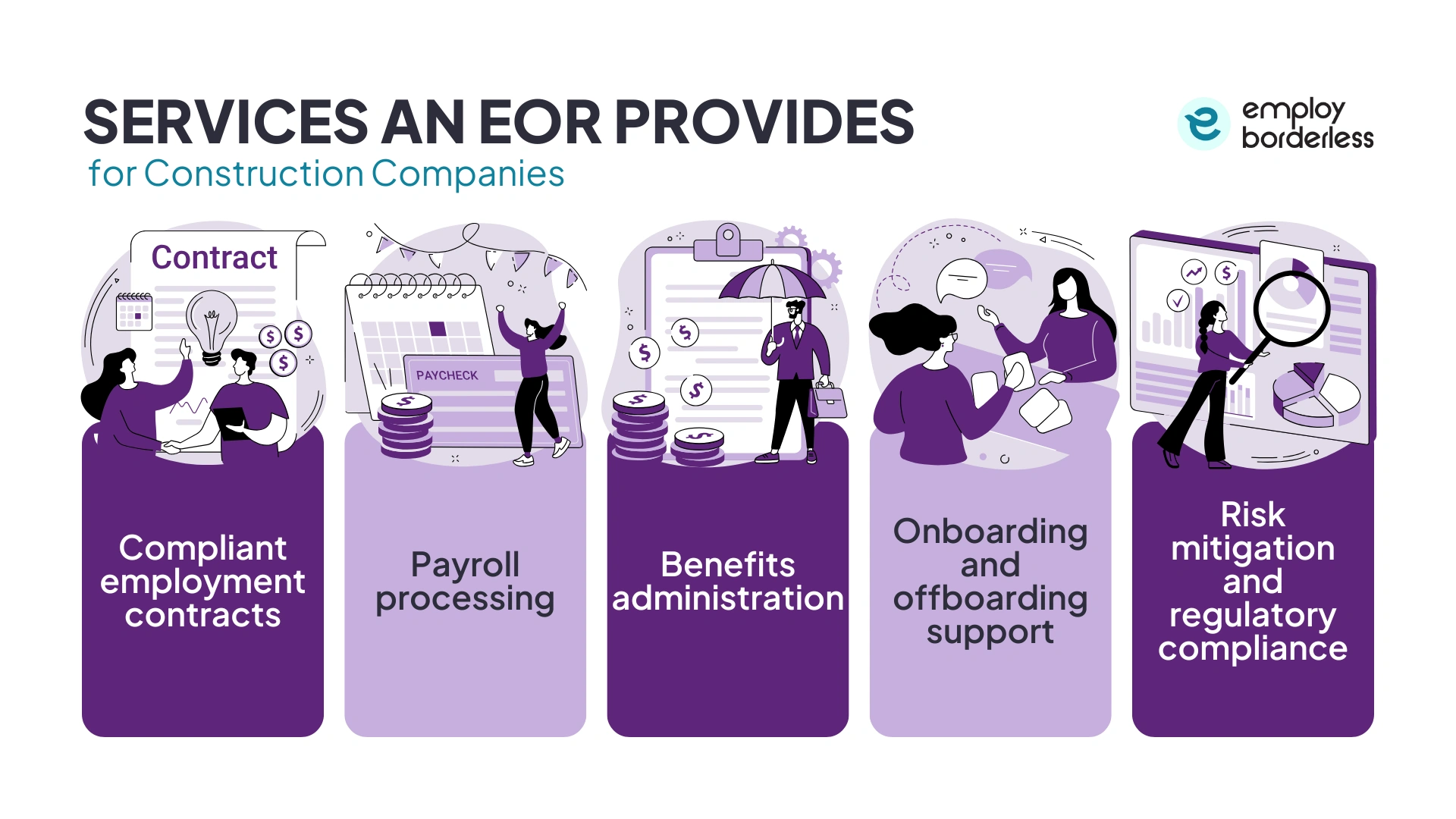
What services does an EOR provide for construction companies?
The services that an EOR provides for construction companies include compliant employment contracts, payroll processing, benefits administration, onboarding and offboarding support, and risk mitigation and regulatory compliance.
Compliant employment contracts
EORs make sure that all employment contracts follow local, state, and federal labor laws, such as the FLSA (Fair Labor Standards Act). These contracts clearly define job roles, responsibilities, and terms of employment to prevent legal disputes. For construction companies working across different jurisdictions, the EOR maintains legal accuracy and consistent compliance. This helps establish trust and transparency between employers and employees.
Payroll processing
Payroll in the construction sector is complex due to different job types, pay rates, and project durations. An EOR accurately manages wage calculations, overtime, deductions, and tax filings under laws such as the EPA (Equal Pay Act). Employees receive accurate pay on time, and payroll errors go down. This third-party employer also helps maintain compliance with multi-state tax and labor reporting requirements.
Benefits administration
EORs handle the setup and management of employee benefits such as healthcare, retirement plans, and workers' compensation. These benefits are tailored to the construction industry's workforce needs and promote retention and job satisfaction. Through group plans and administrative expertise, EORs keep benefits management both cost-effective and compliant. This support allows construction companies to focus on project delivery rather than HR complexities.
Onboarding and offboarding support
EORs simplify the hiring and offboarding processes for both permanent and project-based workers. They manage paperwork, background checks, and orientation to provide a smooth, compliant start for new hires. During offboarding, EORs handle final payments, benefits adjustments, and legal documentation. This keeps projects operating on schedule without HR delays.
Risk mitigation and regulatory compliance
Construction companies face regulatory changes and safety risks governed by agencies such as OSHA (Occupational Safety and Health Administration). An EOR stays on top of these regulations, managing worker classifications, tax filings, and insurance coverage. EORs also protect companies from fines and lawsuits by reducing exposure to legal and financial risks. This active compliance management improves operational stability and reputation in the construction industry.
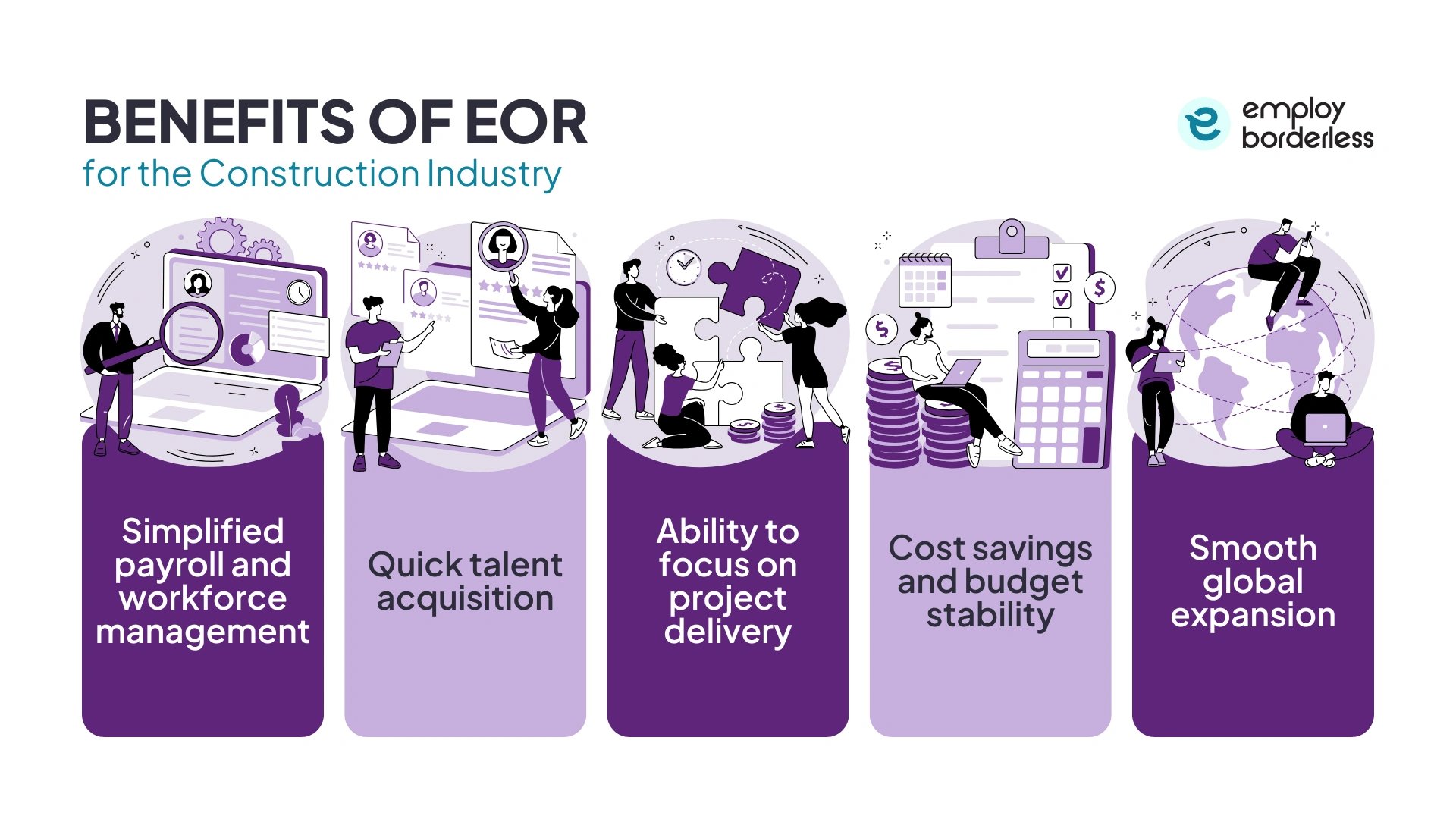
What are the benefits of EOR for the construction industry?
The benefits of EOR for the construction industry include simplified payroll and workforce management, quick talent acquisition, the ability to focus on project delivery, cost savings and budget stability, and smooth global expansion.
Simplified payroll and workforce management
EORs simplify payroll processing for construction companies by handling complex wage structures, overtime, and union-related payments. They make sure client businesses comply with the FLSA (Fair Labor Standards Act) and state-specific tax laws. Workers across multiple projects and locations get accurate, timely payments as a result. The automation of payroll and HR tasks allows companies to manage their workforce without an administrative burden.
Quick talent acquisition
Construction projects often require urgent hiring to meet deadlines or expand teams for new contracts. EORs allow quick onboarding of skilled labor by managing recruitment, background checks, and documentation. Their established global networks make it easy to access certified talent across borders. Construction firms can scale their workforce on demand without delays in compliance or setup.
Ability to focus on project delivery
Construction companies focus more on core operations and project execution by outsourcing HR, payroll, and compliance management to an EOR. The EOR handles all employment-related arrangements and reduces administrative distractions for project managers. This shift allows teams to allocate more time and resources toward improving construction quality and meeting client expectations.
Cost savings and budget stability
EOR services help reduce the costs related to maintaining in-house HR, payroll, and compliance departments. Fixed and transparent pricing models improve budget control and reduce unexpected financial risks associated with fines or misclassification errors. The EOR's expertise in benefits administration also provides access to more affordable insurance and compensation plans. This cost-effectiveness supports long-term financial stability for construction companies.
Smooth global expansion
EORs simplify the process of hiring and managing workers for construction companies operating across borders. They handle local employment laws, taxes, and permits, which reduces the need to establish separate legal entities. The EOR supports quick market entry and simplifies cross-border project execution. Global expansion becomes more strategic and less risky when an EOR manages compliance and HR complexities on behalf of the construction company.
How does an EOR help your construction company grow?
An EOR helps your construction company grow by providing access to global talent, ensuring compliance and risk management, reducing operational costs, and supporting faster market expansion.
An EOR allows construction companies to hire skilled engineers, project managers, and laborers from anywhere in the world without setting up local entities. This global reach allows companies to fill skill gaps quickly and expand operations across regions.
Construction involves strict labor, safety, and tax regulations that differ by region. An EOR keeps you fully compliant with local and international laws, such as OSHA (Occupational Safety and Health Administration) standards and wage requirements.
Construction firms save costs on in-house HR teams, legal fees, and entity setup by outsourcing HR and compliance tasks to an EOR. Transparent service fees allow better budget management for ongoing and upcoming projects.
An EOR allows construction companies to expand into new states or countries without establishing legal entities. This external market expansion support reduces long setup timelines and simplifies project launch, as the EOR manages local hiring, payroll, and compliance.
How to choose the right EOR for your construction company?
To choose the right EOR for your construction company, consider industry expertise, evaluate compliance, confirm technology integration, check cost transparency, and make sure it offers client support.
Choose an EOR with experience in the construction sector that understands the industry's unique workforce needs, safety requirements, and project-based employment models. An experienced provider better manages contractors, unionized workers, and compliance across job sites.
Work with an EOR that has a proven record in managing local and international labor laws, tax regulations, and OSHA (Occupational Safety and Health Administration) standards. Make sure the provider supports your company in maintaining compliance with wage, safety, and reporting requirements.
Select an EOR that offers modern HR and payroll software compatible with your existing systems. Technology integration helps automate time tracking, payments, and workforce data management. This saves time, reduces human error, and improves operational visibility across all construction sites.
Review the EOR's pricing structure carefully before signing any agreement. Look for clear, upfront costs without hidden service fees or extra charges. Transparent pricing offers better budgeting for labor expenses and helps maintain financial stability throughout project timelines.
Choose an EOR that provides responsive client support for quick issue resolution. Construction projects often operate across multiple regions or time zones, so 24/7 support is necessary. Reliable assistance helps manage emergencies, resolve payroll issues, and maintain workforce satisfaction.
What is the difference between an EOR and an independent contractor?
The difference between an EOR and an independent contractor is that an EOR (Employer of Record) legally employs workers on behalf of a company and manages payroll, taxes, and benefits, while independent contractors are self-employed and responsible for their own legal and tax obligations. An EOR for independent contractors complies with labor regulations, simplifies payments, and reduces administrative workload.
What services does an EOR provide for the real estate industry?
The services an EOR provides for the real estate industry include payroll management, compliance with labor and tax laws, employee onboarding and offboarding, and benefits administration. EOR for real estate also includes handling contracts, licensing, and local employment regulations.
Is using an EOR legally compliant?
Yes, using an EOR is legally compliant when the provider operates within local and international employment laws. The EOR compliance support makes sure all contracts, payroll taxes, and benefits follow regional labor regulations.
What features should construction companies look for in EOR software?
The features that construction companies should look for in EOR software include payroll automation, compliance tracking, workforce scheduling, and project-based reporting. The software should also support multi-location management to handle workers across different sites.
How does EOR differ from COR?
An EOR (Employer of Record) differs from a COR (Contractor of Record) in that the EOR manages employment responsibilities, like payroll, taxes, and compliance, for a company's workforce, especially across borders. A COR handles the engagement and compliance of independent contractors but does not employ them. The main difference between an EOR and a COR is that EORs directly employ workers, while CORs only manage contractual and compliance aspects for contractors.

Co-founder, Employ Borderless
Robbin Schuchmann is the co-founder of Employ Borderless, an independent advisory platform for global employment. With years of experience analyzing EOR, PEO, and global payroll providers, he helps companies make informed decisions about international hiring.
Learning path · 8 articles
EOR fundamentals
Master the fundamentals with our step-by-step guide.
Start the pathReady to hire globally?
Get a free, personalized recommendation for the best EOR provider based on your needs.
Get free recommendations